How Mountains Are Made
How Mountains Are Made — an illustrated science story, set in United States. 10 illustrated pages, free to read on Wonder Science.
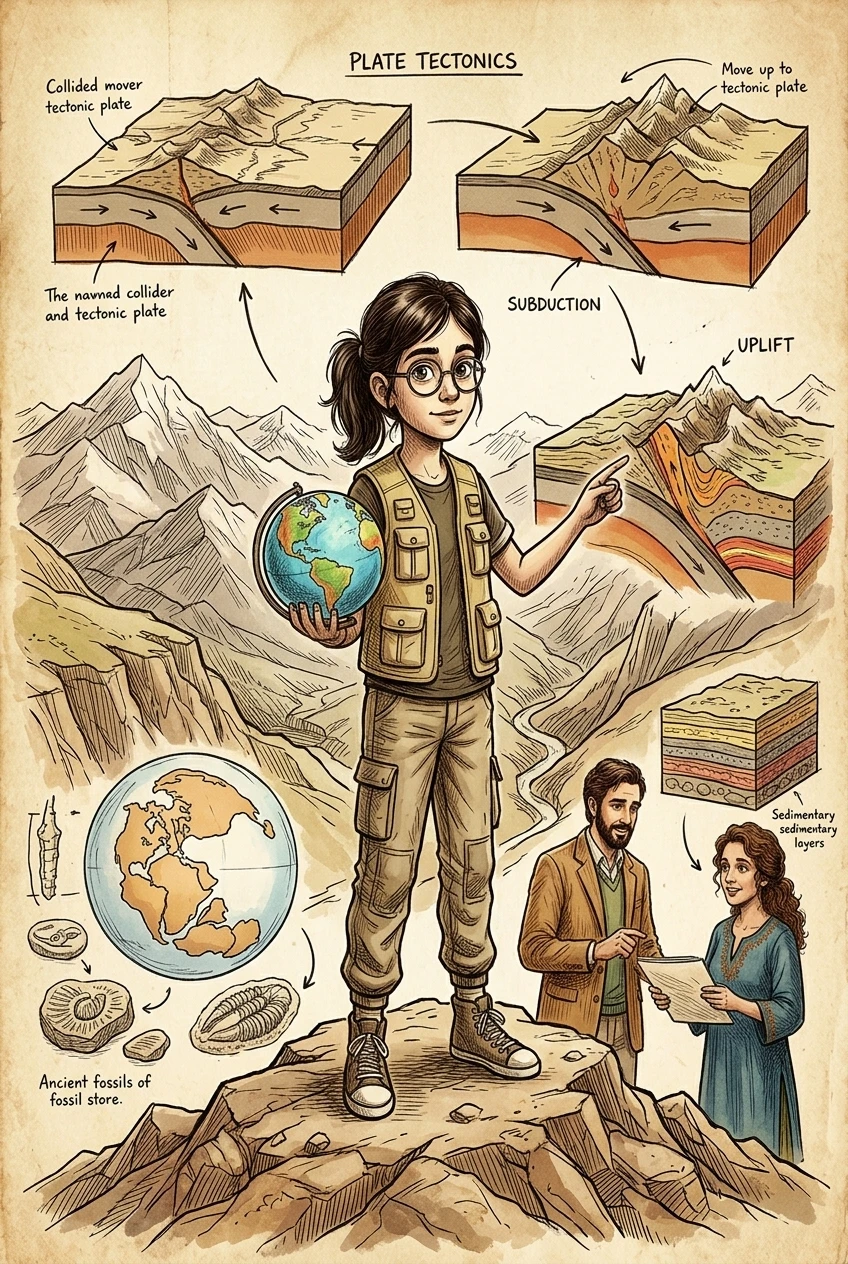
Page 1

At the edge of San Francisco, chilly fog swirled around the cliffs of Ocean Beach. Priya pointed towards the jagged rocks where waves crashed below. "Dad, look how huge those cliffs are!" she exclaimed, pulling her hoodie tighter. Her father knelt beside her, squinting at the towering wall of earth and stone. "They certainly are," he said. "It makes you wonder how something so massive ever got here, doesn't it?"
Page 2

Back home in their cozy Noe Valley kitchen, Priya placed a small, ridged object on the table. "I found this fossil, a seashell, way up on the path!" she announced. "How can a seashell be on a cliff, so far above the water?" Her father picked it up gently, examining the delicate spiral. "That's the perfect question," he said with a smile. "The answer involves giant, slow-moving puzzle pieces that make up the entire surface of our planet."
Page 3

Priya imagined the world a hundred years ago, a time of bold exploration. Scientists had detailed maps of every continent, but a huge mystery remained unsolved. They could see towering mountain ranges and deep ocean trenches, but no one could explain the colossal forces that created them. It was a puzzle with the biggest pieces missing.
Page 4

"Then came a man who thought differently," her father's voice narrated in her mind. His name was Alfred Wegener, and he wasn't a geologist but a meteorologist who studied weather and explored the arctic. Because he was an outsider, most scientists dismissed his ideas at first. But Wegener was a brilliant observer who saw something on the world map that everyone else had missed.
Page 5

Priya pictured Wegener in his study, surrounded by books and charts, tracing the map with his finger. "It wasn't just a hunch," her father explained. "Wegener wrote about it, asking, 'Doesn't the east coast of South America fit exactly against the west coast of Africa, as if they had once been joined?' He saw connections where others only saw empty ocean."
Page 6

Wegener gathered more clues, like a detective solving a planetary crime. He found fossils of the same ancient reptiles, like the Lystrosaurus, on continents separated by thousands of miles of water. He also discovered that rock layers in the Appalachian Mountains of North America perfectly matched formations in Scotland. His theory was that all continents were once a single supercontinent he named Pangaea, which then drifted apart.
Page 7

His idea of 'continental drift' was rejected for 50 years until scientists discovered the Mid-Atlantic Ridge, where new seafloor is constantly created. This proved Wegener was right and became the theory of Plate Tectonics. It explains that when two plates collide, they crumple and fold, pushing land upwards to create massive mountain ranges like the Himalayas. In fact, Mount Everest grows about half an inch taller every single year!
Page 8

Back in the kitchen, Priya held up her seashell fossil, her eyes wide with understanding. "So this little shell was once at the bottom of the ocean!" she gasped. "Then two plates crashed, and the ocean floor was pushed up over millions of years to become the cliffs at the beach!" Her father smiled proudly. "Exactly! You're looking at a piece of an ancient ocean, lifted into the sky."
Page 9

Priya's mother joined them, ruffling her hair. "It's amazing how tiny movements can lead to giant changes." She remembered a quote from the philosopher Lao Tzu: 'A journey of a thousand miles begins with a single step.' Priya's dad added, "And those plates only move about as fast as your fingernails grow, but over millions of years, they build the biggest things on Earth."
Page 10

"So the whole planet is a giant, moving puzzle!" Priya concluded, grabbing her notebook to sketch the idea. Her father nodded. "It's the engine that shapes our world." Priya paused her drawing and looked up with a new question in her eyes. "If plates crashing together makes mountains, what happens here in San Francisco, where they slide past each other?"
About this story
- Location: United States
- Audience: kids (ages 6–12)
Questions and answers
Read Wonder Science on your phone
Wonder Science is available on Android. Get Wonder Science on Google Play.