Katherine Johnson
Katherine Johnson — an illustrated science story, set in Global. 10 illustrated pages, free to read on Wonder Science.
Page 1
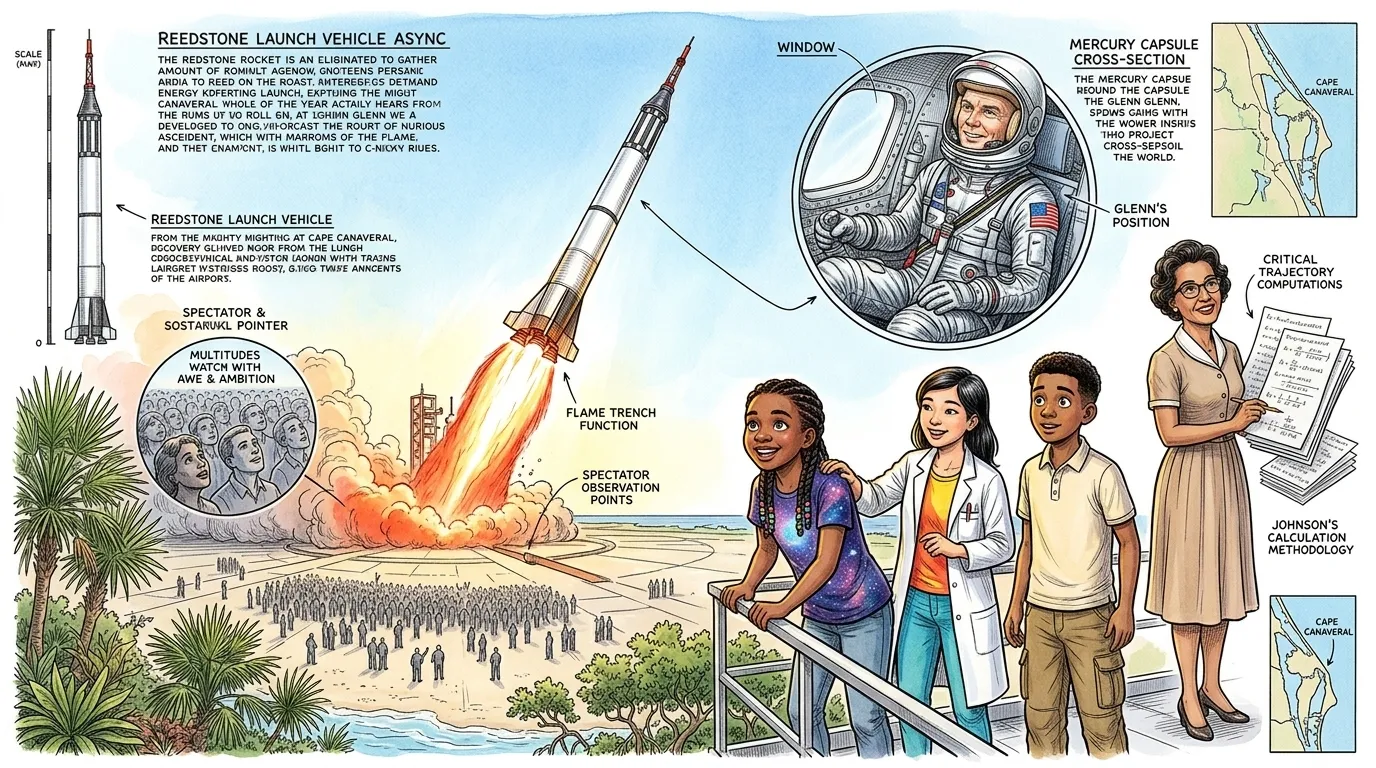
The roar was deafening, a monumental tremor that shook the very ground. On February 20, 1962, humanity held its breath as a Redstone rocket, carrying Project Mercury astronaut John Glenn, ignited its engines. Thousands watched from Cape Canaveral, eyes fixed on the plume of fire ascending into the blue, a spectacle of human ambition against the vastness of space. This launch was a testament to extraordinary courage and meticulous planning, but behind the visible might of the rocket lay an invisible scaffold of numbers, painstakingly calculated to guide man to the stars and back.
Page 2
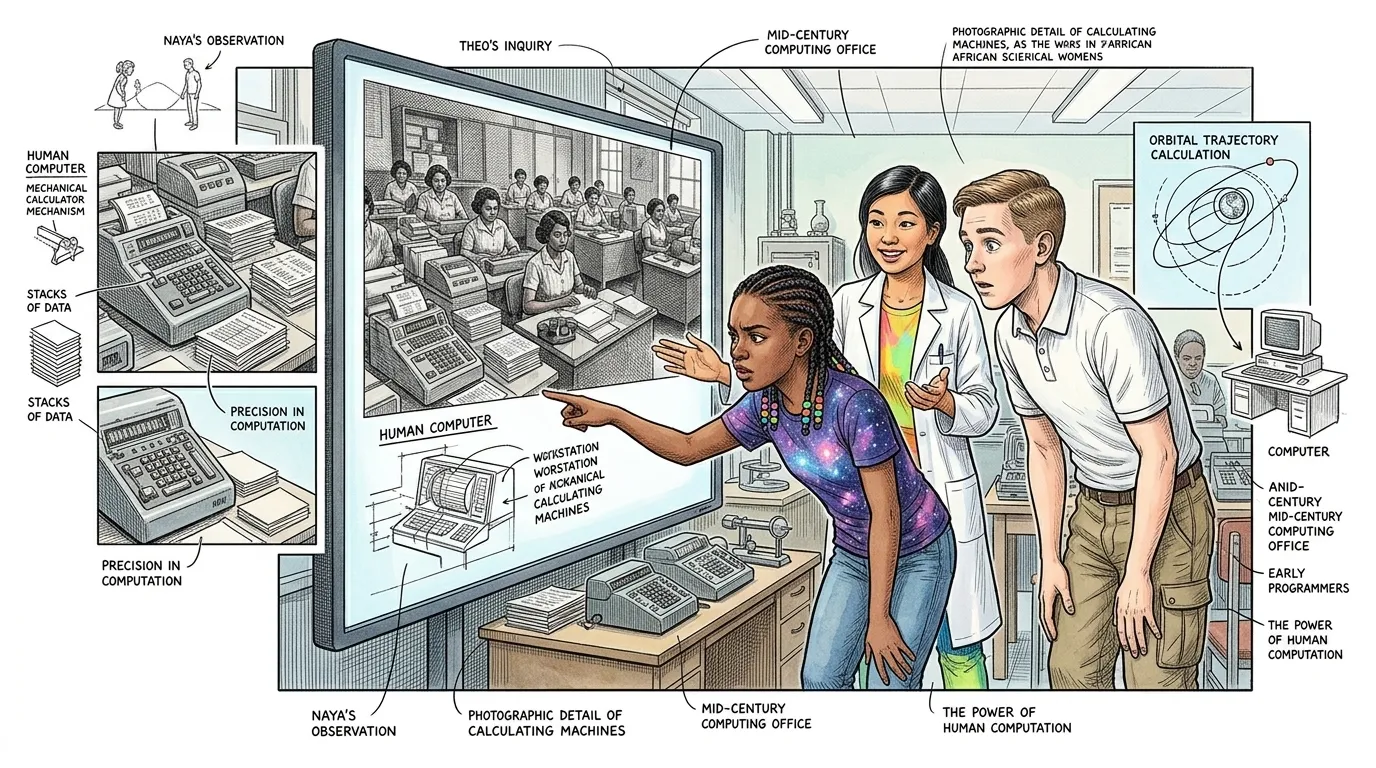
Back in the present, Naya pointed at an old photograph displayed on a screen, depicting rows of women working at desks covered with calculating machines. "Jia, who are these people? They look like they're doing homework, but in a really old office!" she asked, her brow furrowed in curiosity. Jia smiled, explaining, "These are not just any workers, Naya and Theo. These were the 'human computers' of NASA, brilliant mathematicians, predominantly African American women, whose minds were the most powerful calculators of their time. They tackled some of the most complex problems in history, long before electronic computers were reliable."\n\n""Jia, who are these people? They look like they're doing homework, but in a really old office!" Naya asked, her brow furrowed in curiosity. Jia smiled, explaining, "These are not just any workers, Naya and Theo. These were the 'human computers' of NASA, brilliant mathematicians, predominantly African American women, whose minds were the most powerful calculators of their time. They tackled some of the most complex problems in history, long before electronic computers were reliable."
"What kind of problems?" Theo chimed in, leaning closer to the screen. "Like, how far the rocket goes?""
Page 3
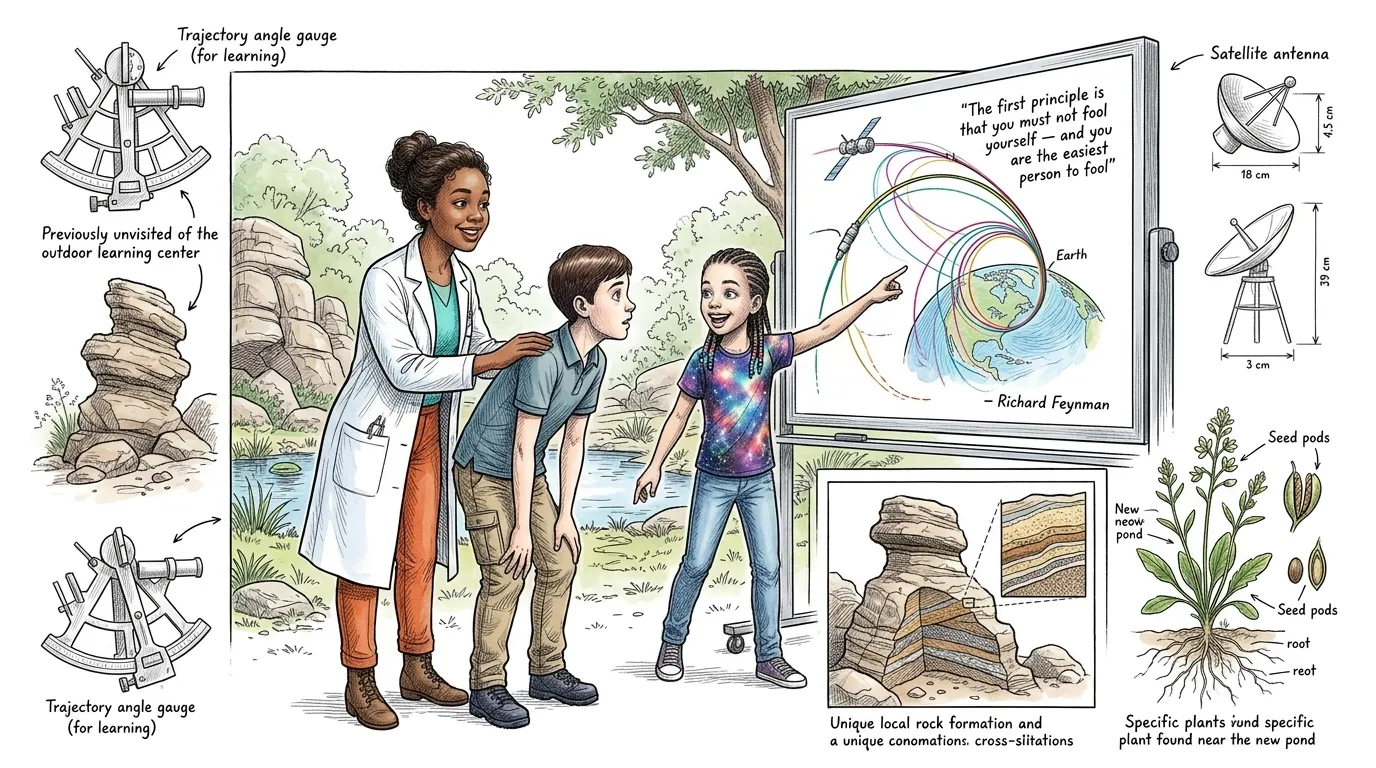
"Exactly, Theo! Even more than that," Jia affirmed. "Imagine trying to throw a ball so precisely that it travels thousands of miles, goes around another object, and then lands in a tiny, exact spot on Earth. That's what Katherine Johnson and her colleagues had to do for space missions. They calculated orbital mechanics, re-entry paths, and launch windows, all demanding absolute precision. Every number had to be perfect. As the renowned physicist Richard Feynman once said, 'The first principle is that you must not fool yourself — and you are the easiest person to fool.' Katherine Johnson lived by that, meticulously checking every figure." Naya then pointed to a diagram on the screen showing a complex curved line. "Is that the ball's path? It looks like a giant rainbow!"\n\n""Exactly, Theo! Even more than that," Jia affirmed. "Imagine trying to throw a ball so precisely that it travels thousands of miles, goes around another object, and then lands in a tiny, exact spot on Earth. That's what Katherine Johnson and her colleagues had to do for space missions. They calculated orbital mechanics, re-entry paths, and launch windows, all demanding absolute precision. Every number had to be perfect. As the renowned physicist Richard Feynman once said, 'The first principle is that you must not fool yourself — and you are the easiest person to fool.' Katherine Johnson lived by that, meticulously checking every figure." Naya then pointed to a diagram on the screen showing a complex curved line. "Is that the ball's path? It looks like a giant rainbow!""
Page 4
Jia knelt down, aligning her gaze with Naya and Theo's. "That's right, Naya! It's the path of a spacecraft. Katherine Johnson's job was to figure out that exact 'rainbow' path. She used a branch of mathematics called analytical geometry, which uses coordinate systems to study geometric shapes and distances. She could translate the incredibly complex physics of motion into a series of equations that described precisely where a spacecraft would go, and more importantly, when and where it would come back down. Her mind was so sharp, she could catch errors that even the early electronic computers sometimes missed."\n\n"Jia knelt down, aligning her gaze with Naya and Theo's. "That's right, Naya! It's the path of a spacecraft. Katherine Johnson's job was to figure out that exact 'rainbow' path. She used a branch of mathematics called analytical geometry, which uses coordinate systems to study geometric shapes and distances. She could translate the incredibly complex physics of motion into a series of equations that described precisely where a spacecraft would go, and more importantly, when and where it would come back down. Her mind was so sharp, she could catch errors that even the early electronic computers sometimes missed." "So, she was like a super-calculator?" Theo asked, his eyes wide with understanding. "Even better," Jia confirmed. "She was a human problem-solver, understanding the numbers and the physics behind them.""
Page 5
When electronic computers were first introduced, even seasoned astronauts like John Glenn trusted Katherine Johnson more. For his Friendship 7 mission, Glenn famously said, "If she says they're good, then I'm ready to go." Jia explained, "Katherine didn't just calculate; she understood the physics, the forces, the very dance of gravity and velocity. She computed the launch window, the orbital path, and crucially, the re-entry corridor—the narrow band where the spacecraft could safely return to Earth without burning up or bouncing off the atmosphere. Her meticulous calculations were the silent guardians of his life."\n\n""If she says they're good, then I'm ready to go," Jia quoted, her voice resonant as she looked at Naya and Theo. "That's what astronaut John Glenn famously said about Katherine Johnson before his mission! She didn't just calculate; she understood the physics, the forces, the very dance of gravity and velocity. She computed the launch window, the orbital path, and crucially, the re-entry corridor—the narrow band where the spacecraft could safely return to Earth without burning up or bouncing off the atmosphere. Her meticulous calculations were the silent guardians of his life."
"So, she double-checked the machines?" Theo asked, impressed. "Absolutely," Jia affirmed. "Her brain was the ultimate verification system.""
Page 6
"Her work extended far beyond Mercury," Jia continued, gesturing to another display. "Katherine Johnson's calculations were equally critical for the Apollo program. She helped determine the trajectory for the Apollo 11 mission to the Moon, solving the 'rendezvous problem'—how to align the lunar module with the orbiting command module for the astronauts to return home. Imagine two tiny dots in the vastness of space, trying to meet up perfectly; her math made it possible. Without her, those iconic 'small steps' might never have been taken."\n\n""Her work extended far beyond Mercury," Jia continued, gesturing to another display. "Katherine Johnson's calculations were equally critical for the Apollo program. She helped determine the trajectory for the Apollo 11 mission to the Moon, solving the 'rendezvous problem'—how to align the lunar module with the orbiting command module for the astronauts to return home. Imagine two tiny dots in the vastness of space, trying to meet up perfectly; her math made it possible. Without her, those iconic 'small steps' might never have been taken."
"So she was like, the director of where everything went in space?" Naya asked, captivated. "In a way, yes," Jia chuckled. "She mapped the invisible paths.""
Page 7
"But why were her manual calculations still so important when they had powerful computers?" Theo asked, pondering the past technology. Jia explained, "Early electronic computers were prone to errors, often called 'glitches.' There was a very real fear that a single computer malfunction could send an astronaut veering off course or, worse, prevent a safe return. Katherine Johnson's hand-calculated numbers provided the crucial verification. Her results were the gold standard, giving astronauts and engineers the confidence to proceed, knowing their lives weren't just in the hands of a new machine, but also confirmed by a brilliant human mind."\n\n""But why were her manual calculations still so important when they had powerful computers?" Theo asked, pondering the past technology. Jia explained, "Early electronic computers were prone to errors, often called 'glitches.' There was a very real fear that a single computer malfunction could send an astronaut veering off course or, worse, prevent a safe return. Katherine Johnson's hand-calculated numbers provided the crucial verification. Her results were the gold standard, giving astronauts and engineers the confidence to proceed, knowing their lives weren't just in the hands of a new machine, but also confirmed by a brilliant human mind."
"So her brain was like the backup plan!" Naya exclaimed, connecting the dots. "Exactly, and sometimes, even the primary plan," Jia added, nodding encouragingly."
Page 8
Katherine Johnson's work ensured the safe return of astronauts from space, directly contributing to humanity's greatest exploratory triumphs. Her unwavering dedication to precision and her deep understanding of mathematics saved lives and built trust in an entirely new frontier. Jia pointed to an image of a spacecraft splashing down safely. "Remember how we talked about the exact path needed for safe re-entry? Katherine Johnson's work ensured that every time, those trajectories were perfect, bringing astronauts home from orbit and from the Moon. Her human touch was vital at a time of immense technological leaps, proving that even with the most advanced machines, the human intellect, driven by curiosity and rigor, remains indispensable."\n\n"Jia pointed to an image of a spacecraft splashing down safely. "Remember how we talked about the exact path needed for safe re-entry? Katherine Johnson's work ensured that every time, those trajectories were perfect, bringing astronauts home from orbit and from the Moon. Her human touch was vital at a time of immense technological leaps, proving that even with the most advanced machines, the human intellect, driven by curiosity and rigor, remains indispensable." "So, if her numbers were wrong, the spaceship could have gone lost?" Theo asked, wide-eyed. "Yes, Theo," Jia confirmed gravely. "Or burned up in the atmosphere. That's why her work was so incredibly important for every single mission.""
Page 9
Katherine Johnson's journey, from a young prodigy who excelled at mathematics to a pivotal figure in space exploration, stands as a beacon of what focused intellect and unwavering dedication can achieve. She broke barriers of race and gender, proving that brilliance knows no limits. Her story reminds us that every great leap in science, every profound discovery, often relies on the foundational work of individuals who dare to think critically and challenge the status quo. Her meticulousness made the impossible possible, not just for astronauts, but for the human spirit.\n\n"Jia turned to Naya and Theo, her voice full of inspiration. "Katherine Johnson's journey, from a young prodigy who excelled at mathematics to a pivotal figure in space exploration, stands as a beacon of what focused intellect and unwavering dedication can achieve. She broke barriers of race and gender, proving that brilliance knows no limits. Her story reminds us that every great leap in science, every profound discovery, often relies on the foundational work of individuals who dare to think critically and challenge the status quo." "So, she made it easier for everyone to dream big about space?" Naya asked. "Absolutely, Naya," Jia replied, "and she showed that every single calculation, every detail, truly matters.""
Page 10
Katherine Johnson's legacy transcends the remarkable calculations for spaceflight. It illuminates the power of human intellect, the critical role of diversity in scientific advancement, and the enduring truth that rigorous foundational work underpins all technological progress. Her story, recognized globally, serves as a powerful anchor in the narrative of women in STEM, inspiring generations to pursue curiosity, challenge norms, and apply their minds to solve the universe's most complex puzzles. The meticulousness she brought to every equation continues to resonate, reminding us that precision can launch dreams.
About this story
- Location: Global
- Audience: kids (ages 6–12)
Read Wonder Science on your phone
Wonder Science is available on Android. Get Wonder Science on Google Play.