The Secret Behind Rainbows

The Secret Behind Rainbows — an illustrated science story, set in United Kingdom. 10 illustrated pages, free to read on Wonder Science.
The Secret Behind Rainbows — book cover — Wonder Science
The Secret Behind Rainbows — an illustrated science story, set in United Kingdom. 10 illustrated pages, free to read on Wonder Science.

Page 1
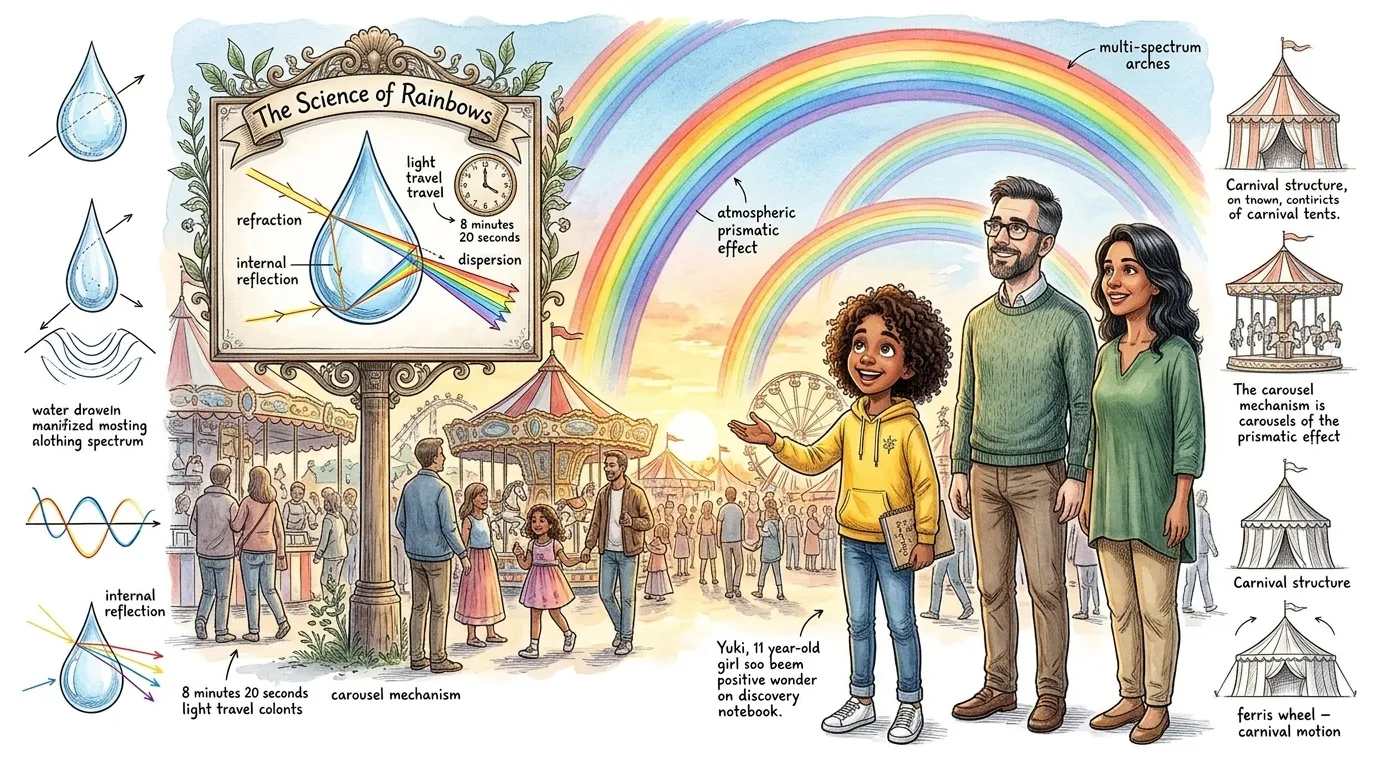
Rainbows arch across the sky during the meteor shower carnival! But what are they, really? "'Wow, look at all the rainbows!' Yuki exclaimed, pointing towards…
Rainbows arch across the sky during the meteor shower carnival! But what are they, really? "'Wow, look at all the rainbows!' Yuki exclaimed, pointing towards the sky. 'It's like a magical carnival!'" Fact: Rainbows are caused by refraction, internal reflection, and dispersion of light in water droplets. Light takes about 8 minutes and 20 seconds to travel from the Sun to Earth.

Rainbows arch across the sky during the meteor shower carnival! But what are they, really?

"'Wow, look at all the rainbows!' Yuki exclaimed, pointing towards the sky. 'It's like a magical carnival!'"

Fact: Rainbows are caused by refraction, internal reflection, and dispersion of light in water droplets. Light takes about 8 minutes and 20 seconds to travel from the Sun to Earth.

Page 2
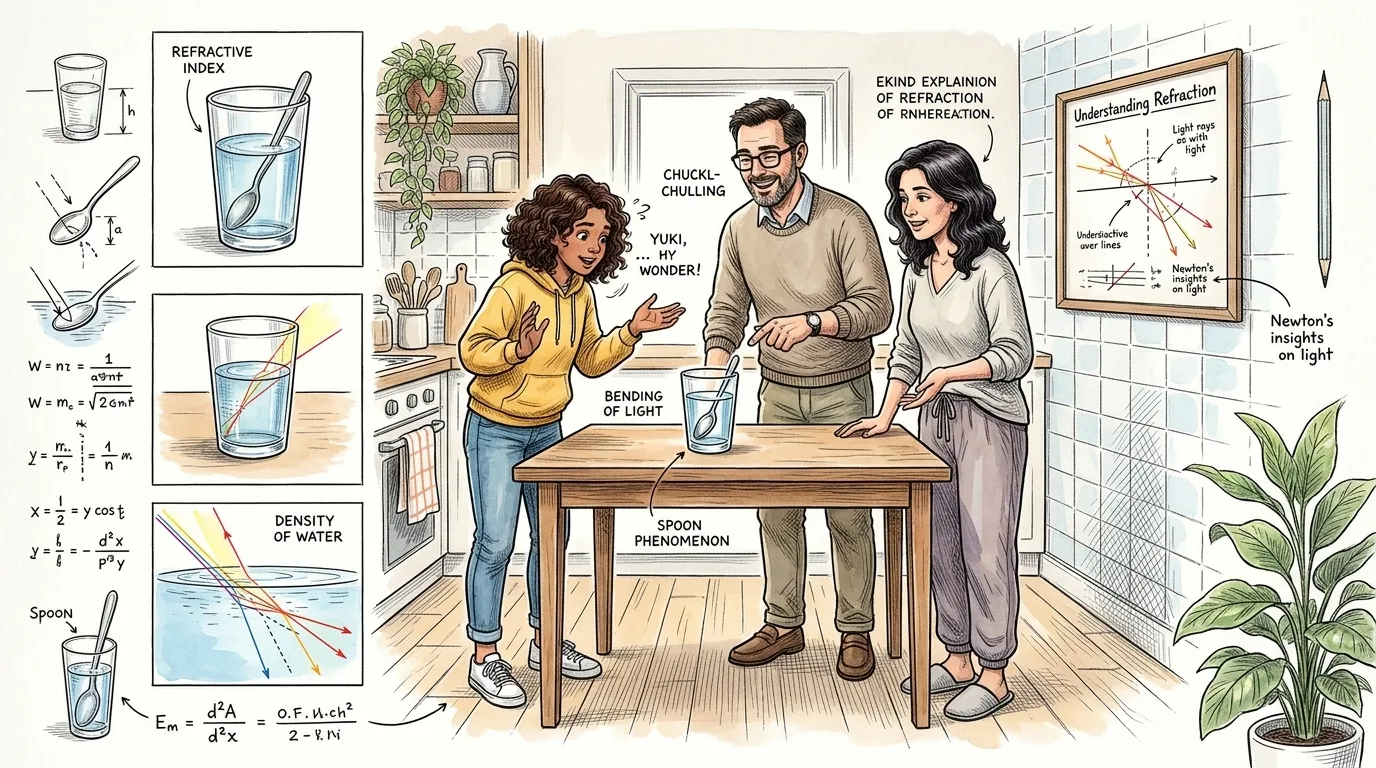
Rainbows appear when sunlight hits raindrops. It's not just any light – it's sunlight! "Yuki's father chuckled. 'It's all about how light bends!
Rainbows appear when sunlight hits raindrops. It's not just any light – it's sunlight! "Yuki's father chuckled. 'It's all about how light bends! Have you ever seen a spoon look bent in a glass of water?' Yuki shook her head. Her mother added, 'That bending is called refraction.'" Fact: Refraction is the bending of light as it passes from one medium to another. This is similar to how a lens focuses light. Sir Isaac Newton studied refraction extensively.

Rainbows appear when sunlight hits raindrops. It's not just any light – it's sunlight!

"Yuki's father chuckled. 'It's all about how light bends! Have you ever seen a spoon look bent in a glass of water?' Yuki shook her head. Her mother added, 'That bending is called refraction.'"

Fact: Refraction is the bending of light as it passes from one medium to another. This is similar to how a lens focuses light. Sir Isaac Newton studied refraction extensively.

Page 3
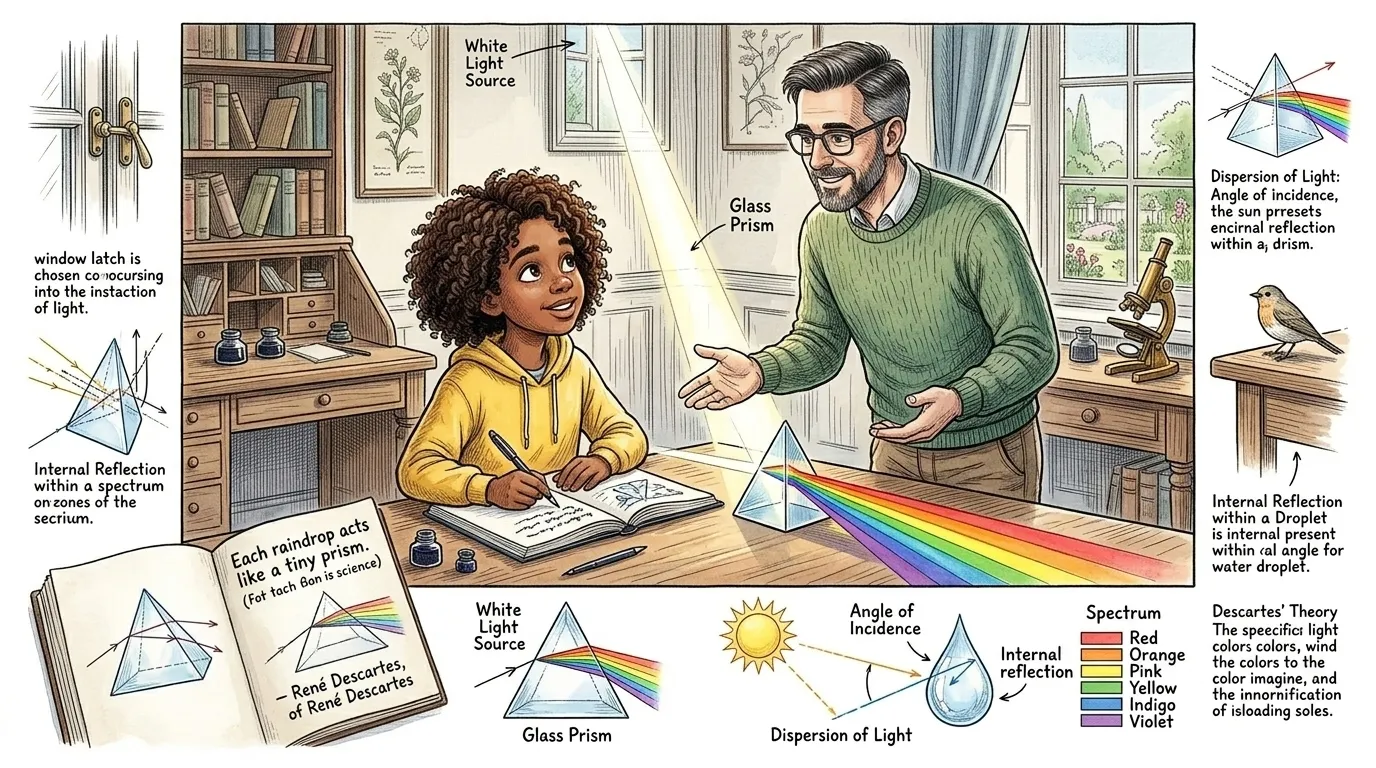
Each raindrop acts like a tiny prism! But how do these water droplets act like a prism? "'So, each raindrop splits the sunlight into different colors?' Yuki…
Each raindrop acts like a tiny prism! But how do these water droplets act like a prism? "'So, each raindrop splits the sunlight into different colors?' Yuki asked, scribbling in her notebook. 'Exactly!' her dad replied. 'Like when you shine light through a prism.'" Fact: A prism is a transparent optical element that refracts light, separating white light into a spectrum. René Descartes was one of the first to correctly explain the physics of rainbows in 1637.

Each raindrop acts like a tiny prism! But how do these water droplets act like a prism?

"'So, each raindrop splits the sunlight into different colors?' Yuki asked, scribbling in her notebook. 'Exactly!' her dad replied. 'Like when you shine light through a prism.'"

Fact: A prism is a transparent optical element that refracts light, separating white light into a spectrum. René Descartes was one of the first to correctly explain the physics of rainbows in 1637.

Page 4
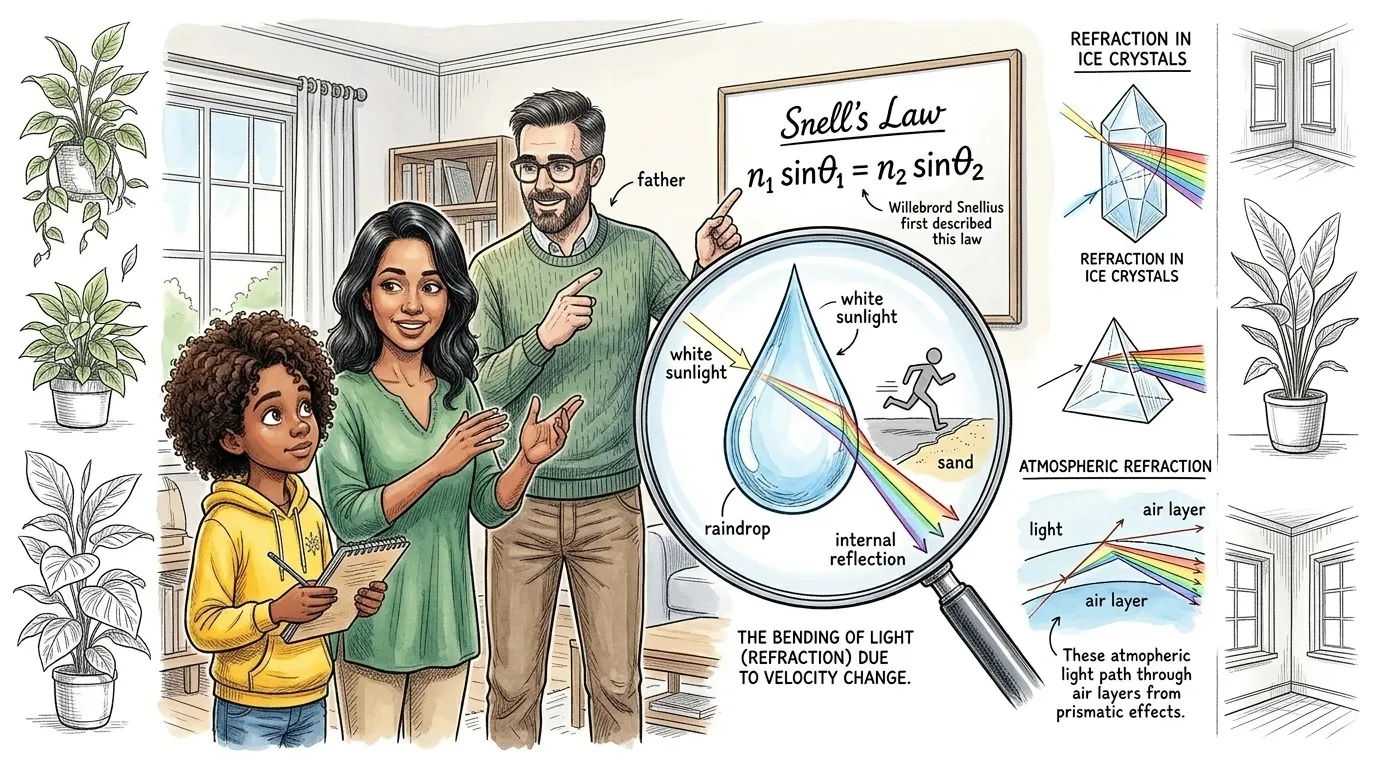
First, sunlight enters the raindrop and slows down, bending as it goes. "Yuki's mother explained, 'When the light enters, it's like running from pavement to…
First, sunlight enters the raindrop and slows down, bending as it goes. "Yuki's mother explained, 'When the light enters, it's like running from pavement to sand - you slow down and change direction!'" Fact: The angle of incidence and the angle of refraction are related by Snell's Law. This law was formulated by Willebrord Snellius in the 17th century.

First, sunlight enters the raindrop and slows down, bending as it goes.

"Yuki's mother explained, 'When the light enters, it's like running from pavement to sand - you slow down and change direction!'"

Fact: The angle of incidence and the angle of refraction are related by Snell's Law. This law was formulated by Willebrord Snellius in the 17th century.

Page 5
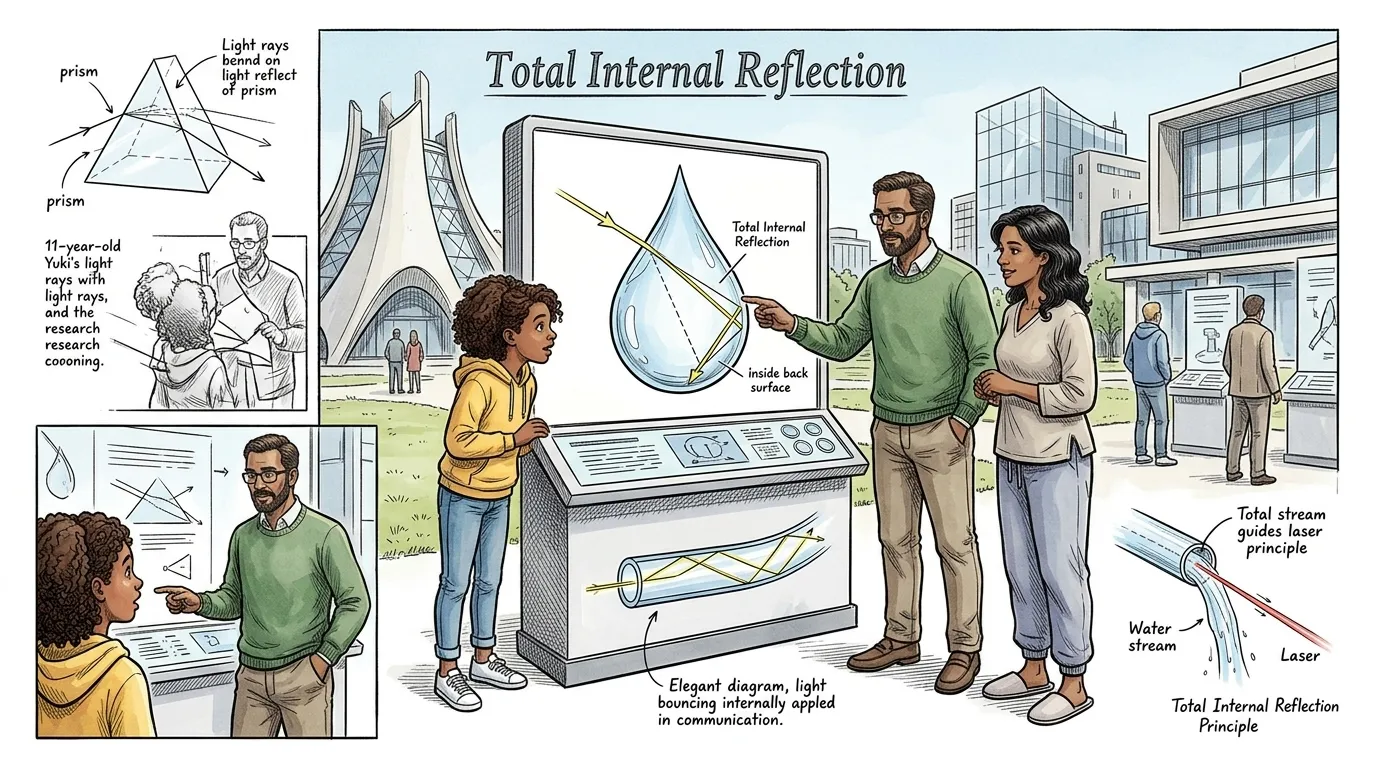
Next, the light bounces off the back of the raindrop, like a mirror inside! "Yuki's father pointed, 'See how the light hits the back and reflects?
Next, the light bounces off the back of the raindrop, like a mirror inside! "Yuki's father pointed, 'See how the light hits the back and reflects? That's total internal reflection!'" Fact: Total internal reflection occurs when light travels from a denser medium to a less dense medium at a large angle. This principle is used in fiber optics.

Next, the light bounces off the back of the raindrop, like a mirror inside!

"Yuki's father pointed, 'See how the light hits the back and reflects? That's total internal reflection!'"

Fact: Total internal reflection occurs when light travels from a denser medium to a less dense medium at a large angle. This principle is used in fiber optics.

Page 6
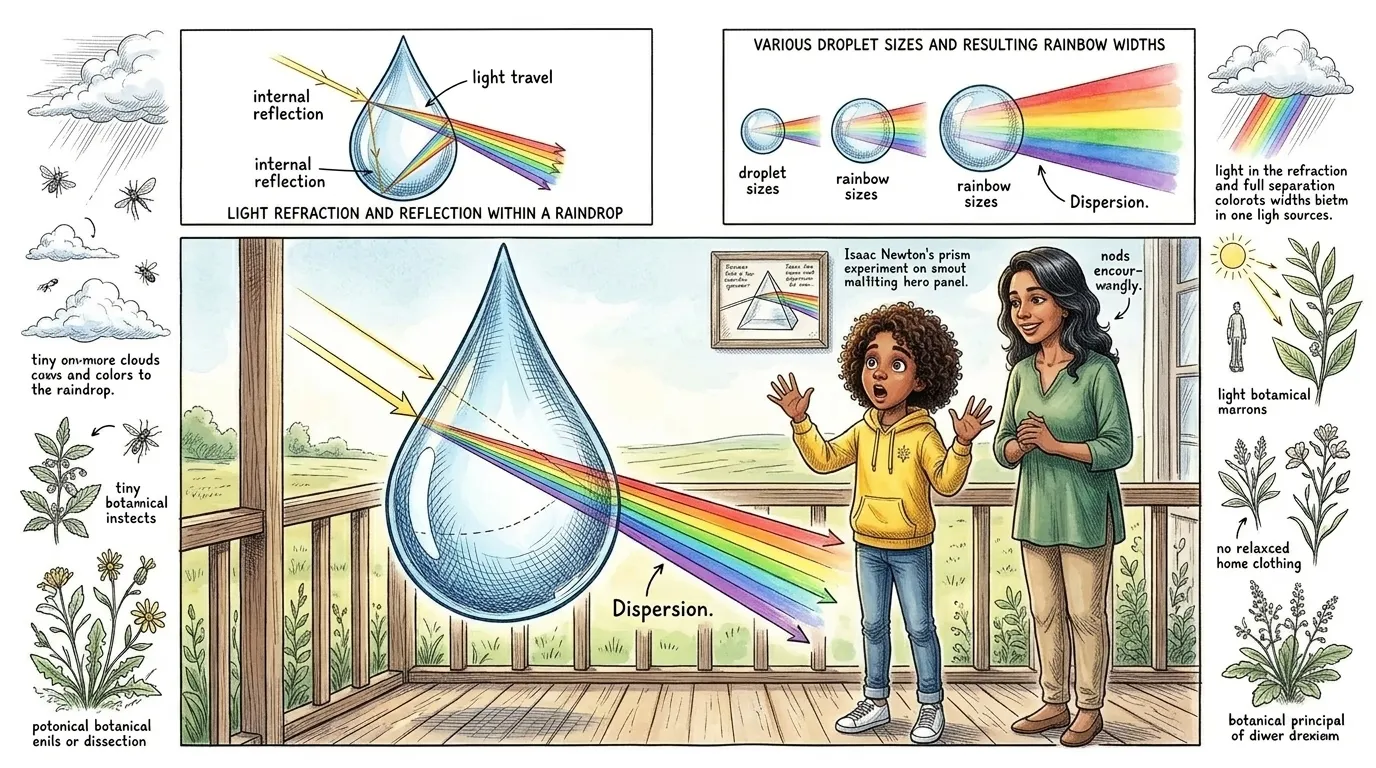
Finally, the light exits the raindrop, separating into all the colors of the rainbow. "Yuki gasped, 'It's like the light is painting the sky with all the…
Finally, the light exits the raindrop, separating into all the colors of the rainbow. "Yuki gasped, 'It's like the light is painting the sky with all the colors!' Her mother smiled, 'Each color bends a little differently when it leaves the drop.'" Fact: Dispersion is the separation of white light into its constituent colors due to differences in refractive index. Isaac Newton's prism experiments demonstrated this.

Finally, the light exits the raindrop, separating into all the colors of the rainbow.

"Yuki gasped, 'It's like the light is painting the sky with all the colors!' Her mother smiled, 'Each color bends a little differently when it leaves the drop.'"

Fact: Dispersion is the separation of white light into its constituent colors due to differences in refractive index. Isaac Newton's prism experiments demonstrated this.

Page 7
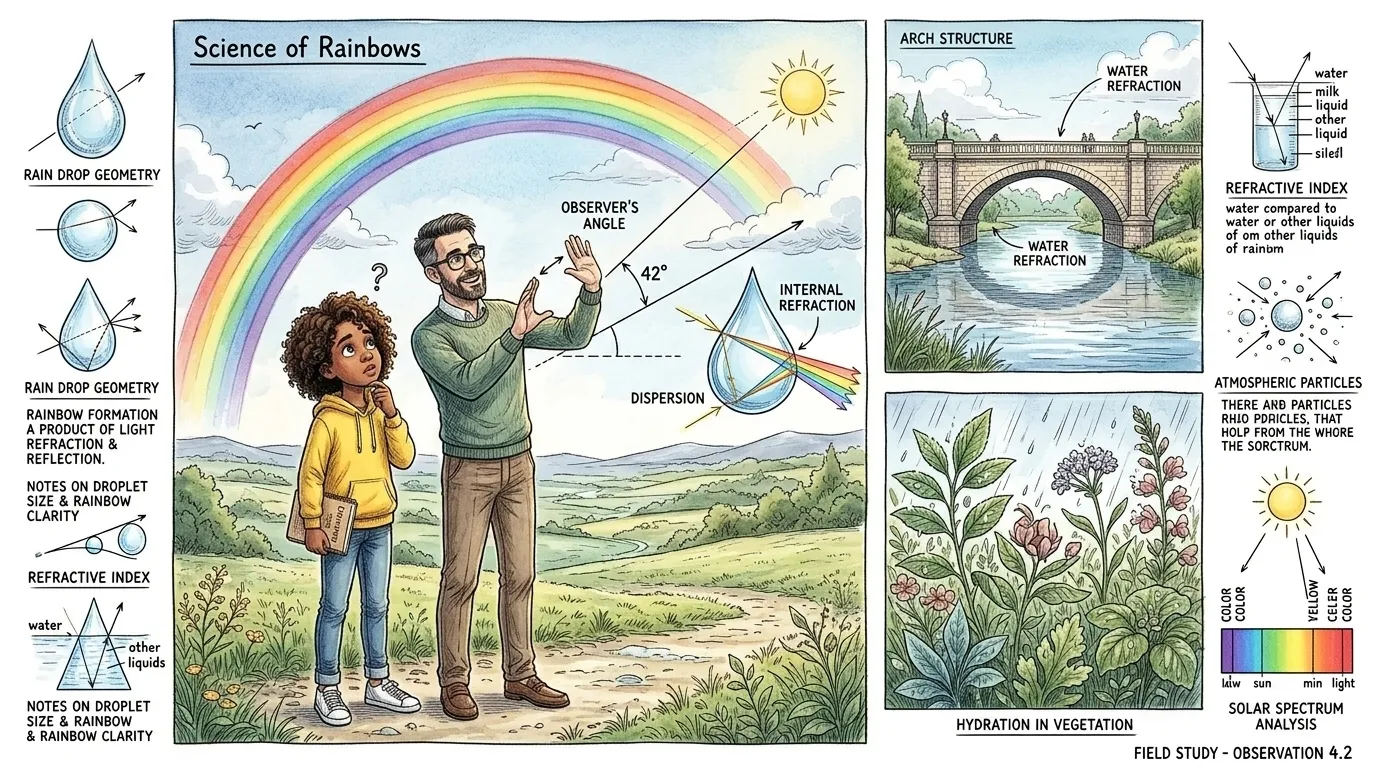
We see rainbows whenever sunlight and rain meet! But only if the angle is just right! "Yuki's father grinned. 'That's why rainbows always seem to curve away…
We see rainbows whenever sunlight and rain meet! But only if the angle is just right! "Yuki's father grinned. 'That's why rainbows always seem to curve away from the sun. It's all about angles!'" Fact: The angle between the incoming sunlight, the observer, and the rainbow is approximately 42 degrees. This is consistent no matter your altitude!

We see rainbows whenever sunlight and rain meet! But only if the angle is just right!

"Yuki's father grinned. 'That's why rainbows always seem to curve away from the sun. It's all about angles!'"

Fact: The angle between the incoming sunlight, the observer, and the rainbow is approximately 42 degrees. This is consistent no matter your altitude!

Page 8
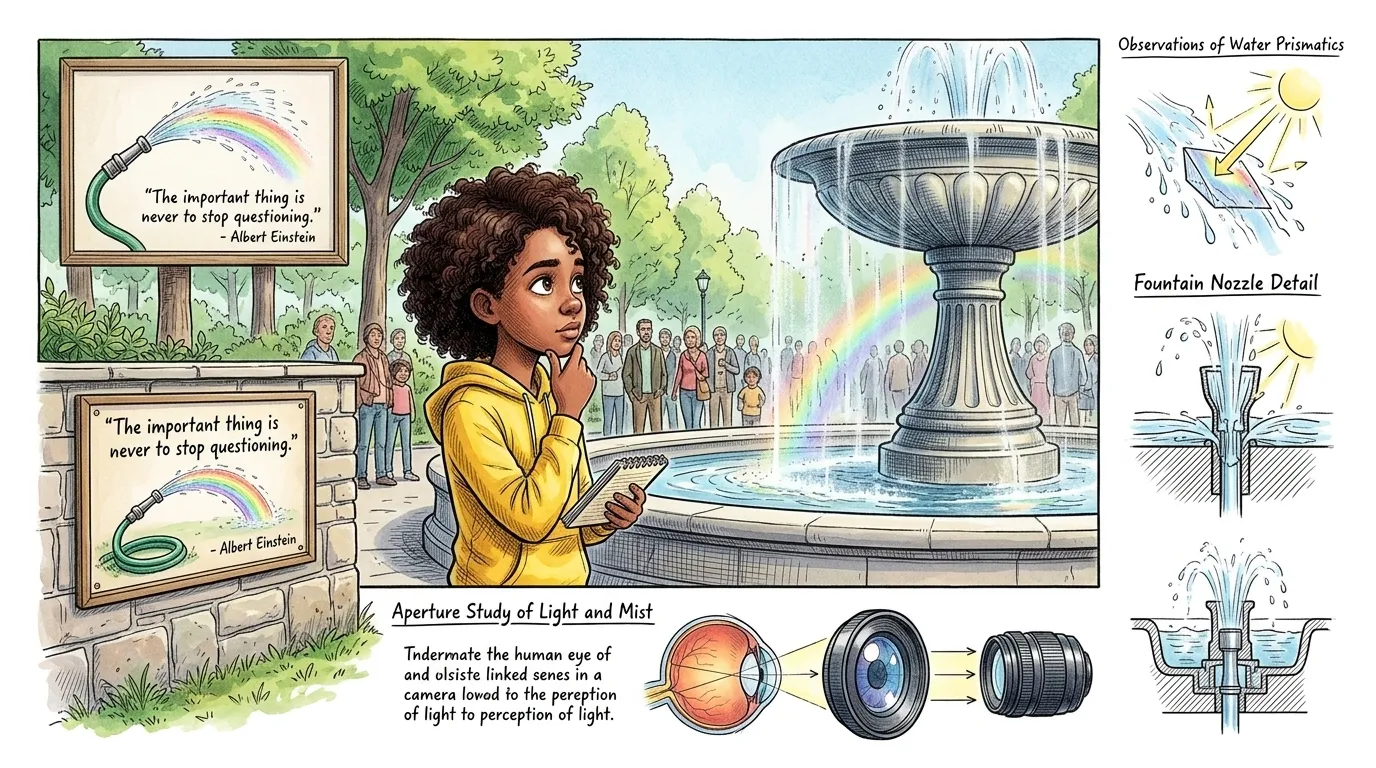
Rainbows even appear in fountains. All these tiny water drops give an amazing colorful light show! "Yuki remembers reading, ''The important thing is never to…
Rainbows even appear in fountains. All these tiny water drops give an amazing colorful light show! "Yuki remembers reading, ''The important thing is never to stop questioning,' Albert Einstein said. So, if rainbows appear in rain, and rain is basically water...what about fountains?'." Fact: Artificial rainbows can be created using garden hoses or sprinklers. The same principles of refraction and reflection apply.

Rainbows even appear in fountains. All these tiny water drops give an amazing colorful light show!

"Yuki remembers reading, ''The important thing is never to stop questioning,' Albert Einstein said. So, if rainbows appear in rain, and rain is basically water...what about fountains?'."

Fact: Artificial rainbows can be created using garden hoses or sprinklers. The same principles of refraction and reflection apply.

Page 9

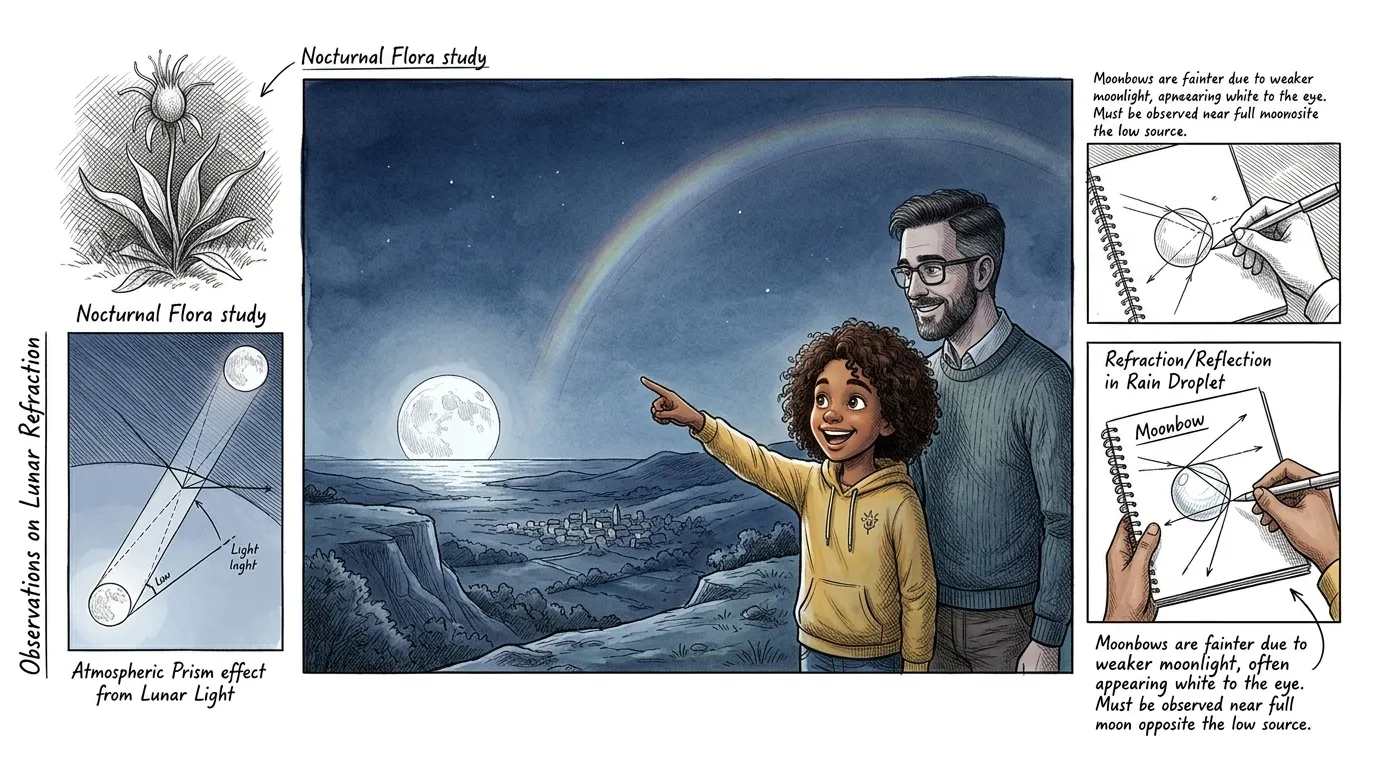
Believe it or not, you can even see rainbows at night. They are called moonbows! "Yuki pointed excitedly, 'Look! A moonbow! It's a rainbow...
Believe it or not, you can even see rainbows at night. They are called moonbows! "Yuki pointed excitedly, 'Look! A moonbow! It's a rainbow... but made by moonlight!' Her father replied, 'Moonbows are fainter because moonlight is weaker, but they're real!'" Fact: Moonbows (also known as lunar rainbows) are best viewed when the moon is low in the sky and the sky is dark. They often appear white because the moonlight isn't as bright as sunlight.

Believe it or not, you can even see rainbows at night. They are called moonbows!

"Yuki pointed excitedly, 'Look! A moonbow! It's a rainbow... but made by moonlight!' Her father replied, 'Moonbows are fainter because moonlight is weaker, but they're real!'"

Fact: Moonbows (also known as lunar rainbows) are best viewed when the moon is low in the sky and the sky is dark. They often appear white because the moonlight isn't as bright as sunlight.

Page 10
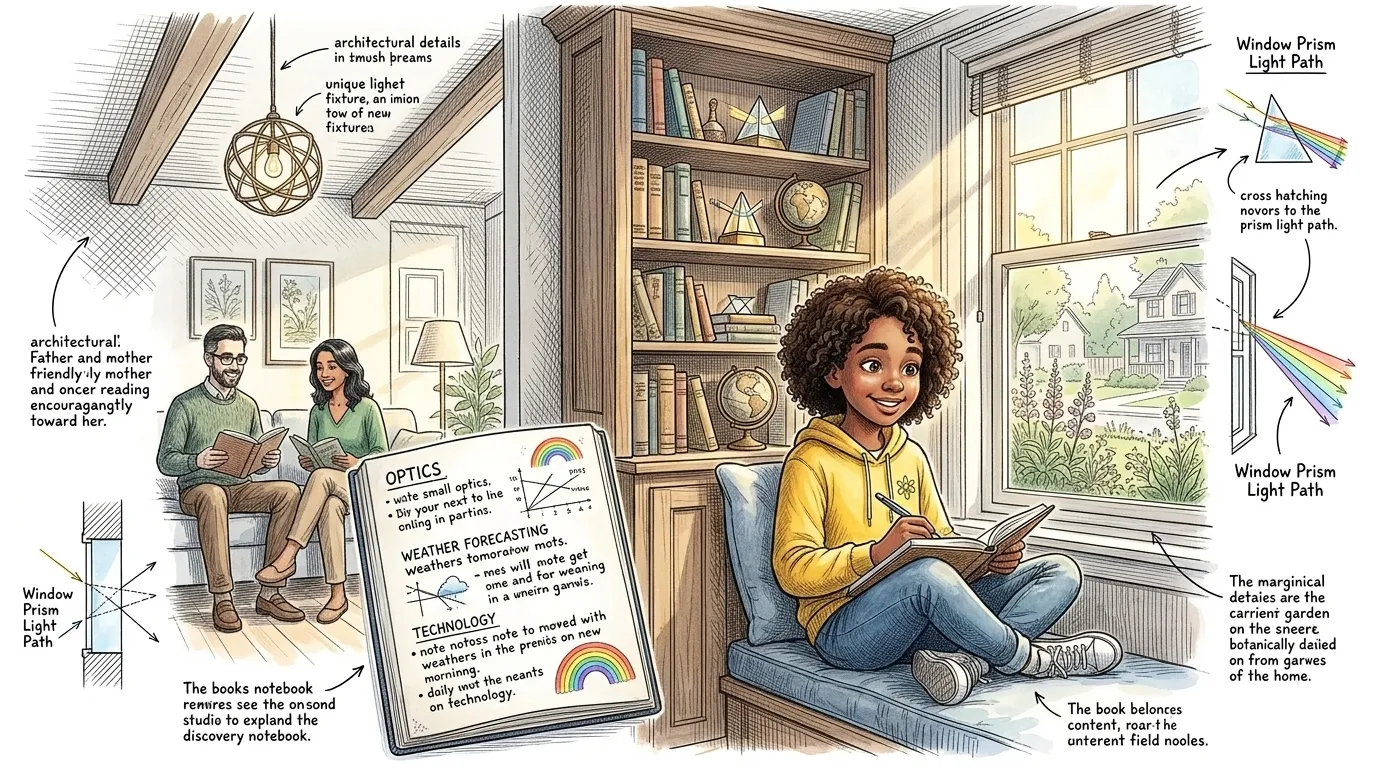
Rainbows remind us that light and water create amazing things. Keep looking, and you'll always see something new! "Yuki smiled, writing in her notebook.
Rainbows remind us that light and water create amazing things. Keep looking, and you'll always see something new! "Yuki smiled, writing in her notebook. 'Rainbows show us how much the universe is trying to teach us.'" Fact: Understanding how rainbows form has led to advances in optics, weather forecasting, and other areas of science and technology. It's all connected!

Rainbows remind us that light and water create amazing things. Keep looking, and you'll always see something new!

"Yuki smiled, writing in her notebook. 'Rainbows show us how much the universe is trying to teach us.'"

Fact: Understanding how rainbows form has led to advances in optics, weather forecasting, and other areas of science and technology. It's all connected!

About this story

  • Location: United Kingdom
  • Audience: kids (ages 6–12)

Questions and answers

Questions and answers about The Secret Behind Rainbows

Read Wonder Science on your phone

Wonder Science is available on Android. Get Wonder Science on Google Play.

More Wonder Science stories

All Wonder Science stories · Open the library