The Speed of Sound

The Speed of Sound — an illustrated science story. 10 illustrated pages, free to read on Wonder Science.
The Speed of Sound — book cover — Wonder Science
The Speed of Sound — an illustrated science story. 10 illustrated pages, free to read on Wonder Science.

Page 1
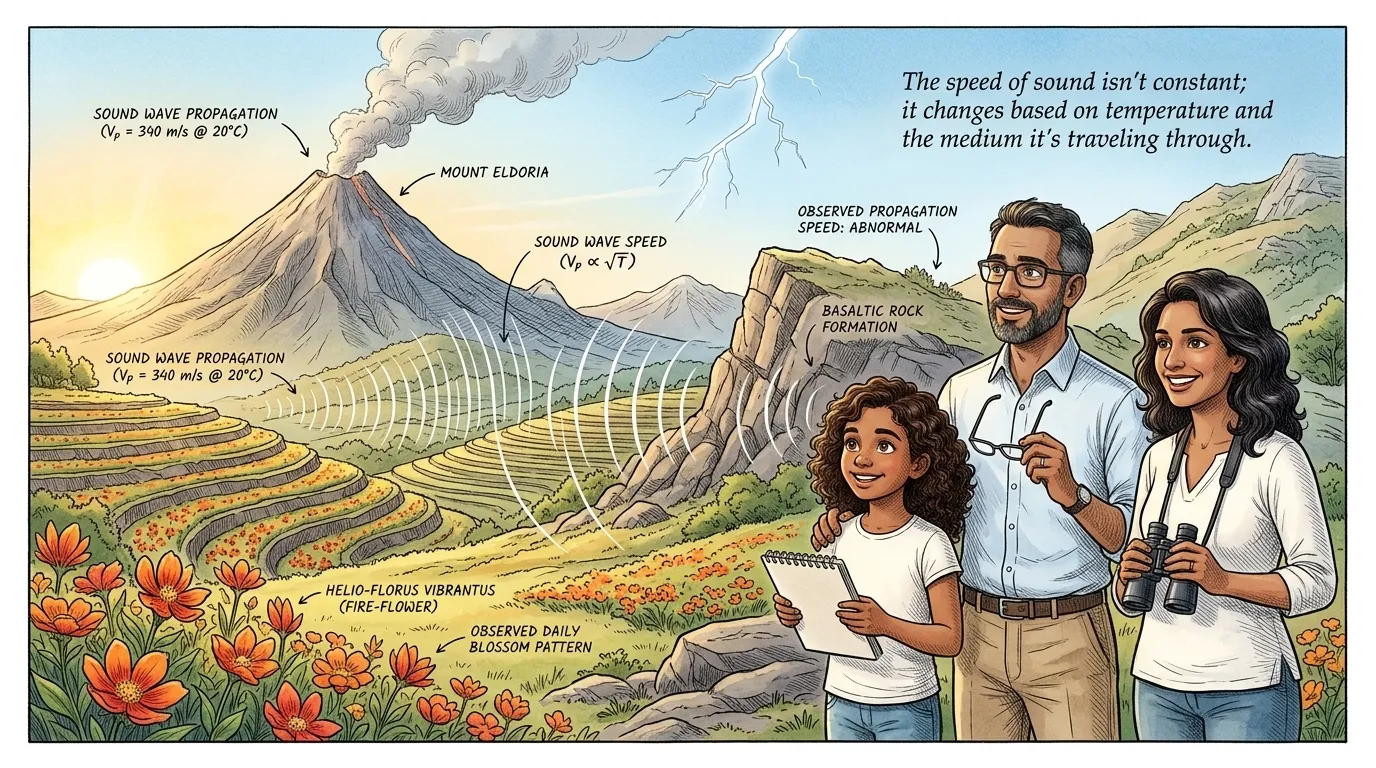
On the volcanic island of Eldoria, strange echoes dance through the air. The gardens of fire-flowers bloom, but something more is at play.
On the volcanic island of Eldoria, strange echoes dance through the air. The gardens of fire-flowers bloom, but something more is at play. The sound of distant thunder travels far faster than it should! Fact: The speed of sound isn't constant; it changes based on temperature and the medium it's traveling through.

On the volcanic island of Eldoria, strange echoes dance through the air. The gardens of fire-flowers bloom, but something more is at play. The sound of distant thunder travels far faster than it should!

Fact: The speed of sound isn't constant; it changes based on temperature and the medium it's traveling through.

Page 2
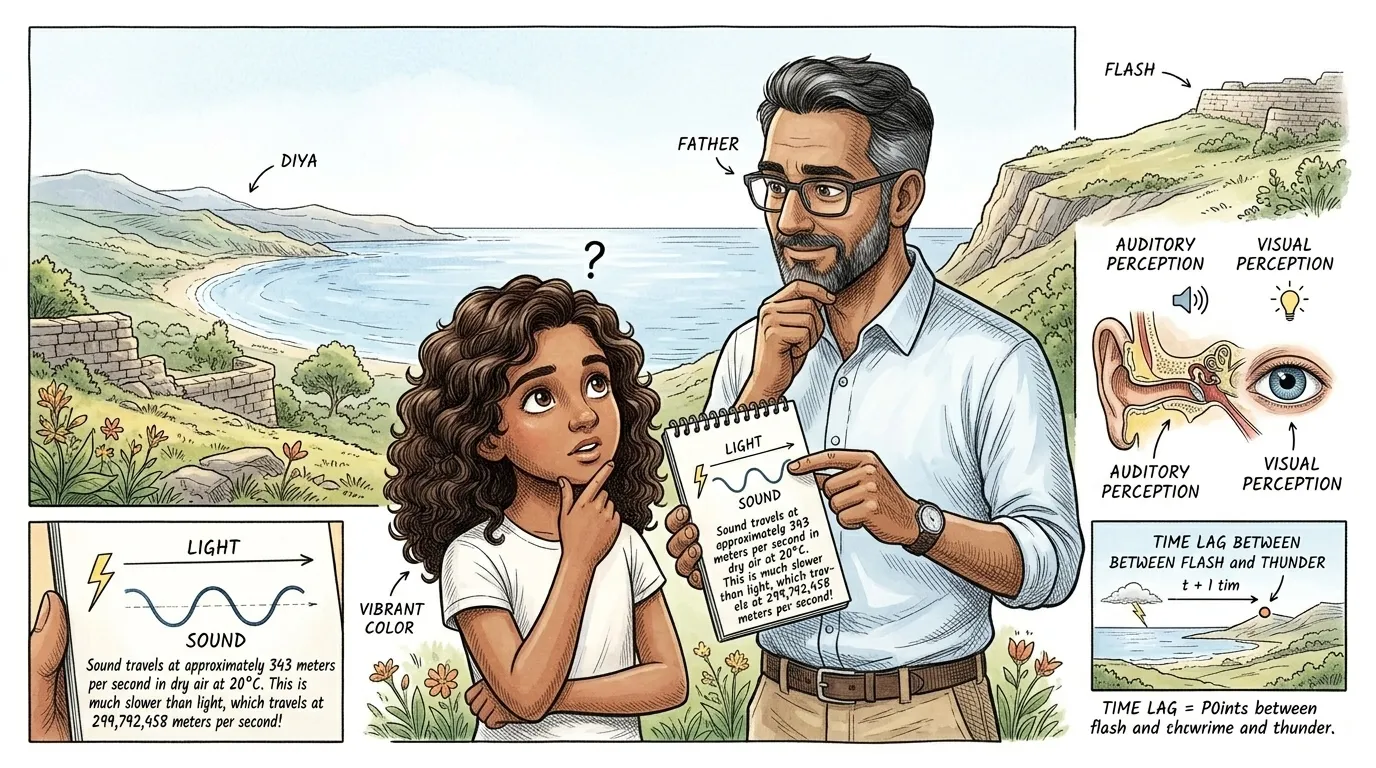
Diya, visiting Eldoria with her family, notices the oddity. "The thunder sounded almost instant, Dad," she says, looking up.
Diya, visiting Eldoria with her family, notices the oddity. "The thunder sounded almost instant, Dad," she says, looking up. Her father, a thoughtful man with glasses, a neat short beard, and graying temples, nods. "That's right, Diya, lightning and thunder happen at the same time, it's the sound that arrives later." ""That's odd, isn't it?", Diya asked. Her father replied, "Yes, it is. It takes sound a little while to travel, so the thunder always comes after the lightning.

Diya, visiting Eldoria with her family, notices the oddity. "The thunder sounded almost instant, Dad," she says, looking up. Her father, a thoughtful man with glasses, a neat short beard, and graying temples, nods. "That's right, Diya, lightning and thunder happen at the same time, it's the sound that arrives later."

""That's odd, isn't it?", Diya asked. Her father replied, "Yes, it is. It takes sound a little while to travel, so the thunder always comes after the lightning. It's just that here, the delay is much shorter than usual. But why?""

Fact: Sound travels at approximately 343 meters per second in dry air at 20 C. This is much slower than light, which travels at 299,792,458 meters per second!

Page 3

Later, Diya and her mother sit on a bench overlooking the fire-flower fields. Diya, notebook in hand, muses aloud. "Mom, the air here is so warm, could that…
Later, Diya and her mother sit on a bench overlooking the fire-flower fields. Diya, notebook in hand, muses aloud. "Mom, the air here is so warm, could that have something to do with it?" Her mother, a friendly woman with dark wavy shoulder-length hair and warm brown eyes, smiles. "That's a fantastic question, Diya!" ""Mom, remember what Aristotle said?

Later, Diya and her mother sit on a bench overlooking the fire-flower fields. Diya, notebook in hand, muses aloud. "Mom, the air here is so warm, could that have something to do with it?" Her mother, a friendly woman with dark wavy shoulder-length hair and warm brown eyes, smiles. "That's a fantastic question, Diya!"

""Mom, remember what Aristotle said? 'The more you know, the more you realize you don't know.' Maybe the island's hot air has something to do with why the sound is going faster. Does heat affect sound?""

Fact: Fun Fact: Sound travels faster in warmer air because the molecules are more energetic and collide more frequently.

Page 4
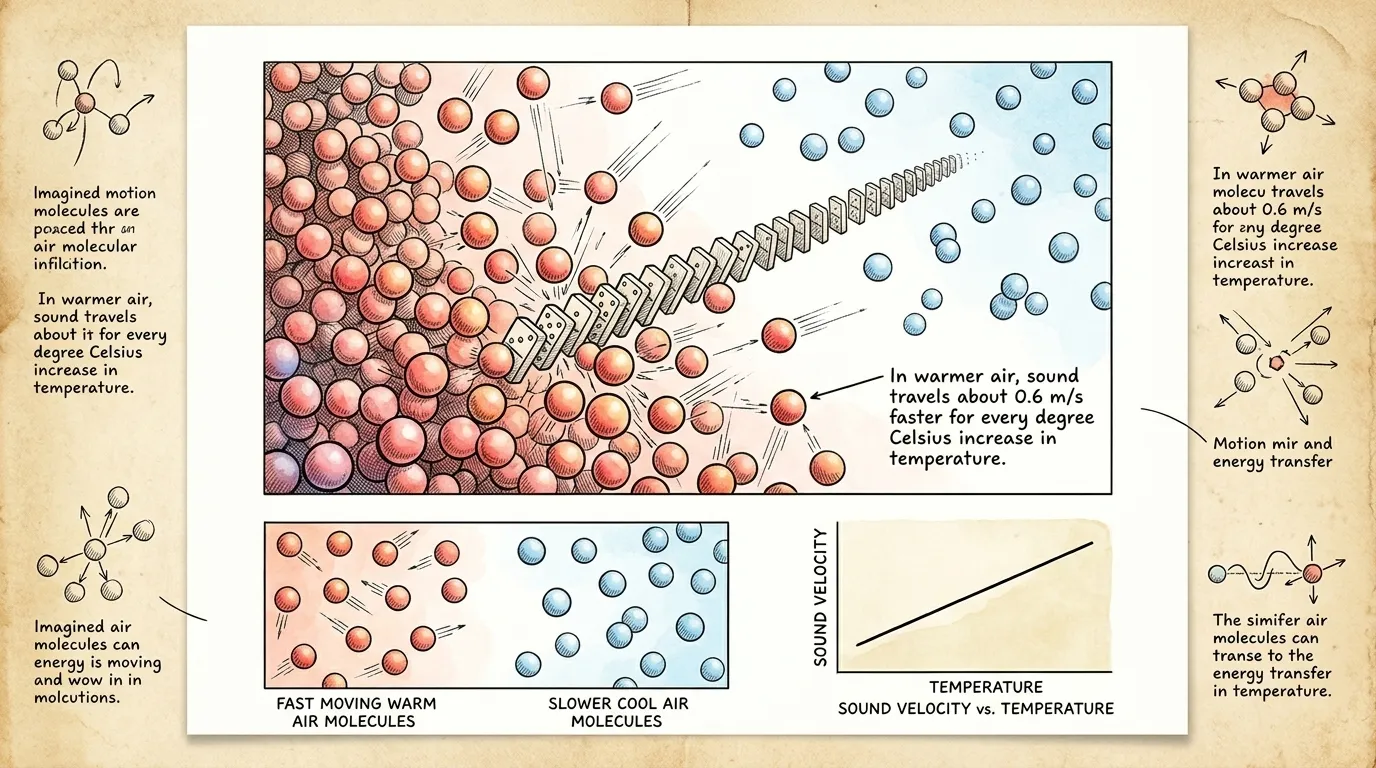
Diya imagines the air up close. The heat from the volcano stirs the air molecules. When sound travels, she thinks, it's like tiny dominoes pushing each other.
Diya imagines the air up close. The heat from the volcano stirs the air molecules. When sound travels, she thinks, it's like tiny dominoes pushing each other. Hotter air makes the 'dominoes' stand closer and the 'push' go faster! Fact: In warmer air, sound travels about 0.6 m/s faster for every degree Celsius increase in temperature.

Diya imagines the air up close. The heat from the volcano stirs the air molecules. When sound travels, she thinks, it's like tiny dominoes pushing each other. Hotter air makes the 'dominoes' stand closer and the 'push' go faster!

Fact: In warmer air, sound travels about 0.6 m/s faster for every degree Celsius increase in temperature.

Page 5
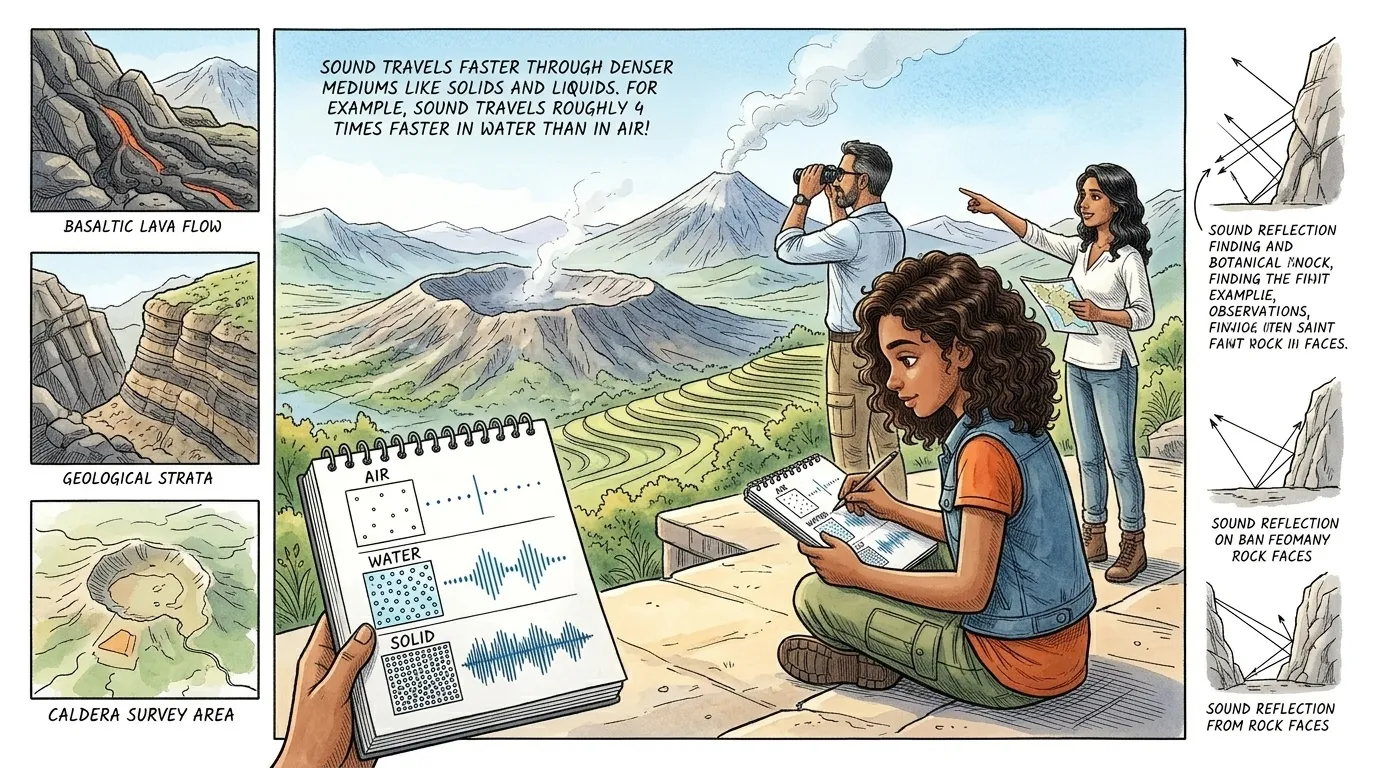
Diya sketches in her notebook. She recalls learning that sound travels faster through denser materials. "Maybe the volcanic gases make the air denser too?" she…
Diya sketches in her notebook. She recalls learning that sound travels faster through denser materials. "Maybe the volcanic gases make the air denser too?" she wonders, drawing a diagram. Fact: Sound travels faster through denser mediums like solids and liquids. For example, sound travels roughly 4 times faster in water than in air!

Diya sketches in her notebook. She recalls learning that sound travels faster through denser materials. "Maybe the volcanic gases make the air denser too?" she wonders, drawing a diagram.

Fact: Sound travels faster through denser mediums like solids and liquids. For example, sound travels roughly 4 times faster in water than in air!

Page 6
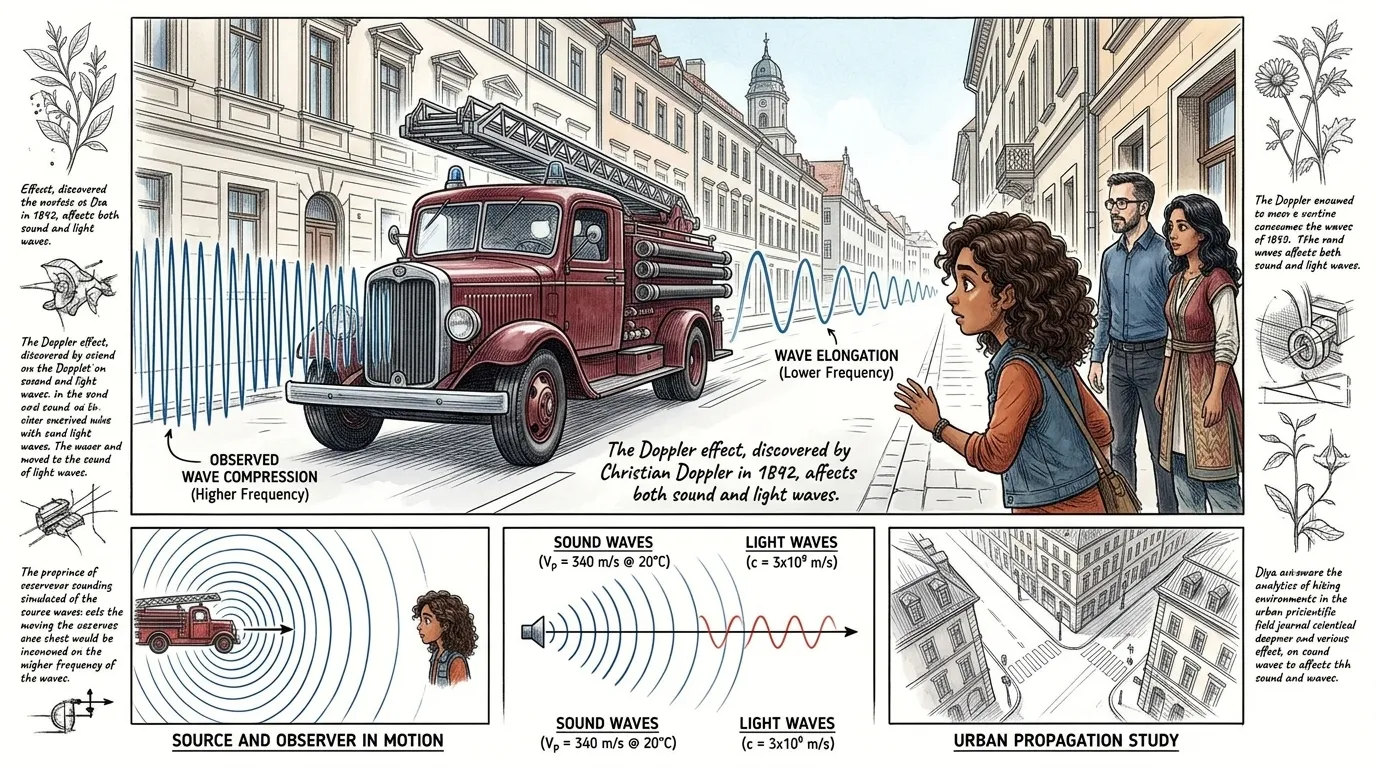
She remembers the Doppler effect. As a fire truck races by, its siren seems to change pitch. If the source is moving towards you, the sound waves compress…
She remembers the Doppler effect. As a fire truck races by, its siren seems to change pitch. If the source is moving towards you, the sound waves compress, raising the frequency! "Could that play a part?" Fact: The Doppler effect, discovered by Christian Doppler in 1842, affects both sound and light waves.

She remembers the Doppler effect. As a fire truck races by, its siren seems to change pitch. If the source is moving towards you, the sound waves compress, raising the frequency! "Could that play a part?"

Fact: The Doppler effect, discovered by Christian Doppler in 1842, affects both sound and light waves.

Page 7
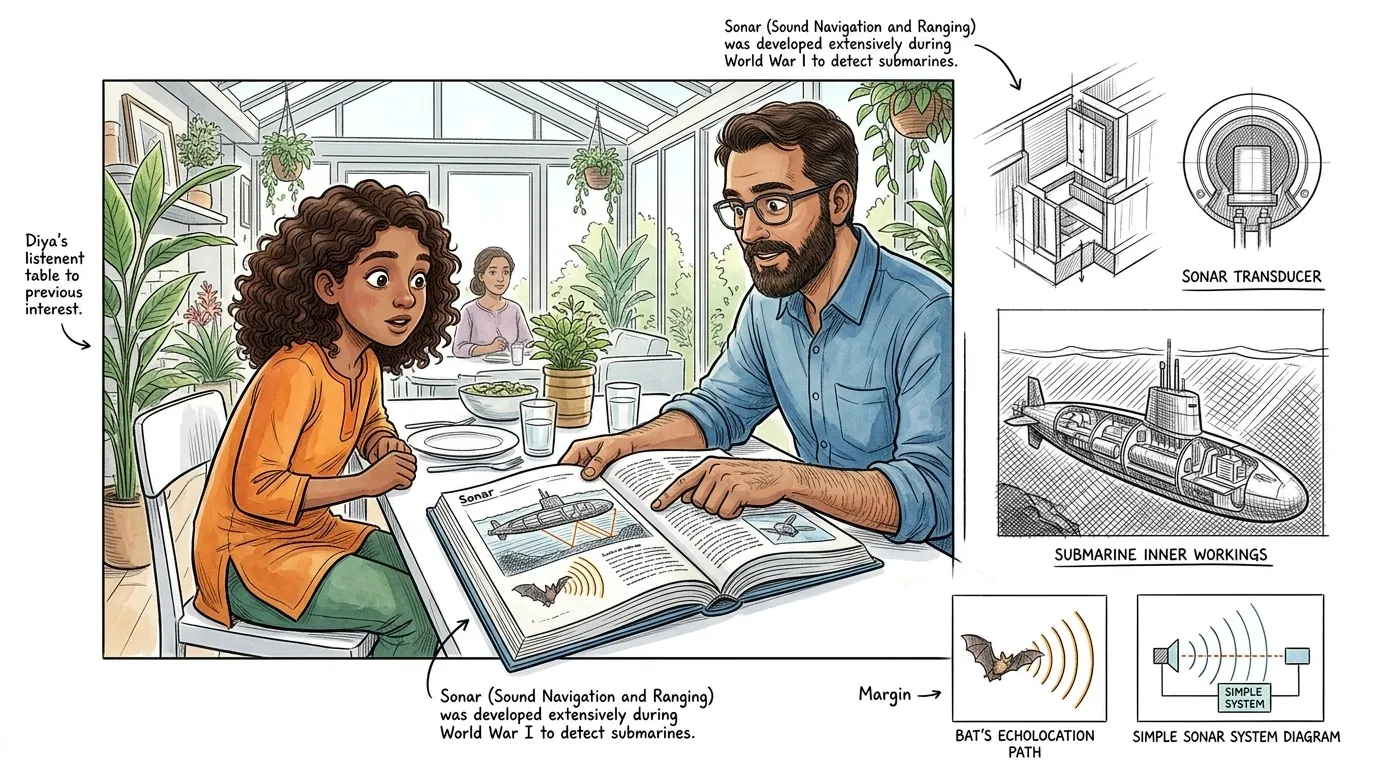
"Sound travels faster underwater, too," Diya's father mentions at dinner that night. "That's why submarines use sonar to navigate." He explains that sonar works…
"Sound travels faster underwater, too," Diya's father mentions at dinner that night. "That's why submarines use sonar to navigate." He explains that sonar works by sending out sound waves and measuring how long they take to return. It's like an echo, but much more precise. ""Did you know that the speed of sound is essential for echolocation used by bats and dolphins?

"Sound travels faster underwater, too," Diya's father mentions at dinner that night. "That's why submarines use sonar to navigate." He explains that sonar works by sending out sound waves and measuring how long they take to return. It's like an echo, but much more precise.

""Did you know that the speed of sound is essential for echolocation used by bats and dolphins? These animals use sound to 'see' in their environment", her father says."

Fact: Sonar (Sound Navigation and Ranging) was developed extensively during World War I to detect submarines.

Page 8
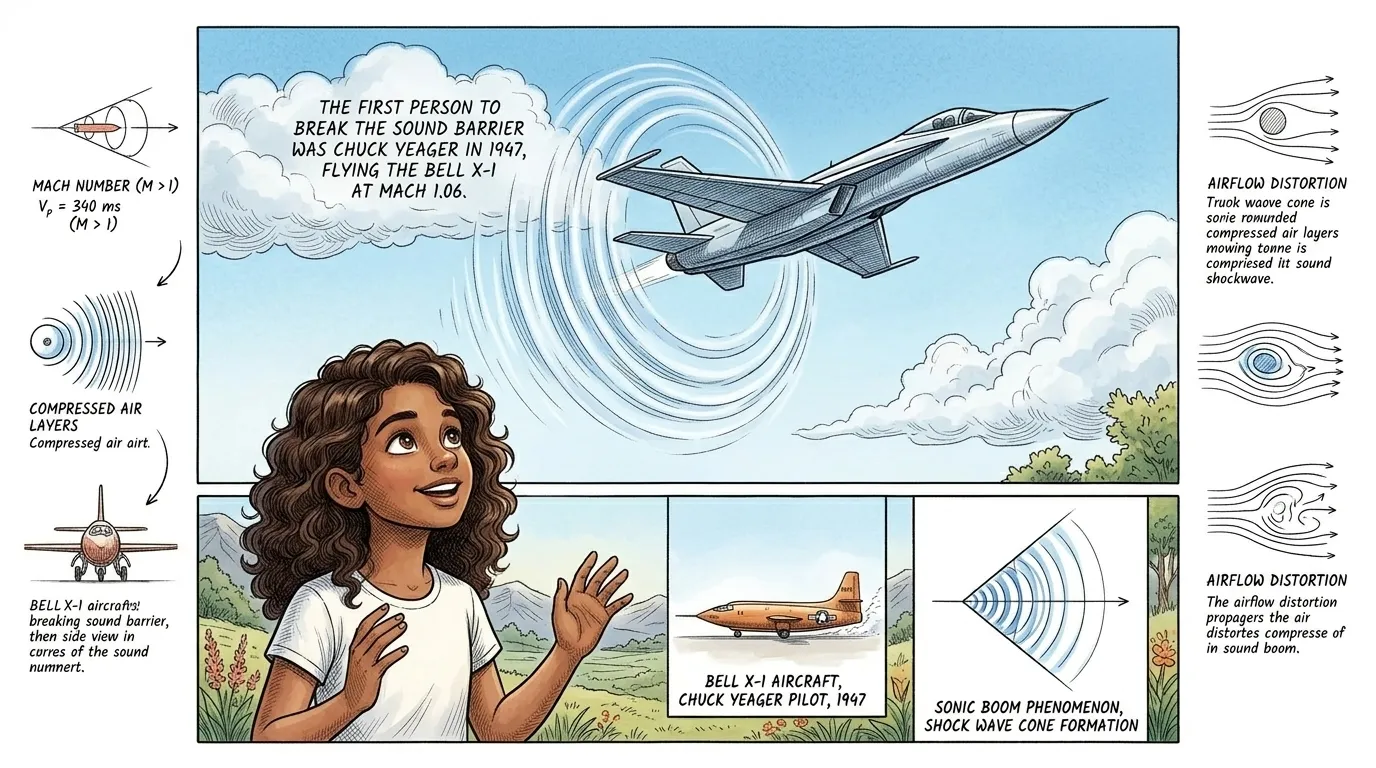
Diya imagines a jet plane soaring through the sky. What happens when a plane flies faster than the speed of sound? It creates a sonic boom!
Diya imagines a jet plane soaring through the sky. What happens when a plane flies faster than the speed of sound? It creates a sonic boom! The plane actually catches up with the sound waves it creates, compressing them into a shockwave. "Now that's a challenge!" Diya exclaims, "How does a plane even go faster than sound?"" Fact: The first person to break the sound barrier was Chuck Yeager in 1947, flying the Bell X-1 at Mach 1.06.

Diya imagines a jet plane soaring through the sky. What happens when a plane flies faster than the speed of sound? It creates a sonic boom! The plane actually catches up with the sound waves it creates, compressing them into a shockwave.

"Now that's a challenge!" Diya exclaims, "How does a plane even go faster than sound?""

Fact: The first person to break the sound barrier was Chuck Yeager in 1947, flying the Bell X-1 at Mach 1.06.

Page 9
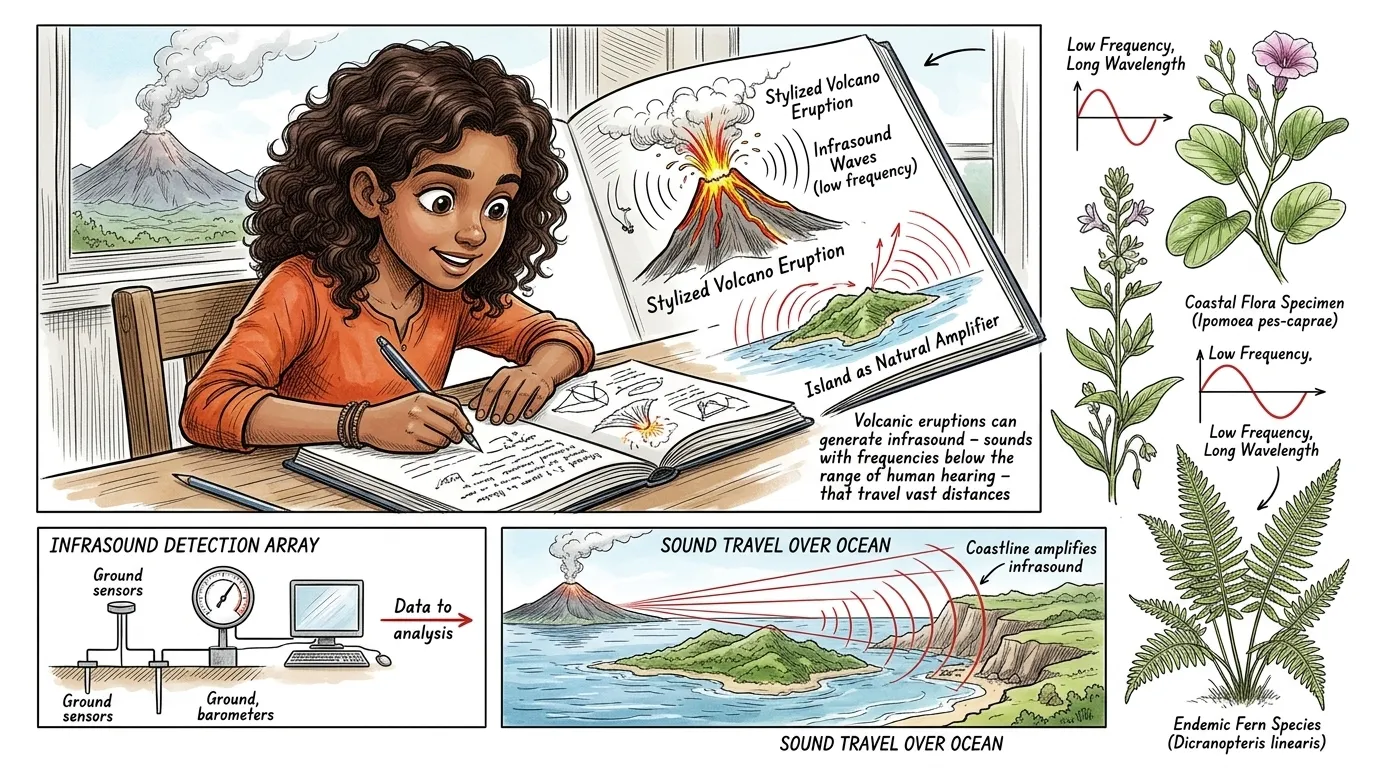
Diya thinks about the volcano again. Could the eruption itself create a kind of sonic boom? Or maybe the shape of the island focuses the sound somehow?
Diya thinks about the volcano again. Could the eruption itself create a kind of sonic boom? Or maybe the shape of the island focuses the sound somehow? It's a puzzle worth solving! ""Wow," Diya said, "the island is like a giant amplifier." She started furiously writing in her notebook." Fact: Volcanic eruptions can generate infrasound – sounds with frequencies below the range of human hearing – that travel vast distances.

Diya thinks about the volcano again. Could the eruption itself create a kind of sonic boom? Or maybe the shape of the island focuses the sound somehow? It's a puzzle worth solving!

""Wow," Diya said, "the island is like a giant amplifier." She started furiously writing in her notebook."

Fact: Volcanic eruptions can generate infrasound – sounds with frequencies below the range of human hearing – that travel vast distances.

Page 10
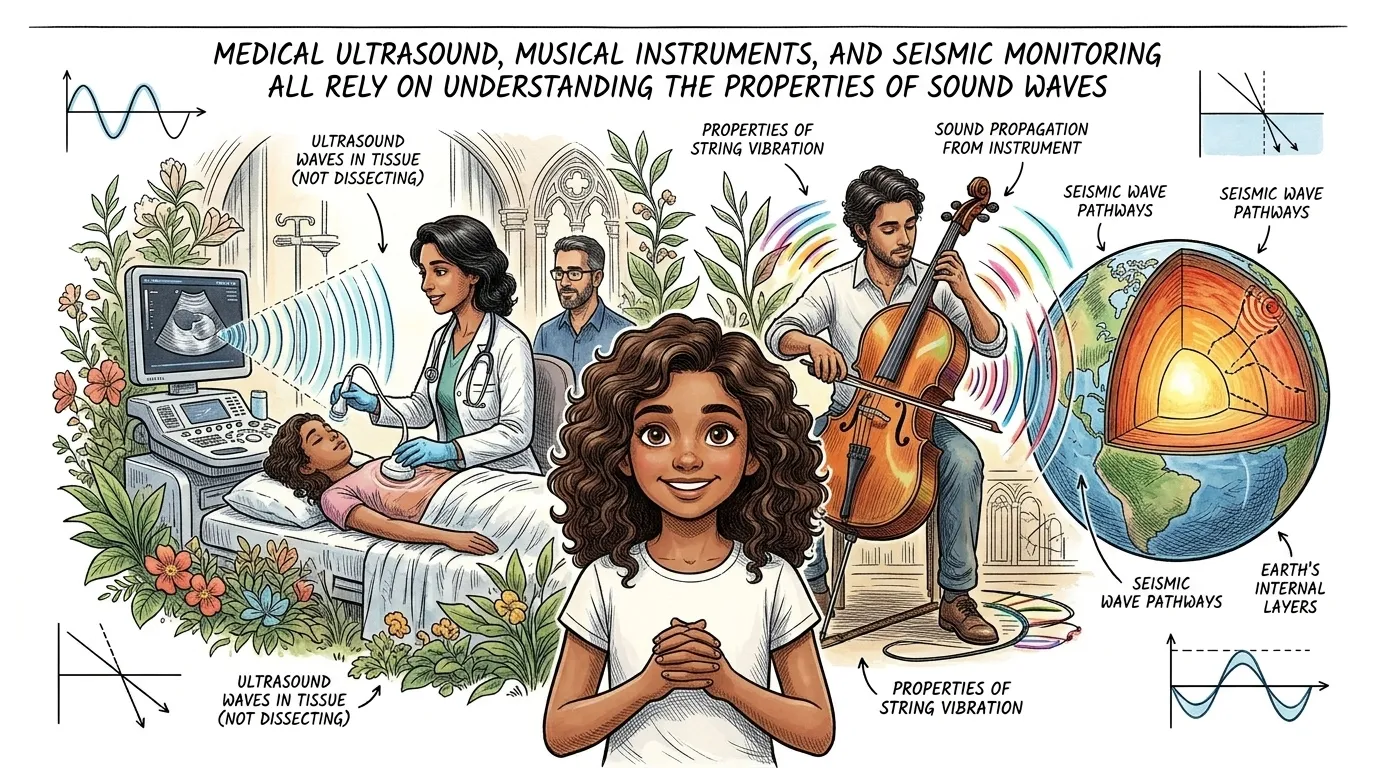
Understanding the speed of sound helps us explore the world. From medicine to music, from communication to climate science, listening to echoes tells us about…
Understanding the speed of sound helps us explore the world. From medicine to music, from communication to climate science, listening to echoes tells us about the universe around us! The answers are waiting, all we have to do is listen. Fact: Medical ultrasound, musical instruments, and seismic monitoring all rely on understanding the properties of sound waves.

Understanding the speed of sound helps us explore the world. From medicine to music, from communication to climate science, listening to echoes tells us about the universe around us! The answers are waiting, all we have to do is listen.

Fact: Medical ultrasound, musical instruments, and seismic monitoring all rely on understanding the properties of sound waves.

About this story

  • Audience: kids (ages 6–12)

Questions and answers

Questions and answers about The Speed of Sound

Read Wonder Science on your phone

Wonder Science is available on Android. Get Wonder Science on Google Play.

More Wonder Science stories

All Wonder Science stories · Open the library