Thomas Hunt Morgan

Thomas Hunt Morgan — an illustrated science story, set in Global. 10 illustrated pages, free to read on Wonder Science.
Thomas Hunt Morgan — book cover — Wonder Science
Thomas Hunt Morgan — an illustrated science story, set in Global. 10 illustrated pages, free to read on Wonder Science.

Page 1
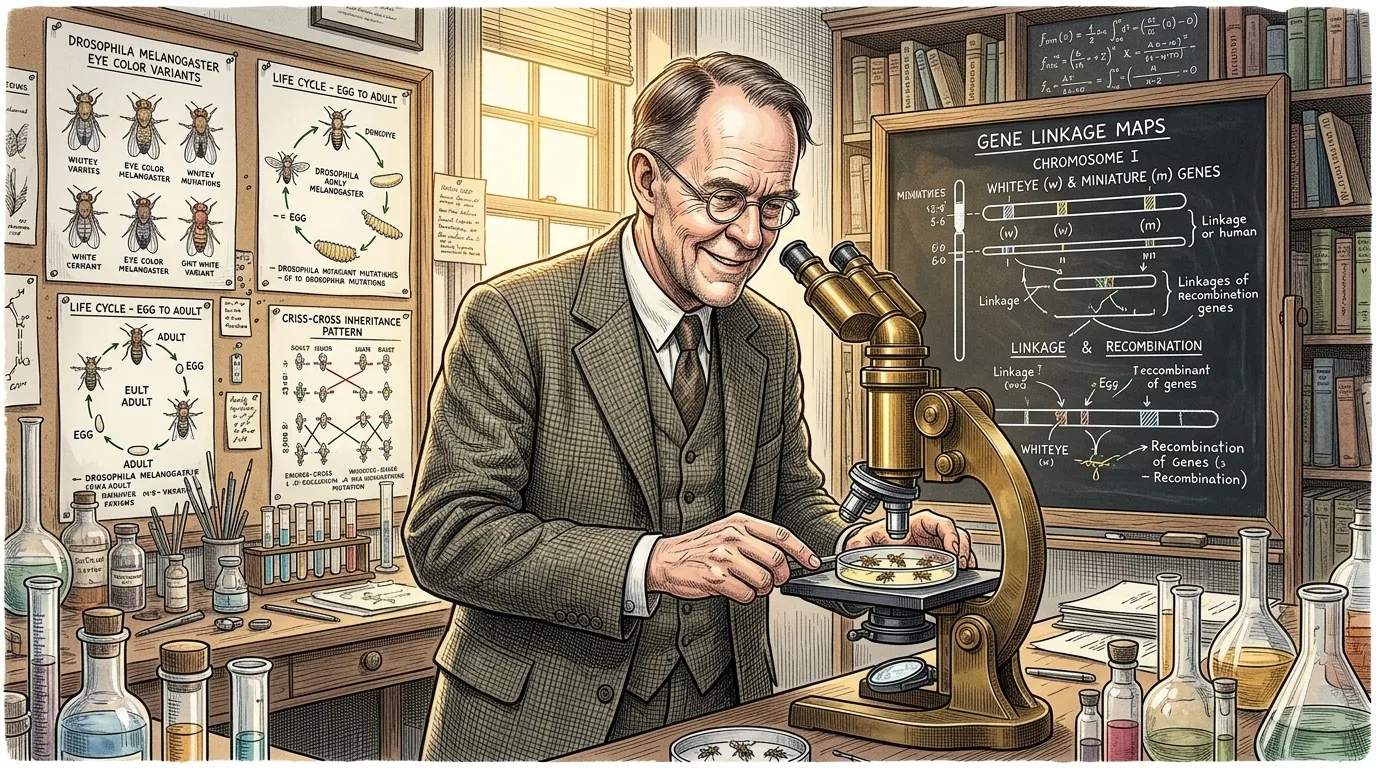
In the early 20th century, inside a cluttered laboratory at Columbia University, Thomas Hunt Morgan spearheaded a revolution in biology.
In the early 20th century, inside a cluttered laboratory at Columbia University, Thomas Hunt Morgan spearheaded a revolution in biology. What began as a skepticism toward the abstract concept of genes blossomed into concrete proof, meticulously gathered from countless generations of tiny fruit flies.

In the early 20th century, inside a cluttered laboratory at Columbia University, Thomas Hunt Morgan spearheaded a revolution in biology. What began as a skepticism toward the abstract concept of genes blossomed into concrete proof, meticulously gathered from countless generations of tiny fruit flies. Morgan's work meticulously mapped the invisible units of heredity to their precise locations on chromosomes, transforming genetics from a theoretical framework into a verifiable science.

Page 2
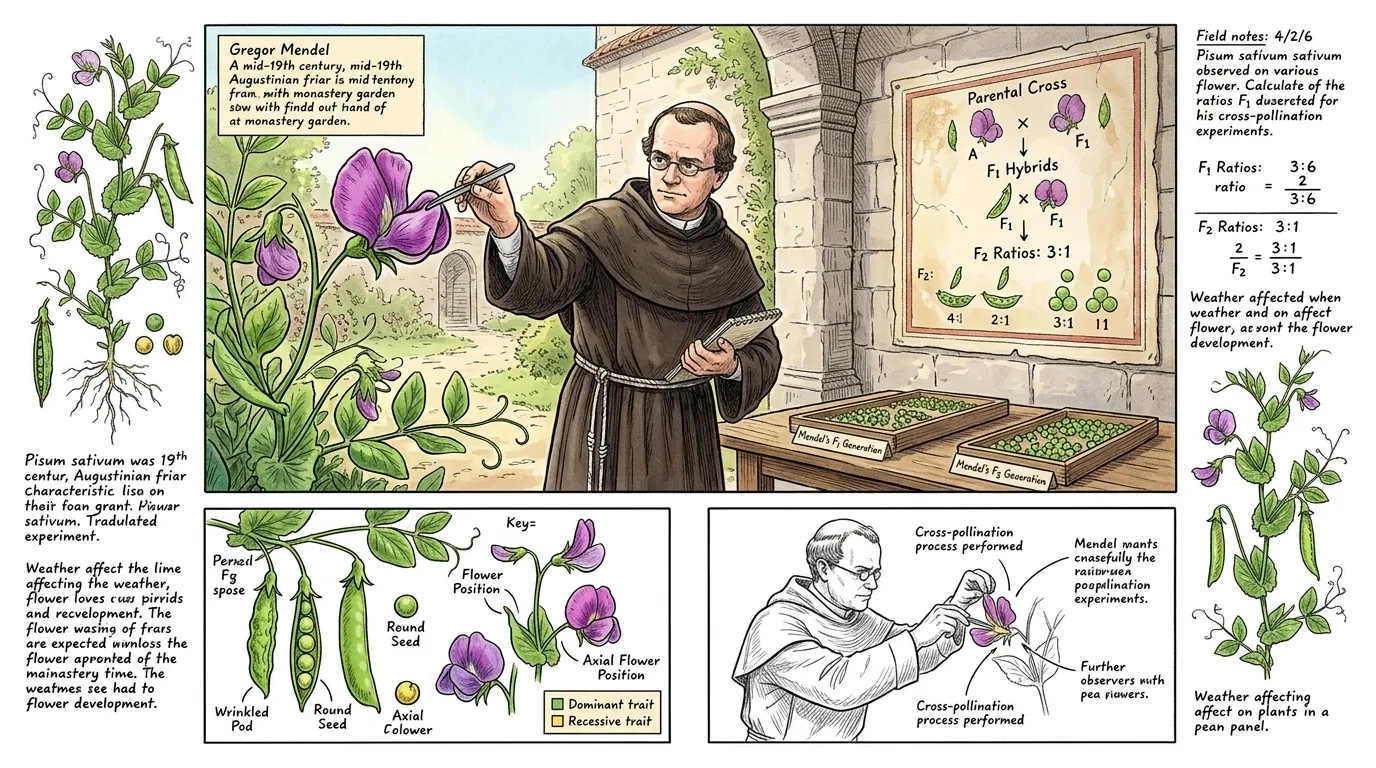
Before Morgan, Gregor Mendel's groundbreaking work in the mid-19th century had established that traits are inherited through discrete 'factors,' later termed…
Before Morgan, Gregor Mendel's groundbreaking work in the mid-19th century had established that traits are inherited through discrete 'factors,' later termed genes. Yet, the physical nature of these factors remained elusive, their mechanisms purely theoretical. Scientists understood that something was being passed down, dictating characteristics from one generation to the next, but how these abstract units behaved, where they resided, and how they physically segregated during…

Before Morgan, Gregor Mendel's groundbreaking work in the mid-19th century had established that traits are inherited through discrete 'factors,' later termed genes. Yet, the physical nature of these factors remained elusive, their mechanisms purely theoretical. Scientists understood that something was being passed down, dictating characteristics from one generation to the next, but how these abstract units behaved, where they resided, and how they physically segregated during reproduction was a profound biological mystery.

Page 3
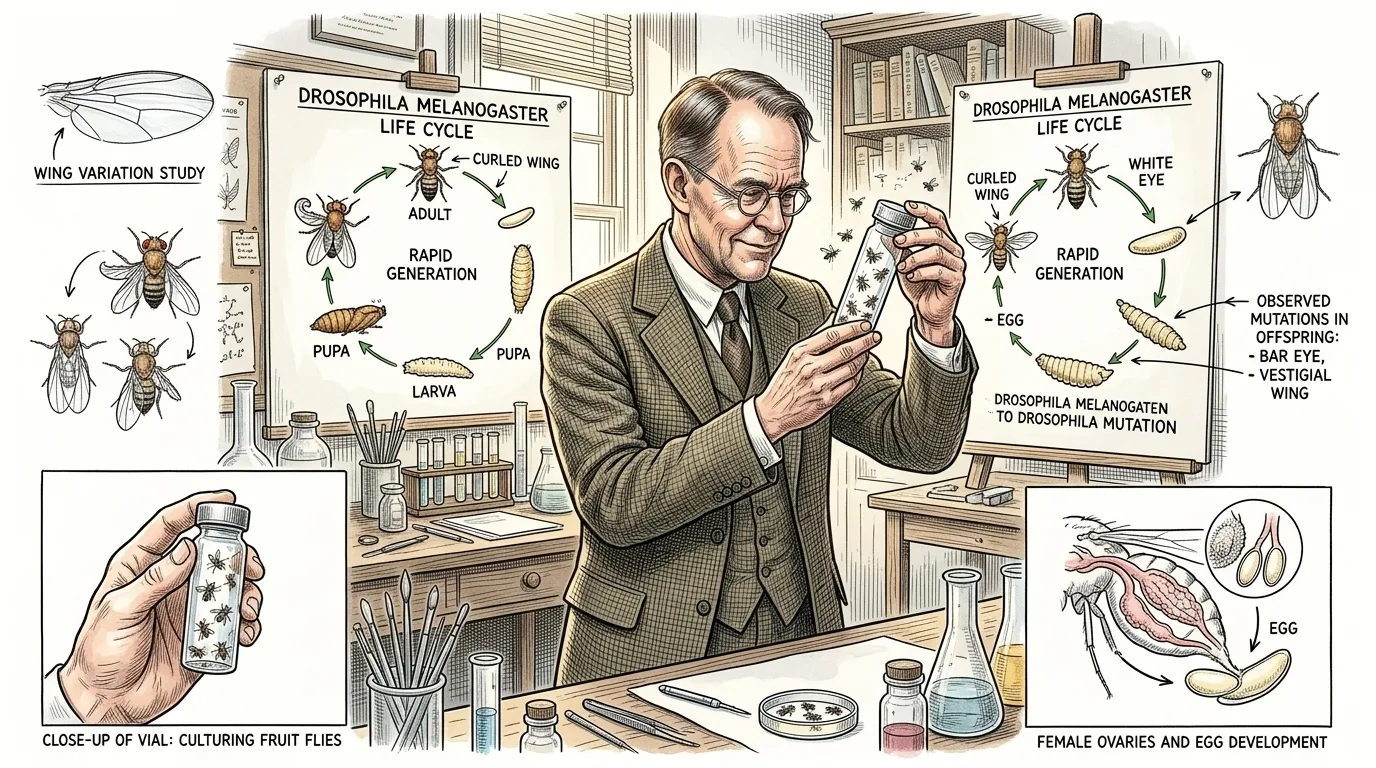
Morgan initially doubted the nascent chromosomal theory, a prevailing hypothesis that chromosomes carried genetic information.
Morgan initially doubted the nascent chromosomal theory, a prevailing hypothesis that chromosomes carried genetic information. To test this and other ideas about heredity, he sought an ideal research subject. His laboratory eventually settled on Drosophila melanogaster, the common fruit fly—a seemingly humble creature that would soon unlock some of life's most fundamental secrets.

Morgan initially doubted the nascent chromosomal theory, a prevailing hypothesis that chromosomes carried genetic information. To test this and other ideas about heredity, he sought an ideal research subject. His laboratory eventually settled on Drosophila melanogaster, the common fruit fly—a seemingly humble creature that would soon unlock some of life's most fundamental secrets. Their rapid reproductive cycle, ease of culture, and numerous visible mutations made them an unparalleled biological tool.

Page 4
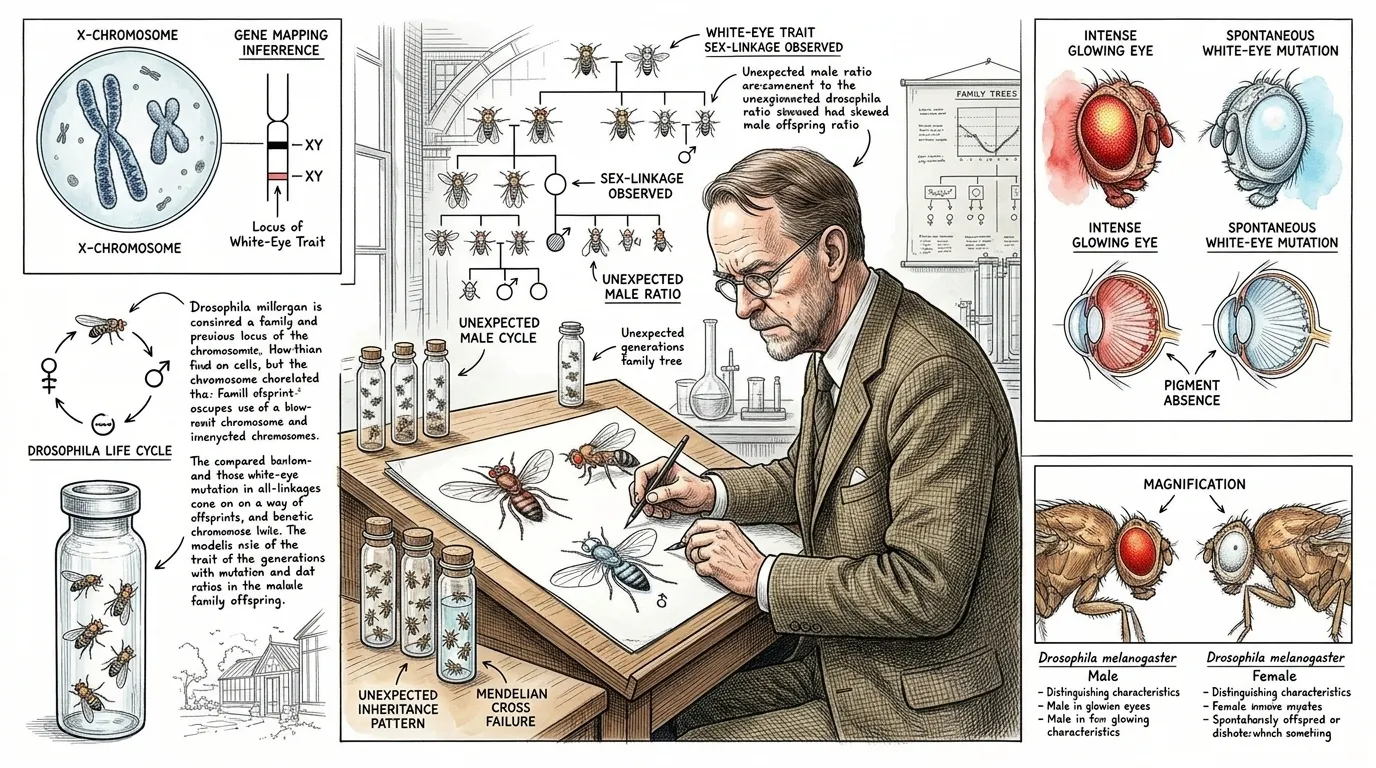
In 1910, a spontaneous mutation appeared in Morgan's lab: a male fruit fly with striking white eyes, instead of the typical red.
In 1910, a spontaneous mutation appeared in Morgan's lab: a male fruit fly with striking white eyes, instead of the typical red. This single anomaly became a pivotal discovery. When Morgan bred this white-eyed male with red-eyed females, the inheritance pattern defied simple Mendelian ratios. The trait seemed inextricably linked to sex, specifically appearing only in male offspring of certain crosses.

In 1910, a spontaneous mutation appeared in Morgan's lab: a male fruit fly with striking white eyes, instead of the typical red. This single anomaly became a pivotal discovery. When Morgan bred this white-eyed male with red-eyed females, the inheritance pattern defied simple Mendelian ratios. The trait seemed inextricably linked to sex, specifically appearing only in male offspring of certain crosses. This observation was the first empirical hint that a specific gene might reside on a specific chromosome.

Page 5
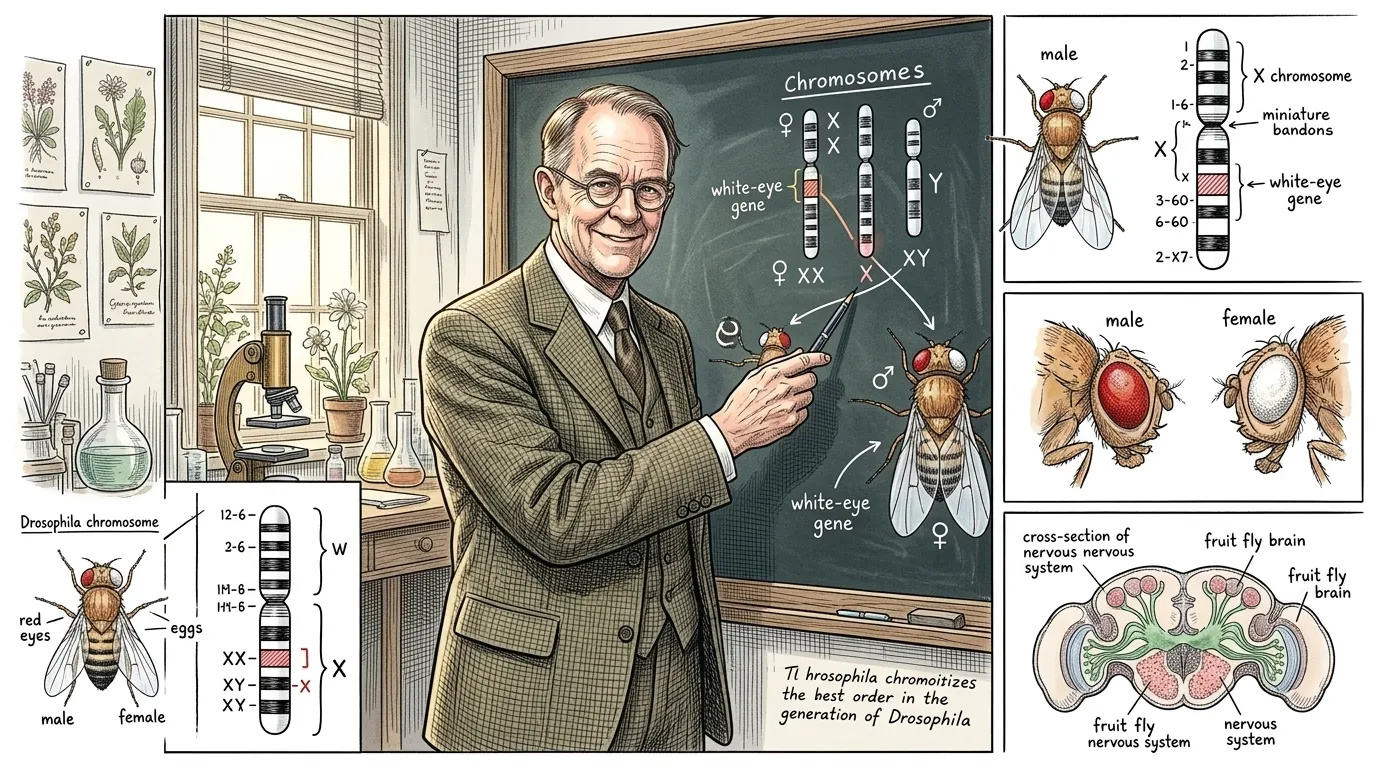
Morgan's subsequent breeding experiments confirmed that the white-eye gene was indeed carried on the X chromosome, one of the two sex chromosomes.
Morgan's subsequent breeding experiments confirmed that the white-eye gene was indeed carried on the X chromosome, one of the two sex chromosomes. Females (XX) could carry two copies of the gene, while males (XY) possessed only one. This explained why a single recessive white-eye allele on the male's X chromosome would result in white eyes, whereas females required two copies.

Morgan's subsequent breeding experiments confirmed that the white-eye gene was indeed carried on the X chromosome, one of the two sex chromosomes. Females (XX) could carry two copies of the gene, while males (XY) possessed only one. This explained why a single recessive white-eye allele on the male's X chromosome would result in white eyes, whereas females required two copies. This phenomenon, termed sex-linkage, was the first irrefutable evidence directly correlating a specific gene with a specific chromosome.

Page 6
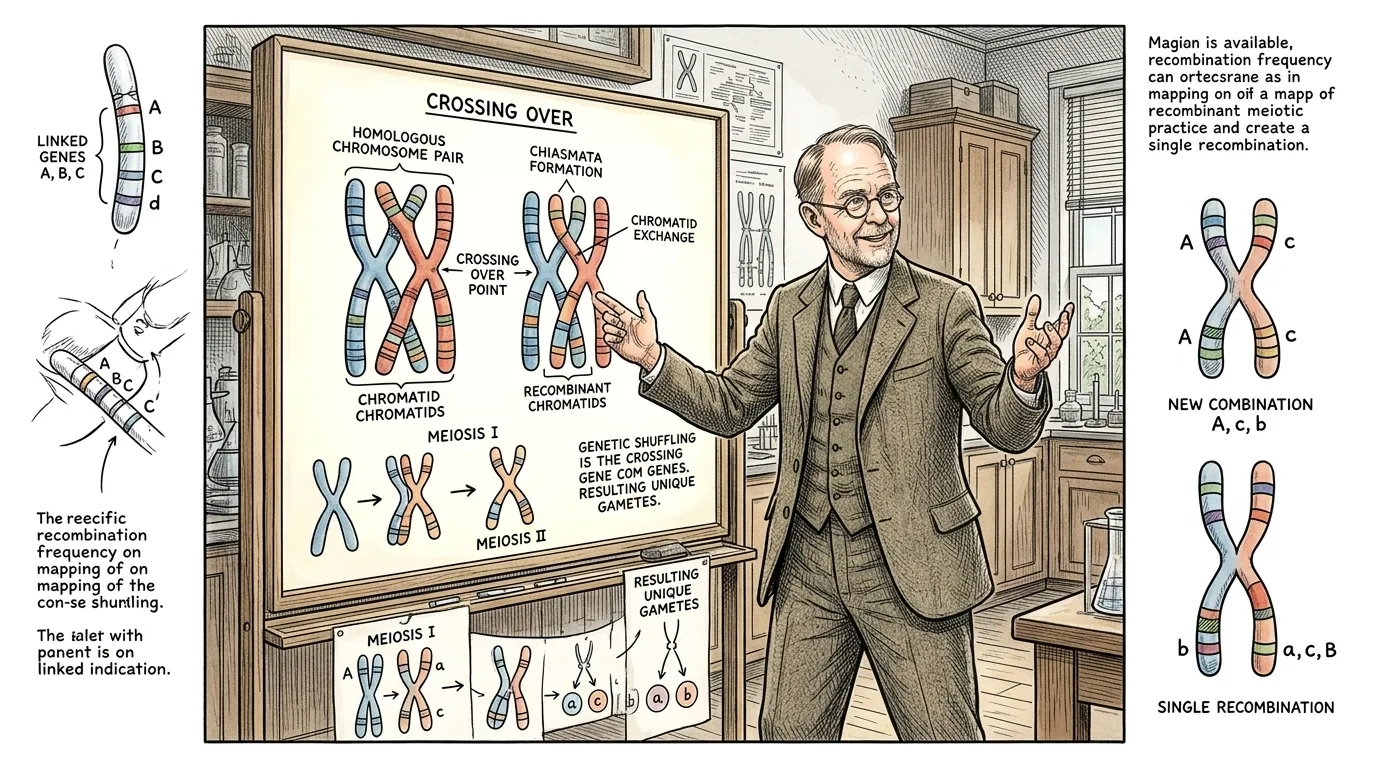
As Morgan and his students examined other linked traits, they observed that genes on the same chromosome were not always inherited together in perfect…
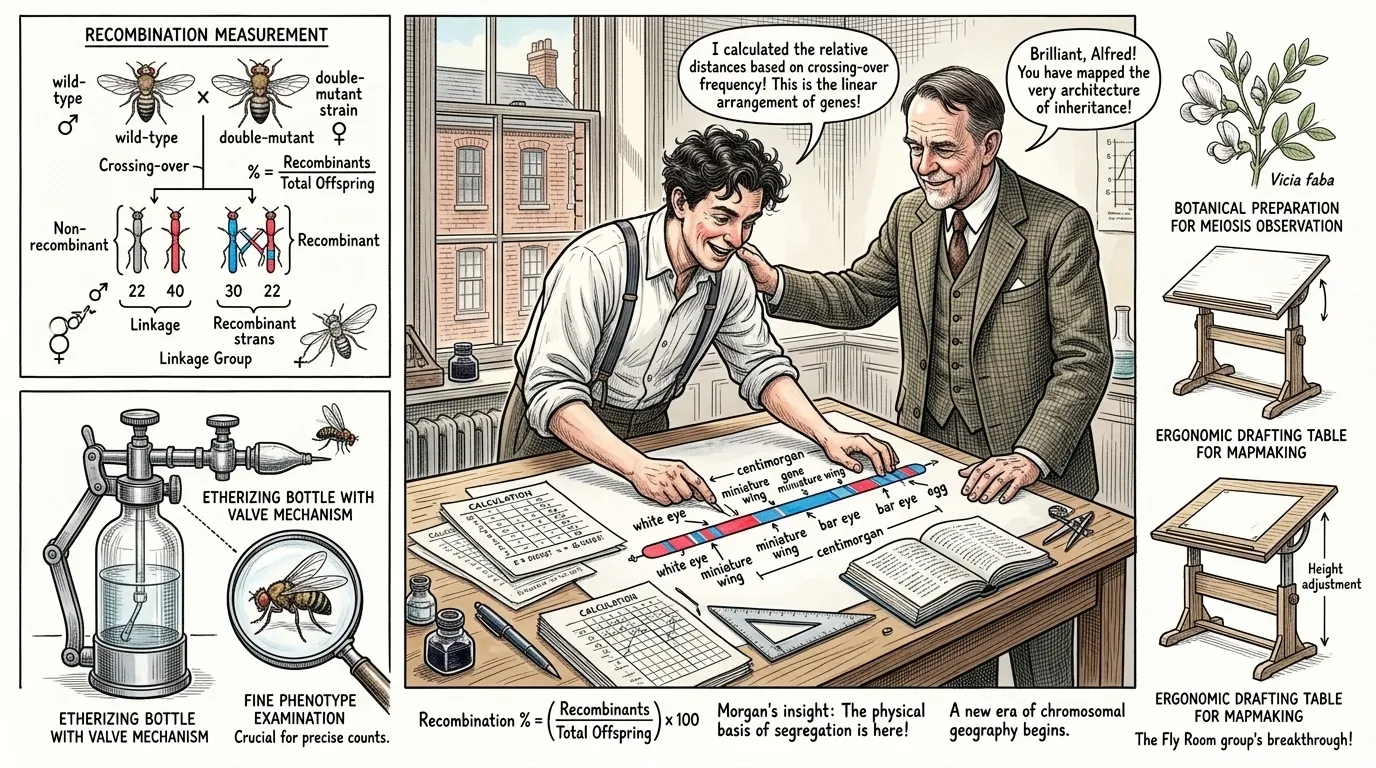
As Morgan and his students examined other linked traits, they observed that genes on the same chromosome were not always inherited together in perfect synchrony. Sometimes, segments of homologous chromosomes would swap during meiosis, a process called crossing over or recombination. This 'shuffling' of genetic material meant that while linked genes tended to stay together, the frequency with which they separated could be measured, providing a groundbreaking insight into the…

As Morgan and his students examined other linked traits, they observed that genes on the same chromosome were not always inherited together in perfect synchrony. Sometimes, segments of homologous chromosomes would swap during meiosis, a process called crossing over or recombination. This 'shuffling' of genetic material meant that while linked genes tended to stay together, the frequency with which they separated could be measured, providing a groundbreaking insight into the physical arrangement of genes.

Page 7

Crucially, Morgan's student Alfred Sturtevant realized that the frequency of recombination between two genes was directly proportional to their distance apart…
Crucially, Morgan's student Alfred Sturtevant realized that the frequency of recombination between two genes was directly proportional to their distance apart on the chromosome. Genes far apart would recombine more often than genes close together. This brilliant insight allowed them to construct the first genetic maps, precisely locating genes along the chromosomes of Drosophila.

Crucially, Morgan's student Alfred Sturtevant realized that the frequency of recombination between two genes was directly proportional to their distance apart on the chromosome. Genes far apart would recombine more often than genes close together. This brilliant insight allowed them to construct the first genetic maps, precisely locating genes along the chromosomes of Drosophila. The unit of genetic distance, later named the centimorgan, became a standard measure, transforming abstract inheritance into a tangible, measurable landscape.

Page 8
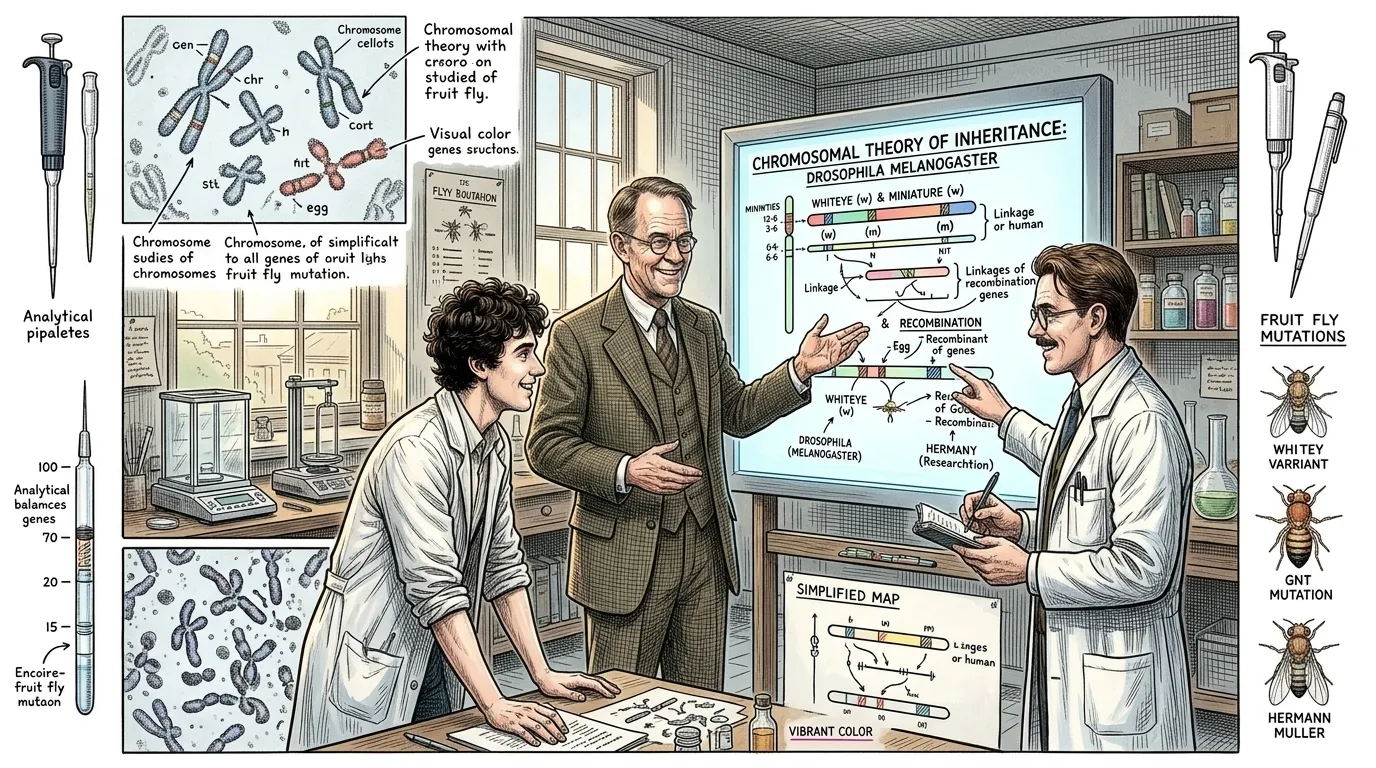
The work of Thomas Hunt Morgan and his 'Fly Room' group — including Alfred Sturtevant, Calvin Bridges, and Hermann Muller — definitively established the…
The work of Thomas Hunt Morgan and his 'Fly Room' group — including Alfred Sturtevant, Calvin Bridges, and Hermann Muller — definitively established the chromosomal theory of inheritance. This validated the century-old idea that discrete units of heredity existed and, more importantly, proved their physical location on chromosomes.

The work of Thomas Hunt Morgan and his 'Fly Room' group — including Alfred Sturtevant, Calvin Bridges, and Hermann Muller — definitively established the chromosomal theory of inheritance. This validated the century-old idea that discrete units of heredity existed and, more importantly, proved their physical location on chromosomes. Their meticulous experimental results, replicable and verifiable, ended decades of debate, providing a robust foundation upon which all subsequent genetic research would be built.

Page 9
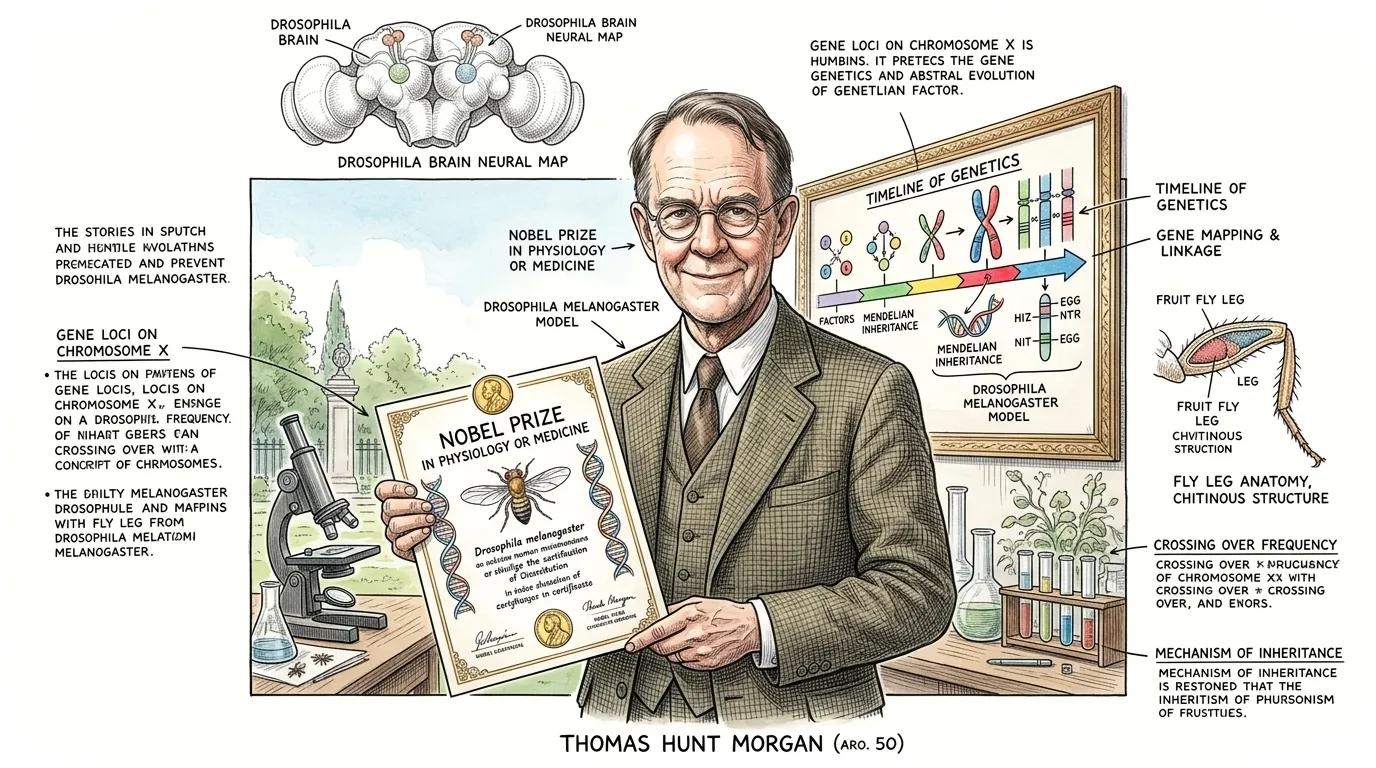
Morgan's profound contributions earned him the Nobel Prize in Physiology or Medicine in 1933, a testament to the immense significance of his discoveries.
Morgan's profound contributions earned him the Nobel Prize in Physiology or Medicine in 1933, a testament to the immense significance of his discoveries. His research provided the empirical bedrock for understanding how genetic information is organized and transmitted across generations.

Morgan's profound contributions earned him the Nobel Prize in Physiology or Medicine in 1933, a testament to the immense significance of his discoveries. His research provided the empirical bedrock for understanding how genetic information is organized and transmitted across generations. The methodologies developed in the Fly Room, from the use of model organisms to quantitative genetic mapping, continue to influence modern biological inquiry, making him a pivotal figure in the transition from classical natural history to experimental biology.

Page 10
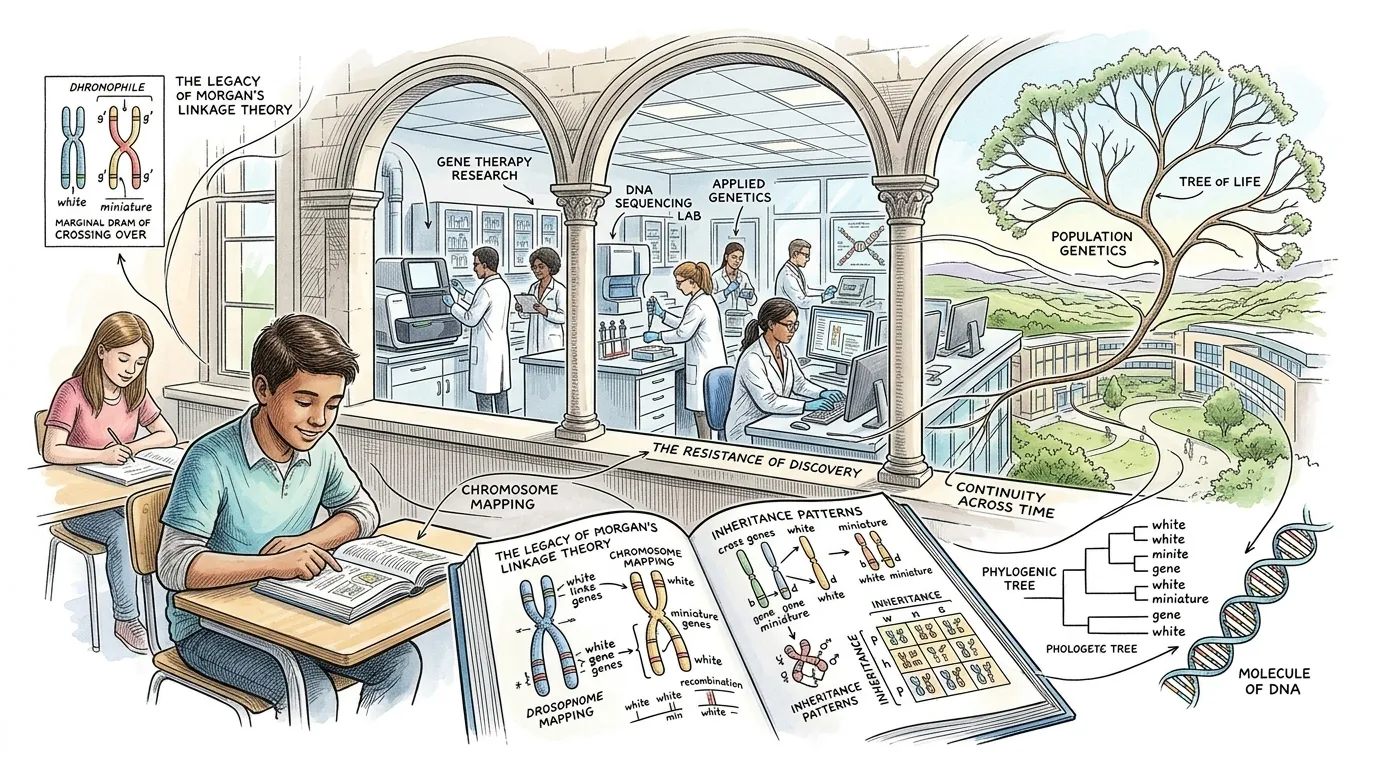
The paradigm shift ushered in by Thomas Hunt Morgan continues to resonate through every facet of contemporary biology and medicine.
The paradigm shift ushered in by Thomas Hunt Morgan continues to resonate through every facet of contemporary biology and medicine. His work on chromosomal inheritance laid the essential groundwork for understanding genetic diseases, population genetics, and evolutionary mechanisms. From the fundamental principles taught in biology classrooms to the cutting-edge techniques used in gene therapy and personalized medicine, the echoes of the 'Fly Room' are ubiquitous, a timeless…

The paradigm shift ushered in by Thomas Hunt Morgan continues to resonate through every facet of contemporary biology and medicine. His work on chromosomal inheritance laid the essential groundwork for understanding genetic diseases, population genetics, and evolutionary mechanisms. From the fundamental principles taught in biology classrooms to the cutting-edge techniques used in gene therapy and personalized medicine, the echoes of the 'Fly Room' are ubiquitous, a timeless testament to the power of meticulous observation and experimental rigor in unraveling life's deepest secrets.

About this story

  • Location: Global
  • Audience: general readers

Questions and answers

Questions and answers about Thomas Hunt Morgan

Read Wonder Science on your phone

Wonder Science is available on Android. Get Wonder Science on Google Play.

More Wonder Science stories

All Wonder Science stories · Open the library