Tu Youyou
Tu Youyou — an illustrated science story, set in Global. 10 illustrated pages, free to read on Wonder Science.
Page 1
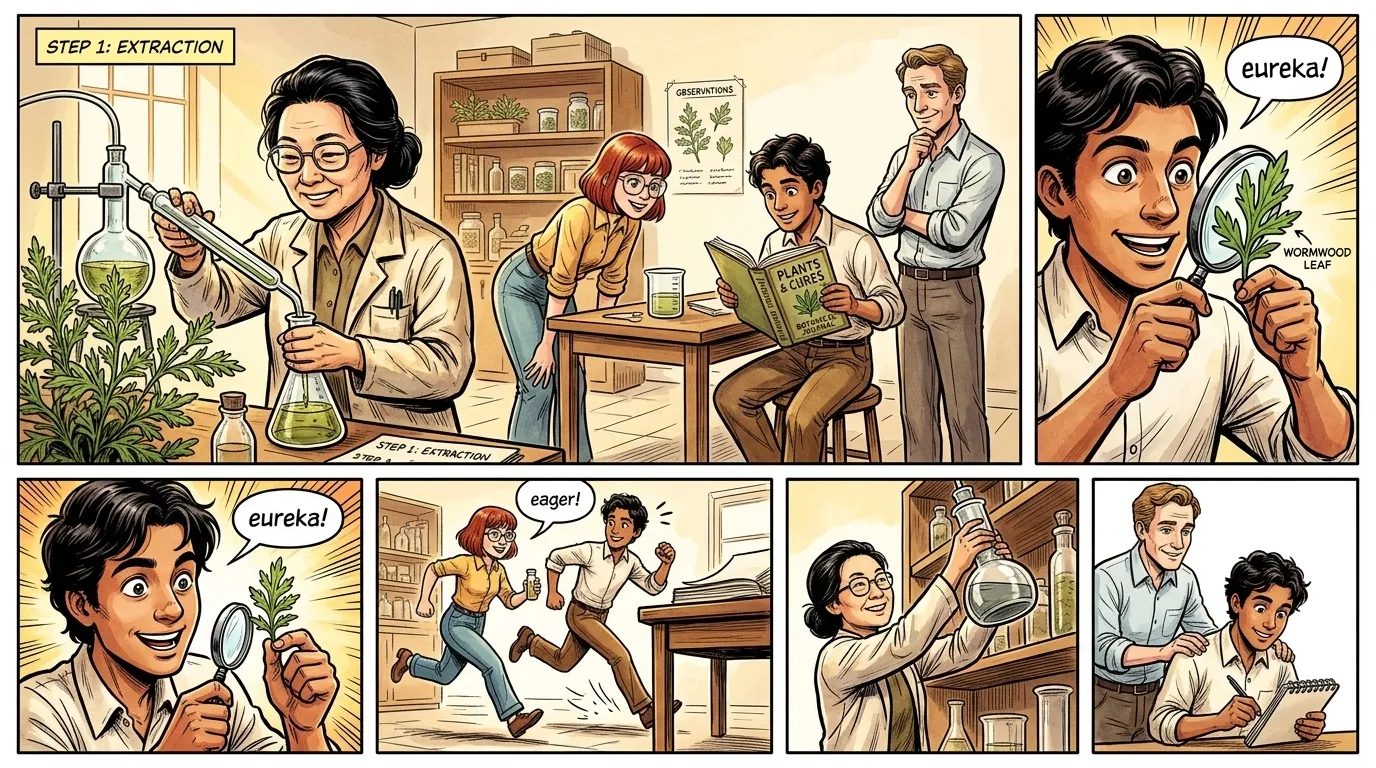
In the hushed intensity of a secluded laboratory, amidst the chaos of 1970s China, a lone scientist, Tu Youyou, meticulously extracts compounds from the unassuming sweet wormwood plant. Malaria, a scourge that had defied eradication for centuries, was claiming millions, and conventional treatments were failing. Her work, Project 523, was a desperate, clandestine mission, driven by an urgent mandate to find a new cure.
Page 2
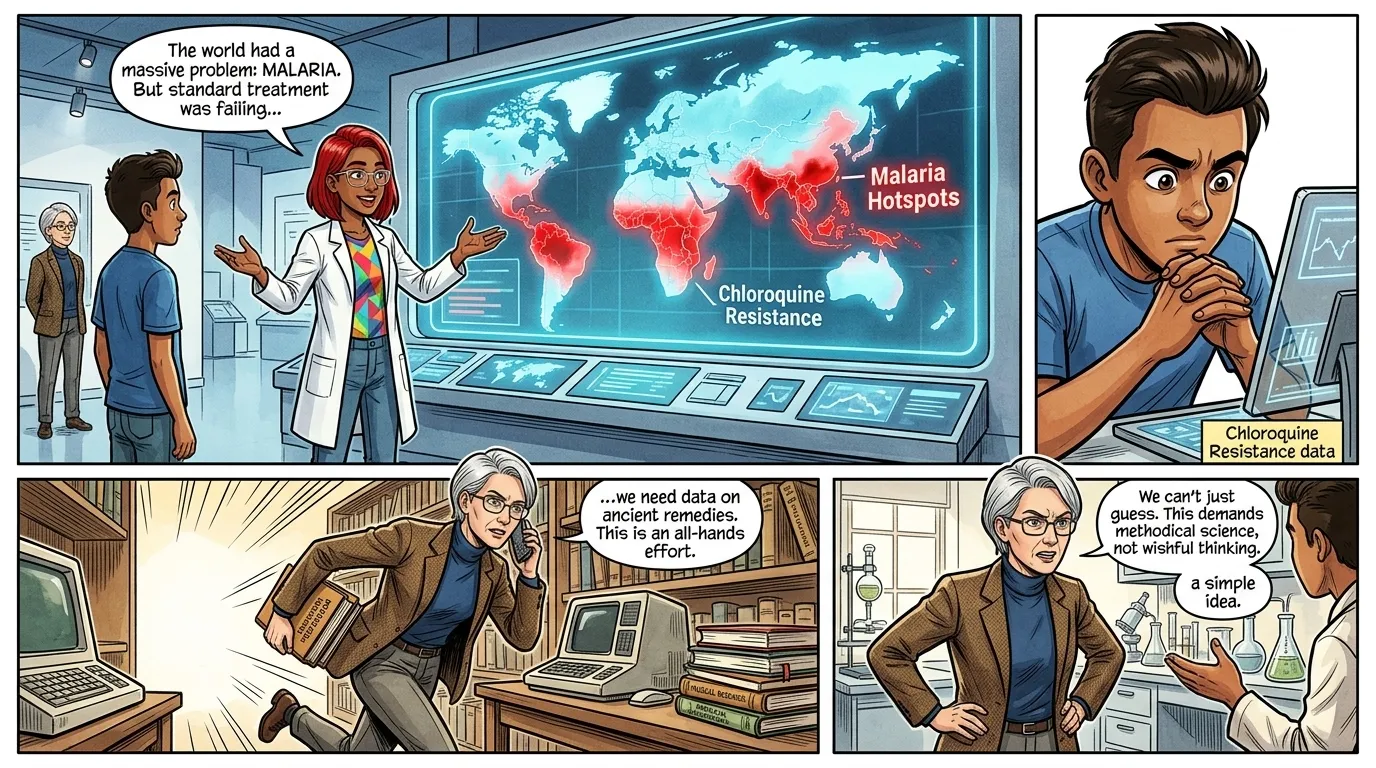
Across continents, malaria ravaged communities, particularly in tropical and subtropical regions. By the mid-20th century, the parasite developed alarming resistance to chloroquine, the once-miraculous antimalarial drug. This escalating crisis prompted a global call for urgent scientific intervention, yet effective solutions remained elusive, leaving millions vulnerable to a debilitating, often fatal, disease.
"'The sheer scale of the malaria problem was staggering,' Ravi explains, gesturing towards a holographic projection. 'Chloroquine, our frontline defense, was collapsing, leaving doctors with dwindling options.' Nikolai nods solemnly. 'Indeed. The world desperately needed a new weapon, but the path forward was far from clear, demanding an unconventional approach to a conventional enemy.'"
Page 3
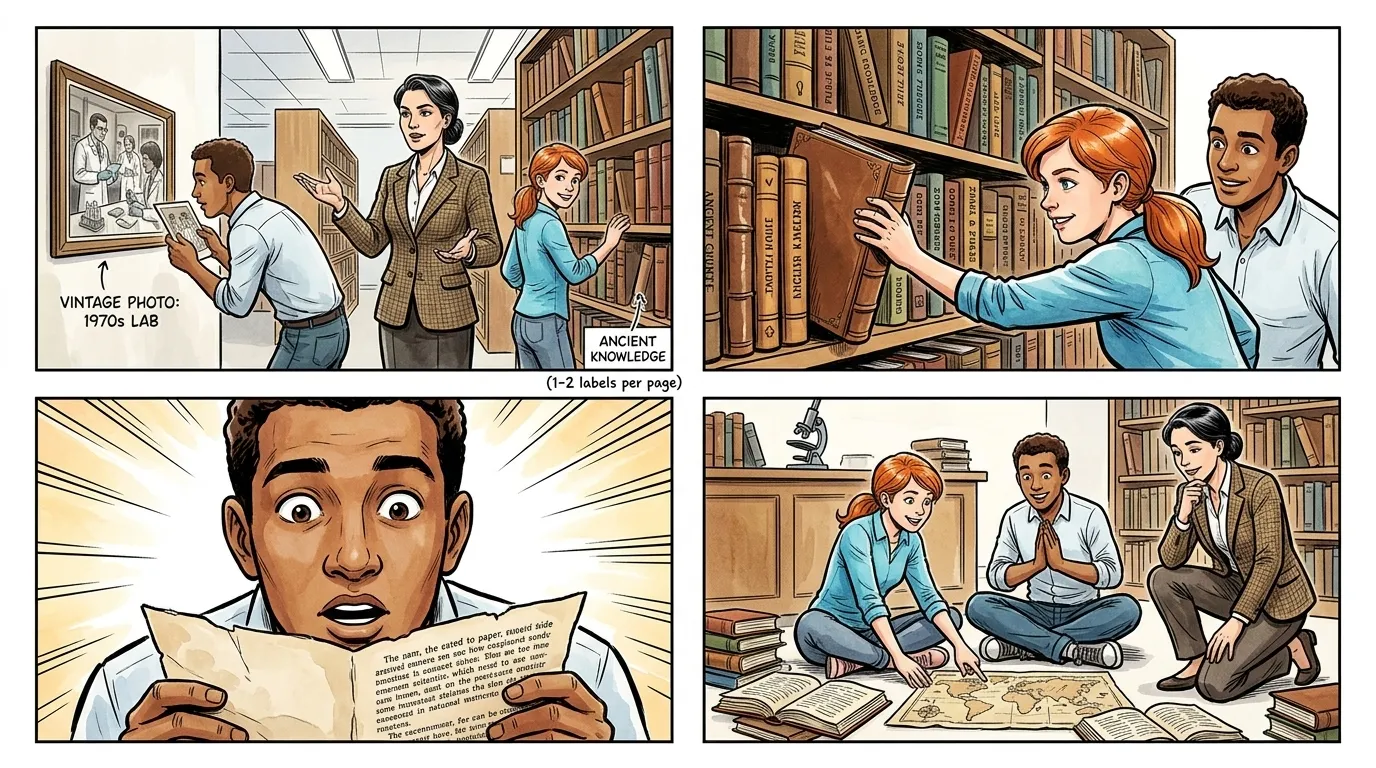
Amidst the turmoil of China's Cultural Revolution, 'Project 523' was a top-secret military initiative, tasked with finding a cure for drug-resistant malaria, especially impacting troops in Vietnam. Conventional scientific collaboration was impossible, isolating researchers in decentralized, hidden labs. Tu Youyou, a pharmaceutical chemist, was thrust into leading a research group, tasked with screening traditional Chinese medicine (TCM) for potential antimalarial compounds.
"'Project 523 was a scientific endeavor born of geopolitical necessity,' Nikolai elaborates, her voice resonating with historical weight. 'It was an extraordinary situation, compelling scientists to work in isolation, yet with a shared, monumental goal.' Santiago, looking at a framed photo of a historical lab, asks, 'So, they had to start almost from scratch, looking at old books?' Ravi replies, 'Precisely. Ancient knowledge became their guiding light, a vast, untapped library of potential cures waiting to be rediscovered.'"
Page 4
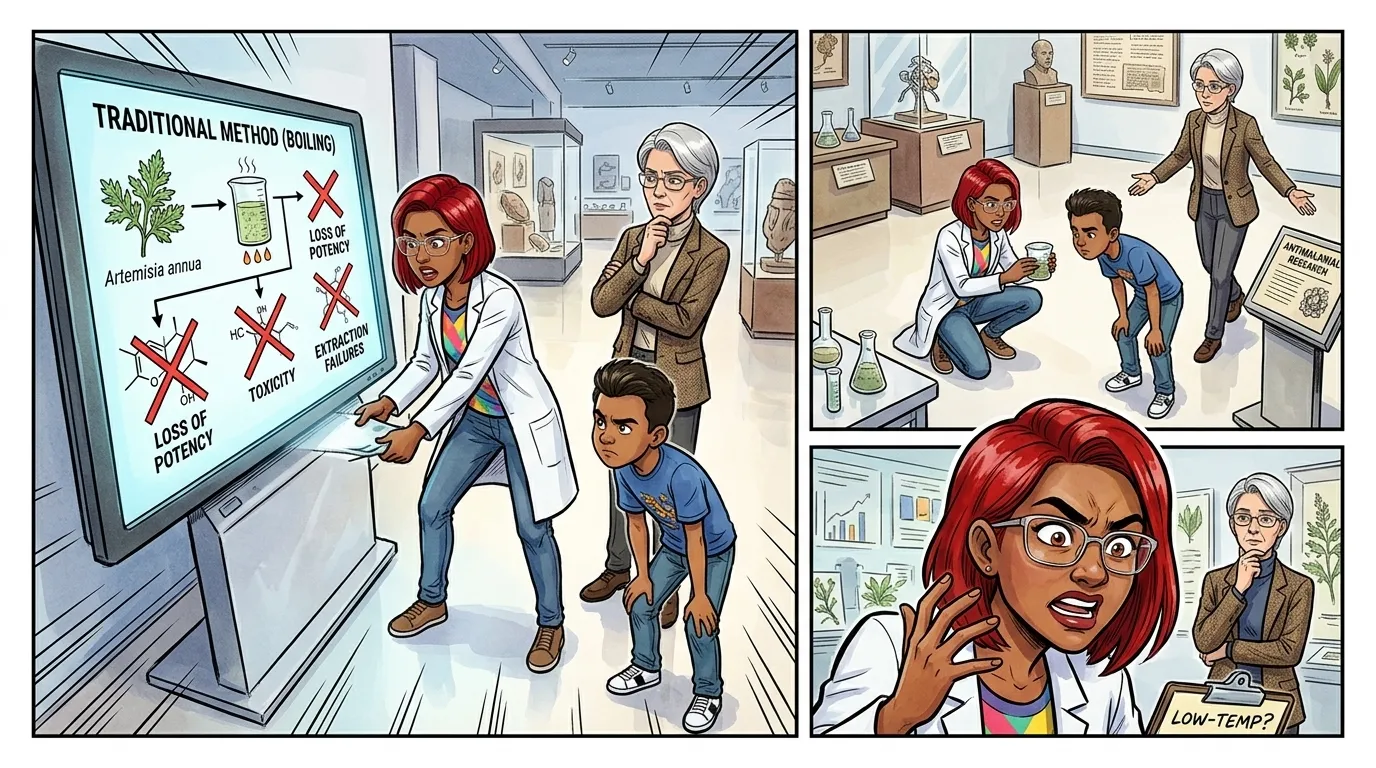
Tu Youyou's team meticulously screened over 2,000 traditional Chinese herbal remedies. While some showed promise, initial efforts to isolate effective compounds from Artemisia annua (sweet wormwood) were frustratingly unsuccessful. Extracts prepared through traditional boiling methods either lost their potency or proved too toxic for safe use, leading to repeated failures and mounting scientific skepticism within the project.
"'The challenge was immense,' Ravi explains, her gaze fixed on a diagram illustrating various extraction failures. 'Boiling, a common method, actually destroyed the active ingredient. It was like trying to catch smoke with a net.' Nikolai adds, 'They faced countless dead ends, each experiment a testament to the compound's elusive nature and the limitations of then-current understanding.' Santiago watches intently, a slight frown of concentration on his face."
Page 5
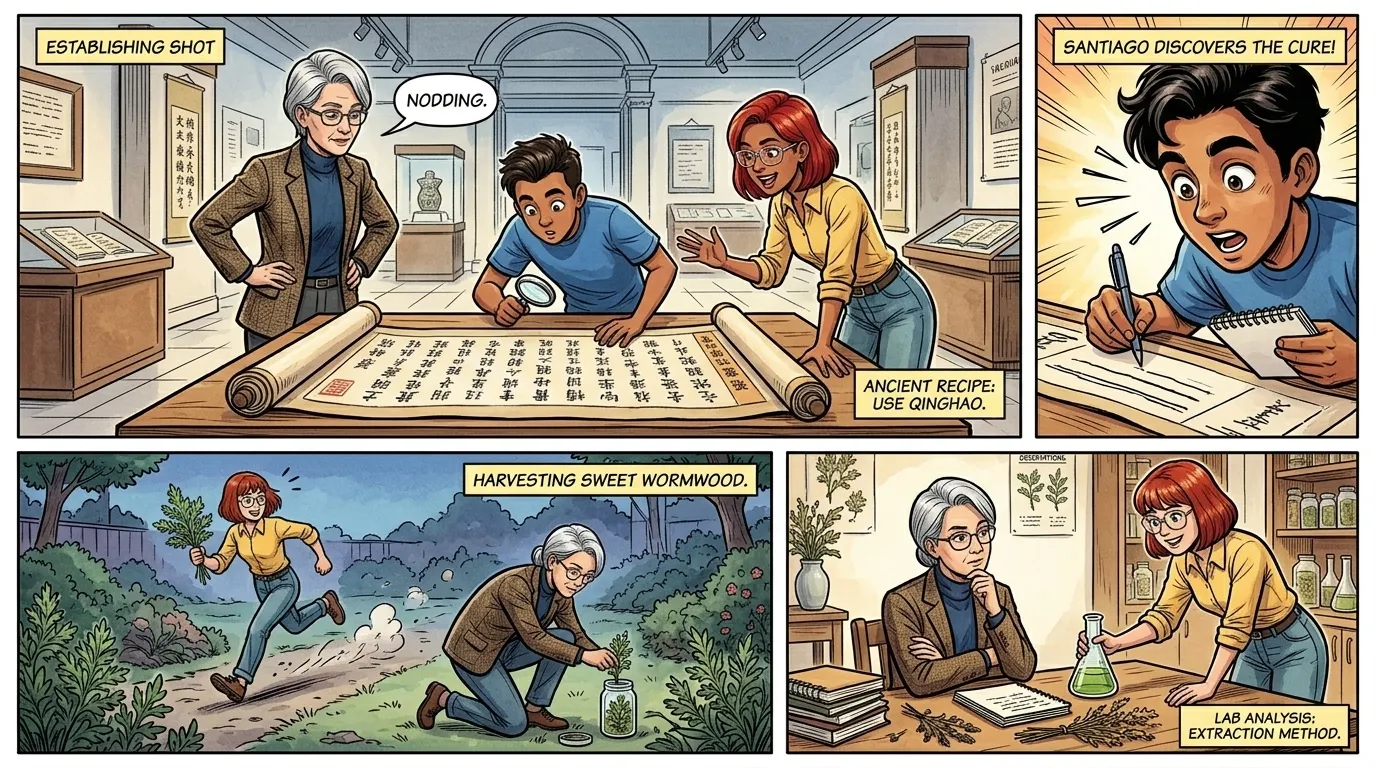
A pivotal moment arrived when Tu Youyou revisited Ge Hong's 4th-century text, A Handbook of Prescriptions for Emergencies. She found a crucial line: 'A handful of qinghao [sweet wormwood], soak in two litres of water, wring out the juice and drink it all.' This ancient advice, emphasizing cold extraction rather than boiling, was the critical clue. It suggested that heat destroyed the active antimalarial component, pointing towards a new methodological path.
"'It was a flash of genius, or rather, a flash of ancient insight,' Nikolai states, motioning towards a recreated historical scroll. 'That single line from Ge Hong's text was the Rosetta Stone they needed.' Ravi adds, 'Sometimes the most profound scientific breakthroughs are hidden in plain sight, requiring not just observation, but a deep, unconventional re-examination of forgotten wisdom.' Santiago looks at the scroll, tracing the characters with his finger, an inquisitive expression on his face."
Page 6
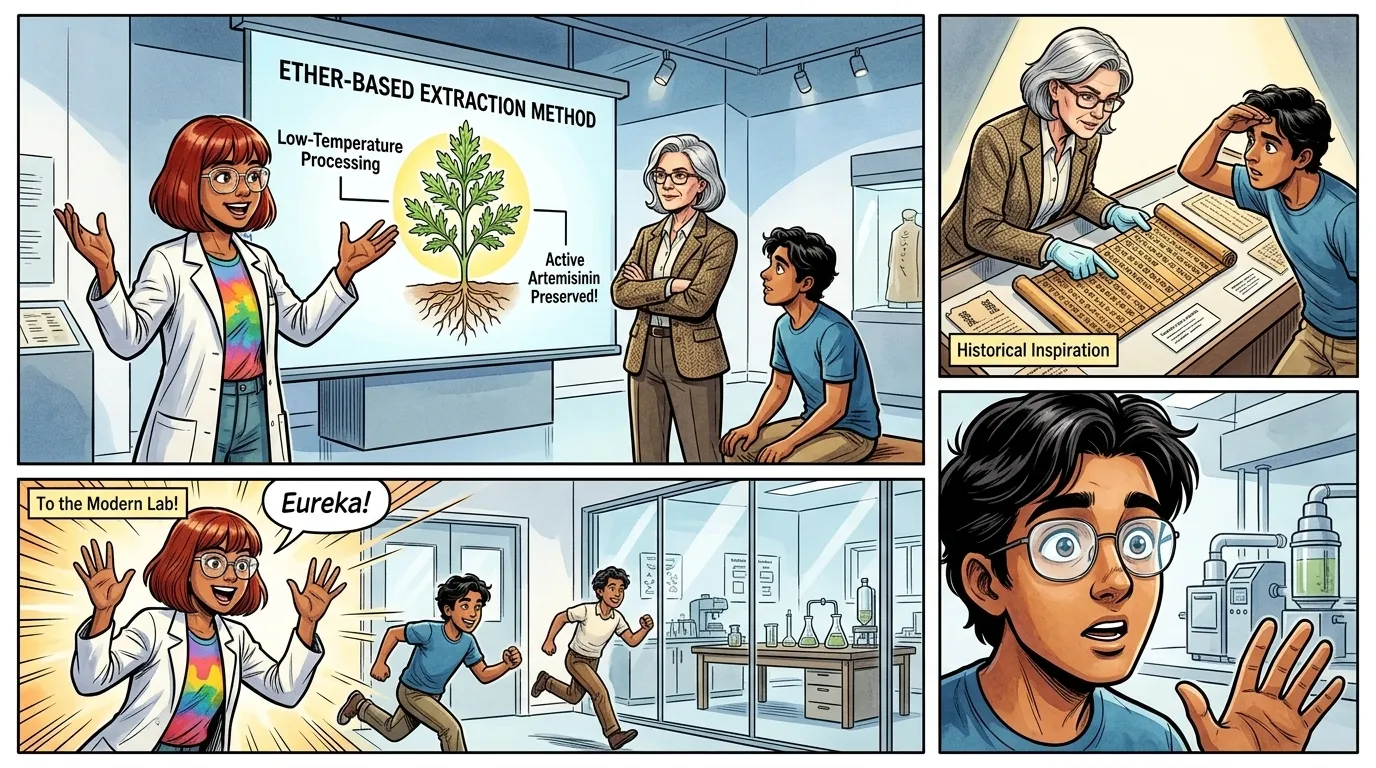
Armed with this ancient knowledge, Tu Youyou's team switched to a low-temperature, ether-based extraction method. This careful process successfully isolated the active compound, later named artemisinin, from the Artemisia annua plant. Early tests revealed its potent efficacy against malaria parasites in infected mice and monkeys, marking a critical turning point in the project.
"'The switch to cold ether extraction was the precise chemical intervention needed,' Ravi explains, gesturing at a diagram of the process. 'It preserved the fragile active molecule that heat would destroy.' Nikolai adds, 'This demonstrated the power of combining historical insight with rigorous modern chemical techniques, yielding a substance of unprecedented therapeutic potential.' Santiago gazes at the diagram, a look of fascination on his face."
Page 7
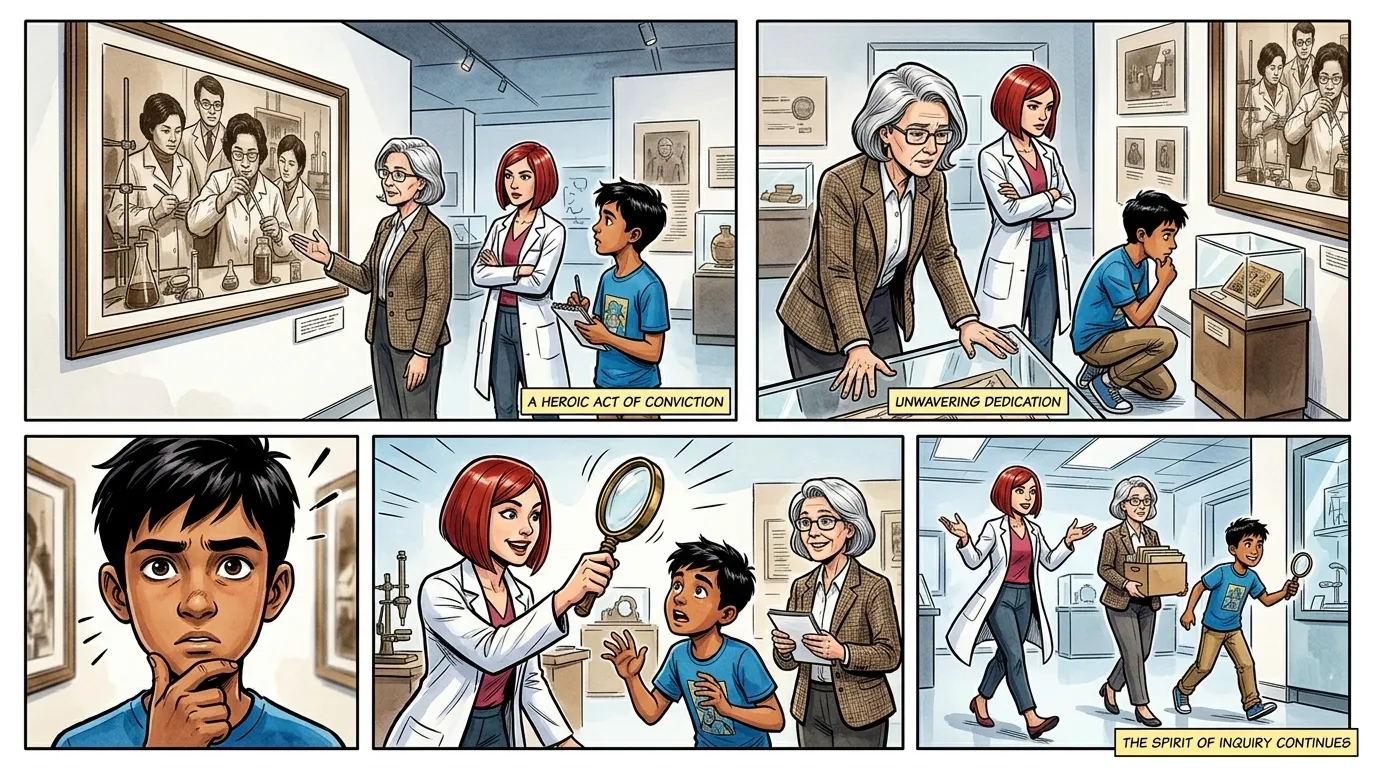
Before proceeding to human trials, Tu Youyou and her colleagues took the extraordinary, ethically daring step of self-administering the purified artemisinin extract. In an era when formal ethical review was scarce, this act demonstrated profound personal conviction and a rigorous commitment to ensuring the compound's safety. Their self-testing paved the way for the critical next phase: clinical trials on malaria patients.
"'Their willingness to self-experiment speaks volumes about their dedication,' Nikolai says, a note of reverence in her voice. 'It was a testament to their belief in the potential of their discovery, even in the face of uncertainty.' Ravi adds, 'In science, there's a fine line between caution and courage. They walked that line for humanity.' Santiago looks on, a serious expression on his young face, understanding the gravity of the decision."
Page 8
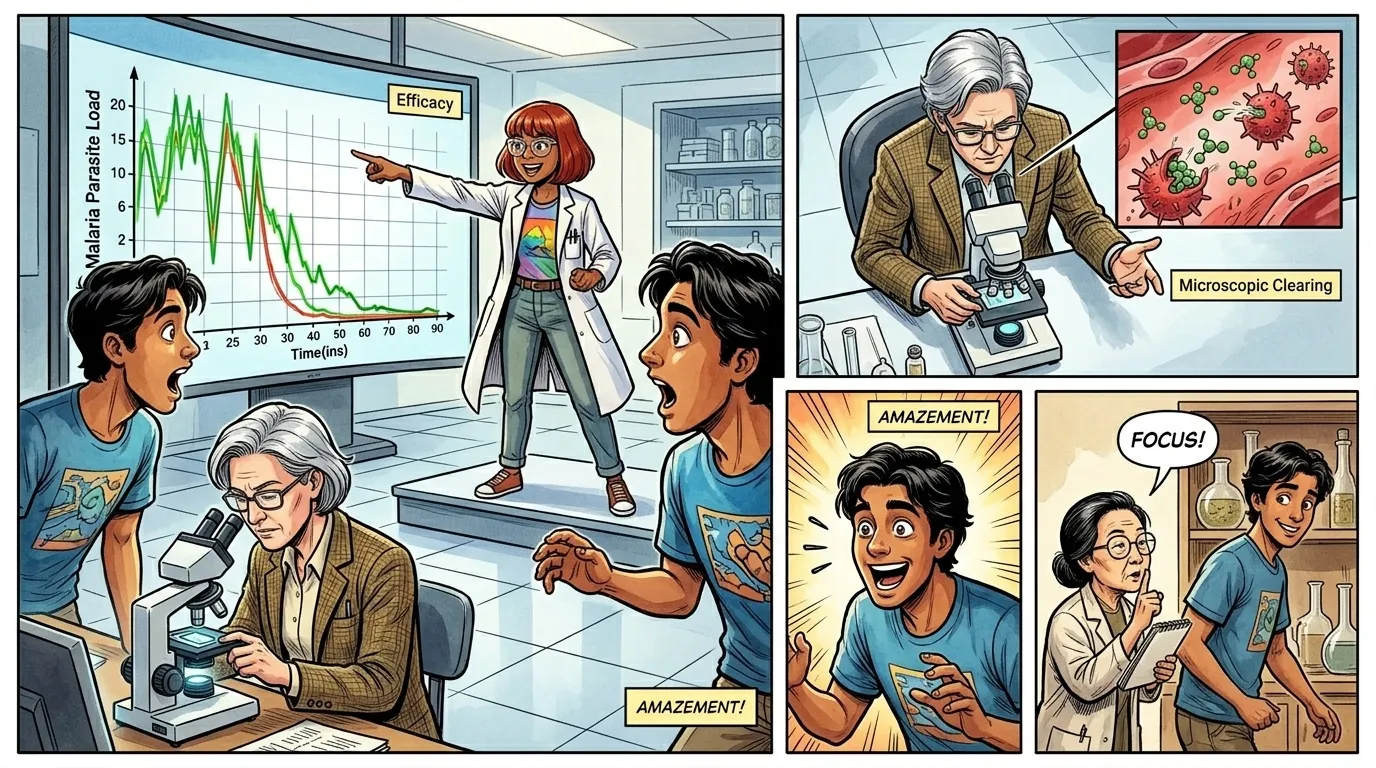
The human clinical trials of artemisinin were overwhelmingly successful. Patients suffering from chloroquine-resistant malaria showed dramatic improvements, often within days. Artemisinin demonstrated a rapid and potent ability to clear the malaria parasite from the bloodstream. This breakthrough provided a desperately needed new class of antimalarial drugs, offering hope where little existed.
"'The clinical results were nothing short of revolutionary,' Ravi asserts, pointing to a graph showing the rapid decline of parasite load. 'Artemisinin attacked the parasite in a fundamentally new way, offering efficacy against resistant strains.' Nikolai explains, 'It was like flipping a switch. The parasite, accustomed to evading other drugs, simply couldn't withstand artemisinin's unique assault.' Santiago's eyes widen as he absorbs the impact of the data."
Page 9
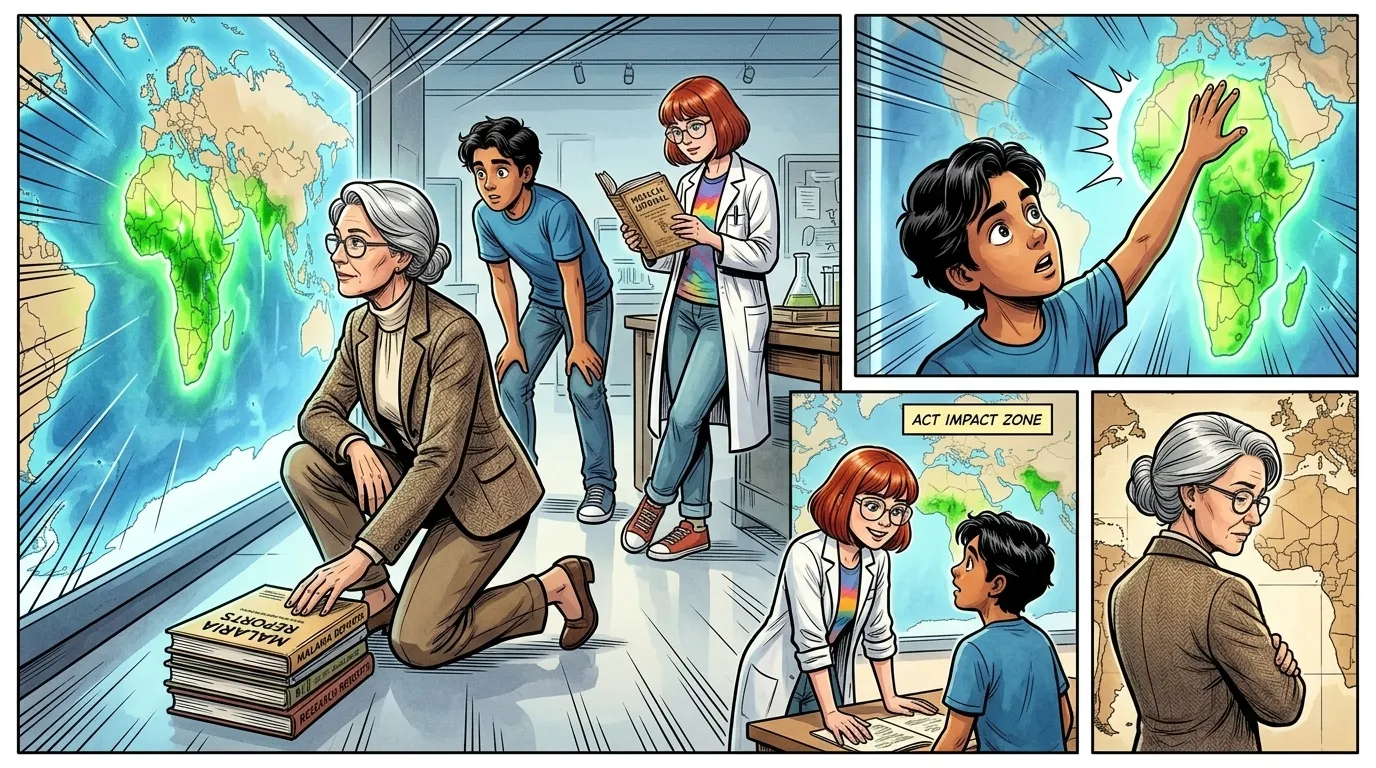
Artemisinin, often used in Artemisinin-based Combination Therapies (ACTs), transformed the global fight against malaria. Its introduction significantly reduced malaria morbidity and mortality worldwide, particularly saving millions of lives in sub-Saharan Africa. The discovery cemented its place as one of the most important medical advancements of the 20th century, a testament to the power of scientific perseverance.
"'Artemisinin-based therapies have averted untold suffering,' Nikolai reflects, her voice imbued with a sense of the drug's profound significance. 'It's a stark reminder that even during periods of isolation, scientific ingenuity can reach across borders and save lives globally.' Santiago, looking at a map highlighting the reduced malaria rates, comments, 'So many people got better because of one plant?' Ravi replies, 'Yes, Santiago. And because of one scientist's unwavering dedication to unlock its secret.'"
Page 10
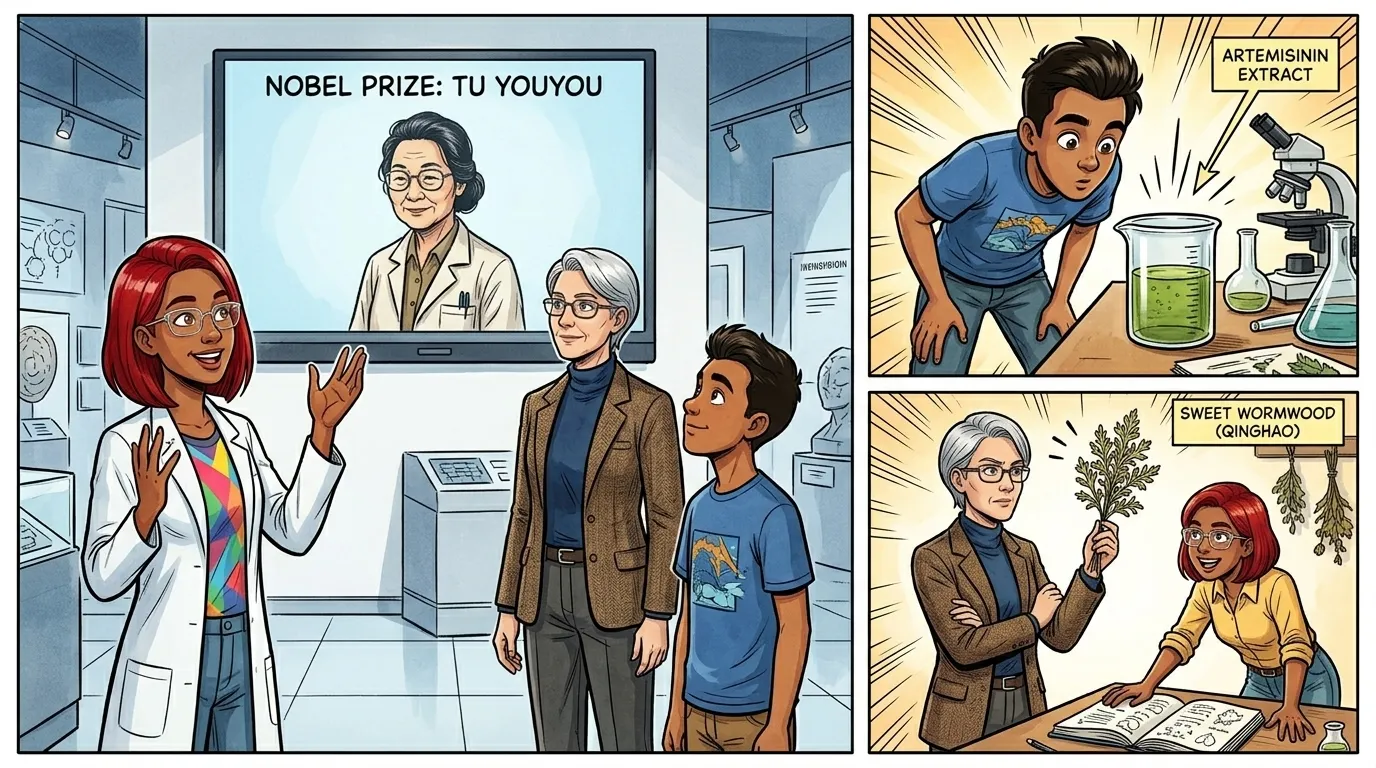
In 2015, Tu Youyou was awarded the Nobel Prize in Physiology or Medicine, becoming the first Chinese woman to receive a Nobel in science. Her discovery, rooted in ancient traditional medicine yet validated by rigorous modern science, stands as a beacon. It underscores the potential in unconventional research paths and the profound impact a single, dedicated mind can have on global health, continuing to inspire the ongoing fight against diseases like malaria.
"'Tu Youyou's story embodies the spirit of scientific inquiry,' Ravi summarizes, looking at a stylized image of Tu Youyou receiving the Nobel Prize. 'Her work transcended political barriers and scientific dogma, proving that truth can be found in the most unexpected places.' Nikolai adds, 'As the French chemist Louis Pasteur once said, 'Chance favors the prepared mind.' Tu Youyou's mind was exceptionally prepared, drawing from a rich tapestry of history and science.' Santiago gazes at the image, a look of profound inspiration on his face."
About this story
- Location: Global
- Audience: kids (ages 6–12)
Questions and answers
Read Wonder Science on your phone
Wonder Science is available on Android. Get Wonder Science on Google Play.