Werner Heisenberg
Werner Heisenberg — an illustrated science story, set in Global. 10 illustrated pages, free to read on Wonder Science.
Page 1
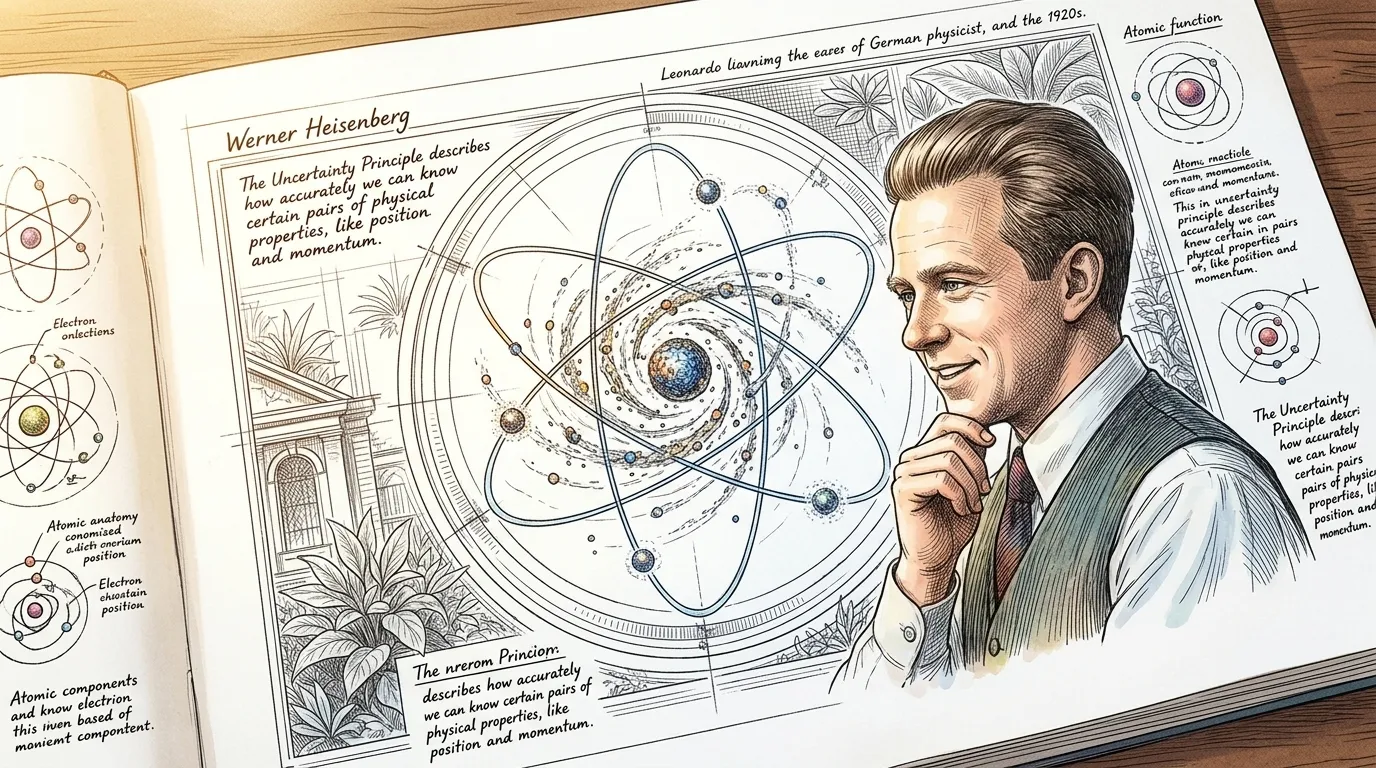
The year is 1927. A storm of particles rages inside an atom. Where is an electron? What is its momentum? Werner Heisenberg, a young German physicist, declared that we cannot know both at the same time with perfect accuracy. This revolutionary idea, the Uncertainty Principle, shook the foundations of classical physics and paved the way for quantum mechanics.
Fact: The Uncertainty Principle describes how accurately we can know certain pairs of physical properties, like position and momentum.
Page 2

Astrid, sitting at her kitchen table, furrows her brow as she reads about Heisenberg. "Dad, this is so confusing! How can we not know where something is and how fast it's moving? It feels like...cheating!" Her father smiles, stirring his coffee. "Well, Astrid, at the quantum level, things aren't so straightforward."
""The more precisely you measure the position, the less precisely you can know the momentum, and vice versa. It's a fundamental property of the universe.""
Fact: Classical physics, which describes the world we see, fails at the atomic scale.
Page 3

Astrid's father gestures to a baseball sitting on the counter. "Think of it this way: we can easily see where that baseball is and how fast it's moving. That's classical physics. But electrons are much, much smaller and behave differently."
""As Niels Bohr, another great physicist, said, 'Every sentence I utter must be understood not as an assertion, but as a question.' We need to question our assumptions about how the universe works at this scale.""
Fact: The act of observing an electron changes its properties.
Page 4

Her mother enters, setting down a plate of cookies. "It's like trying to find something in a dark room," she says. "The moment you turn on the light, you change what you're looking for!" Heisenberg realized that the very act of observing an electron alters its state.
Fact: Photons, used to observe electrons, impart energy and change their momentum.
Page 5
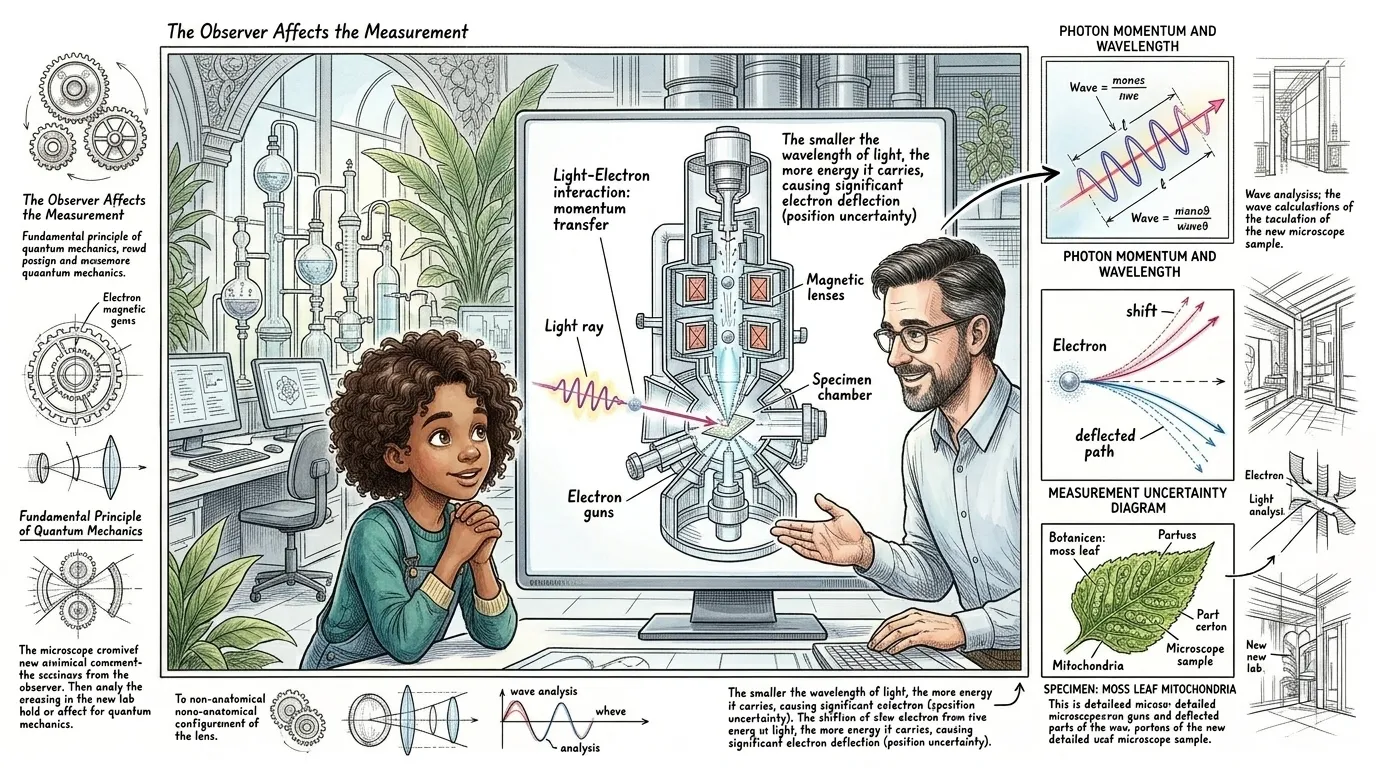
Imagine you want to measure an electron's position with a powerful microscope. To 'see' the electron, you need to bounce light off it. But the light, even a single photon, has energy. When it hits the electron, it changes the electron's momentum, making it impossible to know its original speed and direction.
Fact: The smaller the wavelength of light, the more energy it carries.
Page 6
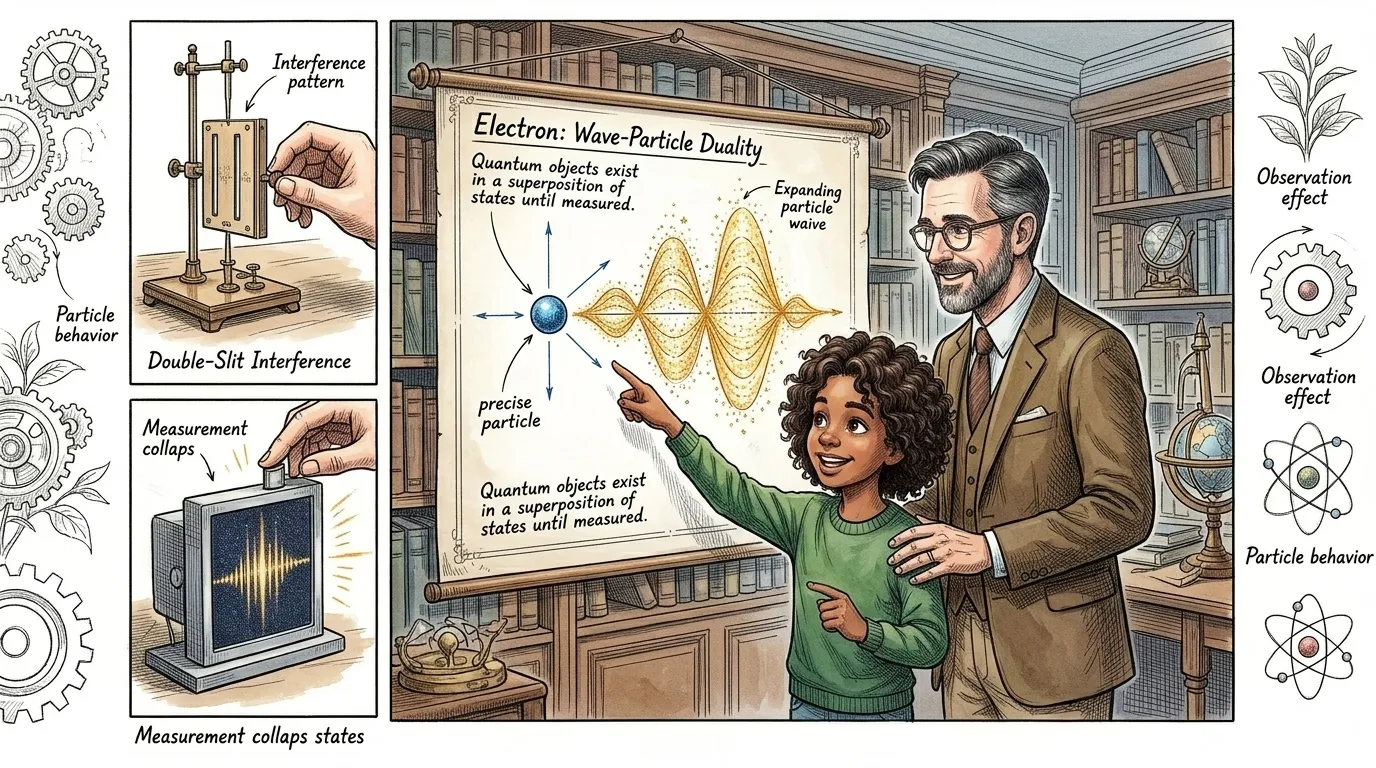
Electrons, like all quantum objects, behave as both particles and waves. This wave-particle duality is at the heart of the Uncertainty Principle. The more you try to pin down the electron's position as a particle, the less defined its wave properties become, and vice versa.
Fact: Quantum objects exist in a superposition of states until measured.
Page 7
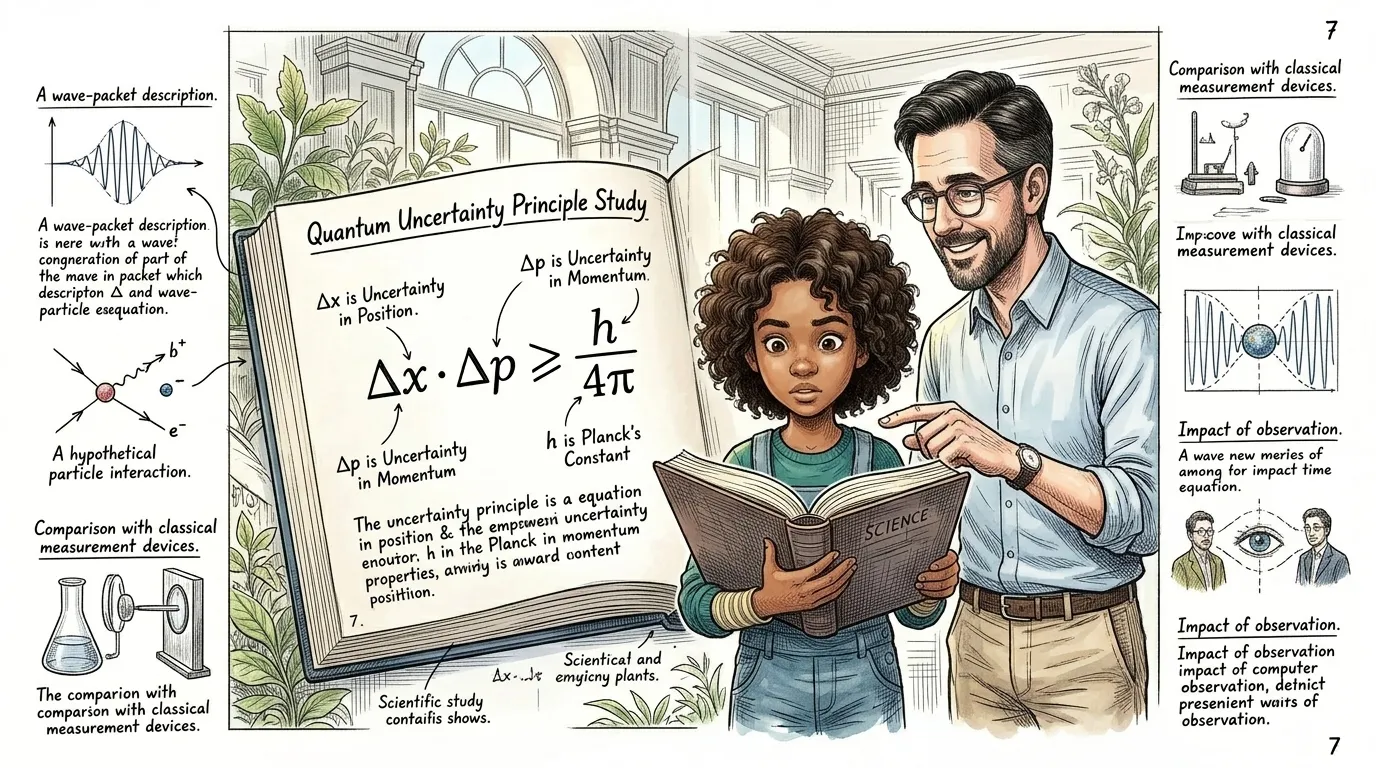
Heisenberg formulated the Uncertainty Principle mathematically, defining the limits of what we can know about the quantum world. The principle states that the product of the uncertainty in position and the uncertainty in momentum must be greater than or equal to a constant value (Planck's constant divided by 4π).
Fact: Planck's constant is a fundamental constant in quantum mechanics.
Page 8
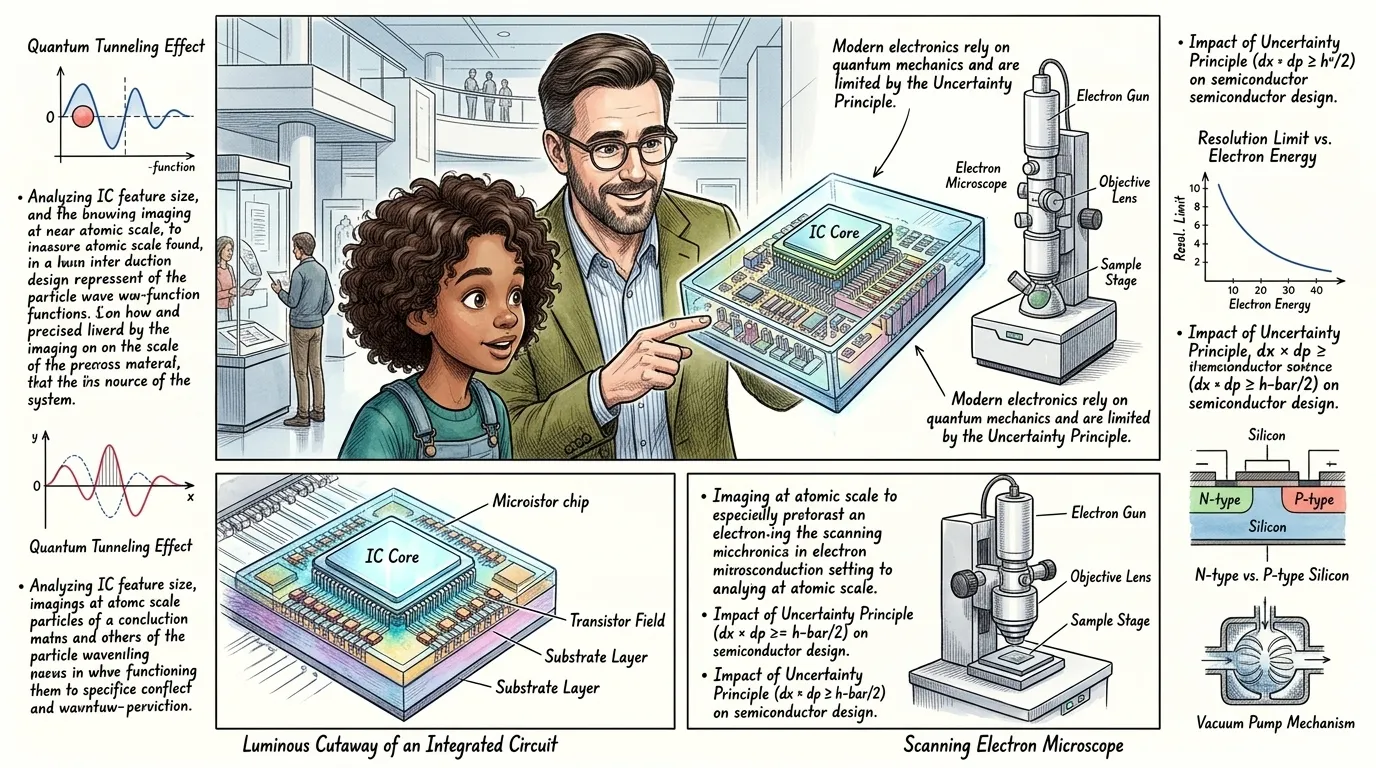
The Uncertainty Principle isn't just a theoretical concept; it has real-world implications. It affects the design and limitations of technologies like electron microscopes and semiconductors. For example, it sets a limit on how small we can make transistors in computer chips.
Fact: Modern electronics rely on quantum mechanics and are limited by the Uncertainty Principle.
Page 9
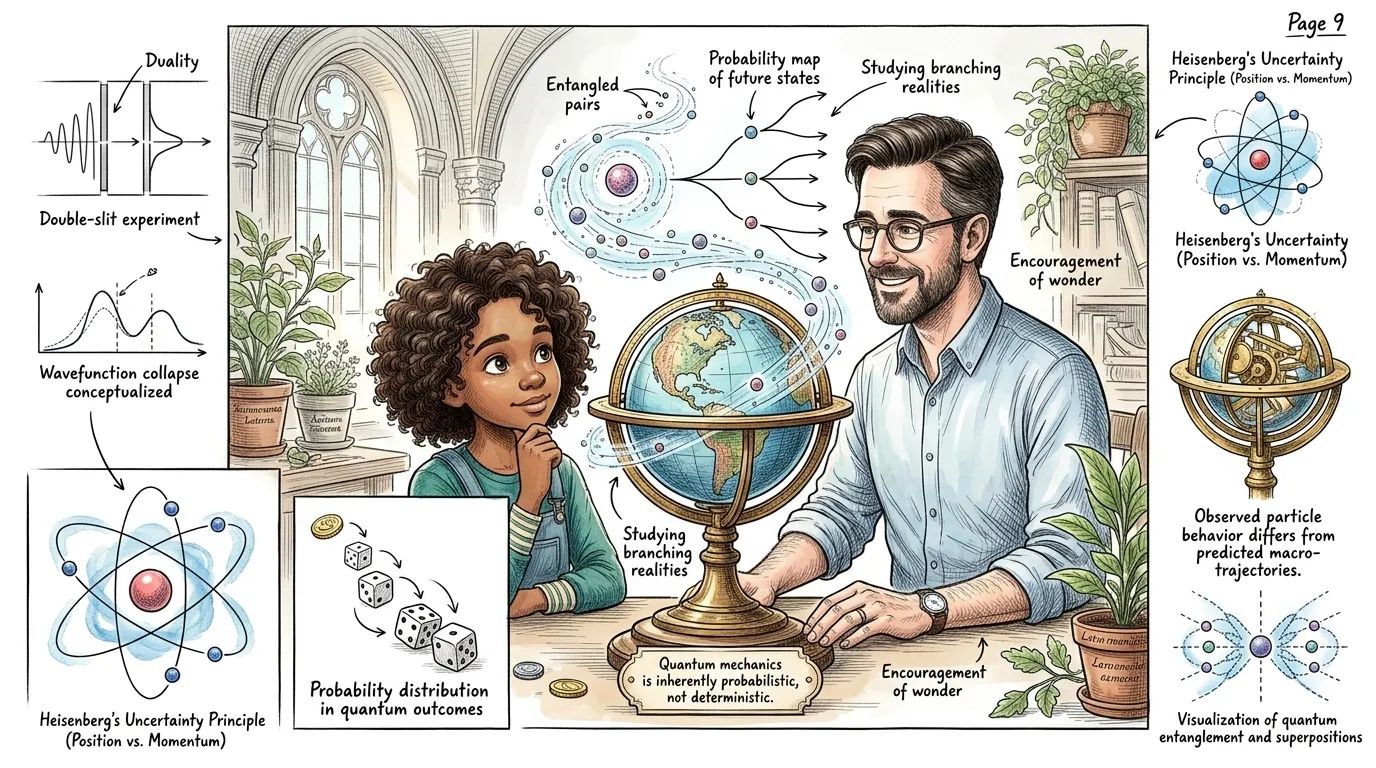
While the Uncertainty Principle might seem like a limitation, it's also a key to understanding the probabilistic nature of the quantum world. It tells us that the universe is not deterministic at its most fundamental level; there's always an element of chance.
Fact: Quantum mechanics is inherently probabilistic, not deterministic.
Page 10

Werner Heisenberg's Uncertainty Principle remains one of the most important and influential ideas in physics. It changed our understanding of the universe and continues to inspire new research and technologies.
Fact: Heisenberg's work paved the way for quantum technologies.
About this story
- Location: Global
- Audience: kids (ages 6–12)
Questions and answers
Read Wonder Science on your phone
Wonder Science is available on Android. Get Wonder Science on Google Play.