What Is Gravity Anyway?
What Is Gravity Anyway? — an illustrated science story. 10 illustrated pages, free to read on Wonder Science.
Page 1
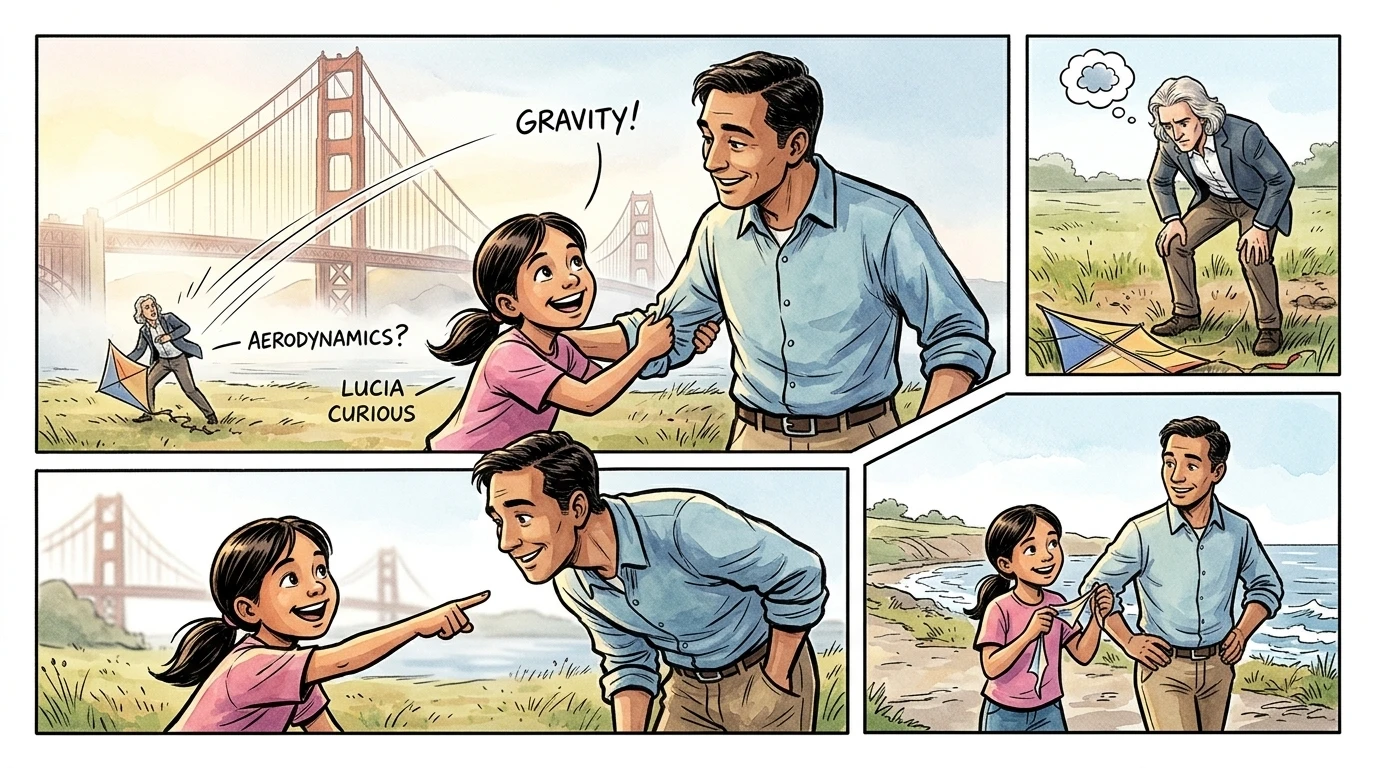
Lucia and her father stood on the breezy expanse of Crissy Field, the Golden Gate Bridge looming through the fog. A man nearby struggled with a large kite, which suddenly lost the wind and plunged straight toward the grass. "Dad, why do things always fall down?" Lucia asked, tugging on his sleeve. "Why not sideways, or even up?"
Page 2
"That invisible pull is called gravity," her father explained, smiling as he picked up a small pebble. "But here's a wild fact: astronauts on the International Space Station still feel about ninety percent of Earth's gravity. They only float because they're also moving sideways so incredibly fast that they constantly 'miss' the ground as they fall!" Lucia's eyes widened in disbelief.
Page 3
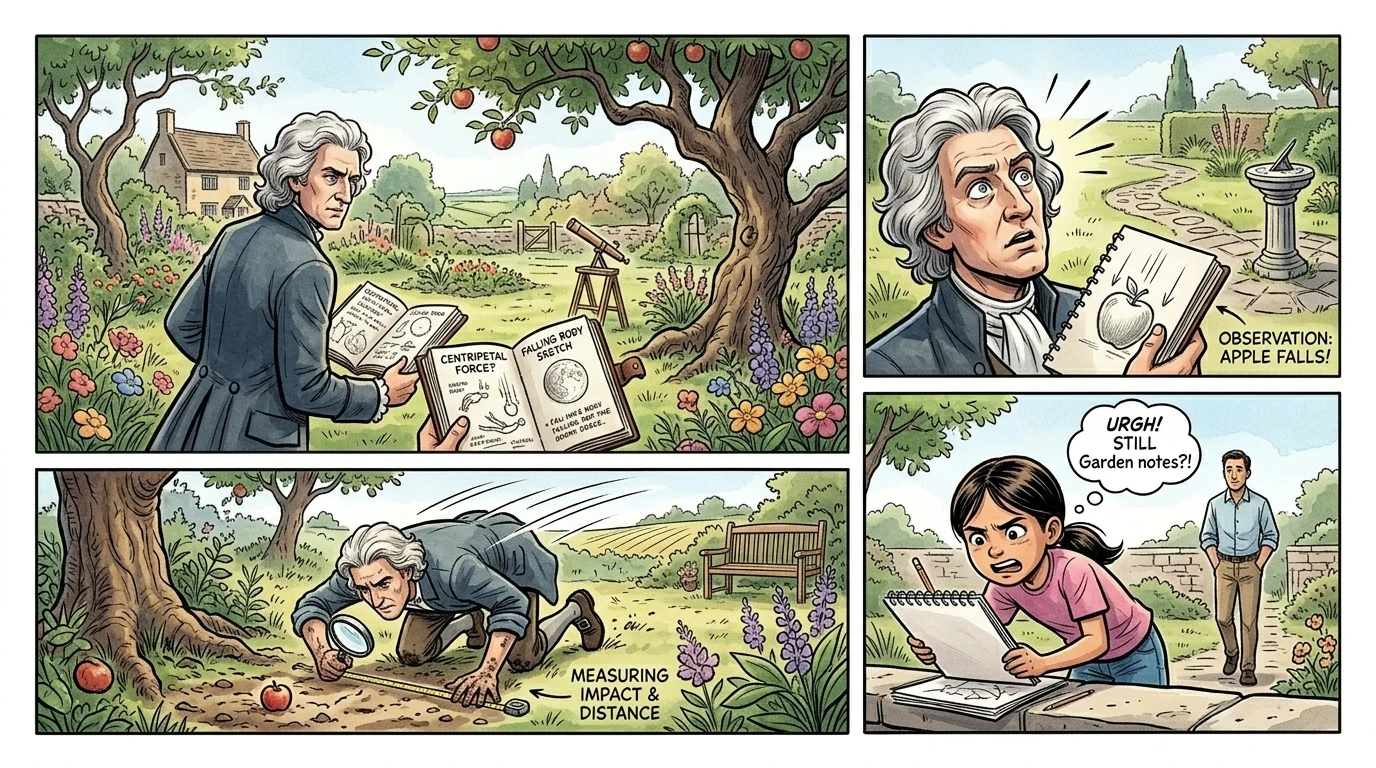
To really understand, you have to travel back in time, to a quiet English farm in 1666. The world was full of mystery, and no one knew what force held the Moon in the sky. People just knew that, on Earth, things fell.
Page 4
A young scientist named Isaac Newton was thinking about that very question. He had returned to this farm from his university to escape a terrible plague. While others saw a simple garden, Newton saw a universe of questions waiting to be answered.
Page 5
One day, he watched an apple fall from a branch, a common sight. But Newton asked a brilliant question: if gravity can pull an apple from a tree, could that same force reach all the way to the Moon? What if the Moon was also... falling?
Page 6
Newton imagined firing a cannonball from a giant mountain. A little gunpowder, and it lands nearby; more gunpowder, and it lands farther away. With enough speed, he realized, the cannonball would fall all the way around the Earth, becoming a satellite, just like the Moon!
Page 7
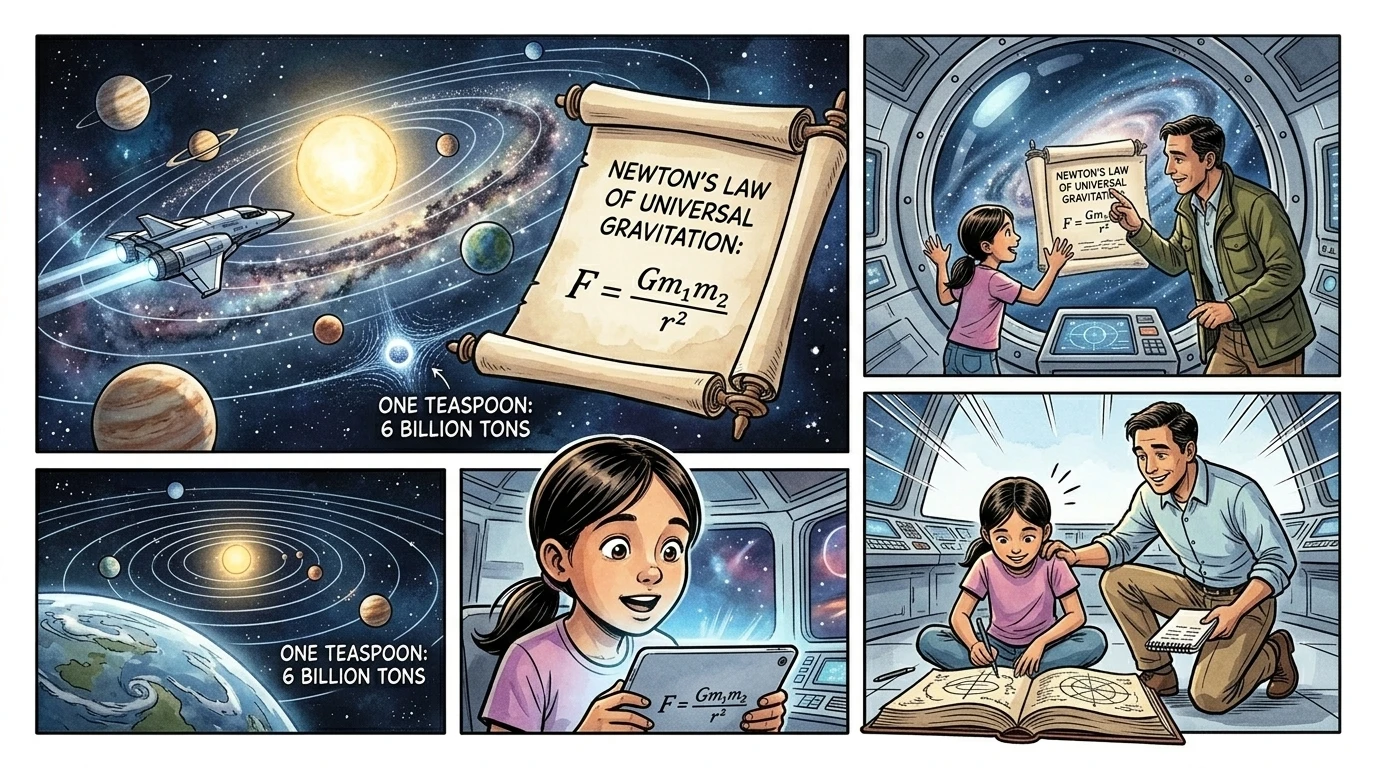
That idea changed everything! Newton's Law of Universal Gravitation let us predict how planets move and guide spaceships across the solar system. Some forces are so strong, a single teaspoon of a neutron star would weigh six billion tons, but gravity is the one that shapes the entire cosmos.
Page 8
Back at Crissy Field, Lucia snapped her fingers with a sudden flash of insight. "I get it now!" she exclaimed, grabbing her father's arm excitedly. "The astronauts are just like Newton's cannonball! They are constantly falling, but they're going sideways so fast they just keep circling the Earth!"
Page 9
"Exactly!" said her dad. "And gravity is why your basketball always comes back down." Lucia nodded, remembering something she'd read. "'The important thing is not to stop questioning,' like Albert Einstein said. He even had a different idea about gravity!"
Page 10
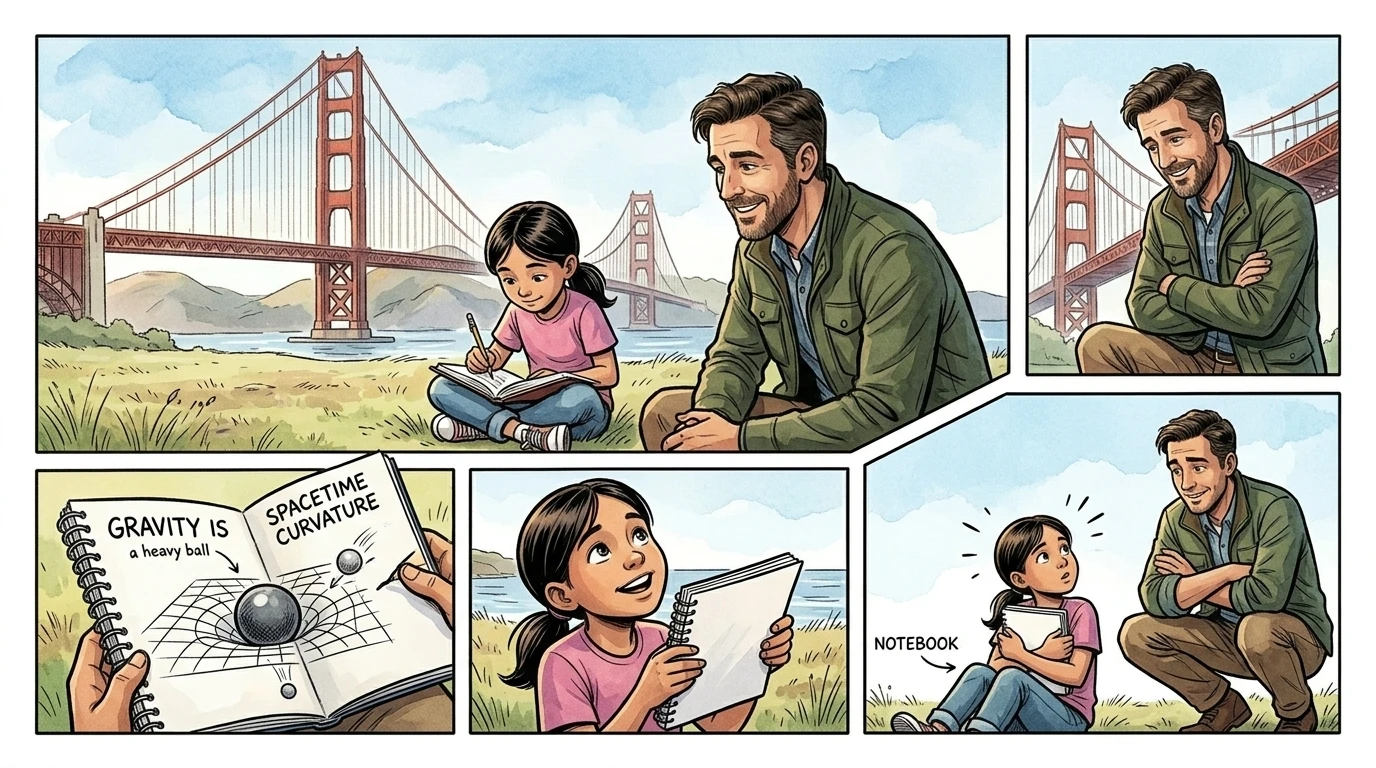
"So gravity isn't just about falling; it's the invisible cosmic glue holding everything together," Lucia summarized, writing in her notebook. She looked up at her dad, her expression thoughtful. "But what if Einstein was right? What if gravity isn't a pull at all, but a bend in the shape of space itself?"
About this story
- Audience: kids (ages 6–12)
Questions and answers
Read Wonder Science on your phone
Wonder Science is available on Android. Get Wonder Science on Google Play.