What Is Centrifugal Force?
What Is Centrifugal Force? — an illustrated science story, set in United States. 10 illustrated pages, free to read on Wonder Science.

Page 1

At a bustling playground near their Noe Valley home, Sage's father pushed the merry-go-round faster and faster. "Whoa!" Sage laughed, holding on tight as her friend Chloe shrieked with delight beside her. "It feels like a giant invisible hand is trying to fling me off!" Chloe yelled over the whoosh of the wind. Sage gripped the metal bar, her yellow hoodie a blur of color. "Yeah, why does it do that?" she wondered aloud, feeling the strange pull.
Page 2

"Be careful, girls!" Sage's father called, slowing the ride to a gentle stop. Chloe stumbled off, still dizzy. "I almost flew into the sandpit! It really feels like a force is pushing you out." Sage jumped off, her mind racing. "Dad, is it a real force? It doesn't have a name, does it?" she asked, picking up a small red bucket they had brought for making sandcastles.
Page 3

"That feeling has a name, but the real story is a little different," her father began. "To understand it, we have to travel back in time, to the Netherlands in the 1600s." The world around them seemed to shimmer and fade. "It was a time of great thinkers, when people were just starting to use math to describe how the world works." The bright playground dissolved into the dim, moody light of a different century.
Page 4
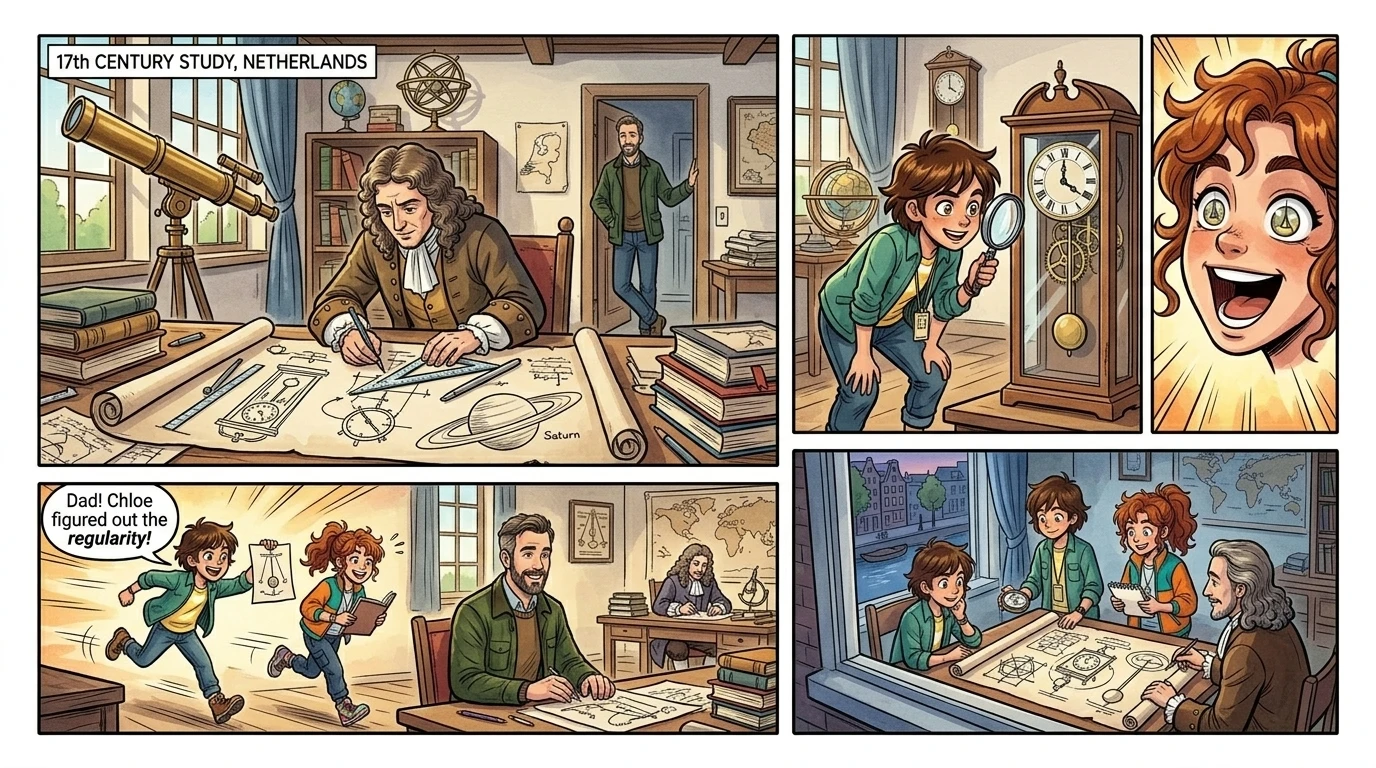
"A brilliant scientist named Christiaan Huygens was fascinated by motion, especially things that move in circles," Sage's father's voice narrated. A man with a thoughtful face looked up from a diagram he was sketching. "Huygens was an astronomer who discovered Saturn's moon, Titan, and a physicist who invented the first pendulum clock! He wanted to be the first to truly measure that strange outward-flinging feeling."
Page 5

Huygens spent countless hours in his study, driven by a deep need to understand the universe. He would often pause his work, staring out the window at the spinning windmills in the distance. He believed in finding answers through observation, once stating, as the writer Voltaire later recorded, that 'The world is my country, science is my religion.' His curiosity was his true guide.
Page 6

Huygens imagined a simple experiment: swinging a stone on a string in a circle. "He realized the string is constantly pulling the stone inward to keep it from flying away," Sage's dad explained. "If the string snaps, the stone doesn't fly outward—it shoots off in a straight line! That outward 'centrifugal force' is really the stone's inertia, its desire to keep going straight." A diagram in the air showed the stone's true path.
Page 7

This discovery was huge! "Understanding this principle allowed us to build incredible things," the narration continued. "From the spin cycle in a washing machine that separates water from clothes, to lab centrifuges that spin blood samples so fast they create forces thousands of times stronger than gravity! It even helps engineers design safe roller coasters and plan for artificial gravity on future space stations."
Page 8
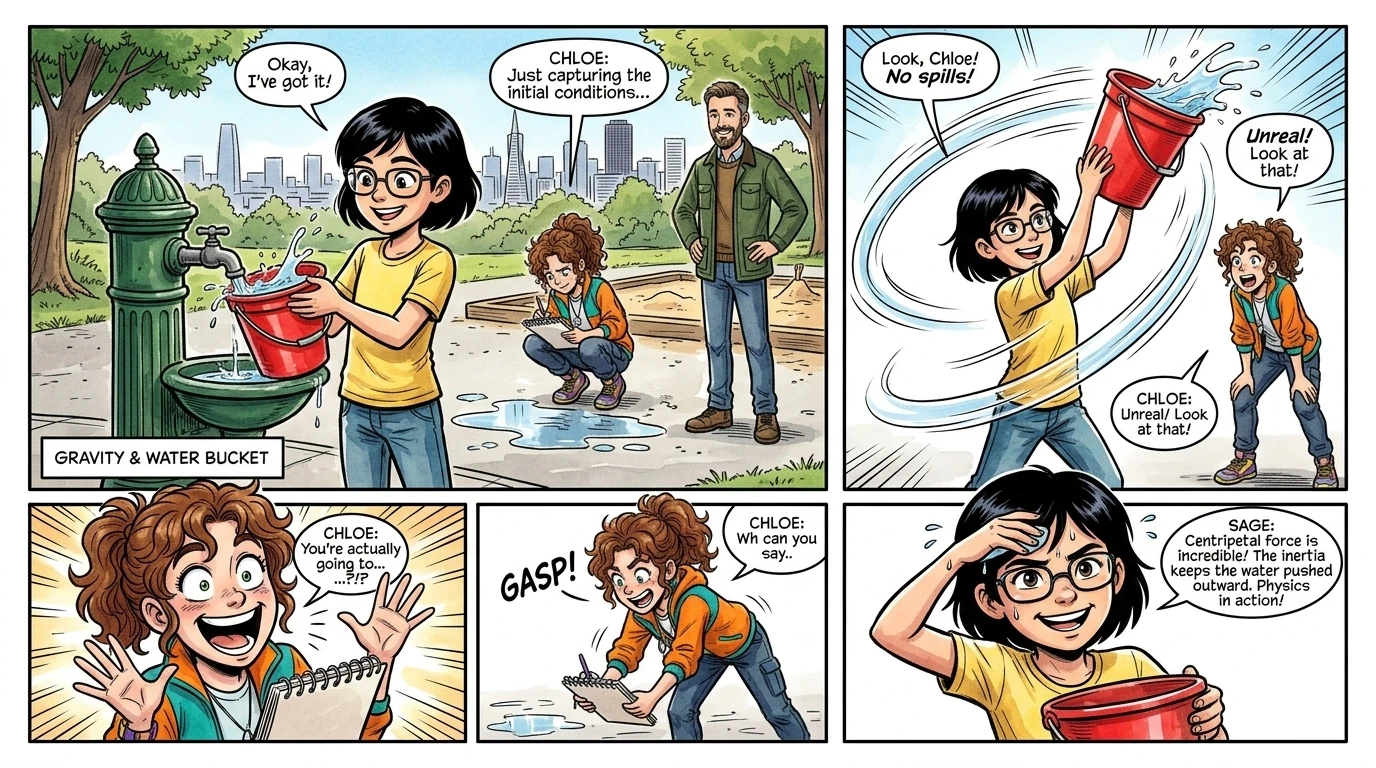
Back in the sunny San Francisco playground, everything clicked for Sage. "I get it!" she exclaimed to Chloe and her dad. "Our bodies want to fly off in a straight line, but the merry-go-round's bars keep pulling us in a circle!" To prove her point, Sage took the small red bucket, filled it with water from a fountain, and swung it in a circle over her head. Not a single drop spilled out.
Page 9

"Wow! So the water is trying to go straight, but the bucket keeps it in a circle," Chloe said, her eyes wide. "That's just like the salad spinner my mom uses to dry lettuce!" Sage's dad added, "And it's why race car drivers have to lean into turns on a banked track." Sage nodded excitedly, "The whole world is full of spinning things held together by these forces!"
Page 10
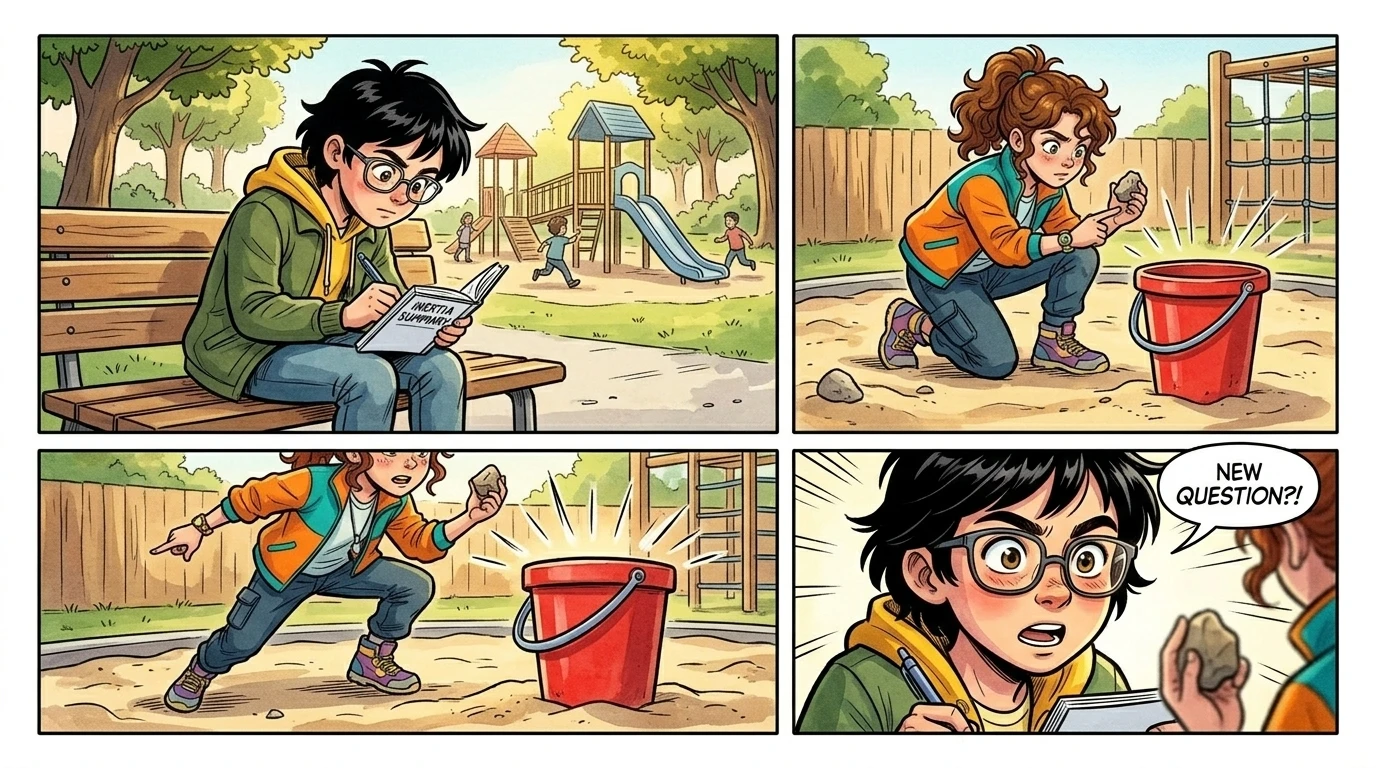
"So the centrifugal push we feel is just our own inertia fighting to go straight," Sage summarized, writing it down in her small notebook. Chloe watched her for a moment, then pointed at the red bucket now sitting on the ground. "Okay, but when you stopped swinging it, what's the invisible force that pulled all the water down to the ground?" Sage looked up from her notebook, a new question sparking in her eyes.
About this story
- Location: United States
- Audience: kids (ages 6–12)
Questions and answers
Read Wonder Science on your phone
Wonder Science is available on Android. Get Wonder Science on Google Play.