Gulliver in Lilliput
Gulliver in Lilliput — a fairy tale. 10 illustrated pages, narrated, on the kids shelf, free to read on Wonder Tales.
Page 1
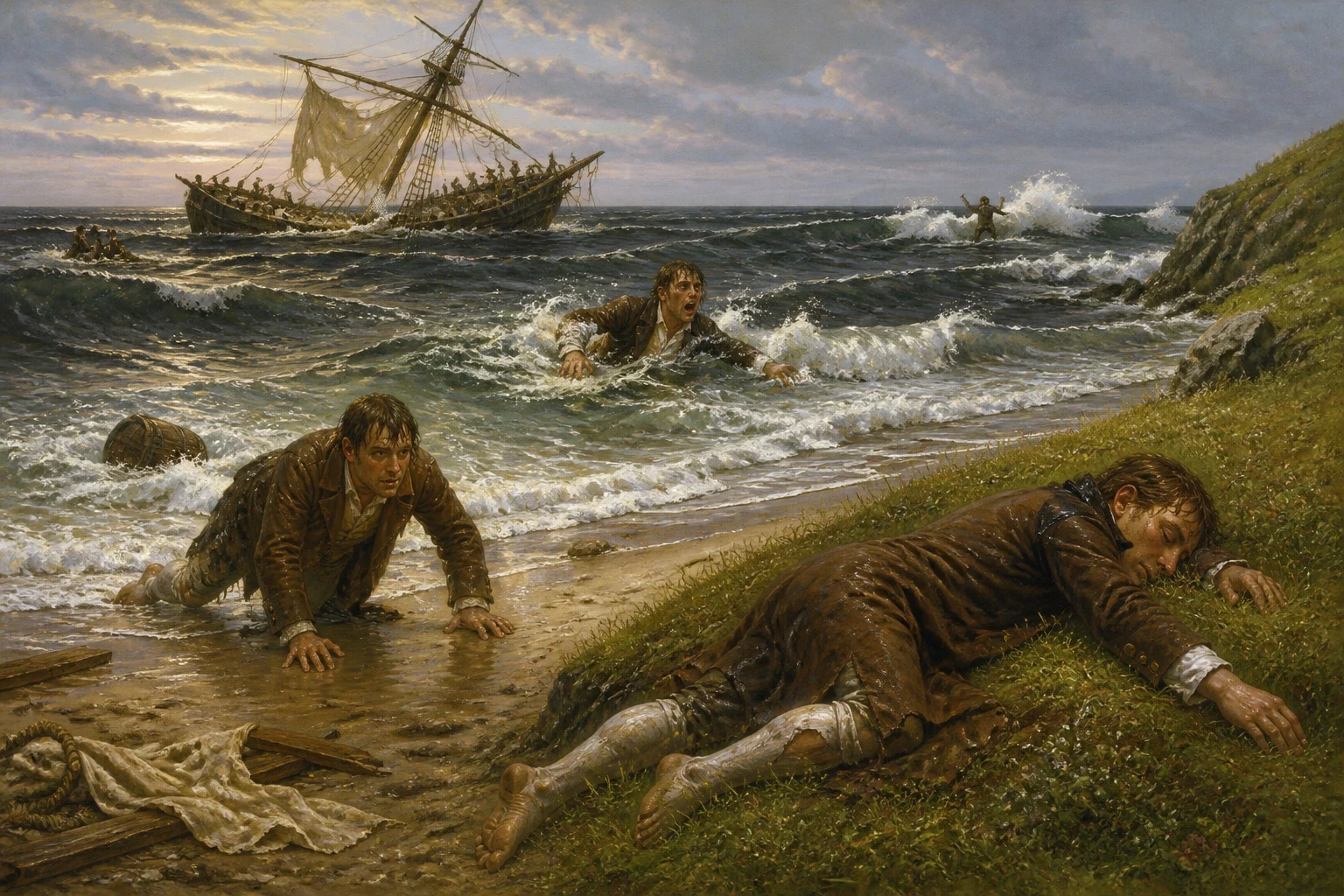
The storm came up out of the south-east like a wall, and there was no fighting it. Gulliver heard the mainmast crack and go over the side, heard the captain shouting orders that the wind tore to nothing, and then a wave bigger than a church struck the ship broadside and he was in the sea. He kicked off his heavy shoes beneath the water, dragged air into his lungs between walls of foam, and swam. The shore was only a smudge of grey at first, then green, then close enough to taste the grass on the wind. His arms burned. His legs would not answer him. He put his feet down at last and found sand, and staggered up through the shallows on legs gone to water, the surf shoving him forward and then dragging at his knees as if it meant to keep him. He crawled past the tideline on his hands, up onto soft grass that smelled of earth instead of salt, and his strength went out of him all at once, like a candle pinched between two fingers. He meant to look about him, to take stock, to be a sensible ship's surgeon about the whole disaster. Instead he put his face down into the grass and slept as though he had been struck dead.
Page 2
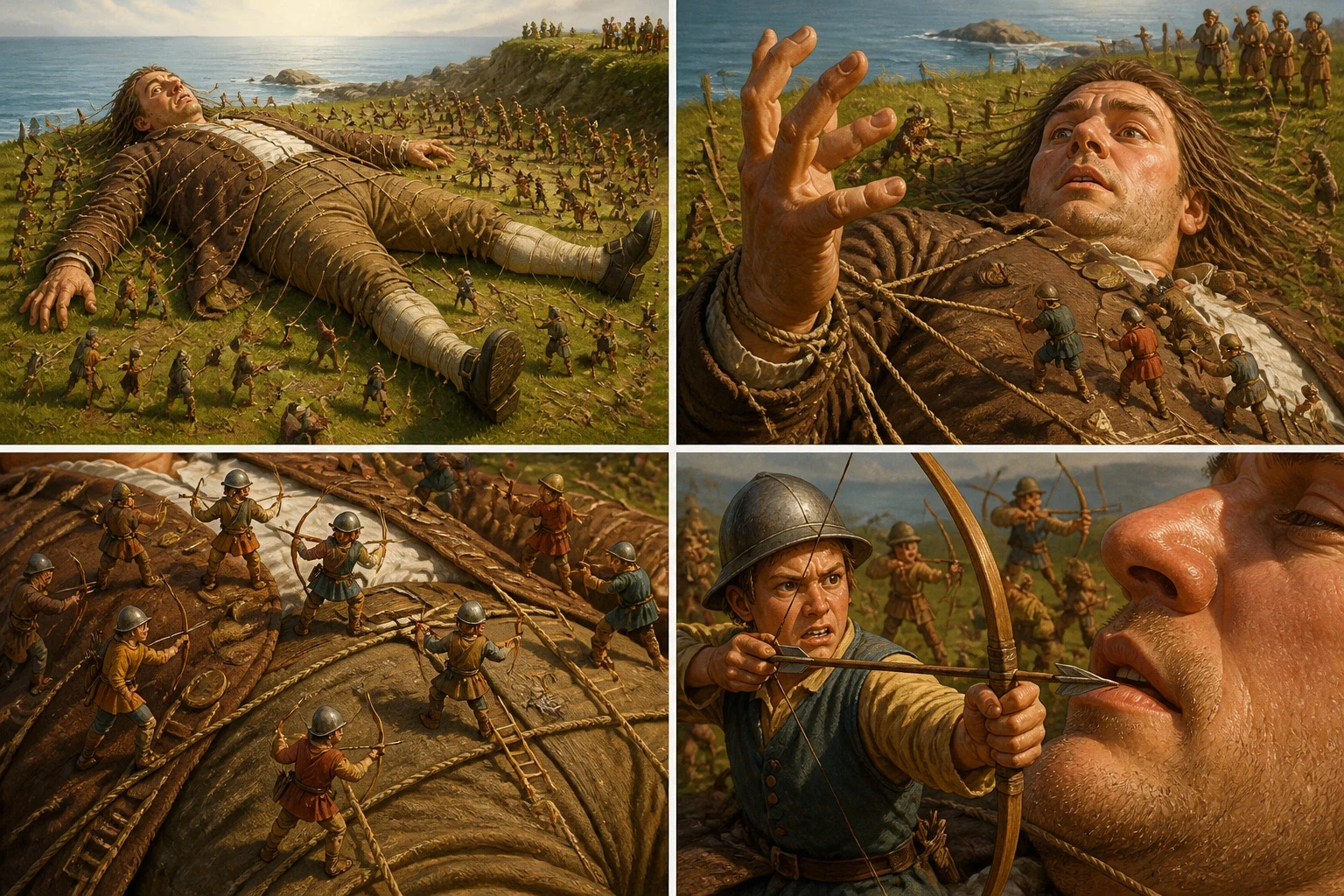
Gulliver opened his eyes to a pale sky and tried to lift his hand to rub them, but his arm would not move. He tried the other arm. Nothing. He tried to sit up and found his chest held flat to the earth, his long chestnut hair stretched tight at the roots as though a thousand fingers gripped each strand. Hundreds of threads no thicker than sewing cotton crossed his wrists, his knees, his ankles, pegged deep into the grass with little stakes. He turned his head, the only part of him that was free, and saw them: tiny figures no taller than his finger, swarming across his waistcoat buttons, climbing the folds of his coat, bows drawn and arrows nocked and pointed at his chin. He opened his mouth to shout and a volley of needle-arrows pricked his cheek like gnat bites, and he fell silent, astonished more than hurt, staring up at this army the size of beetles perched upon his own ribs.
Page 3
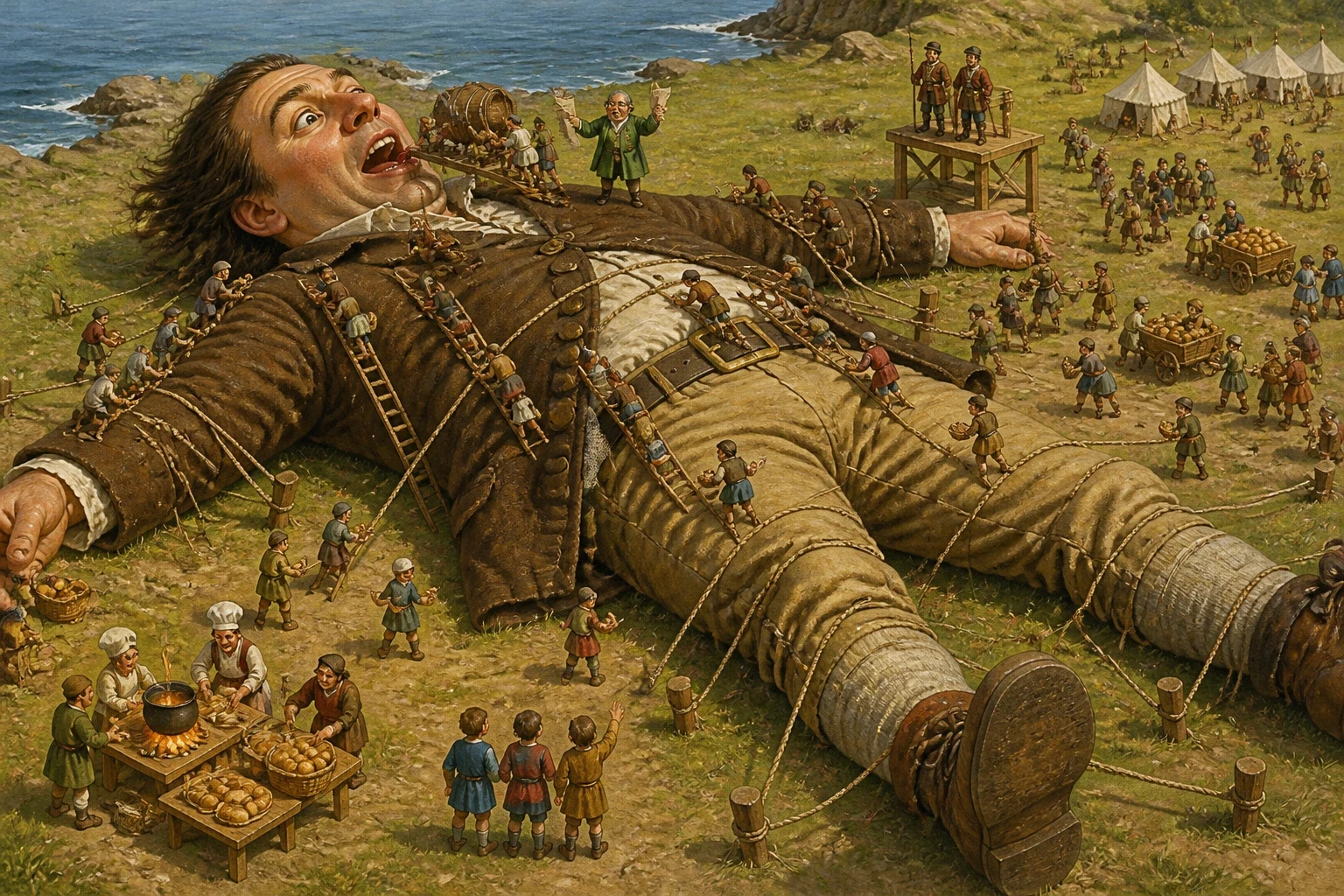
Gulliver lay pegged to the grass, hunger gnawing at him worse than his bonds, when a cry went up among the tiny crowd upon his chest. Ladders no taller than table-legs were run up against his ribs, and up them scrambled dozens of little people bent nearly double under baskets of bread. They tipped loaf after loaf into his open mouth — each no bigger than a musket-ball to him, but he was grateful for every one. Hogsheads of wine, scarce larger than a walnut shell, were rolled along his chin and tipped down his throat three at a time, the small folk cheering each swallow as though it were a feat of strength. Reldresal stood upon Gulliver's collarbone directing the work, waving his roll of parchment like a banner, calling instructions up and down the ladders. When at last Gulliver's hunger eased, he let out a breath that nearly toppled a basket-carrier from his ladder, and the crowd below scattered laughing and shrieking, then came creeping back for more.
Page 4
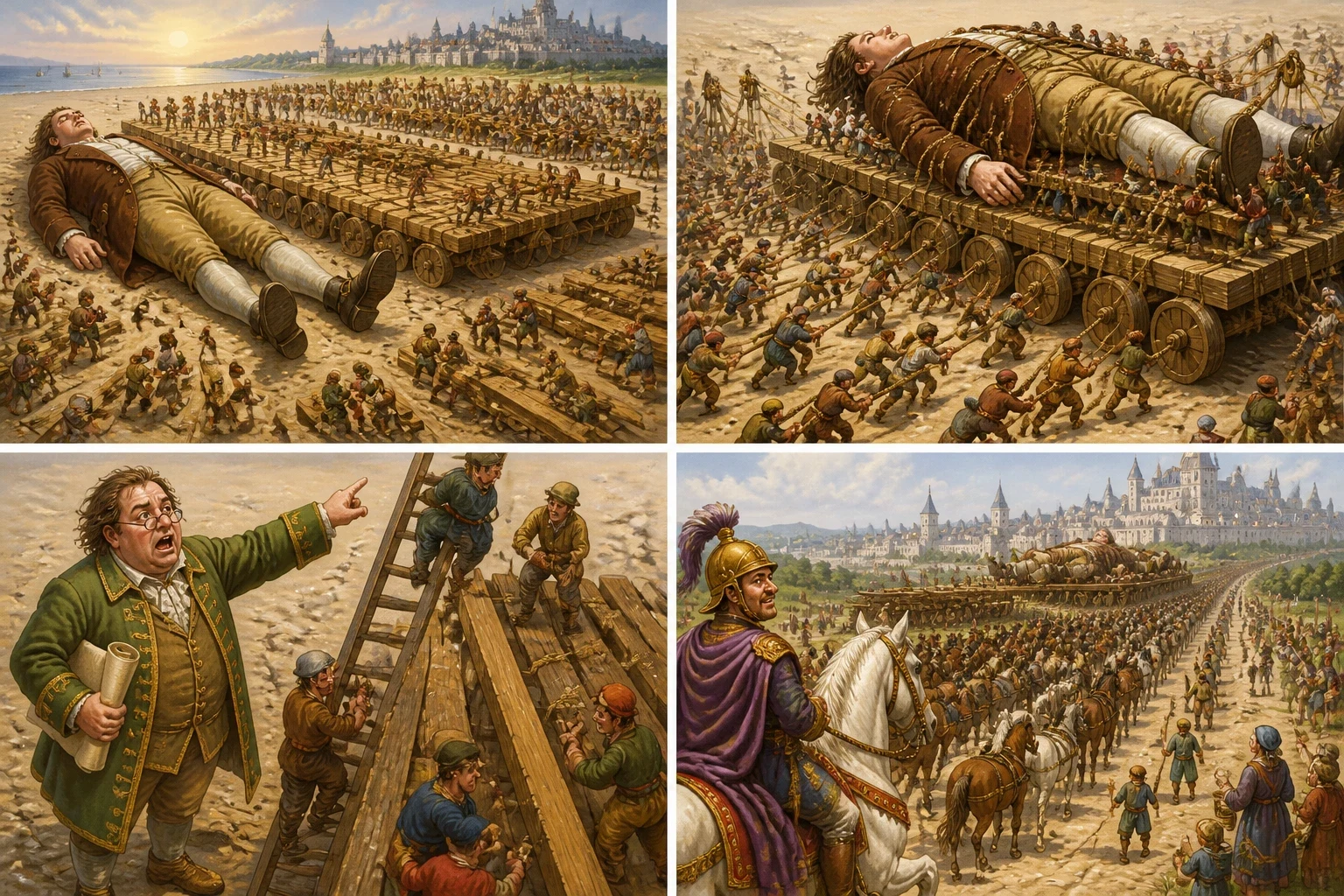
Gulliver lay fast asleep on the sand, lulled by a sleeping draught slipped into his wine, while five hundred carpenters hammered and sawed through the night to build a platform of twenty-two wheels beneath him. Ropes thick as a man's wrist were looped through pulleys fixed to stakes, and nine hundred of the strongest men hauled together until, inch by inch, his great body rolled up onto the frame. Reldresal trotted alongside with his parchment flapping, counting the turns of each wheel and calling instructions up to the carpenters balanced on his shoulders. When all was ready, fifteen hundred horses were harnessed in long traces, and with a crack of tiny whips the whole enormous load began to creep along the great road toward the city, Gulliver's chest rising and falling like a hill breathing in its sleep. The Emperor rode ahead on his finest horse, turning often to watch the procession crawl behind him, marveling that so small a kingdom could move so vast a stranger.
Page 5
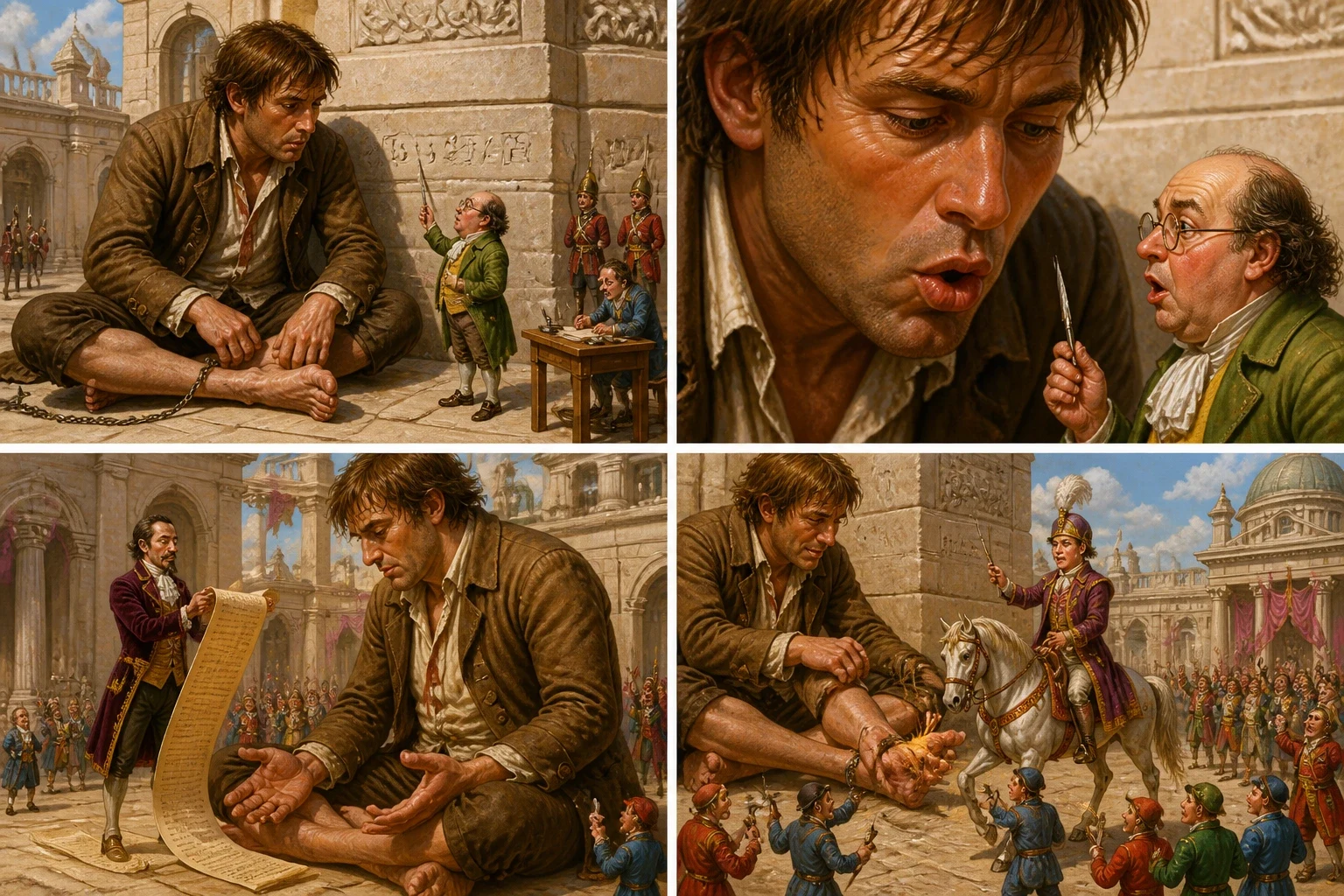
A great chain, stout as any ship's cable to Lilliputian eyes but light as a thread to Gulliver, bound his leg to the old temple door, and there he sat through many patient weeks while Reldresal came each morning with his scroll and his bundle of quills. The round little man pointed at stones, at the sky, at his own buttoned coat, naming each thing slowly until Gulliver's tongue, clumsy as a giant's, began to shape the words. Soon he could speak whole sentences, and the day came when the Emperor himself rode out on his golden-helmeted charger to hear him. Flimnap unrolled a long paper of conditions — that Gulliver must not leave without license, must not crush fields or trample towers, must carry their soldiers in his pockets when asked, must help build and haul and carry. Gulliver knelt in the dust, so that his face came level with the Emperor's, and swore to every line. At the Emperor's nod, the smiths climbed his legs and struck off the great chain, link by link, and Gulliver stood free, towering over the whole delighted, nervous crowd.
Page 6
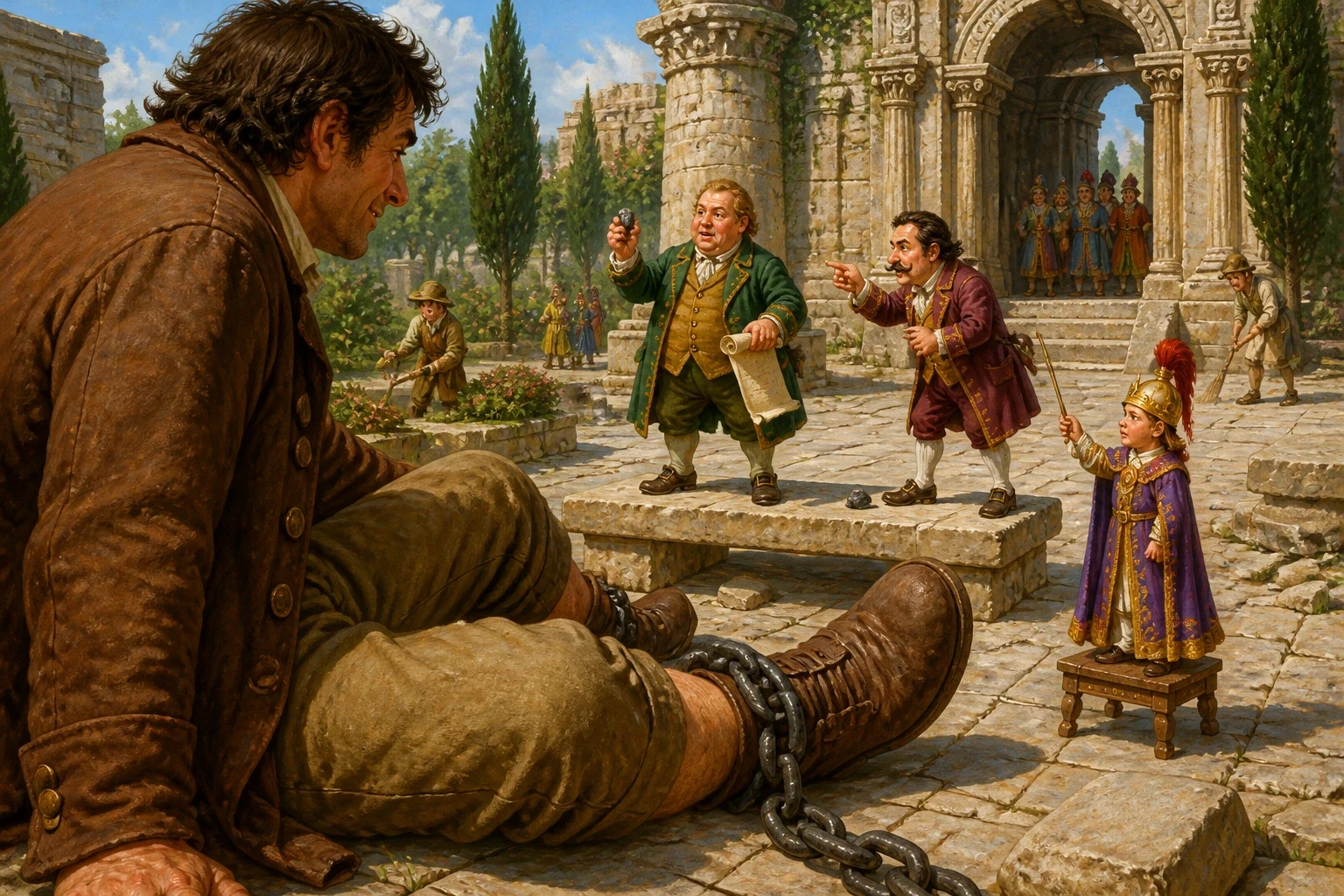
Gulliver sat cross-legged in the temple courtyard, his great chained leg stretched out like a fallen tree, while Reldresal climbed up onto a stone bench to be seen and heard. The plump little man unrolled his parchment with a snap and tapped it with a quill. 'You must understand, Man Mountain,' he said, 'our wars are not small matters.' He acted it out as he spoke: he took an egg-sized pebble from his coat, held it high, and smacked it down on the bench — big end first. Flimnap, nearby, snatched up his own pebble and cracked it the opposite way, little end down, glaring. The Emperor, watching from his small gilded chair, raised his needle-sword and pointed first at Reldresal's pebble, then at Flimnap's, shaking his head at both men as if refereeing a duel. Reldresal explained that eleven thousand had died, that the Emperor's own father had split his finger on the big end and decreed the little end the only lawful one ever since. Gulliver stared at the two cracked pebbles, trying not to laugh at a war fought over breakfast.
Page 7
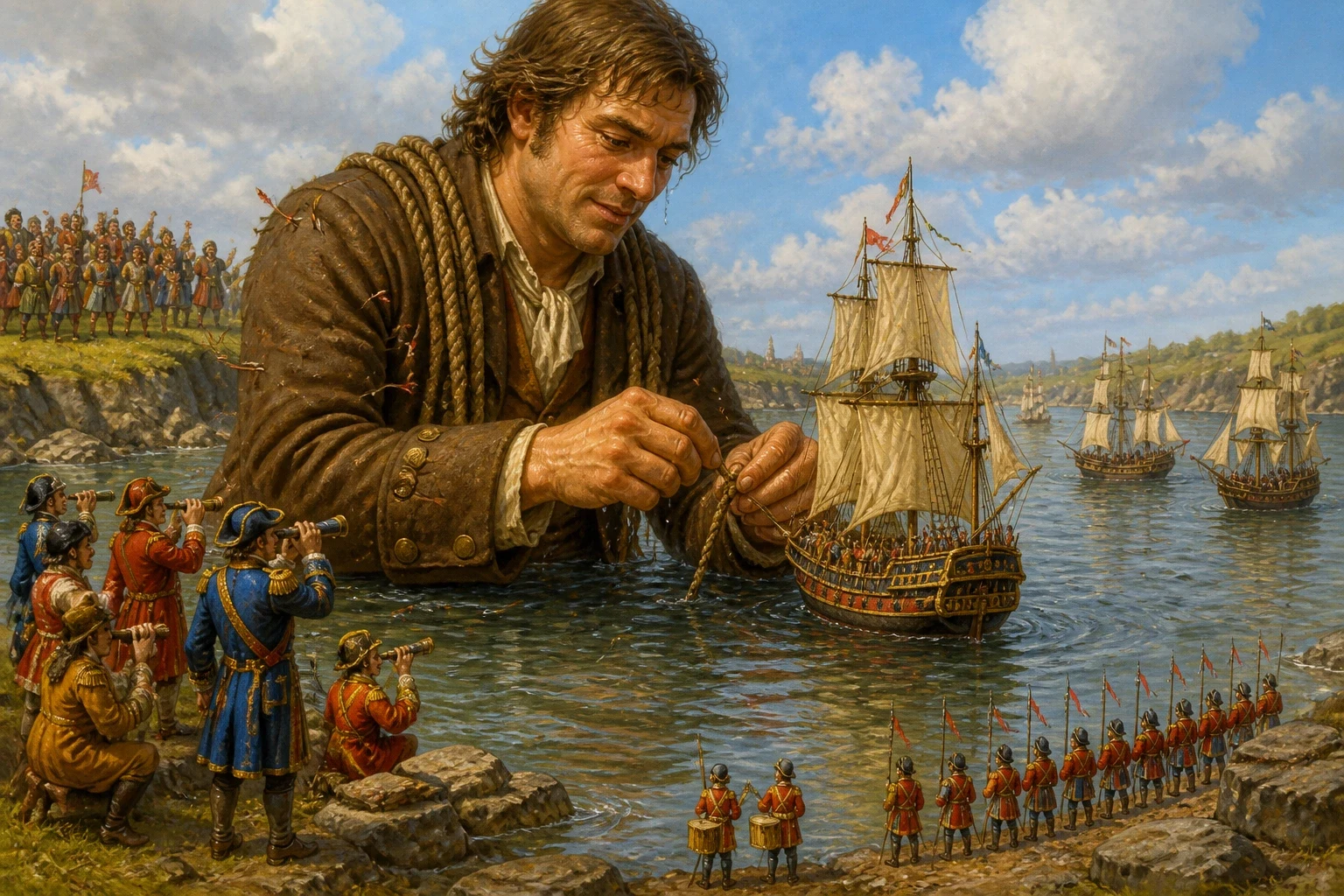
Gulliver had asked for fifty hooks and fifty lengths of the strongest cable the Emperor's rope-makers could twist together. He coiled them over his shoulders like great loops of string and waded out into the channel, the water rising past his waist, then his chest, while the little soldiers of Lilliput watched from the shore and would not believe their eyes. Ahead, the whole fleet of Blefuscu rode at anchor, ships no bigger than toy boats to him, sails full, flags snapping. He pushed through the swell until he stood among them, and began to work — fastening a hook to each anchor cable, one ship after another, his big fingers clumsy but sure. Arrows came down from the decks in stinging showers, rattling off his hands and face like hail, and he only laughed and ducked his head and kept on hooking. When all fifty cables were fast, he drew his knife, cut every anchor rope at once, and felt the whole fleet come free and drift to his pull like a line of toys on a string.
Page 8
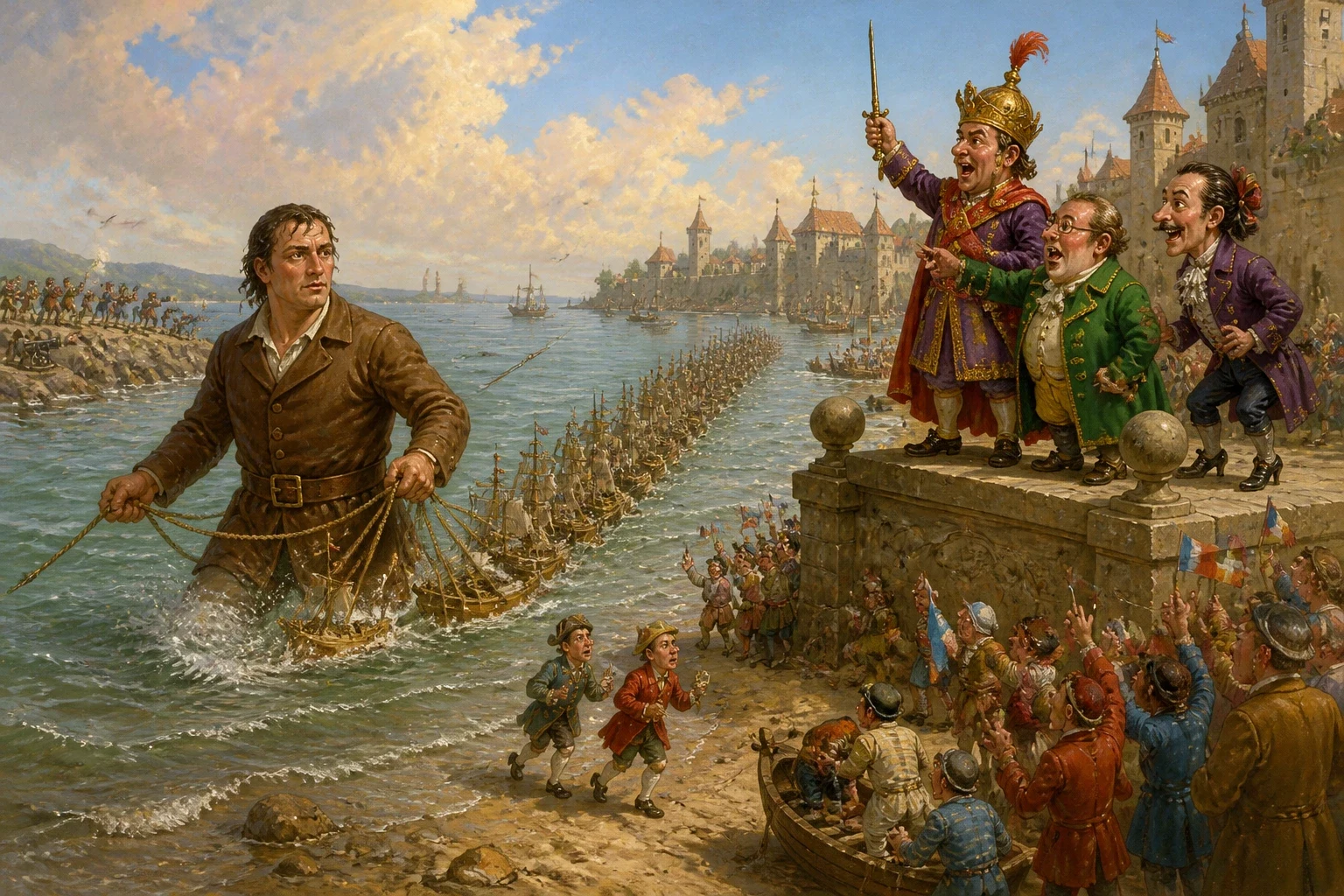
With every cable hooked, Gulliver set his shoulders and began to walk back across the channel, the whole captured fleet dragging at his waist like a string of toy boats. The water churned white behind him. On the far shore the Blefuscudian gunners sent up a last useless volley, arrows pattering off his chest like rain, and then there was only the sea and the slow, enormous labour of hauling fifty ships against the tide. When his head and shoulders rose at last over the royal port, the whole shore was screaming his name. The Emperor stood at the harbour wall in his golden helmet, scarlet plume whipping, and could not stop himself cheering with the rest. Reldresal tugged at his sleeve to point out each ship as it came in, counting them aloud, while Flimnap, forgetting his dignity entirely, hopped up and down on the stones. Gulliver waded the last stretch, set the cables down gently on the sand so as not to crush a single sailor, and bowed as low as his huge frame allowed, to a noise like a thousand tiny trumpets.
Page 9
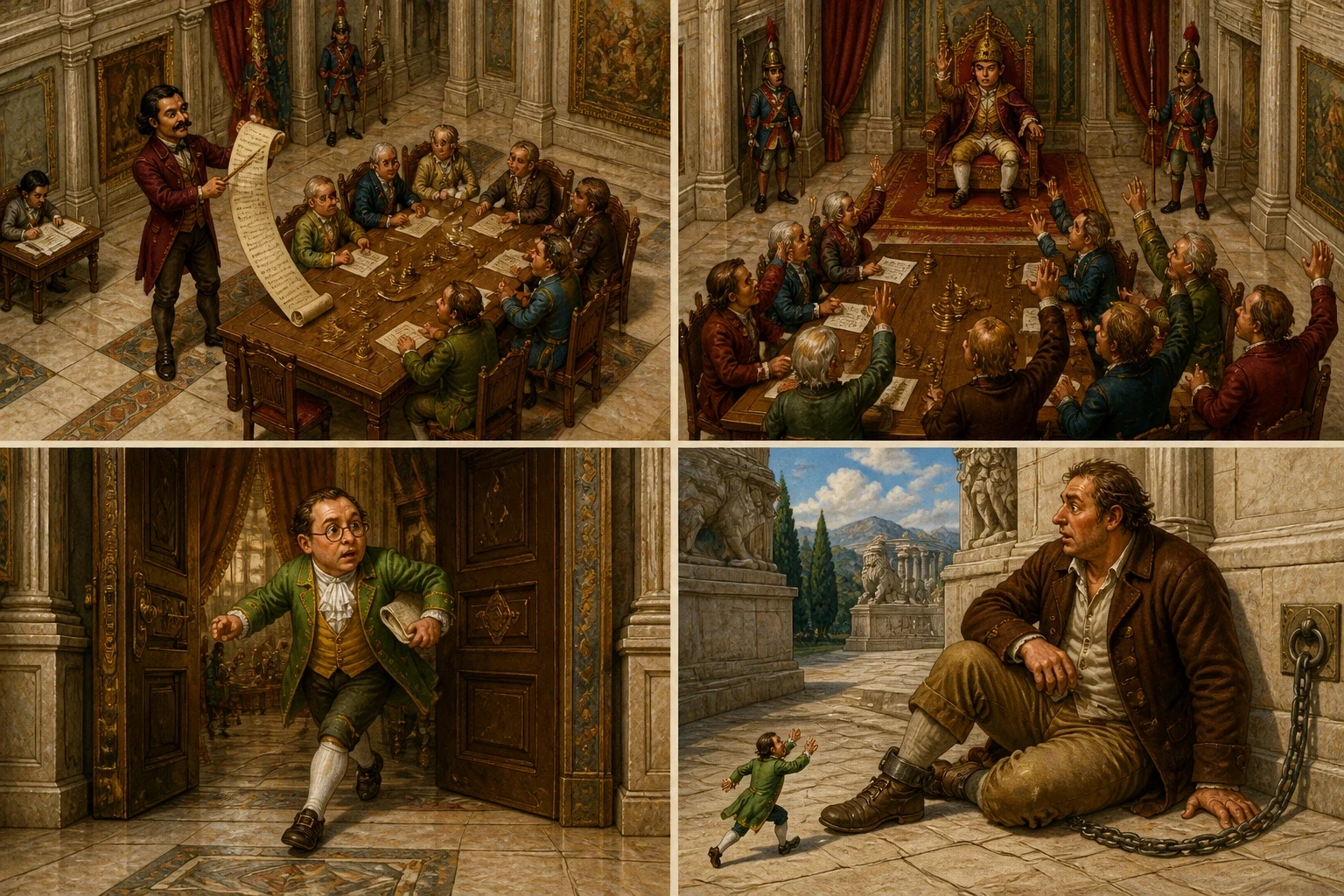
In the council chamber, Flimnap unrolled a scroll of accounts as long as his own body and tapped it with a tiny pointer. 'See here,' he cried, his voice thin and sharp. 'The Man Mountain eats in one day what would feed a thousand Lilliputian families for a month. His stockings alone are made from the sails of six ships!' The Emperor sat frowning on his small throne, turning the numbers over in his mind. Around the table the councillors murmured and nodded, counting coins and grain on their fingers. 'He is a wonder,' the Emperor said slowly, 'but a kingdom cannot feed a wonder forever.' The council voted, hands rising like a field of little flags, and it was decided: the Man Mountain must go. Reldresal, who had written half the laws Gulliver now lived under, gathered his parchment and ran — out through the tall doors, across the courtyard, past the old temple, his short legs pumping, to find his friend before the guards did, his round face white with worry under his black hat.
Page 10
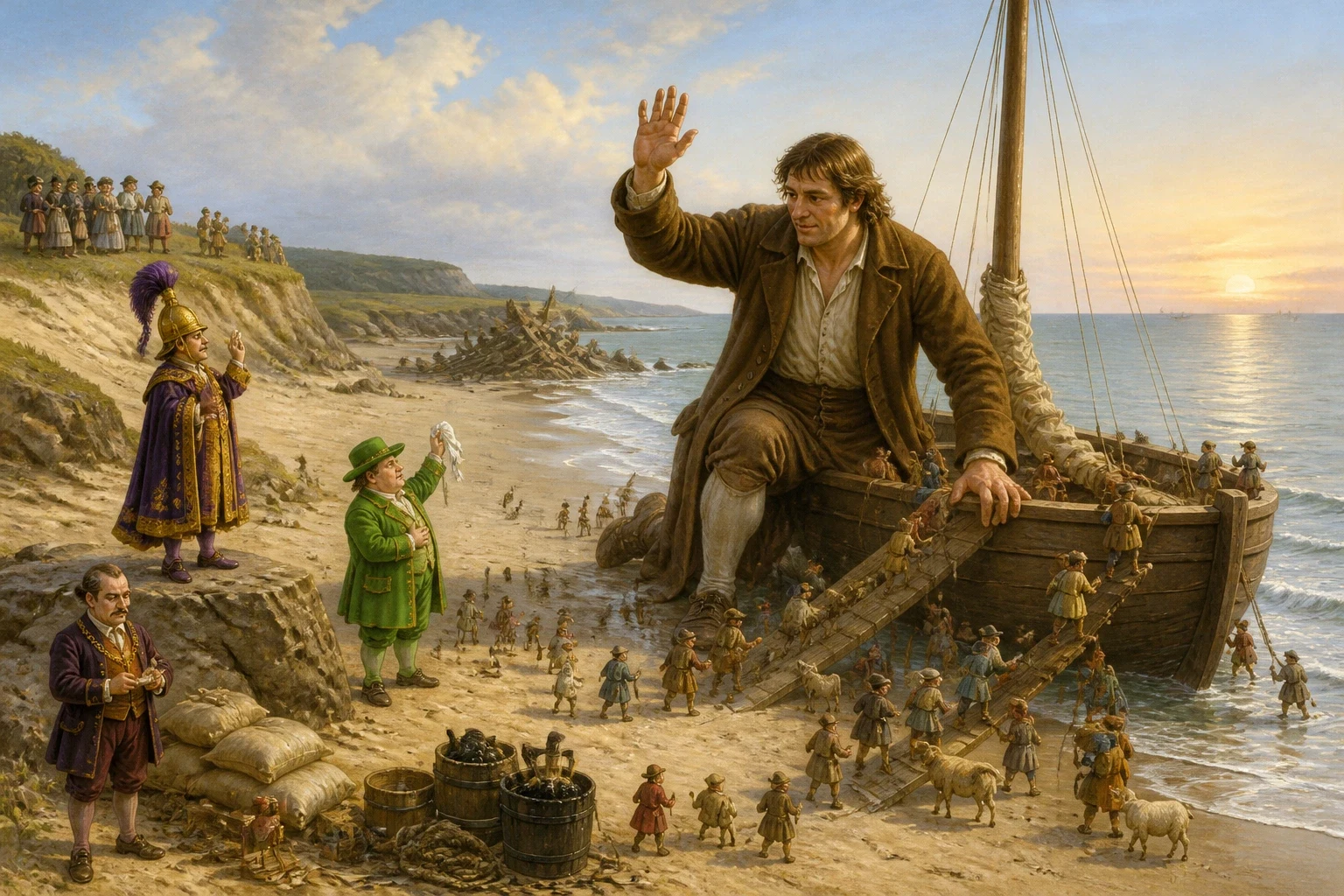
Reldresal had come running in the night, out of breath, his round hat crooked: the council had counted every loaf Gulliver ate and decided the Man Mountain must go. By dawn the matter was settled in Gulliver's own heart before anyone could do worse. Down on the shore he found a real boat, a full-sized ship's boat washed up and overturned since the night of his wreck, its hull sprung but sound enough to mend. He turned it right-side up with one heave, caulked the seams with pitch and tallow begged from the dockyard, and fitted a mast from a young fir tree. All that morning the Lilliputians swarmed about him, driving a hundred cattle and three hundred sheep up little ramps into the hold, stacking biscuit in casks no bigger than dice. The Emperor came down to the tideline in his gold-bell robes, sword in hand, saying nothing for once. Flimnap stood apart, counting the last of it on his chain. Gulliver knelt, bowed his great head to the little kingdom, pushed the boat into the surf, and climbed in.
About this story
- Audience: kids (ages 6–12)
- Format: 10 illustrated pages, narrated, on the kids shelf, free to read on Wonder Tales
Read Wonder Tales on your phone
Wonder Tales is available on Android. Get Wonder Tales on Google Play.