King Thrushbeard
A proud princess, the suitor she mocked, and the three trades she could not learn
Page 1
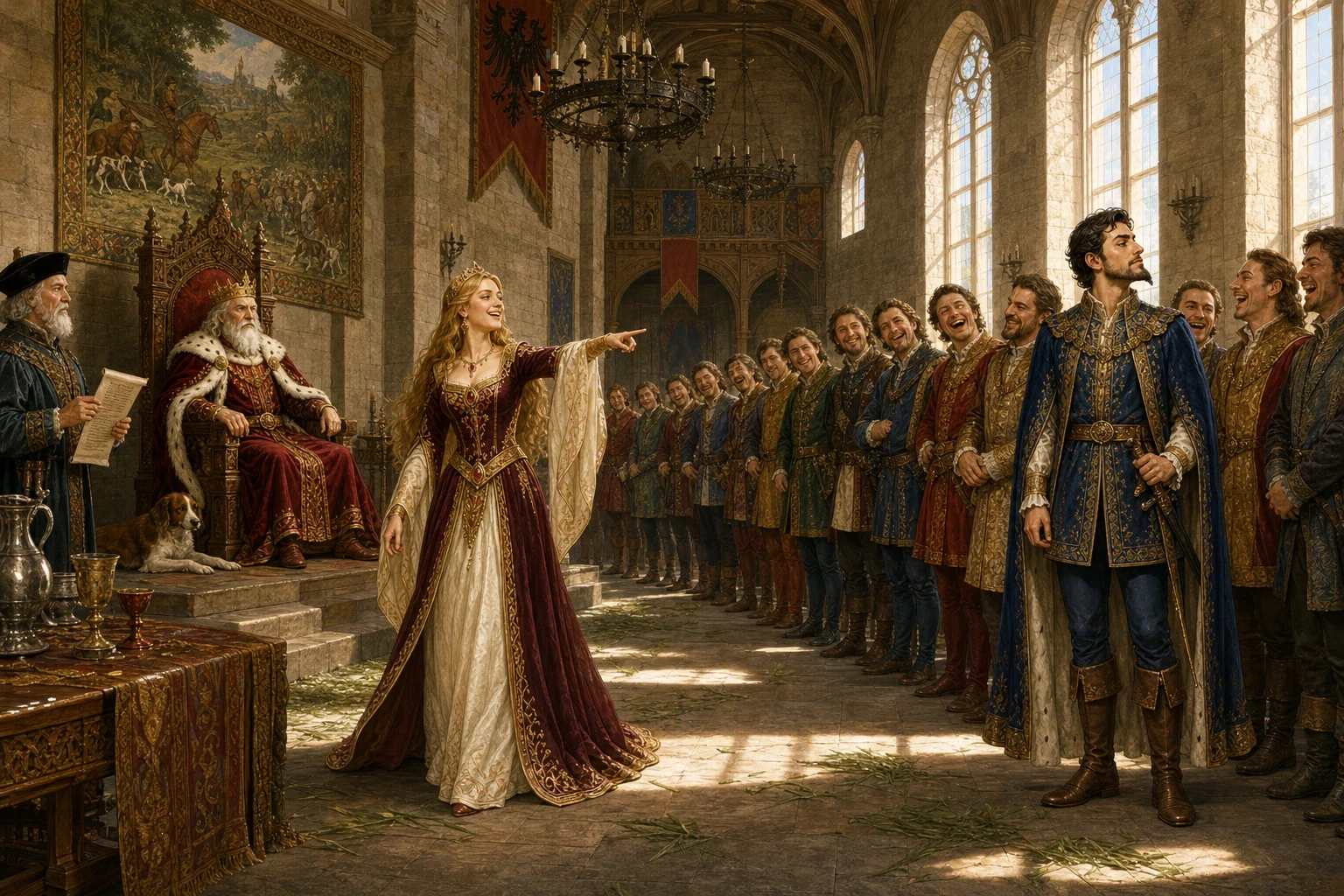
In a great castle in Germany there once lived a king whose daughter was famed through the land for her beauty — and for her cruel tongue. Her father gathered all her suitors into the great hall at once, men who had traveled from far and wide hoping to win her, and had them stand in a long line so she might choose a husband among them. But the princess walked down the line finding fault with every single one. She called the fat one 'Tub of Butter' and the thin one 'Skin and Bone' and the short one 'Dumpling,' until she came to a fine young king who stood a little taller than the rest, with a good face and only one small flaw — his chin was long and slightly crooked, like a thrush's beak. 'Ha!' she laughed. 'That one has a chin like a thrush — King Thrushbeard, I shall call him!' And the whole hall laughed with her, though the young king did not laugh at all.
Page 2

After the suitors had all been sent away, insulted and angry, the old king called his daughter before him in the throne room, alone. He was no longer able to contain his temper. 'You have mocked every good man who came to ask for your hand,' he said, 'and you have shamed me before every court in the land.' The princess tossed her golden hair and said nothing in her own defense, for she did not think she had done anything wrong. Her father grew redder and redder with anger, until at last he struck his hand upon the arm of his throne and swore a great oath before the whole room. 'Since you think so little of kings and princes,' he said, 'I promise you this: I will give you in marriage to the very next beggar who comes knocking at my castle door — whoever he may be.' The princess only laughed at this too, certain her father would never truly do such a thing. But a king's oath, once sworn aloud, cannot be unsworn.
Page 3
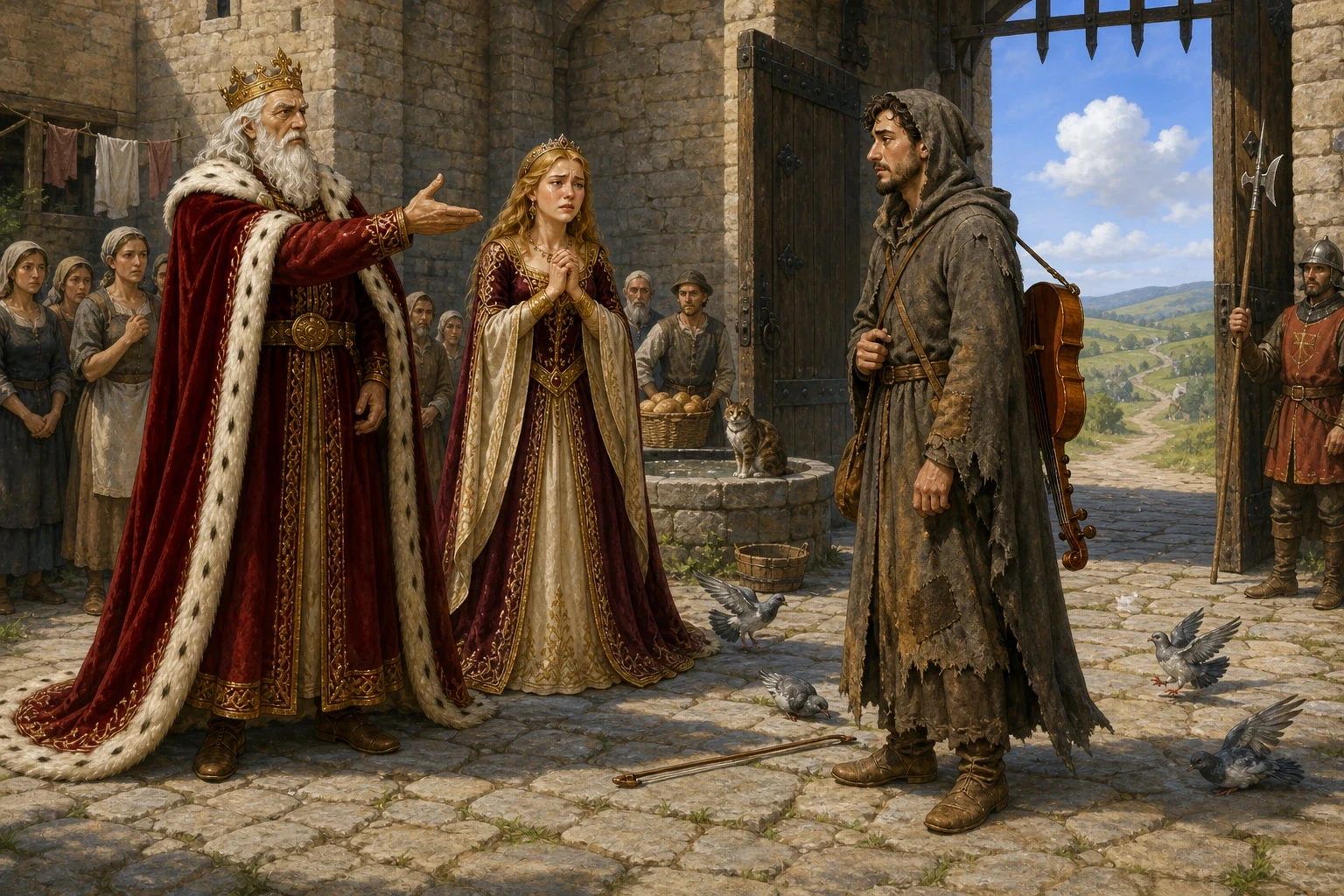
Not long after that, as it happened, a wandering minstrel came walking up to the castle gate with an old fiddle under his arm, and finding himself hungry, he began to sing beneath a window, hoping for a few coins. The king heard the singing and remembered his oath at once. He sent for the minstrel to be brought up into the courtyard before him. The minstrel was a poor, ragged figure in a patched grey cloak, his face half-hidden under a hood — though if anyone had looked closely, they might have noticed his chin was long and slightly crooked. 'Sing a little more,' said the king, 'and you shall have a reward.' When the song was finished, the king called for his daughter and, true to his word, married her to the beggar there in the courtyard before the whole household could stop him. The princess wept and begged, but the oath had been sworn, and a king's oath could not be broken for tears.
Page 4

So the princess left her father's castle, walking beside her new husband down the long road into the countryside, carrying nothing but the gown on her back. As they went, the road passed through broad fields and dark woods, and each time she asked whose land it was, the answer was always the same. 'Whose are these lovely fields?' she asked. 'They belong to King Thrushbeard,' came the answer. 'And this forest?' 'King Thrushbeard's, too.' 'And that town on the hill?' 'King Thrushbeard's.' Three times she asked, and three times she heard the name she herself had given to the suitor she had mocked, and each time it stung her a little more, though she still did not guess the truth walking silently beside her. At last the grand farms and fine towns were left behind, and the road grew narrow and poor, until they came to a small, mean little hut standing alone at the edge of the forest. 'This is our home now,' said her husband.
Page 5
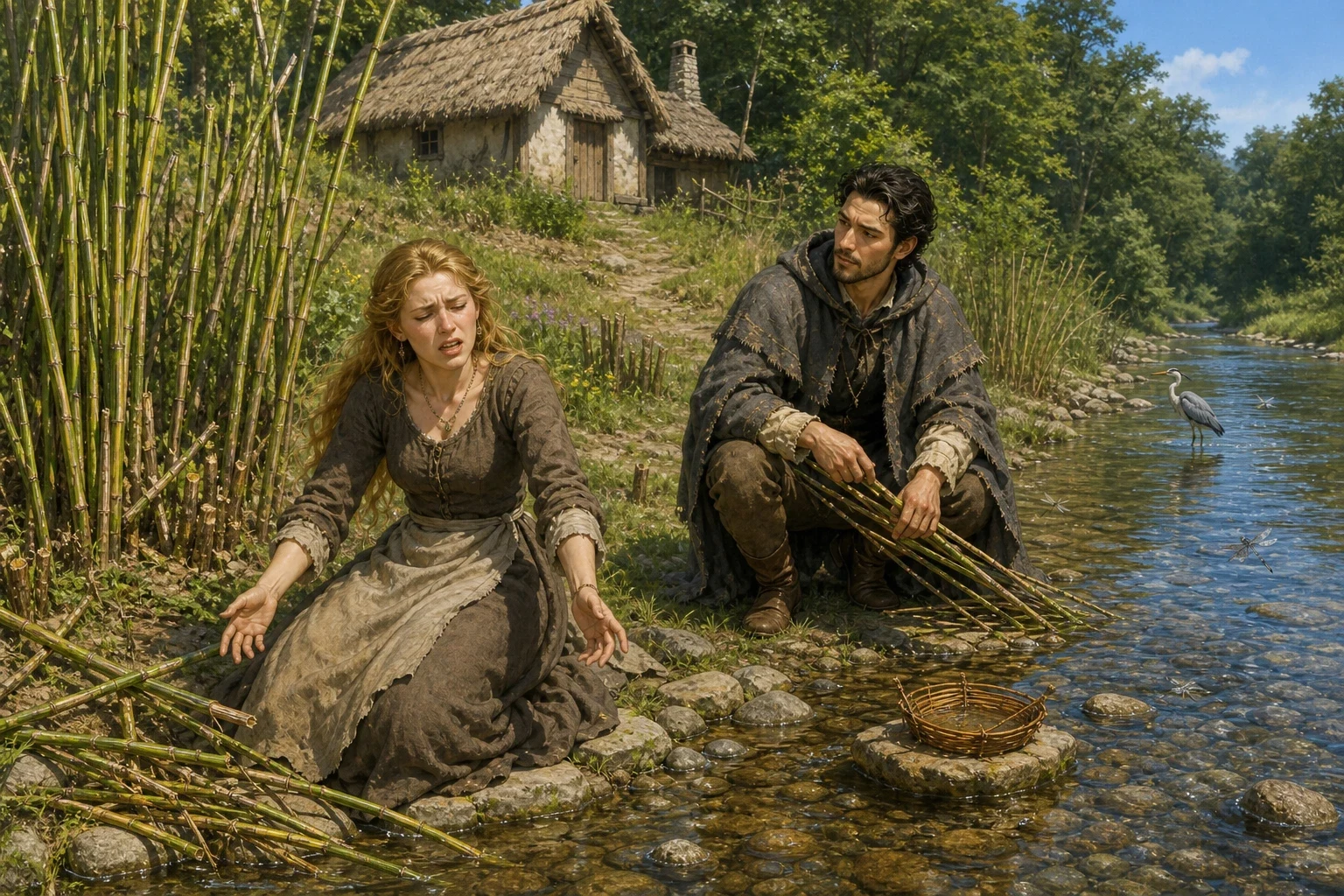
Since they had no money and no servants, the princess soon found she would have to work with her own two hands for the very first time in her life. Her husband led her down to a bend in the river just below the hut, where tall willow rods grew thick along the bank, and cut a great armful of them for her. 'We can sell baskets at the market,' he said, 'if you learn to weave them.' So the princess sat on the riverbank and tried to bend the tough green rods the way he showed her, over and under, over and under. But her hands had never done rough work before, and the stiff willow would not bend the way she wanted. The rods sprang back and scraped across her fingers until they turned sore, red and stinging, and no basket at all took shape in her lap. After trying for a long while, she threw the whole bundle down, her fingers too painful to go on, and gave up the basket-weaving entirely.
Page 6
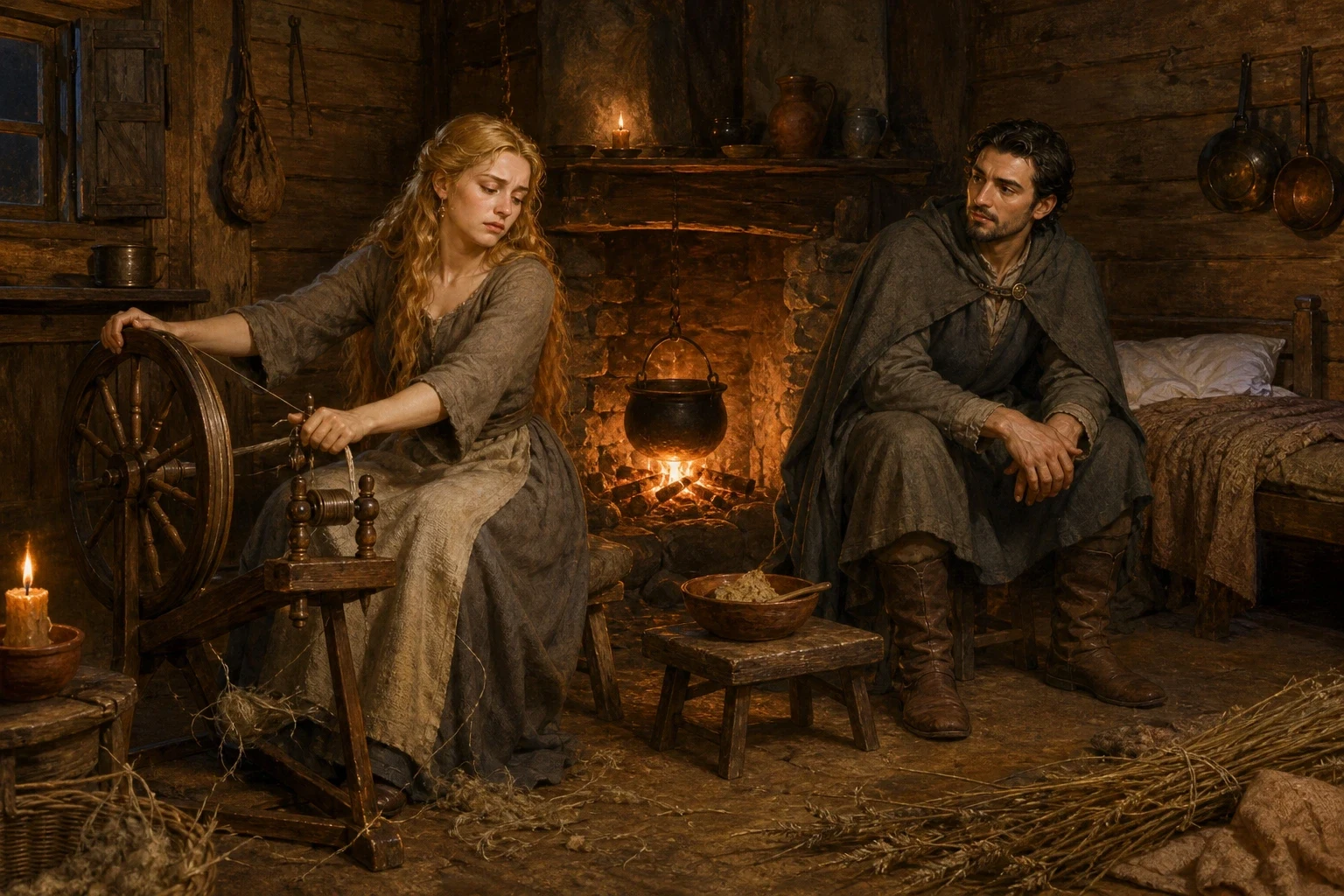
The basket-weaving having come to nothing, her husband tried a gentler trade next. He brought home a bundle of flax and a spinning wheel, and set it up for her by the hearth of their little hut. 'Spinning is easier work,' he told her. 'Sit by the fire and try this instead.' The princess sat down at the wheel as he showed her, and pressed the flax to the spindle, and turned the wheel round and round. But the coarse, rough flax caught and twisted against her soft fingers just as badly as the willow had, until her hands grew sore and stinging all over again, and the thread she spun kept breaking and tangling into knots. She spun on late into the evening by the firelight, determined not to fail a second time, but her fingers simply could not bear the rough work for long. At last she pushed the spinning wheel away from her, unable to go on, and the little hut had still not earned a single coin.
Page 7
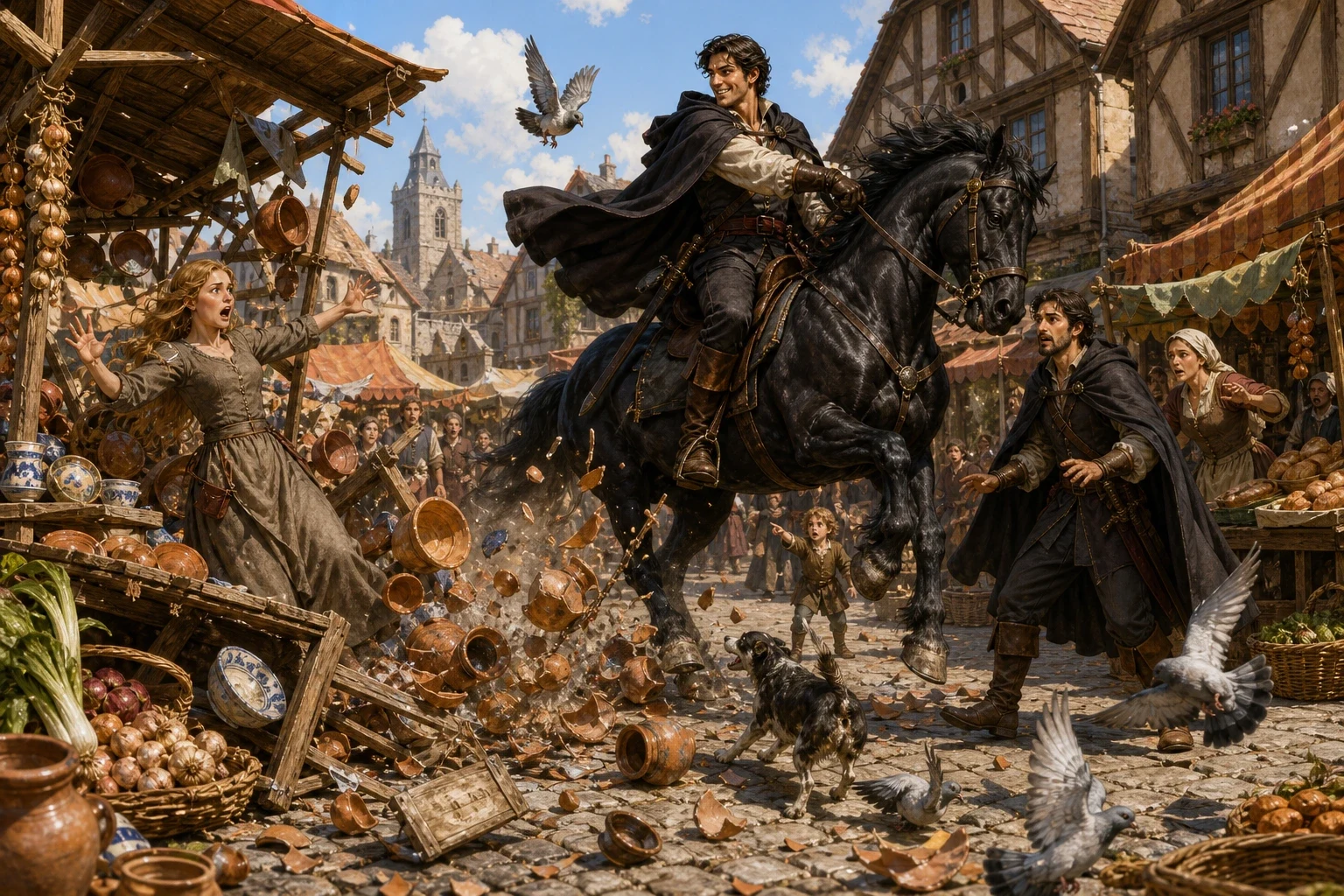
When neither basket-weaving nor spinning had earned them anything, her husband decided to try a third trade. He bought a stock of pots, bowls and earthenware dishes from a potter in the nearest town, and set his wife up with a stall in the village marketplace to sell them. At first this went rather well, for people were glad of good cheap pottery, and even the princess, in her plain dress, found she did not mind sitting behind the stall calling out her prices. But on a busy market morning, a drunken horseman came galloping straight through the square without the least care for anyone in his way. His horse crashed directly into her little stall, scattering pots and bowls across the cobblestones, where every single piece was smashed into pieces beneath its hooves before the rider thundered on, laughing, without ever once looking back. The princess was left sitting among the broken crockery with nothing left to sell at all.
Page 8
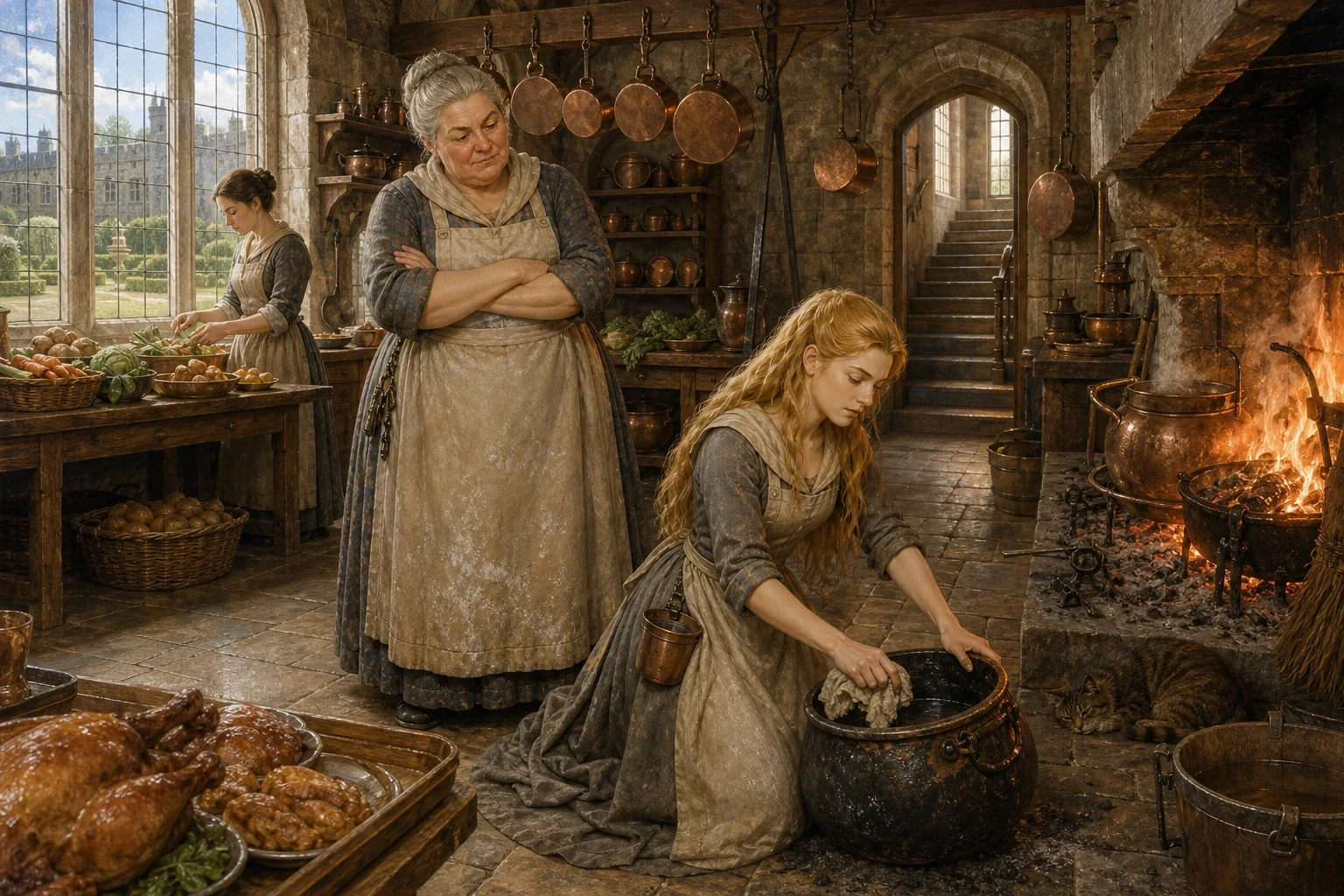
With nothing left to sell and no trade left to try, her husband told her sorrowfully that he had spoken to the cook at a great king's castle nearby, and that she might find work there in the kitchens as a scullery maid. The princess, who had once laughed at every suitor in her father's hall, now swallowed her pride completely and went to the castle to beg for the position herself. The cook, a stout woman with flour always on her hands, looked her over and agreed to take her on, though only for the hardest and humblest work — scrubbing pots, sweeping ashes from the hearth, and carrying out whatever scraps were left over after the grand meals upstairs. The princess tied a little pot to her belt under her apron each evening, so that she might carry home whatever food she was given to share with her husband in their poor hut, never once suspecting that the castle she now swept and scrubbed in belonged to her own husband all along.
Page 9
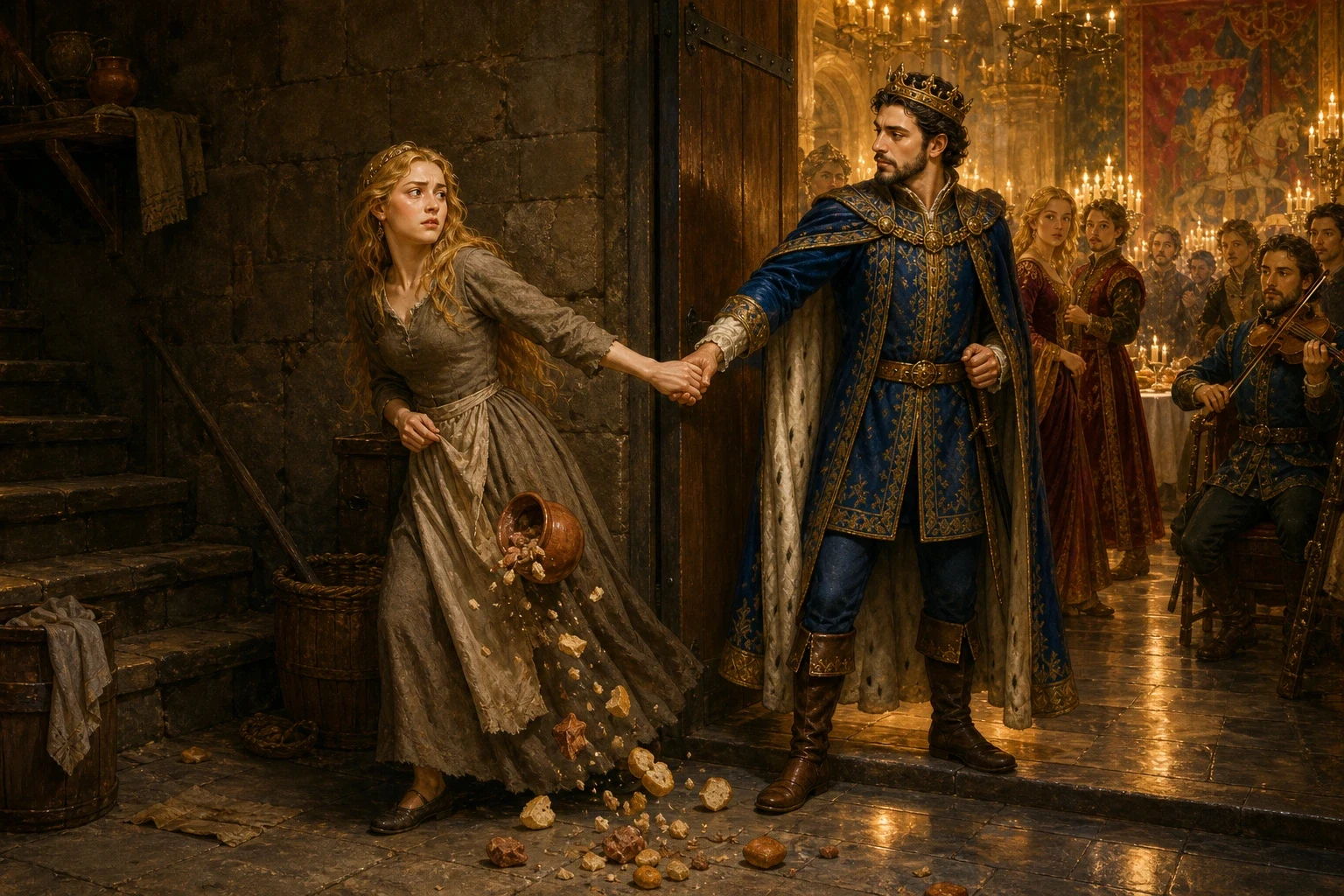
One evening, word went round the kitchens that the young king himself was holding a great feast and ball upstairs, with music and dancing and tables piled high with food, to celebrate his own wedding. Unable to resist, the princess crept up the back stairs in her plain apron to watch through the half-open doorway, just for a moment, at all the splendor she herself had once lived among. But the young king noticed her at once, standing in the shadows of the doorway, and came striding over to take her by the hand and lead her out onto the dancing floor before she could refuse him. As they turned together through the dance, the little pot of scraps hidden under her apron for her husband's supper came loose and spilled — bits of bread and meat scattered across the polished floor in front of every lord and lady in the hall. The princess, scarlet with shame, tore her hand free and ran for the stairs as the whole room burst into laughter behind her.
Page 10

Then the young king took both her hands gently and told her the truth at last: that he himself was the suitor she had mocked as a thrush-chinned stranger, the ragged minstrel she had been married to in anger, and the poor husband she had tried to work for in the forest hut, all three one and the same man, King Thrushbeard, and that he had arranged every single trial himself to humble her pride. The princess wept bitterly, ashamed of all her old cruelty, but he comforted her and told her all was forgiven. Her own father the king was sent for and brought into the great hall, astonished and overjoyed to find his daughter so happily and so truly married after all. The whole castle was dressed in its finest for a real wedding feast at last, with music, dancing and a banquet fit for any king, and the princess and King Thrushbeard lived together afterward in true happiness, the proudest lesson of her life learned and done.
About this story
- Audience: kids (ages 6–12)
Read Wonder Tales on your phone
Wonder Tales is available on Android. Get Wonder Tales on Google Play.