What We Actually Know About Ancient Egypt's 3,000 Years
From unification around 3100 BC to Cleopatra’s death in 30 BC, Ancient Egypt lasted longer than the gap between the pyramids and today. It wasn’t one unbroken era — it rose, broke apart, and rebuilt itself repeatedly.
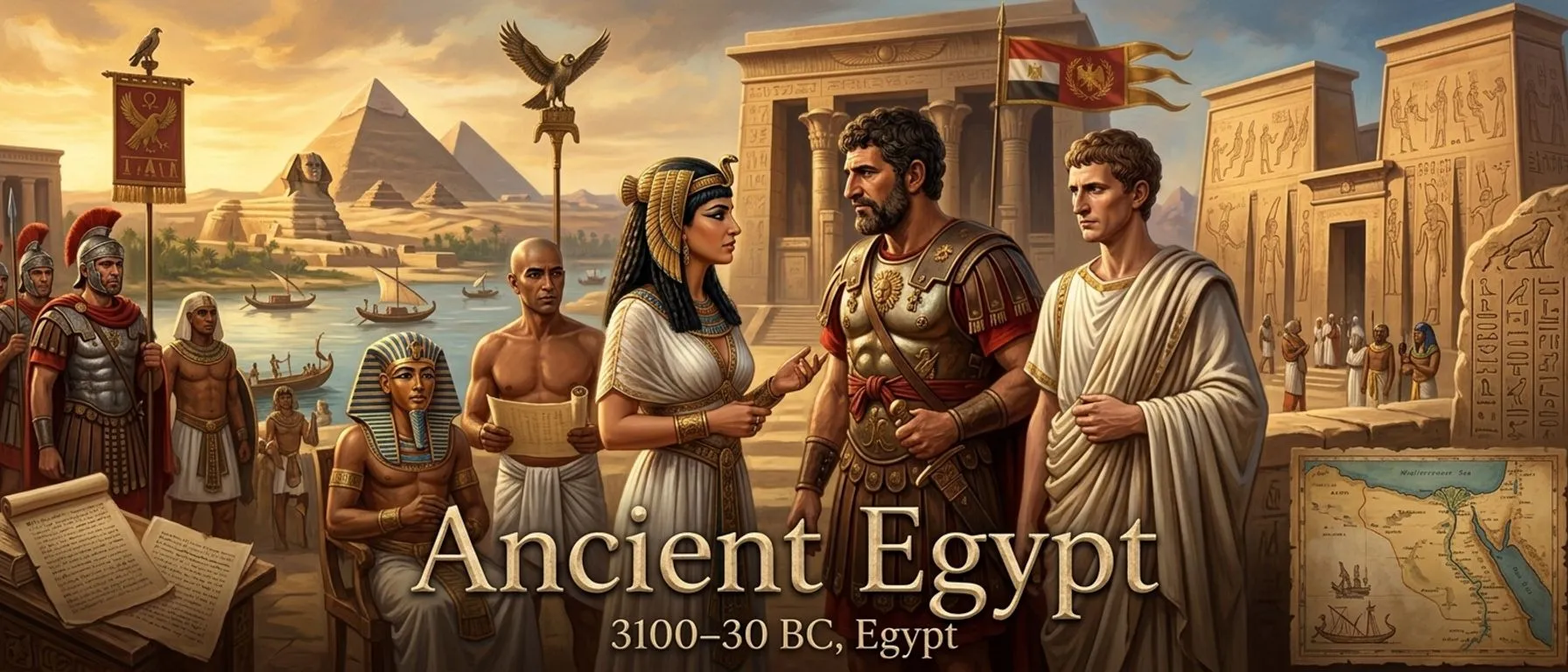
Ancient Egypt is often talked about as though it were one long, continuous civilization, but the timeline itself argues against that. From unification under its earliest pharaohs around 3100 BC to Cleopatra VII’s death in 30 BC, Egyptian civilization spans more than 3,000 years — longer than the distance separating the building of the Great Pyramid from today. Across that span, Egypt wasn’t a single unbroken kingdom; it rose to great strength, fractured into competing regional powers, and reunified more than once, in cycles historians now group into named Kingdoms and Intermediate Periods.
That length matters for how the civilization should actually be understood. Tutankhamun, the New Kingdom pharaoh most people picture first, ruled roughly 1,300 years after the pyramids at Giza were built — a longer gap than separates his own reign from the present day. Cleopatra, similarly, lived closer in time to the moon landing than to the construction of the pyramids. "Ancient Egypt" covers eras as different from each other as they are from the Egypt of today.
The Old Kingdom: the age of the pyramid builders
After unification during the Early Dynastic Period (roughly 3100–2686 BC), Egypt entered the Old Kingdom, around 2686–2181 BC — the era now remembered as the age of the pyramid builders. The three great pyramids at Giza date to this period, along with the Great Sphinx, carved with the head of the king Khafre atop a lion’s body. Building monuments at this scale required a level of centralized authority, organized labor, and surplus resources that took centuries of state-building to reach; it didn’t happen at the very start of Egyptian civilization; it happened roughly four to five centuries in, once the kingdom had matured enough to support it.
Collapse, reunification, and the empire that followed
The Old Kingdom didn’t simply continue — it broke apart into the First Intermediate Period (roughly 2181–2040 BC), a genuinely fractured era with rival power centers at Heracleopolis and Thebes competing for control. Reunification brought the Middle Kingdom (c. 2040–1786 BC), remembered for relative stability and a notable flourishing of Egyptian literature, before a second breakdown, the Second Intermediate Period, saw the Hyksos — rulers from the Near East — seize control of northern Egypt.
Egypt’s most expansive era, the New Kingdom (c. 1567–1069 BC), followed that second collapse. This is the imperial age most associated with famous names — Hatshepsut, Akhenaten, Tutankhamun, Ramesses II — and with the elaborate royal burials of the Valley of the Kings. Even this golden age eventually gave way to the fragmented Third Intermediate and Late Periods, and finally to foreign rule: Persian conquest, then Alexander the Great’s conquest in 332 BC, which opened the Ptolemaic Period. Cleopatra VII, the dynasty’s final ruler, governed from 51 to 30 BC; her death after defeat by Octavian marks the conventional end of pharaonic Egypt, as the country became a province of Rome.
Told as an illustrated story
Frequently Asked Questions
How long did Ancient Egyptian civilization actually last?
Roughly 3,000 years, from unification under its earliest pharaohs around 3100 BC to the death of Cleopatra VII in 30 BC, when Egypt became a province of Rome. That is longer than the time separating the building of the Great Pyramid from today.
Was Ancient Egypt one continuous kingdom the whole time?
No. Egyptologists divide the period into Kingdoms (Old, Middle, and New) separated by Intermediate Periods, during which centralized rule broke down into competing regional powers. Egypt reunified more than once before eventually falling to Persian and then Greek and Roman rule.
Were the pyramids built at the start of Ancient Egyptian history?
No — the Giza pyramids were built during the Old Kingdom, roughly four to five centuries after Egypt’s initial unification around 3100 BC, once the state had built up the organization and resources such monuments required. Tutankhamun, by comparison, ruled about 1,300 years after the pyramids were completed.