A Burial at Ornans by Gustave Courbet (France — 1849)
A Burial at Ornans by Gustave Courbet (France — 1849) — an illustrated arts story, set in France. 10 illustrated pages, free to read on Wonder Arts.
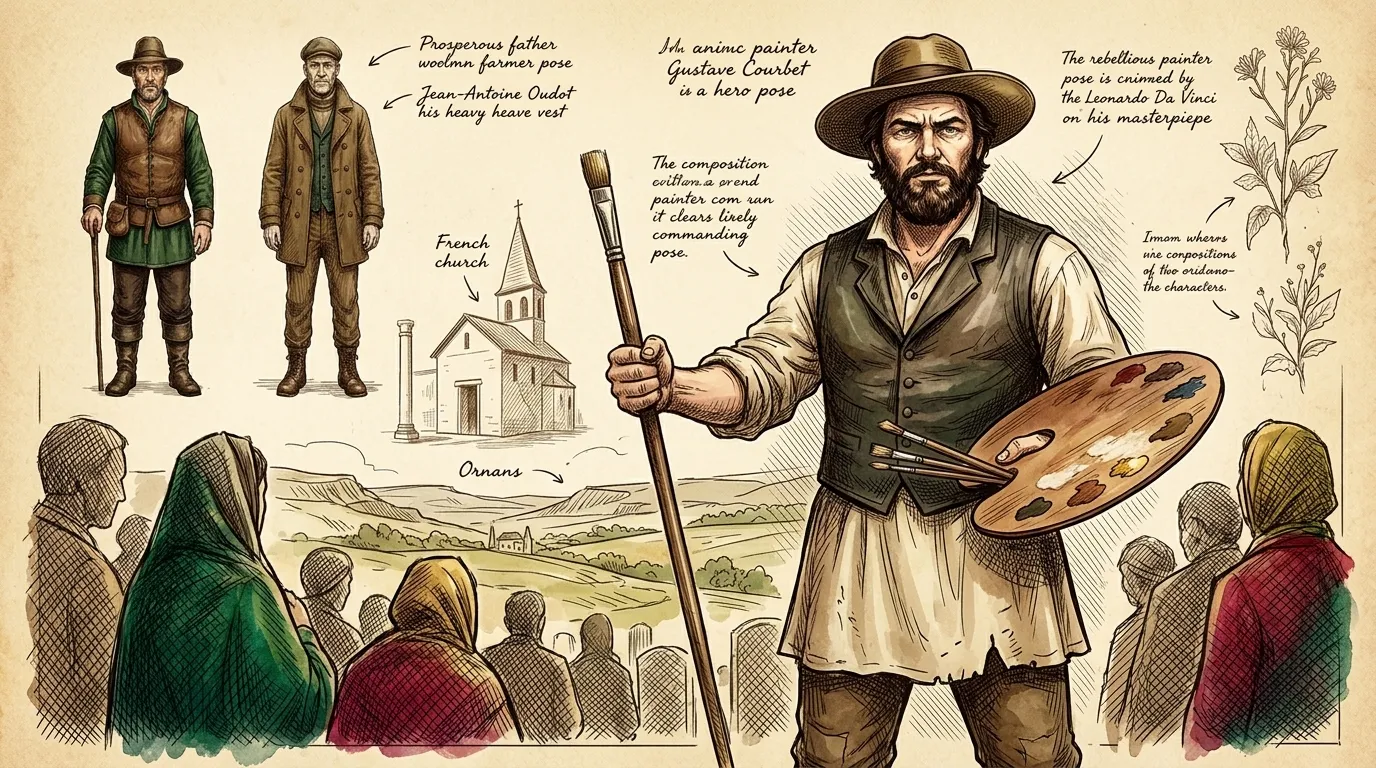
Page 1
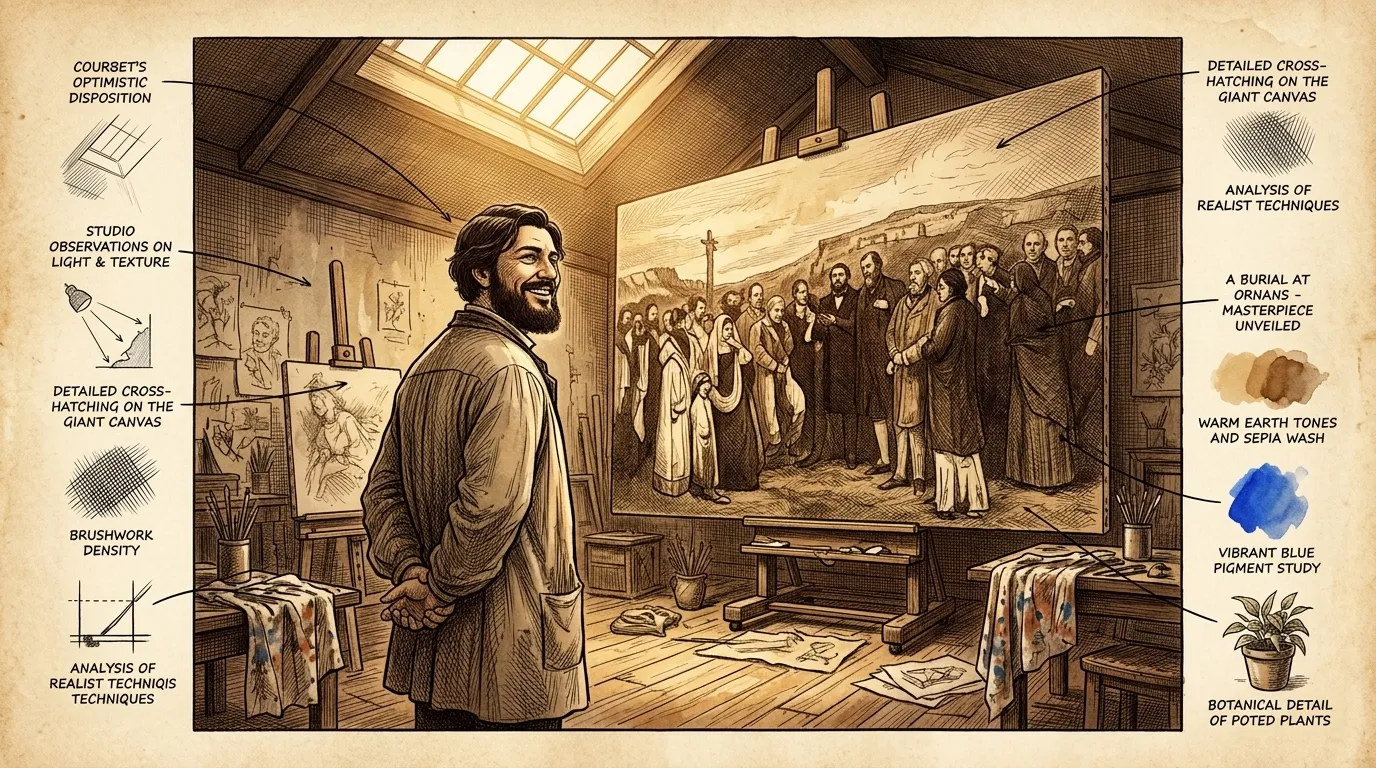
Gustave Courbet, a figure of unyielding principle, stands before 'A Burial at Ornans,' a canvas that defied convention. Completed in 1850, this painting, measuring a monumental 10 feet by 22 feet, challenged the established norms of French art. Its realism was so stark, so devoid of idealized sentiment, that it sparked outrage and cemented Courbet's reputation as a revolutionary.
"Courbet mutters to himself, his eyes reflecting the dim light of his studio. 'They want heroes and gods? I'll give them the people, in all their mortal truth.'"
Art Fact: A Burial at Ornans is a Realist masterpiece, housed at the Musée d'Orsay, Paris. It depicts an ordinary funeral, challenging the Romanticism of the time. Its scale, typically reserved for history paintings, further emphasized Courbet's radical approach.
Page 2
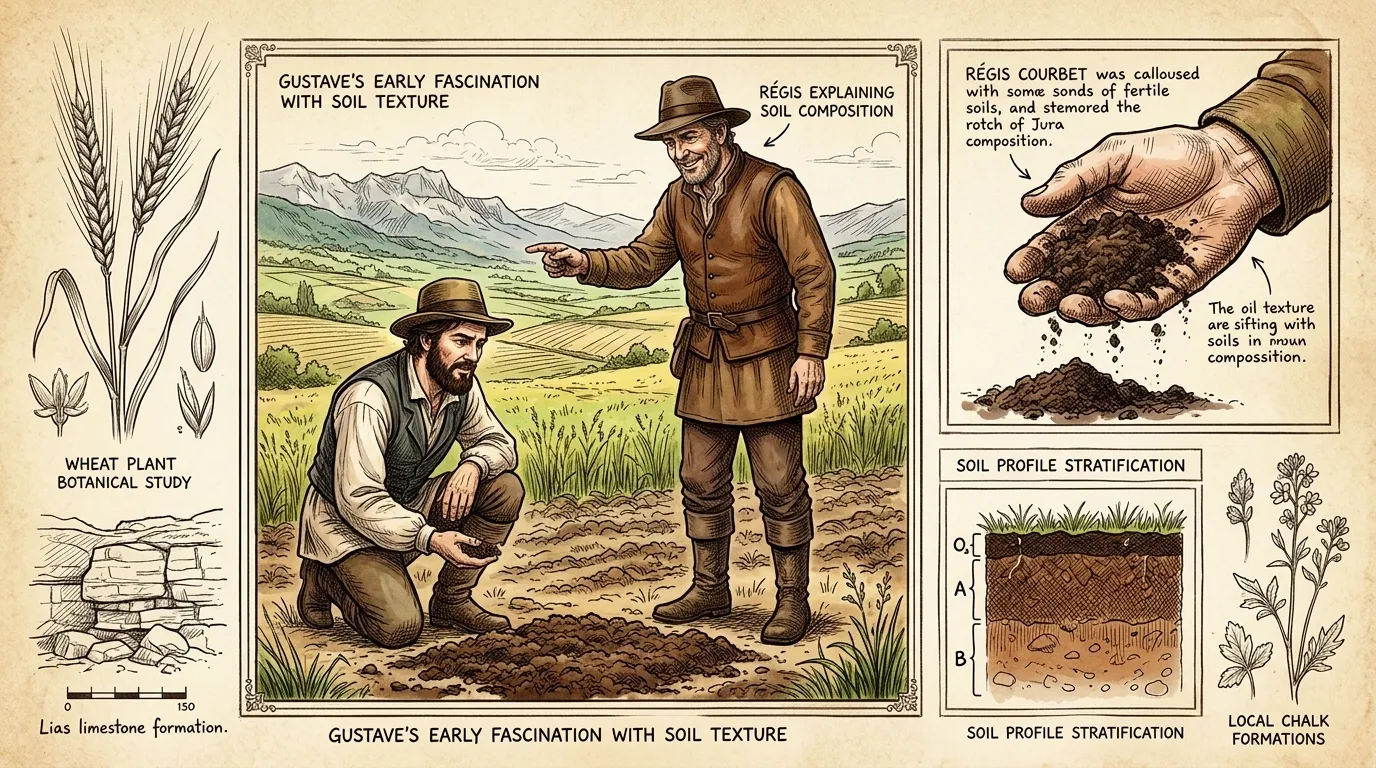
Young Gustave's formative years in Ornans, a small town nestled in the Franche-Comté region, profoundly shaped his artistic vision. The stark beauty of the Jura mountains, the honest labor of the local farmers, and the unvarnished reality of rural life became the bedrock of his realism. It was here, amidst the earth and stone, that Courbet learned to see the world with unflinching clarity.
"His father, Régis Courbet, a prosperous farmer, tells young Gustave, 'Look at the land, Gustave. See the truth in it, not some pretty ideal.' Gustave replies, 'But Papa, the books show kings and queens. Not farmers.' Régis retorts, 'Kings and queens are fleeting; the land endures.'"
Art Fact: Courbet's father, Régis, encouraged his son's artistic inclinations, yet also instilled in him a deep respect for the realities of peasant life. This balance would later inform Courbet's revolutionary approach to art.
Page 3
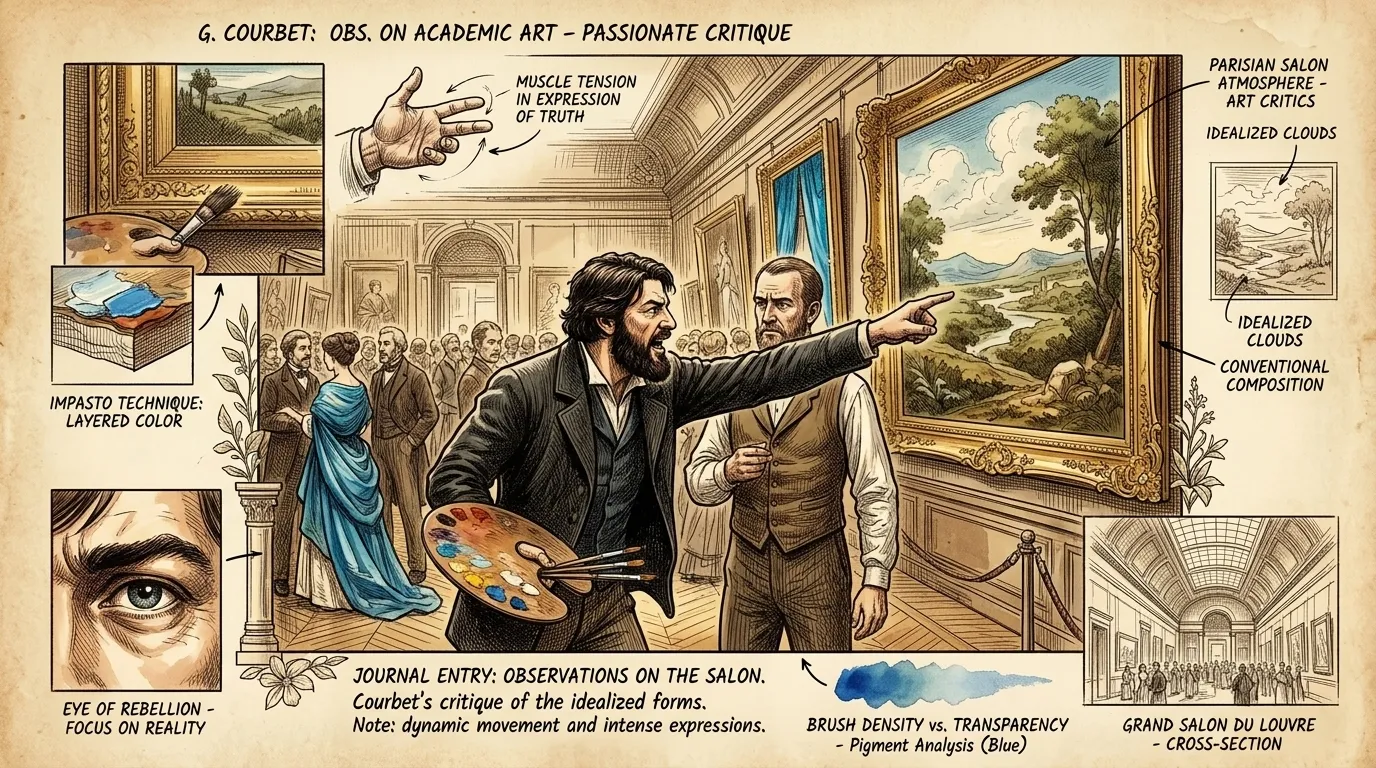
Arriving in Paris to study law, Gustave quickly gravitated towards the city's vibrant art scene. However, he soon grew disillusioned with the idealized subjects and theatrical dramas favored by the Academy. He sought a different truth, one that resonated with his own experiences and observations.
"In a bustling Parisian salon, Gustave vents to a friend, 'These paintings... they're all lies! Where are the real people? Where is the dirt and sweat of honest labor?' The friend, Samuel, replies, 'But Gustave, art is meant to elevate, to inspire!' Courbet retorts, 'I'll find beauty in the ordinary. That's where truth resides.'"
Art Fact: Courbet's rejection of academic conventions marked the beginning of his artistic rebellion. He embraced realism not just as a style, but as a philosophical stance.
Page 4
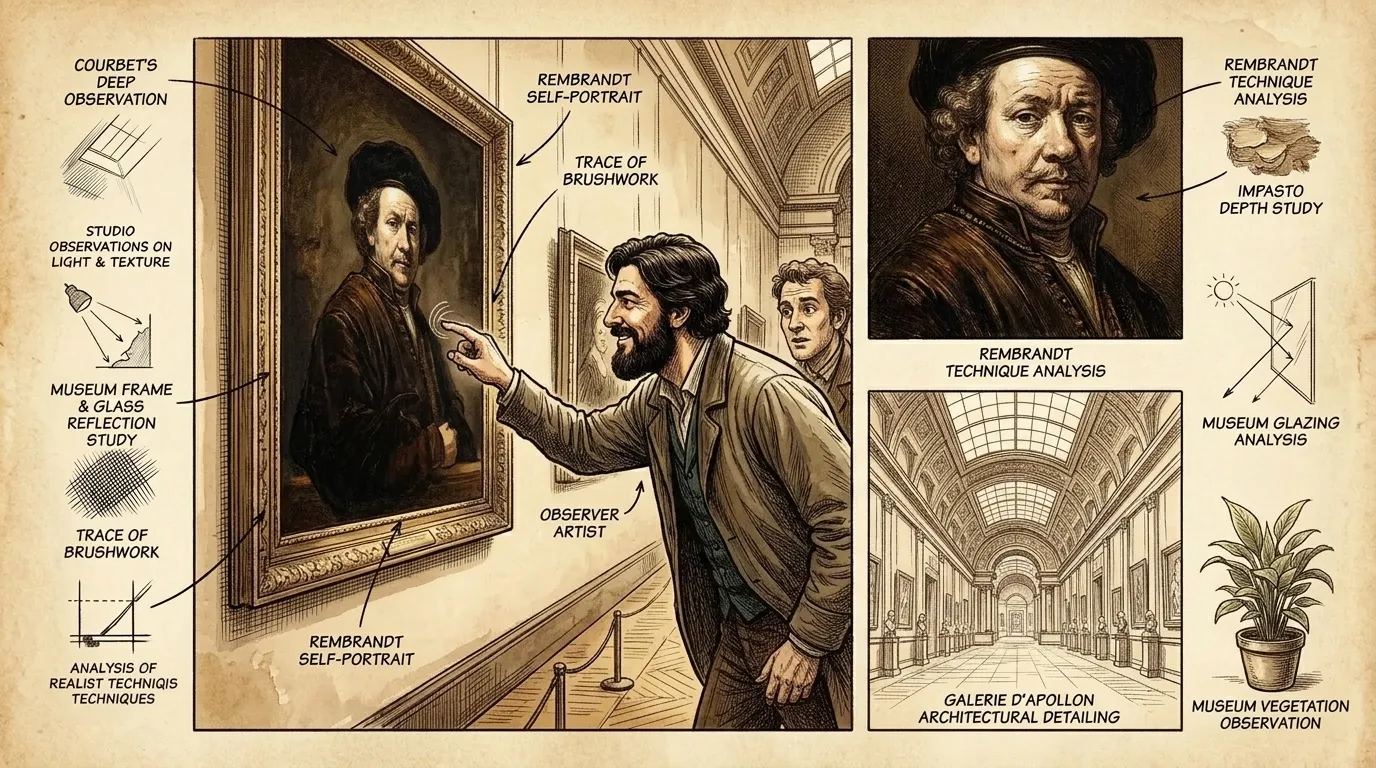
While rejecting the contemporary art establishment, Courbet found inspiration in the works of the Old Masters. He studied the unflinching realism of Caravaggio and the earthy humanity of Rembrandt, learning from their techniques and absorbing their dedication to portraying the world as it truly was.
"In the Louvre, Courbet observes a Rembrandt self-portrait. He notes, 'Look at the shadows, the honesty in his gaze. No flattery, no pretense. Only truth.' A fellow artist nearby comments, 'Rembrandt was a master of light and shadow, but his subjects were often elevated.' Courbet responds, 'Elevation comes from truth, not from subject matter.'"
Art Fact: Courbet's study of the Old Masters provided him with a foundation for his own artistic explorations. He admired their technical skill but sought to apply it to subjects that were relevant to his own time.
Page 5
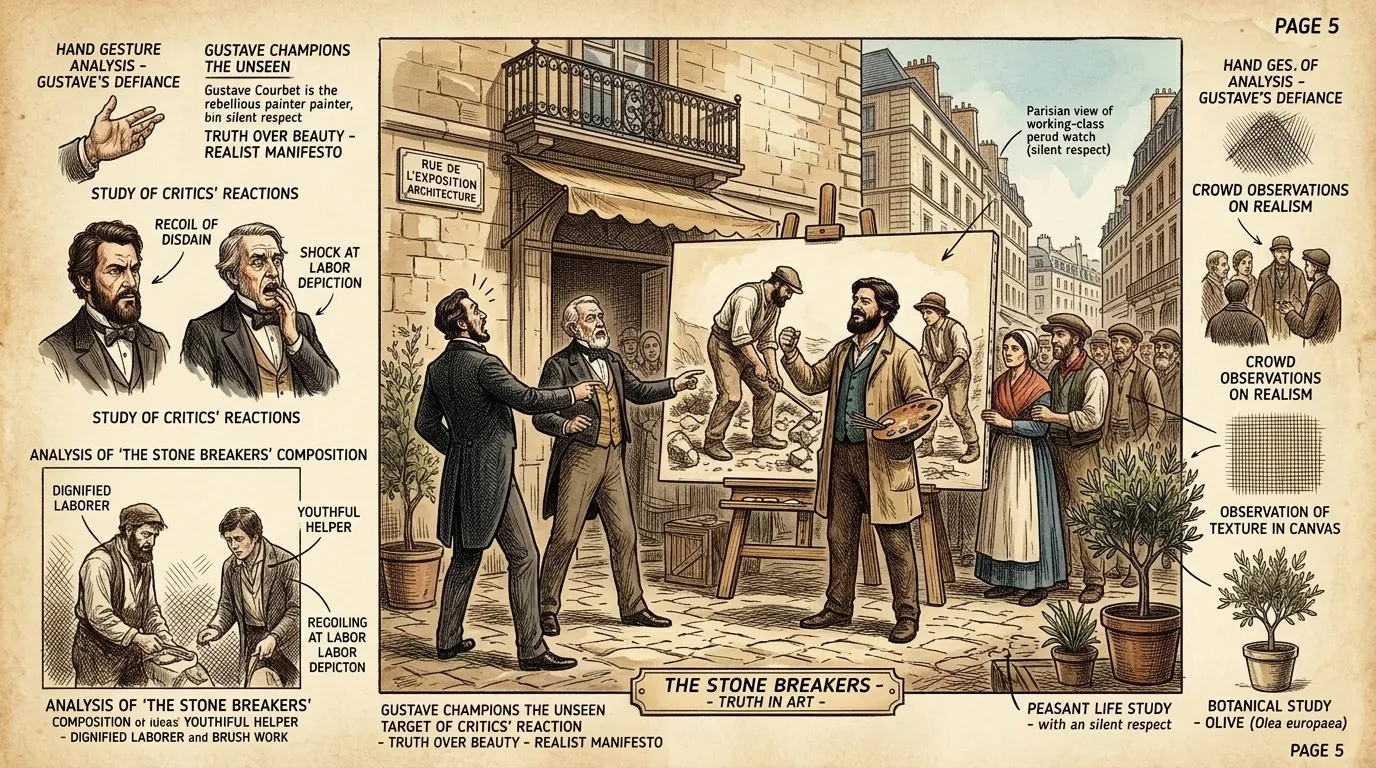
In 1849, Courbet exhibited 'The Stone Breakers,' a painting depicting two laborers engaged in backbreaking work. The painting's unvarnished depiction of poverty and toil scandalized the art world, further solidifying Courbet's reputation as a radical and a troublemaker. The artwork was destroyed during WWII.
"A critic scoffs at 'The Stone Breakers,' 'It's ugly! It glorifies poverty!' Courbet retorts, 'Poverty is a reality. Why should art ignore it? I'll show the dignity of labor, not just the glamour of wealth.' Another critic responds, 'But art should inspire hope, not despair!' Courbet says sharply, 'Hope comes from acknowledging truth.'"
Art Fact: 'The Stone Breakers' was a pivotal work in Courbet's career. Its destruction during World War II makes its message of social realism even more poignant.
Page 6
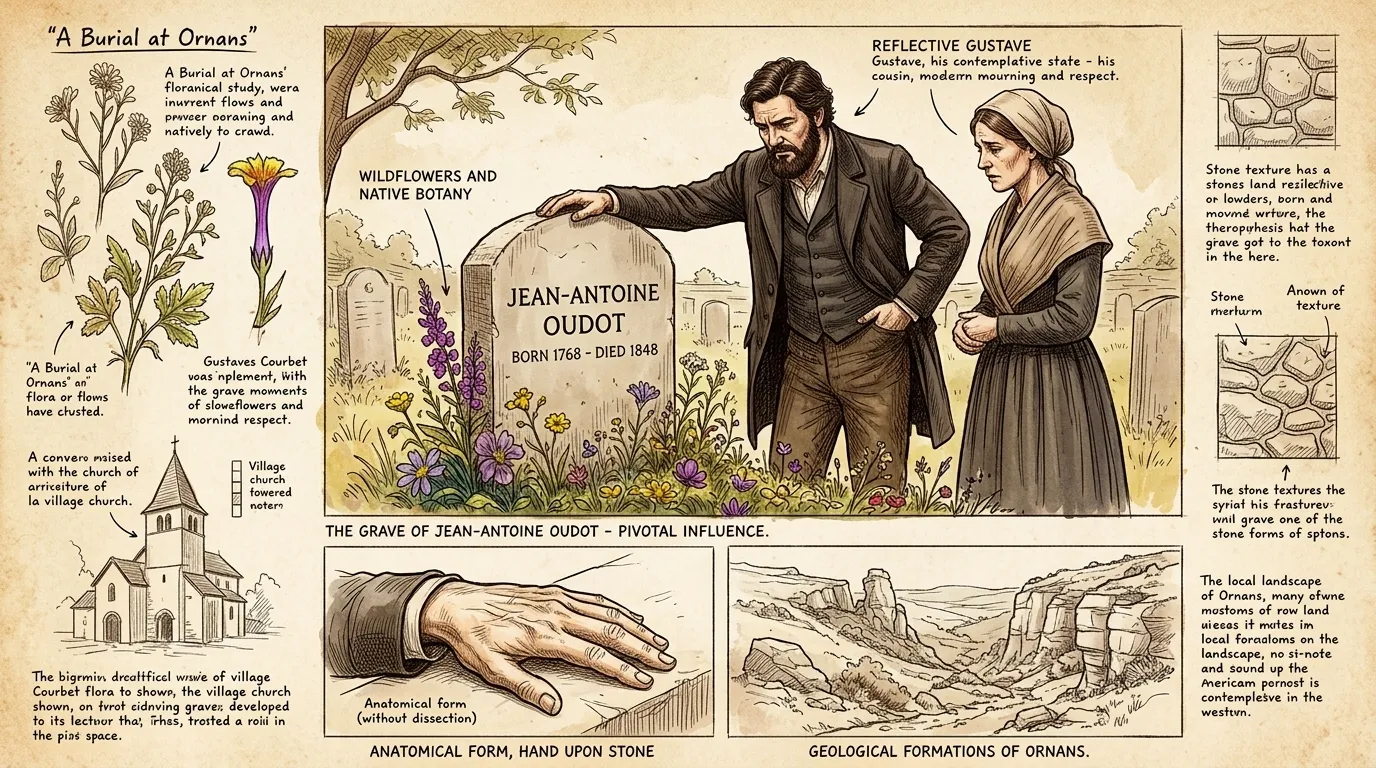
The death of Courbet's grandfather, Jean-Antoine Oudot, in 1848, deeply affected him. This personal loss, combined with his commitment to realism, inspired him to depict an ordinary funeral on a monumental scale. He said, 'I do not paint angels, because I have never seen them.'
"At his grandfather's graveside, Courbet says to a family member, 'We must remember him as he was, not as some idealized figure.' His cousin replies, 'But isn't a funeral meant to celebrate a life?' Courbet states, 'It's meant to acknowledge death, the great leveler.'"
Art Fact: Courbet's personal grief, combined with his artistic convictions, led to the creation of 'A Burial at Ornans,' a painting that challenged the traditional norms of funerary art.
Page 7
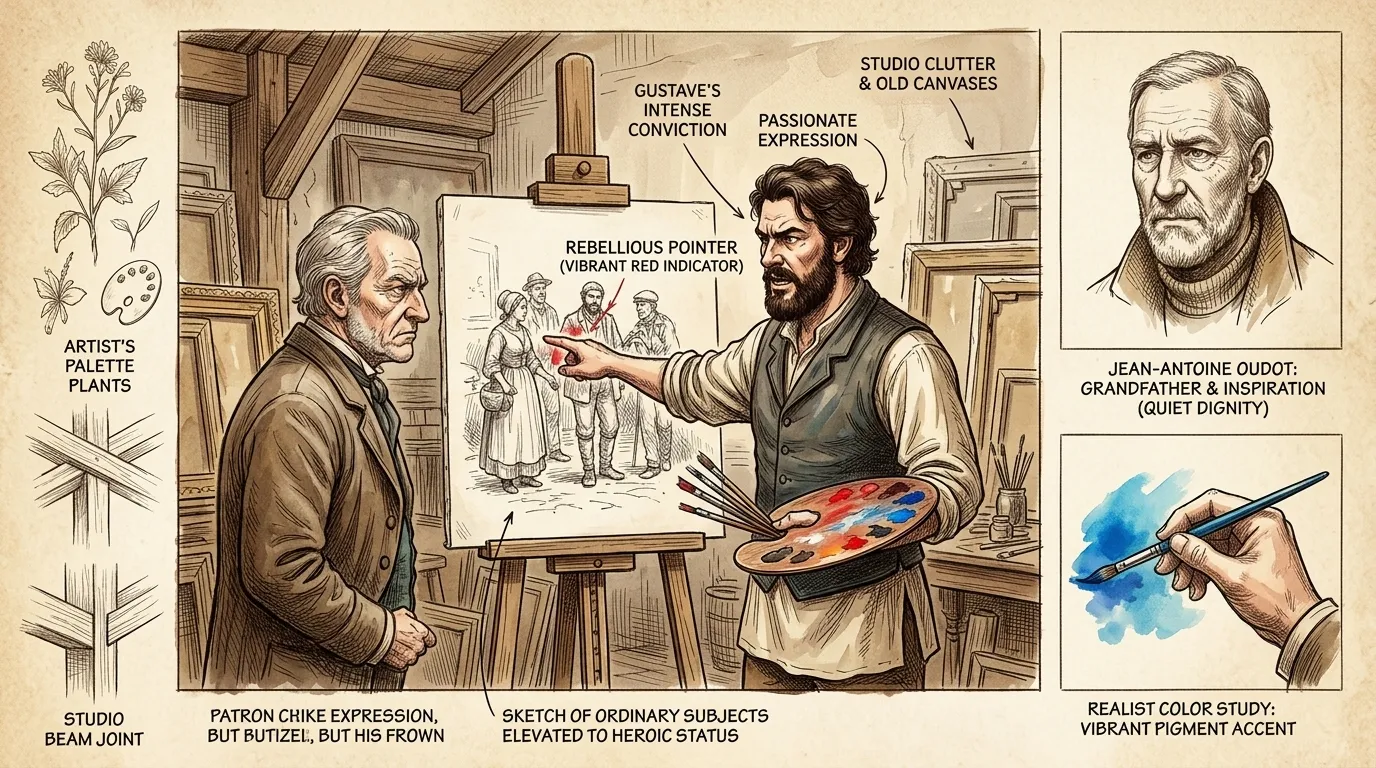
Courbet's decision to paint an ordinary funeral on a canvas typically reserved for historical or religious subjects was a deliberate act of defiance. He wanted to elevate the common man to the level of the grand narratives of the past.
"In his studio, Courbet argues with his patron, 'Why should history paintings be grander than life itself?' His patron counters, 'Because they depict important events, heroes, and gods!' Courbet points to a sketch of ordinary people. 'These are the heroes of our time. The ones who endure.'"
Art Fact: Courbet's monumental scale for 'A Burial at Ornans' was a bold statement, challenging the established hierarchy of artistic subjects.
Page 8
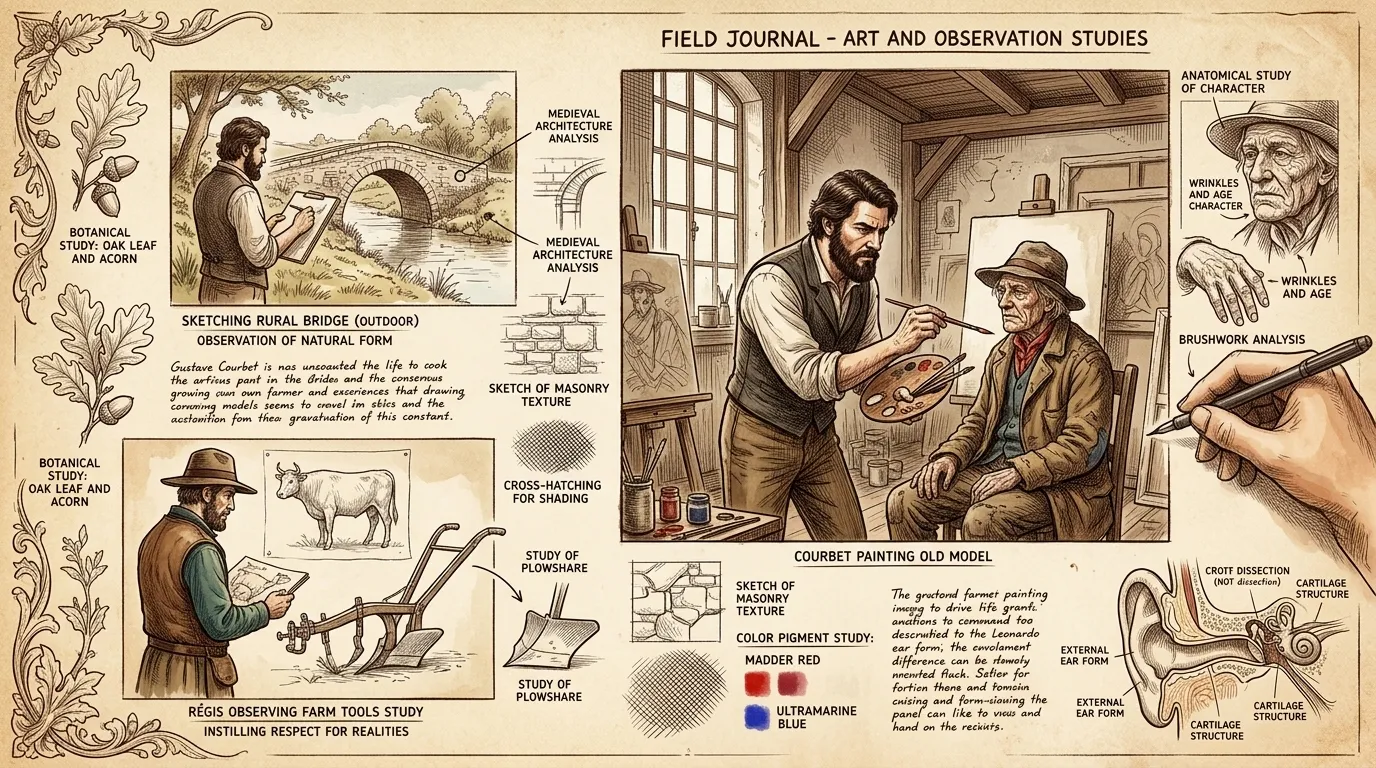
For 'A Burial at Ornans,' Courbet insisted on painting portraits of real people from his hometown. He refused to idealize his subjects, capturing their individual features, their wrinkles, and their expressions of grief with unflinching honesty. He wanted a burial in France to reflect life in France.
"Courbet instructs a sitter. 'Hold still, don't pose. I want to capture your true face.' A sitter complains, 'But my wrinkles, my sagging cheeks...' Courbet retorts, 'Those are the marks of life. The story of your experience.'"
Art Fact: Courbet's commitment to painting from life, without idealization, was a radical departure from the artistic conventions of his time.
Page 9
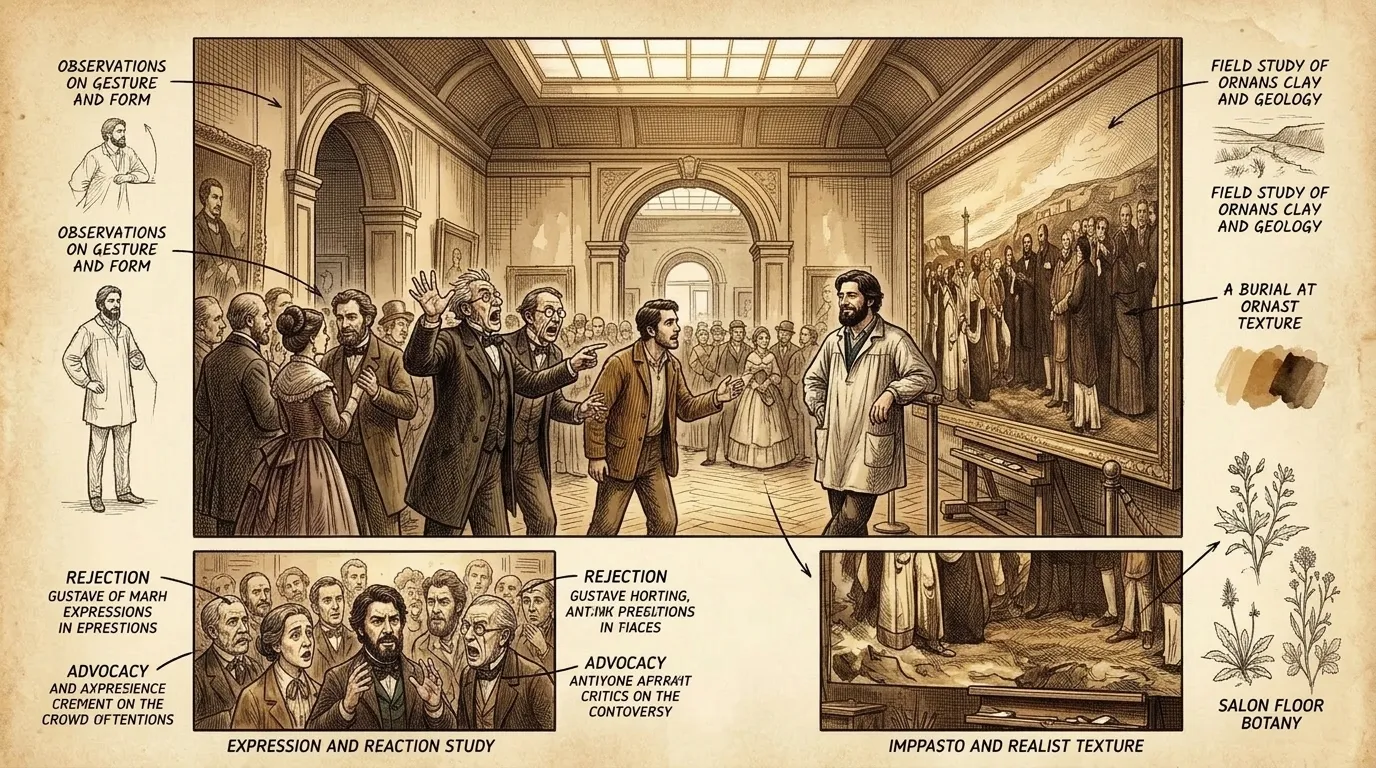
When 'A Burial at Ornans' was submitted to the Paris Salon of 1850, it was met with widespread criticism and rejection. Critics condemned its unidealized figures, its somber colors, and its lack of dramatic action. It was deemed vulgar and unworthy of the grand scale on which it was painted. As Confucius once said, 'Real knowledge is to know the extent of one's ignorance.' Perhaps the critics, in their rejection, were showing their own limited understanding.
"At the Salon, a critic exclaims, 'It's hideous! It's a travesty of art!' Another responds, 'Where is the beauty, the grace? It's just a bunch of ordinary people!' A supporter tries to say, 'It's about the common man, dignity.' The critic yells, 'Dignity isn't ugly.'"
Art Fact: Despite the initial rejection, 'A Burial at Ornans' eventually came to be recognized as a masterpiece of Realism, a pivotal work that paved the way for future generations of artists.
Page 10
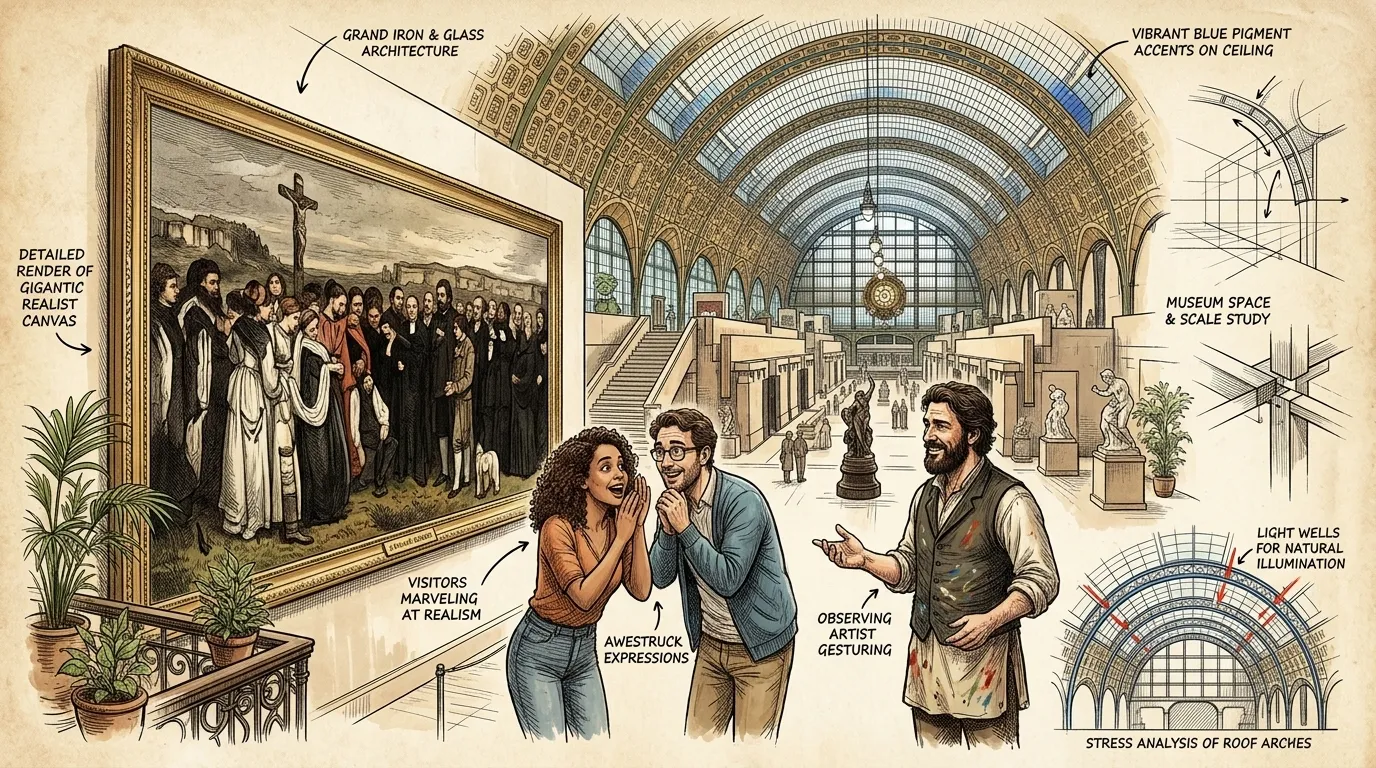
Today, 'A Burial at Ornans' stands as a testament to Courbet's unwavering commitment to truth and his profound influence on the course of art history. Its unflinching realism and its elevation of the common man continue to inspire artists and viewers alike. Courbet's legacy endures because, as he himself declared, 'Painting is essentially a concrete art and can only consist of the representation of real and existing things.'
"A museum visitor, standing before 'A Burial at Ornans', whispers to their companion, 'It's so real, so honest. It's like looking into the past.' A artist adds, 'Courbet changed everything. He showed us that beauty can be found in the ordinary.'"
Art Fact: A Burial at Ornans is now housed at the Musée d'Orsay, Paris. The painting's uncompromising vision has cemented Courbet's position as a pioneer of Realism and a champion of artistic freedom.
About this story
- Location: France
- Audience: general readers
Questions and answers
Questions and answers about A Burial at Ornans by Gustave Courbet (France — 1849)
Read Wonder Arts on your phone
Wonder Arts is available on Android. Get Wonder Arts on Google Play.
More Wonder Arts stories
- A Cavalier by Frans Hals (Australia — 1624)
- A Sunday on La Grande Jatte by Georges Seurat (Paris, France — 1884)
- Abbey in the Oakwood by Caspar David Friedrich (Germany — 1810)
- Abstract Expressionism by Jackson Pollock (New York, USA — 1940s)
- Al-Azhar Mosque (Cairo, Egypt — 972)
- American Gothic by Grant Wood (Chicago, USA — 1930)