Apollo and Daphne by Gian Lorenzo Bernini (Rome, Italy — 1625)
Apollo and Daphne by Gian Lorenzo Bernini (Rome, Italy — 1625) — an illustrated arts story, set in Italy. 10 illustrated pages, free to read on Wonder Arts.
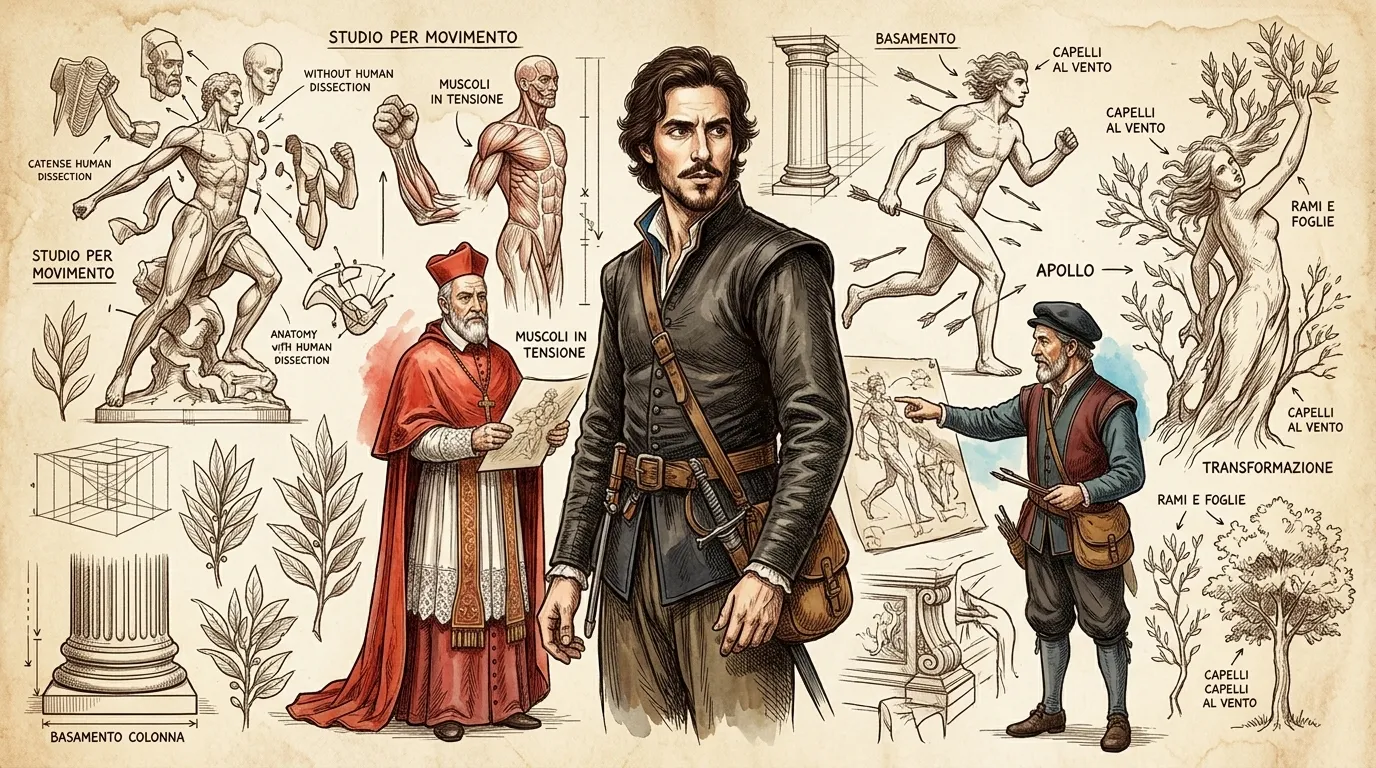
Page 1
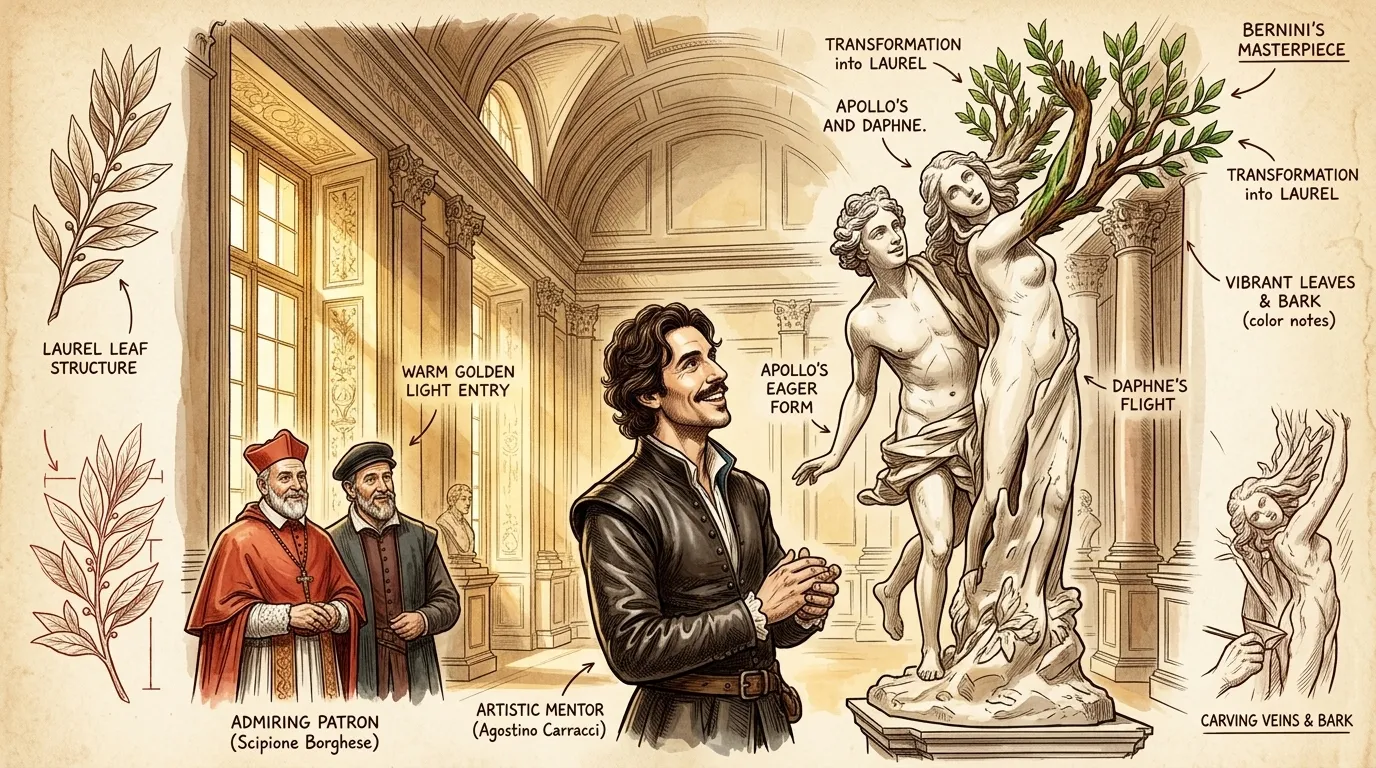
Gian Lorenzo Bernini stands before his masterpiece, Apollo and Daphne, completed in 1625. The sculpture, housed today in the Galleria Borghese in Rome, captures the dramatic climax of Ovid's Metamorphoses. Its life-size marble figures, nearly seven feet tall, embody the moment Daphne transforms into a laurel tree to escape Apollo's pursuit. What's most astonishing is how Bernini made cold marble convey such vibrant emotion and movement.
""This marble breathes," Bernini murmured, his eyes reflecting the light dancing across Daphne's transforming limbs. "It sings of terror, desire, and the profound change that defines our existence.""
Art Fact: Apollo and Daphne demonstrates Bernini's mastery of Baroque sculpture, blending intense drama with technical virtuosity. Its creation was commissioned by Cardinal Scipione Borghese.
Page 2
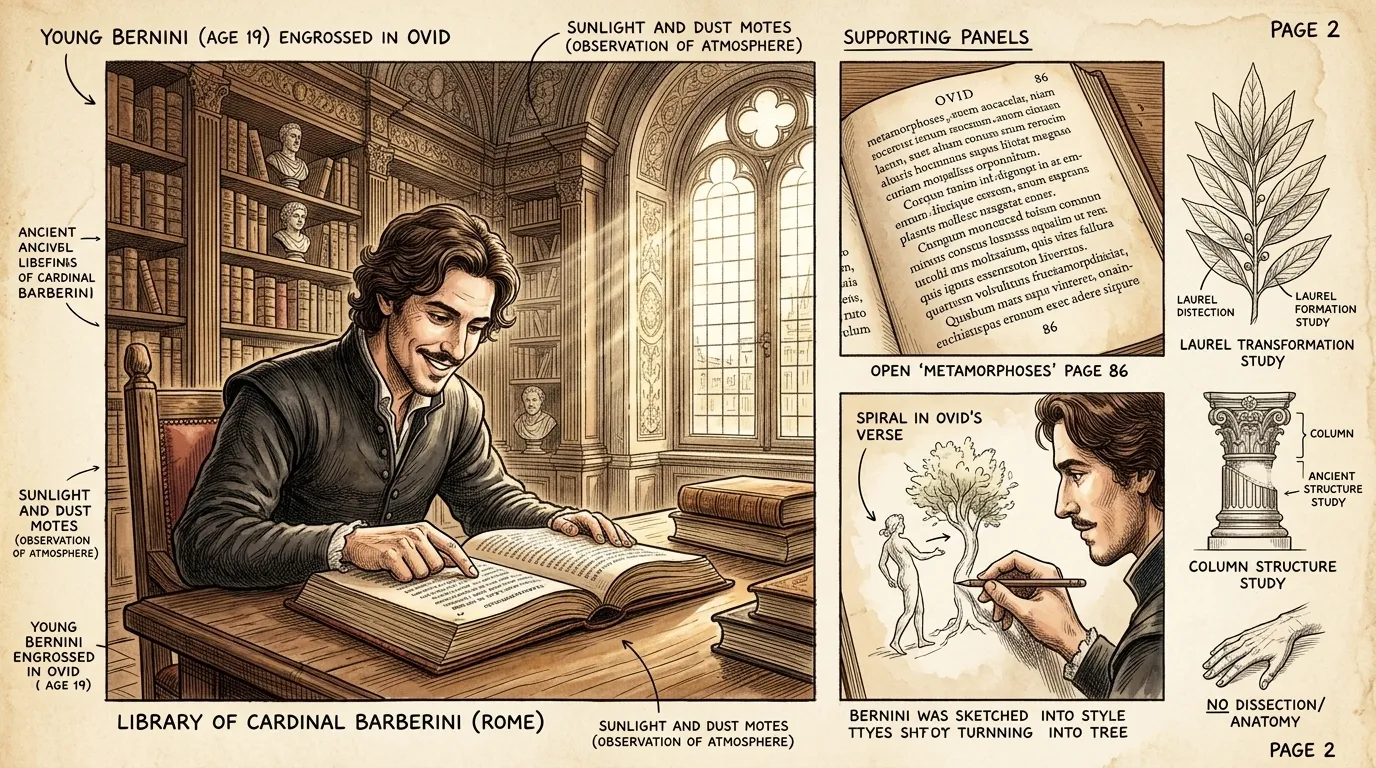
Young Gian Lorenzo pores over a well-worn copy of Ovid's Metamorphoses, his imagination ignited by the vivid tales of gods and mortals. The library of Cardinal Maffeo Barberini, later Pope Urban VIII, becomes his sanctuary. Here, surrounded by ancient texts and Renaissance art, Bernini finds the inspiration that will shape his artistic vision for decades to come.
""Ovid understood transformation," Gian Lorenzo mused, tracing the words with his finger. "He saw the world as a place of constant flux, where boundaries blur and anything is possible.""
Art Fact: Ovid's Metamorphoses, a collection of mythological narratives, provided Bernini with a rich source of dramatic and emotional subjects for his sculptures.
Page 3
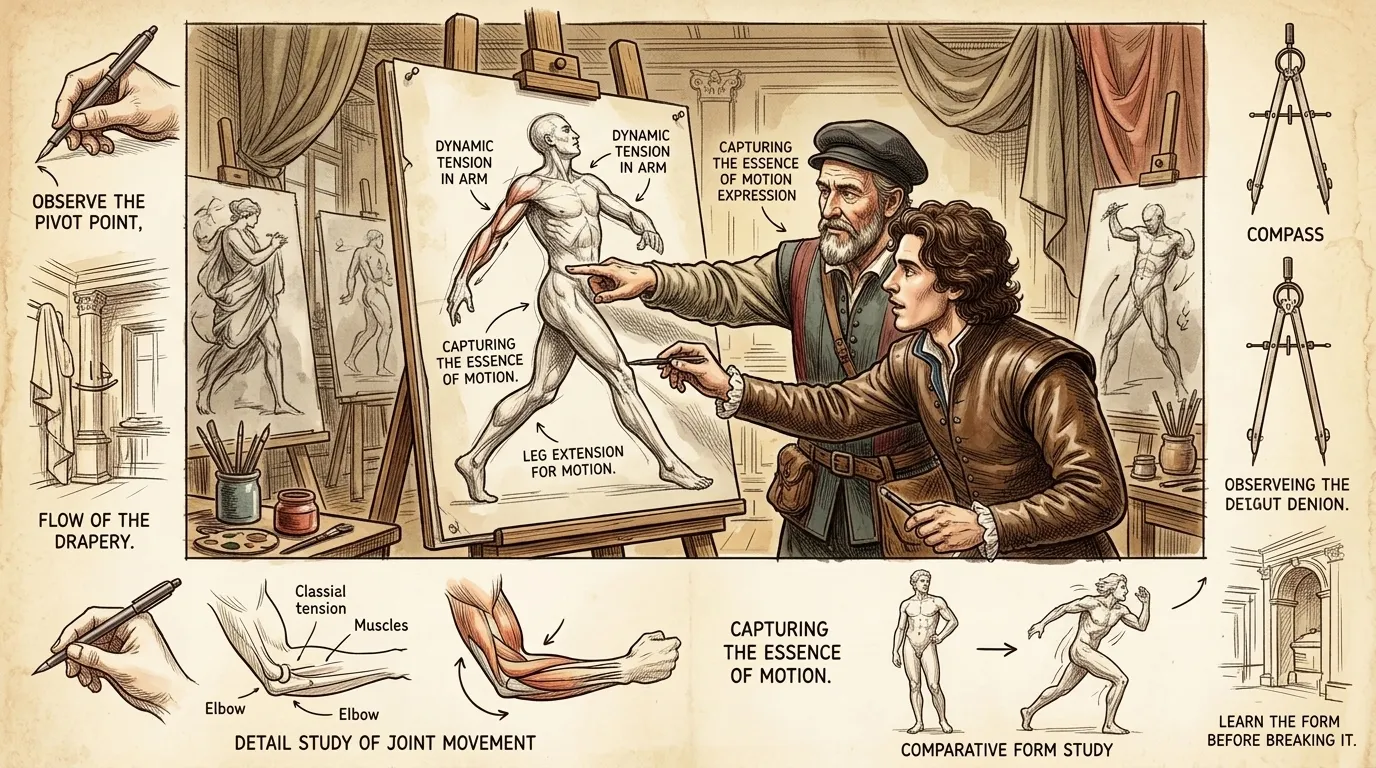
Agostino Carracci, a master painter and engraver, guides the young Gian Lorenzo in the art of drawing and anatomy. Carracci's studio, filled with sketches and anatomical studies, becomes Bernini's training ground. He learns to capture the human form with accuracy and expressiveness, a skill crucial for his later sculptural works. "Remember, Gian Lorenzo," Carracci advises, "truth is beauty and beauty truth, as the poet John Keats said. You must understand what you depict".
""See the muscles beneath the skin," Carracci explained, his hand guiding Gian Lorenzo's. "Understand how they move and interact. Only then can you bring life to stone.""
Art Fact: Agostino Carracci's emphasis on anatomical accuracy and expressive drawing greatly influenced Bernini's sculptural style.
Page 4
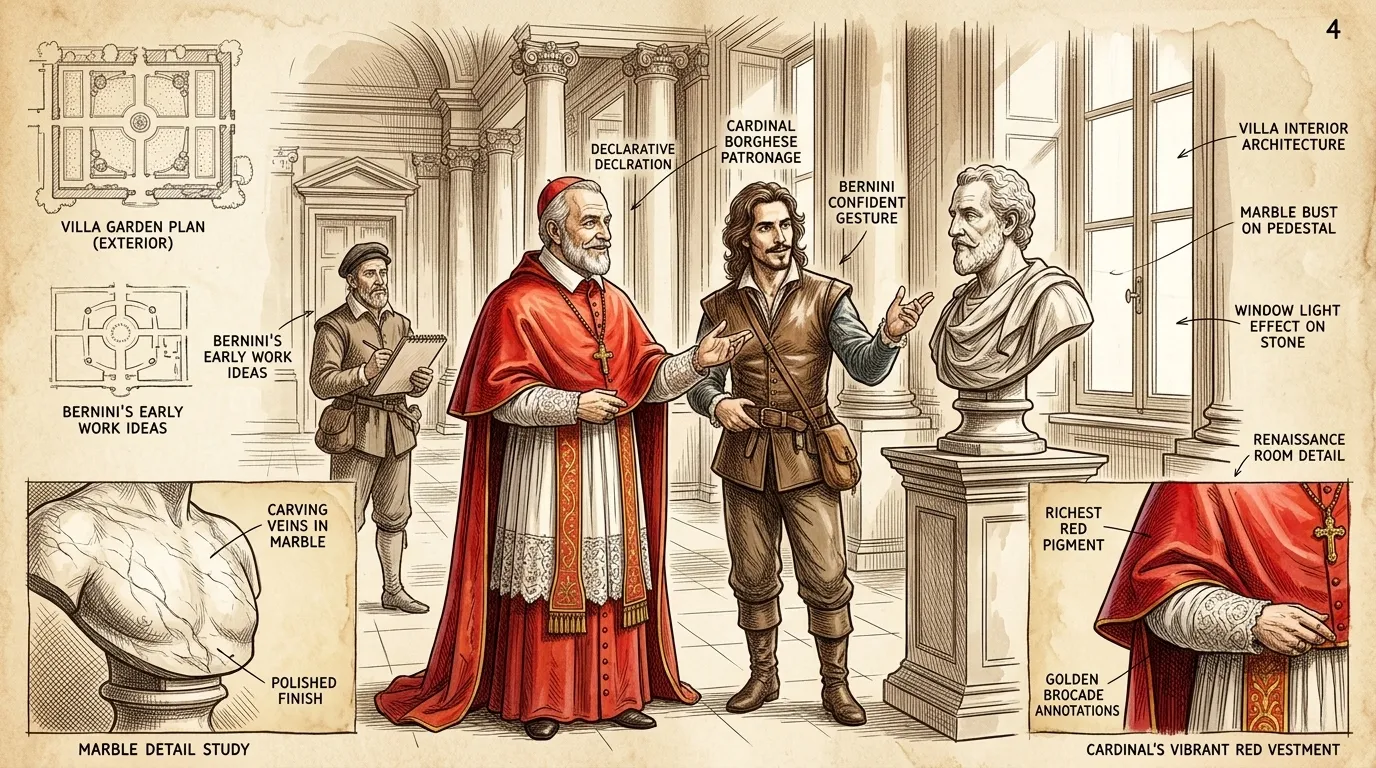
Cardinal Scipione Borghese, a powerful art patron, recognizes Gian Lorenzo's extraordinary talent and commissions a series of sculptures for his villa. This patronage provides Bernini with financial security and artistic freedom, allowing him to experiment and develop his unique style. The cardinal believes in his vision and protects him from his rival artists.
""Your talent is a gift, Bernini," Cardinal Scipione declared, surveying the young sculptor's work. "I shall provide you with the means to unleash it upon the world.""
Art Fact: Cardinal Scipione Borghese's patronage was crucial to Bernini's early career, providing him with the resources and opportunities to create his most celebrated works.
Page 5
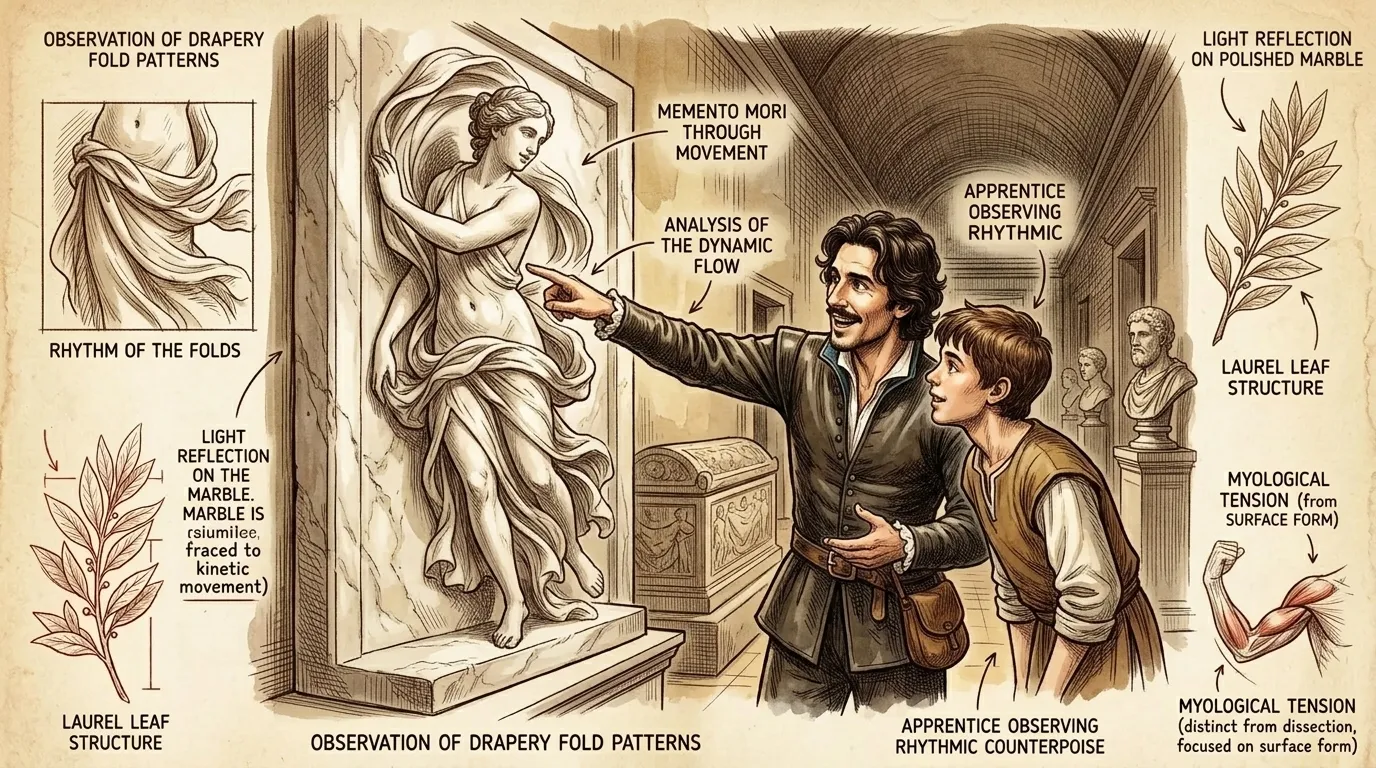
Bernini studies the works of Hellenistic sculptors, particularly their ability to capture dynamic movement and emotional intensity. He becomes fascinated by the challenge of conveying a fleeting moment in a static medium. These sculptures inspire him to push the boundaries of Baroque sculpture, creating figures that seem to defy the limitations of marble. "As Leonardo da Vinci said, 'Sculpture to me is that which is performed by taking away,'" Bernini declares to his apprentice, Enzo. "It is for us to reveal the life within the stone."
""Look at the way the drapery flows," Bernini exclaimed, pointing to a Hellenistic sculpture of a nymph. "It captures the essence of movement, even though the figure is frozen in time.""
Art Fact: Bernini drew inspiration from Hellenistic sculpture, seeking to emulate their ability to capture movement and emotion in marble.
Page 6
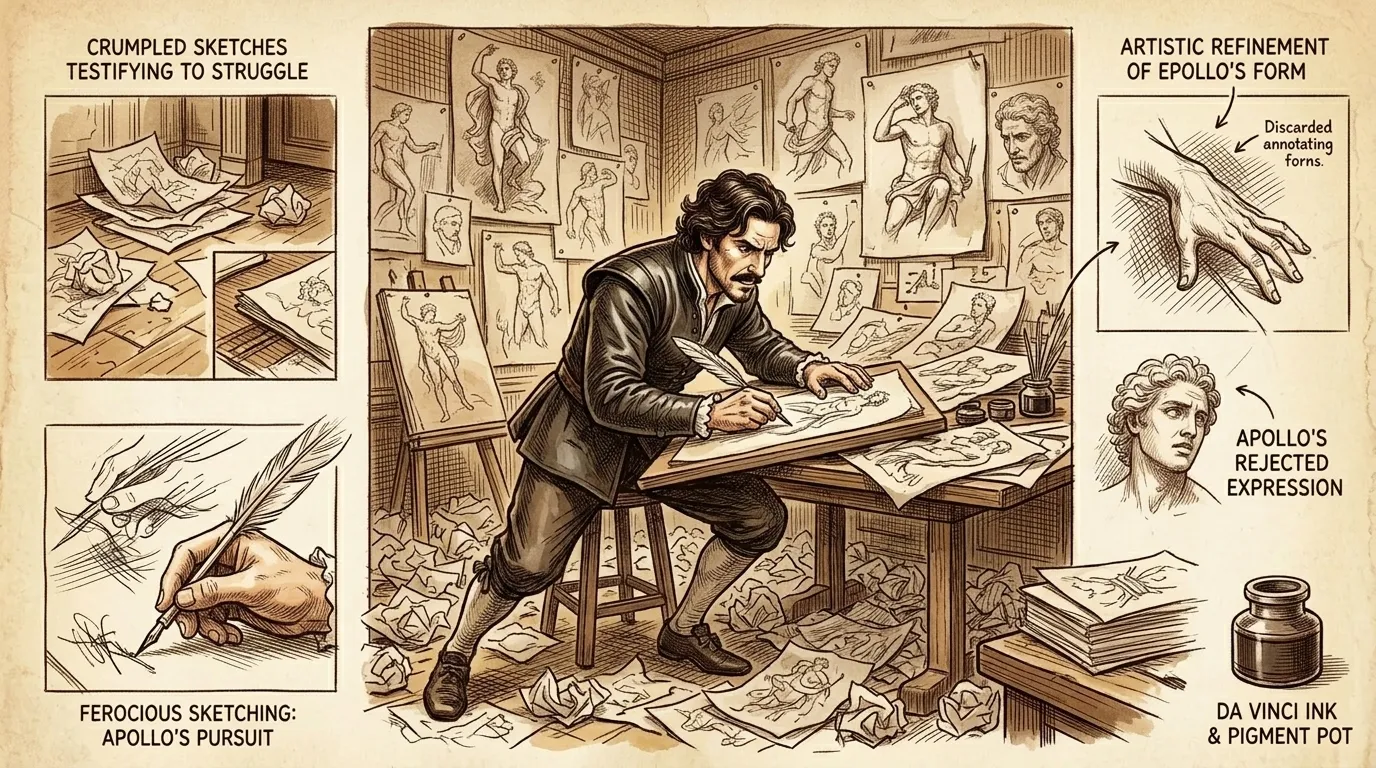
Bernini grapples with the challenge of depicting Apollo's passionate pursuit of Daphne. He studies classical depictions of the god, seeking to convey his divine beauty and irresistible desire. However, he also wants to capture the darker side of Apollo's character, his arrogance and relentless pursuit. "The greater the obstacle, the more glory in overcoming it," Bernini mutters to himself, recalling the words of Molière. He spends days blocked by the challenge.
""Apollo is not merely a god of light and music," Bernini argued, sketching furiously. "He is also a figure of intense passion and unwavering determination. I must capture both sides of his nature.""
Art Fact: Bernini meticulously researched classical representations of Apollo, seeking to convey his divine beauty and complex character.
Page 7
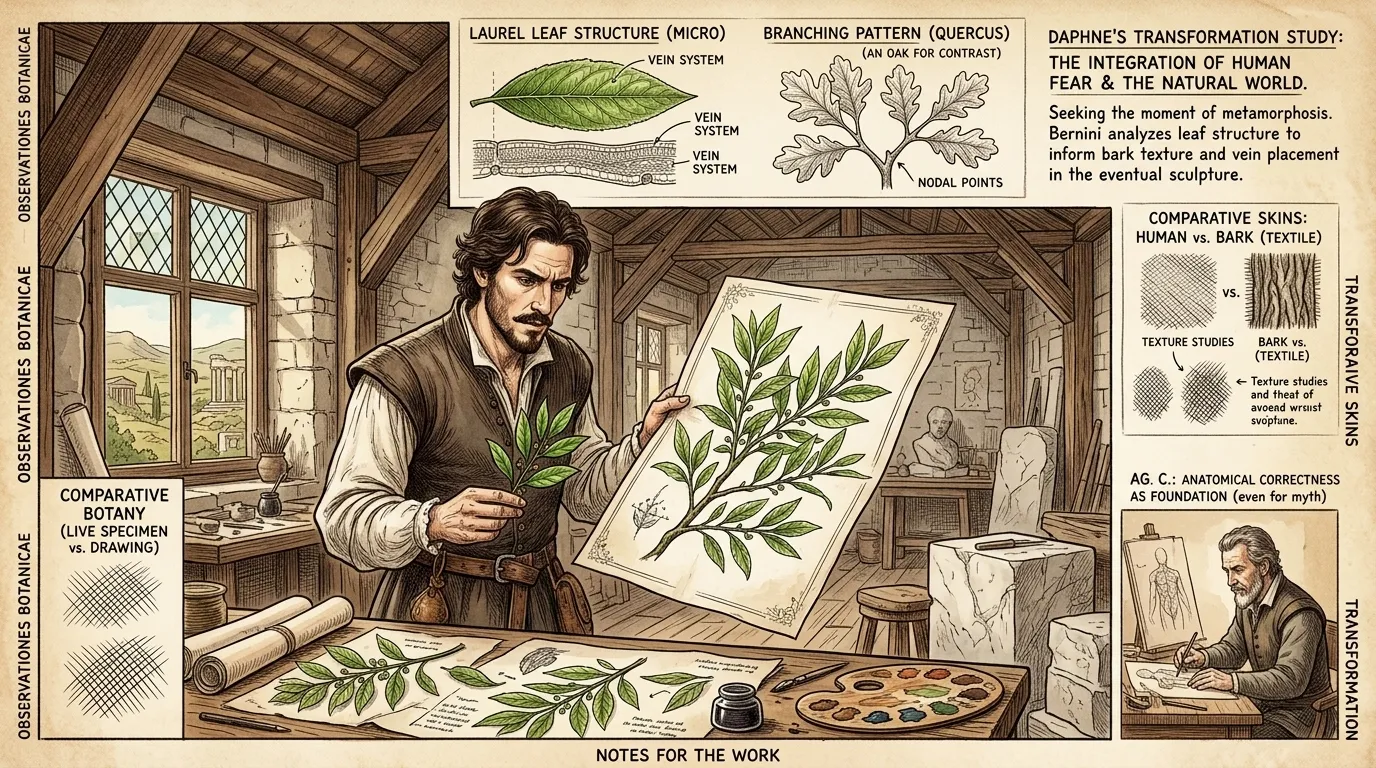
Bernini focuses on Daphne's transformation, seeking to capture her terror and desperation as she is turned into a laurel tree. He studies the anatomy of plants and trees, paying close attention to the way their forms convey growth and change. He wants to convey the sense of Daphne's humanity slowly fading as she merges with the natural world.
""Her transformation must be a sacrifice, not a salvation," Bernini declared, his eyes filled with intensity. "She is choosing to relinquish her humanity rather than submit to Apollo's desires.""
Art Fact: Bernini's meticulous study of plants and trees allowed him to depict Daphne's transformation with remarkable anatomical accuracy and expressive detail.
Page 8
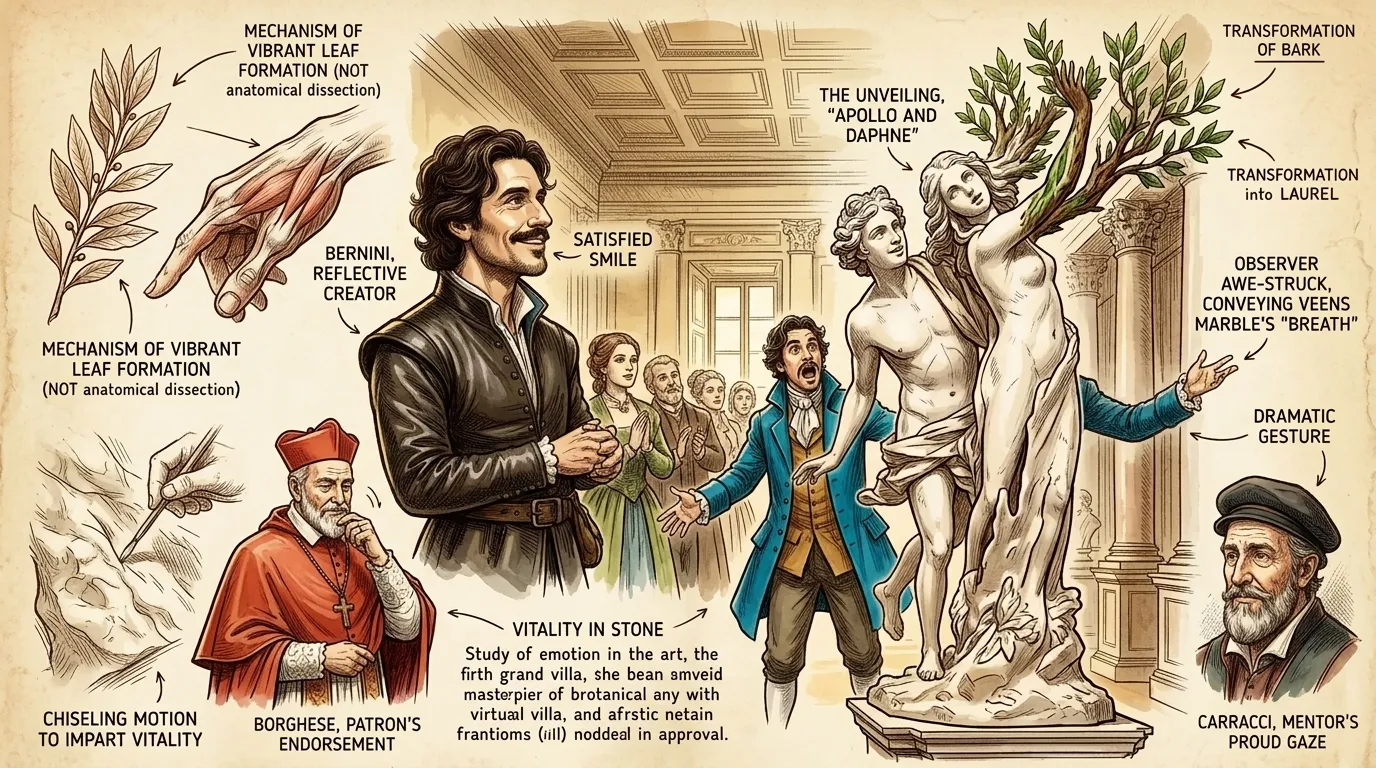
After years of meticulous work, Bernini completes Apollo and Daphne. The sculpture is unveiled to great acclaim, stunning viewers with its dramatic intensity and technical virtuosity. Bernini's ability to make marble convey such vibrant emotion and movement is hailed as a triumph of Baroque art. "The only source of knowledge is experience," Bernini reflects, quoting Albert Einstein, as he watches the onlookers.
""It is as if the marble breathes," one awed observer exclaimed. "Bernini has brought these figures to life before our very eyes!""
Art Fact: The unveiling of Apollo and Daphne marked a pivotal moment in Bernini's career, solidifying his reputation as one of the greatest sculptors of the Baroque era.
Page 9
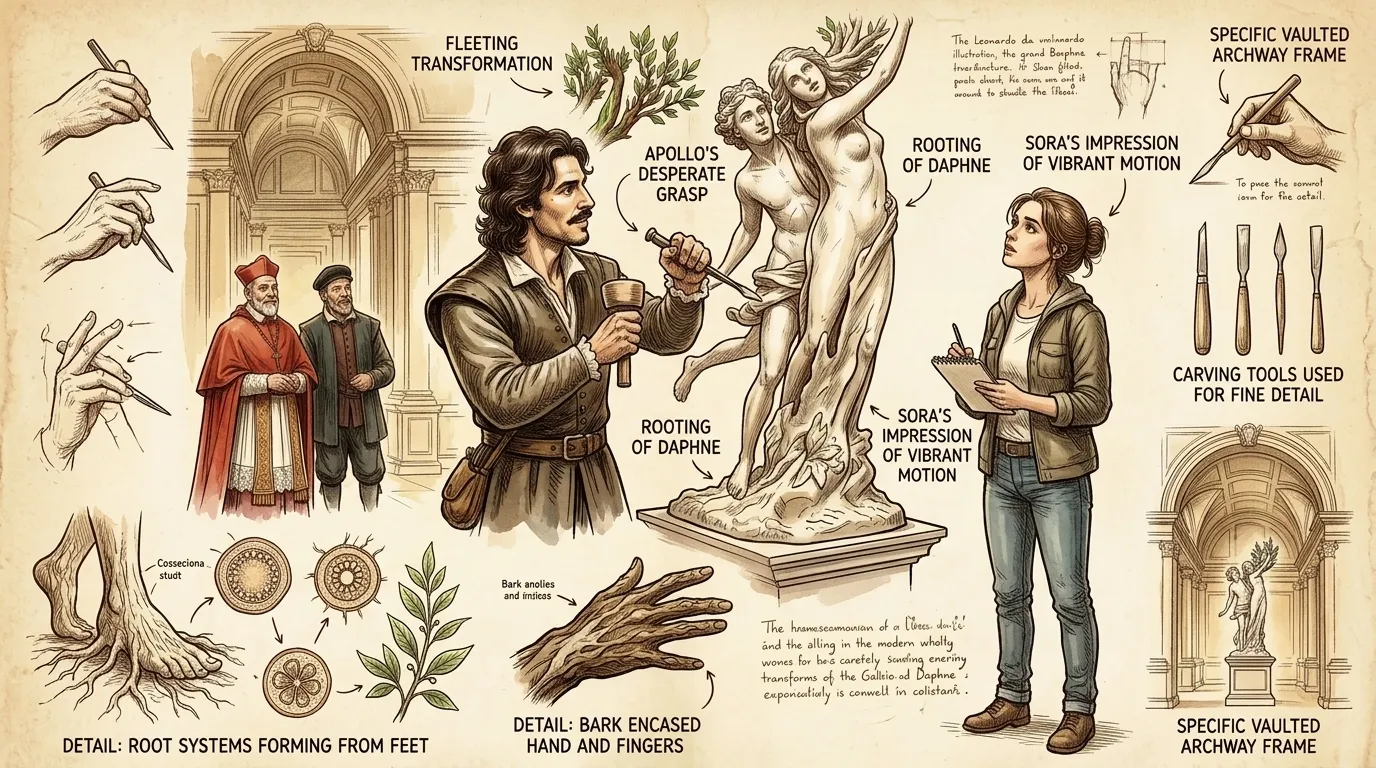
Centuries later, Apollo and Daphne continues to captivate audiences at the Galleria Borghese. Bernini's masterpiece serves as a reminder of the power of art to capture the human condition in all its complexity and beauty. Visitors today wonder at Bernini's technical brilliance and his understanding of human drama.
""It's incredible," says Sora, a visiting artist, gazing at the sculpture. "The way Bernini captured that fleeting moment of transformation... it's timeless.""
Art Fact: Apollo and Daphne remains one of the most celebrated sculptures in the Galleria Borghese, attracting visitors from around the world.
Page 10
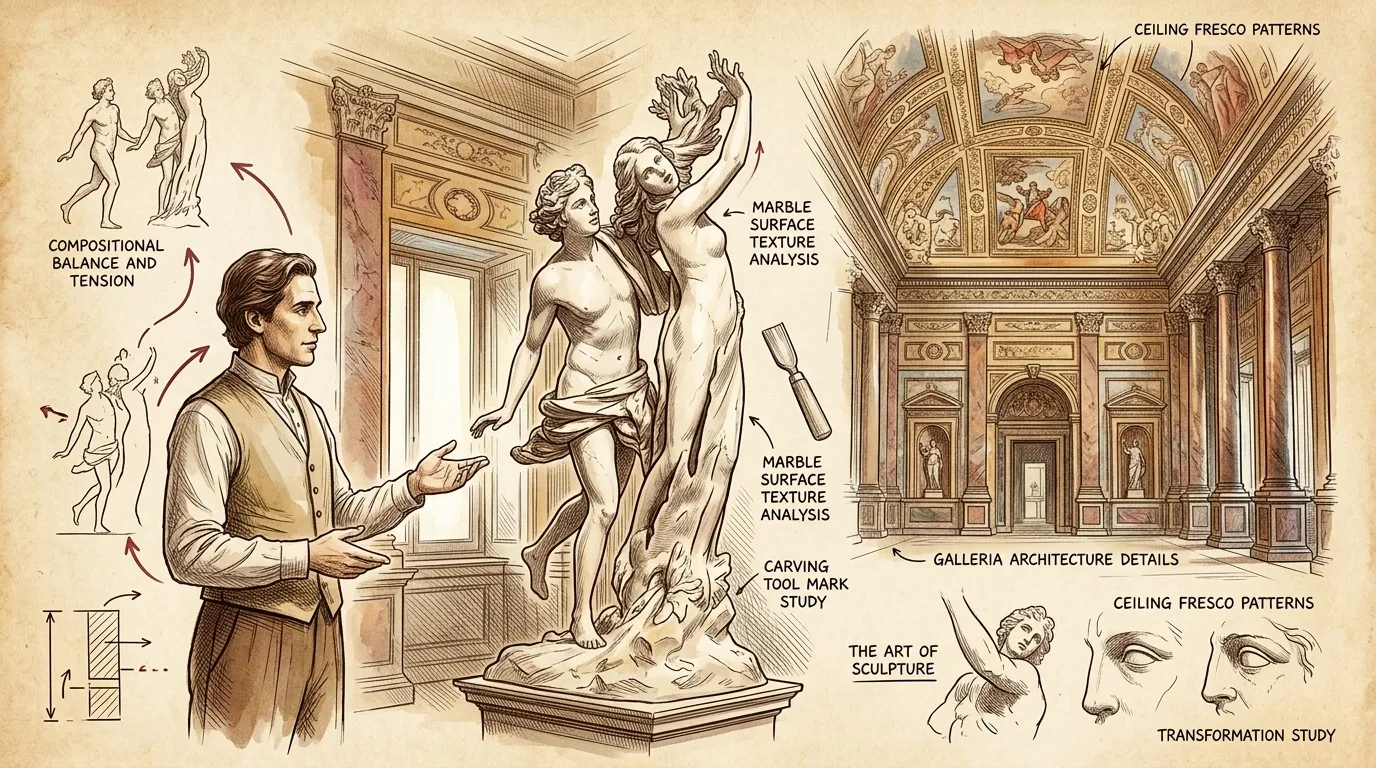
In the Galleria Borghese, Bernini's spirit seems to linger, his vision echoing through the centuries. The marble figures of Apollo and Daphne stand as a testament to his genius, reminding us of the eternal themes of love, loss, and transformation. The pursuit continues, eternally frozen in stone, yet forever alive. Bernini's genius survives because, in the words of André Malraux, "Art is the shortest route from man to man."
"A museum curator says, "Bernini's genius was to capture the impossible — the fleeting moment of metamorphosis — and make it eternal.""
Art Fact: Apollo and Daphne's enduring appeal lies in its ability to capture universal themes of love, loss, and transformation with unparalleled artistry.
About this story
- Location: Italy
- Audience: general readers
Questions and answers
Questions and answers about Apollo and Daphne by Gian Lorenzo Bernini (Rome, Italy — 1625)
Read Wonder Arts on your phone
Wonder Arts is available on Android. Get Wonder Arts on Google Play.
More Wonder Arts stories
- Arc de Triomphe (Paris, France — 1806–1836)
- Arrival of a Train by Lumière Brothers (France — 1895)
- Art Nouveau by Victor Horta (Brussels, Belgium — 1893)
- Ashmolean Museum (Oxford, UK — 1683)
- Bacchus by Michelangelo (Florence, Italy — 1497)
- Bal du moulin de la Galette by Pierre-Auguste Renoir (Paris, France — 1876)