Cubism by Picasso and Braque (Paris, France — 1907)
Cubism by Picasso and Braque (Paris, France — 1907) — an illustrated arts story, set in France. 10 illustrated pages, free to read on Wonder Arts.
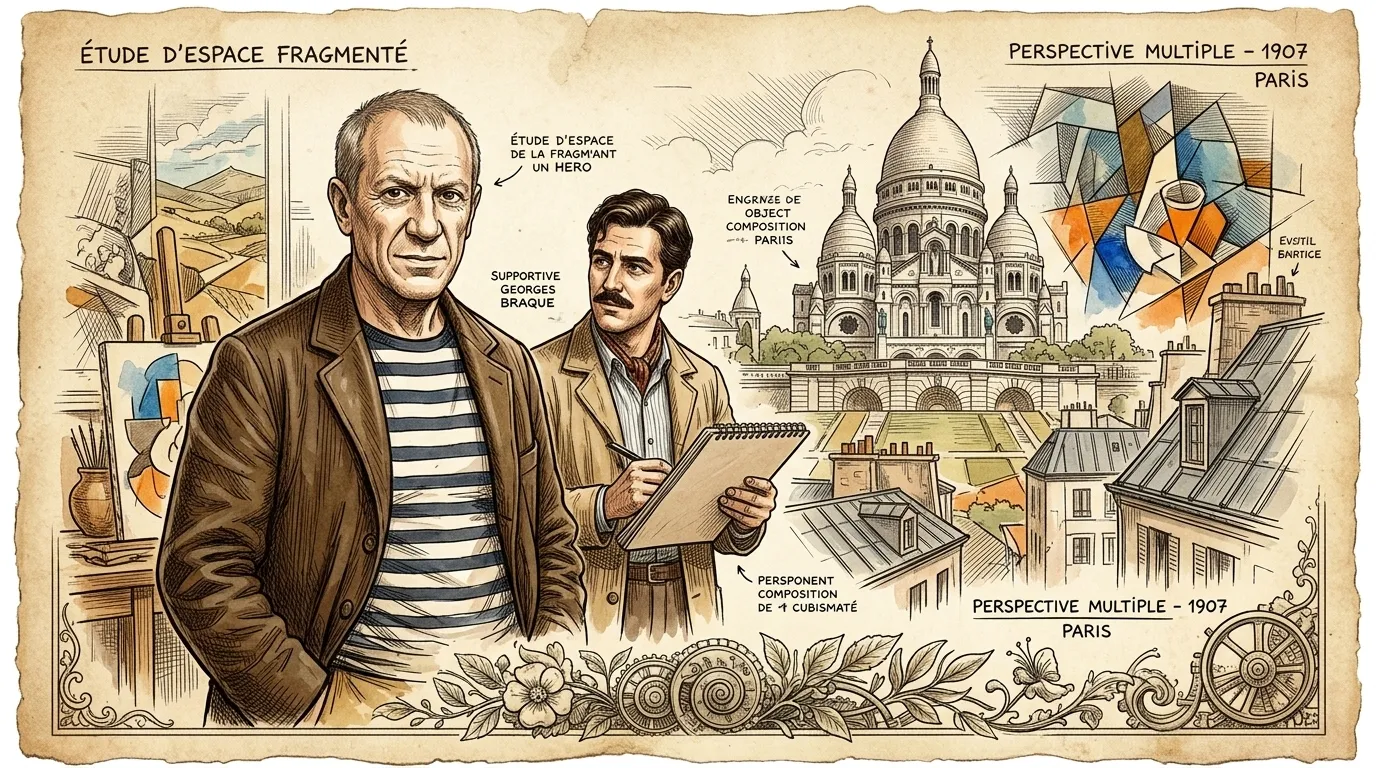
Page 1
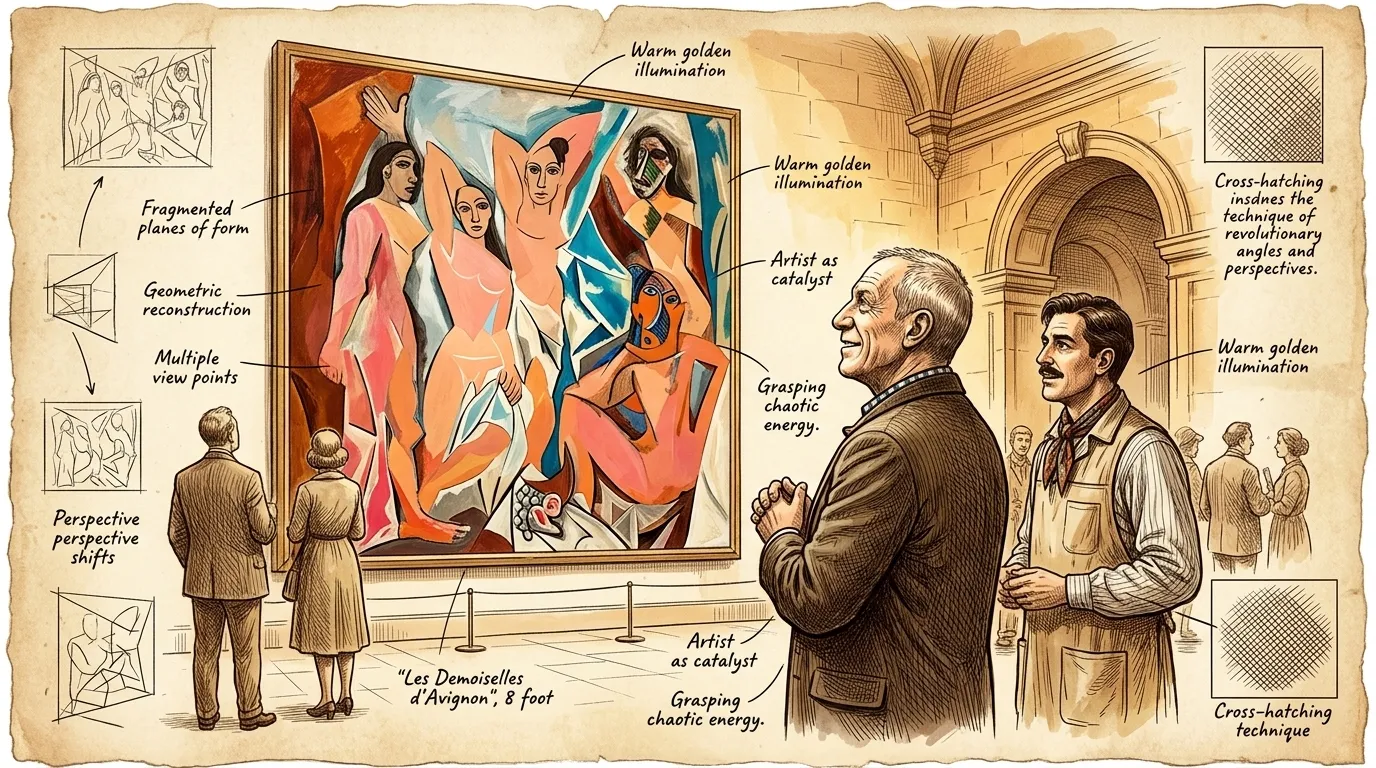
Pablo Picasso, at 26, stood before 'Les Demoiselles d'Avignon,' a painting that defied all conventions. Created in 1907, it marked a radical departure from traditional art. The painting, measuring 8 feet square, resides in the Museum of Modern Art, New York. Its fragmented figures and multiple perspectives ignited a revolution.
""This is not just a painting, it's a challenge," Picasso murmured, his eyes reflecting the chaotic energy of the canvas. "We must break down forms to truly see them.""
Art Fact: 'Les Demoiselles d'Avignon' initially shocked viewers, but it's now seen as the proto-Cubist work that shattered traditional representation.
Page 2

Picasso and Braque visited the ethnographic museum at the Palais du Trocadéro in Paris. They were captivated by the power and abstract forms of African masks. The masks revealed a new way of representing the human figure.
""Look, Pablo," Braque exclaimed, pointing to a Fang mask from Gabon. "They aren't trying to replicate reality. They're capturing its essence.""
Art Fact: African art's influence on Cubism helped liberate European artists from traditional representational constraints.
Page 3

The art world was still reeling from the death of Paul Cézanne. His emphasis on geometric forms and multiple viewpoints influenced Picasso and Braque profoundly. They saw him as a precursor to their own experiments.
""Cézanne showed us that everything in nature can be modeled according to the cube, the sphere, and the cone," Picasso declared, sketching furiously in his notebook. "He unlocked the door.""
Art Fact: Cézanne's emphasis on form and structure provided a critical foundation for the development of Cubism.
Page 4

Picasso and Braque worked intensely together in Paris and at Braque's studio in L'Estaque, Southern France, often painting the same subjects from slightly different angles. This collaboration was a crucial element in the birth of Cubism.
""Look, Pablo, I'm trying to capture the object from every angle, simultaneously," Braque explained, gesturing at his canvas. Picasso replied, "We must become like brothers in art.""
Art Fact: Picasso and Braque's close collaboration fostered a spirit of experimentation and mutual influence that defined early Cubism.
Page 5
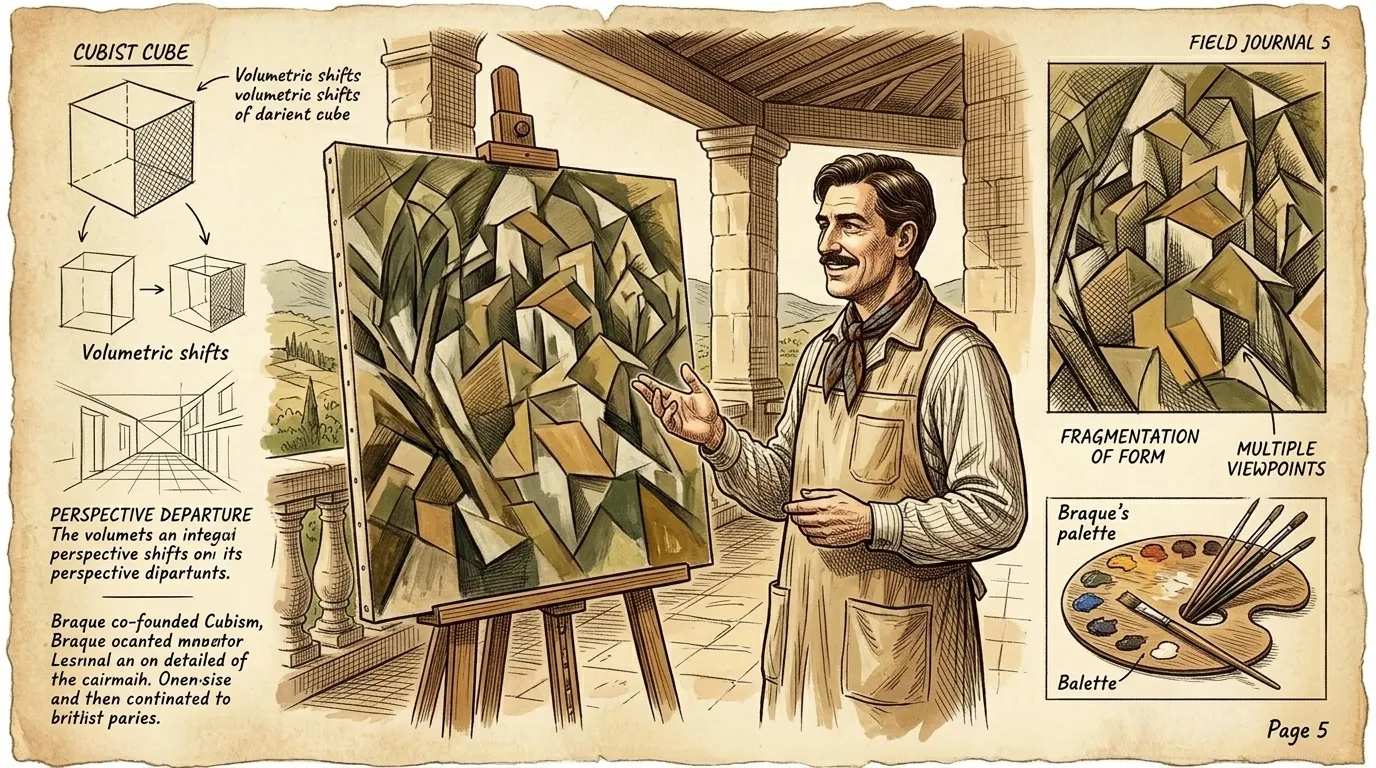
Analytical Cubism emerged as the first phase, characterized by monochrome palettes and the fragmentation of objects. "Houses at L'Estaque", painted by Braque, exemplifies this style.
"Braque said, "The hard and fast rules of perspective were brushed aside. The picture ceased to be a reproduction, it became a representation.""
Art Fact: Analytical Cubism aimed to dissect and represent the essence of objects through geometric fragmentation and muted color.
Page 6

Synthetic Cubism followed, incorporating collage and brighter colors. Picasso's 'Still Life with Chair Caning' marked this shift, introducing real-world textures into the canvas.
""We aren't trying to deceive the eye anymore," Picasso declared, pressing a piece of oilcloth onto the canvas. "We are presenting reality itself!""
Art Fact: Synthetic Cubism embraced collage and brighter colors, moving towards a more decorative and accessible form of Cubism.
Page 7

Cubism divided critics, some hailing it as revolutionary, others dismissing it as incomprehensible. The Salon d'Automne in Paris became a battleground for artistic debate.
"The critic Louis Vauxcelles wrote, 'Monsieur Braque is a very audacious young man. It is difficult not to be troubled by the cubist reduction.'"
Art Fact: Cubism's radical departure from tradition sparked fierce debate and challenged established notions of artistic representation.
Page 8
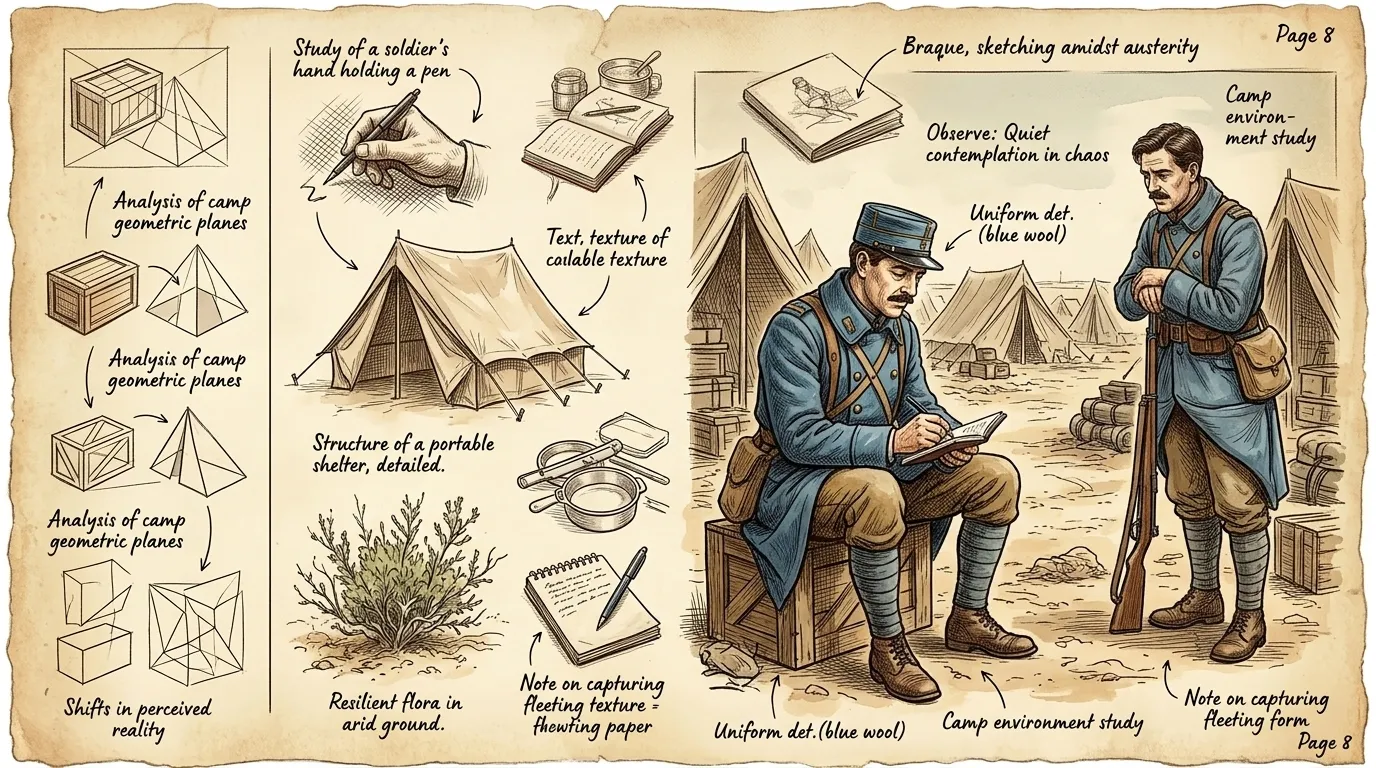
World War I disrupted the Cubist movement, separating Picasso and Braque. Braque served in the French army, and his experiences profoundly affected his later work.
""As Pablo Picasso once profoundly stated, 'Art is a lie that makes us realize truth,'" Georges Braque said to the fellow soldier, reflecting on how to find beauty amidst the chaos."
Art Fact: The trauma of World War I impacted the trajectory of Cubism and shaped the artistic vision of its key figures.
Page 9

Despite its challenges, Cubism irrevocably changed the course of modern art. Its influence extended to architecture, sculpture, and design, inspiring generations of artists.
"An art critic, contemplating a Cubist sculpture, remarks, "They've transformed our vision. We see the world differently now.""
Art Fact: Cubism's innovative approach to form and perspective continues to inspire and influence artists across various disciplines.
Page 10

Today, Cubism remains a cornerstone of modern art history, celebrated for its revolutionary spirit. 'Les Demoiselles d'Avignon' and Braque's Cubist landscapes continue to captivate audiences at MoMA and other museums worldwide. Picasso's vision lives on, challenging us to see the world anew.
""The most important thing is to move, to love, to hope, to tremble, to live," Pablo Picasso once said. His work continues to move us, to provoke thought and to inspire us."
Art Fact: Cubism's legacy endures, its revolutionary spirit continuing to inspire and challenge artists and viewers alike.
About this story
- Location: France
- Audience: general readers
Questions and answers
Questions and answers about Cubism by Picasso and Braque (Paris, France — 1907)
Read Wonder Arts on your phone
Wonder Arts is available on Android. Get Wonder Arts on Google Play.
More Wonder Arts stories
- Cupid and Psyche by Antonio Canova (Paris, France — 1793)
- Daguerreotype by Louis Daguerre (Paris, France — 1839)
- Dante and Virgil in Hell by William-Adolphe Bouguereau (France — 1850)
- David by Donatello (Florence, Italy — 1440)
- David by Michelangelo (Florence, Italy — 1504)
- Diana of Versailles by Leochares (Paris, France — c. 325 BC)