Cupid and Psyche by Antonio Canova (Paris, France — 1793)
Cupid and Psyche by Antonio Canova (Paris, France — 1793) — an illustrated arts story, set in France. 10 illustrated pages, free to read on Wonder Arts.
Page 1

Antonio Canova, the celebrated Neoclassical sculptor, stands before his masterpiece, 'Cupid and Psyche.' Completed in 1793, this marble sculpture, measuring 155 cm by 168 cm by 101 cm, now resides in the Louvre Museum, Paris. What many don't realize is that this wasn't just a commission for a wealthy patron; it was Canova's attempt to capture the very essence of a kiss – the moment just before lips meet.
"Canova sighs, running a hand over the cool marble. "Now, to capture the soul of the moment, to freeze eternity...""
Art Fact: Antonio Canova, known for his Neoclassical sculptures, aimed to capture fleeting moments of emotion and beauty in marble.
Page 2

Years before the marble took shape, Canova experimented with sketches. His first ideas were rough, energetic lines capturing the dynamic tension between Cupid and Psyche. He filled a notebook with ideas. He thought about how to convey the essence of a love story through stone.
""How to show the soul in stone?" Canova muses, pencil flying across the page. "The touch, the longing... it must all be there.""
Art Fact: Canova's initial sketches were crucial for exploring the composition and capturing the emotional essence of his sculptures.
Page 3

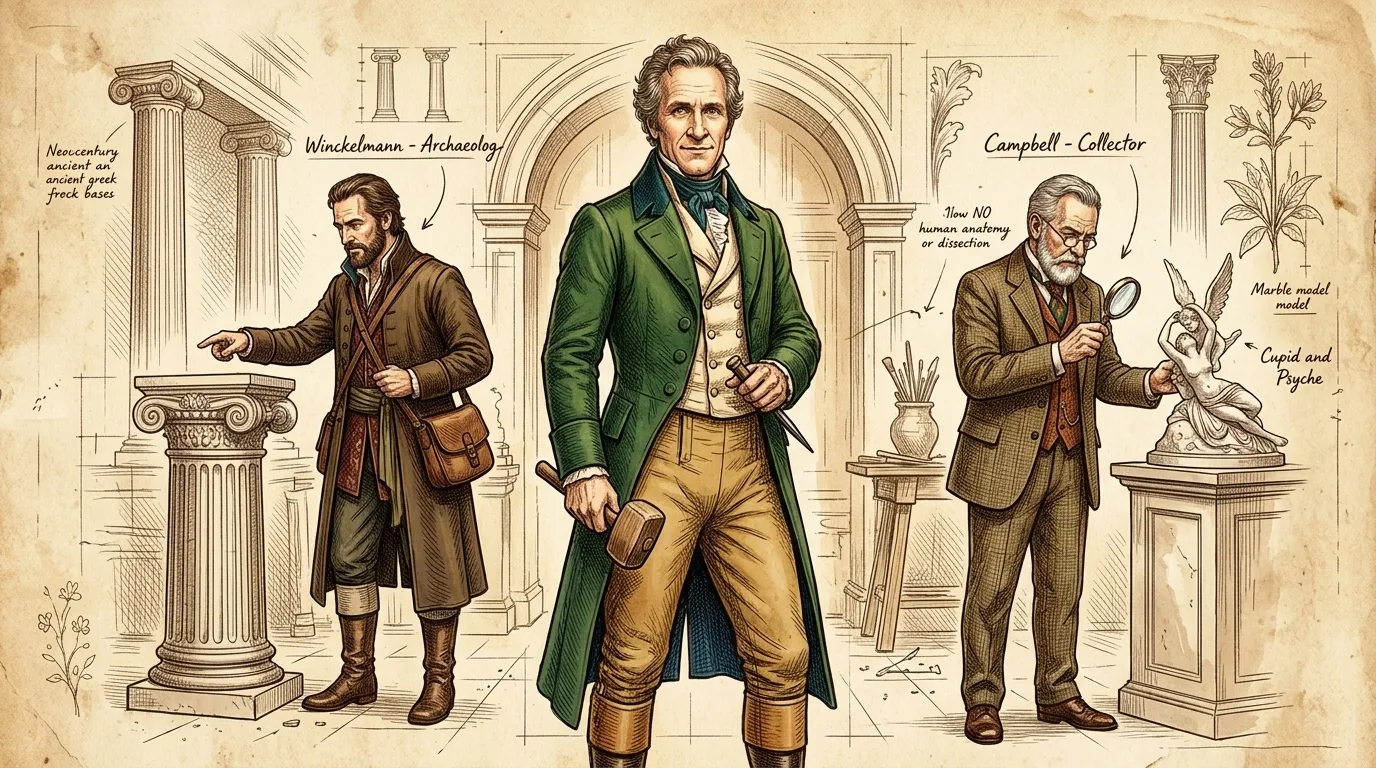
A chance encounter with the writings of Johann Winckelmann, the father of art history, profoundly impacted Canova's vision. Winckelmann's celebration of Greek art and its ability to capture ideal beauty resonated deeply. "The only way for us to become great, or if this were possible, inimitable, is to imitate the ancients," Canova recited, remembering Winckelmann's famous words. He knew that to achieve true greatness, he must embrace the Classical tradition while forging his own path.
""Winckelmann's words are a guiding light," Canova declares, holding a well-worn copy of 'History of Ancient Art.' "To capture the ideal...""
Art Fact: Johann Winckelmann's emphasis on the imitation of classical ideals heavily influenced Canova's artistic philosophy.
Page 4

The commission for 'Cupid and Psyche' came from Colonel John Campbell. Campbell, a wealthy art collector, desired a sculpture that embodied both passion and grace. His specifications were explicit. He wanted Cupid to be recognizable by his wings and youthful face. Psyche had to represent innocence and beauty, her human form a contrast to the divine Cupid. He wanted to capture the moment right before the kiss.
""Colonel Campbell desires a sculpture that breathes life, Signor Canova," the messenger states formally. "A moment of eternal beauty!""
Art Fact: The commission from Colonel John Campbell provided the impetus and financial support for Canova to bring his vision to life.
Page 5

Canova insisted on using the finest Carrara marble for his sculpture. He personally travelled to the quarries, seeking a block free of imperfections. For days he inspected the marble, striking it and listening to the reverberations. It was not merely a block of stone but the embodiment of possibility.
""This is it!" Canova exclaims, his voice echoing through the quarry. "This marble holds the soul of Cupid and Psyche!""
Art Fact: Canova's insistence on using the finest Carrara marble demonstrates his dedication to the quality and artistry of his work.
Page 6

Before carving the marble, Canova created several clay models. These allowed him to refine the composition and test different poses for Cupid and Psyche. Canova meticulously sculpted the folds of their garments and the delicate curve of their limbs. These models were not mere prototypes, they held the promise of beauty.
""Here, in clay, they first meet," Canova whispers, gently adjusting the arm of the clay Cupid. "The beginning of their eternal embrace.""
Art Fact: The clay models served as essential prototypes, allowing Canova to experiment and refine the composition of 'Cupid and Psyche' before committing to the marble.
Page 7

The moment Canova's chisel first touched the marble was a crucial step. With precise intent he started to cut away the stone. Slowly, the rough contours of the block began to transform into the forms of Cupid and Psyche. He knew that every strike of the chisel brought him closer to the heart of beauty.
""Now begins the dance between man and stone," Canova declares, raising his chisel. "Let us see what beauty lies within!""
Art Fact: The first chisel stroke marked a critical turning point in the creation of 'Cupid and Psyche,' as Canova began to reveal the figures from the marble block.
Page 8

After months of carving, Canova reached the final stage: polishing. Using pumice and fine cloths, he gently smoothed the surface of the marble, revealing its natural luster. He had to capture a sense of softness and warmth. Each polish brought the stone closer to life.
""The final touch," Canova murmurs, rubbing the marble with a soft cloth. "To bring forth the warmth of human skin!""
Art Fact: The polishing process was crucial for enhancing the marble's natural beauty and giving 'Cupid and Psyche' a lifelike quality.
Page 9

Finally, 'Cupid and Psyche' was complete. Canova had captured the moment just before the kiss, an eternal instant of yearning and love. The sculpture captivated all who saw it. It was seen as an example of perfect form, balance, and emotion. But this moment before the kiss, Canova said, was far more potent than the kiss itself.
""It is done," Canova declares softly, stepping back from his creation. "The kiss of immortality!""
Art Fact: The completed sculpture of 'Cupid and Psyche' embodies Canova's mastery of Neoclassical sculpture and his ability to capture profound emotions in marble.
Page 10
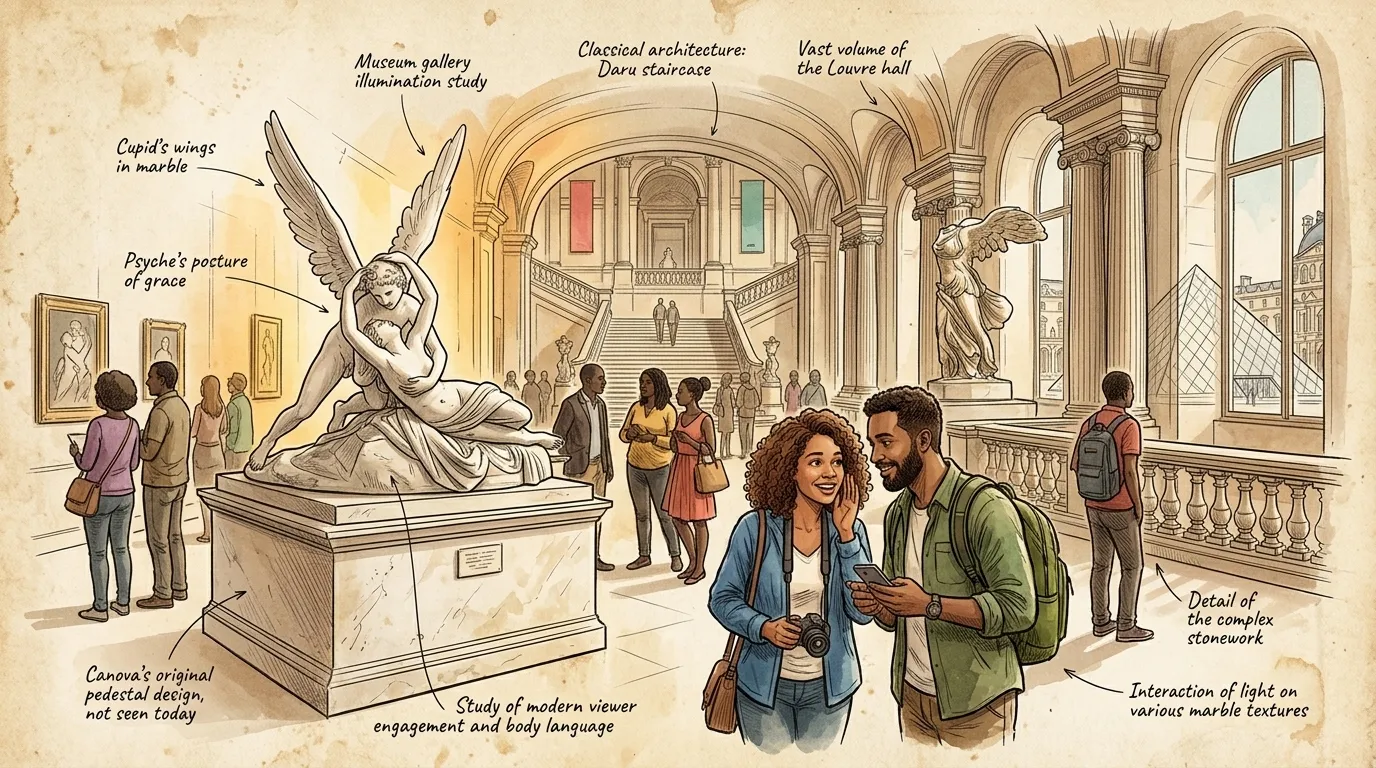
Today, 'Cupid and Psyche' resides in the Louvre Museum, captivating visitors from around the world. Generations of artists have been inspired by Canova's masterpiece. As the French sculptor Auguste Rodin said, "Art is contemplation. It is the joy of the spirit that discovers that nature also exists everywhere." So, Canova's work survives not just as art, but as a contemplation of the nature that exists everywhere.
"A modern visitor whispers to their companion, "It's breathtaking. The way he captured the moment...""
Art Fact: Canova's 'Cupid and Psyche' remains a symbol of beauty and love, inspiring artists and captivating audiences worldwide.
About this story
- Location: France
- Audience: general readers
Questions and answers
Questions and answers about Cupid and Psyche by Antonio Canova (Paris, France — 1793)
Read Wonder Arts on your phone
Wonder Arts is available on Android. Get Wonder Arts on Google Play.
More Wonder Arts stories
- Daguerreotype by Louis Daguerre (Paris, France — 1839)
- Dante and Virgil in Hell by William-Adolphe Bouguereau (France — 1850)
- David by Donatello (Florence, Italy — 1440)
- David by Michelangelo (Florence, Italy — 1504)
- Diana of Versailles by Leochares (Paris, France — c. 325 BC)
- Discobolus by Myron (Rome, Italy — c. 460 BC)