Discobolus by Myron (Rome, Italy — c. 460 BC)
Discobolus by Myron (Rome, Italy — c. 460 BC) — an illustrated arts story, set in Italy. 10 illustrated pages, free to read on Wonder Arts.

Page 1

Here stands Myron of Eleutherae, the master sculptor, before his Discobolus. Forged circa 460-450 BC, this bronze statue captured a fleeting moment of athletic prowess. Measuring approximately 170 cm (67 inches) in height, it's not the original bronze, lost to time, but a Roman marble copy that immortalizes Myron's vision. Its value? Incalculable, as it represents the epitome of classical athletic form.
"Myron murmurs to himself, a smile playing on his lips, 'The body is only the thread upon which experience is hung. Now, it is finally complete.'"
Art Fact: The original Discobolus was bronze, but is now only known through later Roman marble copies.
Page 2

A young Myron attends the Academy, filled with youthful sculptors all eager to learn from the master, Ageladas. There he learns the secrets of anatomy and proportion, fundamental to classical sculpture. Ageladas emphasizes the importance of capturing the ideal human form, not just any form.
"Ageladas said, 'Myron, remember what Socrates said, 'Know thyself'. But also, know the human form. Only then can you truly create something timeless.'"
Art Fact: Ageladas was a renowned sculptor and teacher, whose students included Phidias and Polyclitus.
Page 3

Myron, now a young man, frequents the athletic games, sketching the movements of the athletes. He is particularly drawn to the discus throwers, fascinated by the dynamic pose and the fleeting moment of balance and power. He understands that capturing this fleeting moment is the key to his sculpture.
"Myron mutters to himself, 'It's all about the moment... the precise instant where power and grace converge. I must capture that.'"
Art Fact: The ancient Olympic Games were held every four years in Olympia, Greece.
Page 4

A wealthy patron, Lycius, approaches Myron with a commission. Lycius desires a statue that celebrates athleticism and the human form, something that will inspire generations to come. He trusts Myron's vision and artistic skill, providing him with the resources needed to bring his vision to life.
"Lycius declares, 'Myron, I want a statue that captures the essence of athleticism. Something that will inspire generations! I trust your vision.' Myron replied, 'I am eternally grateful for this chance, Lycius!'"
Art Fact: Wealthy patrons often commissioned sculptures to commemorate athletic victories and honor the gods.
Page 5

Myron experiments with the lost-wax casting technique, a complex process requiring precision and skill. He learns to control the flow of molten bronze, shaping it into the desired form. Each statue requires years to achieve. His apprentices assist him. The heat is intense, the work arduous, but the result is worth the effort.
"Myron directs his apprentice, 'Tendai, carefully control the heat! The bronze must flow smoothly, filling every detail of the mold!'"
Art Fact: The lost-wax casting technique was used to create bronze sculptures in ancient Greece.
Page 6

Myron struggles with the statue's balance. He tries different poses, adjusting the weight distribution to ensure the sculpture won't topple. He experiments with different positions, striving for a dynamic yet stable composition. This moment is an absolute challenge for Myron.
"Myron, frustrated, exclaims, 'Damn this statue! How can I capture a moment of such dynamic action and maintain balance? I have no clue.'"
Art Fact: The Discobolus is notable for its dynamic composition and the challenge of achieving balance.
Page 7

In a moment of epiphany, Myron realizes the key is capturing the exact moment before the discus is released. He focuses on the coiled energy, the potential for movement, and the anticipation in the athlete's face. He finally understands how to solve this. This moment informs him for years to come.
"Myron proclaims, 'Eureka! The key is not the throw itself, but the moment before. The anticipation! The coiled energy!'"
Art Fact: Myron's breakthrough came with the understanding that he needed to capture the moment of potential energy.
Page 8

Myron and his assistants meticulously polish the bronze surface, bringing out the details of the athlete's muscles and features. They use fine abrasives and tools, revealing the beauty of the sculpture. This is their final step towards perfection.
"Myron instructs, 'Tendai, gently polish the bronze. Reveal the muscles, the tension... the life within! I'm so excited for others to see this.'"
Art Fact: Polishing was a crucial step in creating a lifelike bronze sculpture.
Page 9
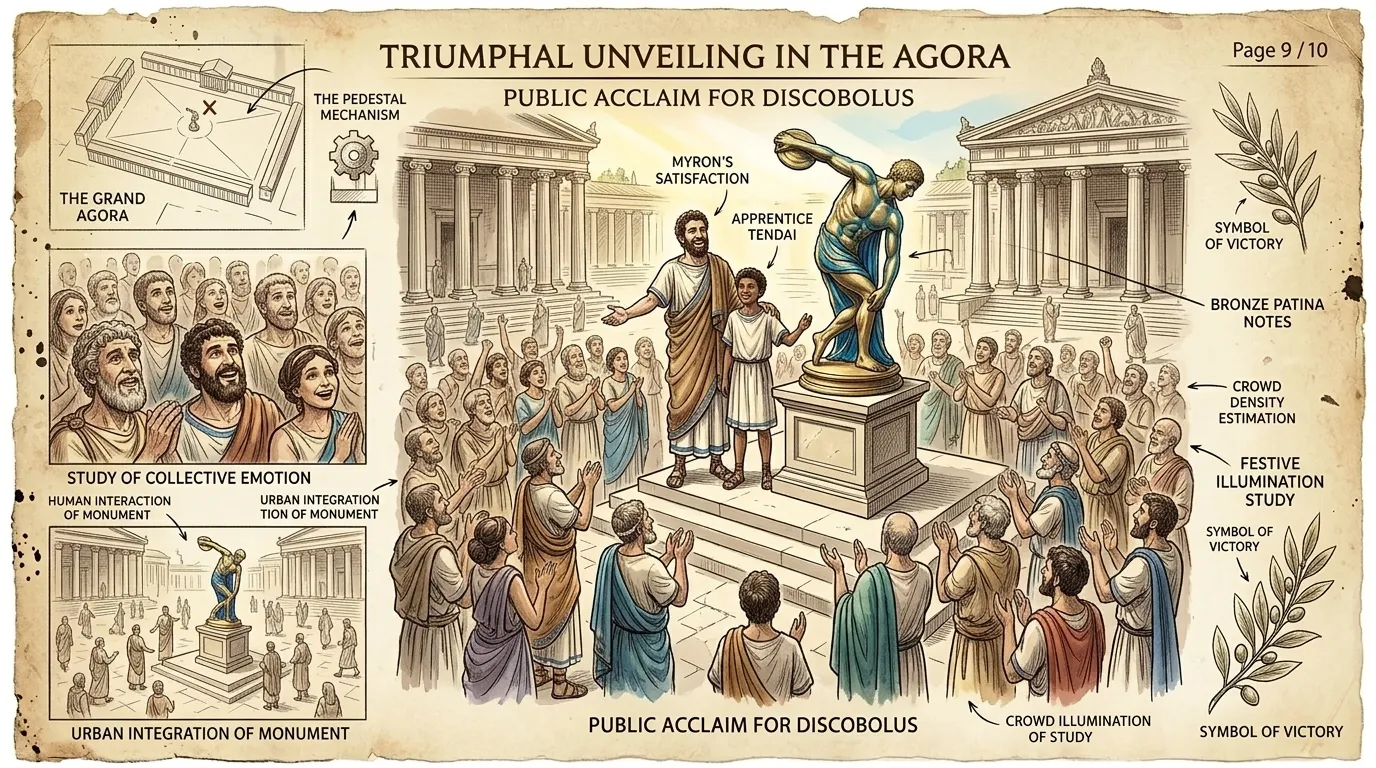
The Discobolus is unveiled to the public, to great acclaim. People admire its beauty, its dynamism, and its capture of the ideal human form. Myron's masterpiece becomes an icon of classical sculpture, inspiring artists for centuries to come. He is happy to see its triumph in the city.
"Tendai says proudly, 'Myron, your statue has become a symbol of our time. Everyone admires its beauty and skill! It's amazing.' Myron sighed, 'I am so grateful."
Art Fact: The Discobolus quickly became famous and was widely copied throughout the ancient world.
Page 10

Today, the Discobolus remains an enduring symbol of athletic perfection and classical beauty. Though the original is lost, its memory lives on in marble copies, inspiring athletes and artists alike. It's displayed in museums across the world, captivating people of all ages, cultures and backgrounds. Myron's work survives because, as the Roman writer Pliny the Elder said, 'He was the first to impart more subtlety to the curves, and was more successful than anyone else in representing the hair.'
"It captures the enduring legacy of the human spirit. I couldn't be more grateful and blessed by this creation.'"
Art Fact: The Discobolus continues to inspire artists and athletes, and is a symbol of classical art.
About this story
- Location: Italy
- Audience: general readers
Read Wonder Arts on your phone
Wonder Arts is available on Android. Get Wonder Arts on Google Play.
More Wonder Arts stories
- Doge’s Palace (Venice, Italy — 1340)
- Don Giovanni by Wolfgang Amadeus Mozart (Prague — 1787)
- Don Quixote by Miguel de Cervantes (Madrid, Spain — 1605)
- Dutch Golden Age by various masters (Netherlands — c. 1620)
- Ecstasy of Saint Teresa by Gian Lorenzo Bernini (Rome, Italy — 1652)
- Eiffel Tower (Paris, France — 1889)