Doge’s Palace (Venice, Italy — 1340)
Doge’s Palace (Venice, Italy — 1340) — an illustrated arts story, set in Italy. 10 illustrated pages, free to read on Wonder Arts.
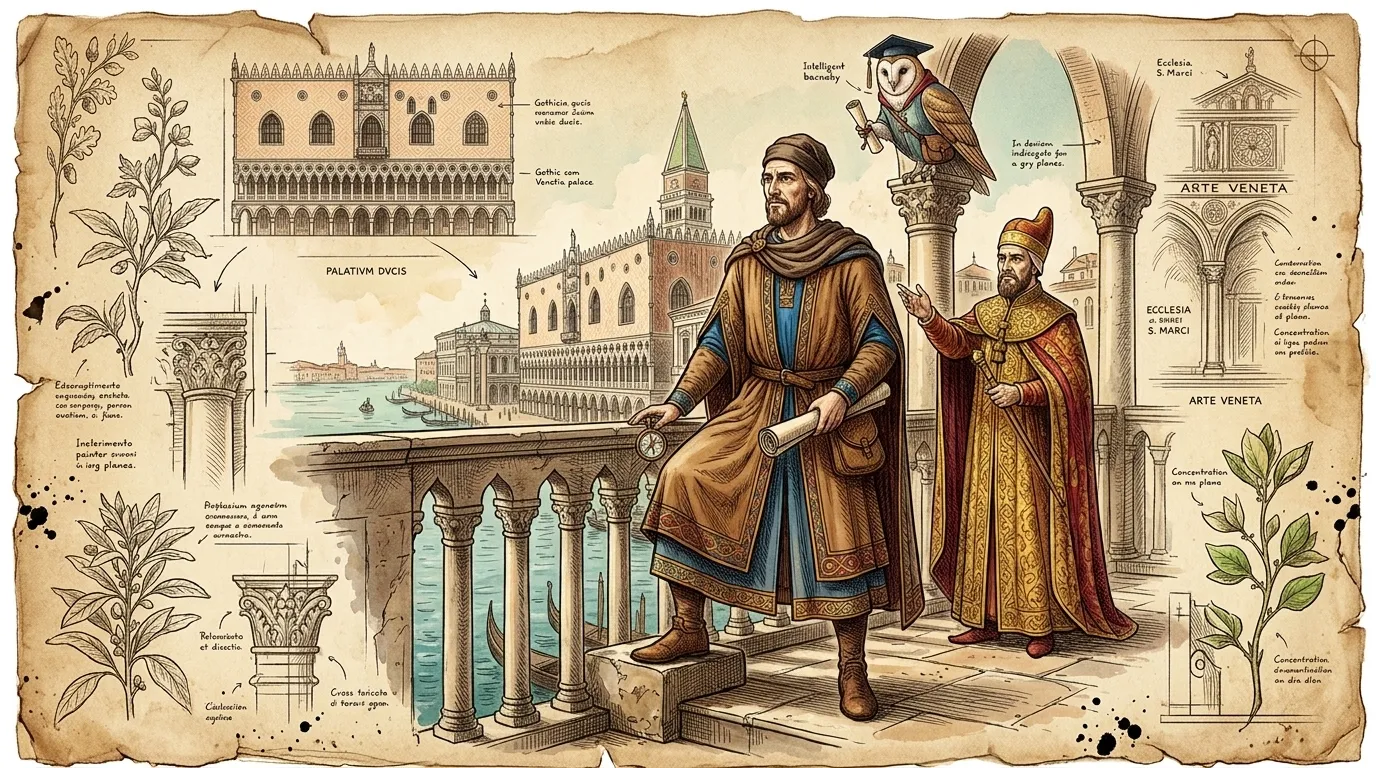
Page 1

Standing before his creation, the 'Doge's Palace,' completed around 1340, is the artist Guariento di Arpo. A vision of Venetian grandeur captured in tempera on wood, the painting measures approximately 57 x 175 cm. Guariento's work showcases a unique blend of Byzantine and Gothic styles, a testament to Venice's rich artistic heritage.
"Guariento: (to himself) At long last, it is finished. A reflection of Venice, its power, and its enduring spirit."
Art Fact: The Doge's Palace panel is a significant early depiction of the iconic Venetian landmark, capturing its architectural essence before later renovations.
Page 2

Young Guariento found himself amidst a peculiar scene. Animals, each donning tiny spectacles, were engrossed in books. It was here, in this scholarly forest, that Guariento encountered an elderly bear named Barnaby, a master of perspective and geometry.
"Barnaby: (adjusting his spectacles) Ah, Guariento, welcome! As Leonardo da Vinci once said, 'Study the science of art. That will develop your art!' Today, we delve into the secrets of creating depth on a flat surface."
Art Fact: The forest represents the center of knowledge. The location that inspired Guariento to become an artist.
Page 3

Barnaby spoke to Guariento about the brilliance of Byzantine art. He then explained, that the Byzantine art style was characterized by flat perspectives, rich colors, and golden backgrounds. 'Remember,' Barnaby said, 'these techniques will allow you to represent the grandeur of Venice in your art!'
"Guariento: But Barnaby, how can I make the building look real?"
Art Fact: Barnaby is a mentor to young Guariento, inspiring his artistic passions.
Page 4

News of Guariento's growing talent reached the ears of Doge Bartolomeo Gradenigo. The Doge summoned the young artist, commissioning him to create a grand panel depicting the Doge's Palace. 'Venice,' proclaimed the Doge, 'must be immortalized in art! As Shakespeare said, 'Not marble, nor the gilded monuments of princes, shall outlive this powerful rhyme.' And your art, Guariento, shall be that rhyme.'
"Doge Bartolomeo: Your skills, young Guariento, will be used to inspire others for all time!"
Art Fact: This is the first major commission in Guariento's artistic journey.
Page 5

Before setting brush to wood, Guariento meticulously sketched the Doge's Palace from every conceivable angle. He spent hours studying the play of light on its facade, the intricate details of its arches, and the bustling life around it. From the sketches, the first visions of the Doge's Palace painting were born.
"Guariento: Every line, every shadow, must capture the essence of this magnificent structure."
Art Fact: The artist meticulously studies the Doge's Palace, laying the foundation for his detailed painting.
Page 6

Guariento turned to tempera, a technique favored by Byzantine masters. Mixing pigments with egg yolk, he created vibrant hues that would bring the palace to life. 'Color,' he declared, 'is the language of the soul.' A language capable of conveying the grandeur of Venice.'
"Guariento: The golden hues of Venice will fill the painting."
Art Fact: Guariento's tempera technique, learned from Byzantine masters, is central to his artistic style.
Page 7

Gold leaf, a symbol of divine light and Venetian wealth, became a crucial element in Guariento's depiction. He painstakingly applied it to the sky and the palace's ornate details, creating a luminous, ethereal effect. 'As Confucius said,' Guariento mused, 'Everything has beauty, but not everyone sees it. I see it in the golden light of Venice.'
"Guariento: Gold, Venice's color, to show the greatness of the palace. The art will speak to all."
Art Fact: Gold represents not just wealth, but also the divine light reflecting Venice's power.
Page 8

As the painting neared completion, Guariento sought to capture the bustling life of Venice. Gondolas gliding along the canals, merchants hawking their wares, and citizens going about their daily lives—all found their place in his depiction, filling the palace in the paintings.
"Guariento: Venice lives in every brushstroke."
Art Fact: Guariento infuses his painting with the dynamic energy of Venice, making it a living portrait of the city.
Page 9

With the final brushstroke, the 'Doge's Palace' was complete. A testament to Guariento's skill, Venice's grandeur, and the enduring power of art. The painting went on display at the Doge's palace for all to see. All were impressed by the artists new painting. What a grand painting it was.
"Guariento: 'It has been an honor to serve the city."
Art Fact: The completion of the Doge's Palace panel marks the culmination of Guariento's artistic journey.
Page 10

Centuries later, Guariento's 'Doge's Palace' remains a vital piece of Venetian history. Displayed prominently in the Museo Correr, it stands as a testament to the city's artistic legacy. As Vincent van Gogh once said, 'I dream my painting, and then I paint my dream.' Guariento dreamed of Venice, and his dream continues to inspire generations.
"Curator: Guariento's vision of Venice still captivates and inspires."
Art Fact: Guariento's legacy endures as his painting continues to inspire and educate, preserving Venice's rich artistic history.
About this story
- Location: Italy
- Audience: kids (ages 6–12)
Questions and answers
Questions and answers about Doge’s Palace (Venice, Italy — 1340)
Read Wonder Arts on your phone
Wonder Arts is available on Android. Get Wonder Arts on Google Play.
More Wonder Arts stories
- Don Giovanni by Wolfgang Amadeus Mozart (Prague — 1787)
- Don Quixote by Miguel de Cervantes (Madrid, Spain — 1605)
- Dutch Golden Age by various masters (Netherlands — c. 1620)
- Ecstasy of Saint Teresa by Gian Lorenzo Bernini (Rome, Italy — 1652)
- Eiffel Tower (Paris, France — 1889)
- Eine kleine Nachtmusik by Wolfgang Amadeus Mozart (Vienna, Austria — 1787)