Don Quixote by Miguel de Cervantes (Madrid, Spain — 1605)
Don Quixote by Miguel de Cervantes (Madrid, Spain — 1605) — an illustrated arts story, set in Spain. 10 illustrated pages, free to read on Wonder Arts.
Page 1

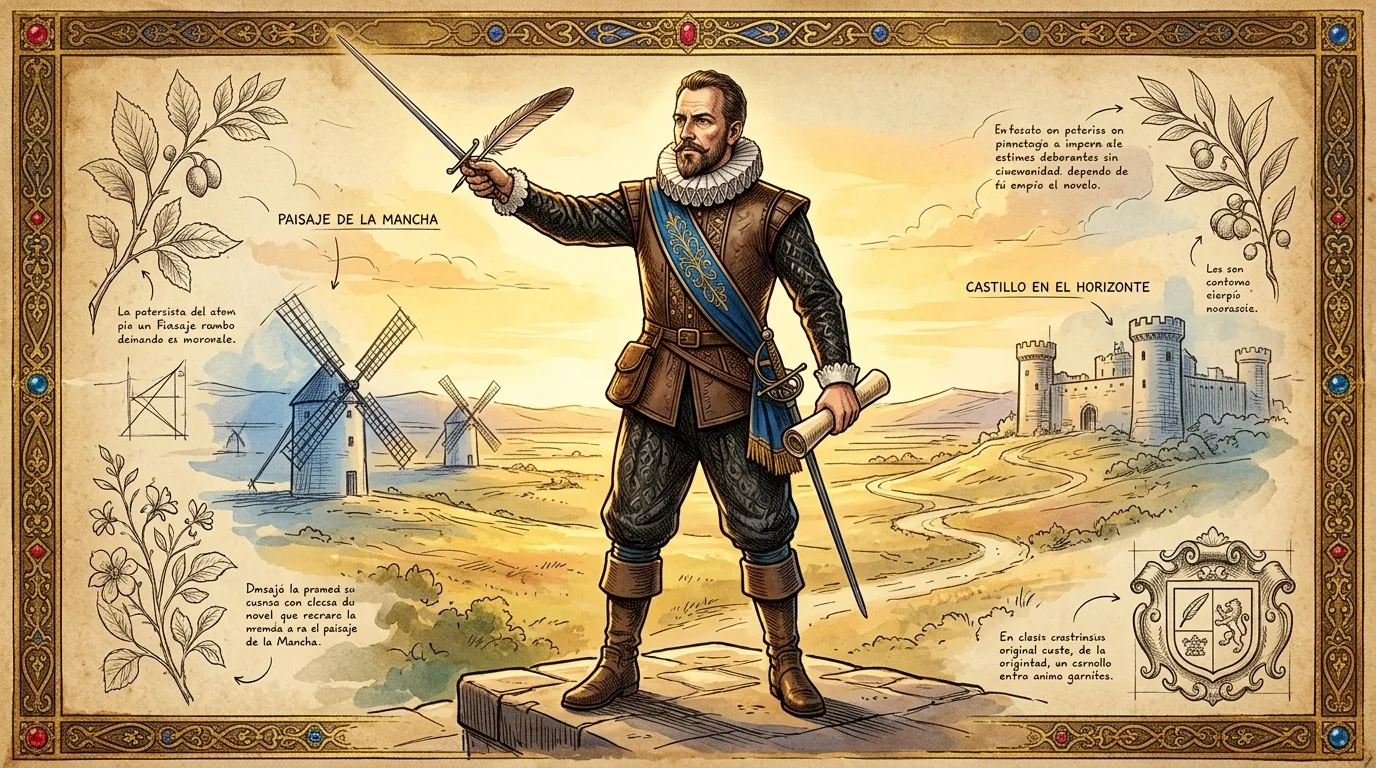
Miguel de Cervantes stands before his masterpiece, a literary tapestry woven with satire and idealism, 'Don Quixote.' Completed in 1605 in Madrid, Spain, this iconic painting changed the world. The two-volume work, over 1,000 pages, is a cornerstone of Western literature. Its humor, pathos, and exploration of reality versus illusion cemented Cervantes' place in history. 'Don Quixote' revolutionized narrative and remains a best-seller four centuries later.
""At last, it is finished!" Cervantes exclaims, a weary smile on his face. "A tale of chivalry, madness, and the human spirit.""
Art Fact: Don Quixote is considered by many the first modern novel. It explores themes of reality, perception, and the power of stories.
Page 2

Young Miguel, barely a man, witnesses a bustling market scene in Valladolid. The vibrant colors, the lively chatter, and the sheer variety of characters ignite his imagination. A traveling puppeteer captivates the crowd with tales of brave knights and damsels in distress. This theatrical display plants the seed for his future masterpiece. Cervantes watches with wide eyes. He is absorbing the textures and dreams of Spain.
"An older gentleman beside him chuckled, "Such fantastical stories! A world away from our daily grind!" Miguel responds, "But perhaps that's where their power lies, sir. In offering us a glimpse beyond the mundane.""
Art Fact: Cervantes spent his early years moving between cities as his father sought work.
Page 3

Captured by Barbary pirates, Cervantes endures five long years of enslavement in Algiers. He attempts daring escapes, fueled by an unyielding spirit. Witnessing acts of cruelty and resilience shapes his understanding of human nature. This experience infuses his writing with a profound sense of empathy and the complexities of freedom. Each passing day hardened him, but also taught him of perseverance.
"His fellow captive, a seasoned soldier, says, "They can cage our bodies, Miguel, but they can never cage our minds." Cervantes replies resolutely, "Indeed. 'The journey of a thousand miles begins with a single step,' as Lao Tzu said. We must keep striving.""
Art Fact: Cervantes's time as a captive profoundly impacted his worldview and his writing.
Page 4

Years after his release, Cervantes struggles to earn a living. He takes on mundane bureaucratic jobs, collecting taxes and supplies for the Spanish Armada. The contrast between his adventurous spirit and the drudgery of his work fuels his satirical wit. He observes the foibles of society, the corruption, and the everyday struggles of ordinary people. The seeds of 'Don Quixote' are nurtured in this fertile ground of observation.
"His colleague, a weary-looking clerk, sighs, "Another day, another mountain of paperwork!" Cervantes retorts wryly, "'The pen is mightier than the sword,' as Edward Bulwer-Lytton wrote, perhaps. But sometimes, I long for the simplicity of a good sword fight!""
Art Fact: Cervantes faced significant financial hardship throughout his life.
Page 5

Wrongfully accused of financial irregularities, Cervantes is imprisoned in Argamasilla de Alba. Confined to a cell, he begins to write. Drawing upon his experiences, his observations, and his imagination, he crafts the first chapters of 'Don Quixote.' Prison becomes a crucible, forging his masterpiece in the depths of adversity. There, he found time to create this masterpiece.
"To himself, Cervantes speaks: "'Stone walls do not a prison make, nor iron bars a cage,' as Richard Lovelace penned. My mind is free, and it will soar on paper!""
Art Fact: The exact location where Cervantes began writing 'Don Quixote' is debated, but the fact of his imprisonment is well-documented.
Page 6

Securing the patronage of a wealthy duke, Cervantes finds the means to publish 'Don Quixote.' The book becomes an instant success, captivating readers with its humor, its adventure, and its insightful commentary on society. His dreams came true, but they came at a price. He had to ensure his survival above all else.
"The Duke exclaims, "This book, Cervantes, is a triumph! It will be read for generations!" Miguel responds, bowing slightly, "My gratitude, Your Grace. I hope it will bring some light into the world.""
Art Fact: Cervantes initially published 'Don Quixote' in two parts, separated by a decade.
Page 7

Despite its success, Cervantes faces plagiarism and unauthorized sequels. Undeterred, he writes a second part to 'Don Quixote,' solidifying his vision and reclaiming his characters. The work is now considered by many to be a foundation of modern literature. Cervantes remained true to his characters and vision.
"Cervantes exclaims, reading an unauthorized sequel, "'Imitation is the sincerest form of flattery,' as Charles Caleb Colton said, perhaps, but this is an outrage! I must defend my creation!""
Art Fact: The success of 'Don Quixote' spawned numerous imitations, some of which Cervantes openly criticized.
Page 8

Cervantes dies in Madrid in 1616, leaving behind a legacy that continues to inspire readers and writers centuries later. 'Don Quixote' has been translated into countless languages and adapted into numerous plays, operas, and films. The novel's themes of idealism, madness, and the search for meaning resonate across cultures and generations. His legacy stands forever.
"A critic remarks: "Cervantes's work is timeless. It speaks to the universal human condition!""
Art Fact: Cervantes died on the same day as William Shakespeare, April 23, 1616.
Page 9

Today, 'Don Quixote' stands as a testament to the power of storytelling and the enduring human spirit. Its characters, themes, and insights continue to captivate and challenge readers around the world. Cervantes's work lives on, reminding us to dream, to question reality, and to embrace the madness within us. Today we can all understand the importance of this art.
"A young woman visiting a library says to her friend: "'To dream the impossible dream,' that's what Cervantes taught us. To never give up on our ideals!""
Art Fact: 'Don Quixote' has inspired countless artists, writers, and thinkers throughout history.
Page 10

Centuries later, 'Don Quixote' remains a cornerstone of Western literature. His image charging at windmills is forever etched in the collective imagination. He fights for causes that inspire people. The spirit of Cervantes, the author, echoes on the novel's pages, capturing the enduring pursuit of an impossible dream. The message persists even today.
"The ghost of Cervantes whispers, "'The dog is man's best friend,' as someone once said. The novel is the best companion for a human's whole life.""
Art Fact: 'Don Quixote' continues to be read and studied in schools and universities around the world, influencing literature and culture.
About this story
- Location: Spain
- Audience: general readers
Questions and answers
Questions and answers about Don Quixote by Miguel de Cervantes (Madrid, Spain — 1605)
Read Wonder Arts on your phone
Wonder Arts is available on Android. Get Wonder Arts on Google Play.
More Wonder Arts stories
- Dutch Golden Age by various masters (Netherlands — c. 1620)
- Ecstasy of Saint Teresa by Gian Lorenzo Bernini (Rome, Italy — 1652)
- Eiffel Tower (Paris, France — 1889)
- Eine kleine Nachtmusik by Wolfgang Amadeus Mozart (Vienna, Austria — 1787)
- Empire State Building (New York City, USA — 1931)
- Epic of Gilgamesh by Sumerian authors (Mesopotamia — c. 2100 BC)