Eiffel Tower (Paris, France — 1889)
Eiffel Tower (Paris, France — 1889) — an illustrated arts story, set in France. 10 illustrated pages, free to read on Wonder Arts.

Page 1

Paris, 1889. Gustave Eiffel, the visionary engineer, stands proudly before his completed masterpiece: the Eiffel Tower. The wrought-iron lattice structure soars above the Champ de Mars, a testament to engineering prowess and architectural audacity. Standing at 330 meters (1,083 ft) tall, it was the tallest man-made structure in the world for 41 years. Its construction for the Exposition Universelle marked a pivotal moment in architectural history. The Eiffel Tower faced initial criticism, but now stands as an emblem of Paris and France. It's estimated to be worth over 434 billion to the French economy.
"Eiffel turns to his chief engineer, Maurice Koechlin, and says, 'Imagine, Maurice, a structure that embodies the spirit of modern engineering! A beacon of progress!' Maurice replies, 'Indeed, Monsieur Eiffel, a symbol that will resonate for generations to come.'"
Art Fact: The Eiffel Tower, initially criticized by some of France's leading artists and intellectuals, was intended to be a temporary structure.
Page 2

Zurich, 1884. Maurice Koechlin, Eiffel's senior engineer, sketches a daring design on a napkin. It's a tower of four lattice girders separated at the base and coming together at the top, joined by metal girders at regular intervals. He presents his concept to Eiffel and Émile Nouguier. Doubts linger, but Eiffel recognizes the potential.
"Koechlin, holding up the napkin sketch, explains, 'Monsieur Eiffel, imagine a tower soaring above Paris, a symbol of our engineering age!' Nouguier responds skeptically, 'But Koechlin, is such a structure even feasible? The wind resistance alone!'"
Art Fact: Maurice Koechlin and Émile Nouguier, both senior engineers in Eiffel's company, are credited with the initial design concept of the Eiffel Tower.
Page 3

Paris, 1885. Eiffel and his team grapple with the challenges of wind resistance. The tower's design must withstand the fierce winds that sweep across the Champ de Mars. They conduct wind tunnel tests, meticulously calculating the forces at play. Saanvi, a brilliant engineer, plays a crucial role in the calculations.
"Eiffel, studying the wind tunnel data, exclaims, 'The wind pressure is far greater than we anticipated! We must reinforce the structure.' Saanvi adds, 'Monsieur Eiffel, I've developed a new formula that accounts for the varying wind speeds at different heights.' Saanvi is a man in his early 30s female, stocky and strong, with light brown skin with warm undertones and medium curly caramel-brown hair with sun highlights."
Art Fact: The aerodynamic shape of the Eiffel Tower was carefully designed to minimize wind resistance, a significant engineering challenge.
Page 4

Paris, 1887. A storm of protest erupts from leading artists and intellectuals. They denounce the Eiffel Tower as an eyesore, a monstrous intrusion on the Parisian skyline. A manifesto signed by figures like Guy de Maupassant and Charles Garnier is published, fiercely criticizing the project. The Eiffel tower sparked widespread controversy.
"Guy de Maupassant, pacing angrily, declares, 'This metal monstrosity will forever mar the beauty of Paris! It is a disgrace to our artistic heritage.' Charles Garnier adds, 'Imagine, Eiffel, casting a dark shadow over our cherished monuments!'"
Art Fact: Guy de Maupassant famously said he often ate lunch in the Eiffel Tower because it was the only place in Paris where he couldn't see it.
Page 5
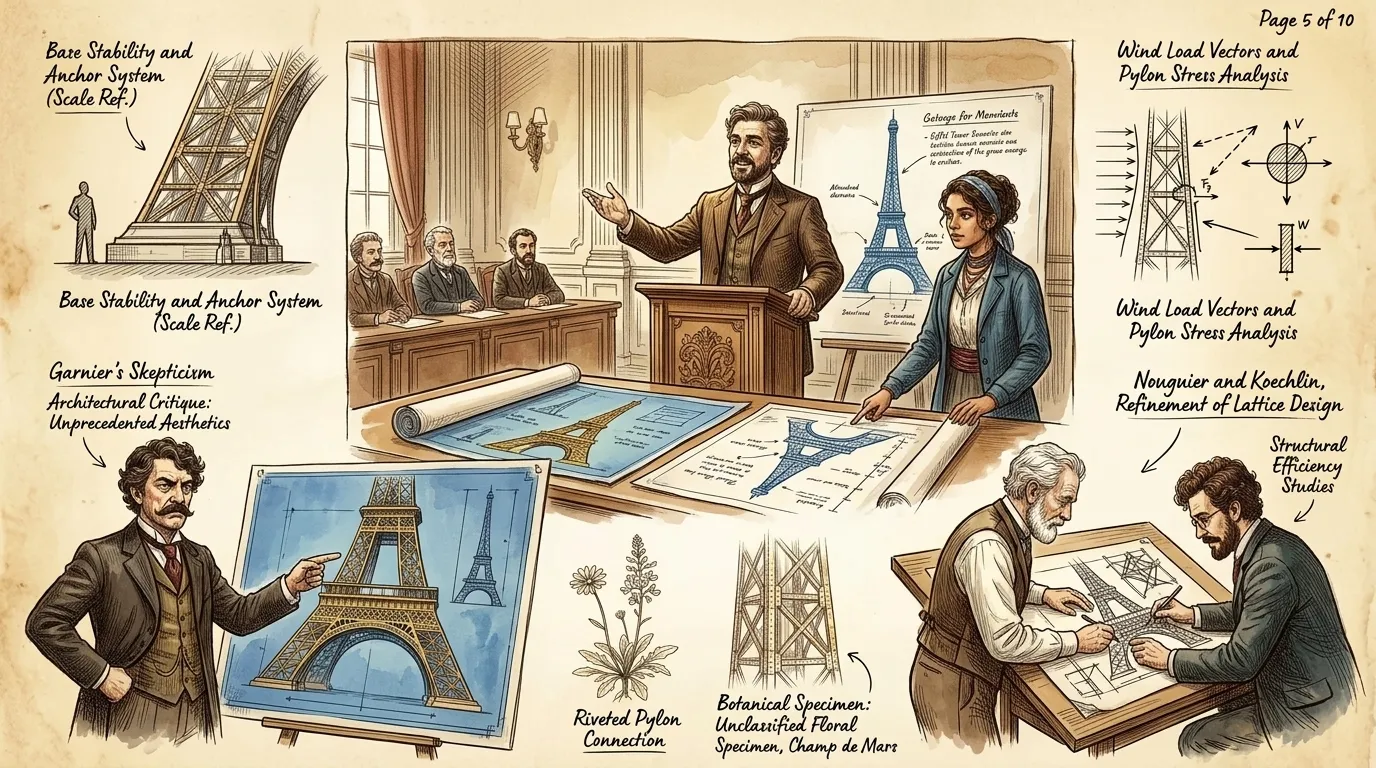
Paris, 1887. Gustave Eiffel defends his project with unwavering conviction. He argues that the tower represents the spirit of modern engineering and progress. He emphasizes its scientific utility, its potential for communication and observation. He believes it will become a symbol of French ingenuity.
"Eiffel addresses the critics, 'Gentlemen, this tower is not merely a structure of iron, but a testament to human innovation! It will serve as a beacon of scientific progress, a symbol of our nation's ambition!'"
Art Fact: Eiffel argued that the tower was not only an aesthetic achievement but also had practical applications for scientific research and communication.
Page 6
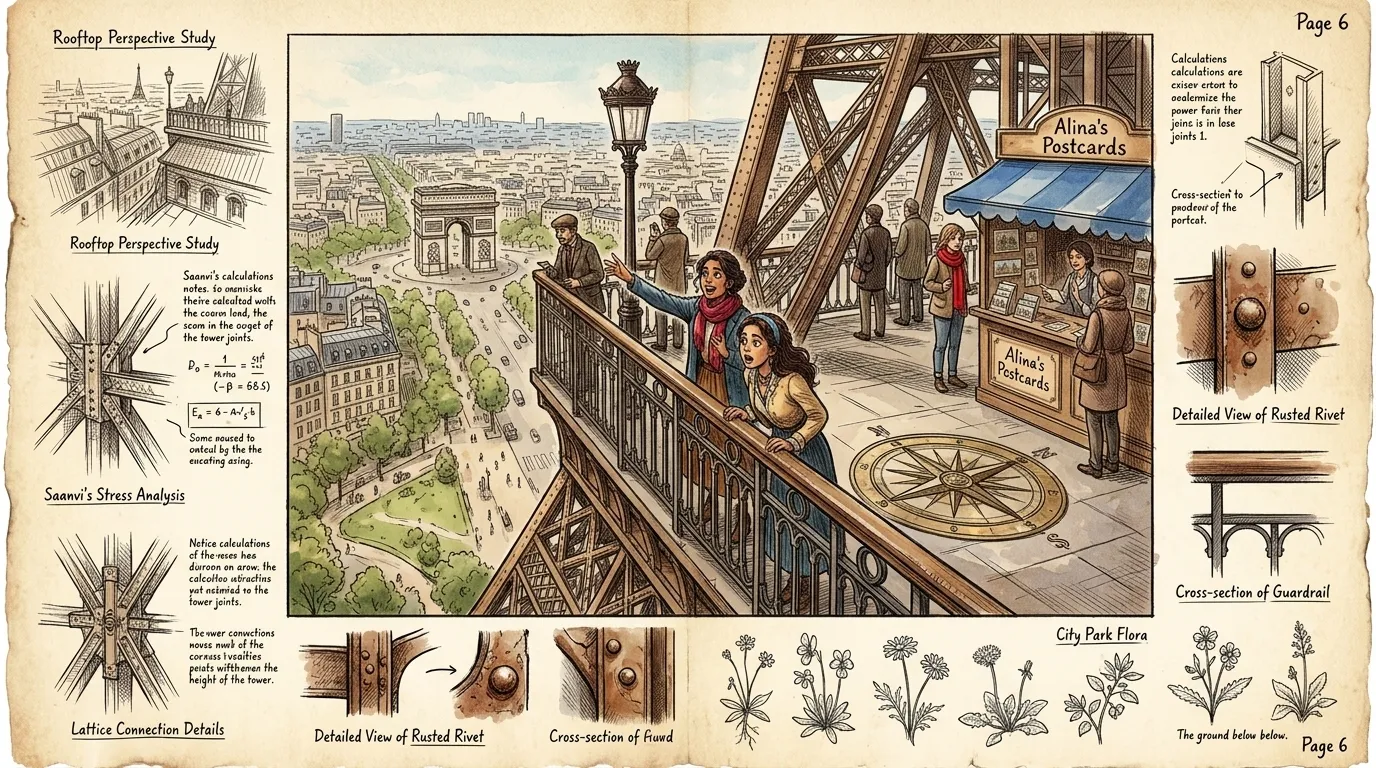
Paris, May 6, 1889. The first platform of the Eiffel Tower opens to the public. Visitors marvel at the s of Paris, a breathtaking spectacle from an unprecedented height. The initial skepticism begins to fade as the public embraces the tower's novelty and grandeur.
"A visitor exclaims, 'The view is magnificent! I can see the entire city from up here!' Another adds, 'It's an engineering marvel! I never imagined Paris could look so beautiful from above.'"
Art Fact: The first platform of the Eiffel Tower is located 57 meters (187 ft) above ground level.
Page 7
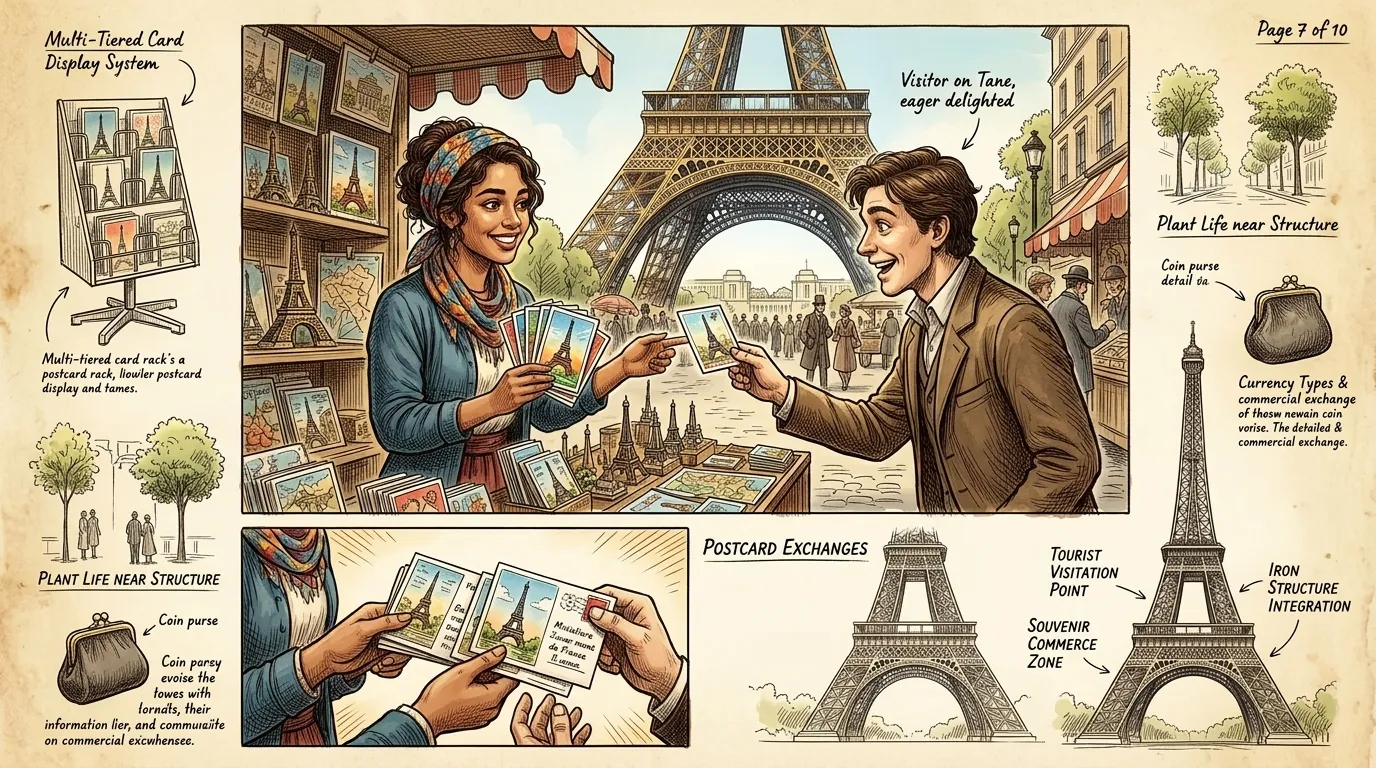
Paris, 1890s. The Eiffel Tower gradually becomes an iconic symbol of Paris and France. It appears on postcards, posters, and advertisements, its image synonymous with the city's modernity and romance. The tower's initial detractors are silenced by its overwhelming popularity.
"Alina, selling postcards, calls out, 'Get your Eiffel Tower postcards here! A souvenir of your visit to the city of lights!' Tane stops to buy one, exclaiming, 'It's magnificent! I must send this to my family back home.'"
Art Fact: The Eiffel Tower quickly became a popular subject for postcards, cementing its status as a symbol of Paris.
Page 8
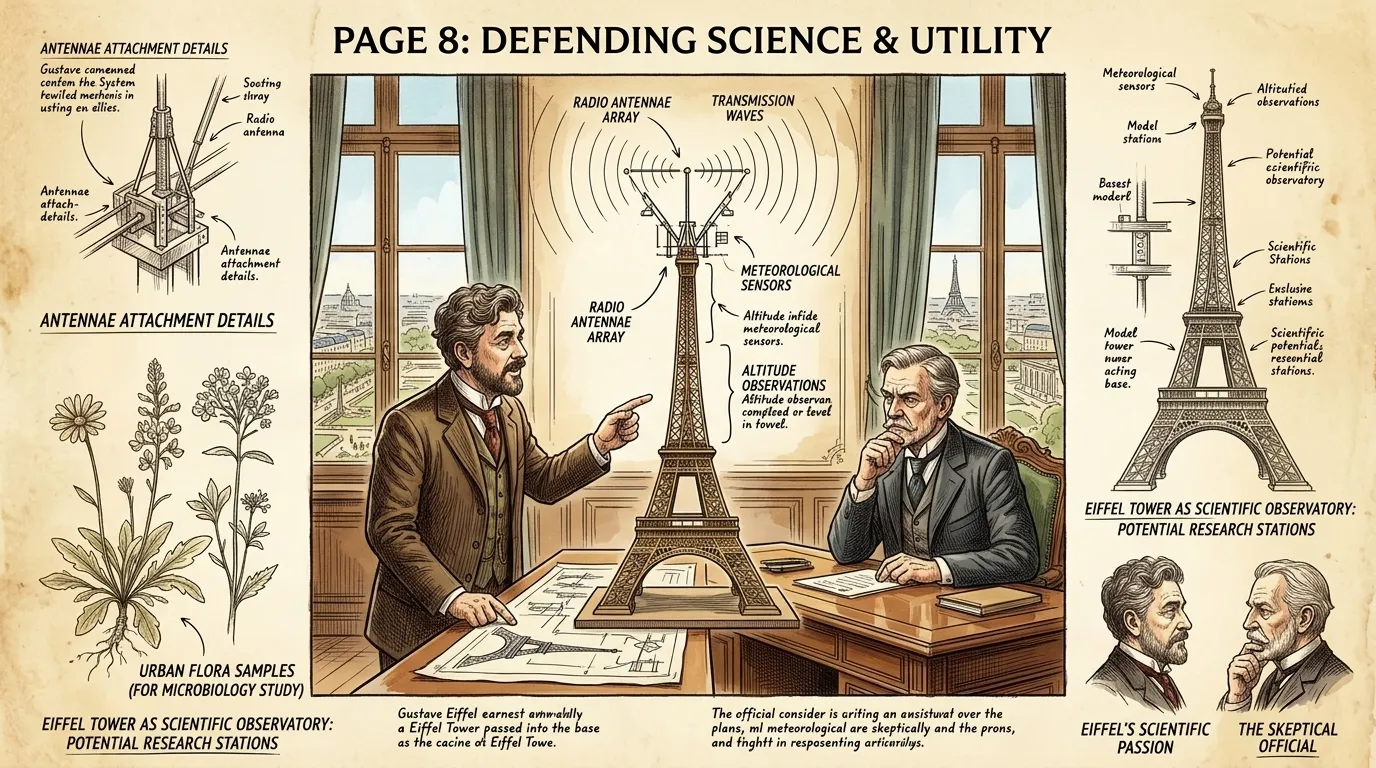
Paris, early 20th century. As the 20-year concession nears its end, debates rage about the tower's fate. Eiffel champions its scientific value, highlighting its use for radio transmissions. He convinces the authorities to preserve it, saving it from demolition. Remembering the words of Leonardo da Vinci, he knew it would become an iconic symbol. As da Vinci said, 'I have been impressed with the urgency of doing. Knowing is not enough; we must apply. Being willing is not enough; we must do.'
"Eiffel pleads, 'This tower is not just a monument, it is a vital instrument for scientific progress! Demolishing it would be a grave mistake.' An official responds, 'But Monsieur Eiffel, the cost of maintaining it is considerable. Can you demonstrate its continued usefulness?'"
Art Fact: Eiffel successfully argued that the tower was essential for radio transmissions, which ultimately saved it from being dismantled.
Page 9

Paris, present day. The Eiffel Tower stands as a testament to Eiffel's vision and engineering prowess. It welcomes millions of visitors each year, a symbol of Paris, France, and human ingenuity. It inspires artists, engineers, and dreamers worldwide.
"A modern-day engineer, Saanvi, says, 'The Eiffel Tower is an inspiration! It shows what can be achieved with daring vision and brilliant engineering.' A tourist adds, 'It's even more impressive in person than in the photos!'Saavni is a man in his early 30s female, stocky and strong, with light brown skin with warm undertones and medium curly caramel-brown hair with sun highlights."
Art Fact: The Eiffel Tower remains one of the most visited monuments in the world, attracting millions of tourists each year.
Page 10
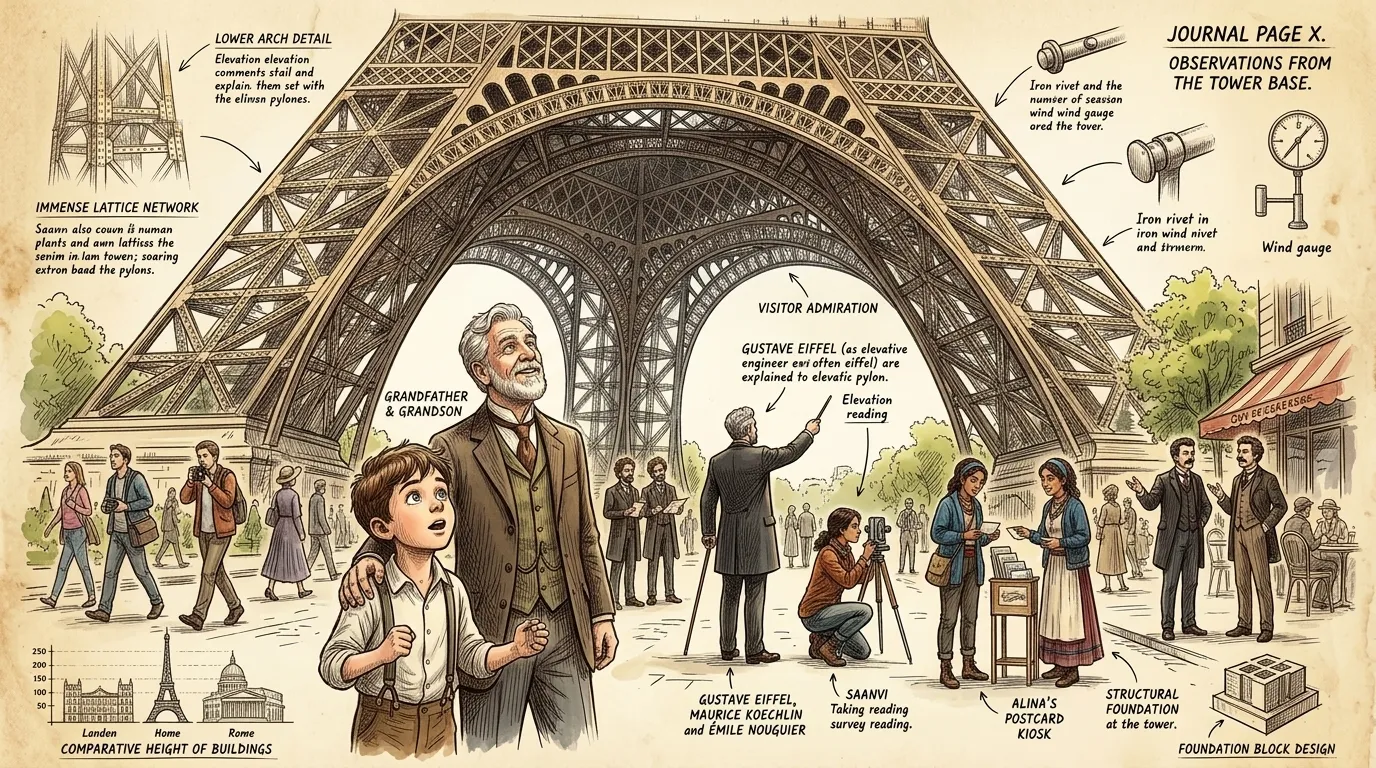
The Eiffel Tower stands tall, not just as a structure of iron, but as a monument to vision, innovation, and the relentless pursuit of progress. It continues to capture the imagination of the world, a symbol of what humanity can achieve when daring dreams are coupled with engineering brilliance. The tower survives because it is not just a tower, but a testament to the human spirit. It is a legacy that will endure through generations.
"A young boy, gazing up at the tower, whispers to his grandfather, 'It's so big! It's amazing that someone built this!' The grandfather replies, 'Indeed, my boy. It is a testament to what human ingenuity can achieve. It is a symbol of what we can do.'"
Art Fact: The Eiffel Tower is a symbol of Paris, France, and human ingenuity, inspiring awe and wonder in visitors from around the world.
About this story
- Location: France
- Audience: general readers
Questions and answers
Questions and answers about Eiffel Tower (Paris, France — 1889)
Read Wonder Arts on your phone
Wonder Arts is available on Android. Get Wonder Arts on Google Play.
More Wonder Arts stories
- Eine kleine Nachtmusik by Wolfgang Amadeus Mozart (Vienna, Austria — 1787)
- Empire State Building (New York City, USA — 1931)
- Epic of Gilgamesh by Sumerian authors (Mesopotamia — c. 2100 BC)
- Equestrian Statue of Colleoni by Andrea del Verrocchio (Venice, Italy — 1496)
- Farnese Hercules by Glykon (Naples, Italy — 3rd Century AD)
- Fidelio by Ludwig van Beethoven (Vienna, Austria — 1805)