Dante and Virgil in Hell by William-Adolphe Bouguereau (France — 1850)
Dante and Virgil in Hell by William-Adolphe Bouguereau (France — 1850) — an illustrated arts story, set in France. 10 illustrated pages, free to read on Wonder Arts.
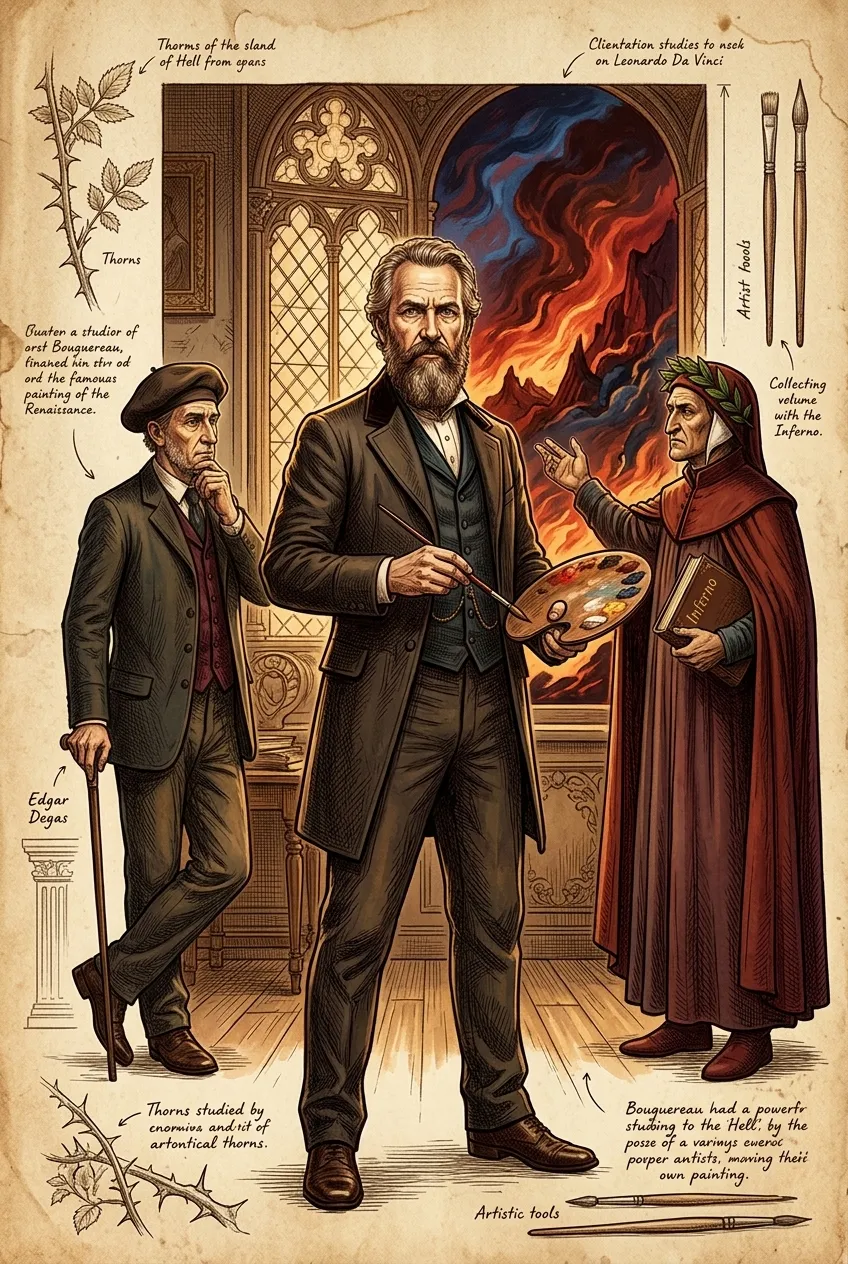
Page 1
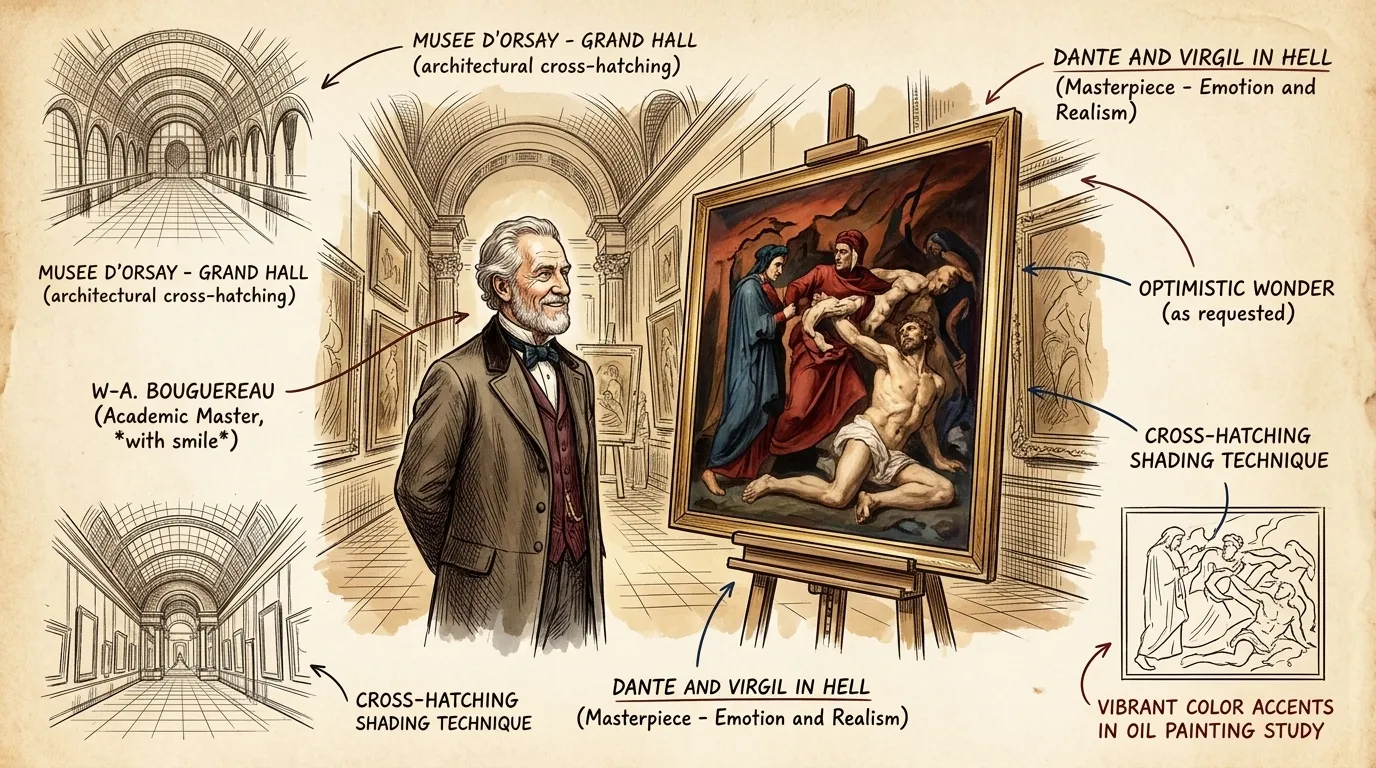
William-Adolphe Bouguereau, a master of academic art, stands before his controversial masterpiece, 'Dante and Virgil in Hell.' Completed in 1850, this painting, measuring 281 x 225 cm, currently resides at the Musée d'Orsay. The work sparked debate for its graphic depiction of Dante's Inferno, a departure from Bouguereau's more sentimental works.
""The canvas breathes with a torment I scarcely imagined possible," Bouguereau murmurs, his gaze fixed on the writhing figures. "May it serve as a reminder of the depths to which humanity can sink.""
Art Fact: The painting's graphic depiction of suffering caused controversy upon its debut, but also cemented Bouguereau's reputation as a formidable talent.
Page 2
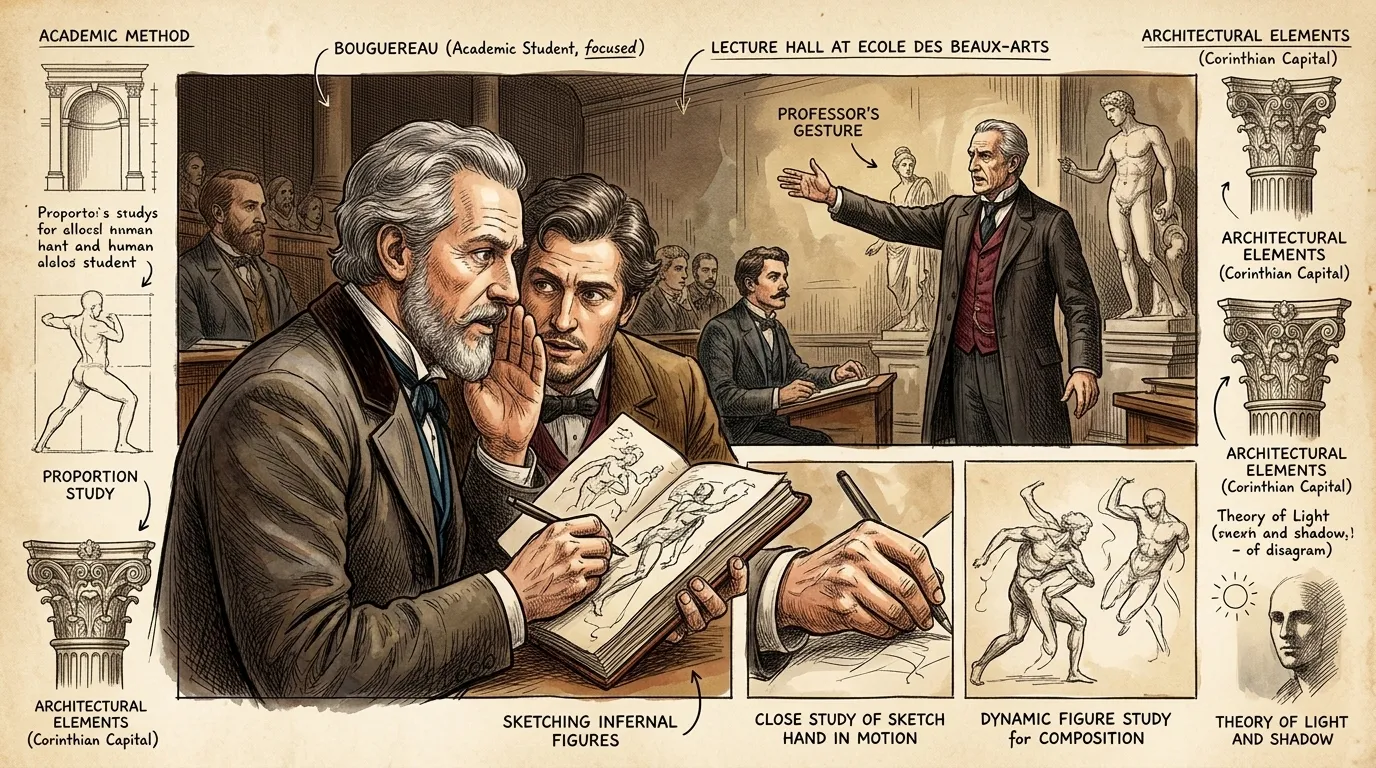
A young Bouguereau attends a lecture at the École des Beaux-Arts in Paris. The rigid academic style, emphasizing classical forms and historical subjects, clashes with his burgeoning artistic sensibilities. He listens intently, sketching furiously in his notebook, absorbing the lessons while simultaneously questioning their limitations.
""Remember, young artists," the professor booms, "that true art lies in the pursuit of perfection through classical ideals!" Bouguereau whispers to a fellow student, "But what of the raw emotion, the untamed spirit of the human condition?""
Art Fact: Bouguereau's formal training at the École des Beaux-Arts instilled in him a mastery of technique, but also sparked a desire to break free from academic constraints.
Page 3
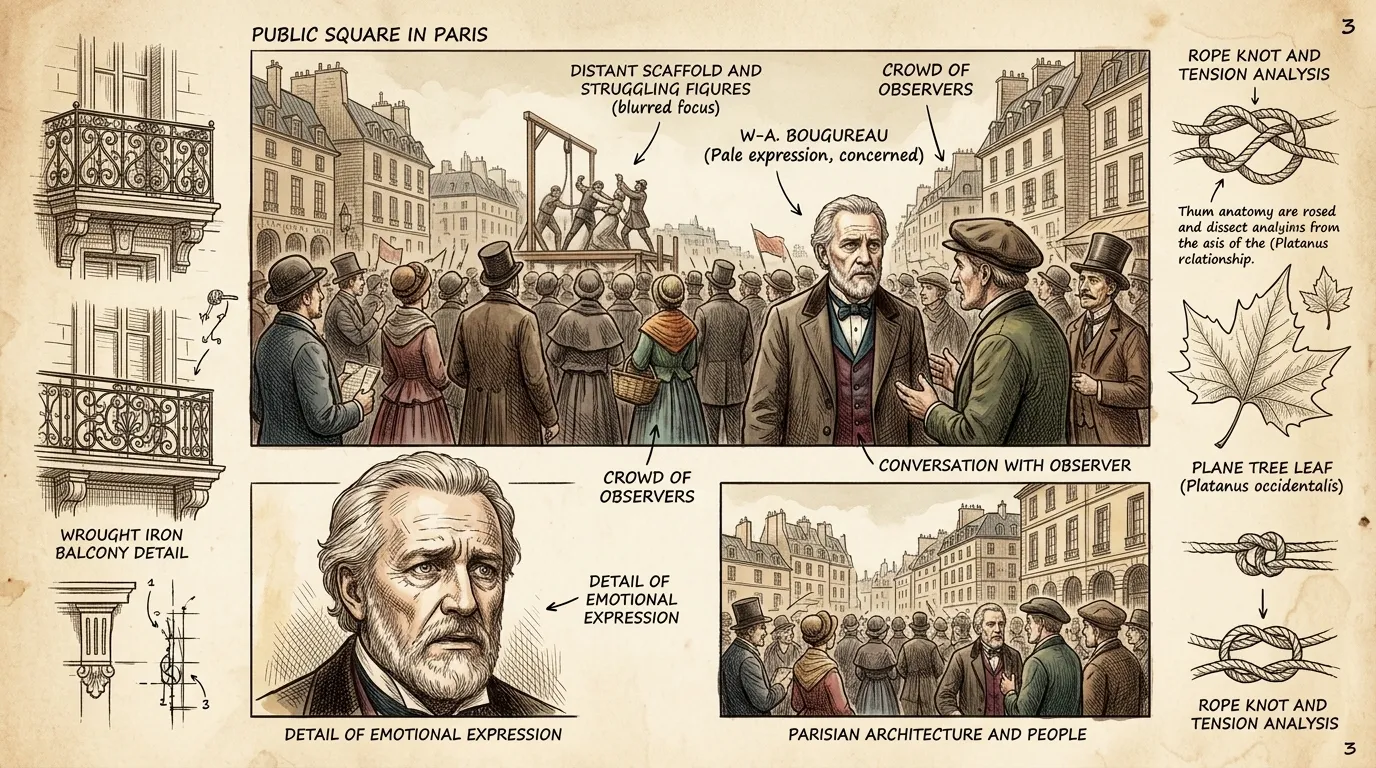
Bouguereau witnesses a public execution in Paris. The raw, visceral display of human suffering deeply affects him, etching itself into his memory. He sees not just death, but the agony and despair of the condemned, an image that will later fuel his depiction of Hell. He realizes suffering should be represented realistically.
"A fellow onlooker exclaims, "Such a barbaric spectacle! It is a stain on our civilization!" Bouguereau, his face pale, responds quietly, "Perhaps... but it is also a truth we must confront. Such suffering exists, and we must not turn away.""
Art Fact: The public execution served as a harrowing reminder of the pain and suffering in the world, profoundly shaping Bouguereau's artistic vision.
Page 4
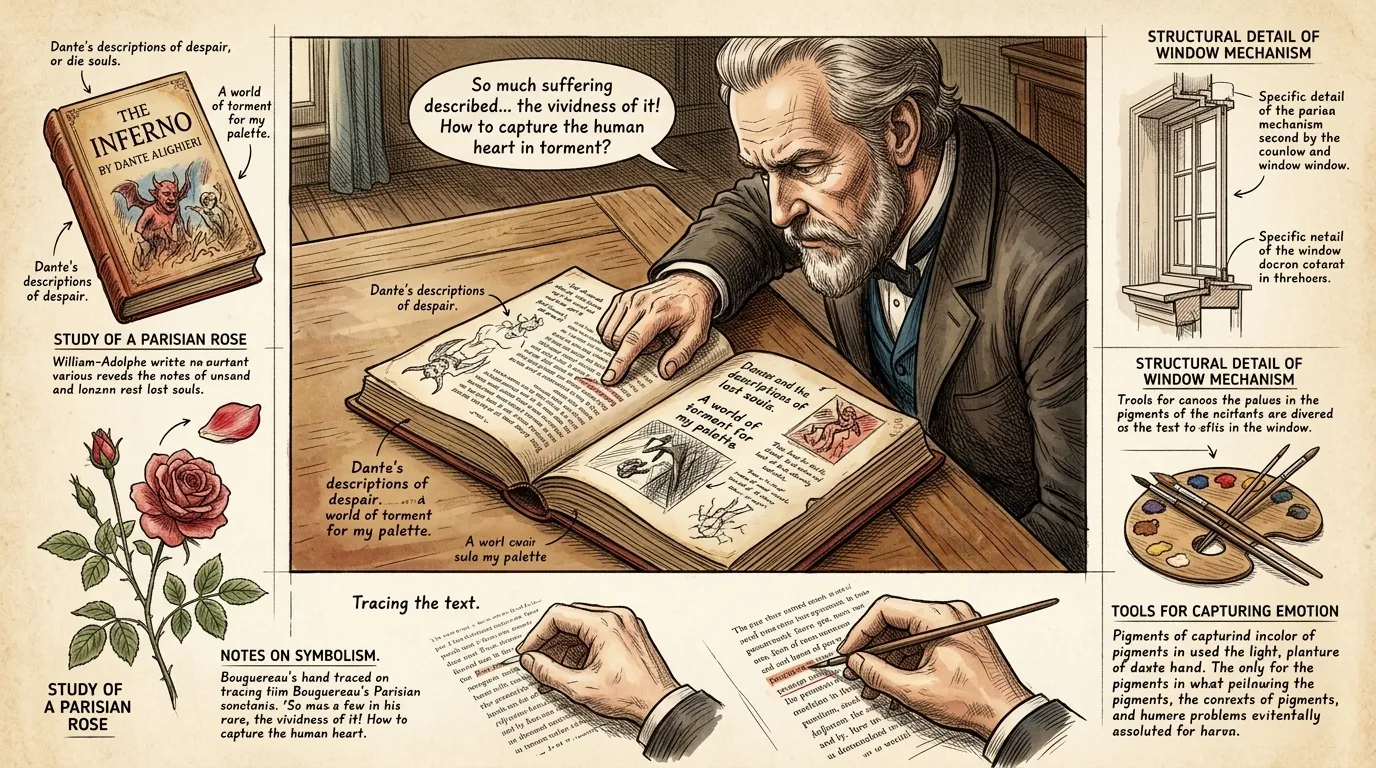
In his small Parisian apartment, Bouguereau immerses himself in Dante Alighieri's 'Inferno.' The vivid descriptions of Hell's torments ignite his imagination, providing a framework for his own artistic exploration of human suffering. He is struck by the moral implications of Dante's writing.
"As Dante wrote, 'The darkest places in hell are reserved for those who maintain their neutrality in times of moral crisis,' Bouguereau mused, remembering the words of Dante Alighieri. "Indeed," he whispers, "to stand idly by in the face of injustice is a sin in itself.""
Art Fact: Dante's 'Inferno' provided Bouguereau with the narrative structure and thematic depth to explore the darker aspects of human existence.
Page 5
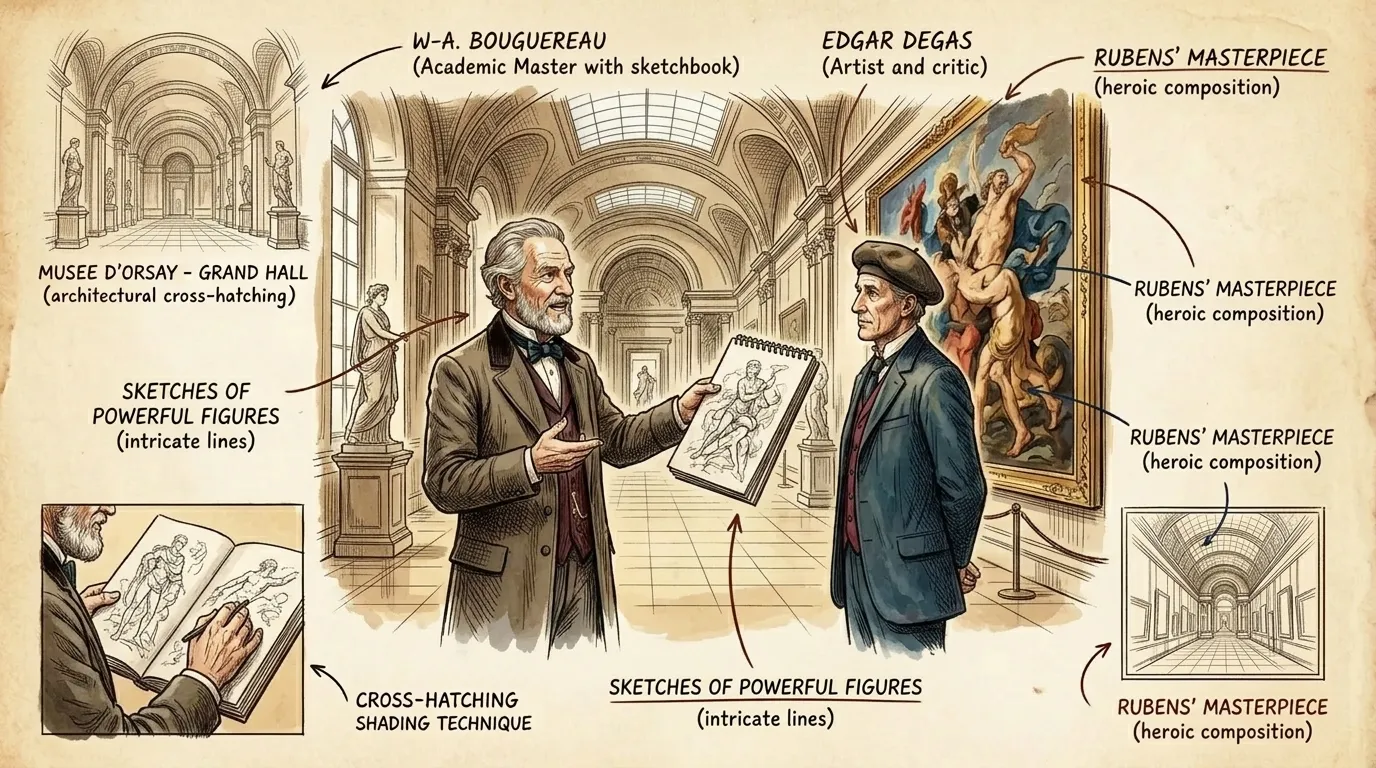
Bouguereau visits the Louvre, studying the works of Michelangelo and Rubens. He admires their mastery of the human form and their ability to convey powerful emotions. However, he seeks to surpass them, to create a vision of Hell that is both classical in form and unflinchingly realistic in its depiction of suffering.
"Comparing his sketches to a Rubens canvas, Bouguereau tells his friend, "Rubens captures the drama, but I aim for the truth. I will show Hell as it truly is, a place of unimaginable suffering.""
Art Fact: Studying the masters at the Louvre provided Bouguereau with the technical skills and artistic ambition to undertake his ambitious project.
Page 6
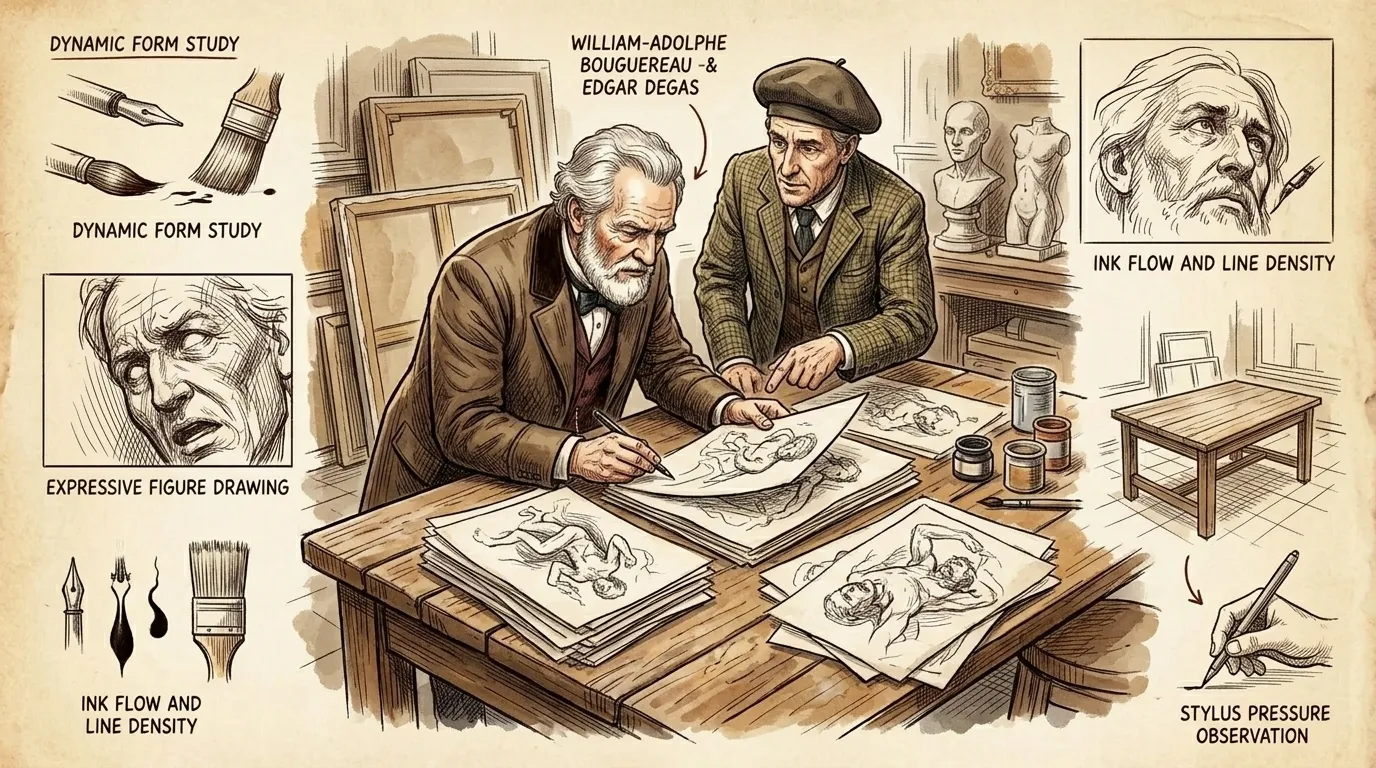
Bouguereau begins sketching studies for 'Dante and Virgil in Hell,' filling pages with images of writhing bodies and anguished faces. He seeks to capture the physical and emotional extremes of human suffering, pushing the boundaries of classical form. Every inch represents realistic depictions of the human experience.
"Looking over his early sketches, his friend comments, "These figures... they are almost too real, too disturbing." Bouguereau replies, his eyes gleaming with intensity, "That is the point. Hell is not a pretty place, nor a pleasant thought.""
Art Fact: Bouguereau's extensive sketching process allowed him to refine his vision of Hell and develop the technical skills necessary to execute it on canvas.
Page 7
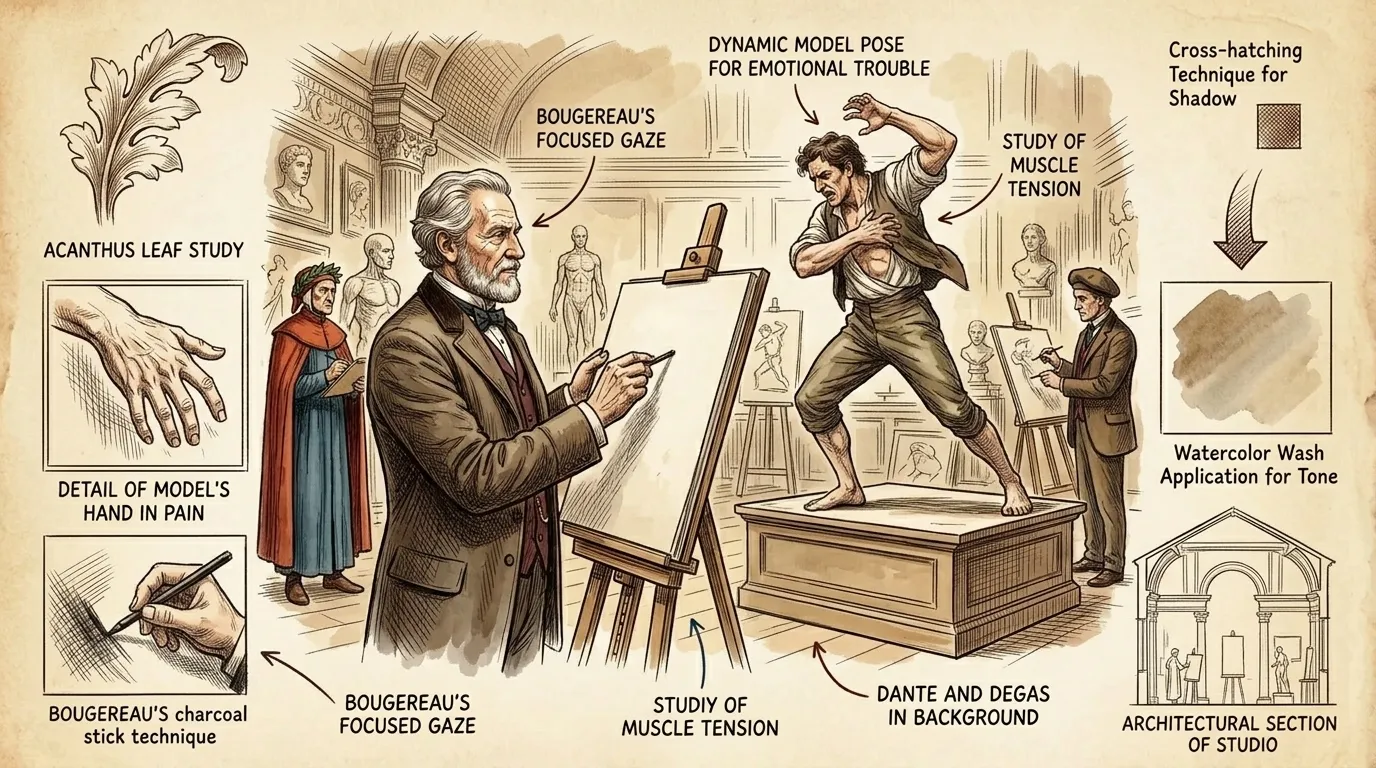
Bouguereau experiments with different techniques, striving for a level of realism that surpasses anything he has achieved before. He studies anatomy, meticulously rendering every muscle and sinew. He is determined to depict the human body realistically. He wants to highlight the true realistic torment and pain the body would endure.
"While observing models, he states, "As Leonardo da Vinci said, 'Painting embraces all the ten functions of the eye; that is to say, darkness, light, body and colour, shape and situation, distance and nearness, motion and rest.' I must capture the very essence of human form in all its agonized detail.""
Art Fact: Bouguereau's dedication to realism led him to push the boundaries of artistic representation, challenging traditional notions of beauty and idealism.
Page 8
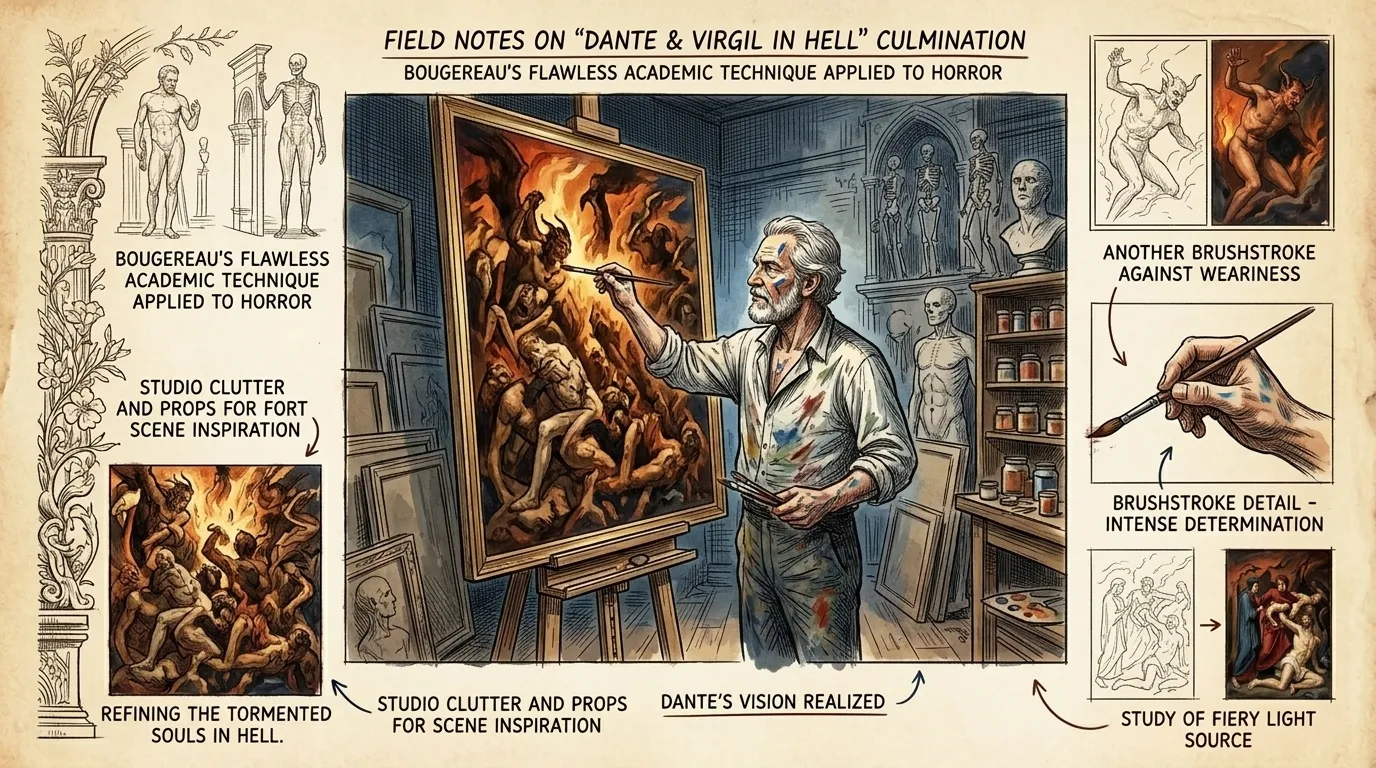
Bouguereau spends countless hours painting 'Dante and Virgil in Hell,' pouring all his energy and emotion into the canvas. He becomes consumed by the vision of Hell, pushing himself to the limits of his physical and mental endurance. With every brushstroke, he is pushing himself.
"After working tirelessly through the night, Bouguereau stares at his canvas and says, exhausted but determined, "I will not rest until I have captured the true essence of Hell's torment. I will not compromise.""
Art Fact: The creation of 'Dante and Virgil in Hell' was a grueling and emotionally demanding process for Bouguereau, pushing him to the brink of exhaustion.
Page 9
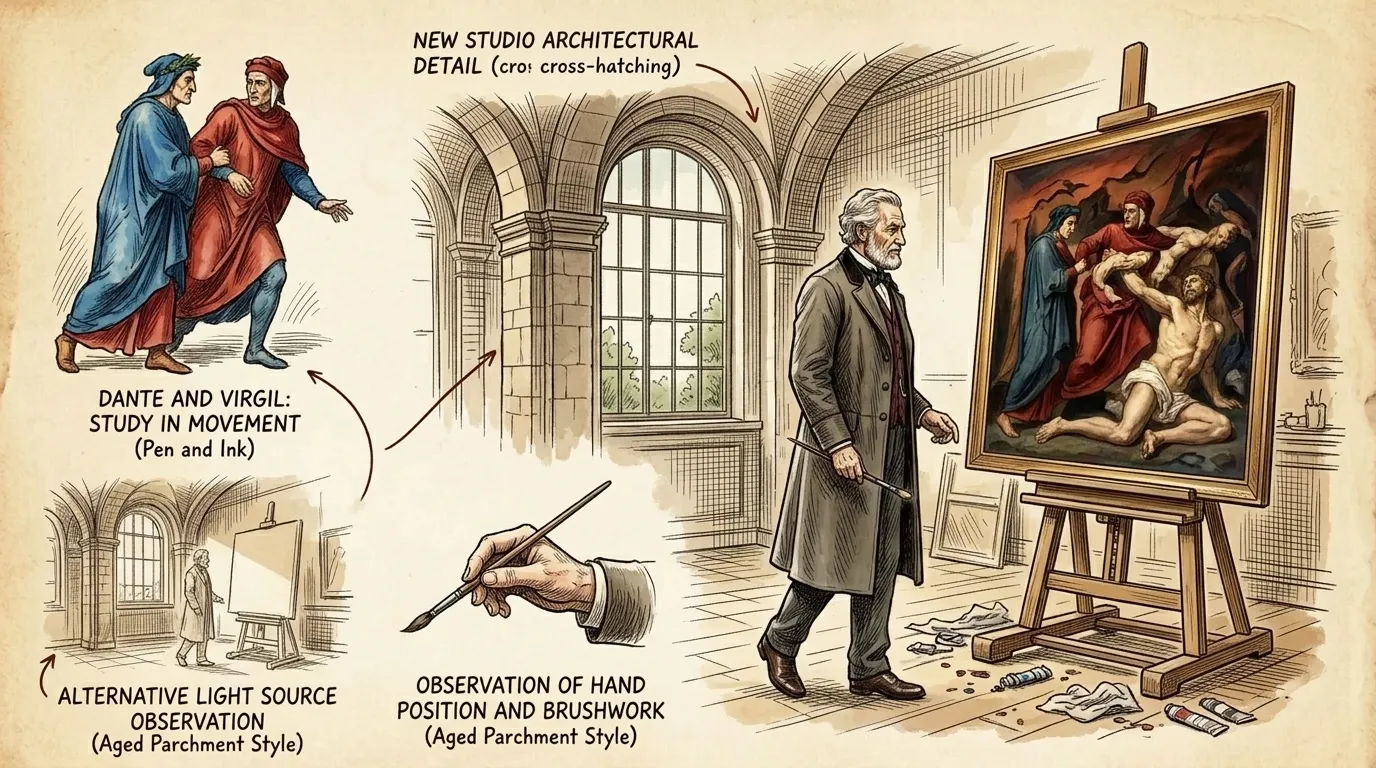
Bouguereau puts the finishing touches on 'Dante and Virgil in Hell.' Stepping back, he feels a sense of both accomplishment and unease. He knows that the painting is a powerful statement, one that is sure to provoke strong reactions. He hopes it has the desired realistic shock value.
"As he adds the final brushstroke, Bouguereau whispers, "It is finished. May it serve as a reminder of the darkness that lies within us all.""
Art Fact: The completion of 'Dante and Virgil in Hell' marked a turning point in Bouguereau's career, solidifying his reputation as a master of academic art and a fearless explorer of the human condition.
Page 10
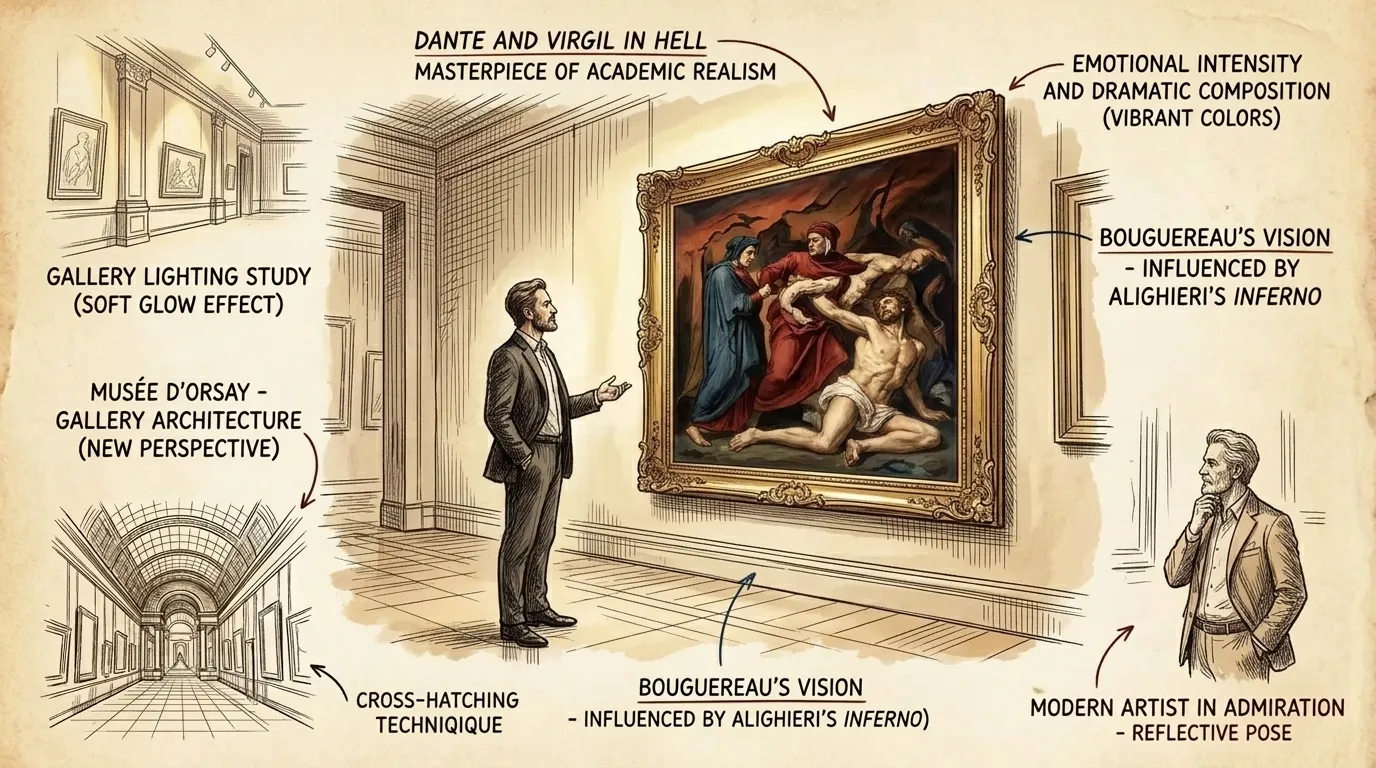
Bouguereau's 'Dante and Virgil in Hell' hangs in the Musée d'Orsay, continuing to provoke and inspire viewers. The painting remains a powerful testament to the enduring power of art to confront the darker aspects of human existence. As the painting has been placed in many art galleries and museums over the years, its significance remains.
"A modern artist looks upon the painting and remarks, "Art is not what you see, but what you make others see", remembering the words of Edgar Degas. "Bouguereau forced us to confront the reality of suffering.""
Art Fact: Bouguereau's work survives because it continues to challenge and provoke, forcing us to confront the uncomfortable truths about ourselves and the world around us.
About this story
- Location: France
- Audience: general readers
Questions and answers
Questions and answers about Dante and Virgil in Hell by William-Adolphe Bouguereau (France — 1850)
Read Wonder Arts on your phone
Wonder Arts is available on Android. Get Wonder Arts on Google Play.