David by Michelangelo (Florence, Italy — 1504)
David by Michelangelo (Florence, Italy — 1504) — an illustrated arts story, set in Italy. 10 illustrated pages, free to read on Wonder Arts.

Page 1

Michelangelo, a name synonymous with artistic genius, gazes upon his masterpiece, David. Completed in 1504 in Florence, Italy, the statue stands an imposing 17 feet tall. Carved from a single block of Carrara marble, its value is immeasurable, a symbol of Florentine freedom. It's a testament to his skill and a beacon of the High Renaissance.
"Michelangelo sighs, running a hand over his beard, "After years of toil, you stand, David. A symbol not just of strength, but of the power of Florence itself.""
Art Fact: The statue of David, originally intended for the roofline of Florence's cathedral, was instead placed in front of the Palazzo Vecchio, the seat of government, as a symbol of the city's republican ideals.
Page 2
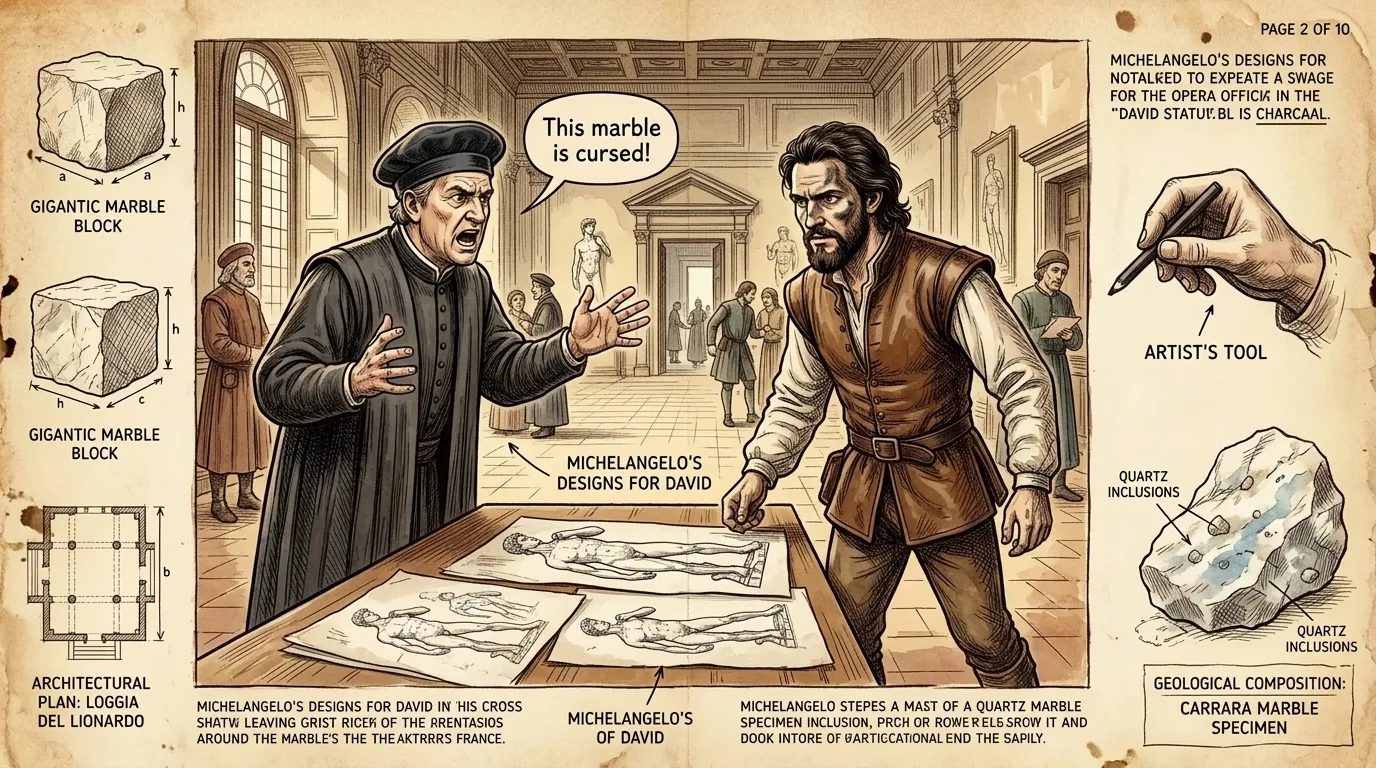
Years before, the Opera del Duomo, the governing body of Florence's cathedral, seeks a sculptor. They had a massive block of marble, nicknamed 'the Giant', which had been abandoned by previous sculptors. Leonardo da Vinci and other artists debated how best to use the marble, but ultimately the commission went to the young Michelangelo.
""This marble... it's been cursed," declares a member of the Opera del Duomo, his voice echoing in the hall. Michelangelo, barely more than a boy, steps forward. "I see not a curse, but potential," he replies, his eyes fixed on the drawings of David."
Art Fact: The block of marble, known as 'The Giant,' had been sitting unused for decades due to its size and perceived imperfections. Several artists deemed it impossible to work with.
Page 3

Michelangelo's early sketches reveal his struggle with the marble's limitations. He had to work within the existing shape, as the block was narrow and flawed. His initial ideas for David's pose, inspired by classical sculpture, had to be adapted to fit the unforgiving stone. He recalls DaVinci's words: 'Art is never finished, only abandoned'
"Michelangelo, charcoal smudged on his face, mutters to himself, bending over countless sketches. "How to capture such power, such...divine grace, from this imperfect stone? DaVinci said, 'Art is never finished, only abandoned'. Will I abandon this too?""
Art Fact: Michelangelo spent months studying the marble block, meticulously planning his approach to maximize the use of the stone and minimize waste.
Page 4
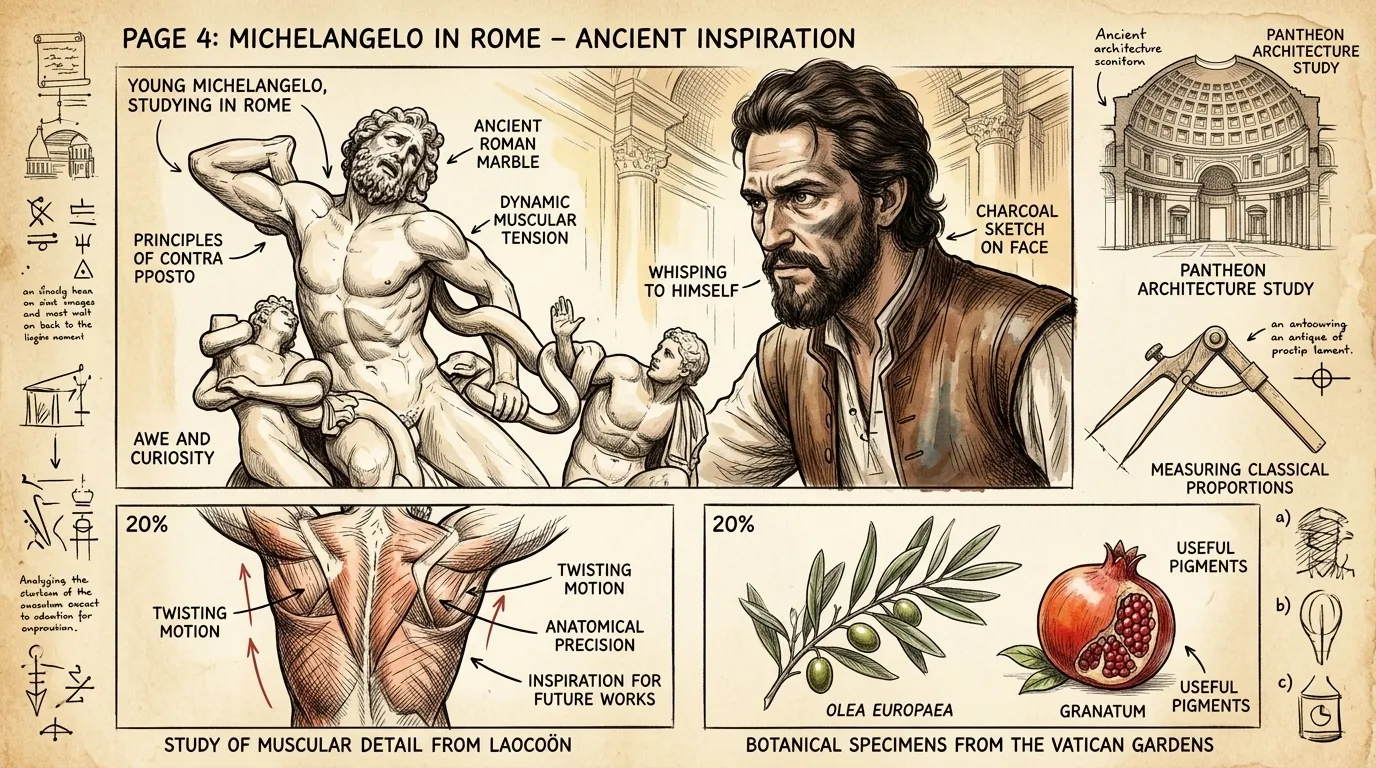
Michelangelo travels to Rome. There, he studies the ancient sculptures. He is deeply influenced by the heroic figures of antiquity. He absorbs the principles of contrapposto, the classical stance of weight shifting that brings life and dynamism to his work. The statues whisper of ancient strength.
"Looking at the ancient Laocoön, Michelangelo whispers to himself, 'See how the body moves, the tension of the muscles! This is the essence of true power.'"
Art Fact: The Laocoön, recently rediscovered at the time, profoundly impacted Renaissance artists, including Michelangelo, influencing their understanding of classical form and emotion.
Page 5
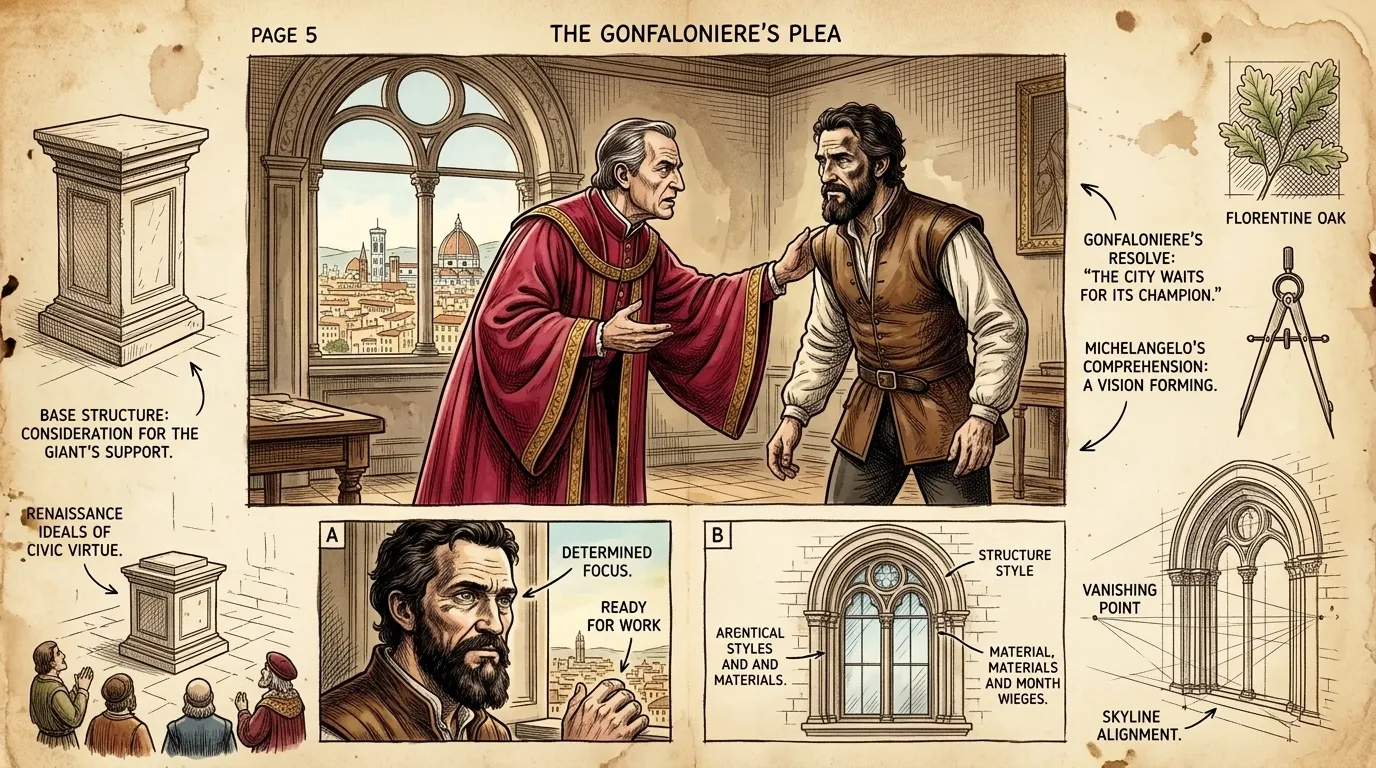
The city of Florence faces political turmoil. Savonarola's fiery sermons had recently shaken the city, leaving it in a state of religious fervor and uncertainty. The young David must be a symbol of defiance against tyranny, a protector of Florence. David represents the city's hopes for freedom.
""Florence needs a hero, Michelangelo. A symbol of our resolve," the Gonfaloniere of Florence urges. Michelangelo nods grimly. "Then a hero she shall have. A David to stand against all Goliaths.""
Art Fact: The placement of David outside the Palazzo Vecchio was a deliberate political statement, meant to symbolize the city's republican ideals and its defiance against potential threats.
Page 6

Michelangelo begins the arduous task of carving. Day after day, he chips away at the marble. He works tirelessly, driven by a vision of the perfect human form. The sound of hammer against chisel echoes through the workshop. He remembers the words of Machiavelli: 'It is better to be feared than loved, if you cannot be both.'
"Michelangelo, sweat dripping from his brow, strikes the marble with his chisel. "'It is better to be feared than loved, if you cannot be both,' Machiavelli said," he grunts, his muscles straining. "Florence will fear our strength!""
Art Fact: Michelangelo was known for his intense work ethic, often spending long hours alone in his workshop, meticulously carving the marble.
Page 7

Michelangelo refines David's expression. He captures not just strength, but also intelligence and determination. David is not just a warrior, but a thinker. His gaze is fixed on the horizon, anticipating the battle to come. The hero's eyes show he is determined.
"Michelangelo steps back, studying David's face. "There!" he exclaims, a hint of satisfaction in his voice. "Not just brawn, but a mind, a purpose. A gaze that sees beyond mere conflict.""
Art Fact: David's intense gaze is one of the statue's most striking features, conveying a sense of purpose and determination.
Page 8

Once complete, the statue is transported through the streets of Florence. A committee of artists, including Leonardo da Vinci, decides on its final location. After much debate, it is placed in front of the Palazzo Vecchio, replacing Donatello's bronze David. The people of Florence stare in awe.
""He stands proud, doesn't he?" Leonardo DaVinci remarks to Michelangelo as they walk beside the statue through the Florentine streets. Michelangelo replies, "As Florence should. May his presence be a reminder of the Republic.""
Art Fact: The transportation of David from Michelangelo's workshop to the Palazzo Vecchio was a major event, requiring the collaboration of numerous workers and the construction of a special wooden structure.
Page 9

David stands in front of the Palazzo Vecchio, a symbol of Florentine freedom. He is a reminder of the city's strength and its republican ideals. The statue becomes an iconic image, inspiring artists and citizens for generations to come. David remains at Florence.
""He is magnificent!" a Florentine citizen exclaims, gazing up at the statue. Another replies, "He represents us, our strength, our defiance!""
Art Fact: David's nudity was a subject of debate at the time, but it ultimately contributed to its powerful message of human perfection and strength.
Page 10

About this story
- Location: Italy
- Audience: general readers
Questions and answers
Questions and answers about David by Michelangelo (Florence, Italy — 1504)
Read Wonder Arts on your phone
Wonder Arts is available on Android. Get Wonder Arts on Google Play.
More Wonder Arts stories
- Diana of Versailles by Leochares (Paris, France — c. 325 BC)
- Discobolus by Myron (Rome, Italy — c. 460 BC)
- Doge’s Palace (Venice, Italy — 1340)
- Don Giovanni by Wolfgang Amadeus Mozart (Prague — 1787)
- Don Quixote by Miguel de Cervantes (Madrid, Spain — 1605)
- Dutch Golden Age by various masters (Netherlands — c. 1620)