Las Meninas — Madrid, Spain — 1656
Las Meninas — Madrid, Spain — 1656 — an illustrated arts story, set in Spain. 10 illustrated pages, free to read on Wonder Arts.

Page 1
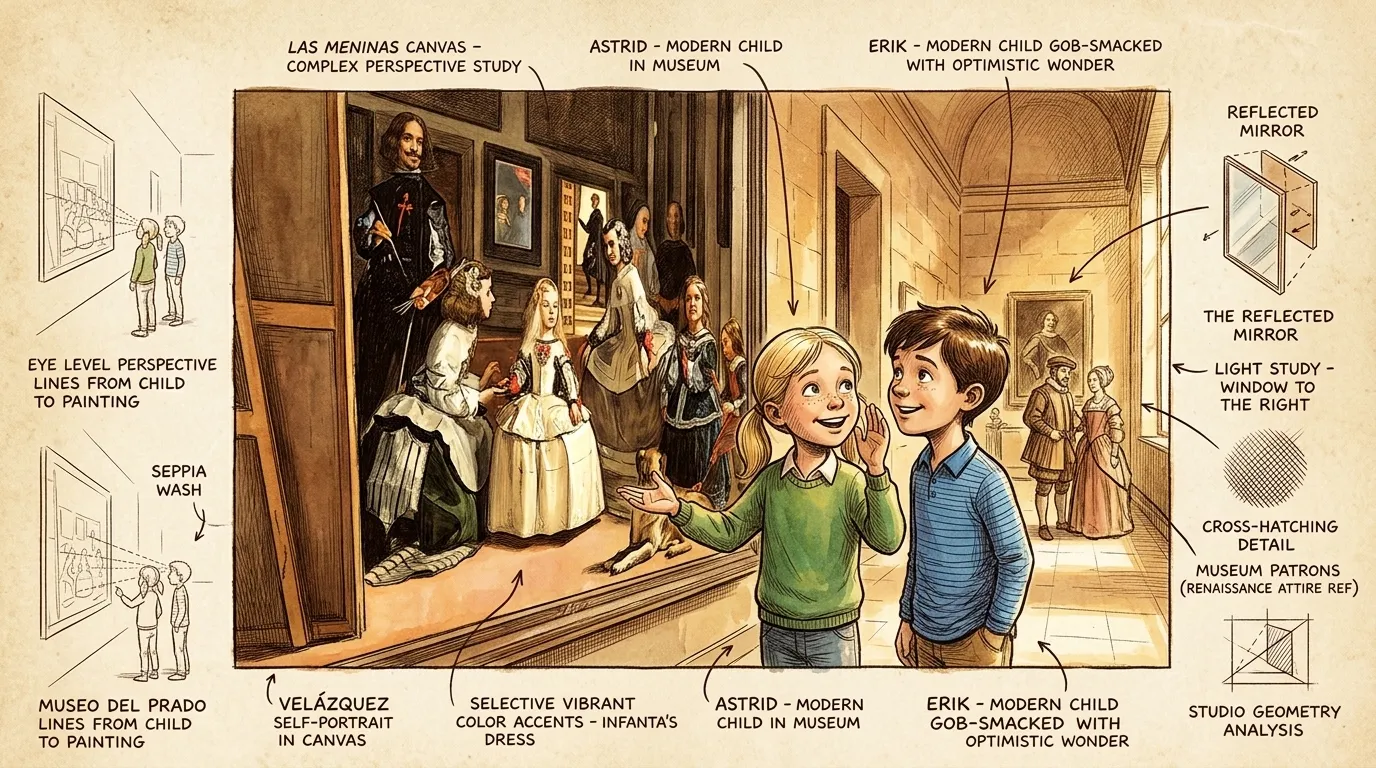
In the heart of Madrid, within the hallowed halls of the Museo del Prado, hangs a masterpiece that has captivated and perplexed art enthusiasts for centuries: 'Las Meninas' by Diego Velázquez. Painted in 1656, this monumental canvas, measuring 10 feet by 9 feet, presents a complex tableau of the Spanish royal court. Its enigmatic nature has led to countless interpretations and debates, solidifying its place as one of the most analyzed paintings in Western art history. The painting is currently valued at upwards of 40 million euros, a testament to its enduring legacy.
""Look at the light, Erik. It practically dances on the Infanta's dress," Astrid whispered, gazing up at the painting. Erik, equally mesmerized, nodded slowly. "It's like a puzzle, Astrid. So many people, so many stories, all captured in one moment.""
Art Fact: Las Meninas, also known as The Family of Philip IV, is located in the Museo del Prado in Madrid. The painting is renowned for its complex composition and the mysteries surrounding its subjects.
Page 2
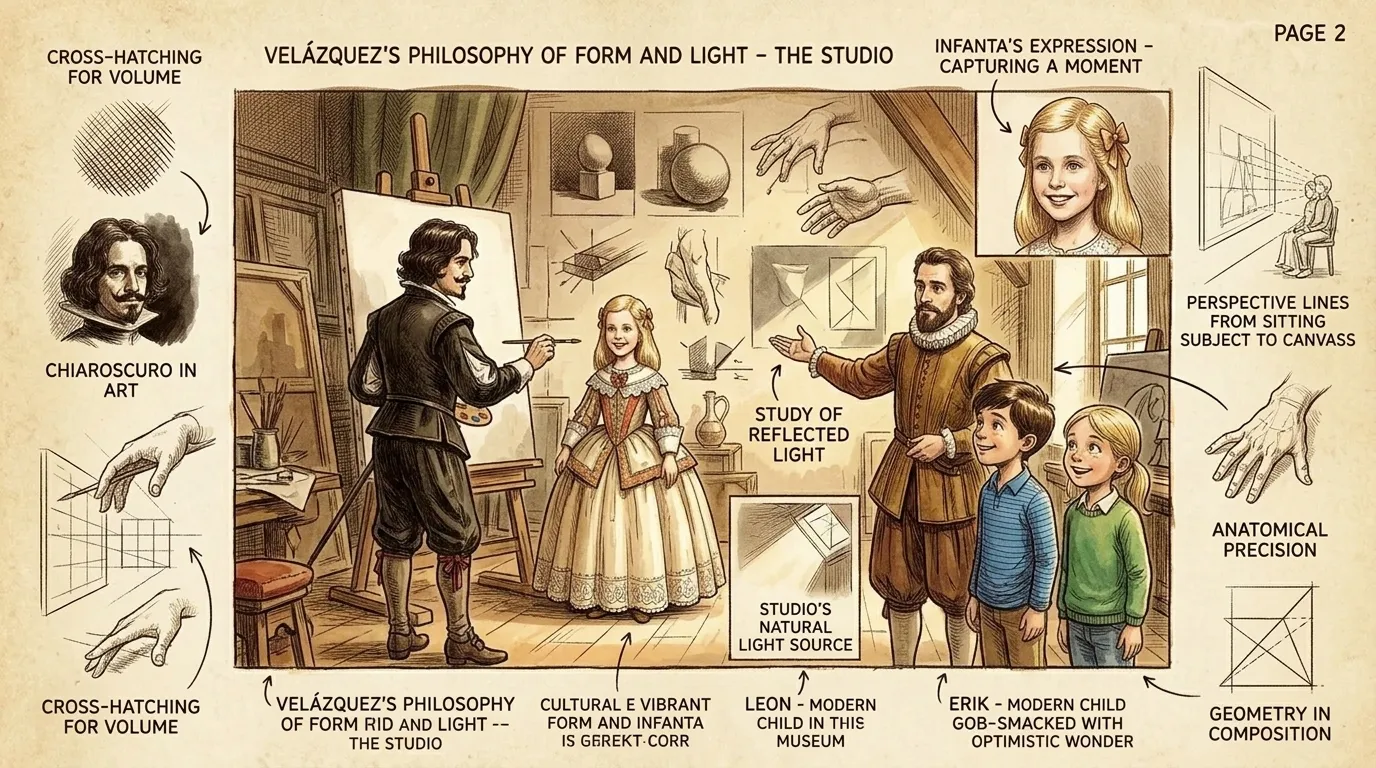
Diego Velázquez, born in Seville in 1599, rose through the ranks to become the court painter for King Philip IV. His genius lay in his ability to capture the essence of his subjects with startling realism. Velázquez's studio was a hub of creativity, a place where he meticulously studied light, color, and form. His dedication to his craft was unwavering. He spent hours observing the Infanta Margarita, trying to catch her elusive smile.
"Leon explains, "Velázquez believed that a painter should not only imitate nature but also interpret it, Erik. He sought to reveal the soul of his subjects, not just their appearance. He once mentioned to his students the quote 'Painting is poetry that is seen rather than felt, and poetry is painting that is felt rather than seen.' Leonardo Da Vinci said that, Astrid.""
Art Fact: Diego Velázquez (1599-1660) was a Spanish painter and the leading artist in the court of King Philip IV. He was a master of realism and portraiture.
Page 3
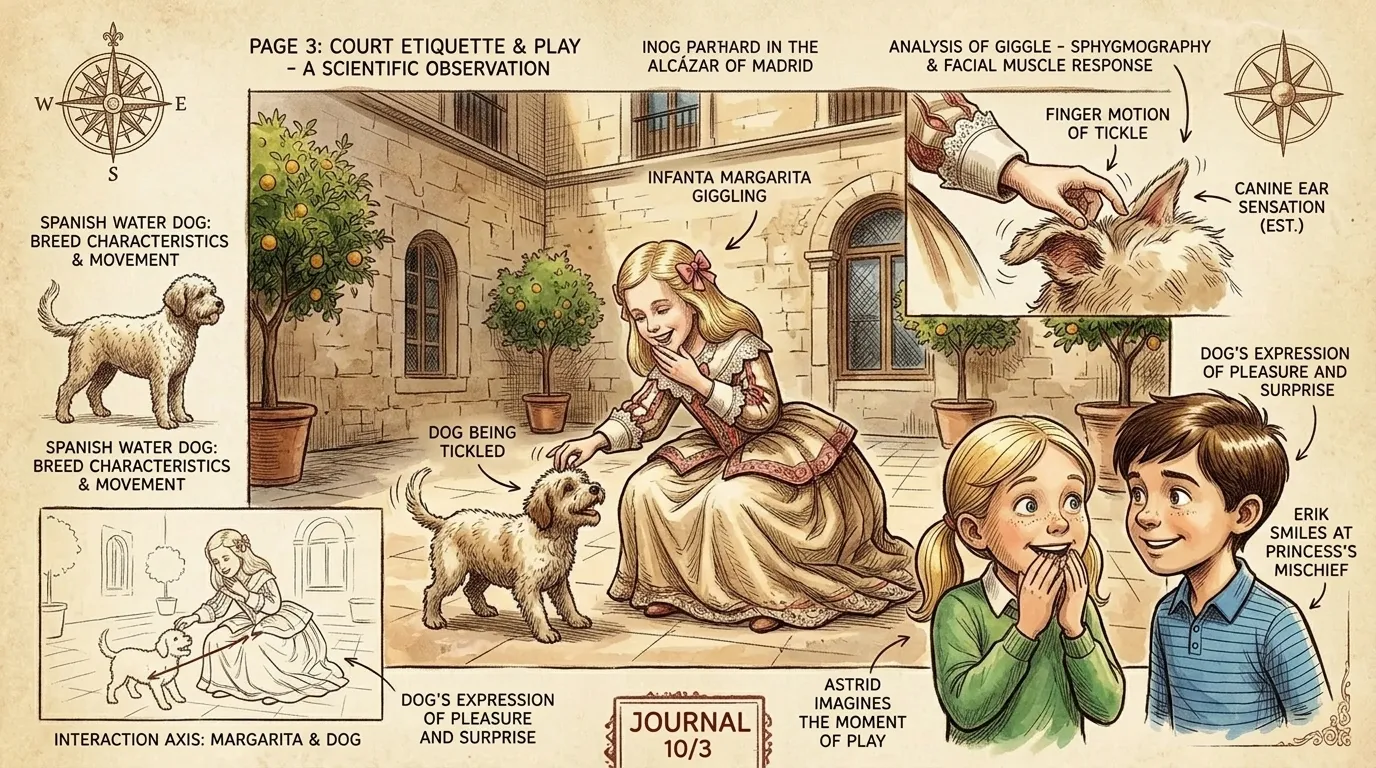
The Infanta Margarita, the young princess at the heart of 'Las Meninas,' was a cherished member of the royal family. Her world was one of privilege and formality, yet she possessed a childlike curiosity and a playful spirit. Velázquez found her to be a captivating subject, her expressions shifting like the light on a summer afternoon. It was rumored she found the act of sitting still for hours exhausting, leading to less than natural smiles in many court portraits.
"Astrid whispers, "Imagine being a princess, Erik. All those dresses and rules..." Erik, ever practical, replies, "But she also got to play with dogs and dwarves!""
Art Fact: Infanta Margarita (1651-1673) was the daughter of King Philip IV of Spain and Mariana of Austria. She appears prominently in several of Velázquez's paintings.
Page 4
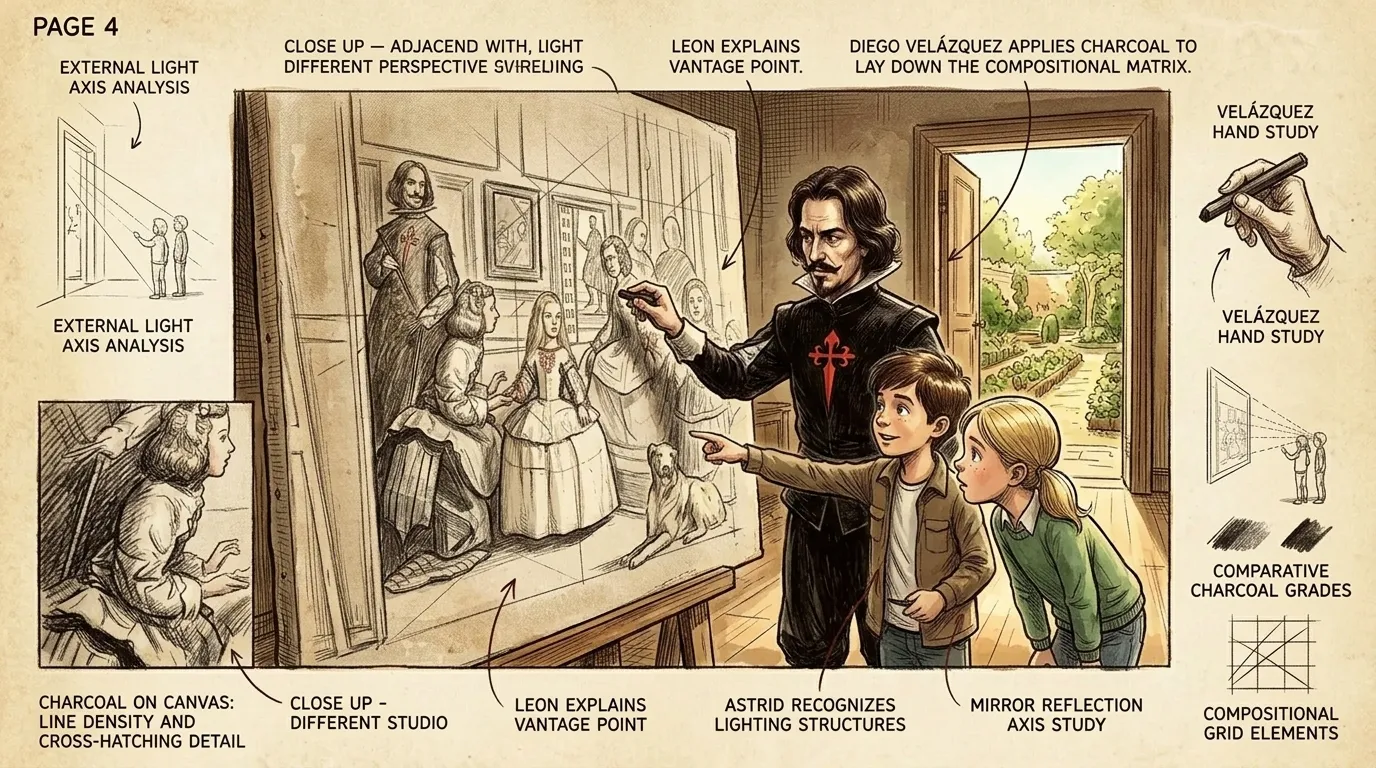
Velázquez began with a series of preliminary sketches, mapping out the composition and experimenting with different arrangements of figures. He worked with charcoal on canvas, capturing the essential forms and lines before applying color. His technique was methodical, building up layers of paint to achieve a luminous effect. The underpainting was crucial in defining the spatial relationships and establishing the overall tone.
"Leon points to a charcoal sketch, saying, "See how Velázquez is focusing on the light and shadow here, Astrid? It's the foundation of the whole painting. You have to get the structure right before you can add the details. Michelangelo said 'I saw the angel in the marble and carved until I set him free.' and I think Velazquez felt the same way.""
Art Fact: Velázquez's meticulous process involved numerous preliminary sketches and studies to refine the composition and lighting.
Page 5
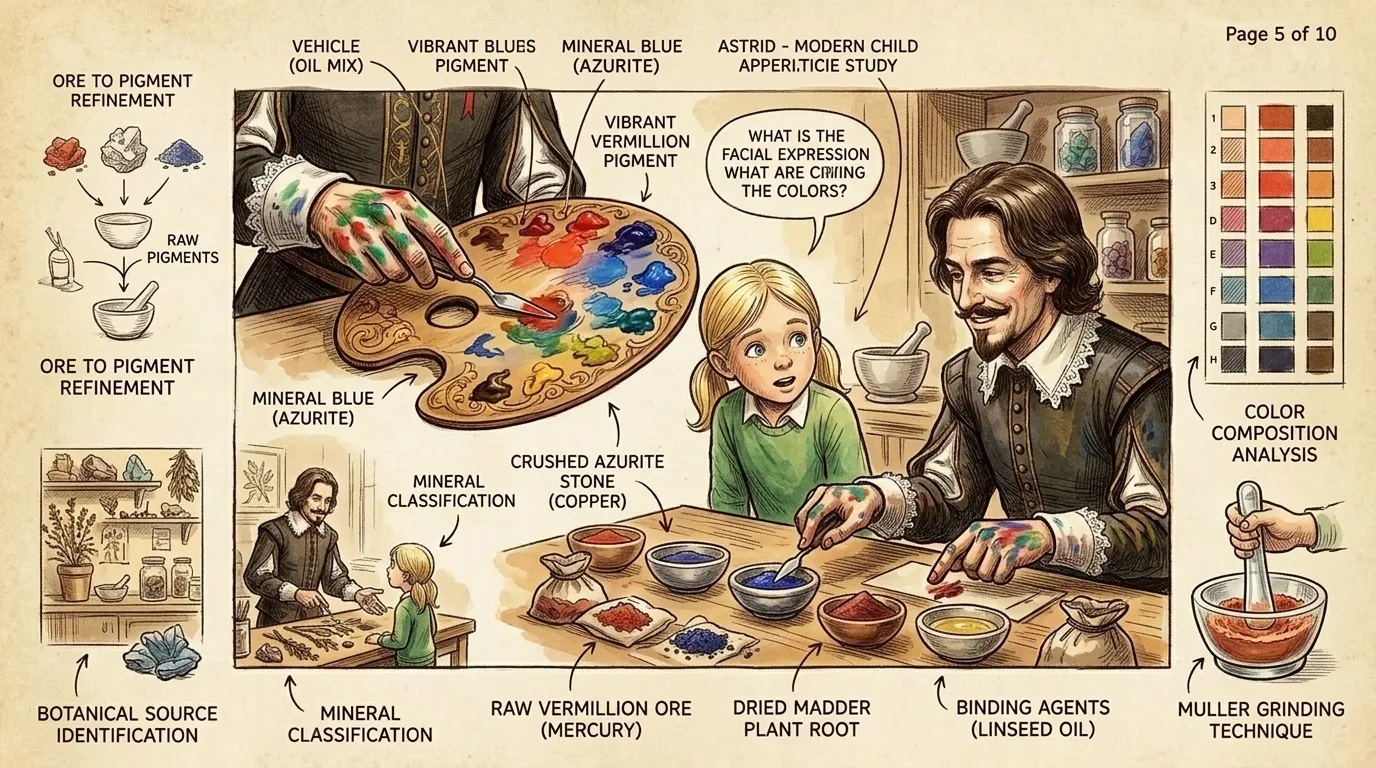
Velázquez's palette was rich and varied, consisting of pigments derived from natural sources. He mixed his paints carefully, creating subtle gradations of color that captured the textures of silk, velvet, and skin. He employed a technique called 'alla prima,' applying wet paint onto wet paint to achieve a fluid, spontaneous effect. Vermillion, lead white, and azurite were all colors used.
"Astrid asks Velazquez, "Where do all these colors come from?" Velázquez smiles, "From the earth itself, child. From minerals and plants. Each color holds a story. From distant lands like Persia and the mountains of Italy.""
Art Fact: Velázquez's mastery of color and texture was achieved through careful mixing of pigments and innovative painting techniques.
Page 6
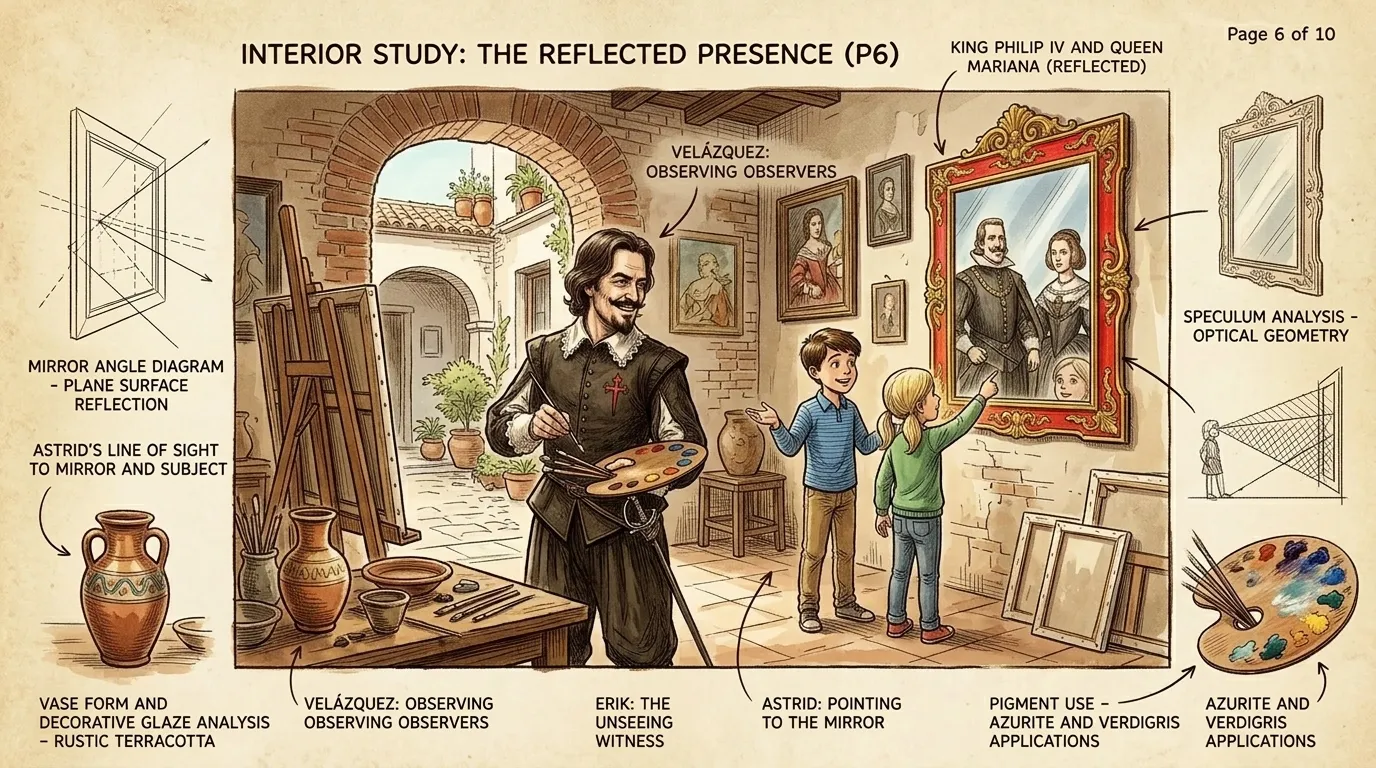
The inclusion of the King and Queen in the mirror at the back of the painting was a daring innovation. It added a layer of complexity to the composition, inviting the viewer to consider their own role as observers. It also subtly elevated the status of the painter, placing him in the company of royalty. Many have speculated that the mirror is not reflective, and is instead a portrait of the King and Queen being painted by Velazquez.
""Why did he put the King and Queen in the mirror, Erik?" Astrid asked. Erik shrugged, "Maybe they wanted to watch him paint?" Velázquez overheard and chuckled softly. "As William Shakespeare said 'All the world's a stage, And all the men and women merely players.' and even Kings and Queens have a role to play in the grand drama of life, even when it seems they are just observers, Astrid.""
Art Fact: The mirror reflection of King Philip IV and Queen Mariana adds a layer of complexity and invites interpretation about the viewer's role.
Page 7
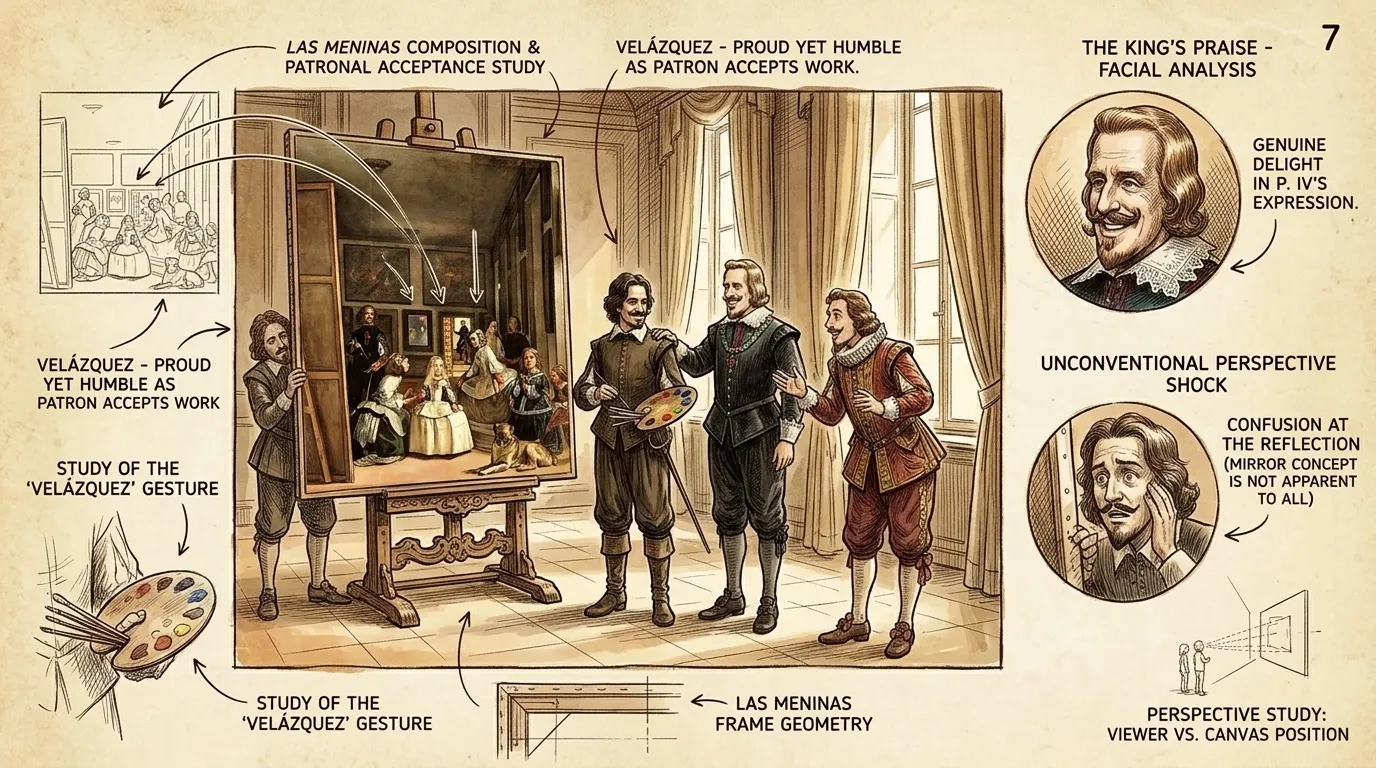
When 'Las Meninas' was first unveiled, it was met with a mixture of awe and bewilderment. Critics praised Velázquez's technical skill and his ability to capture the likenesses of his subjects. However, some questioned the painting's unconventional composition and its lack of a clear narrative. The King himself was said to have been delighted with the work, rewarding Velázquez handsomely.
"A courtier exclaims, "The painting is a marvel! It captures the very essence of the royal family!" Another critic whispers, "But what does it all mean? It's so...unconventional.""
Art Fact: The initial reaction to 'Las Meninas' was a mixture of praise for its technical skill and bewilderment at its unconventional composition.
Page 8
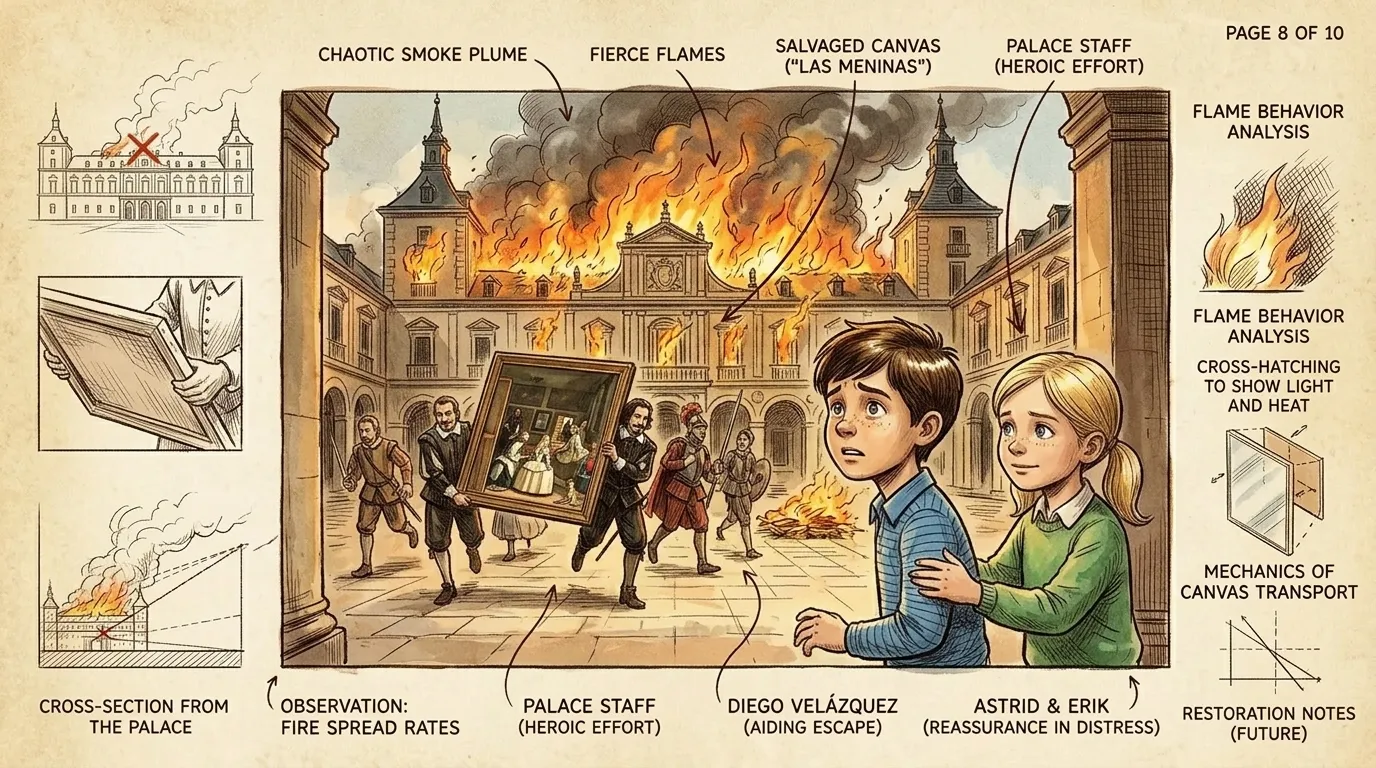
Over the centuries, 'Las Meninas' has survived wars, fires, and political upheavals. It has been moved from palace to palace, its surface cleaned and restored. Despite the passage of time, the painting has retained its power to fascinate and provoke. In the 18th century, a fire in the Royal Alcazar of Madrid nearly destroyed the masterpiece. Only quick action by palace staff saved it from complete destruction.
"Erik worries, "What if something happened to it, Astrid? What if it got lost?" Astrid reassures him, "It's too important, Erik. People wouldn't let that happen.""
Art Fact: 'Las Meninas' has survived numerous historical events, including wars and fires, testaments to its cultural significance.
Page 9

In the late 20th century, 'Las Meninas' underwent a major restoration, revealing the painting's original colors and details. The cleaning process removed layers of dirt and varnish, bringing the artwork back to its former glory. Art historians marveled at the vibrancy of Velázquez's brushstrokes and the depth of his vision. Velázquez's genius continues to inspire and challenge artists today.
"Astrid marvels, "Look, Erik! It's like they brought it back to life! All the colors are so bright and clear now." Erik stares, entranced, "It's more amazing than ever!""
Art Fact: A major restoration in the late 20th century revealed the painting's original colors and details, enhancing its brilliance.
Page 10
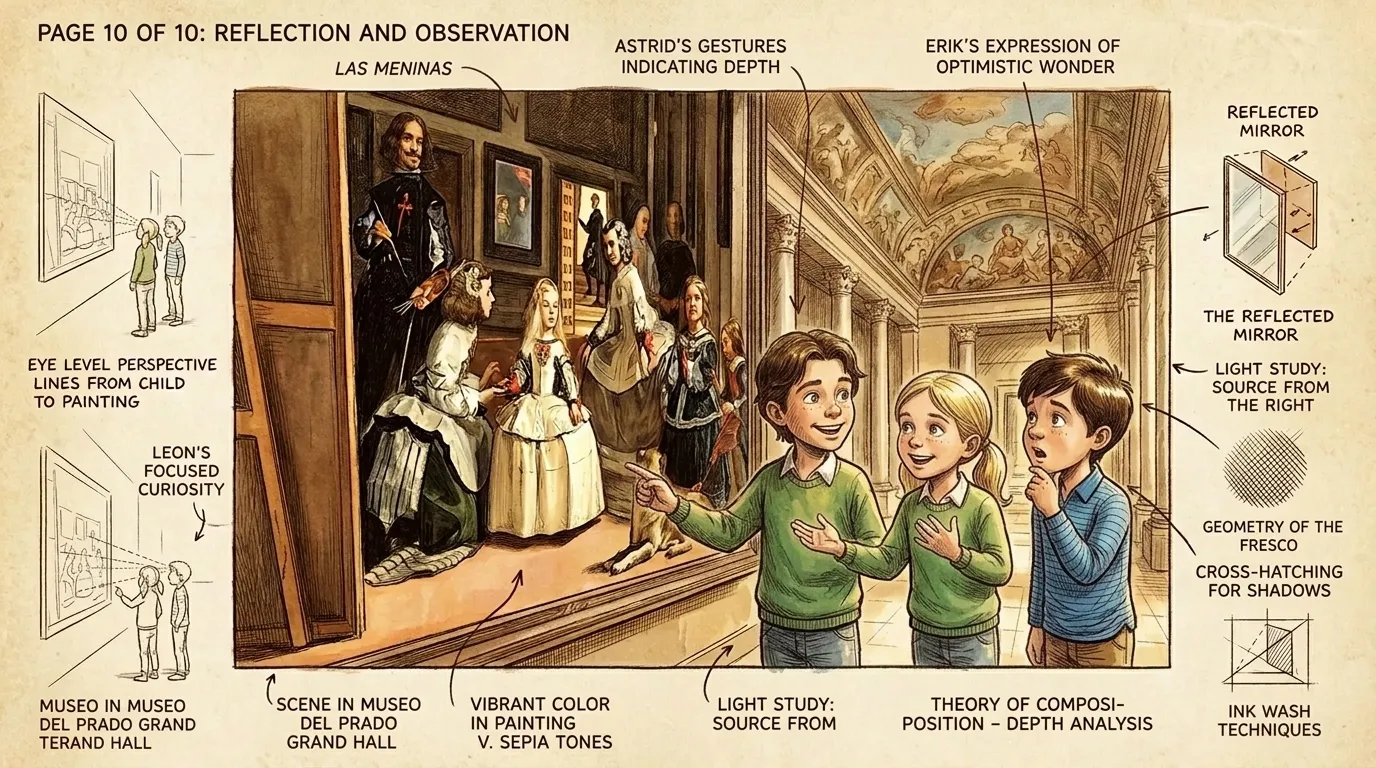
Today, 'Las Meninas' remains a source of endless fascination and debate. It is a testament to Velázquez's genius and a window into the world of the Spanish royal court. The painting continues to inspire artists, scholars, and art lovers around the world, its mysteries and complexities ensuring its enduring legacy. It is a national treasure.
"Leon smiles, watching Astrid and Erik looking up at the painting with awe, 'As Pablo Picasso, who tried to paint his own version, said 'You have to know the rules to break them.', but Velazquez already broke them, and so now we see his world'."
Art Fact: 'Las Meninas' continues to be a source of fascination, debate, and inspiration, cementing its place as a masterpiece of Western art.
About this story
- Location: Spain
- Audience: general readers
Questions and answers
Questions and answers about Las Meninas — Madrid, Spain — 1656
Read Wonder Arts on your phone
Wonder Arts is available on Android. Get Wonder Arts on Google Play.
More Wonder Arts stories
- Leda and the Swan by Leonardo da Vinci (France — c. 1508)
- Liberty Leading the People by Eugène Delacroix (Paris, France — 1830)
- Library of Alexandria destruction (Alexandria, Egypt — c. 3rd Century BC)
- Lion Monument by Bertel Thorvaldsen (Lucerne, Switzerland — 1821)
- Lithography by Alois Senefelder (Germany — 1796)
- Louvre Museum opening (Paris, France — 1793)