Neuschwanstein Castle (Bavaria, Germany — 1869–1886)
Neuschwanstein Castle (Bavaria, Germany — 1869–1886) — an illustrated arts story, set in Germany. 10 illustrated pages, free to read on Wonder Arts.

Page 1

King Ludwig II of Bavaria stands before the partially completed Neuschwanstein Castle in 1882. The castle, a Romanesque Revival palace, is perched high on a rugged hill overlooking the Hohenschwangau valley. Its towers and turrets reach towards the sky, a vision of romantic medievalism taking form. The castle's design incorporates elements from Wagnerian operas, reflecting Ludwig's deep admiration for the composer.
"Ludwig: (to himself, gazing at the castle) My dream is becoming reality. A place of fantasy and escape, away from the troubles of the world. It shall be my sanctuary, my New Swan Stone Castle."
Art Fact: Neuschwanstein Castle, commissioned by King Ludwig II of Bavaria in 1869, was intended as a personal refuge and a tribute to Richard Wagner. The castle's construction continued until Ludwig's death in 1886. It measures approximately 65 meters in height and has over 200 interior rooms, though only a few were completed. Despite being incomplete, it became a major tourist attraction shortly after Ludwig's death and remains one of Germany's most visited castles.
Page 2

Young Ludwig attends a performance of Richard Wagner's 'Lohengrin' at the Munich Opera. He is captivated by the romantic tale of the Swan Knight and the visual spectacle of the stage design. The opera's themes of chivalry, love, and redemption deeply resonate with the sensitive prince, sparking a lifelong obsession with Wagner's works and medieval legends.
"Ludwig: (whispering to his tutor) This music...these stories...it is as if I am transported to another world! Wagner is a genius!"
Art Fact: Richard Wagner's operas, particularly 'Lohengrin,' profoundly influenced King Ludwig II's artistic vision. Ludwig saw himself as a patron of the arts, much like the rulers depicted in Wagner's operas. This early exposure fueled his desire to create his own world of fantasy and grandeur.
Page 3

Ludwig, now king, pores over architectural drawings with Christian Jank, the stage designer who created the sets for Wagner's operas. Ludwig shares his vision for a castle inspired by the Wartburg, a medieval castle associated with the legends of the Holy Grail. He envisions a romantic palace that blends historical styles with theatrical elements.
"Ludwig: Herr Jank, I want a castle that embodies the spirit of the Middle Ages, but with all the comforts and splendor of the modern age. It must be a place of beauty and wonder!"
Art Fact: Christian Jank's experience as a stage designer was instrumental in shaping Neuschwanstein's dramatic and theatrical design. His collaboration with Ludwig brought a sense of fantasy and spectacle to the castle's architecture.
Page 4

The groundbreaking ceremony for Neuschwanstein takes place in 1869. Workers begin blasting away the existing rock formations on the mountain ridge to create a level platform for the castle's foundation. The ambitious project faces significant engineering challenges due to the difficult terrain.
"Engineer: Your Majesty, the terrain is proving more challenging than anticipated. We will need to reinforce the foundation significantly to ensure the castle's stability."
Art Fact: The construction of Neuschwanstein Castle presented significant engineering challenges due to the rugged terrain. The foundation required extensive reinforcement to ensure the castle's stability, adding to the project's cost and complexity.
Page 5
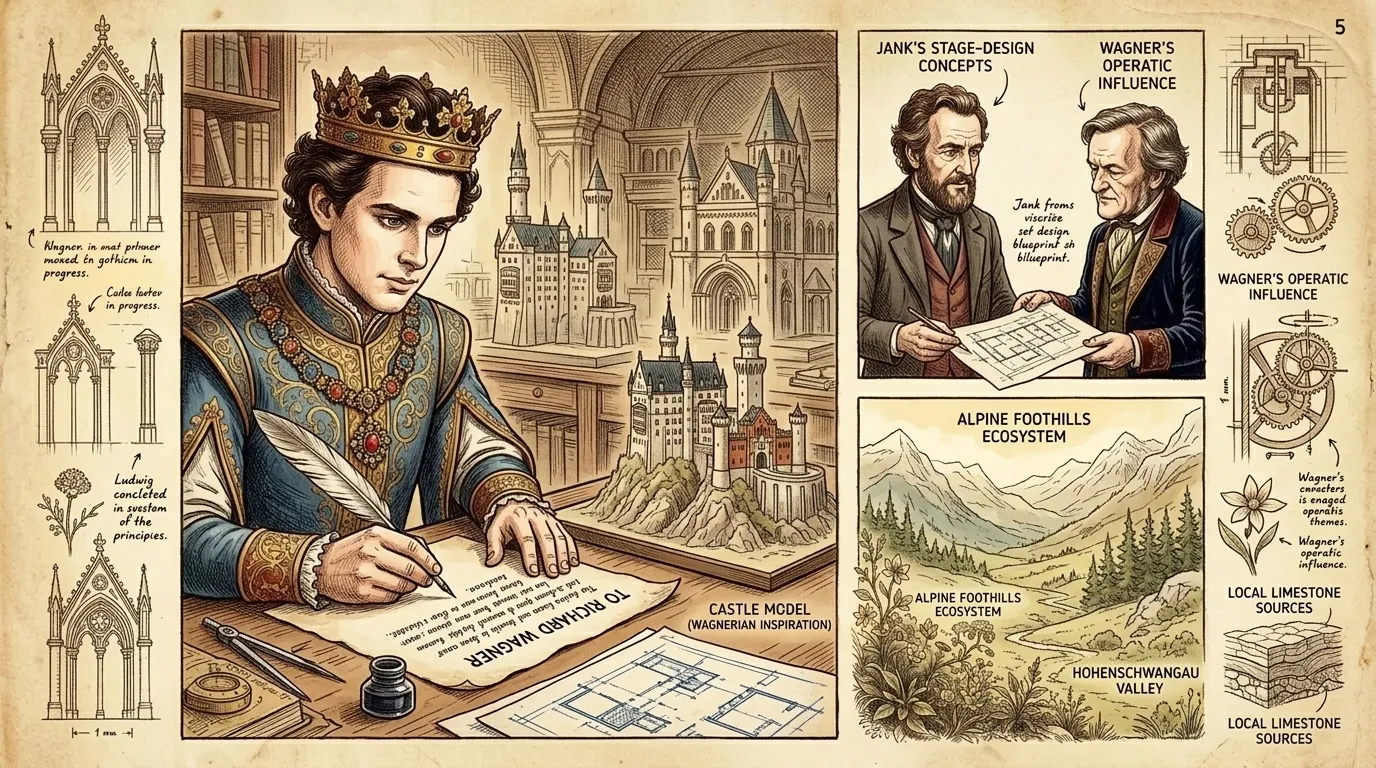
Ludwig writes to Richard Wagner, detailing his progress on the castle and expressing his desire for it to be a monument to Wagner's genius. Ludwig sees Neuschwanstein as a physical manifestation of the romantic ideals found in Wagner's operas.
"Ludwig: (writing in his diary) My dearest Wagner, the castle rises stone by stone, a testament to your immortal art. It shall be a place where your music echoes through the halls, a refuge for the soul."
Art Fact: King Ludwig II's letters to Richard Wagner reveal his deep admiration for the composer and his intention to dedicate Neuschwanstein Castle to Wagner's artistic vision.
Page 6

Construction of the Singer's Hall, inspired by the Wartburg, is underway. Artists and craftsmen decorate the hall with murals depicting scenes from the 'Lohengrin' saga and other medieval legends. Ludwig intends for the hall to be a place for private performances and celebrations.
"Painter: Your Majesty, the murals are progressing as planned. We are striving to capture the essence of the legends you cherish so deeply."
Art Fact: The Singer's Hall in Neuschwanstein Castle was inspired by the hall in the Wartburg Castle, a significant location in German medieval legends. The hall was intended for private performances and celebrations, reflecting Ludwig's love of music and theater.
Page 7

Ludwig retreats to Neuschwanstein to escape the pressures of his royal duties and the political turmoil in Bavaria. He finds solace in the castle's romantic atmosphere and the beauty of the surrounding landscape. The castle becomes his personal sanctuary, a place where he can indulge his artistic passions.
"Ludwig: (to his aide) Leave me, I wish to be alone. Let the silence of these halls wash away the troubles of the world. Here, I am truly free."
Art Fact: Neuschwanstein Castle served as a personal refuge for King Ludwig II, allowing him to escape the pressures of his royal duties and indulge his artistic passions. The castle's romantic atmosphere and stunning location provided a sanctuary for the troubled king.
Page 8

In 1886, Ludwig is declared mentally unfit to rule and is deposed. Shortly after, he mysteriously dies. Neuschwanstein remains unfinished at the time of his death, a testament to his grand vision and tragic fate. The castle, however, soon becomes a popular tourist attraction, drawing visitors from around the world.
"Aide: Your Majesty, there are whispers... they say you are unfit to rule. The council..."
Art Fact: King Ludwig II's tragic death in 1886 left Neuschwanstein Castle unfinished. Despite being incomplete, the castle quickly became a popular tourist attraction, drawing visitors from around the world.
Page 9

After Ludwig's death, Neuschwanstein is opened to the public. Tourists flock to see the fairytale castle, marveling at its opulent interiors and breathtaking views. The castle becomes a symbol of Bavaria and a reminder of Ludwig's romantic vision.
"Tourist: (gazing in awe) It's like stepping into a fairytale! I can hardly believe such a place exists."
Art Fact: Following King Ludwig II's death, Neuschwanstein Castle was opened to the public and quickly became a popular tourist destination. The castle's fairytale aesthetic and stunning location continue to captivate visitors from around the world.
Page 10

Today, Neuschwanstein Castle stands as a testament to King Ludwig II's romantic vision and architectural ambition. His dream lives on, inspiring generations with its beauty and grandeur. 'Imagination is more important than knowledge,' as Albert Einstein said, and Ludwig's imagination created a castle that continues to enchant the world.
"Narrator: Neuschwanstein, a monument not to power, but to the power of dreams."
Art Fact: Neuschwanstein Castle remains one of Germany's most popular tourist destinations, attracting millions of visitors each year. The castle is a symbol of Bavaria and a testament to King Ludwig II's romantic vision and architectural ambition.
About this story
- Location: Germany
- Audience: general readers
Questions and answers
Questions and answers about Neuschwanstein Castle (Bavaria, Germany — 1869–1886)
Read Wonder Arts on your phone
Wonder Arts is available on Android. Get Wonder Arts on Google Play.