Notre-Dame Cathedral (Paris, France — 1345)
Notre-Dame Cathedral (Paris, France — 1345) — an illustrated arts story, set in France. 10 illustrated pages, free to read on Wonder Arts.
Page 1

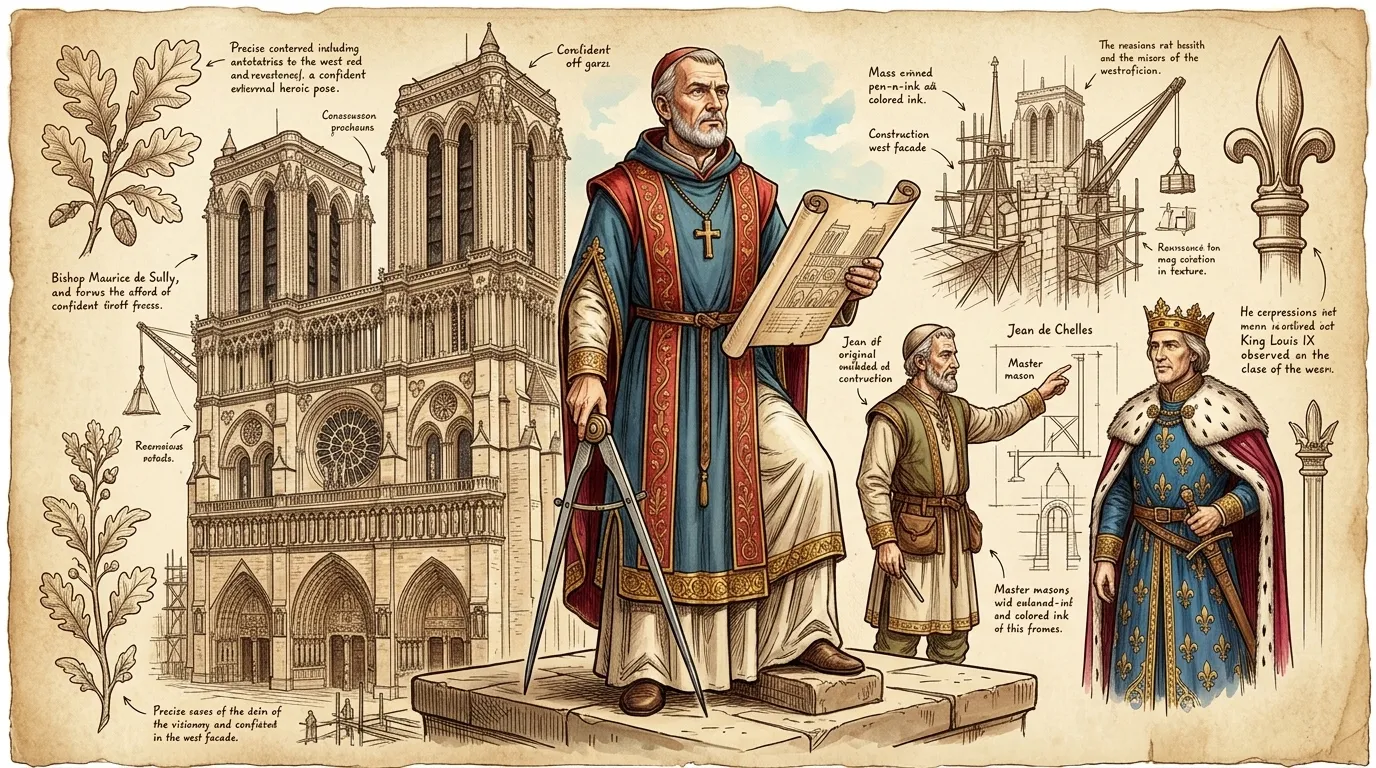
Paris, 1163. Bishop Maurice de Sully surveys the nascent Notre-Dame Cathedral, a testament to his unwavering faith and architectural ambition. Its scale is breathtaking: 128 meters long, 48 meters wide, the vaults soaring to 33 meters. This ambitious project would replace the older Saint-Étienne cathedral, symbolizing a new era for Paris and the Catholic Church. The weight of responsibility is evident in his eyes, but so is the burning conviction that this cathedral will touch the heavens.
""This, my brothers, will be more than a church. It will be a beacon," de Sully proclaims, his voice echoing in the half-built space. "A testament to God's glory, a sanctuary for all!""
Art Fact: Notre-Dame Cathedral, begun in 1163, stands as a pinnacle of French Gothic architecture. Its construction spanned centuries, undergoing numerous modifications and restorations. A symbol of Paris, it has witnessed pivotal moments in French history, from royal coronations to national tragedies. It remains one of the most visited landmarks in the world.
Page 2

The first sketches of Notre-Dame reveal de Sully's audacious vision. He pours over parchment filled with geometric forms and soaring arches. He envisioned a structure that would use the innovative ribbed vaults and pointed arches to create a sense of lightness and verticality, drawing the eye heavenward. The blueprints are revolutionary, pushing the boundaries of medieval engineering.
""The arches must reach higher, Jean!" de Sully exclaims to his master builder, Jean de Chelles. "They must defy gravity itself!""
Art Fact: The early designs for Notre-Dame reflect the Gothic style's emphasis on verticality and light. Ribbed vaults and pointed arches were key innovations, allowing for larger windows and a more spacious interior.
Page 3

The cathedral's foundations prove a challenge. The marshy ground near the Île de la Cité requires innovative solutions to support the immense weight of the stone. Piles are driven deep into the earth, a testament to the ingenuity of the medieval engineers. The work is backbreaking, and the logistical challenges seem insurmountable. "As Aristotle said, 'The roots of education are bitter, but the fruit is sweet.'" de Sully says, observing the laborers hard at work. "This toil will be worth it!"
""These foundations must hold, or all will be for naught!" Anders, a spirited 9-year-old male, lean and athletic, with medium brown skin and straight black hair combed back neatly, says to Bishop de Sully, wiping sweat from his brow. "It is no easy task, my lord."
"
Art Fact: The construction of Notre-Dame required significant engineering expertise to overcome the challenges of the site's unstable ground. Driving piles deep into the earth provided a solid foundation for the massive structure.
Page 4

The creation of the rose windows marks a turning point. Master glassmakers craft intricate designs from stained glass, transforming sunlight into a kaleidoscope of colors. The north rose window, dedicated to the Virgin Mary, is particularly stunning, depicting scenes from the Old Testament and the lives of the saints. The windows are not merely decorative; they are didactic tools, teaching biblical stories to a largely illiterate population.
""Behold! The light of God made manifest!" Jean de Chelles exclaims, admiring the newly installed north rose window. "It is a symphony of color!""
Art Fact: The rose windows of Notre-Dame are among the cathedral's most iconic features. They are masterpieces of stained glass art, transforming natural light into a dazzling spectacle of color and form.
Page 5

King Louis IX, known as Saint Louis, becomes a fervent supporter of the cathedral. His patronage provides crucial funding and legitimacy to the project. Louis believes that Notre-Dame will enhance the prestige of Paris and serve as a symbol of royal piety. He often visits the construction site, offering encouragement and advice to the builders. "As Seneca said, 'Every new beginning comes from some other beginning's end.' This cathedral will be a testament to a new era for France," Louis remarks to de Sully.
""This cathedral will be a jewel in the crown of France," King Louis declares, surveying the progress with satisfaction. "It will inspire generations!""
Art Fact: The patronage of King Louis IX, or Saint Louis, was instrumental in the construction of Notre-Dame Cathedral. His support provided financial resources and enhanced the project's prestige.
Page 6

The cathedral's facade takes shape, adorned with intricate sculptures. The west facade, with its three portals, is particularly elaborate, depicting scenes from the Last Judgment, the Virgin Mary, and Saint Anne. These sculptures are not mere decoration; they are part of a comprehensive theological program, designed to instruct and inspire the faithful. The stone carvers work tirelessly, bringing biblical narratives to life.
""Each stone tells a story," Anders says, admiring the sculpted figures on the west facade. "They speak to us across the ages.""
Art Fact: The sculptural program of Notre-Dame is a remarkable achievement of medieval art. The sculptures on the west facade, in particular, are integral to the cathedral's theological message.
Page 7

The completion of the nave in 1250 marks a significant milestone. The vast interior space is now enclosed, allowing for liturgical celebrations to take place in a grand setting. The nave's soaring vaults and stained glass windows create an awe-inspiring atmosphere, inviting worshippers to contemplate the divine. It is a triumph of engineering and artistic vision.
""The nave is complete!" Bishop de Sully declares, his voice filled with emotion. "Let us give thanks to God for his blessings.""
Art Fact: The completion of the nave was a major milestone in the construction of Notre-Dame Cathedral. It provided a grand space for liturgical celebrations and solidified the cathedral's role as a center of religious life in Paris.
Page 8

The construction of the two west towers commences, further defining the cathedral's iconic silhouette. The towers rise majestically above the Parisian skyline, visible from miles away. The north tower is completed first, followed by the south tower. They are not merely aesthetic additions; they also serve as bell towers, housing the cathedral's famous bells.
""Higher and higher they rise!" Tendai exclaims, watching the towers take shape. "They will touch the sky!""
Art Fact: The west towers of Notre-Dame are iconic features of the cathedral's silhouette. They serve as bell towers and provide stunning views of the city.
Page 9

Notre-Dame endures through centuries of change, witnessing revolutions, wars, and restorations. The cathedral is a symbol of resilience, adapting to the evolving needs of the city and the nation. It has been desecrated during the French Revolution and restored in the 19th century. Through it all, it remains a source of inspiration and solace. As Victor Hugo wrote, "Time is the soul of this great building."
""This cathedral has seen so much," Astrid says, tracing the weathered stones with her fingers. "It is a living testament to history.""
Art Fact: Notre-Dame Cathedral has endured centuries of change, including periods of desecration and restoration. It has served as a symbol of resilience and continuity for the city of Paris.
Page 10

Today, Notre-Dame continues to inspire millions. Despite the devastating fire of 2019, its spirit remains unbroken. The ongoing restoration efforts reflect a commitment to preserving this architectural masterpiece for future generations. Maurice de Sully's vision endures, echoing through the ages. His legacy lives on in every soaring arch and stained-glass window. Why does Notre-Dame survive forever? Because it embodies the unwavering human spirit and the enduring power of faith.
""Notre-Dame will rise again!" Astrid declares, her voice filled with hope. "Its beauty will inspire the world for centuries to come.""
Art Fact: Notre-Dame Cathedral continues to inspire millions around the world. Despite recent challenges, its legacy as a masterpiece of Gothic architecture and a symbol of Parisian identity remains secure.
About this story
- Location: France
- Audience: general readers
Questions and answers
Questions and answers about Notre-Dame Cathedral (Paris, France — 1345)
Read Wonder Arts on your phone
Wonder Arts is available on Android. Get Wonder Arts on Google Play.
More Wonder Arts stories
- Olympia by Édouard Manet (Paris, France — 1863)
- Ophelia by John Everett Millais (London, UK — 1852)
- Palace of Knossos (Crete, Greece — c. 1700 BC)
- Palace of Versailles (Versailles, France — 1661–1715)
- Parthenon (Athens, Greece — 432 BC)
- Pauline Bonaparte as Venus Victrix by Antonio Canova (Rome, Italy — 1805)