Still Life with Apples by Paul Cézanne (France — 1890)
Still Life with Apples by Paul Cézanne (France — 1890) — an illustrated arts story, set in France. 10 illustrated pages, free to read on Wonder Arts.
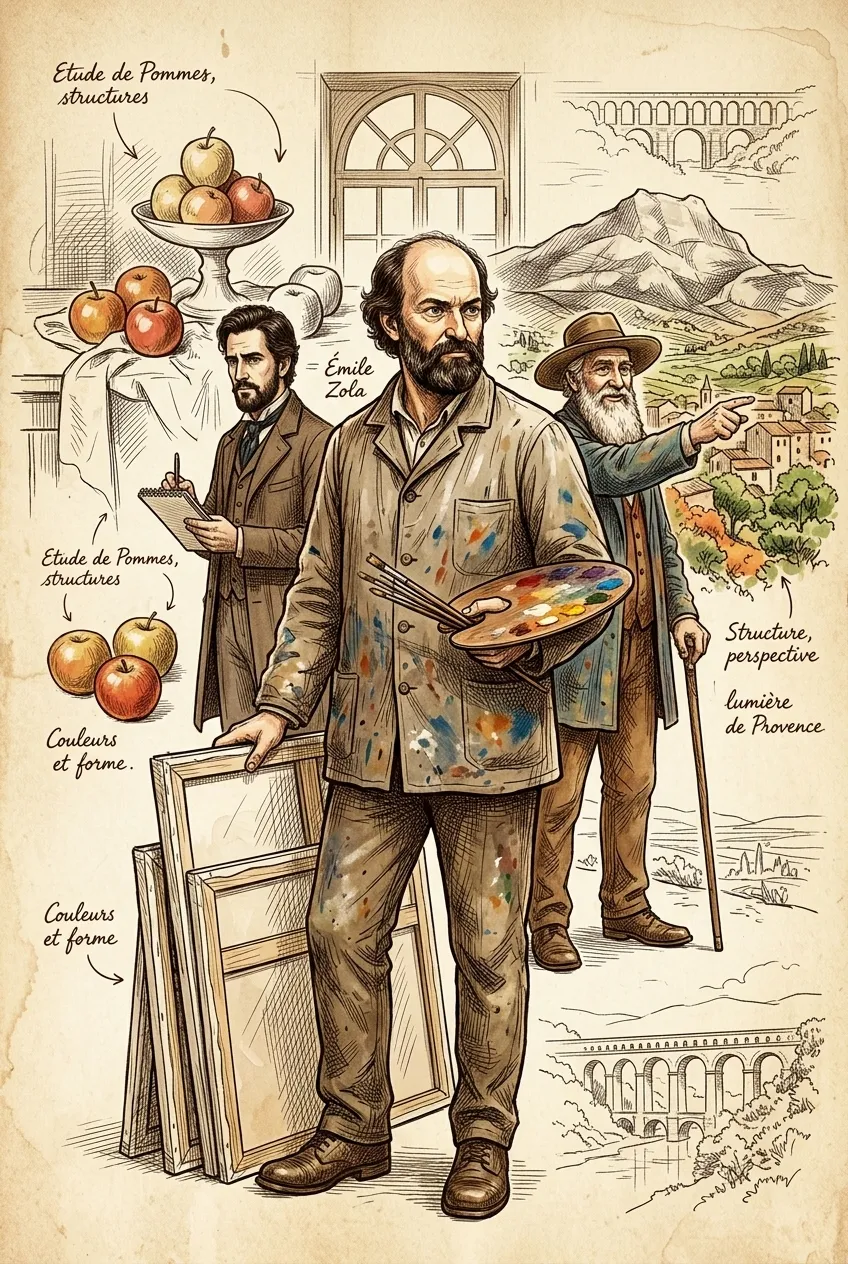
Page 1

A chill wind rustles through the forest as Paul Cézanne surveys his latest work, 'Still Life with Apples'. Completed around 1890, this painting, now residing in the National Gallery of Art in Washington D.C., is a study in form and color, a departure from traditional still life. Little did the artist know, this collection of fruit would become a cornerstone of modern art. What secrets are hidden within these carefully arranged apples?
""These aren't just apples, these are volumes, spheres, challenges!" Cézanne murmurs, his breath misting in the cold air. He adjusts his spectacles, peering at the canvas with intense focus. "Each brushstroke must capture their essence.""
Art Fact: Still Life with Apples, painted around 1890, exemplifies Cézanne's exploration of form and his move towards abstraction. Its current estimated value exceeds 40 million.
Page 2

Aix-en-Provence, 1852. A young Cézanne, barely a teenager, sits sketching in the garden of his school. He's struggling to capture the roundness of an apple, frustrated by its simplicity. A fellow student, Émile Zola, approaches, observing Cézanne's struggle.
""Why wrestle with such a common thing, Paul?" Zola asks, peering over Cézanne's shoulder. "Because," Cézanne replies, wiping sweat from his brow, "within the common lies the extraordinary, the challenge to truly see.""
Art Fact: Émile Zola's friendship was a formative influence on Cézanne, encouraging his artistic pursuits despite his father's initial disapproval.
Page 3

Paris, 1863. Cézanne stands before the Salon des Refusés, his shoulders slumped. His paintings have been rejected by the official Salon, a devastating blow. Pissarro, a fellow painter known for his landscapes, approaches him, a knowing glint in his eyes.
""So, they didn't understand your vision?" Pissarro asks gently. Cézanne sighs. "They said it was... clumsy, unfinished." Pissarro smiles. "'The artist is nothing without the gift, but the gift is nothing without work,' Zola always said, Paul," Pissarro said, patting Cézanne's shoulder. "Create for yourself, not for their approval.""
Art Fact: The Salon des Refusés was created for works rejected by the official Salon, marking a turning point in artistic independence.
Page 4

Pontoise, 1872. Cézanne works alongside Pissarro in the countryside. He's learning to break down forms into their constituent colors, to see the world in a new way. The older artist points to an apple tree, illustrating his point.
""Look, Paul," Pissarro says, gesturing with his brush. "The apple isn't just red. See the blues, the yellows, the greens reflecting from the sky, the grass!" Cézanne squints, adjusting his perspective. "It's like 'learning how to see. Once you do that, then you know there's no end to it,' like Cartier-Bresson once said!""
Art Fact: Cézanne's time in Pontoise with Pissarro marked a significant shift in his artistic style, moving towards Impressionism.
Page 5

Provence, 1880s. Cézanne is consumed by Mont Sainte-Victoire, painting it again and again. He seeks to capture its monumental form, its underlying structure. He's becoming less interested in fleeting impressions and more focused on the enduring geometry of the landscape.
""This mountain... it's more than just rock and earth," Cézanne grunts, stepping back from his easel. "It's a lesson in permanence, in solidity. 'Nature is not only all that is visible to the eye... it also includes the inner pictures of the soul,' as Munch once said.""
Art Fact: Mont Sainte-Victoire became a recurring subject in Cézanne's work, representing his quest to capture the underlying structure of nature.
Page 6

Aix, 1890. Back in his studio, Cézanne begins to experiment with still life compositions. He arranges apples and oranges on a draped table, carefully considering their relationships, their colors, their volumes. This new approach differed from anything he had done before.
""The objects... they speak to each other," Cézanne murmurs, circling the table. "Each one influences the others. It's a conversation of forms, a harmony of colors.""
Art Fact: Cézanne's still life paintings are characterized by their flattened perspective and their emphasis on the geometric forms of the objects.
Page 7

Cézanne stares at one apple in particular, noticing its imperfections, its asymmetry. He realizes that these flaws are what make it unique, what give it character. He embraces the irregularity, incorporating it into his painting.
""It doesn't have to be perfect," Cézanne mutters to himself, picking up the apple. "Its imperfections are its strength, its truth. 'Have no fear of perfection - you'll never reach it,' said Salvador Dalí, and I am glad.""
Art Fact: Cézanne's rejection of idealized forms was a radical departure from traditional art, paving the way for modern abstraction.
Page 8

Cézanne steps back from the canvas, satisfied. He has broken free from convention, creating a still life that is both familiar and utterly new. He knows that it will challenge viewers, but he's confident in his vision. 'I am the master of all the reading forest creatures' he chuckled silently, knowing that this was an untrue statement.
""This is it," Cézanne declares, wiping his hands on his smock. "This is what I've been striving for: a new way of seeing, a new way of painting.""
Art Fact: Cézanne's 'Still Life with Apples' is considered a foundational work of modern art, influencing generations of artists.
Page 9

Decades later, Cézanne's influence reverberates through the art world. Artists like Picasso and Braque take inspiration from his geometric forms, his flattened perspective. His vision lives on, transforming how we see the world.
""Cézanne showed us that everything in nature can be modeled according to the sphere, the cone and the cylinder. He was right!" Picasso explains to Braque, their studios filled with Cubist canvases."
Art Fact: Cézanne's exploration of form directly influenced the development of Cubism and other modern art movements.
Page 10

Today, 'Still Life with Apples' hangs in the National Gallery of Art, a testament to Cézanne's enduring legacy. Its simple forms, its vibrant colors, continue to inspire and challenge viewers. The reading forest creatures are nowhere to be seen.
"A visitor whispers, "It's more than just apples; it's a revolution in perception.""
Art Fact: Cézanne's relentless pursuit of form and his rejection of traditional perspective redefined still life painting and continues to inspire artists today.
About this story
- Location: France
- Audience: kids (ages 6–12)
Questions and answers
Questions and answers about Still Life with Apples by Paul Cézanne (France — 1890)
Read Wonder Arts on your phone
Wonder Arts is available on Android. Get Wonder Arts on Google Play.