The Last Supper
The Last Supper — an illustrated arts story, set in Global. 10 illustrated pages, free to read on Wonder Arts.
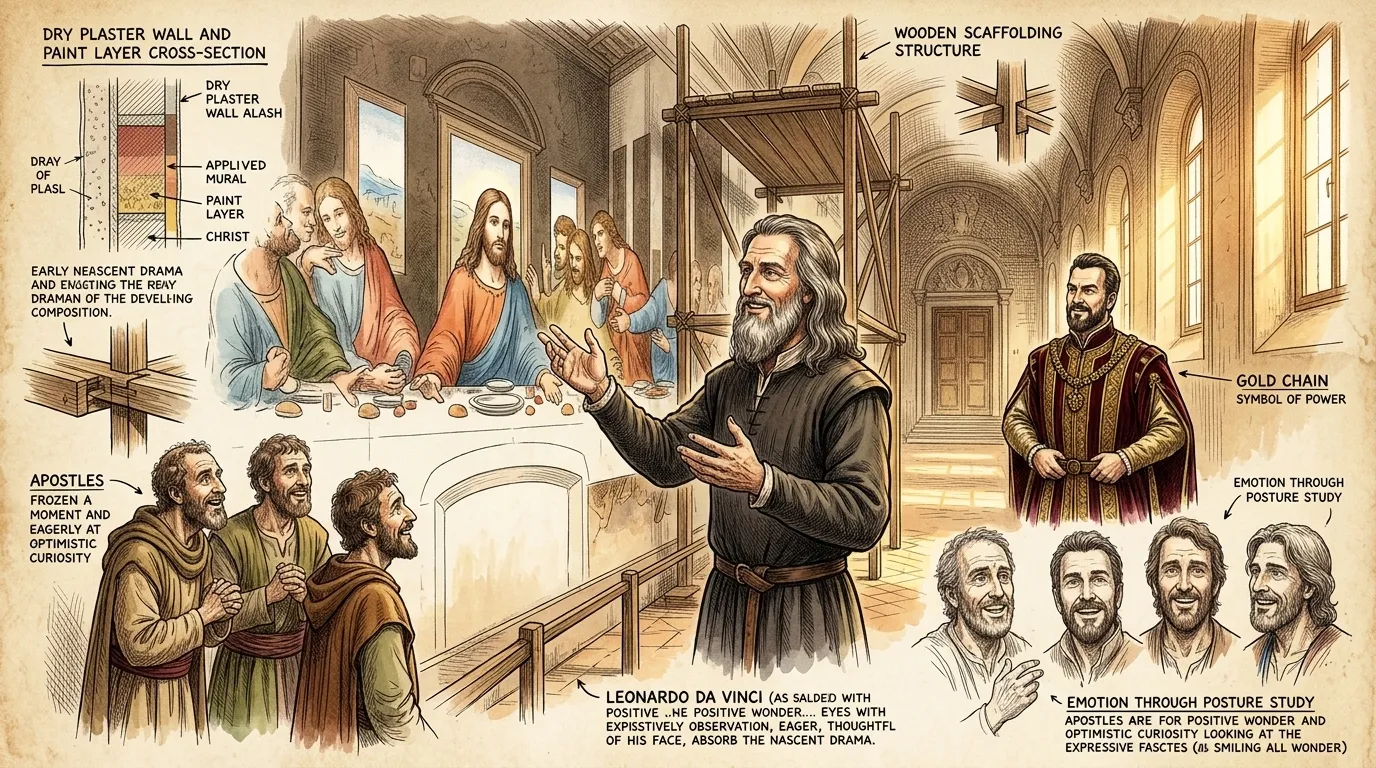
Page 1
In the bustling city of Milan, within the refectory of Santa Maria delle Grazie, an extraordinary vision was taking form. Leonardo da Vinci, a master of observation and innovation, stood before his colossal creation. This was not merely a painting; it was a psychological drama unfolding across a vast canvas of dry plaster, an audacious experiment destined to define an era.
""To capture the exact instant of revelation," Leonardo mused, "that is the painter's true challenge. To reveal the very motion of the soul.""
Art Fact: Artist: Leonardo da Vinci Artwork: The Last Supper Year: c. 1495-1498 Location: Santa Maria delle Grazie, Milan, Italy Medium: Tempera and oil on dry plaster Dimensions: 460 cm 880 cm (15 ft 29 ft). This experimental technique, deviating from true fresco, would contribute to its rapid deterioration, a continuous challenge for centuries of preservation.
Page 2
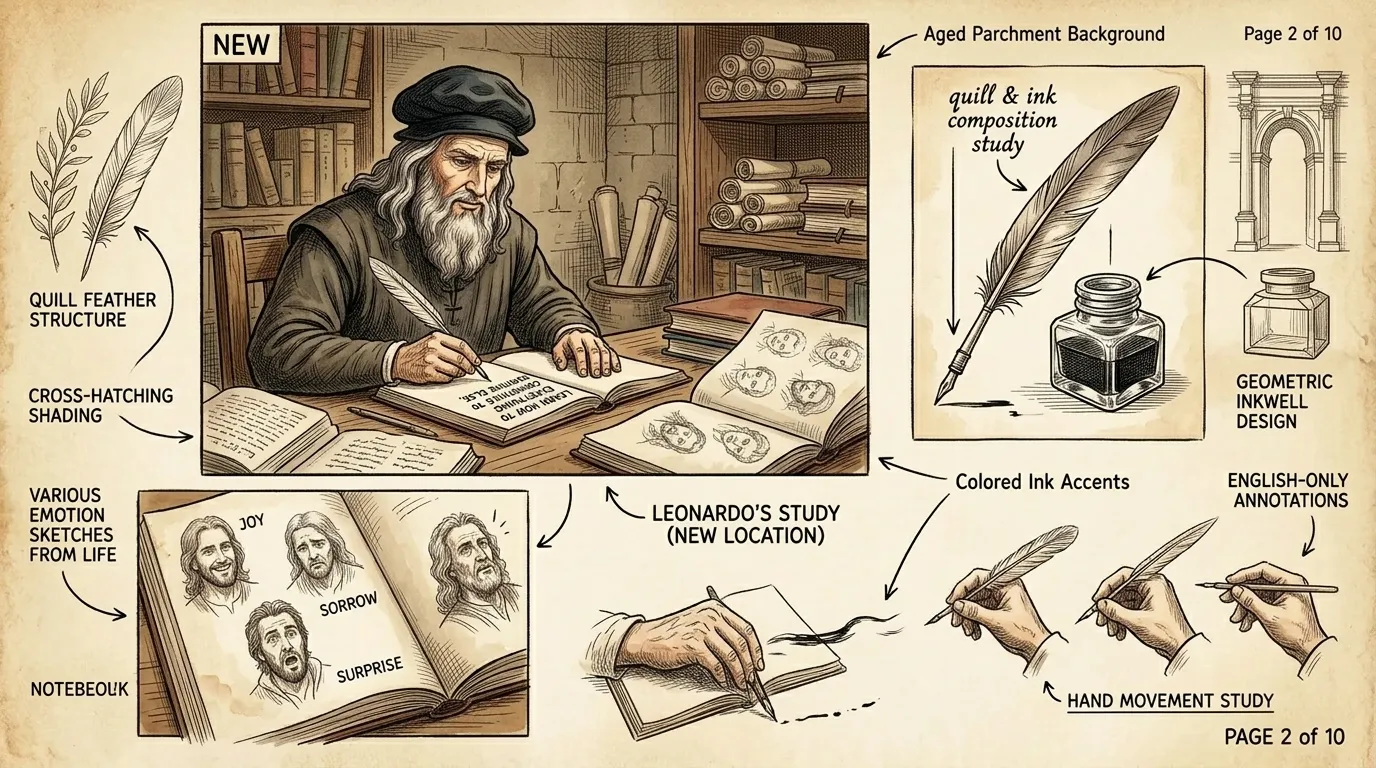
Before the grand commission, Leonardo immersed himself in the relentless study of the human form and its inner workings. His fascination extended beyond muscle and bone, delving into the unseen landscape of human emotion. He believed that to paint life, one must first comprehend its every flicker.
""'Learn how to see,' Leonardo often wrote in his notebooks. 'Realize that everything connects to everything else.' For me, this is the key to depicting the soul's movements through the body.""
Art Fact: Leonardo's notebooks are filled with thousands of anatomical drawings, a testament to his belief that understanding the body's mechanics was essential for depicting authentic human expression in his art. These studies were unprecedented for their time.
Page 3
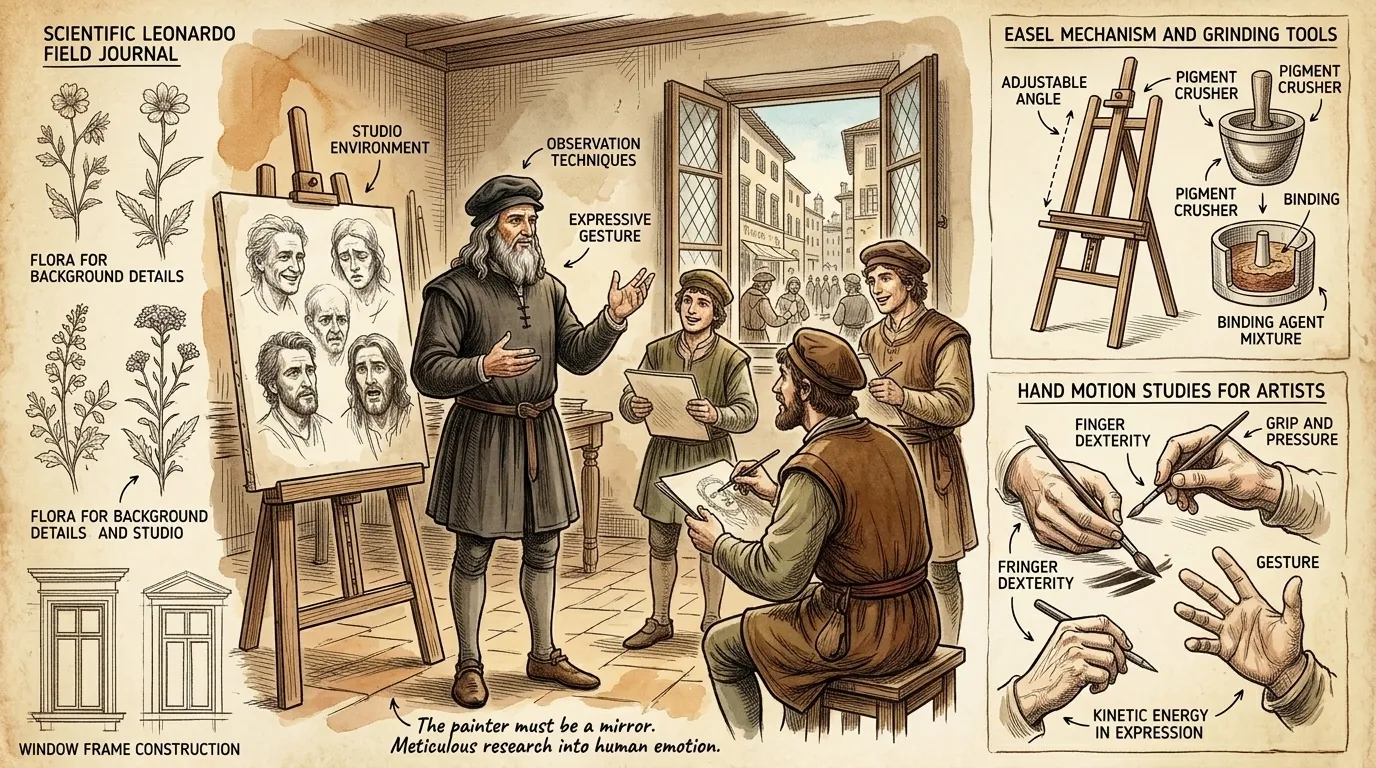
To truly render the profound drama of the Last Supper, Leonardo knew he could not simply paint static figures. He sought to capture the instantaneous, varied shock and dismay on each disciple's face, a cascade of human reactions to an unthinkable pronouncement. He observed people from all walks of life, capturing fleeting expressions.
""The painter must be a mirror," Leonardo dictated to his apprentices, "reflecting every human joy, sorrow, anger, and surprise. The moment Christ speaks, each apostle must reveal his unique soul.""
Art Fact: Leonardo spent countless hours observing people in the streets, sketching their expressions, and even inviting subjects into his studio to emote for him. This meticulous research allowed him to imbue his figures with unparalleled psychological depth and realism.
Page 4
The audacious project of The Last Supper began with the patronage of Duke Ludovico Sforza, the ruler of Milan. He envisioned the refectory of the Dominican convent of Santa Maria delle Grazie not merely as a dining hall, but as a testament to his piety and the cultural grandeur of his court. He sought an artist capable of an equally grand vision.
""Maestro Leonardo," Duke Sforza declared, gesturing to the empty wall, "I desire a masterpiece that will speak to the faithful for generations. Let it be a vision of Christ's final meal, unlike any seen before.""
Art Fact: Ludovico Sforza, Duke of Milan, was a pivotal patron of Leonardo da Vinci. The commission for The Last Supper was part of his extensive renovation and decoration of the convent and church, intended to serve as a dynastic burial place for his family.
Page 5
Rejecting the traditional, swift fresco method, which required painting on wet plaster, Leonardo embarked on a perilous technical experiment. He chose to work with tempera and oil paints directly onto a dry plaster wall, mimicking the luminosity and depth achievable on a panel painting. This allowed for slow, deliberate brushstrokes and fine details, but carried immense risk.
""True fresco is too quick, too unforgiving," Leonardo explained to a curious friar, carefully mixing pigments. "I require time, the freedom to revise, to achieve a richer texture, a more profound light. This new method allows me to chase perfection.""
Art Fact: Leonardo's desire for the slow, nuanced blending of oil painting was at odds with the demands of traditional fresco. His chosen technique—a binder of oil and tempera on gesso, pitch, and mastic—ultimately proved unstable, leading to the painting's rapid deterioration.
Page 6
Leonardo's genius was not only in psychological portraiture but also in architectural illusion. He harnessed linear perspective with unparalleled mastery, making the refectory wall seemingly vanish and opening into an extension of the room itself. The vanishing point was strategically placed behind Christ's head, drawing all attention to the central figure.
""All lines converge upon Him," Leonardo declared, stepping back to observe the receding planes of the painted room. "The architecture itself must bow to the divinity of the moment, guiding the viewer's eye inevitably to the core of the story.""
Art Fact: Leonardo's application of one-point linear perspective in The Last Supper was groundbreaking. The painted room appears as a natural extension of the actual refectory, creating an immersive experience for the Dominican friars who dined beneath it.
Page 7
The heart of The Last Supper lies in its portrayal of the precise moment Christ reveals, 'One of you will betray me.' This single statement ignites a firestorm of human emotion, Leonardo masterfully capturing twelve distinct psychological reactions, each apostle frozen in a unique posture of disbelief, anger, sorrow, or desperate inquiry.
""Judas recoils, Peter grasps his knife, John collapses in despair," Leonardo explained to Duke Sforza during an inspection, pointing to the figures. "Each gesture, each turn of the head, must speak volumes without uttering a sound.""
Art Fact: Leonardo broke from traditional depictions that often isolated Judas or showed the Eucharist. Instead, he chose the dramatic revelation, capturing the apostles in a flurry of human emotion, making the scene deeply relatable and psychologically penetrating. The arrangement in four groups of three was also a departure, creating a dynamic visual rhythm.
Page 8
Even as The Last Supper was hailed as a marvel, the inherent flaw in Leonardo's experimental technique began to manifest. Within years, the tempera and oil on dry plaster began to flake, peel, and fade, a tragic consequence of innovation. The Duke's delight turned to dismay, and Leonardo himself witnessed the slow decay of his magnum opus.
""The very qualities I sought—the luminosity, the layered depth—are now turning against it," Leonardo lamented, running a hand over a flaking section. "The wall breathes, and my colors depart. It is as if the work itself seeks to vanish.""
Art Fact: Unlike true fresco, which binds pigments chemically to wet plaster, Leonardo's technique did not create a lasting bond. Moisture, temperature fluctuations, and the natural movements of the wall quickly caused the paint to detach, initiating centuries of conservation challenges. This was the unintended 'payoff' of his earlier experimental choice.
Page 9
The deterioration of The Last Supper was relentless. From early attempts at 'restoration' that often caused more harm than good—including repainting by later artists—to the ravages of war and environmental neglect, the mural faced an uphill battle for survival. Yet, its profound artistic and spiritual power ensured its continuous, albeit damaged, presence.
""It is a miracle it still exists," a Benedictine monk murmured to a visiting cardinal in the 17th century, observing the faded forms. "Though scarred by time, its spirit remains, a perpetual witness.""
Art Fact: Over the centuries, the painting suffered from numerous well-intentioned but often destructive restorations. Monks even cut a doorway through Christ's feet in 1652. Humidity, smoke, and later, the vibrations of Allied bombing during WWII, all took their toll, leaving only fragments of Leonardo's original work discernible.
Page 10
Today, The Last Supper survives as a testament to human genius and enduring faith, painstakingly restored to reveal as much of Leonardo's original intent as possible. It remains in its original setting in Milan, drawing millions, its influence echoing through every facet of art, culture, and religious contemplation. Leonardo's meticulous observation and groundbreaking composition continue to inspire, challenging artists and viewers to look deeper, to feel more profoundly.
""A masterpiece speaks across centuries," reflected a modern art historian, gazing at the restored work. "It reminds us that the human spirit, through art, can truly touch eternity. Leonardo's vision of the soul lives on.""
Art Fact: The most recent and extensive restoration, led by Pinin Brambilla Barcilon and completed in 1999, took over two decades, meticulously removing layers of grime and previous repaintings to reveal the fragile fragments of Leonardo's original work. The painting's global significance is profound, influencing countless artists, writers, and thinkers for over 500 years, securing Leonardo da Vinci's place as one of humanity's greatest visionaries.
About this story
- Location: Global
- Audience: general readers
Read Wonder Arts on your phone
Wonder Arts is available on Android. Get Wonder Arts on Google Play.
More Wonder Arts stories
- The Last Supper by Leonardo da Vinci (Milan, Italy — 1498)
- The Last Supper — Leonardo da Vinci
- The Light of the World by William Holman Hunt (London, UK — 1854)
- The Mona Lisa by Leonardo da Vinci (Paris, France — 1503–1519)
- The Mona Lisa — Paris, France — 1503–1519
- The Monk by the Sea by Caspar David Friedrich (Germany — 1810)