The Last Supper by Leonardo da Vinci (Milan, Italy — 1498)
The Last Supper by Leonardo da Vinci (Milan, Italy — 1498) — an illustrated arts story, set in Italy. 10 illustrated pages, free to read on Wonder Arts.
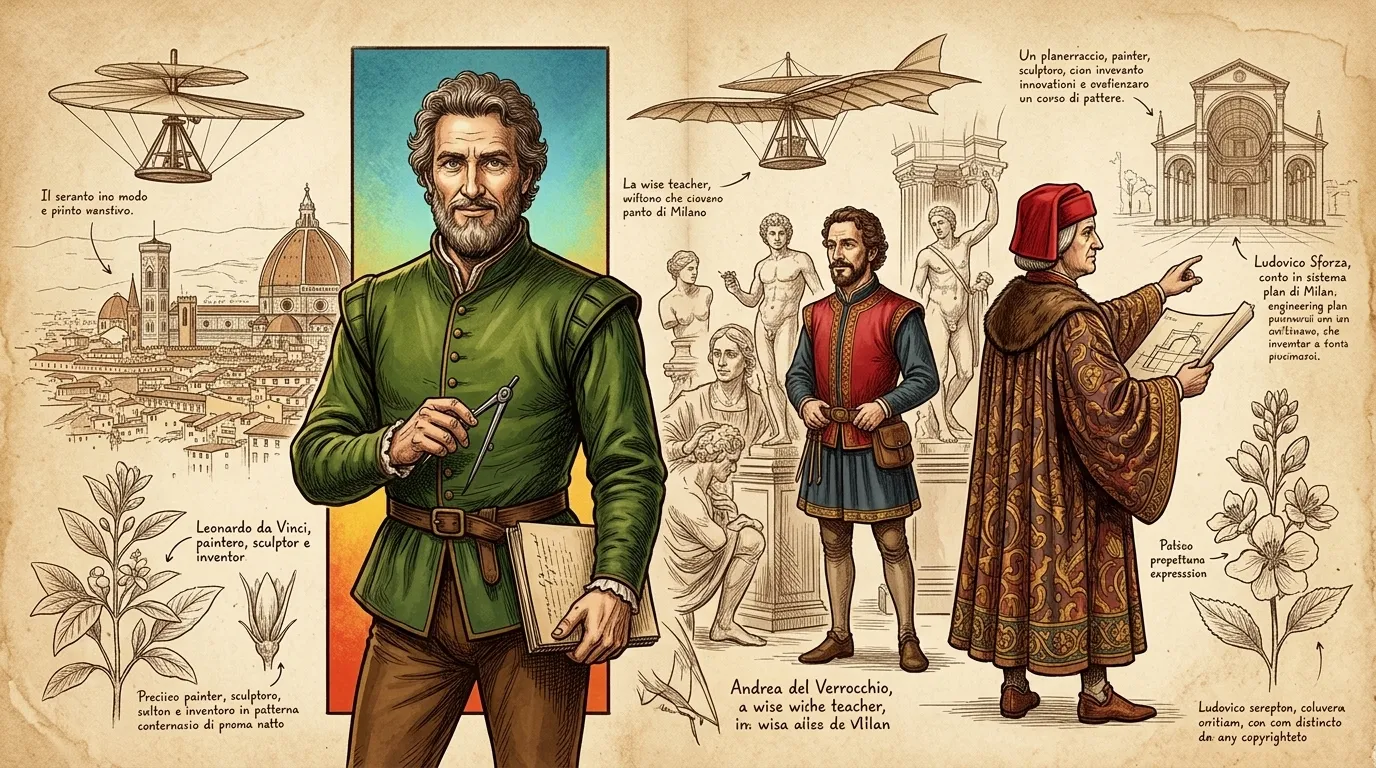
Page 1
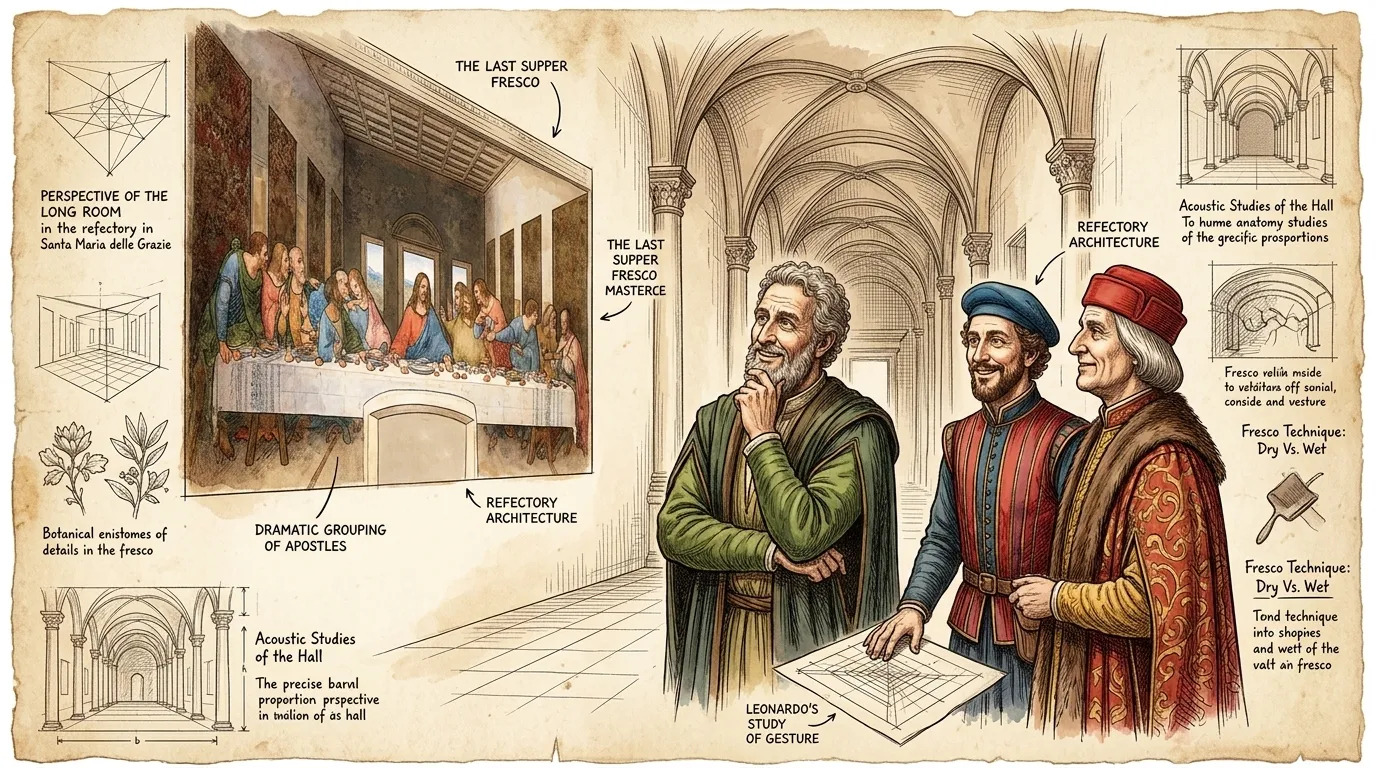
Milan, 1498. Leonardo da Vinci stands before his completed masterpiece, 'The Last Supper.' The fresco, measuring approximately 15 feet by 29 feet, dominates the refectory of the Santa Maria delle Grazie. Its groundbreaking use of perspective and depiction of human emotion mark a pivotal moment in art history.
"Leonardo murmurs, 'I have captured a moment frozen in time, a testament to faith and betrayal. But will it last?'"
Art Fact: The Last Supper is not a true fresco but was painted 'secco' (on dry plaster), allowing for finer detail but leading to its rapid deterioration.
Page 2
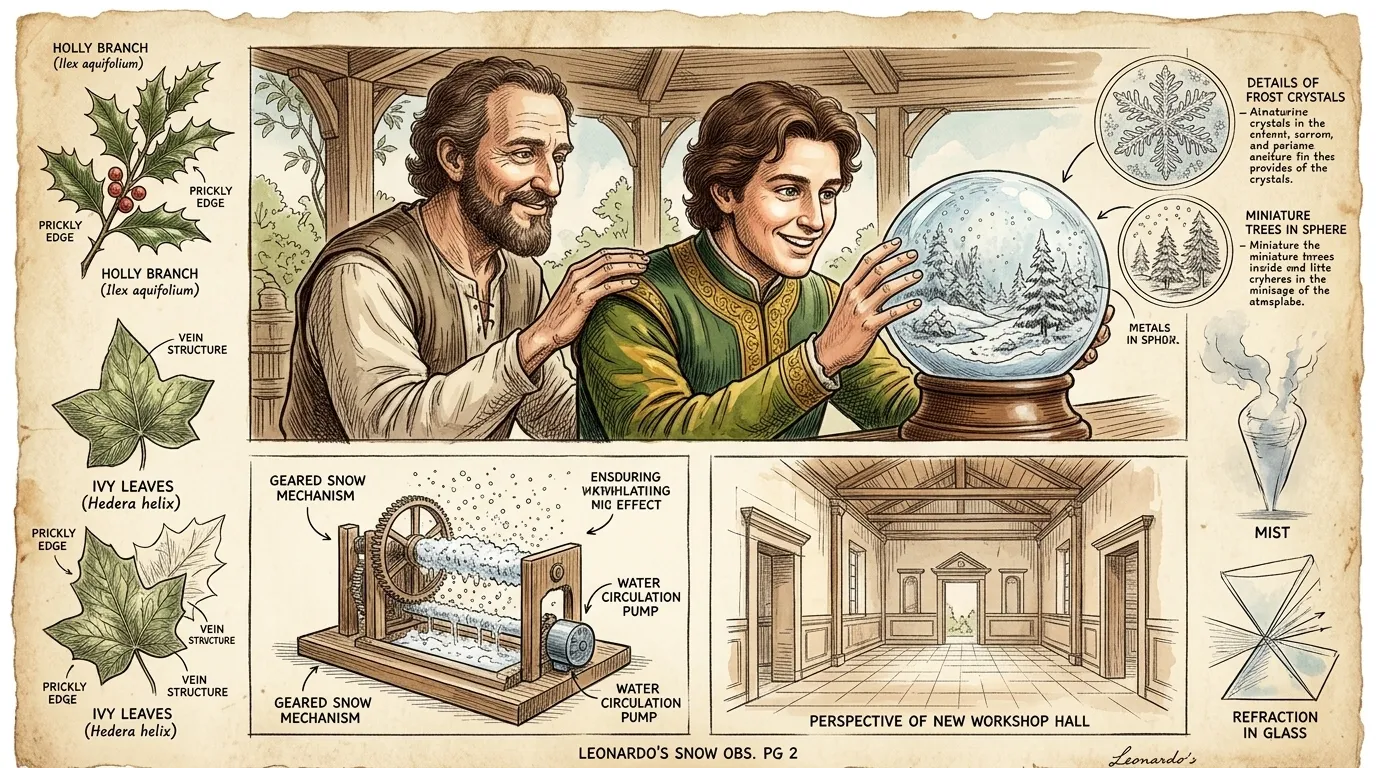
Young Leonardo explores the frost-covered landscape inside the snow globe. The artist, still an apprentice, watches the microcosm's tiny world come to life. This unique perspective becomes the foundation for his detailed observations of the natural world.
"Verrocchio, Leonardo's master, says, 'Observe closely, Leonardo. Even in the smallest kingdom, there is greatness to be found. Leonardo replies, 'Every detail matters, Master, from the highest mountain to the smallest stone.'"
Art Fact: Leonardo's early training in Verrocchio's workshop instilled in him a deep understanding of anatomy, perspective, and the use of oil paints.
Page 3
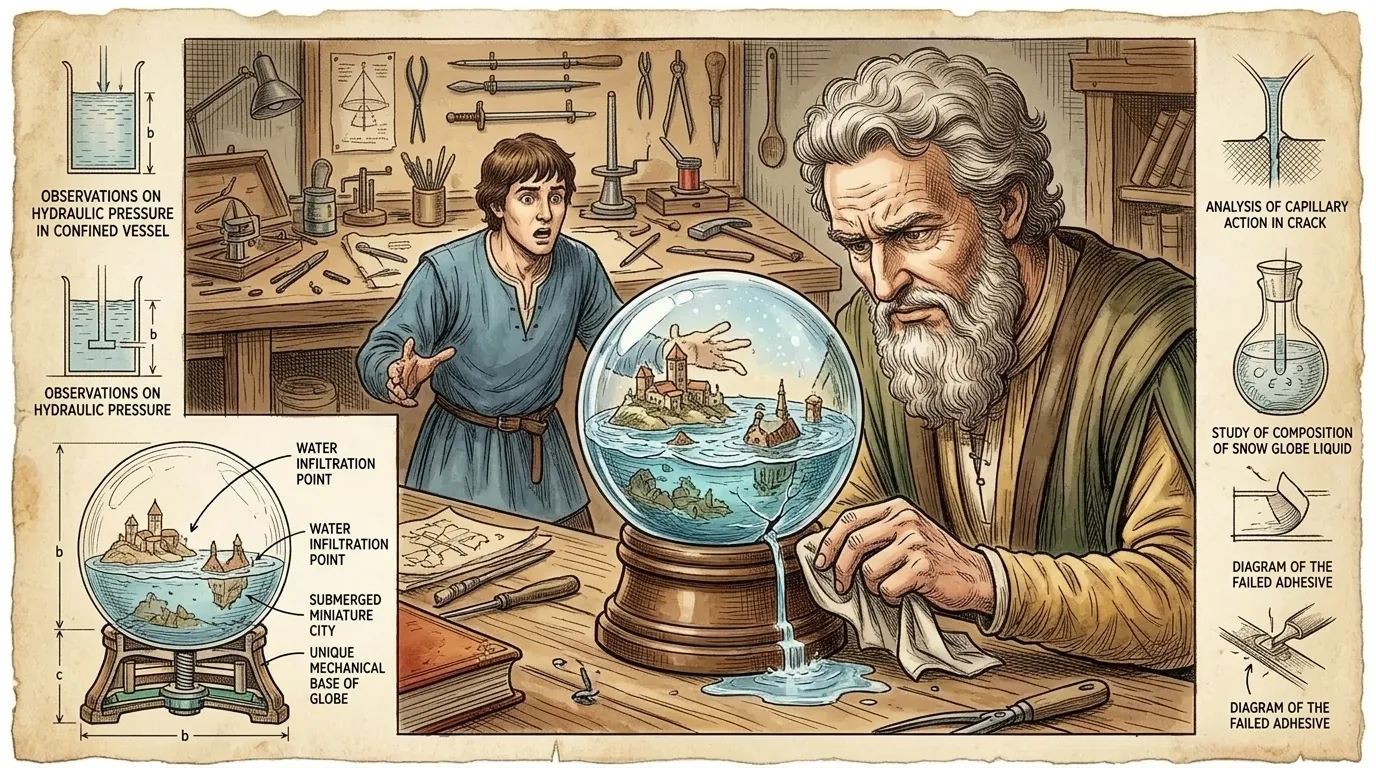
Leonardo, striving for perfection, experiments with new techniques inside the snow globe. His ambition leads to risky choices, mirroring the characters in his future masterpiece. He fails to control the climate inside the globe causing water to flood the landscape. 'As Machiavelli once said, 'It is much safer to be feared than loved, when one of the two must be chosen',' Leonardo mutters as he tries to stop the flow, realizing his attempt to create a perfect environment had unforeseen consequences.
"A fellow apprentice exclaims, 'Leonardo, look what you've done! You've flooded the entire kingdom!' Leonardo replies, 'I aimed for perfection, but in the pursuit, I made errors.'"
Art Fact: Leonardo's relentless pursuit of perfection often led to experimentation and delays, a characteristic reflected in 'The Last Supper' through his use of unconventional techniques.
Page 4
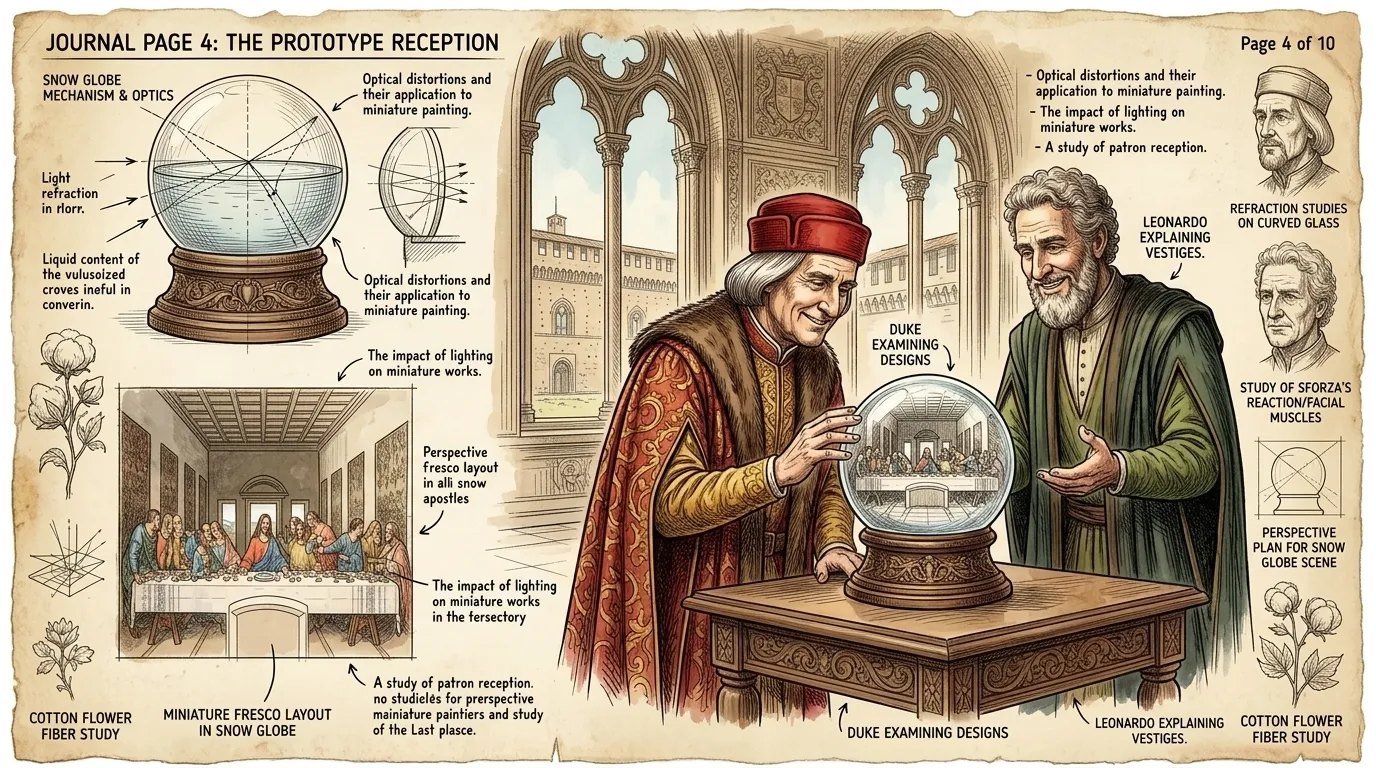
Ludovico Sforza, Duke of Milan, examines Leonardo's early sketches for the Last Supper inside the snow globe. He recognizes the artist's genius, securing a commission that would define Leonardo's legacy. He knows that Leonardo is the most talented painter in the land and can create the perfect piece.
"Ludovico declares, 'Leonardo, your talent is undeniable. I entrust you with this task, to create a vision of grandeur and faith!' Leonardo responds, 'Your Grace, I shall endeavor to surpass all expectations.'"
Art Fact: Ludovico Sforza's patronage was crucial to Leonardo's career, providing him with the resources and opportunity to undertake ambitious projects like 'The Last Supper.'
Page 5
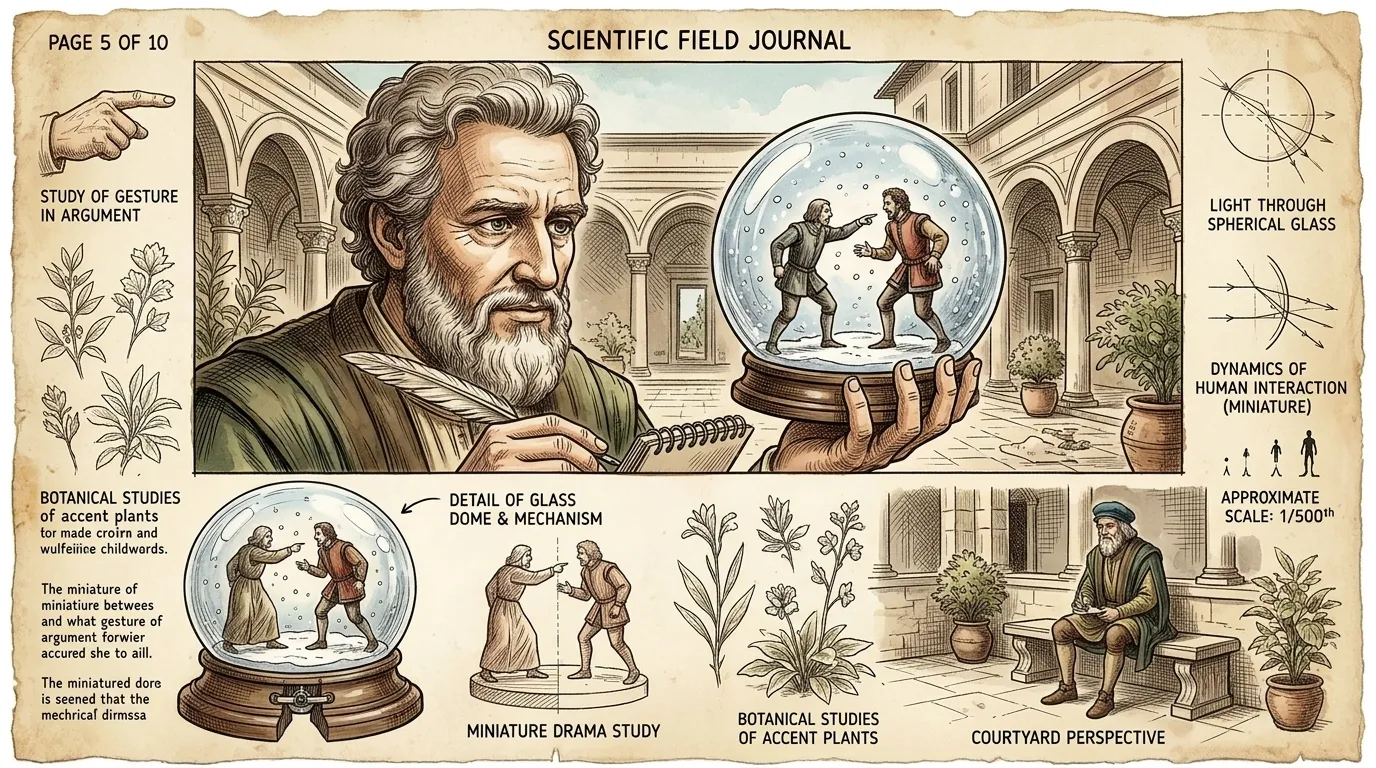
Within the snow globe, Leonardo witnesses a heated argument between two figures. The betrayal within the miniature kingdom fuels his depiction of Judas's treachery. These fights allowed Leonardo to reflect on the human condition.
"One figure shouts, 'You have betrayed my trust!'. The other defends himself, 'I had no choice, circumstances forced my hand!'"
Art Fact: Leonardo's understanding of human psychology, gleaned from observation and experience, allowed him to imbue 'The Last Supper' with profound emotional depth.
Page 6
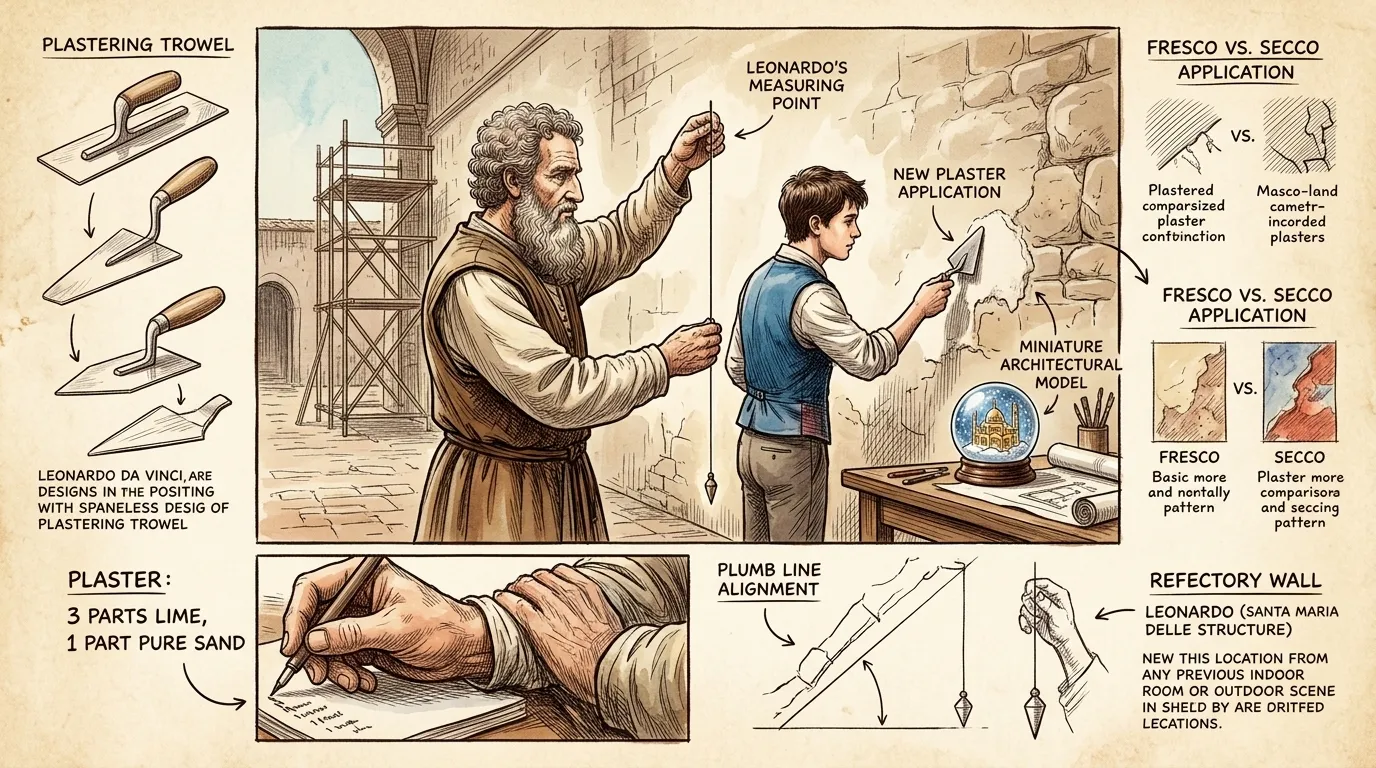
Leonardo, with the help of the snow globe, meticulously prepares the wall of the refectory for the fresco. His attention to detail ensures the foundation is sound for his ambitious masterpiece. He measures the wall and makes sure that all the dimensions are precise.
"Leonardo instructs his assistant, 'Ensure the plaster is perfectly smooth, every imperfection will be magnified by the paint.' The assistant replies, 'Yes, Master, every detail is vital.'"
Art Fact: Leonardo's meticulous preparation of the wall was critical to the initial success of 'The Last Supper,' although his experimental technique ultimately contributed to its decay.
Page 7
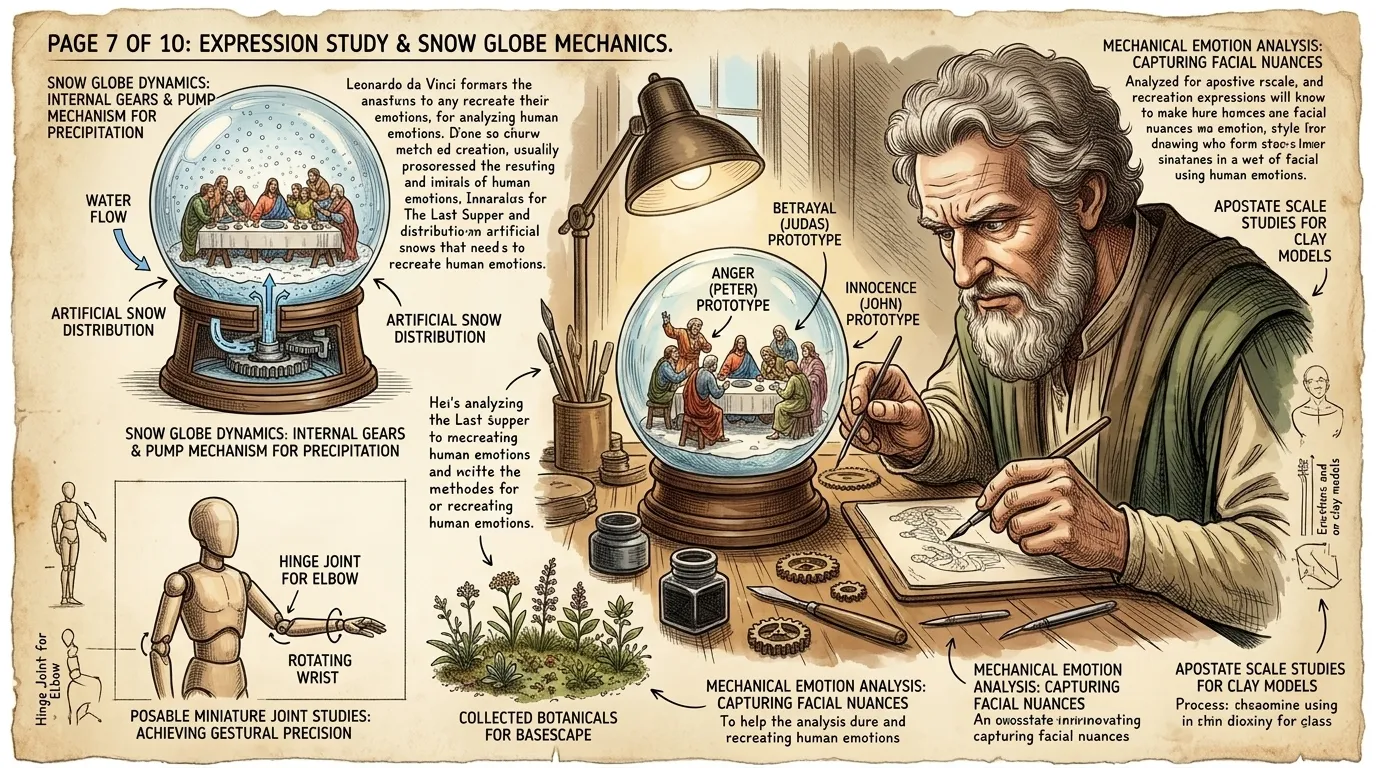
Leonardo struggles to capture the precise expressions of each apostle within the snow globe. His relentless pursuit of authenticity drives him to study human emotion in all its forms. Leonardo studies the faces of all the characters. He knows that they must represent all facets of the human condition.
"Leonardo says, 'Judas must embody betrayal, Peter must reflect anger, John must exude innocence,'"
Art Fact: Leonardo's ability to capture the nuances of human emotion in 'The Last Supper' is a testament to his keen observation and understanding of human psychology.
Page 8
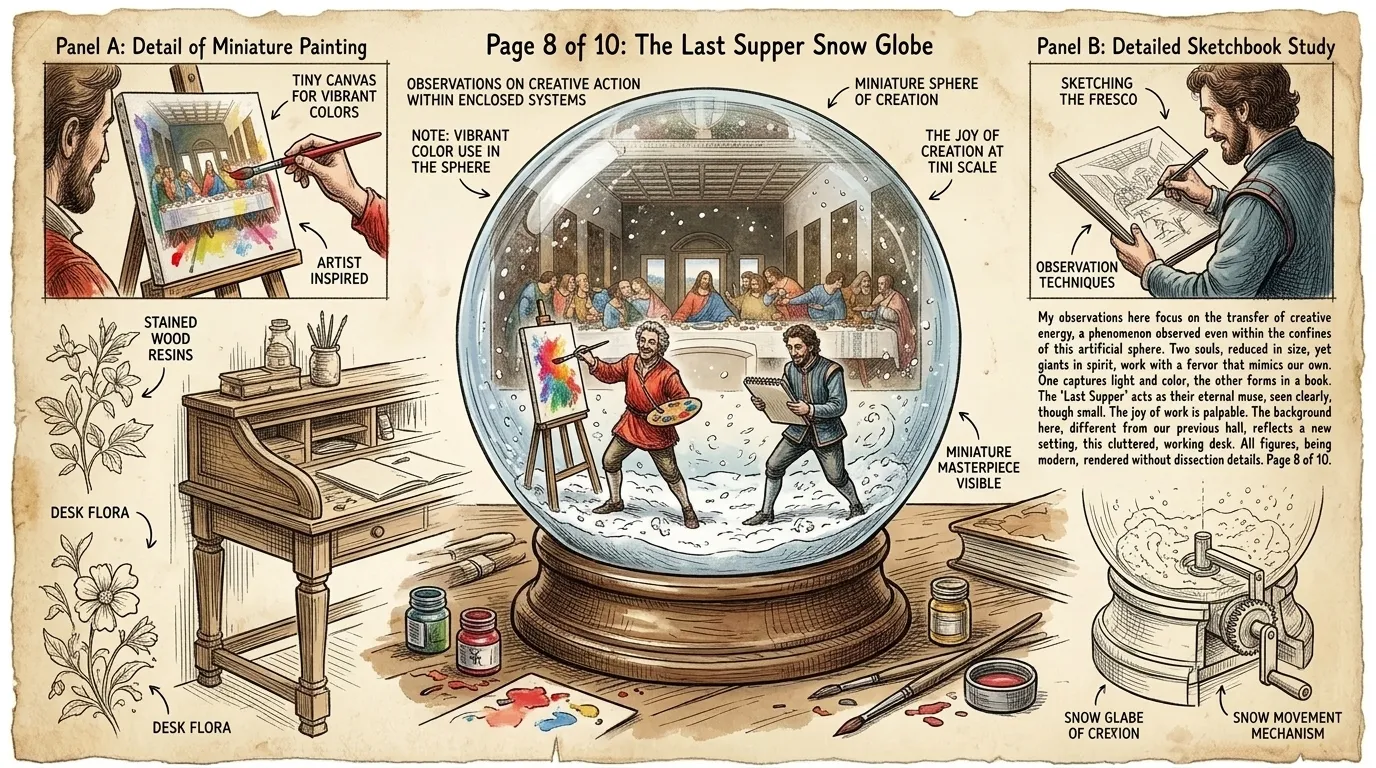
Centuries later, artists inside the snow globe, inspired by the Last Supper, create their interpretations. Leonardo's influence resonates through time, shaping the course of art history. He is remembered as the greatest Renaissance painter of all time. His legacy is forever solidified.
"An artist exclaims, 'Leonardo's genius transcends time! His work continues to inspire!' Another adds, 'The Last Supper is a masterpiece, a testament to the power of art!'"
Art Fact: The Last Supper has inspired countless artists throughout history, influencing the development of composition, perspective, and emotional expression in art.
Page 9
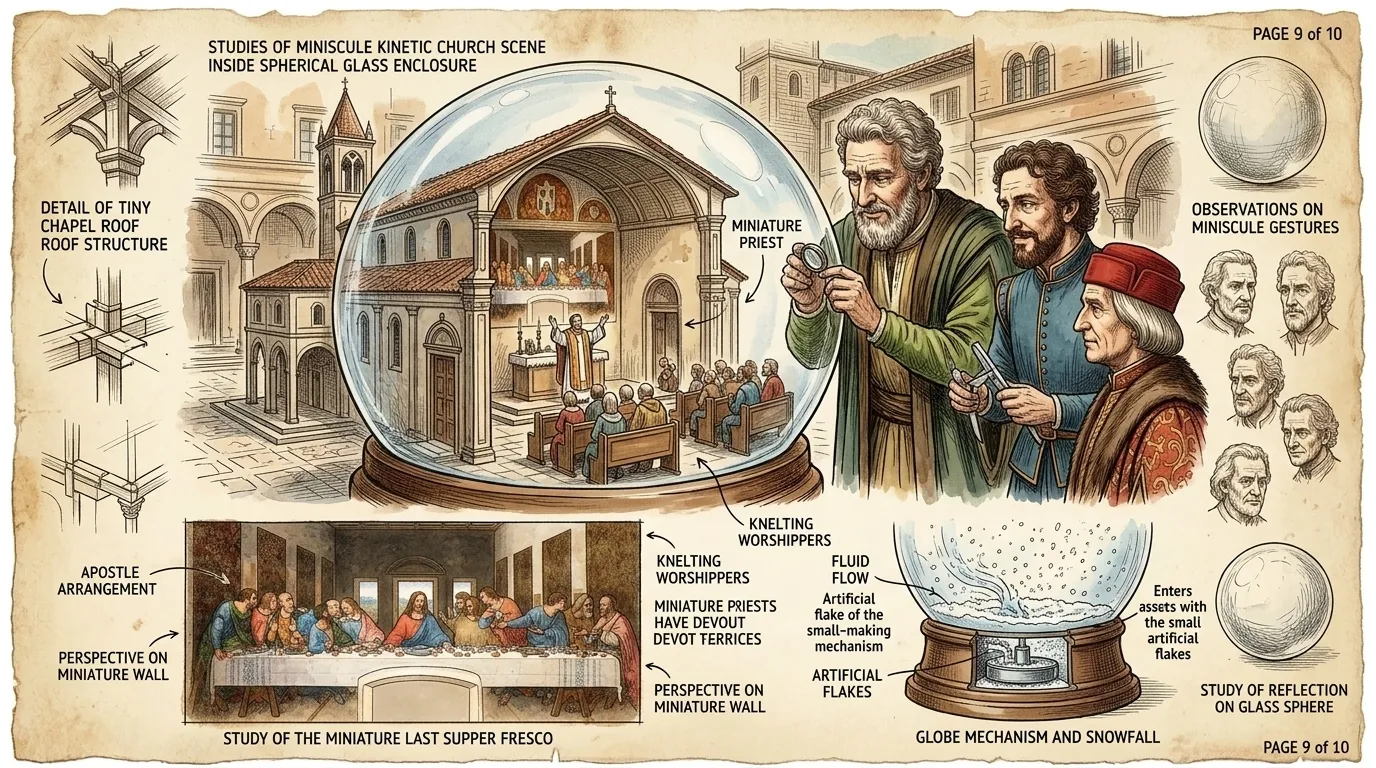
Inside the snow globe, a service is held with the Last Supper displayed. Leonardo's work continues to inspire devotion, faith, and reflection. The Last Supper acts as a reminder of what's important in life.
"The priest says, 'Let us remember the sacrifice and betrayal, the themes that resonate through time.' Worshippers respond, 'Amen.'"
Art Fact: The Last Supper is more than just a painting; it is a powerful symbol of faith, sacrifice, and the human condition.
Page 10
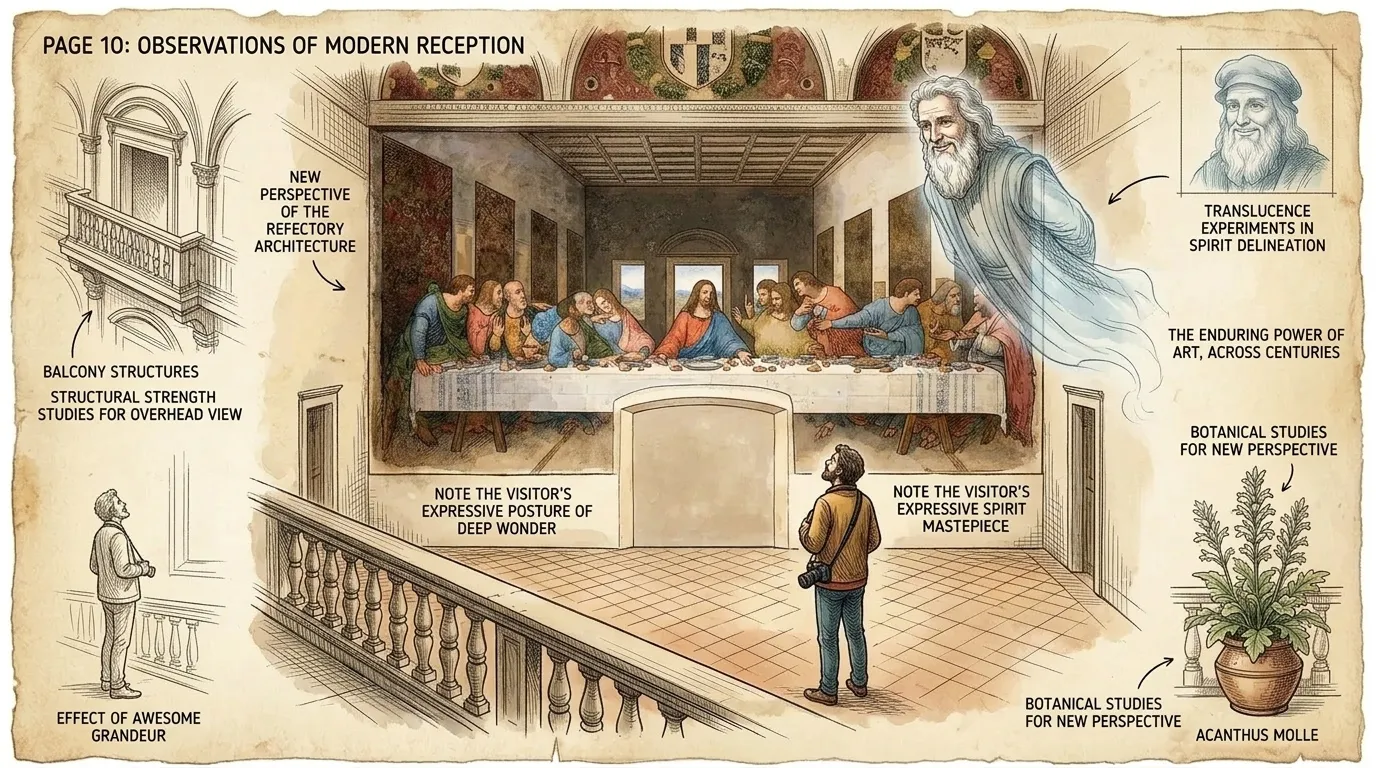
Leonardo's spirit stands watch over the restored Last Supper, his creation forever etched in the halls of Santa Maria delle Grazie. As Helen Keller famously said, "The best and most beautiful things in the world cannot be seen or even touched - they must be felt with the heart". Leonardo's masterpiece transcends the visual realm, reaching into the very soul of humanity.
"A visitor whispers, 'Its beauty remains undimmed, a testament to Leonardo's genius.'"
Art Fact: Despite its fragility, 'The Last Supper' endures as a masterpiece of the High Renaissance, a testament to Leonardo da Vinci's genius and the enduring power of art.
About this story
- Location: Italy
- Audience: general readers
Read Wonder Arts on your phone
Wonder Arts is available on Android. Get Wonder Arts on Google Play.
More Wonder Arts stories
- The Last Supper — Leonardo da Vinci
- The Light of the World by William Holman Hunt (London, UK — 1854)
- The Mona Lisa by Leonardo da Vinci (Paris, France — 1503–1519)
- The Mona Lisa — Paris, France — 1503–1519
- The Monk by the Sea by Caspar David Friedrich (Germany — 1810)
- The Night Café by Vincent van Gogh (Arles, France — 1888)