The School of Athens by Raphael (Vatican City, Rome — 1509–1511)
The School of Athens by Raphael (Vatican City, Rome — 1509–1511) — an illustrated arts story, set in Global. 10 illustrated pages, free to read on Wonder Arts.
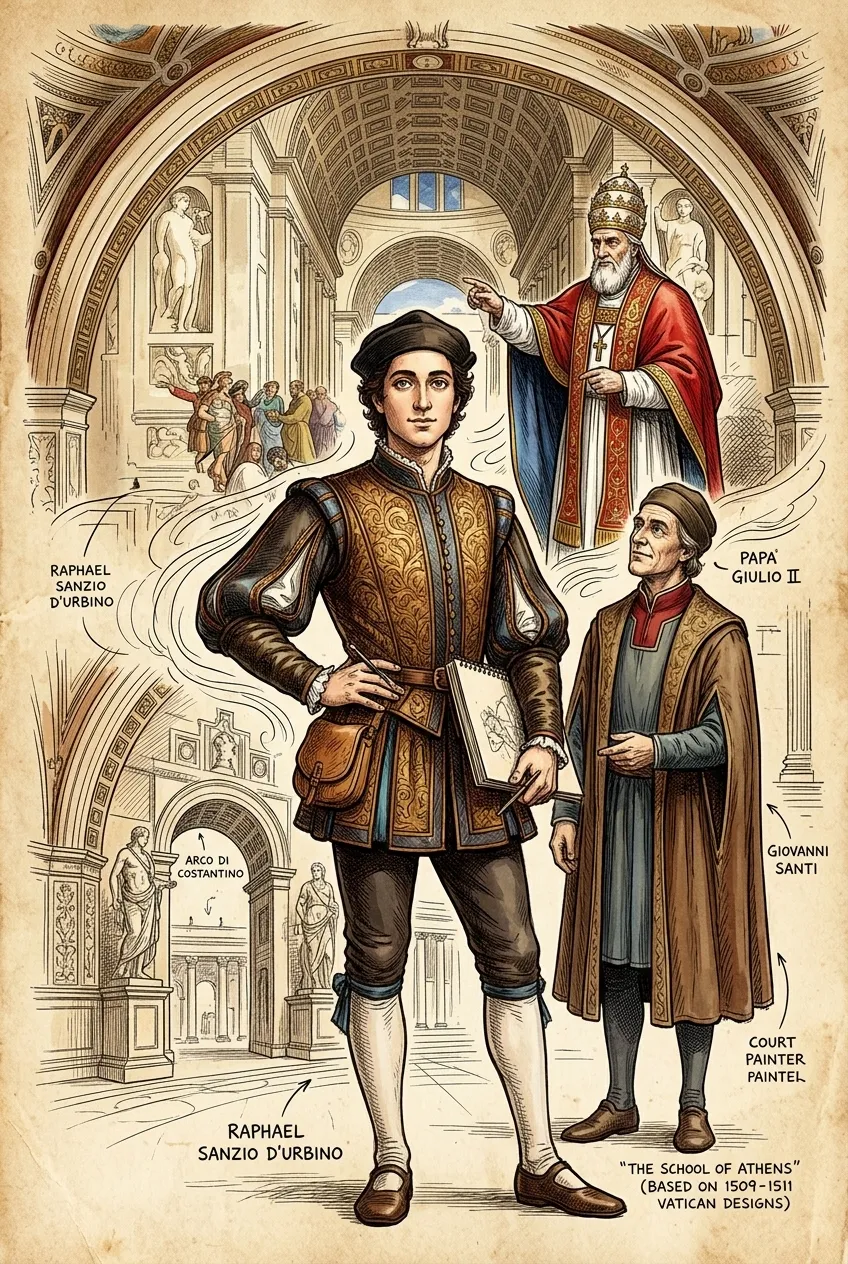
Page 1
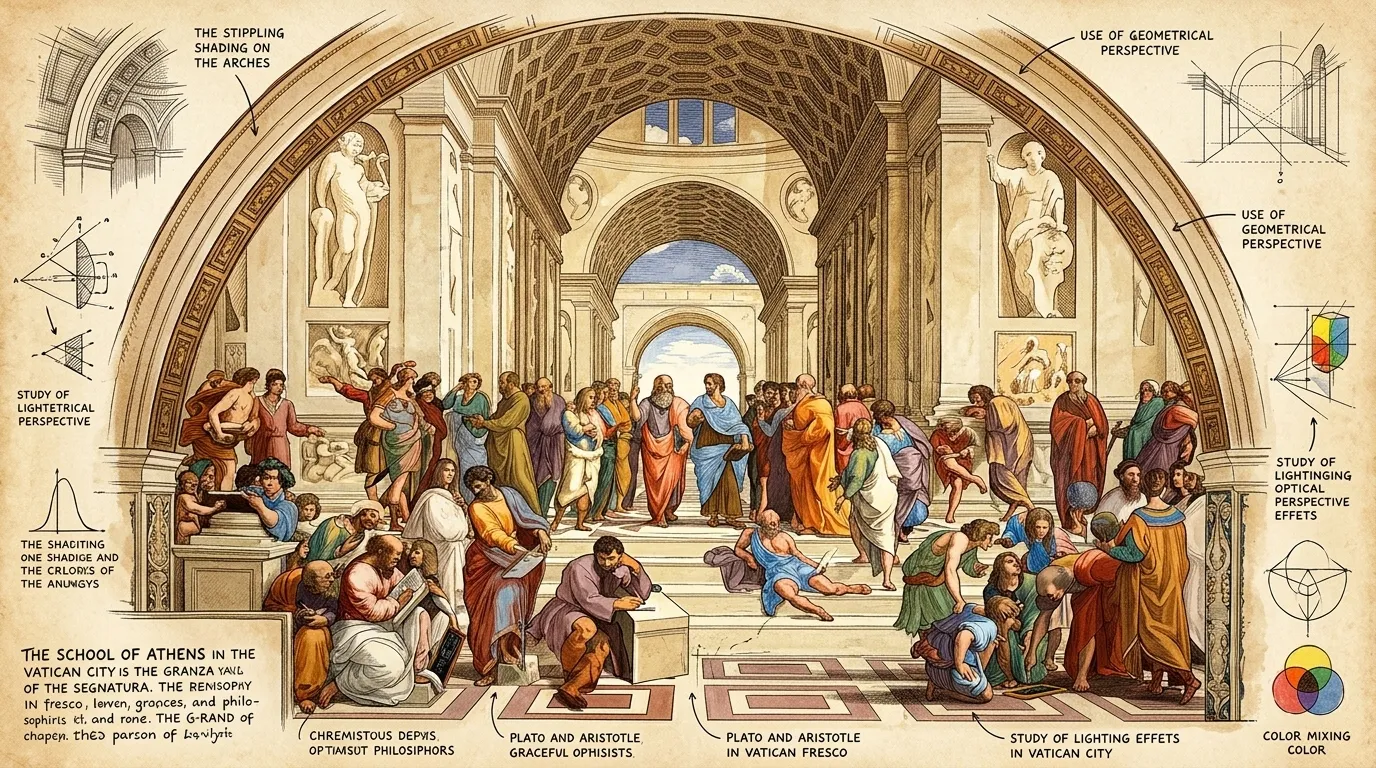
In the Apostolic Palace, Vatican City, resides Raphael's fresco, The School of Athens. Completed between 1509 and 1511, this grand depiction of philosophy measures approximately 26 feet wide and is a centerpiece of the Stanza della Segnatura. Art historians consider it a prime example of High Renaissance ideals, blending classical philosophy with contemporary figures.
"Giorgio Vasari, Raphael's contemporary biographer, later wrote: 'This work is executed with so much care and diligence that it may truly be said to surpass all other pictures. The composition is admirably designed, and the figures are invested with such grace and beauty that they seem rather divine than human.'"
Art Fact: The Stanza della Segnatura was the first of the rooms to be decorated by Raphael in the Vatican. It served as Pope Julius II's library.
Page 2
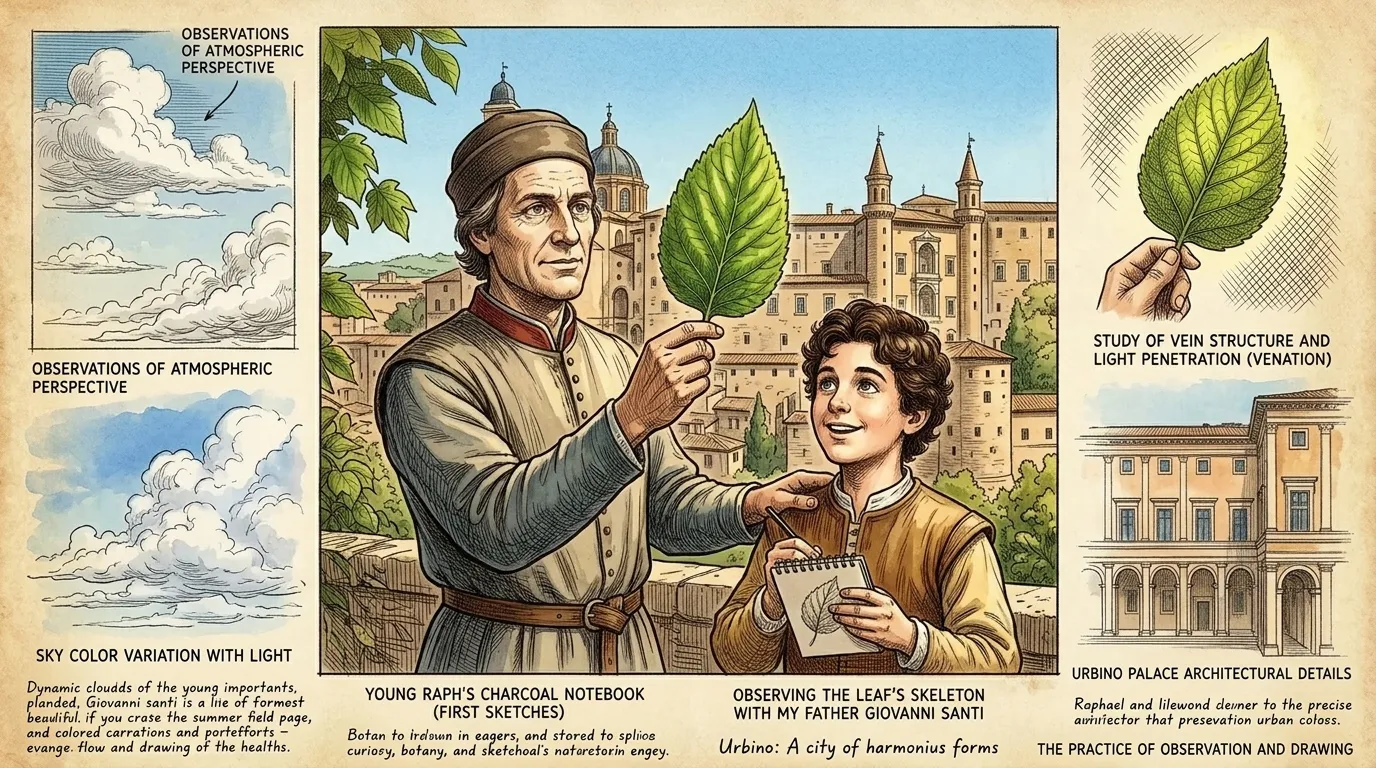
Raffaello Sanzio, later known as Raphael, was born in Urbino in 1483. His father, Giovanni Santi, was a painter at the court of Federico da Montefeltro. It was in this environment of artistic innovation that Raphael first learned to draw and appreciate the beauty of the world.
"Giovanni Santi to young Raphael: 'My son, observe the world around you. Note the fall of light, the shape of every leaf. As Leonardo da Vinci said, 'Painting embraces all the ten functions of the eye; that is to say, darkness, light, body and colour, form and situation, distance and nearness, motion and rest.' Remember this, and your art will flourish.'"
Art Fact: Raphael's early training under his father exposed him to the techniques of Renaissance painting and the importance of observation.
Page 3
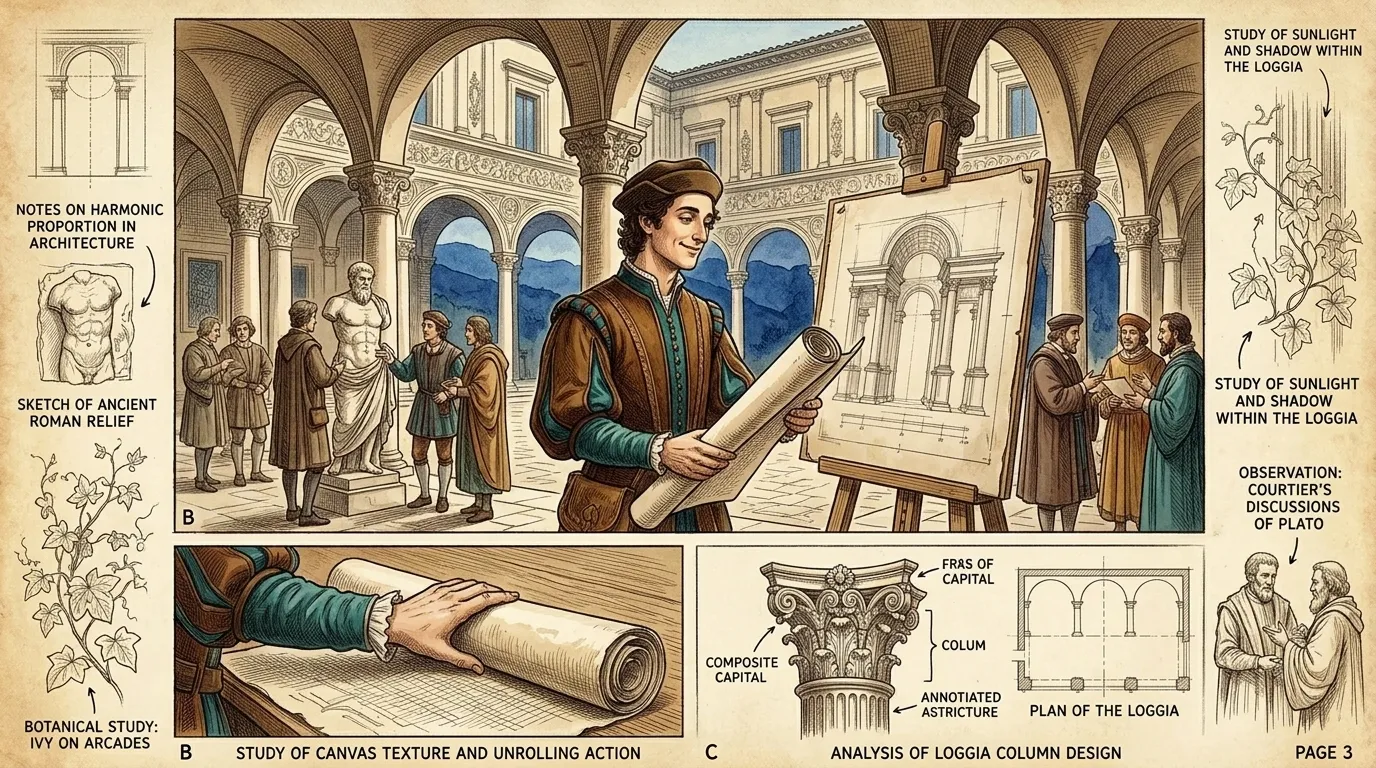
The court of Urbino, under Federico da Montefeltro, was a center of humanist thought and artistic patronage. Raphael absorbed the classical ideals that would later influence his compositions. The emphasis on balance, harmony, and intellectual pursuits shaped his vision.
"Baldassare Castiglione, a courtier and writer, observed: 'Raphael has an innate ability to perceive beauty and translate it onto canvas. His genius lies in his ability to distill the essence of classical ideals.'"
Art Fact: The Palazzo Ducale in Urbino housed an impressive library and art collection, exposing Raphael to classical knowledge and artistic masterpieces.
Page 4
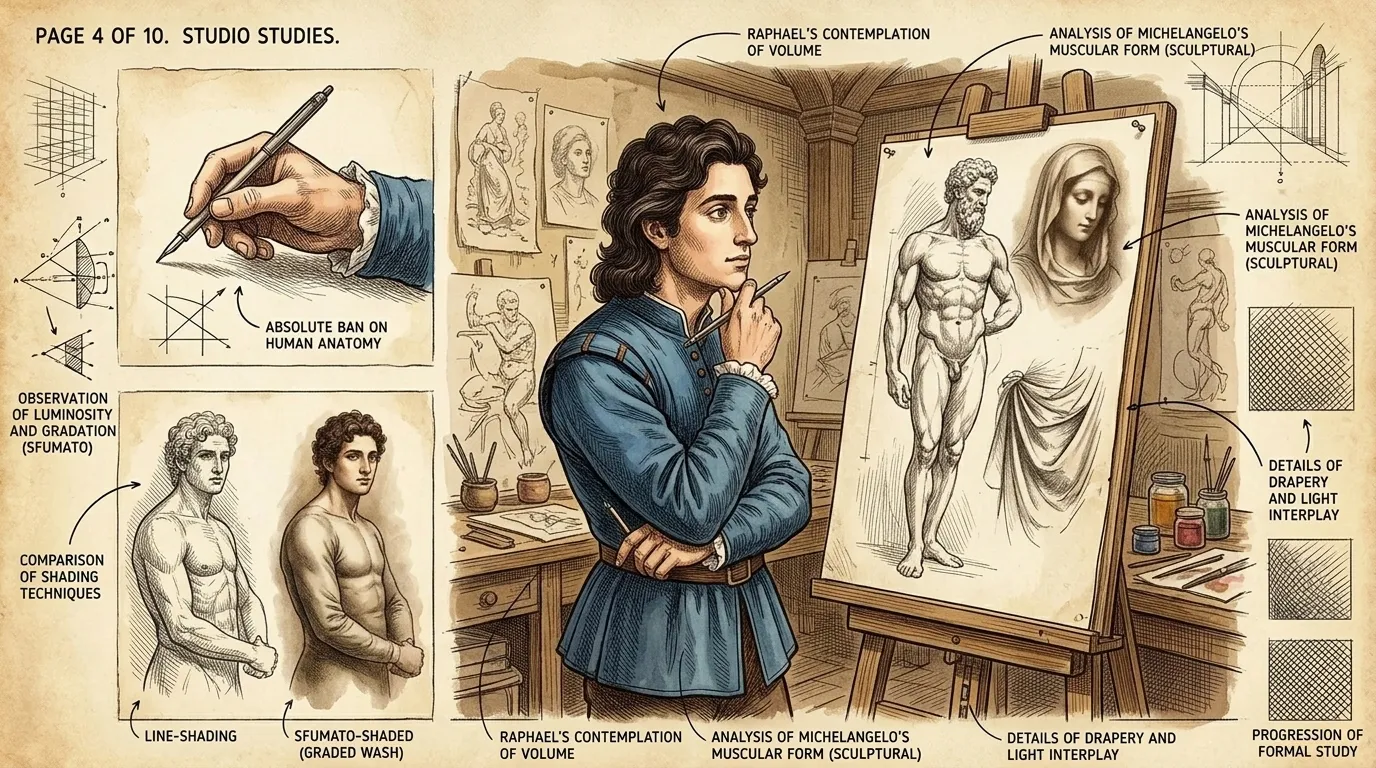
Around 1504, Raphael moved to Florence, where he studied the works of Leonardo da Vinci and Michelangelo. He was particularly impressed by Leonardo's sfumato technique and the anatomical precision of Michelangelo's sculptures. These influences began to shape his own unique style.
"Raphael to a fellow artist: 'Leonardo's approach to light and shadow is revolutionary. He has truly mastered the art of creating the illusion of depth and form. But as Michelangelo says, 'I saw the angel in the marble and carved until I set him free.' I must seek the truth within my subjects.'"
Art Fact: Raphael's time in Florence was crucial in his development as an artist, allowing him to learn from the leading figures of the High Renaissance.
Page 5
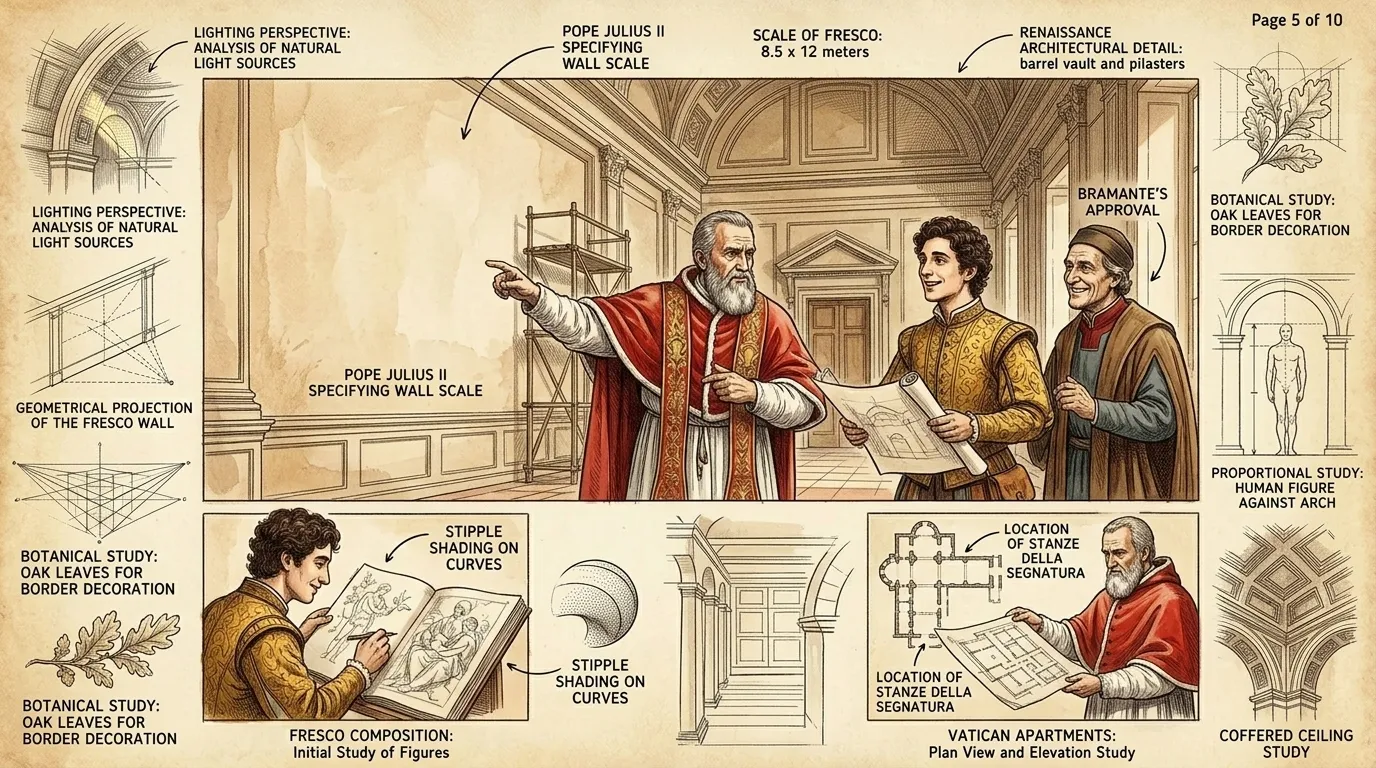
In 1508, Pope Julius II summoned Raphael to Rome to decorate the papal apartments in the Vatican. This commission marked a turning point in Raphael's career, placing him at the center of artistic innovation in the Catholic world. He was charged with creating frescoes that reflected the ideals of the Renaissance.
"Donato Bramante, the papal architect, to Raphael: 'The Pope sees in you a genius capable of surpassing all others. He desires to transform the Vatican into a testament to human intellect and divine inspiration. Do not disappoint him.'"
Art Fact: Pope Julius II was a major patron of the arts, commissioning works from Raphael, Michelangelo, and Bramante to enhance the prestige of the papacy.
Page 6
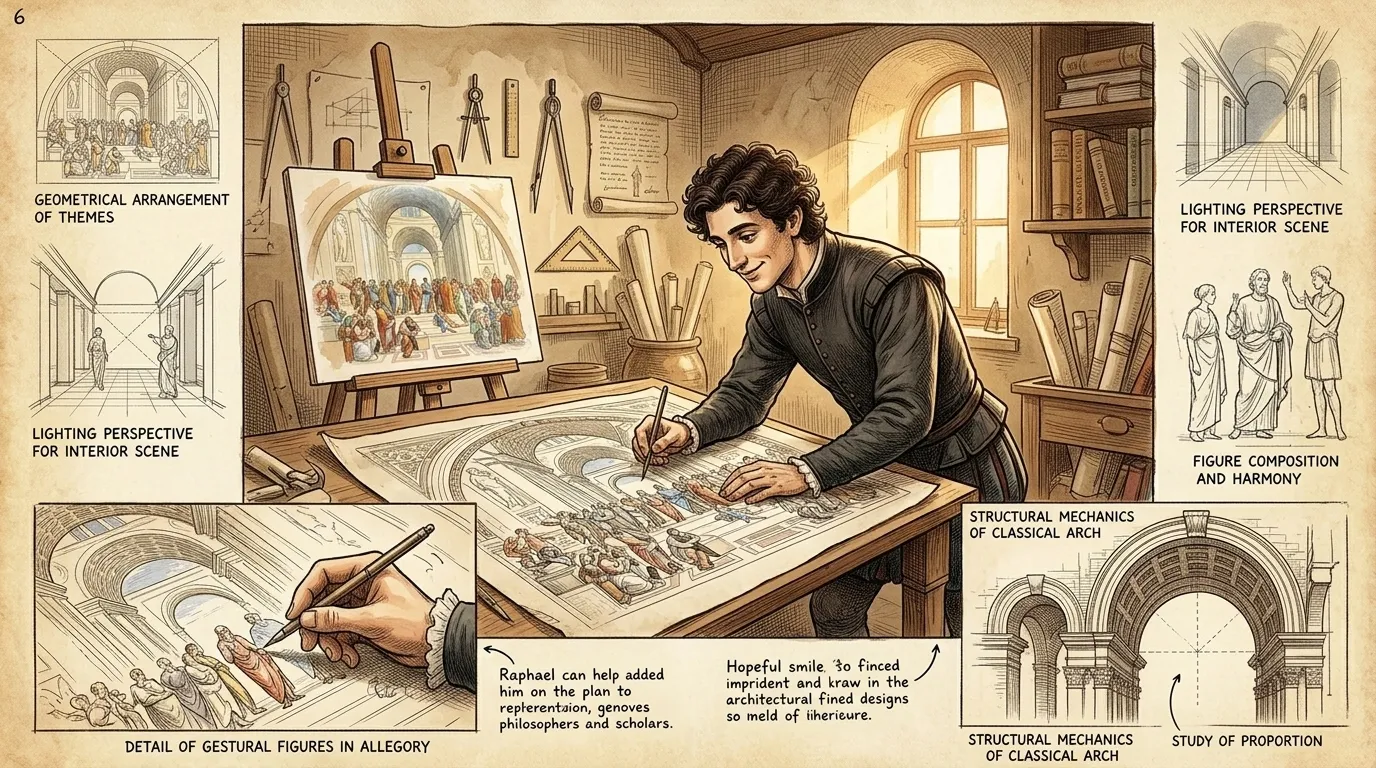
Raphael began to conceive the School of Athens as a grand allegory of philosophy. He sought to depict the great thinkers of antiquity, placing them in a harmonious architectural setting inspired by classical Roman structures. The composition was carefully planned to reflect the order and balance of the philosophical ideals.
"Raphael, in his studio: 'Each figure must represent a different school of thought, but all must come together in a unified vision. I am trying to capture the very essence of human intellect.'"
Art Fact: Raphael employed a team of assistants to help him prepare the frescoes, including experts in perspective and anatomy.
Page 7
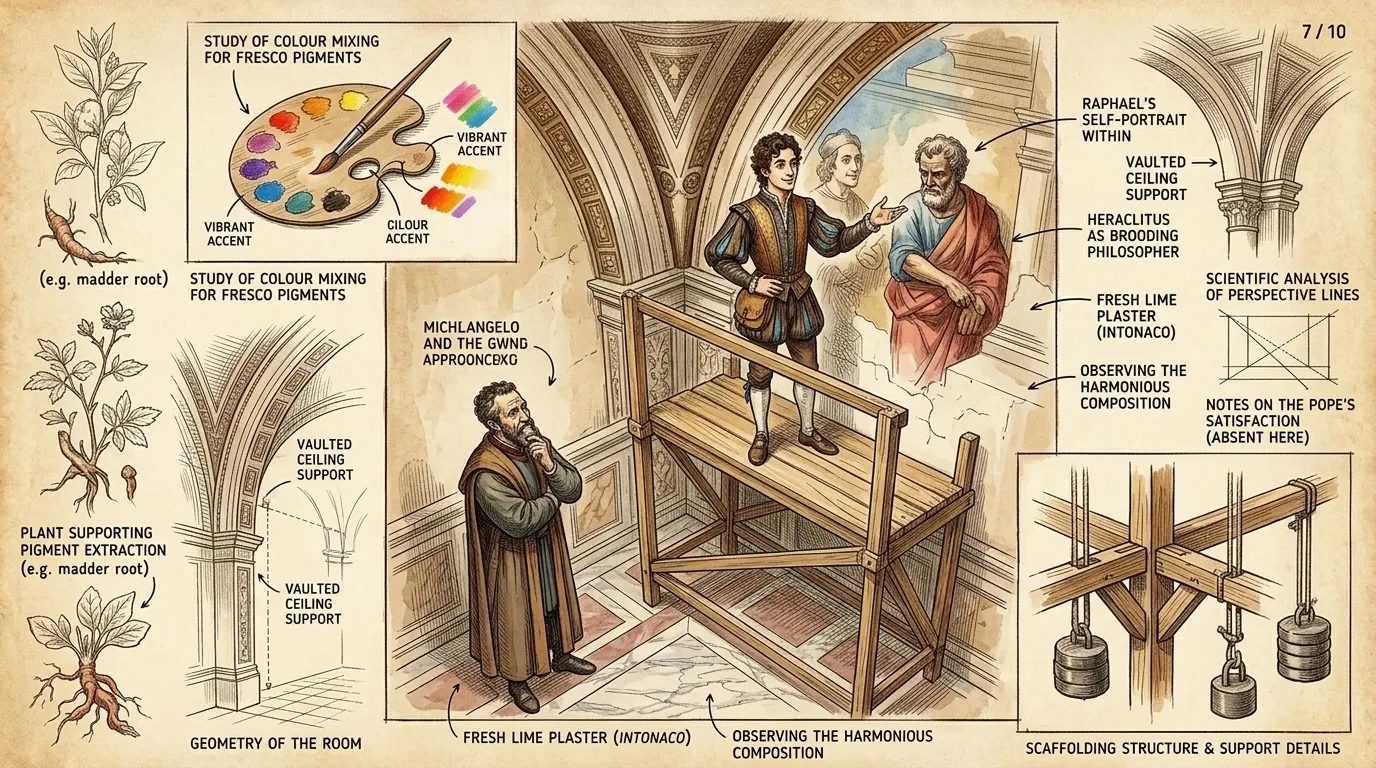
Raphael included portraits of his contemporaries among the philosophers. Plato is believed to be a likeness of Leonardo da Vinci, while Michelangelo is portrayed as Heraclitus, the brooding philosopher. Raphael's own self-portrait appears on the right side of the fresco.
"Michelangelo, observing Raphael's work: 'You have dared to include me among the ancient philosophers? As Socrates said, 'The only true wisdom is in knowing you know nothing.' I am merely a sculptor, not a sage.' Raphael replies, 'But you are the greatest sculptor of our age.'"
Art Fact: The inclusion of contemporary figures as classical philosophers added a layer of meaning to the fresco, highlighting the continuity of intellectual traditions.
Page 8
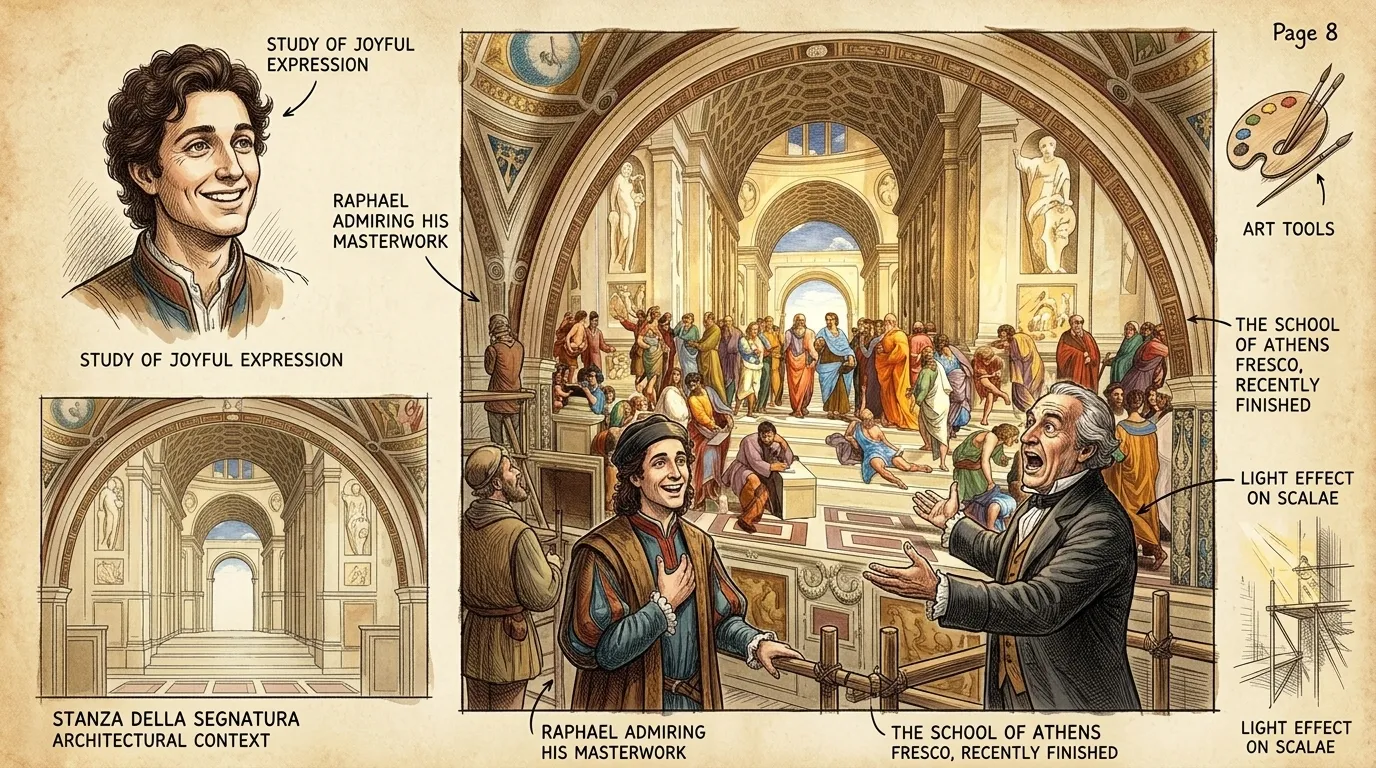
Upon its completion, the School of Athens was met with immediate acclaim. The fresco was celebrated for its harmonious composition, the beauty of its figures, and its profound intellectual depth. It became a symbol of the High Renaissance, embodying the ideals of humanism and classical learning.
"An art critic to Raphael: 'Your fresco is a masterpiece! It captures the essence of human intellect and the spirit of the Renaissance. The harmony of the composition and the beauty of the figures are truly breathtaking.'"
Art Fact: The School of Athens established Raphael as one of the leading artists of the Renaissance, securing his reputation for generations to come.
Page 9
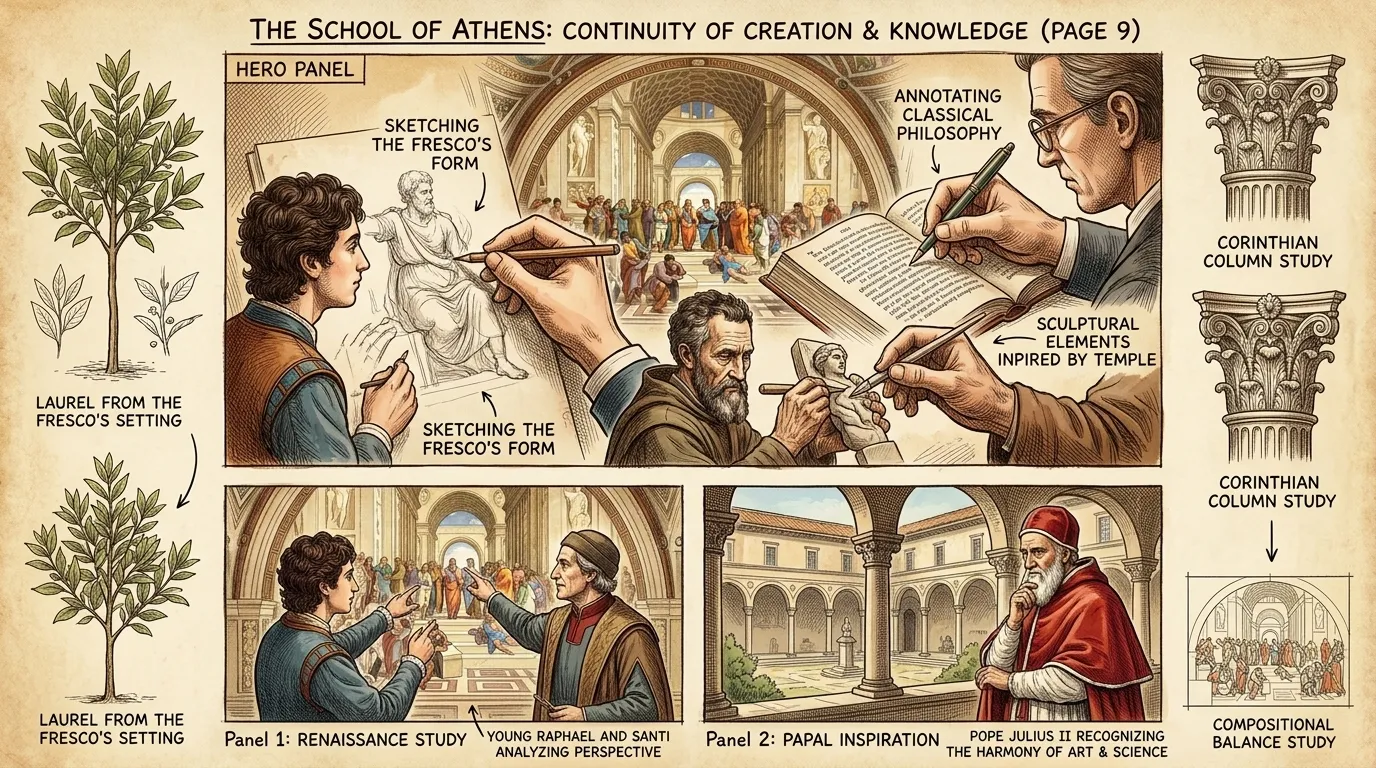
Over the centuries, The School of Athens has continued to inspire artists and scholars. Its composition has been emulated in countless artworks, and its themes of philosophy and learning remain relevant to this day. The fresco stands as a testament to the enduring power of human intellect and the beauty of classical ideals.
"As the Renaissance humanist Petrarch wrote centuries before Raphael, 'The greater the difficulty, the more glory in surmounting it.' That challenge, embodied in art, lasts through the ages."
Art Fact: Copies and prints of The School of Athens have spread its influence around the world, making it one of the most recognizable images of the Renaissance.
Page 10
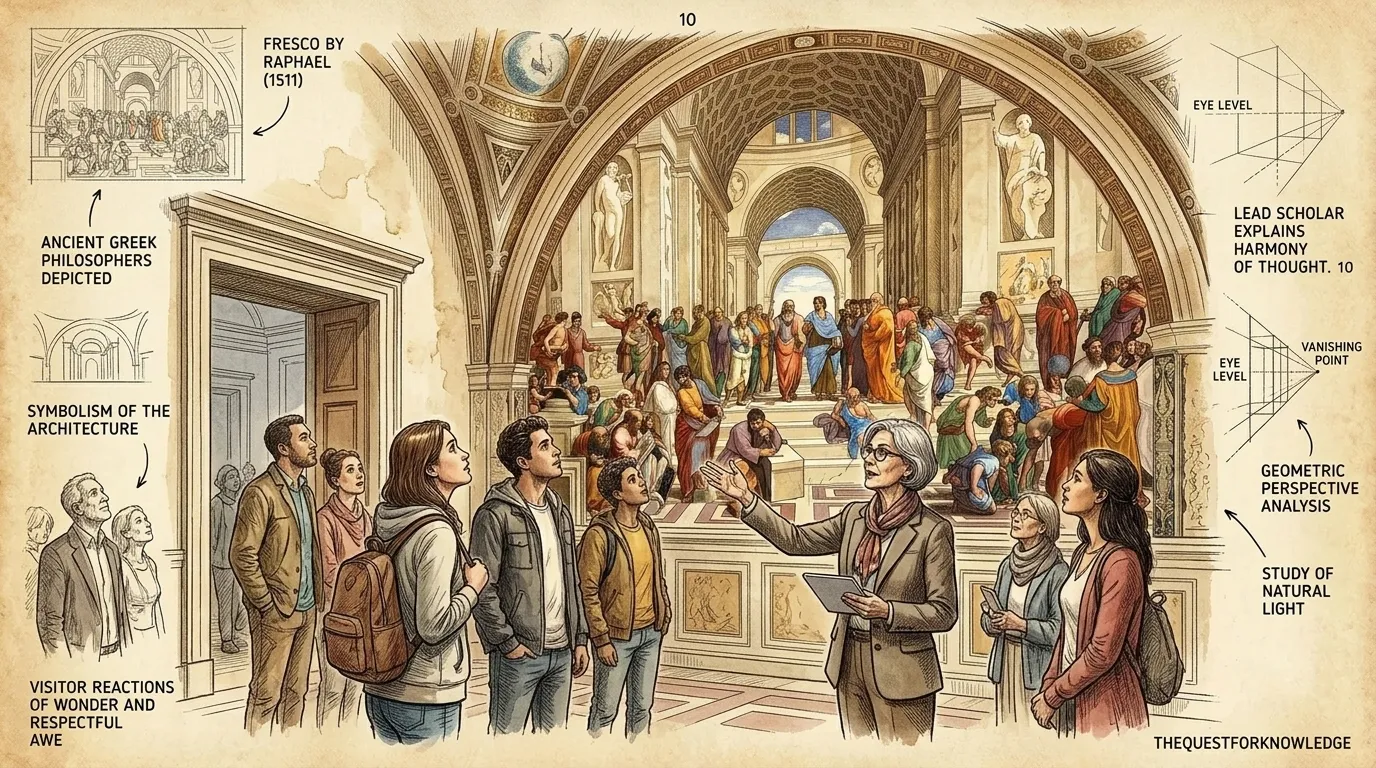
Today, The School of Athens remains in the Stanza della Segnatura, Vatican City, drawing visitors from around the globe. Its enduring appeal lies in its ability to capture the essence of human intellectual aspiration. The fresco is a reminder of the timeless quest for knowledge and the beauty of classical ideals.
"A modern art historian: 'Raphael's School of Athens is a testament to the power of art to embody the highest ideals of human civilization. Its beauty and intellectual depth continue to resonate with audiences centuries later.'"
Art Fact: The School of Athens remains a central work in the history of Western art, embodying the ideals of the High Renaissance and the pursuit of knowledge.
About this story
- Location: Global
- Audience: general readers
Read Wonder Arts on your phone
Wonder Arts is available on Android. Get Wonder Arts on Google Play.
More Wonder Arts stories
- The Sea of Ice by Caspar David Friedrich (Germany — 1824)
- The Slave Ship by J.M.W. Turner (London, UK — 1840)
- The Sleeping Gypsy by Henri Rousseau (Paris, France — 1897)
- The Snake Charmer by Henri Rousseau (Paris, France — 1907)
- A Burial at Ornans by Gustave Courbet (France — 1849)
- A Cavalier by Frans Hals (Australia — 1624)