The Sower by Jean-François Millet (France — 1850)
The Sower by Jean-François Millet (France — 1850) — an illustrated arts story, set in France. 10 illustrated pages, free to read on Wonder Arts.
Page 1
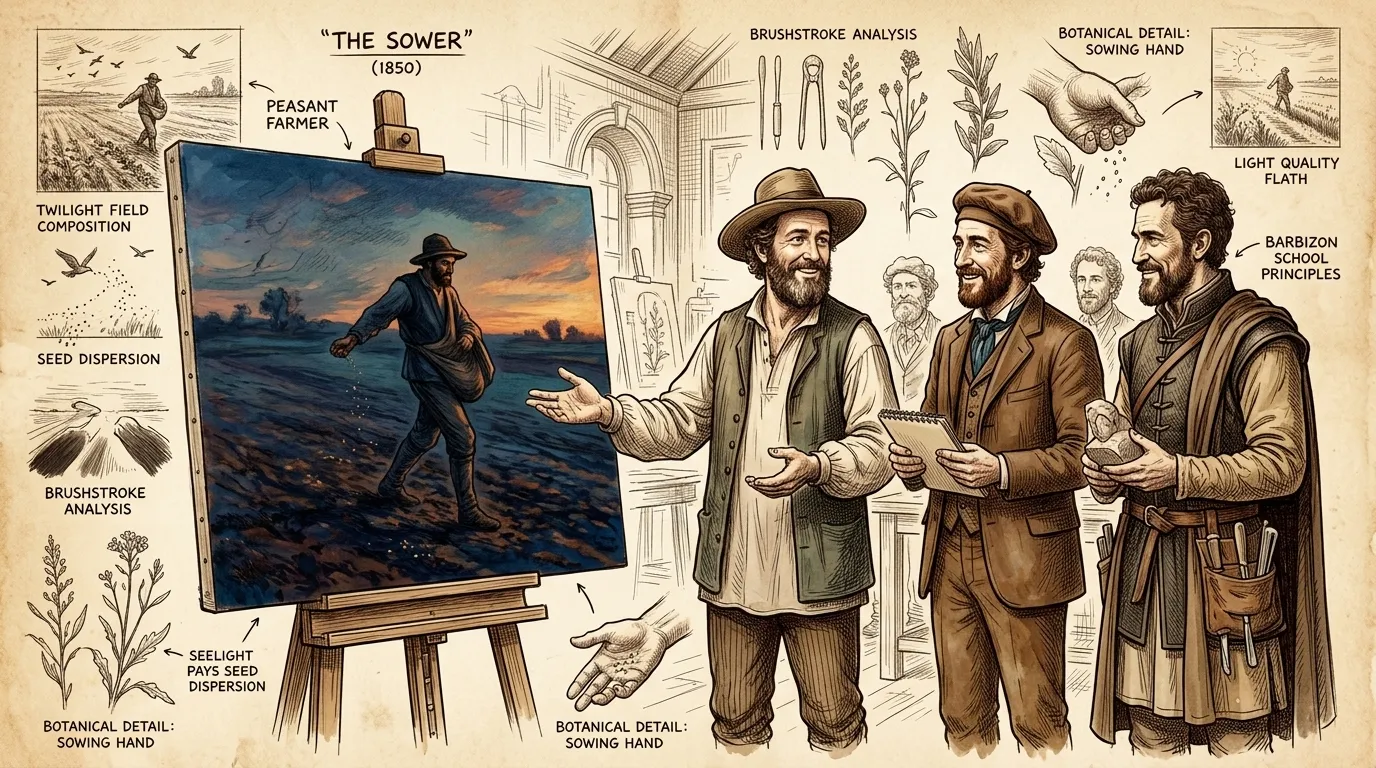
Jean-François Millet, a name synonymous with the dignity of rural life, stands before his creation, 'The Sower.' Completed in 1850, this painting, measuring 101.6 cm 82.6 cm, is more than just a depiction of a farmer; it is a statement about the nobility of labor. The work was initially criticized for its perceived socialist undertones, a testament to its powerful impact on the Parisian art scene.
""This canvas, it speaks of the earth and the sweat that nourishes us," Millet murmurs, his eyes reflecting the twilight tones of the field."
Art Fact: The painting, now residing at the Phoenix Art Museum, was initially rejected by the Paris Salon, but later gained recognition for its powerful depiction of rural life.
Page 2
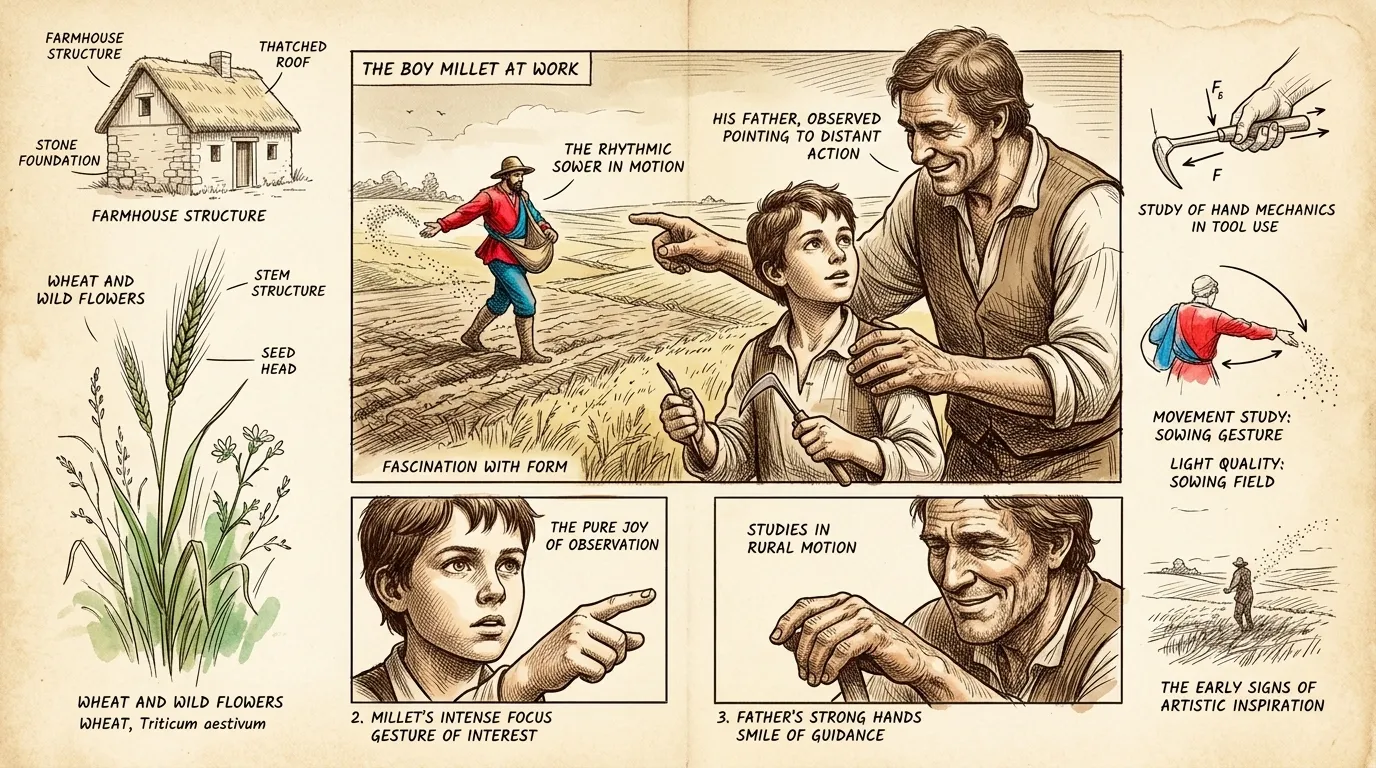
Young Millet, barely a boy, is working in the fields with his father. The sun beats down, but his eyes are not on the task at hand. Instead, he watches the rhythmic movement of the sower, a figure that imprints itself upon his mind. Years later, this image would resurface, immortalized on canvas.
""Look, Father," Millet says, pointing to the sower. "His work is like a dance with the earth itself." His father replies, "Yes, Jean-François, it is honest labor, the foundation of our lives.""
Art Fact: Millet's early life in rural Normandy profoundly shaped his artistic vision, instilling in him a deep respect for the working class.
Page 3
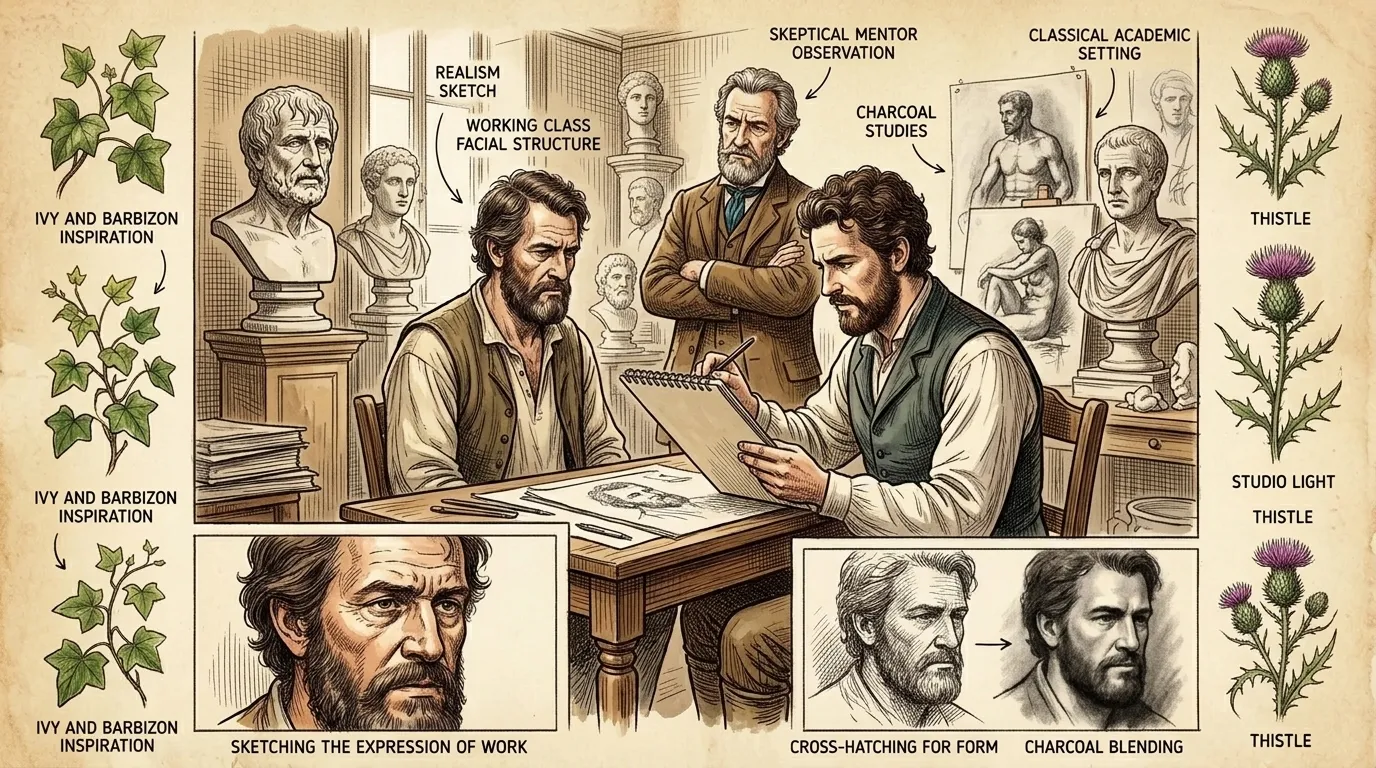
In Cherbourg, Millet begins his formal artistic training. He learns the techniques of portraiture, but his heart is not in the gilded halls of the bourgeoisie. He sketches the faces of the working class, drawn to their raw, unadorned humanity. He realizes that art should reflect the life of the common man.
""These portraits of wealthy merchants, they lack soul," Millet says to his mentor. "I want to paint the people who truly build this nation!""
Art Fact: Millet's early artistic training exposed him to classical techniques, but his desire to depict the lives of ordinary people set him apart.
Page 4
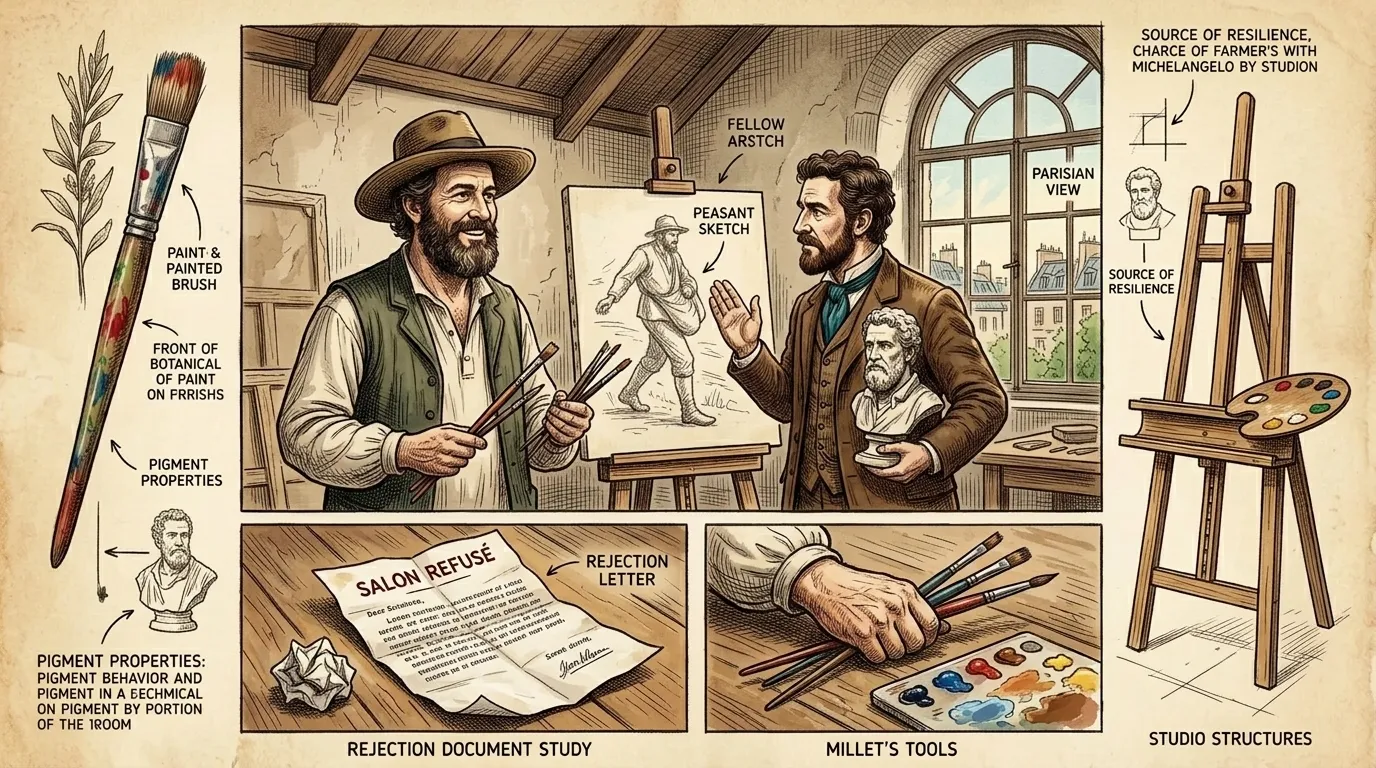
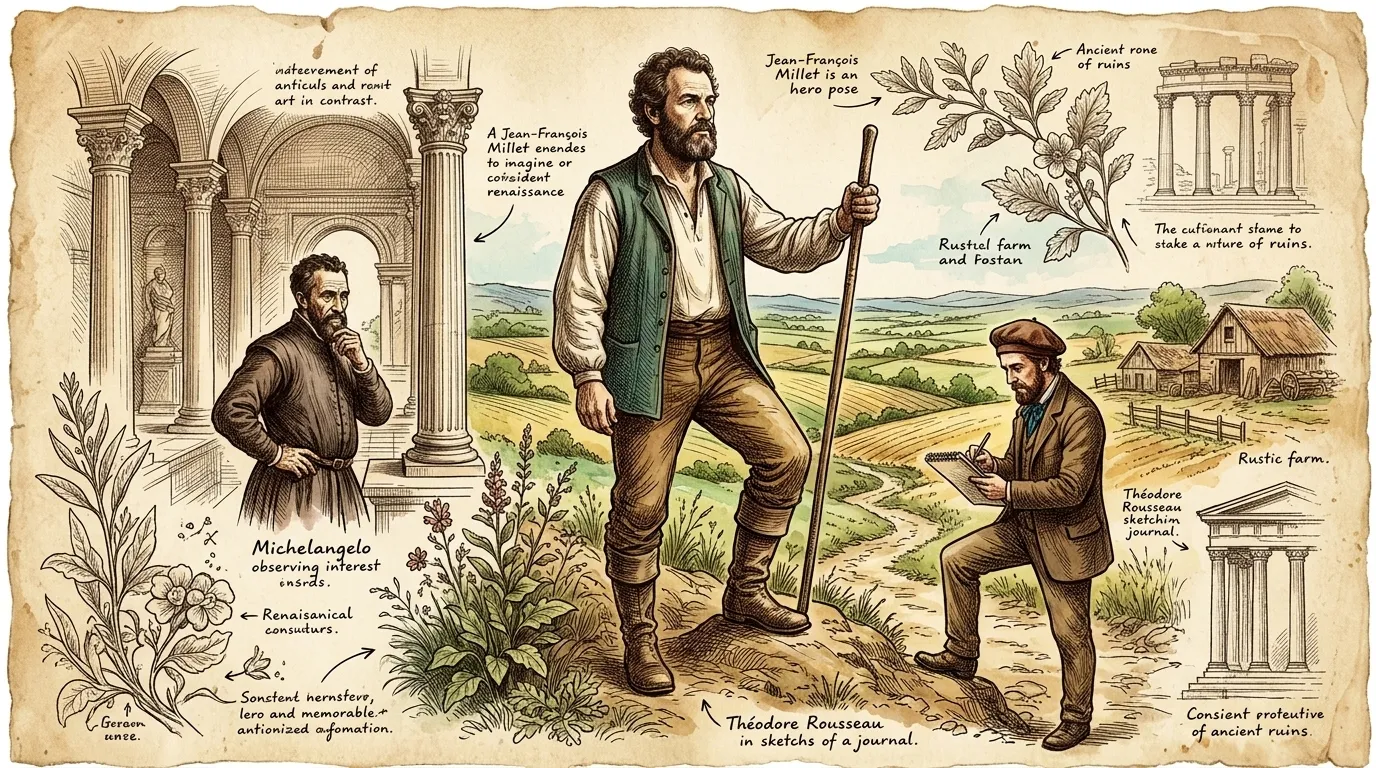
Millet arrives in Paris, full of hope and ambition. He submits his work to the Salon, but it is rejected. Critics dismiss his depictions of rural life as vulgar and unrefined. Undeterred, Millet continues to paint his truth, finding strength in the words of Michelangelo, 'I saw the angel in the marble and carved until I set him free'.
"A fellow artist says, "The Salon wants pretty landscapes and noble portraits, Millet, not farmers covered in dirt!" Millet replies, "Then I shall paint dirt with such honesty that they cannot ignore it!""
Art Fact: Initial rejection by the Paris Salon fueled Millet's determination to depict the realities of rural life.
Page 5
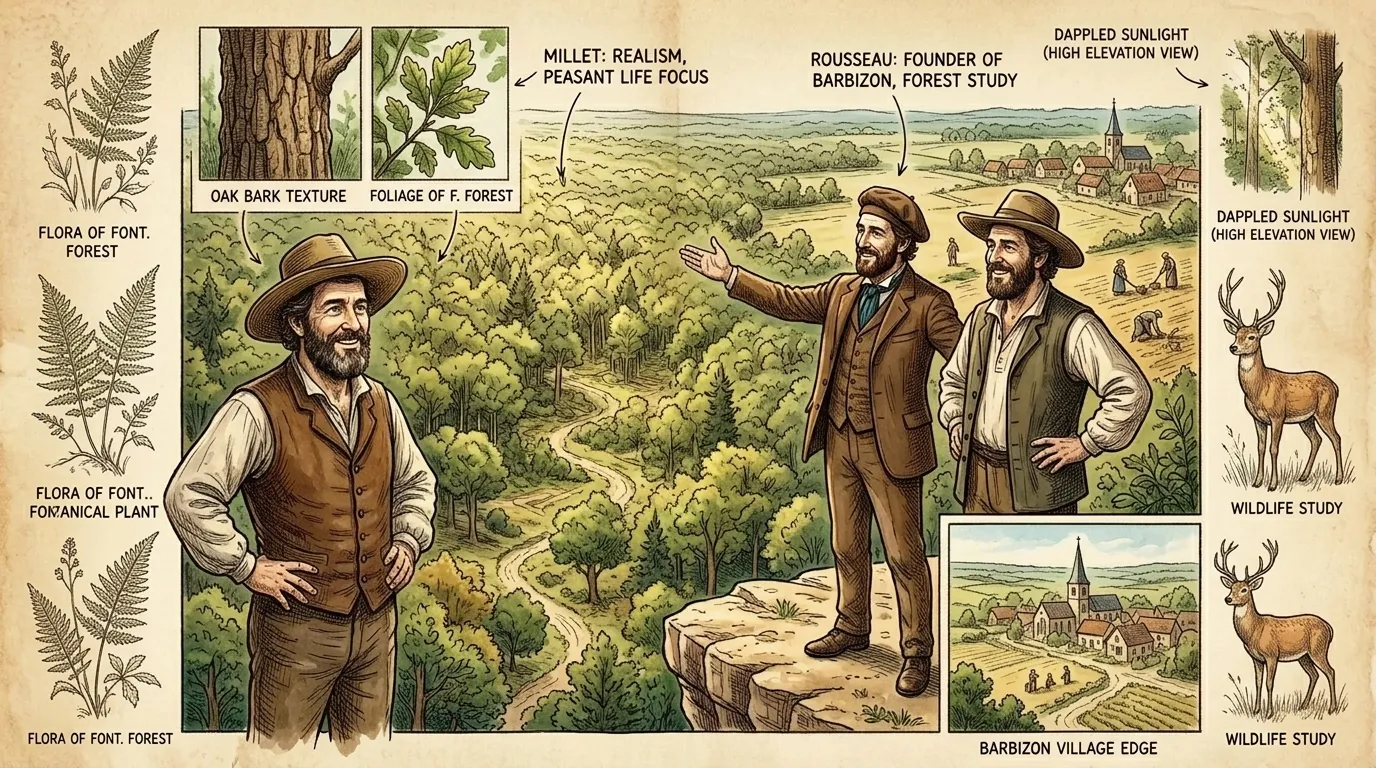
Seeking solace and inspiration, Millet moves to Barbizon, a village on the edge of the Fontainebleau forest. There, he finds a community of artists who share his love of nature and his commitment to depicting the lives of ordinary people. The simplicity of rural existence allows him to reconnect with the scenes of his youth.
"Théodore Rousseau, another artist, says, "Here, Millet, you will find the truth that eludes you in Paris. The land speaks to those who listen!" Millet responds, "I feel like I'm home.""
Art Fact: The move to Barbizon marked a turning point in Millet's career, as he found both artistic inspiration and a supportive community.
Page 6
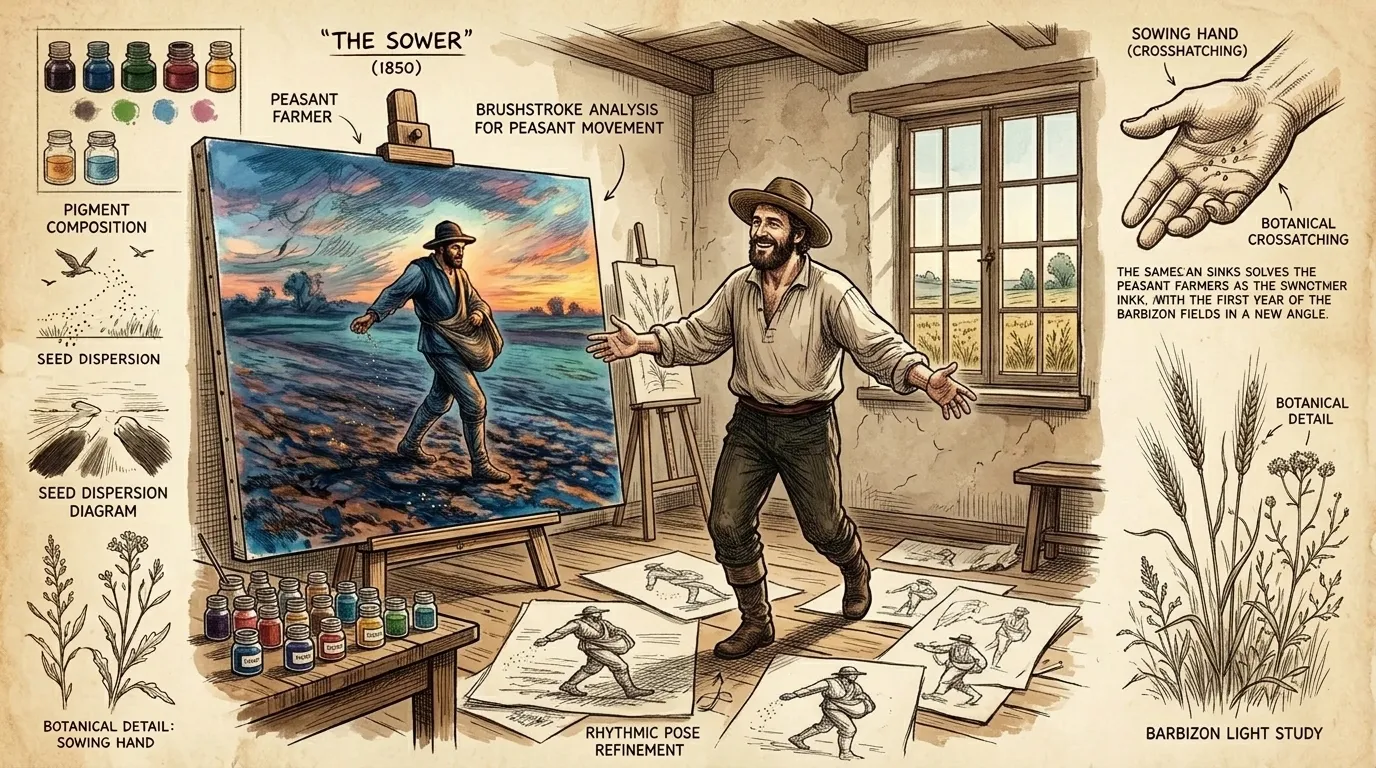
In his Barbizon studio, Millet begins to work on 'The Sower'. He sketches the figure repeatedly, refining the pose and capturing the essence of the farmer's rhythmic movement. He experiments with different color palettes, seeking to convey the harshness and beauty of rural life. He captures the essence of the sower in an increasingly clear form.
""The earth is dark, but life springs forth!" Millet exclaims, stepping back from his canvas. "It must show this!""
Art Fact: Millet's Barbizon studio provided him with the space and tranquility necessary to develop his iconic depiction of the sower.
Page 7
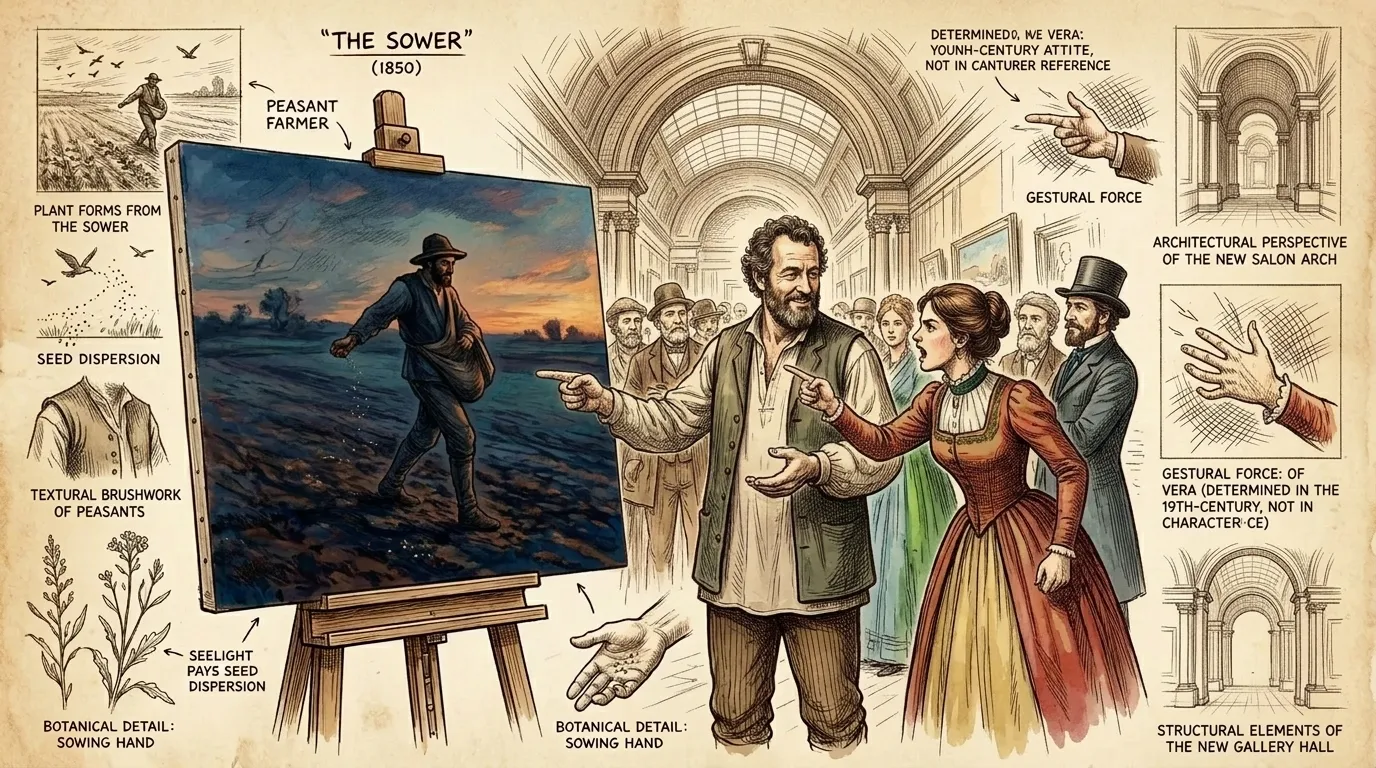
Millet exhibits 'The Sower' at the Salon. The critics are divided. Some praise its raw honesty, while others condemn its perceived socialist message. They accuse Millet of glorifying the working class and undermining the social order. The artist faces criticism, as Obinna said: 'There is only one way to avoid criticism: do nothing, say nothing, and be nothing.'
"A critic exclaims, "This is not art, Monsieur Millet! It is propaganda! You are inciting the rabble!" Vera defends, "No, it is the truth!""
Art Fact: The initial reception of 'The Sower' was marked by controversy, reflecting the social and political tensions of the time.
Page 8
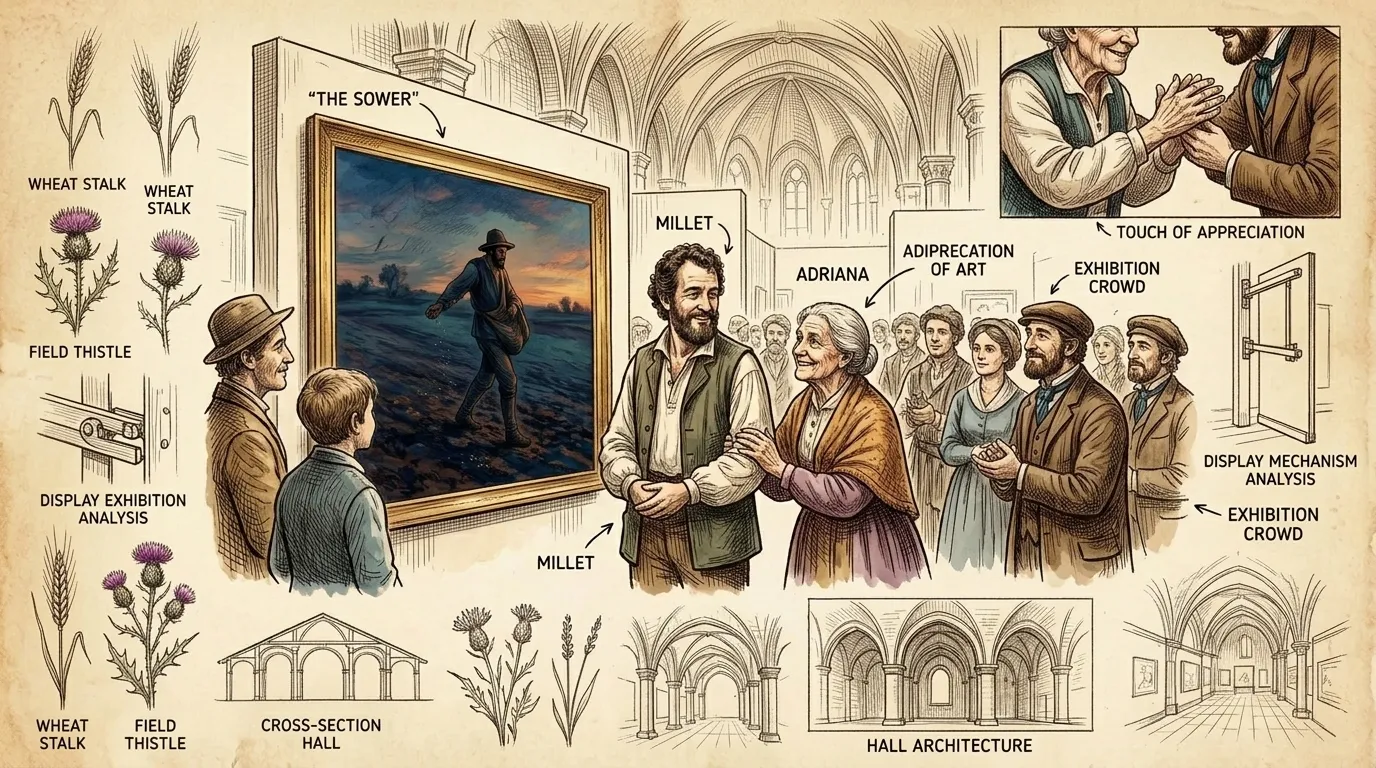
Despite the criticism, 'The Sower' resonates with the public. Ordinary people see themselves reflected in its depiction of honest labor and the dignity of rural life. The painting becomes a symbol of the working class and a testament to the power of art to speak truth to power. Millet gains recognition for his talent.
"Adriana, an elderly woman with kind eyes, says, "This painting, Monsieur Millet, it makes me proud of the work my family has done for generations. It captures the soul of the land!""
Art Fact: Despite initial criticism, 'The Sower' gained popular acclaim for its powerful depiction of rural life and its celebration of the working class.
Page 9

Millet's 'The Sower' goes on to inspire generations of artists and social reformers. Its message of dignity and hope continues to resonate in a world still grappling with issues of class and inequality. 'The Sower' endures. The themes in Millet's work continue to inspire.
"Millet's friend says, "Your sower's influence has spread all around the world. It reminds people about humanity and hope.""
Art Fact: The enduring legacy of 'The Sower' lies in its timeless message of hope, dignity, and the power of art to inspire social change.
Page 10
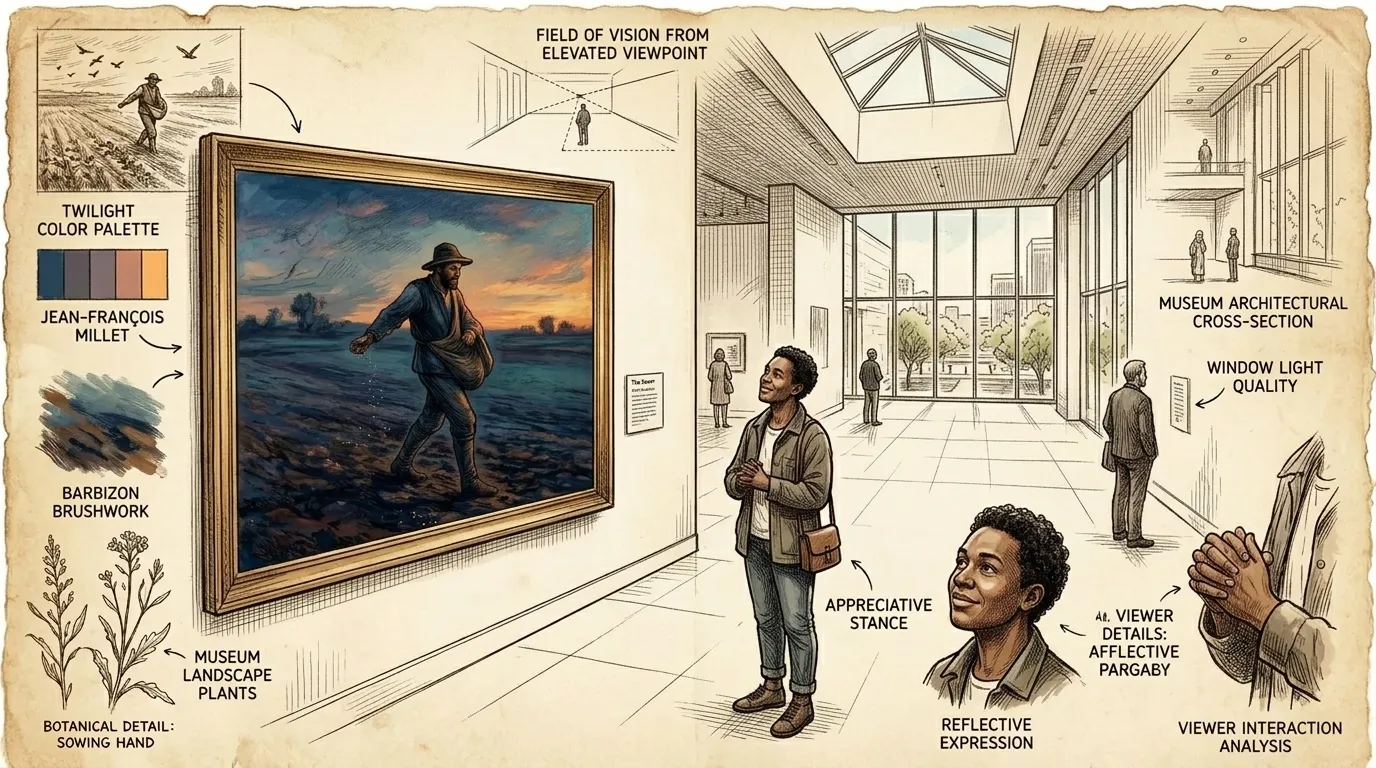
Today, 'The Sower' hangs in the Phoenix Art Museum, a testament to Millet's enduring vision. It reminds us that even in the face of hardship and adversity, the human spirit can triumph. It reminds us that the most beautiful works of art come from the heart. As Rumi says, 'Let the beauty of what you love be what you do.'
"A modern viewer says, "This painting, it speaks to me across the centuries. It reminds me of the importance of hard work and the beauty of the land.""
Art Fact: Millet's art survives forever because it speaks to the universal human experience of labor, hope, and the connection to the land. The painting reminds us of the timeless values that transcend generations.
About this story
- Location: France
- Audience: general readers
Read Wonder Arts on your phone
Wonder Arts is available on Android. Get Wonder Arts on Google Play.
More Wonder Arts stories
- A Burial at Ornans by Gustave Courbet (France — 1849)
- A Cavalier by Frans Hals (Australia — 1624)
- A Sunday on La Grande Jatte by Georges Seurat (Paris, France — 1884)
- Abbey in the Oakwood by Caspar David Friedrich (Germany — 1810)
- Abstract Expressionism by Jackson Pollock (New York, USA — 1940s)
- Al-Azhar Mosque (Cairo, Egypt — 972)