The Stone Breakers by Gustave Courbet (France — 1849)
The Stone Breakers by Gustave Courbet (France — 1849) — an illustrated arts story, set in France. 10 illustrated pages, free to read on Wonder Arts.
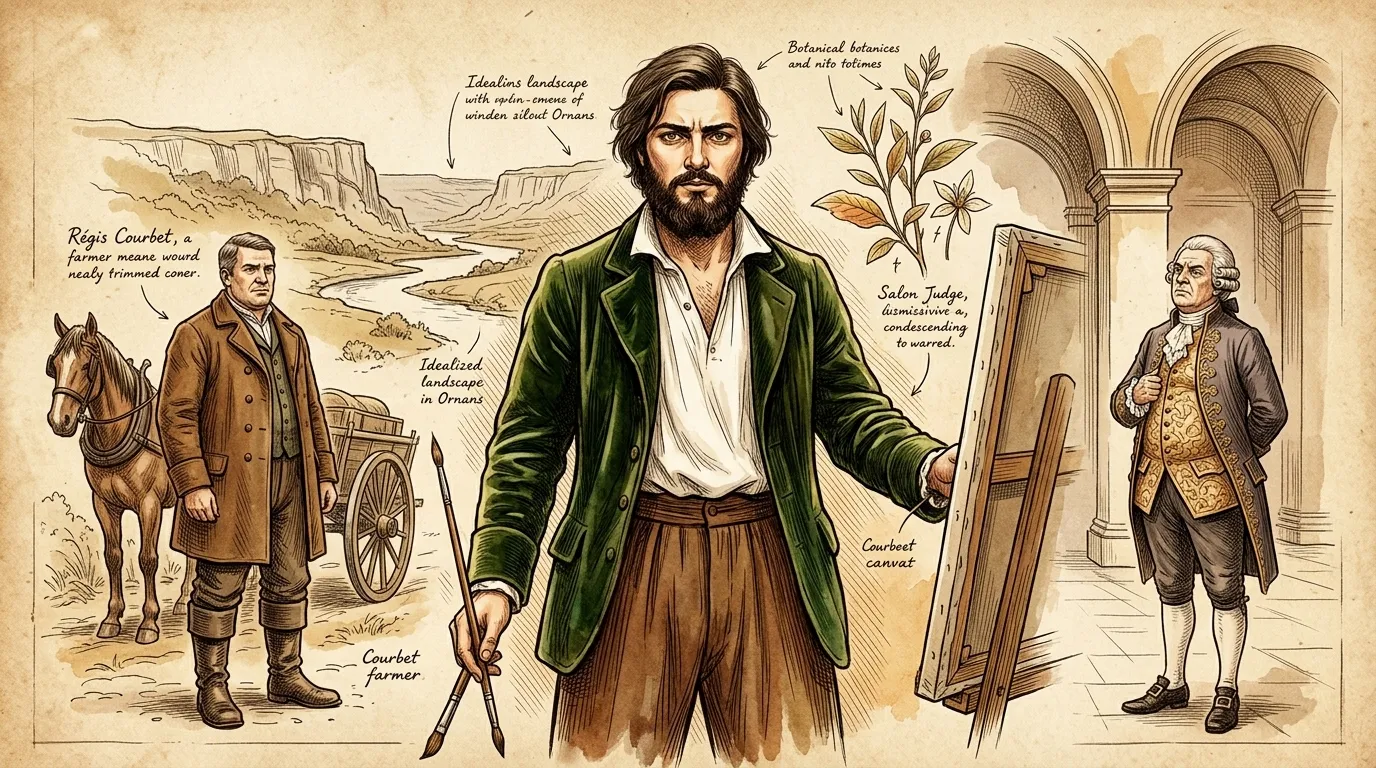
Page 1
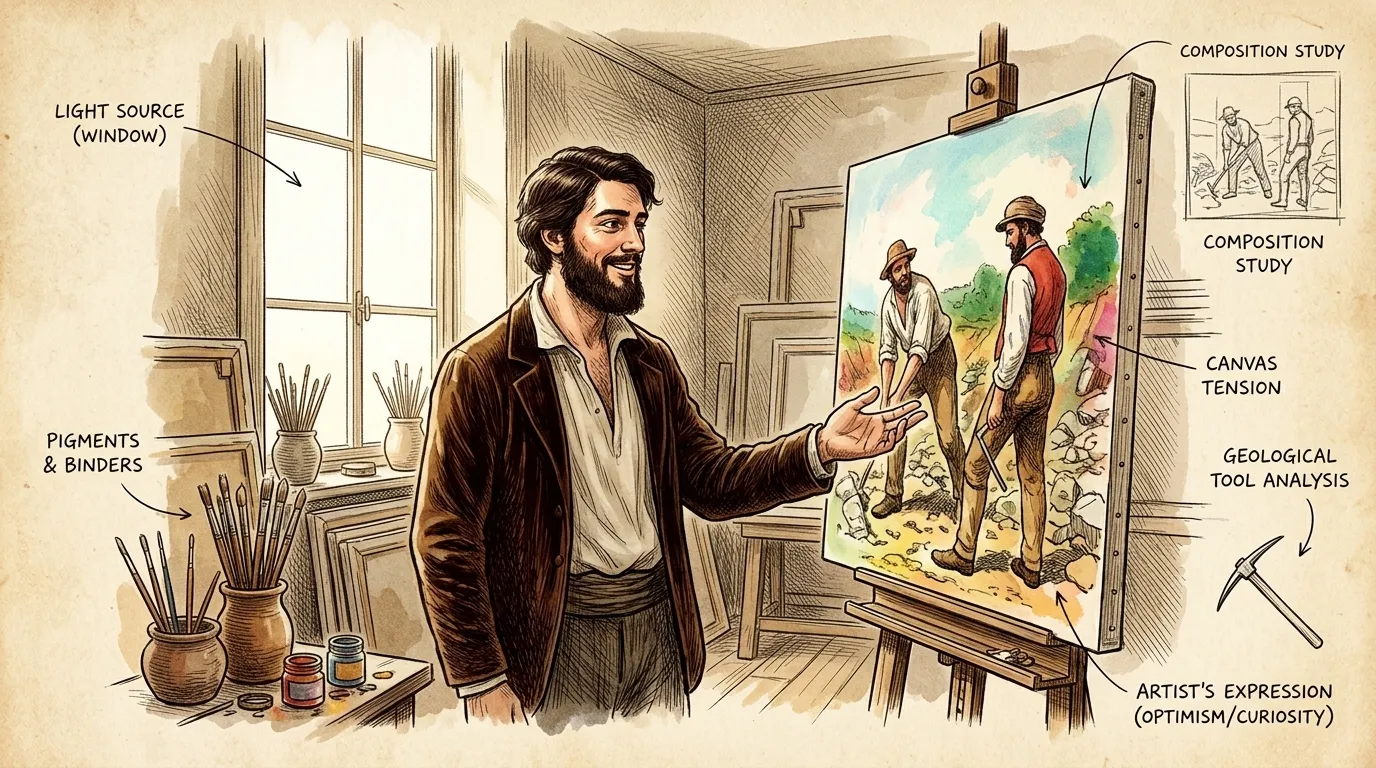
Gustave Courbet, a man of unwavering conviction, stands before his controversial masterpiece, 'The Stone Breakers.' Painted in 1849, this canvas, measuring 165 x 257 cm, challenged the conventions of the art world. Its raw depiction of poverty and labor ignited both outrage and admiration, marking a turning point in art history. The painting was sadly destroyed during a WWII bombing raid in Dresden, leaving only photographic records.
""I want to show the world as it is, without idealization!" Courbet declares, his voice echoing in the studio. "These are the heroes of our time, not gods or kings.""
Art Fact: The Stone Breakers' was first exhibited at the Paris Salon of 1850, where it was met with mixed reviews. Some critics praised its honesty, while others condemned its perceived ugliness.
Page 2
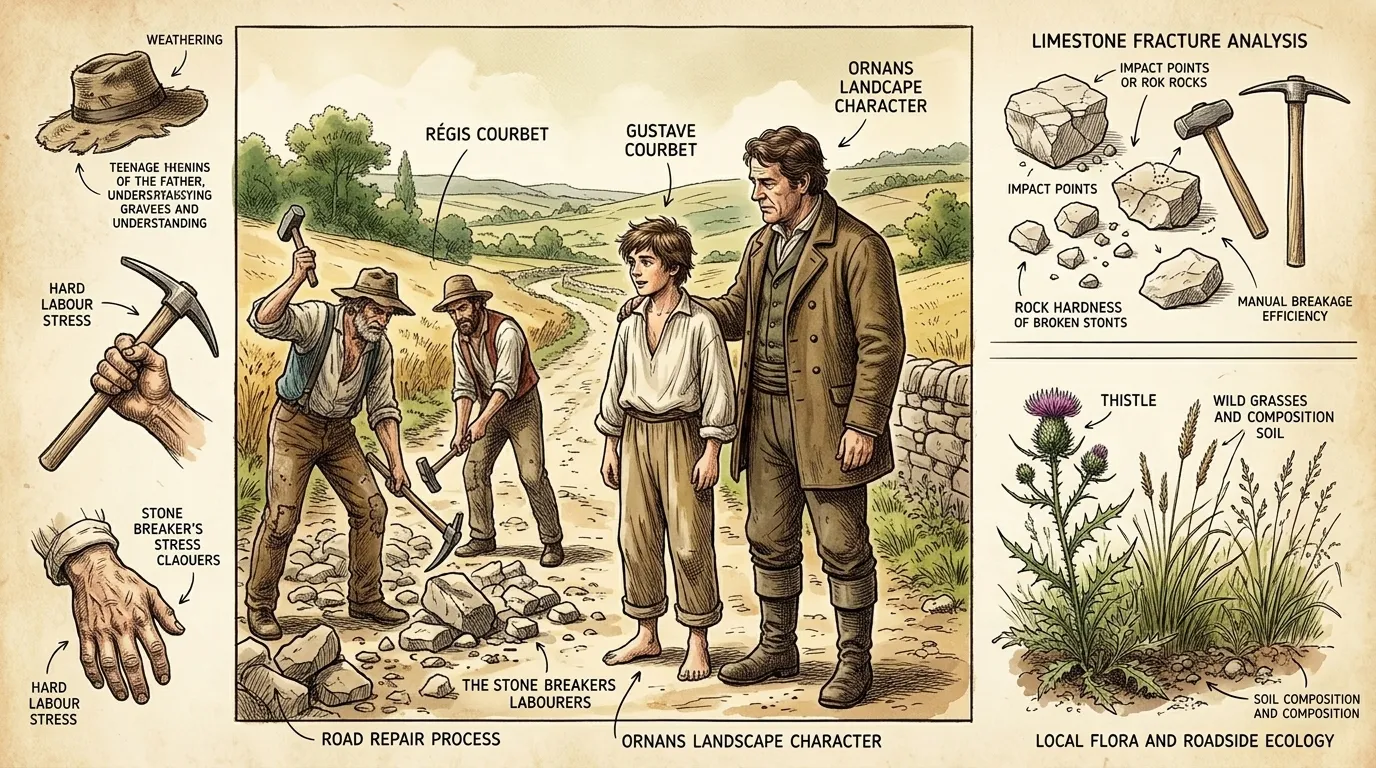
Young Gustave, barely a teenager, witnesses a scene that will forever be etched in his memory. Near his hometown of Ornans, he sees two men breaking stones by the roadside. The harshness of their labor, the poverty etched on their faces, leaves a profound impression.
""Look, Papa," Gustave says, pointing to the men. "Why do they have to work so hard?" His father replies gravely, "That, Gustave, is the reality for many. Remember it.""
Art Fact: Courbet's father, Régis Courbet, was a prosperous farmer who encouraged his son's artistic inclinations, but also insisted on a practical education.
Page 3
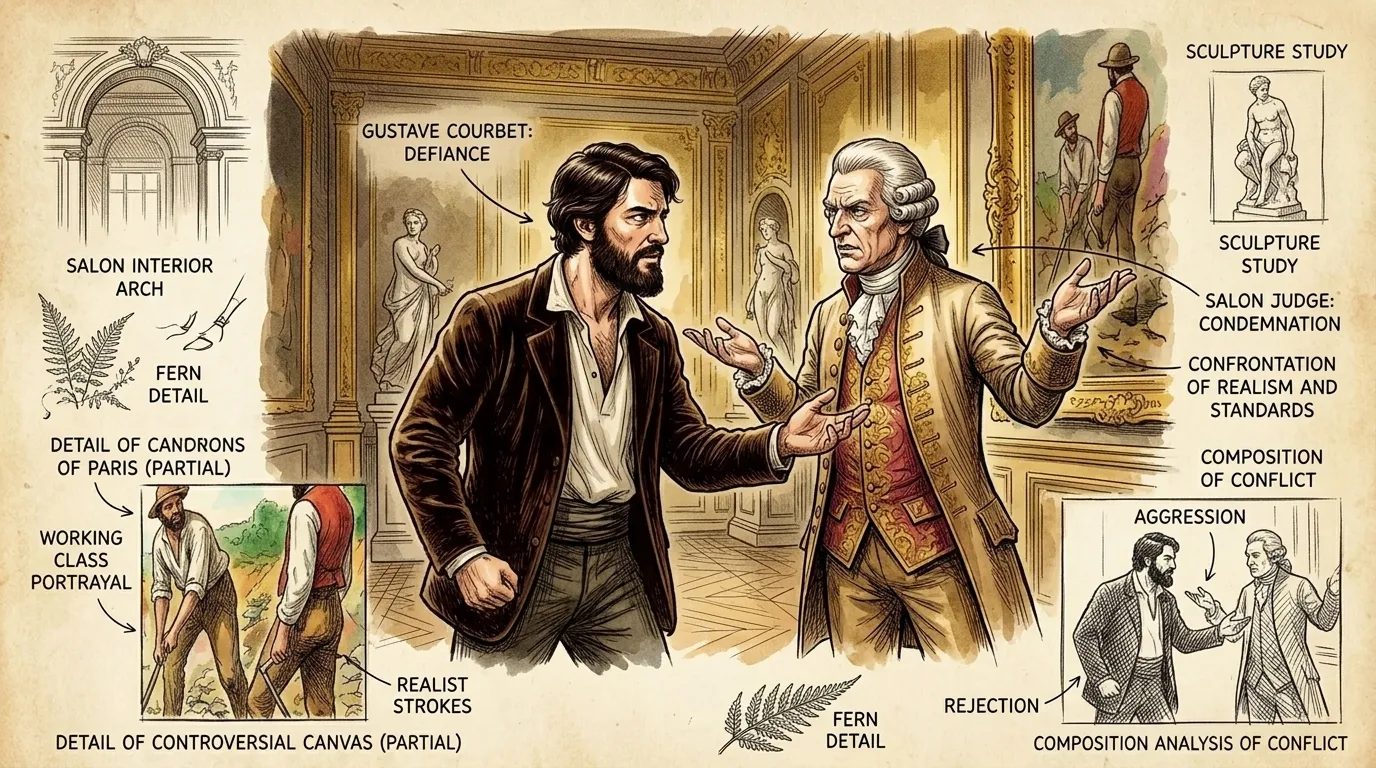
The Paris Salon, the gatekeeper of artistic success, rejects Courbet's early submissions. The judges deem his work too unconventional, too lacking in the idealized beauty they demand. This rejection fuels Courbet's rebellious spirit and solidifies his commitment to portraying the world as he sees it.
""Your paintings lack refinement, Courbet!" one of the Salon judges sneers. "They are vulgar, uninspired!" Courbet retorts, his eyes blazing, "Then I shall paint a new kind of art, one that reflects the truth!""
Art Fact: The Paris Salon was the most important art exhibition in France. Acceptance was crucial for an artist's career.
Page 4
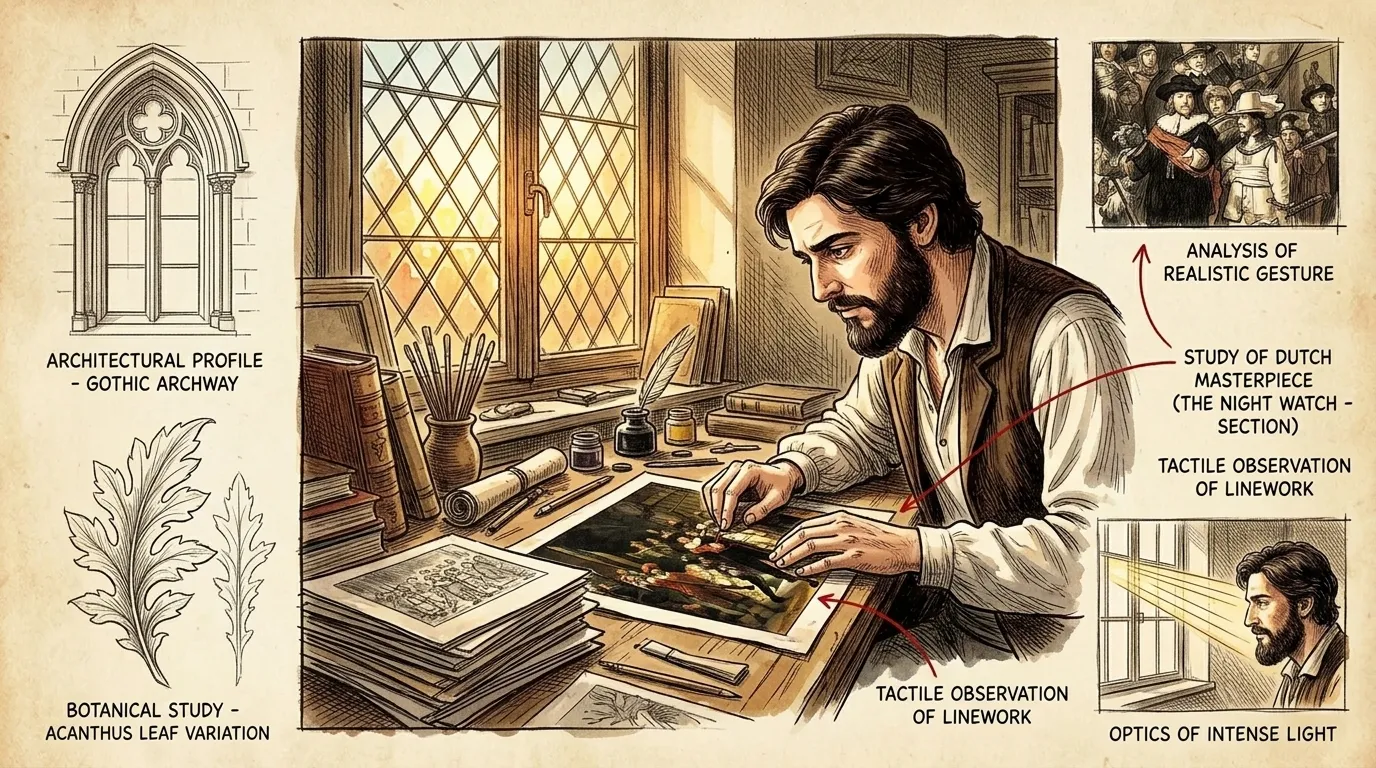
Courbet discovers the works of the Dutch Masters – Rembrandt, Hals, and others. He is captivated by their unflinching realism, their ability to find beauty in everyday life. He studies their techniques, learning to capture the play of light and shadow, the texture of skin and cloth.
""Rembrandt understands humanity," Courbet exclaims, studying a print of 'The Anatomy Lesson of Dr. Nicolaes Tulp'. "He sees the truth in every face, every gesture! That is the art I aspire to.""
Art Fact: Courbet admired the Dutch Masters for their realism and their focus on ordinary people, qualities that would become central to his own art.
Page 5
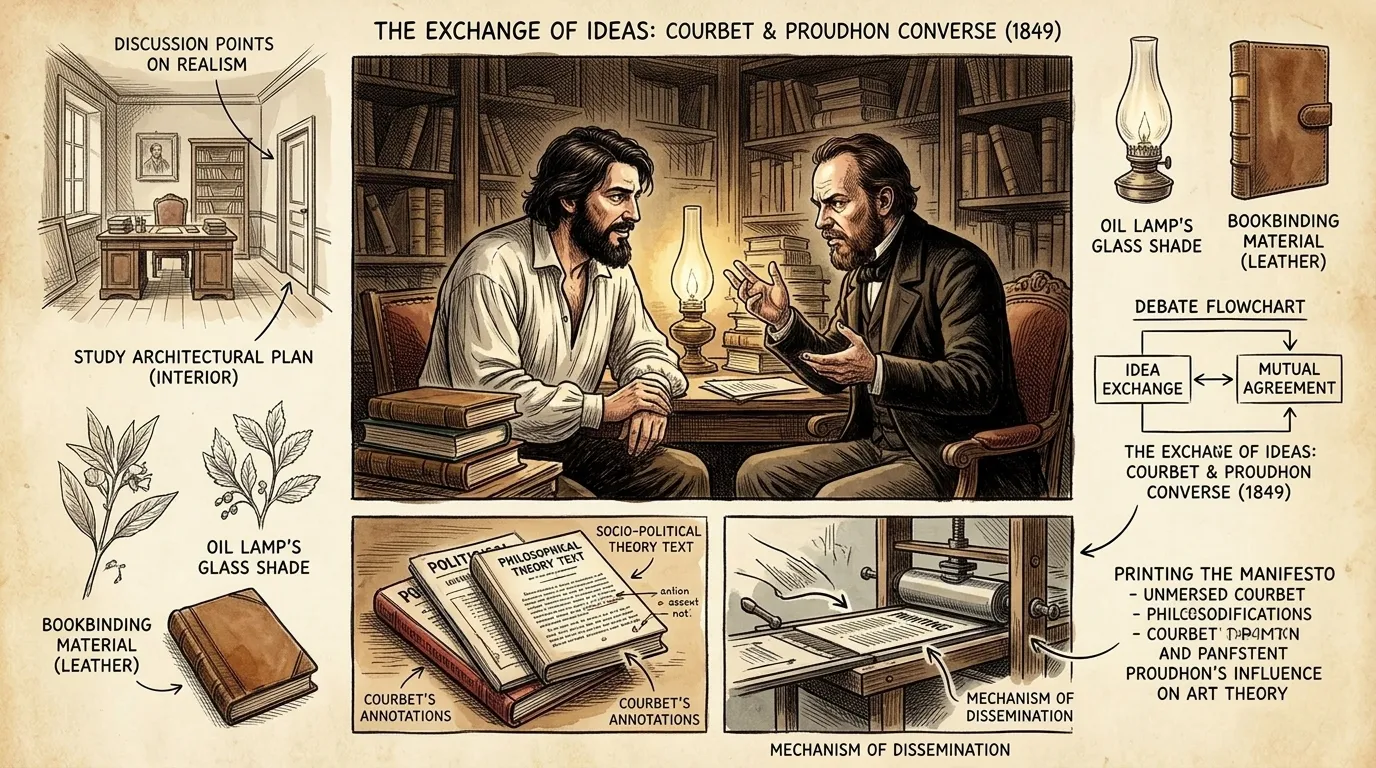
Courbet becomes acquainted with the socialist philosopher Pierre-Joseph Proudhon. Proudhon's ideas about social justice and the plight of the working class deeply resonate with the artist. He sees art as a tool for social change, a way to expose the inequalities of society.
""Art must serve the people, Courbet!" Proudhon declares, his voice filled with passion. "It must be a weapon against injustice!" Courbet nods in agreement. "I will paint the truth, Proudhon. I will show the world what it refuses to see.""
Art Fact: Pierre-Joseph Proudhon was a leading socialist thinker who advocated for the rights of the working class. His ideas had a profound influence on Courbet's art.
Page 6
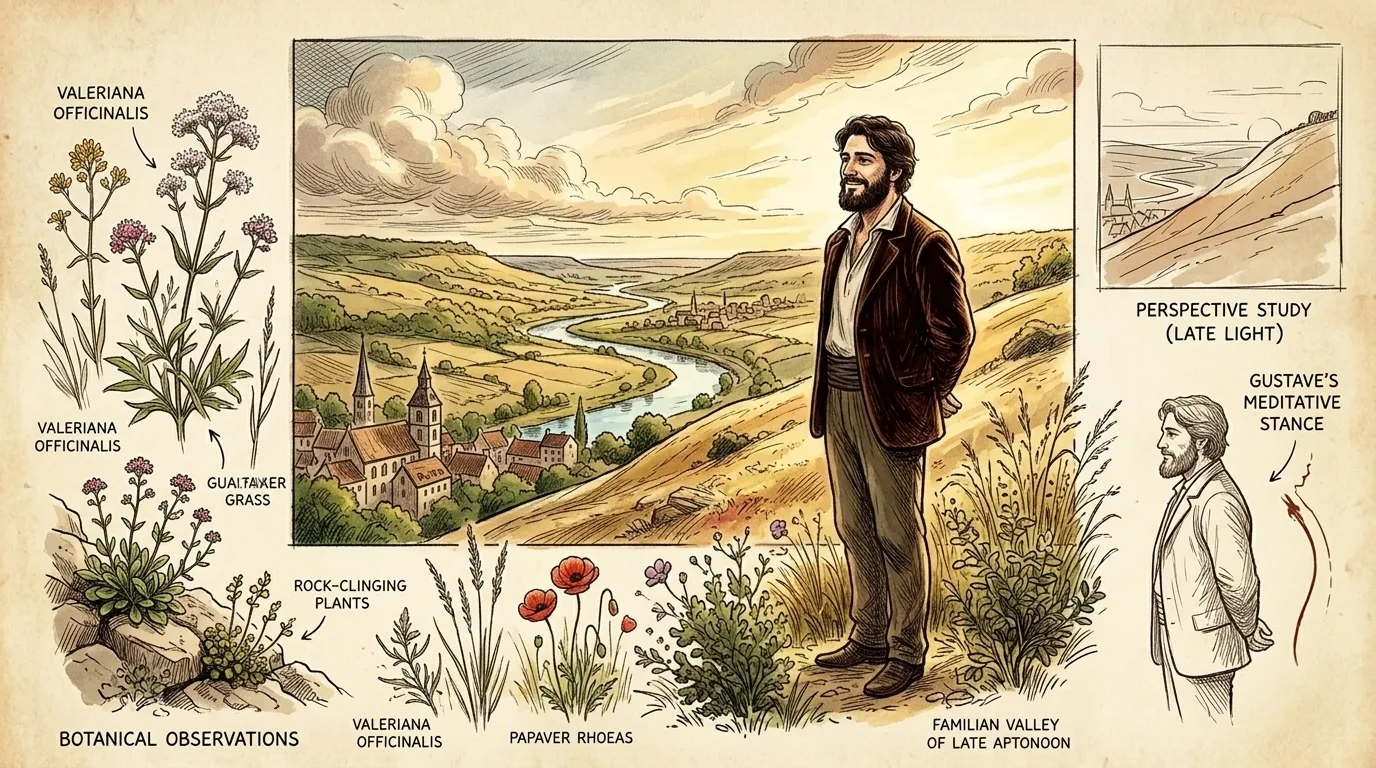
Courbet returns to his hometown of Ornans, seeking inspiration. He rediscovers the landscapes and the people of his childhood. He sees the beauty in the ordinary, the dignity in the labor of the working class. He finds the subjects for his most important paintings.
""This is where I belong," Courbet muses, gazing at the familiar landscape. "This is the truth I must capture on canvas.""
Art Fact: Courbet's return to Ornans marked a turning point in his career. He found his voice as an artist and began to produce his most important works.
Page 7
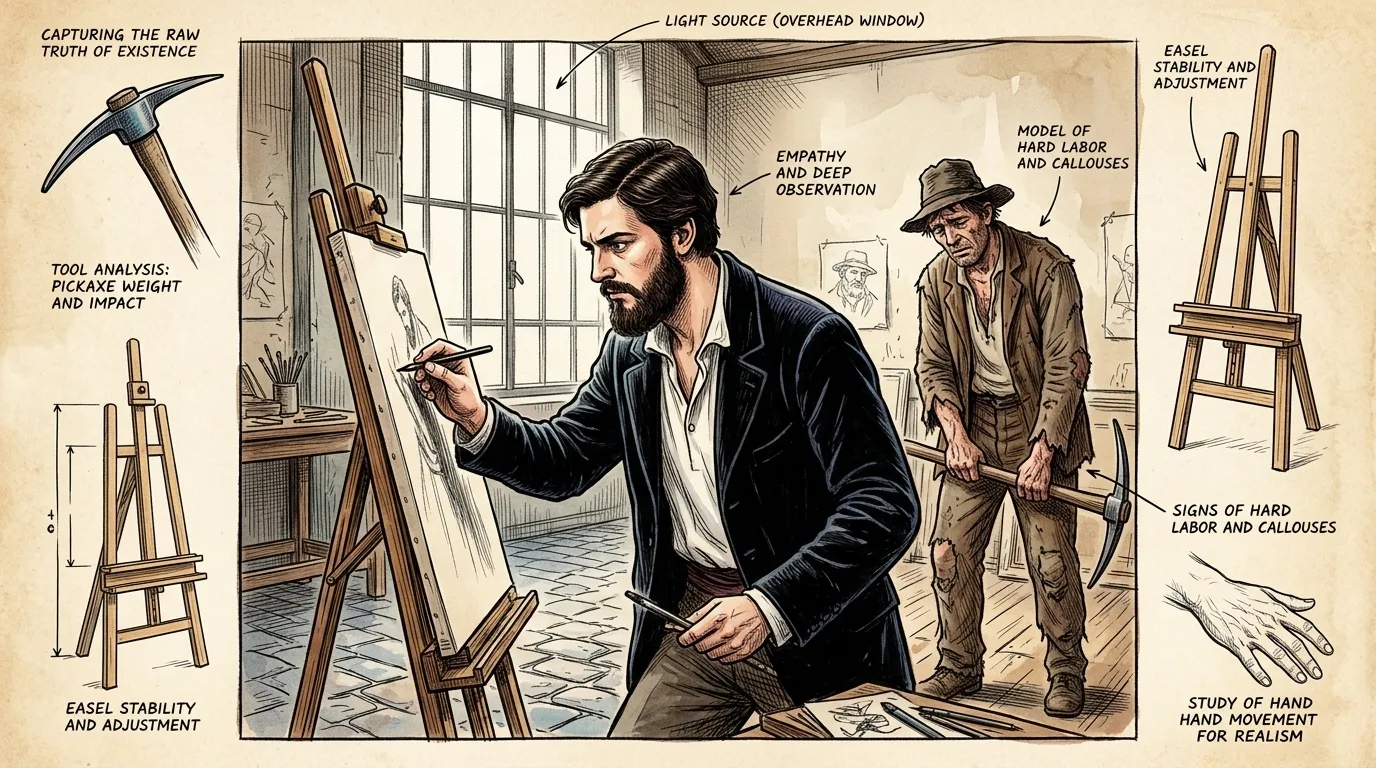
Courbet hires a model to pose for 'The Stone Breakers.' He insists on portraying the laborers with unflinching realism, showing their worn clothes, their calloused hands, their stooped postures. He wants to capture the truth of their existence, without romanticization or idealization.
""Hold that pose," Courbet instructs the model. "Show me the weight of the stone, the weariness of the day. I want to see the truth in your face!" The model replies, wincing, "It's heavy, Monsieur Courbet.""
Art Fact: Courbet's insistence on realism extended to his choice of models. He sought to portray ordinary people, not idealized figures.
Page 8
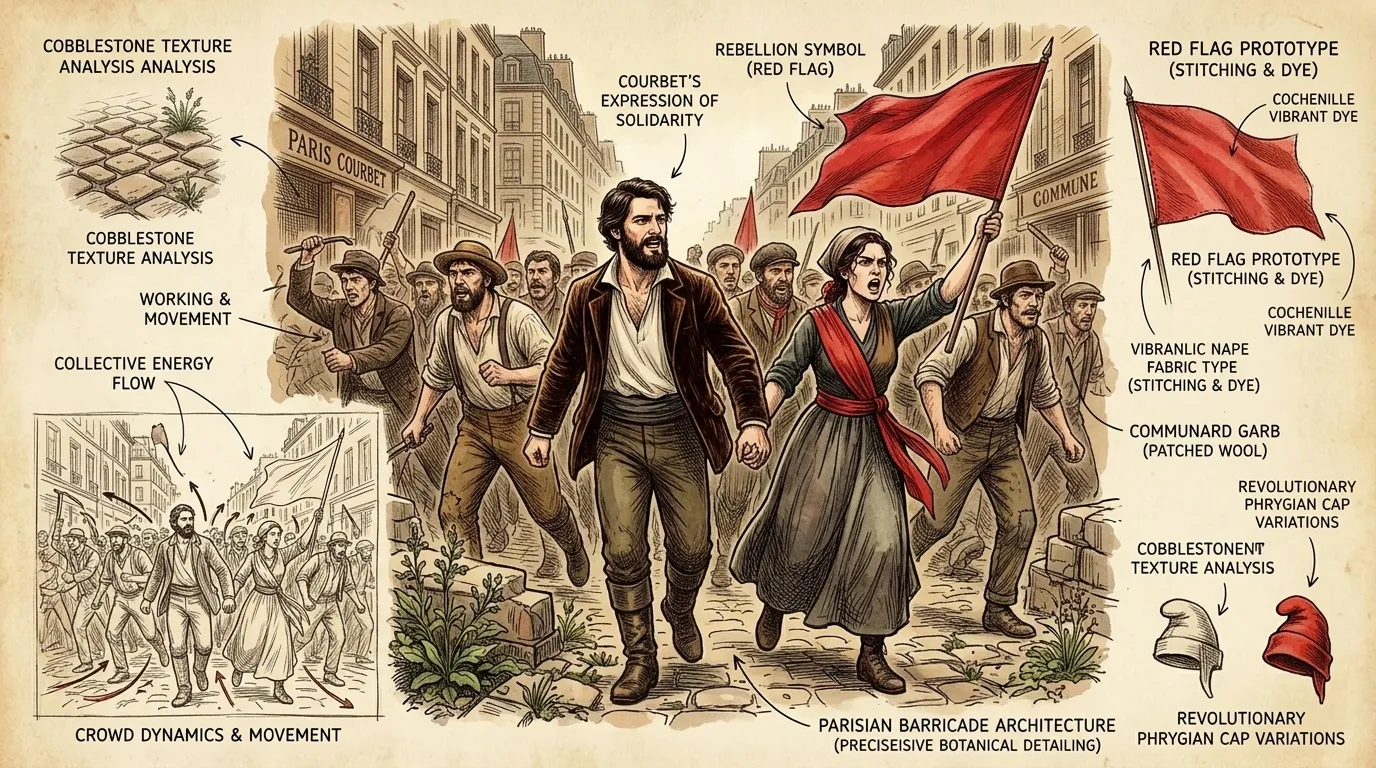
Years later, during the Paris Commune, Courbet becomes involved in the political turmoil. He witnesses the struggles of the working class, their demands for social justice. He sees the red flag as a symbol of their rebellion, a challenge to the established order. He later defended the destruction of the Vendôme Column, a symbol of imperial power.
""The red flag represents the hope of the people!" a Communard shouts, waving the flag aloft. "It is a symbol of our fight for freedom and equality!" Courbet nods in agreement. "Art must stand with the people," Courbet said, recalling the words of Thomas Jefferson: "I predict future happiness for Americans if they can prevent the government from wasting the labors of the people under the pretense of taking care of them.""
Art Fact: Courbet's involvement in the Paris Commune led to his imprisonment and exile. He was later fined for his role in the destruction of the Vendôme Column.
Page 9
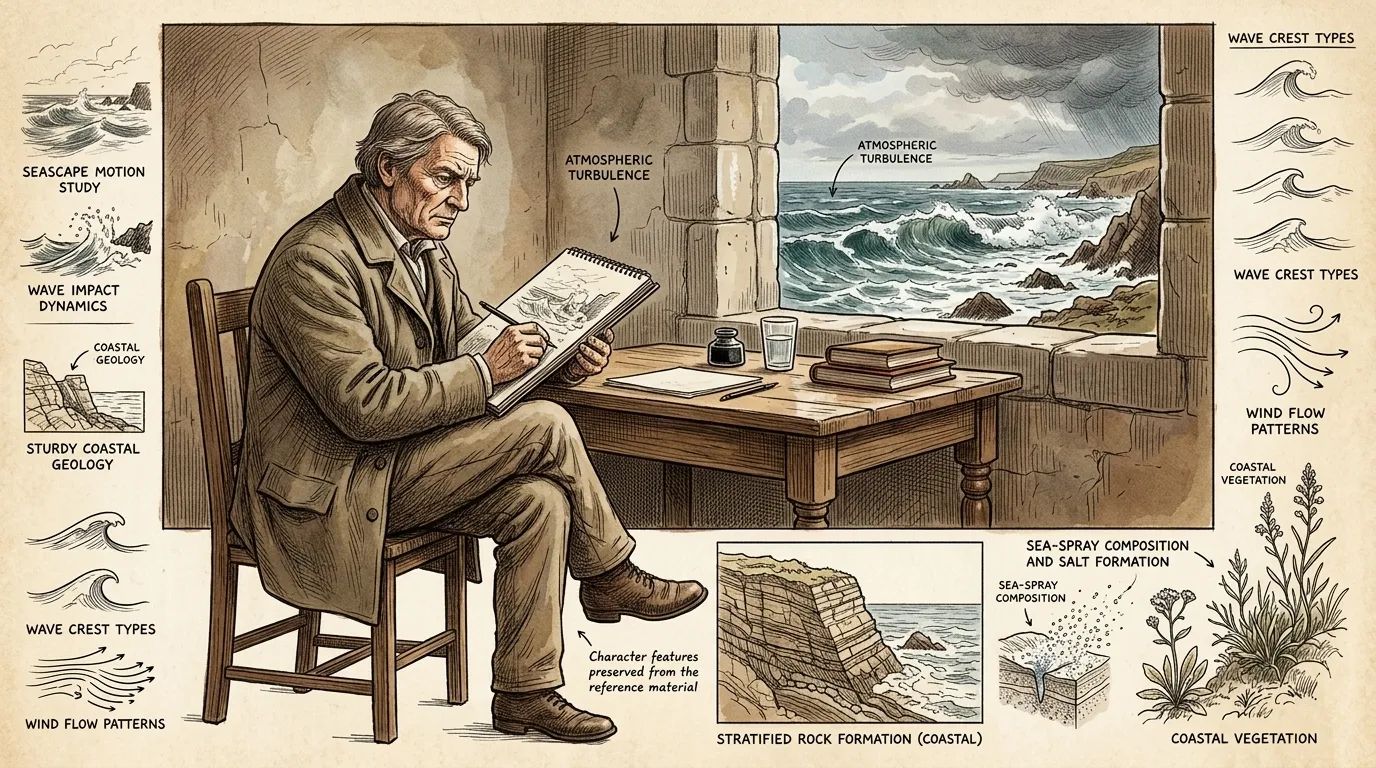
Courbet sketches furiously, capturing the scene – the Communard’s defiant stance, the crimson flag snapping in the wind. Régis watches him, a worried frown etched on his face. “This is dangerous, Gustave,” he murmurs.
“It is *truth*, Régis,” Courbet replies, not looking up. "And truth, like stone, endures." He glances at the Model for ‘The Stone Breakers’, now assisting with barricade construction. Even in hardship, there’s dignity in labor.
A Salon Judge approaches, his face contorted with disapproval. “This… this rabble! And you, Courbet, glorifying them?”
Pierre-Joseph Proudhon steps forward, calmly addressing the judge. "These are not 'rabble', sir. They are citizens reclaiming their rights." The judge scoffs and turns away.
Courbet continues sketching, a steely resolve hardening his gaze. He will document this moment, for history – and for art.
Page 10
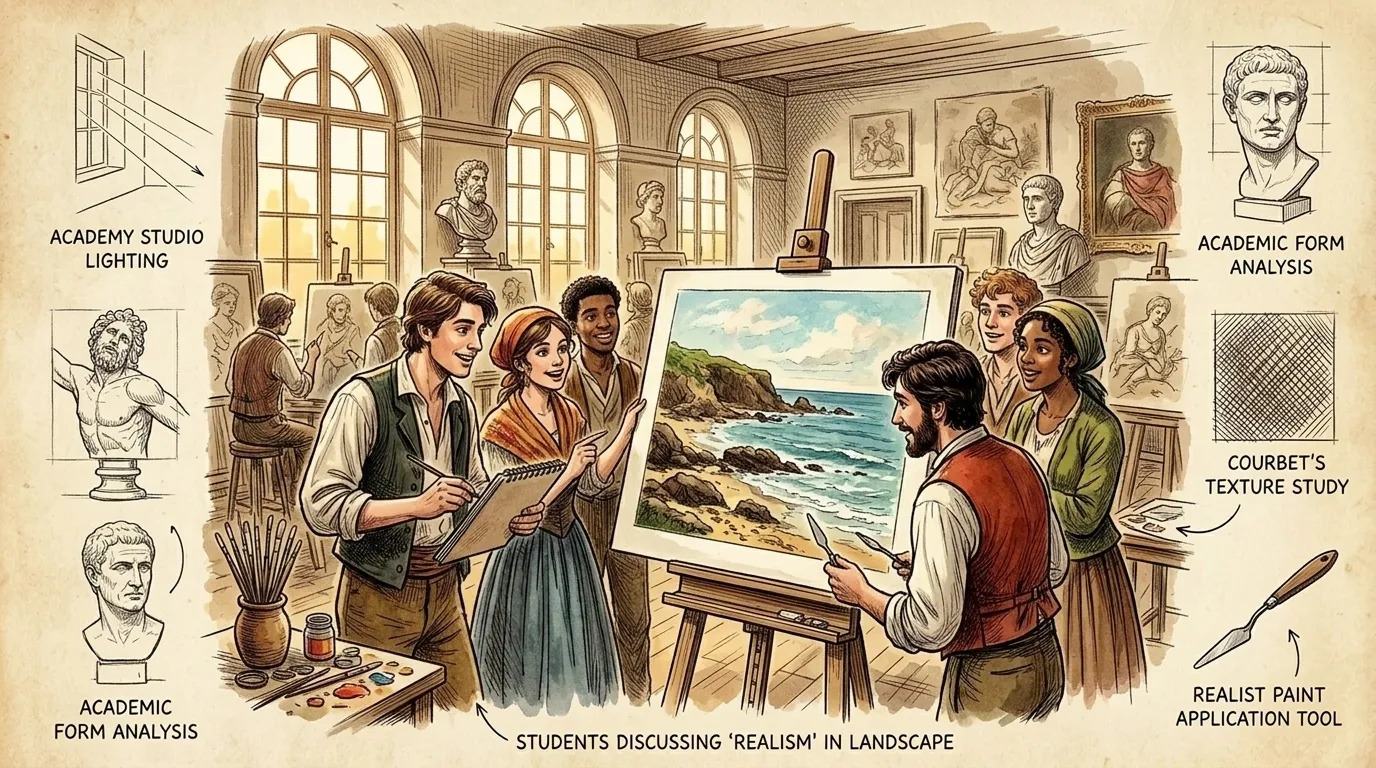
…the dust motes dancing in the late afternoon sun. Proudhon shifted his weight, glancing at Régis who was sketching furiously in a small notebook. “A rather grim subject, wouldn’t you say, Gustave? To depict such labor…”
Courbet snorted, wiping sweat from his brow with a forearm. “Grim reality, Pierre-Joseph. Not sentimentality. These men *are* France.” He gestured towards the model, still patiently chipping at the stones. The Salon Judge cleared his throat. "While technically proficient, Monsieur Courbet, its… lack of idealization may not appeal to patrons."
Courbet fixed him with a steely gaze. “I paint what I see, not what they *want* to see.” He turned back to the canvas, adding another layer of ochre to the broken road. Régis looked up from his sketch, a thoughtful expression on his face. Even in silence, the rhythmic clang of the hammer against stone filled the air.
About this story
- Location: France
- Audience: general readers
Questions and answers
Questions and answers about The Stone Breakers by Gustave Courbet (France — 1849)
Read Wonder Arts on your phone
Wonder Arts is available on Android. Get Wonder Arts on Google Play.
More Wonder Arts stories
- The Stonebreakers by Gustave Courbet (Dresden, Germany — 1849)
- The Swing Bridge by Thomas Cole (USA — 1837)
- A Burial at Ornans by Gustave Courbet (France — 1849)
- A Cavalier by Frans Hals (Australia — 1624)
- A Sunday on La Grande Jatte by Georges Seurat (Paris, France — 1884)
- Abbey in the Oakwood by Caspar David Friedrich (Germany — 1810)