The Tale of Genji by Murasaki Shikibu (Kyoto, Japan — c. 1008)
The Tale of Genji by Murasaki Shikibu (Kyoto, Japan — c. 1008) — an illustrated arts story, set in Japan. 10 illustrated pages, free to read on Wonder Arts.
Page 1
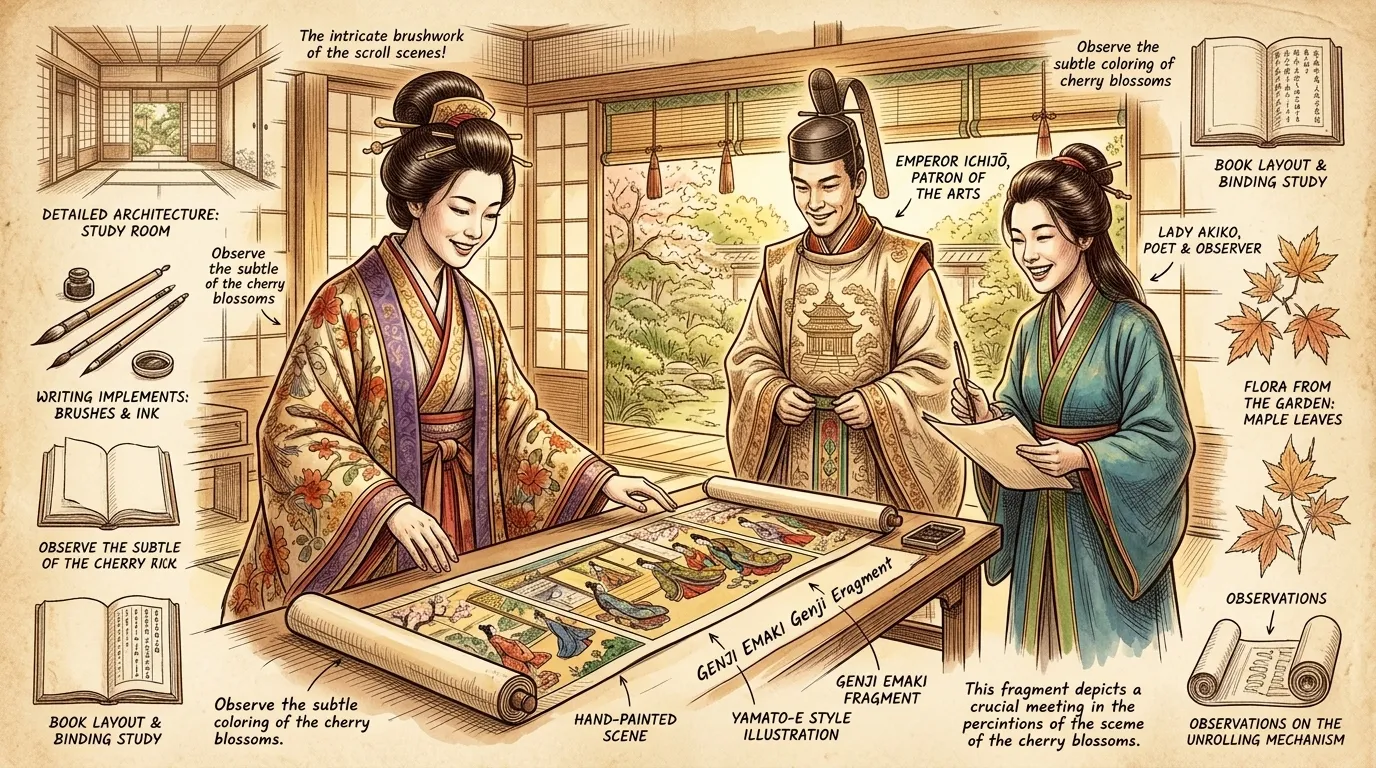
Murasaki Shikibu stands before her masterpiece, The Tale of Genji Emaki, circa 1120, in Kyoto. This collection, now fragmented and scattered across various museums, once comprised numerous scrolls illustrating her epic novel. Each panel, measuring approximately 21.8 x 18.2 cm, showcases scenes from Genji's life, offering a glimpse into the Heian court. This particular panel captures a poignant moment of reflection.
"Murasaki whispers to herself, 'Can ink and brush truly capture the fleeting beauty of the world, the depth of human emotion?'"
Art Fact: The Tale of Genji Emaki is one of the earliest surviving examples of Yamato-e style painting, dating from approximately 1120, a little over a century after Murasaki Shikibu wrote The Tale of Genji. Few original scrolls survive, with only fragments remaining in museums today.
Page 2
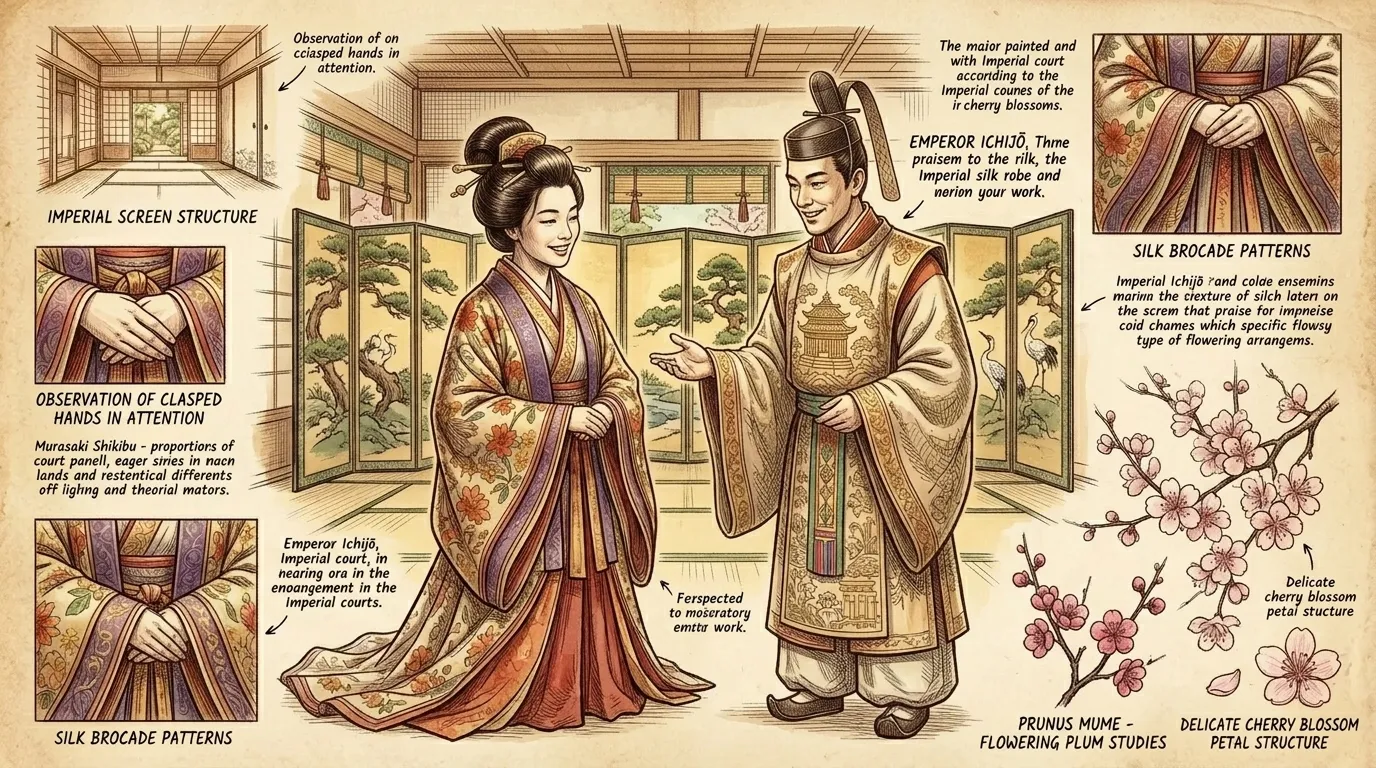
Murasaki finds herself summoned to the Imperial court. Emperor Ichijō, a known patron of the arts, expresses his admiration for her literary talent. He believes her work reflects the sophisticated sensibilities of the Heian era, and encourages her to continue writing. This royal endorsement provides her with unprecedented access and resources.
"Emperor Ichijō says, 'Lady Murasaki, your words paint a world of unparalleled beauty. Continue to illuminate our court with your talent!' Murasaki replies, 'Your Majesty's patronage is a boundless honor. I strive to capture the essence of our world with every stroke of the brush, every carefully crafted verse.'"
Art Fact: Emperor Ichijō (980-1011) was a significant patron of the arts and literature during his reign. His support for Murasaki Shikibu's work was instrumental in its widespread recognition.
Page 3
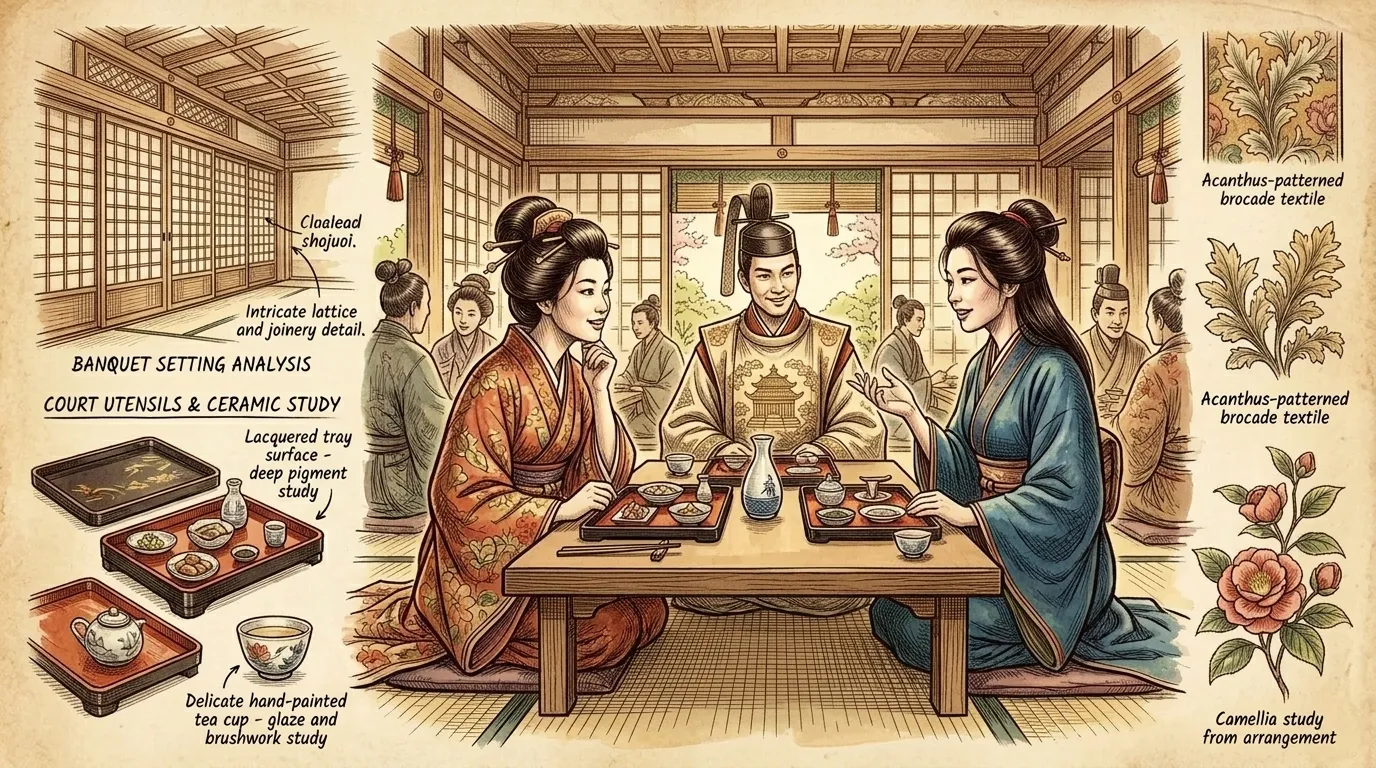
At a banquet, Murasaki observes Lady Akiko, Empress Shōshi's companion, a woman renowned for her sharp wit and artistic flair. Lady Akiko's insights on courtly life and her appreciation for subtle emotional nuances deeply influence Murasaki's evolving understanding of human relationships.
"Lady Akiko observes, 'The heart, Lady Murasaki, is a labyrinth of desires and concealed truths. Your talent lies in unveiling these hidden complexities.' Murasaki responds, 'Your wisdom illuminates my path, Lady Akiko. I strive to capture the delicate dance between outward grace and inner turmoil.'"
Art Fact: Lady Akiko, also known as Izumi Shikibu, was a contemporary poet known for her passionate and expressive verse. Her influence on Murasaki Shikibu's understanding of emotion and courtly life cannot be overstated.
Page 4
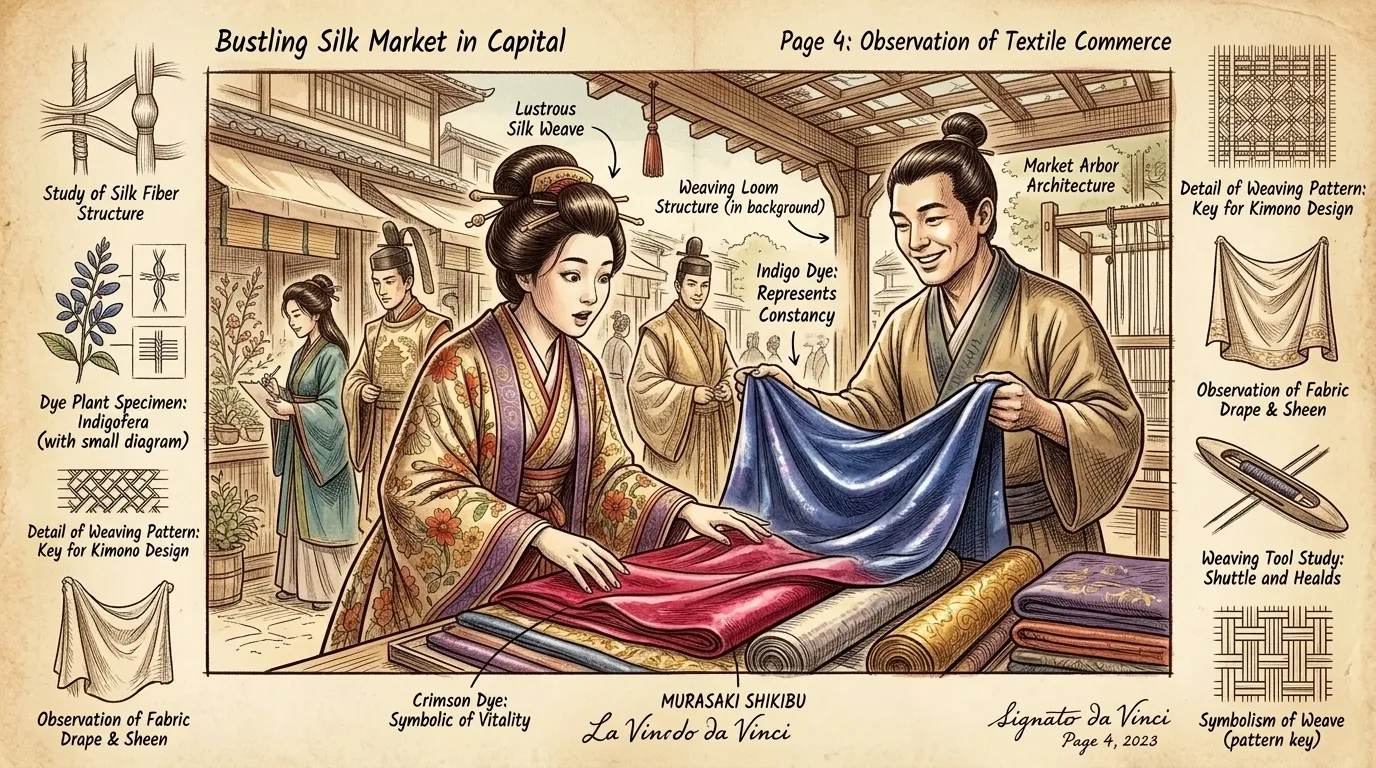
Visiting a silk merchant, Murasaki marvels at the array of colors. She realizes that the subtle shades and hues are not mere decoration, but can evoke deep emotions and define character. The vibrant palettes become essential tools in her storytelling, mirroring the complexities of the human heart.
"The silk merchant states, 'Each color, Lady Murasaki, whispers a different tale. Crimson for passion, indigo for melancholy, and gold for enduring grace.' Murasaki responds, 'Indeed, colors are the language of the soul. I shall weave them into my narratives to amplify the tales of Genji and his world.'"
Art Fact: The Heian period was characterized by its sophisticated aesthetic sensibilities, with particular emphasis on color and its symbolic associations. Murasaki Shikibu keenly understood the emotional resonance of colors and used them deliberately in her writing.
Page 5
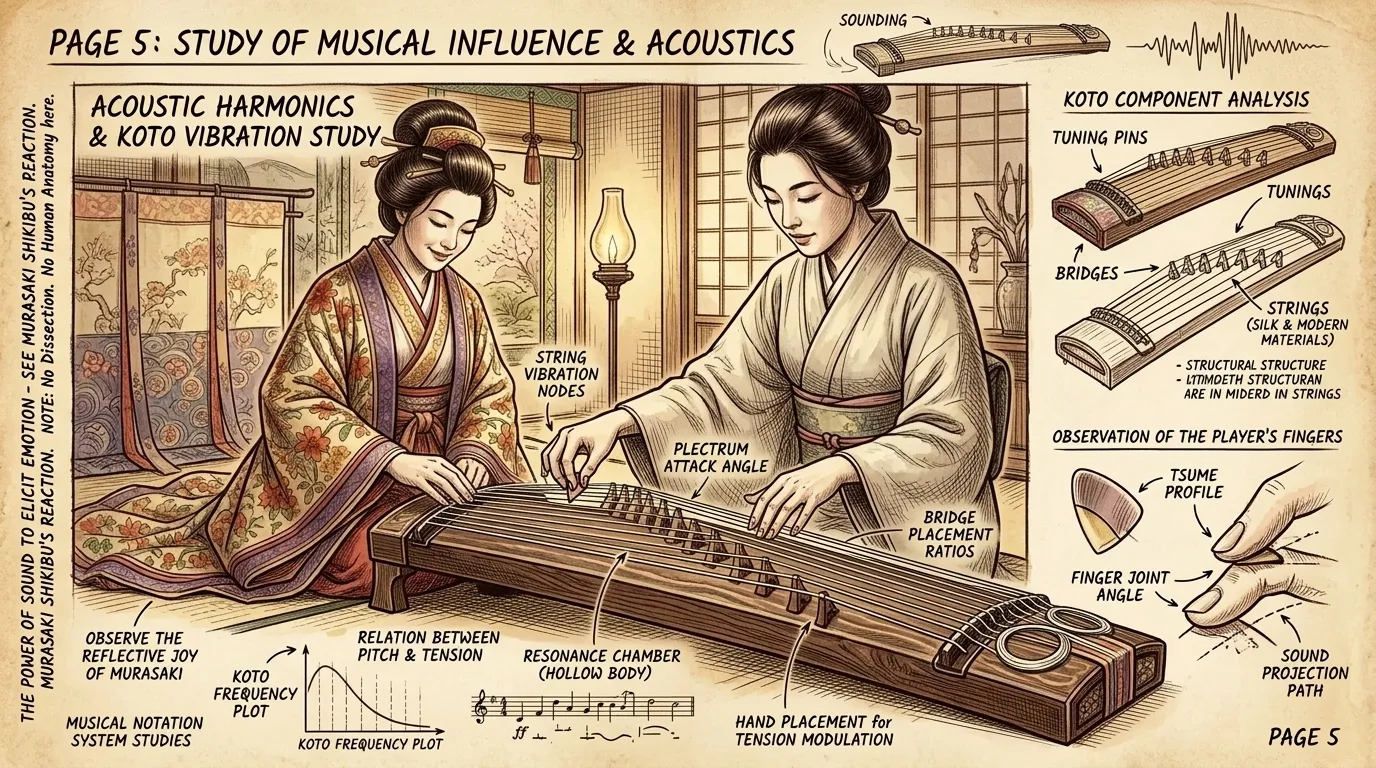
Listening to a koto performance, Murasaki is struck by the instrument's ability to express a wide range of emotions, from delicate joy to profound sorrow. The music echoes the intricate relationships and subtle dramas she seeks to capture in her novel, influencing her narrative structure and emotional pacing.
"A koto player explains, 'The koto is not merely an instrument, Lady Murasaki, but a vessel for the soul. Each note is a whisper of the heart.' Murasaki remarks, 'Indeed, the music mirrors the delicate tapestry of human emotions. I shall strive to weave a similar melody into my tales of Genji.'"
Art Fact: Music played a vital role in Heian courtly life, providing both entertainment and a means of emotional expression. The koto, in particular, was revered for its ability to evoke subtle and profound emotions.
Page 6
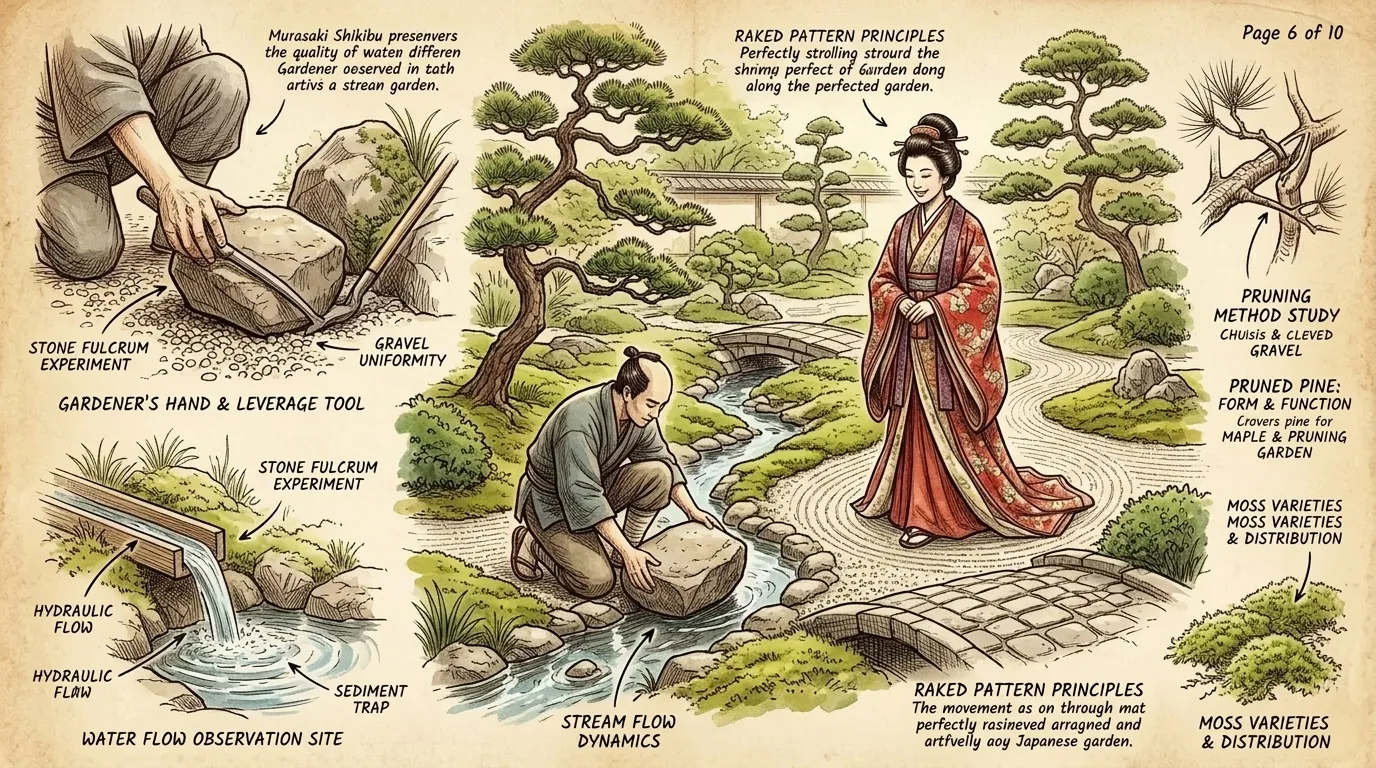
In a serene garden, Murasaki finds solace and inspiration. The carefully arranged stones, ponds, and plants mirror the themes of impermanence and beauty that permeate her writing. The garden becomes a metaphor for the complex world of The Tale of Genji, a space for contemplation and artistic renewal.
"A gardener explains, 'Each stone, Lady Murasaki, has its place and purpose. Together, they create a world of harmony and reflection.' Murasaki responds, 'Like the garden, life is a carefully arranged tapestry of beauty and sorrow. I shall strive to capture its essence in my tale of Genji.'"
Art Fact: Japanese gardens during the Heian period were designed as spaces for contemplation and aesthetic appreciation, reflecting the principles of Zen Buddhism and Shintoism.
Page 7
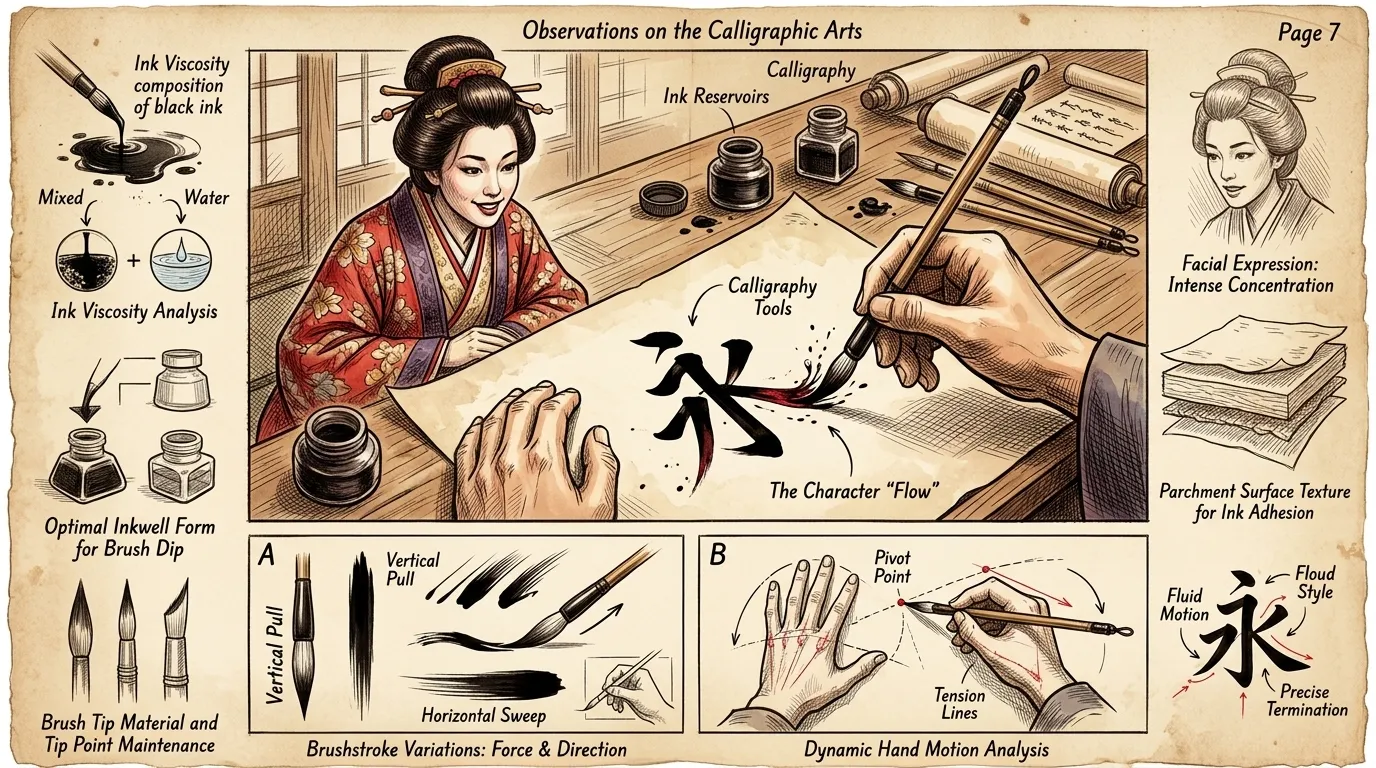
Murasaki observes a master calligrapher at work, fascinated by the way a single stroke can convey so much meaning and emotion. She understands that the beauty of her writing lies not only in the words themselves, but also in the artful arrangement and delicate execution of each character.
"The calligrapher says, 'Each stroke, Lady Murasaki, is a breath of the soul. It must flow with grace and precision.' Murasaki reflects, 'Like calligraphy, writing is an act of profound artistry. I shall strive to imbue my words with the same elegance and spirit.'"
Art Fact: Calligraphy was considered a highly refined art form during the Heian period, valued for its ability to express both skill and artistic sensibility. Murasaki Shikibu understood the importance of both the content and the form of her writing.
Page 8
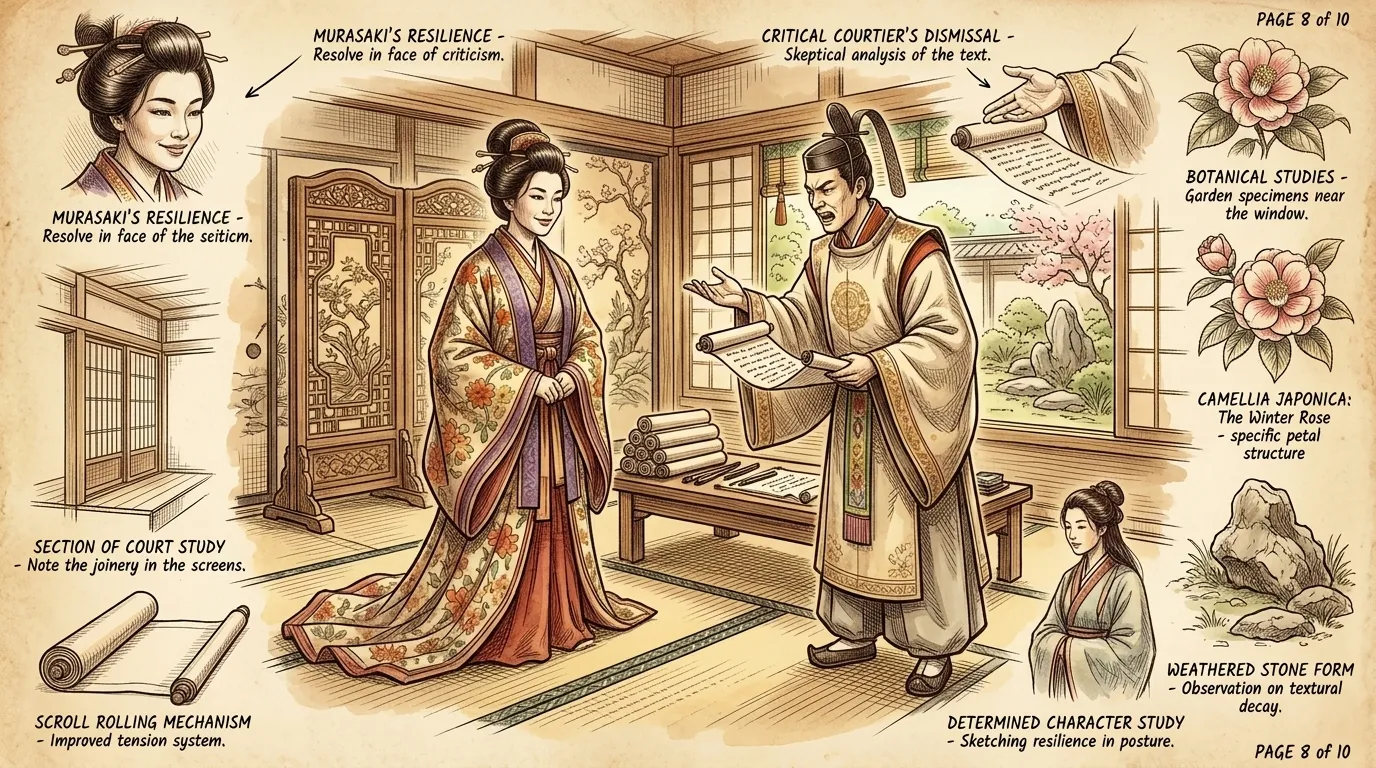
A courtier criticizes Murasaki's writing, deeming it overly sentimental and detached from reality. Initially disheartened, Murasaki recognizes the criticism as an opportunity to refine her craft. She strives to blend realism with emotional depth, creating a richer and more nuanced portrayal of human life.
"The courtier scoffs, 'Your tales are mere fantasies, Lady Murasaki. They bear little resemblance to the harsh realities of our world.' Murasaki replies, 'Perhaps, but within these tales lie deeper truths. I shall strive to balance beauty with honesty, and create a world that reflects both our hopes and our sorrows.'"
Art Fact: Criticism, both positive and negative, played a significant role in shaping the artistic landscape of the Heian period. Murasaki Shikibu faced both praise and critique, which ultimately influenced her approach to storytelling.
Page 9
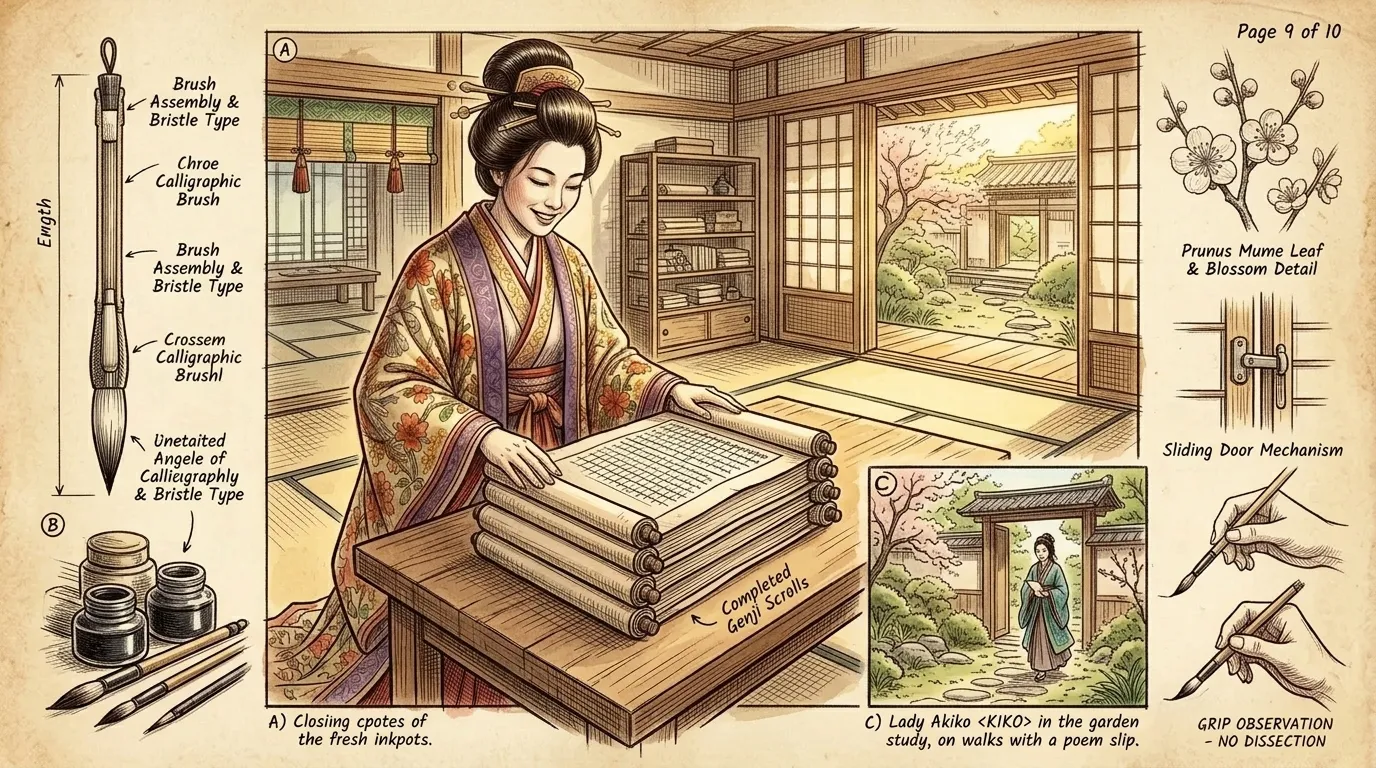
After years of dedication, Murasaki Shikibu completes The Tale of Genji. The novel's intricate plot, vivid characters, and profound emotional depth solidify her legacy as one of Japan's greatest writers. She realizes that her work is a testament to the power of art to transcend time and touch the human heart.
"Murasaki says, 'It is finished! Though I cannot say that I am perfectly pleased with my masterpiece, it has come to fruition. Like Leonardo Da Vinci said, 'Art is never finished, only abandoned.''"
Art Fact: The Tale of Genji is widely regarded as the world's first novel. Its profound influence on Japanese literature and culture cannot be overstated.
Page 10
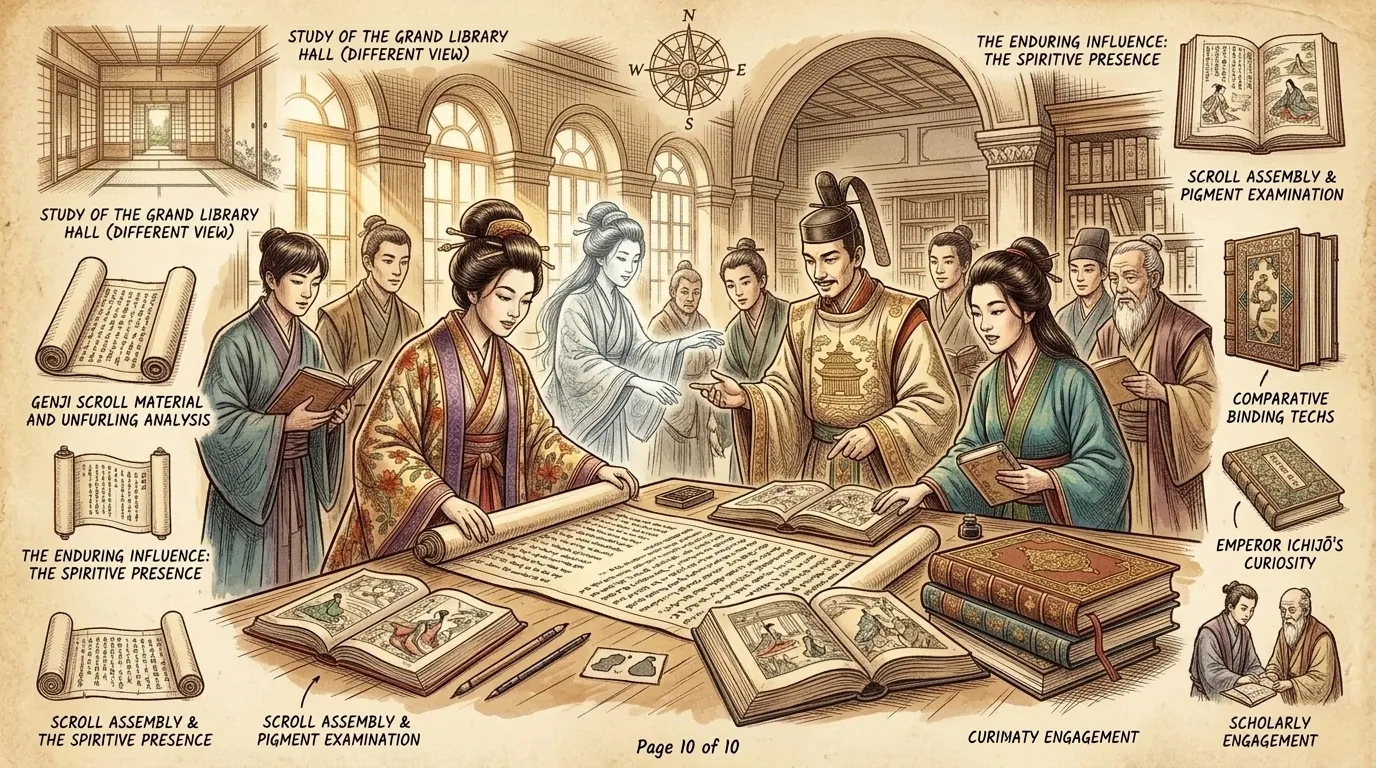
Centuries later, The Tale of Genji continues to captivate and inspire. Scholars, artists, and readers alike are drawn to its timeless themes and profound insights into the human condition. Murasaki Shikibu's voice echoes through the ages, a testament to the enduring power of art.
"The voice of Murasaki echoes, 'Though time may pass and empires crumble, the human heart remains unchanged. Art is the mirror that reflects our shared joys and sorrows, and it is through this reflection that we find enduring connection.'"
Art Fact: The Tale of Genji remains one of the most important works of Japanese literature, inspiring countless artists, writers, and scholars throughout the centuries. Its themes of love, loss, and the complexities of human relationships continue to resonate with readers today.
About this story
- Location: Japan
- Audience: general readers
Questions and answers
Questions and answers about The Tale of Genji by Murasaki Shikibu (Kyoto, Japan — c. 1008)
Read Wonder Arts on your phone
Wonder Arts is available on Android and iPhone and iPad. Get Wonder Arts on Google Play · Get Wonder Arts on the App Store.
More Wonder Arts stories
- The Terracotta Army by Qin Shi Huang’s artisans (Shaanxi, China — 210 BC)
- The Thinker by Auguste Rodin (Paris, France — 1880)
- The Third of May 1808 by Francisco Goya (Madrid, Spain — 1814)
- The Tower of London (UK — 1078)
- The Turkish Bath by Jean-Auguste-Dominique Ingres (France — 1862)
- The Veiled Christ by Giuseppe Sanmartino (Naples, Italy — 1753)