The Starry Night
The Starry Night — an illustrated arts story, set in Global. 10 illustrated pages, free to read on Wonder Arts.
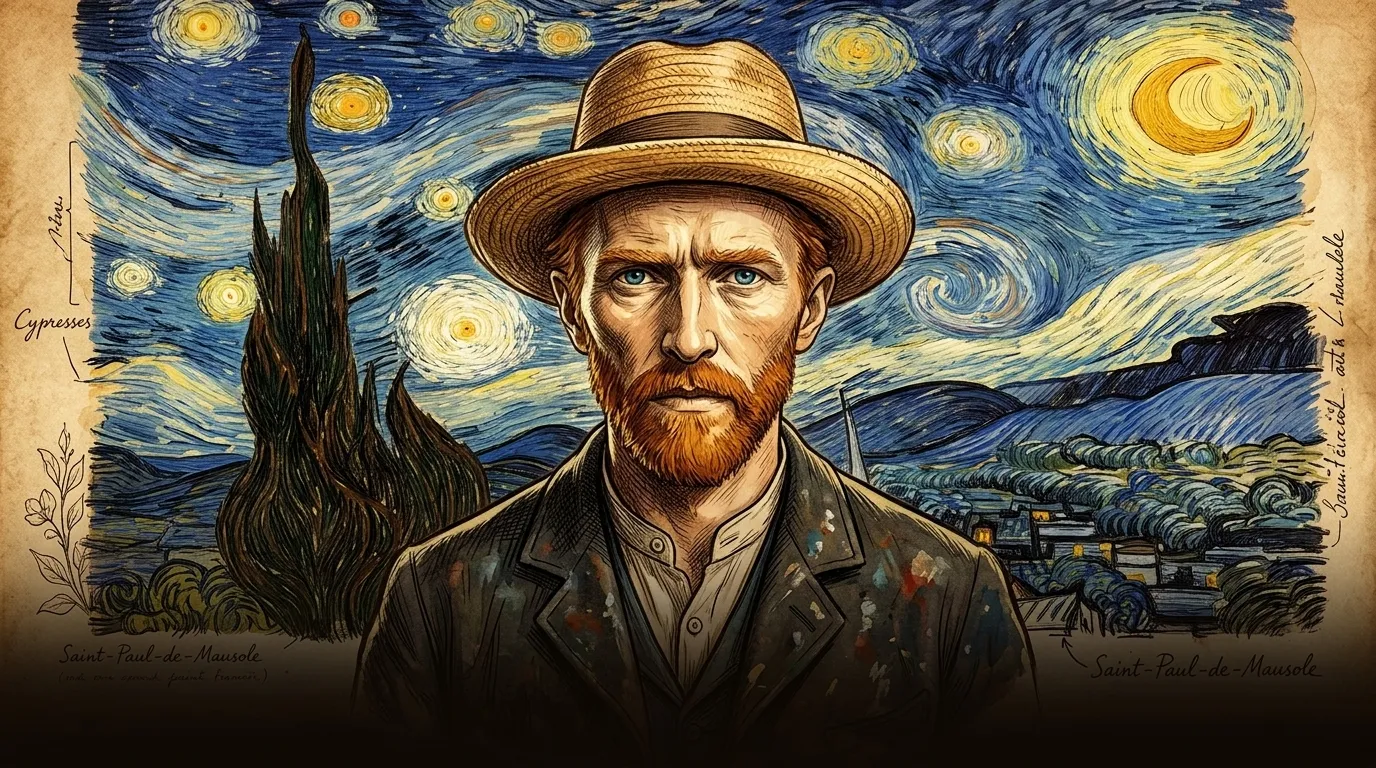
Page 1
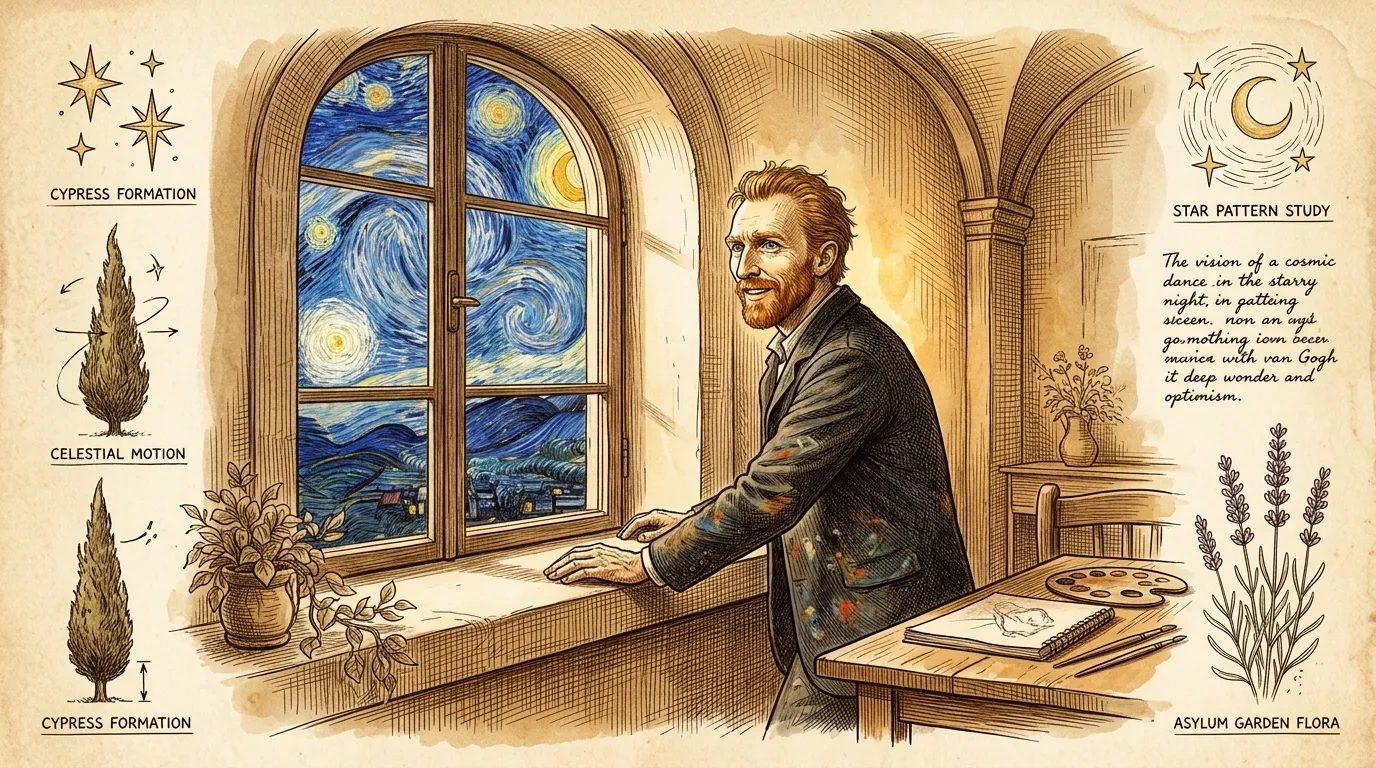
In the quiet confines of Saint-Paul-de-Mausole asylum, nestled in the sun-drenched landscape of Saint-Rémy-de-Provence, France, Vincent van Gogh wrestled with the very essence of vision. It was June of 1889 when he transmuted a fractured reality into an unparalleled cosmic spectacle, giving birth to a masterpiece that would defy the conventions of its age. His canvas became a window into a soul ablaze, rendering the night sky not as seen, but as felt.
"Vincent van Gogh: "This night... it speaks to me in swirling tongues of cobalt and gold. It is more alive than any day.""
Art Fact: Artist: Vincent van Gogh. Artwork: The Starry Night. Location: Saint-Rémy-de-Provence, France. Date: June 1889. Medium: Oil on canvas. Dimensions: 73.7 cm 92.1 cm (29 in 36 1/4 in). Current Location: Museum of Modern Art, New York City. Extraordinary Fact: Van Gogh painted this from memory and imagination, largely inspired by the view from his east-facing asylum window before sunrise, but adding the dramatic cypress and idealized village.
Page 2
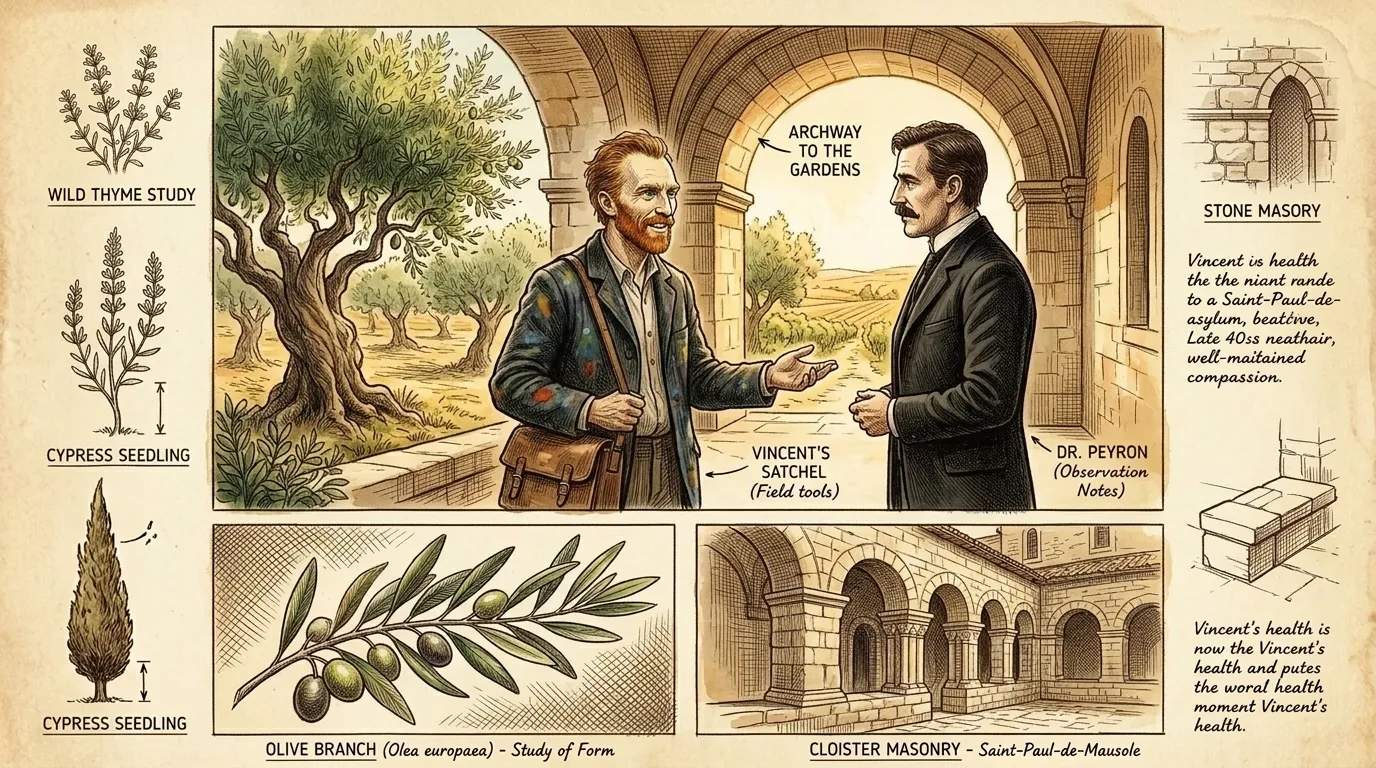
The spring of 1889 found Vincent van Gogh stepping into the cloistered world of the Saint-Paul-de-Mausole asylum. Seeking respite from his profound mental anguish, he entered a place of quiet contemplation, though his inner turmoil remained a constant, fervent undercurrent. This new environment, with its sun-baked fields and ancient olive groves, paradoxically offered a fresh perspective, a novel canvas for his besieged mind.
"Vincent van Gogh, clutching his worn satchel, murmured to Dr. Théophile Peyron: "The light here... it is different. Even through the bars, the world outside offers a strange, intense beauty.""
Art Fact: Upon his arrival at Saint-Paul-de-Mausole on May 8, 1889, Van Gogh willingly admitted himself. The asylum provided him with two cells, one for sleeping and one for use as a studio.
Page 3
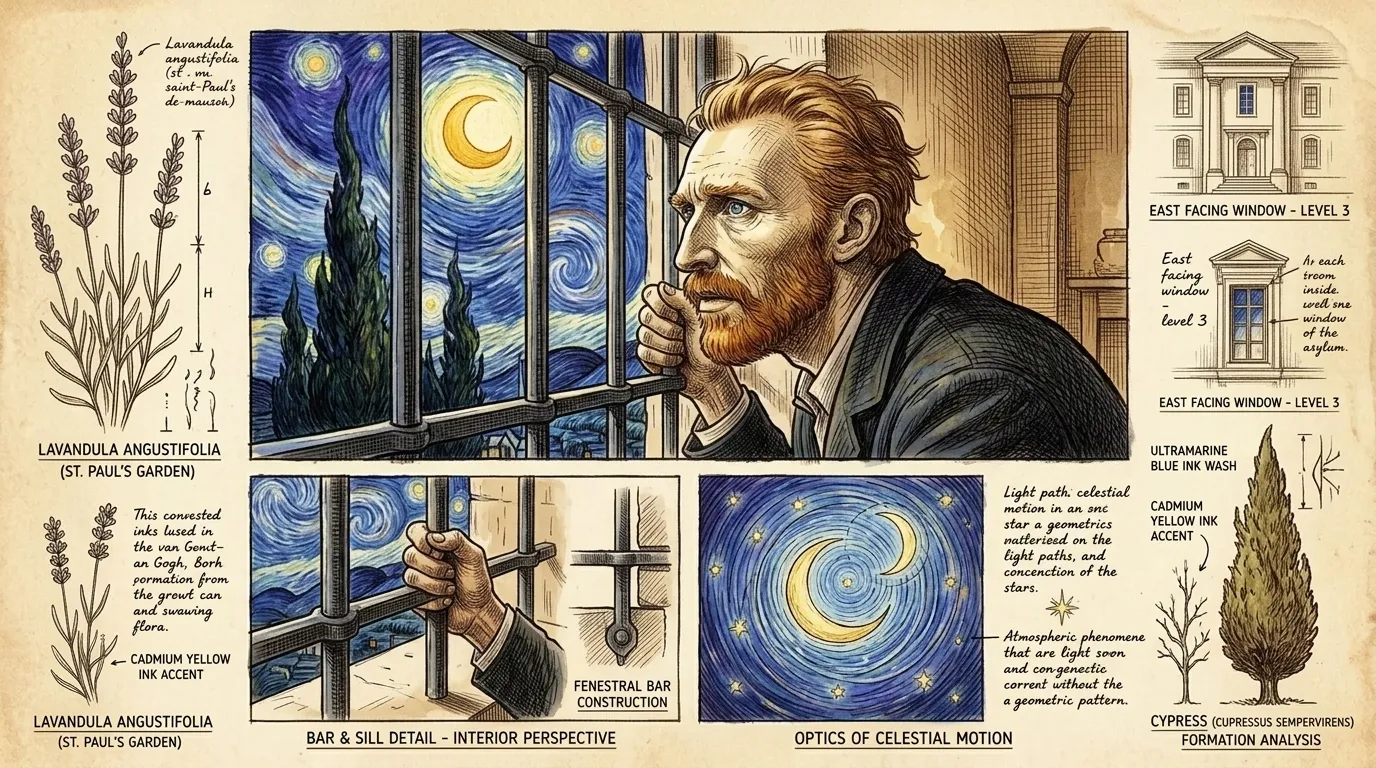
From his asylum room, the barred window became a portal to the nocturnal world. Unable to paint directly outside at night, Van Gogh absorbed the shifting patterns of the moon, the incandescent glow of the stars, and the dark, swaying forms of the cypress trees. These observations merged with his inner emotional landscape, transforming into a vivid memory that clamored for expression, a vision of the night imbued with profound, almost spiritual, intensity.
"Vincent van Gogh, his face pressed against the cool window bars, whispered: "The night is more richly coloured than the day. These stars... they blaze with a furious, comforting light.""
Art Fact: Van Gogh wrote to his brother Theo about the view: 'Through the iron-barred window I see a field of wheat...Above it, in the morning, I watch the sunrise, with all the villagers out walking, and there's a great star, which is usually Sirius.' This direct observation, fused with imagination, formed the genesis of 'The Starry Night.'
Page 4
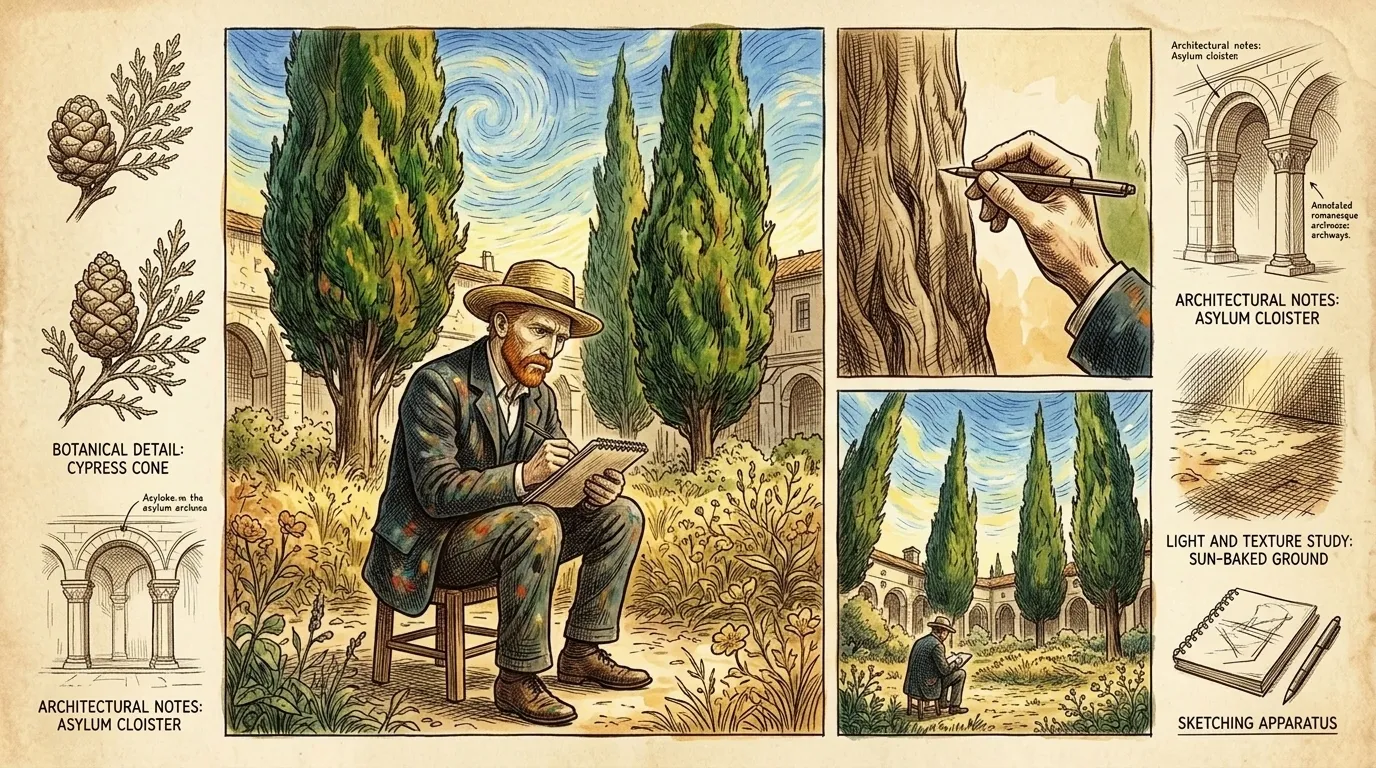
Amidst the asylum grounds, the towering cypress trees became a powerful motif for Van Gogh. Their dark, flame-like forms, rooted firmly in the earth yet reaching skyward, resonated deeply with his own yearning for spiritual elevation amidst earthly struggle. He sketched them repeatedly, their dramatic verticality providing an anchor to his swirling visions of the cosmos, a bridge between mortal ground and infinite heavens.
"Vincent van Gogh, sketching furiously in a small notebook, remarked to himself: "These cypresses... they are like a dark flame, a symbol of life's struggle, but also of aspiration.""
Art Fact: Van Gogh found solace and potent symbolism in nature. The cypress tree, often associated with death and mourning, also represented a connection between the earth and the heavens for him, a theme central to 'The Starry Night'.
Page 5
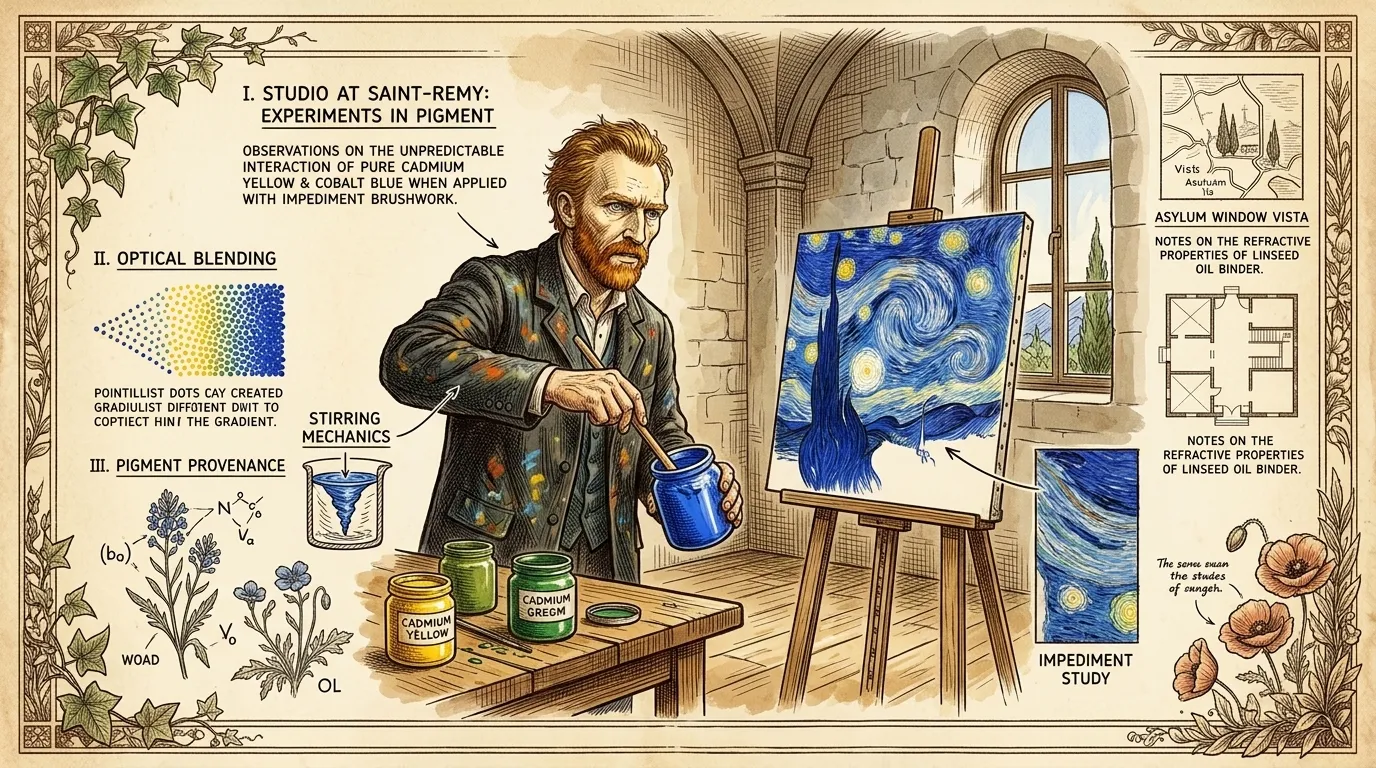
Back in his improvised studio, Van Gogh approached his canvas with an almost feverish intensity. His colors were not merely descriptive; they were emotional, chosen for their raw power and psychological resonance. Cobalt blue for the profound depth of the night, cadmium yellow for the blazing stars, and rich greens for the life-force of the cypresses. He applied the paint thickly, allowing the impasto to create a tangible texture, making the surface of the canvas a vibrant, living entity.
"Vincent van Gogh, stirring a pot of brilliant blue pigment, declared to an imaginary interlocutor: "Color must convey feeling, not merely represent. A brushstroke can be a cry, a whisper, a furious exhalation!""
Art Fact: Van Gogh was known for his innovative use of color and impasto. He often applied paint directly from the tube or with a palette knife, creating a sculptural quality that conveyed intense emotion and energy.
Page 6
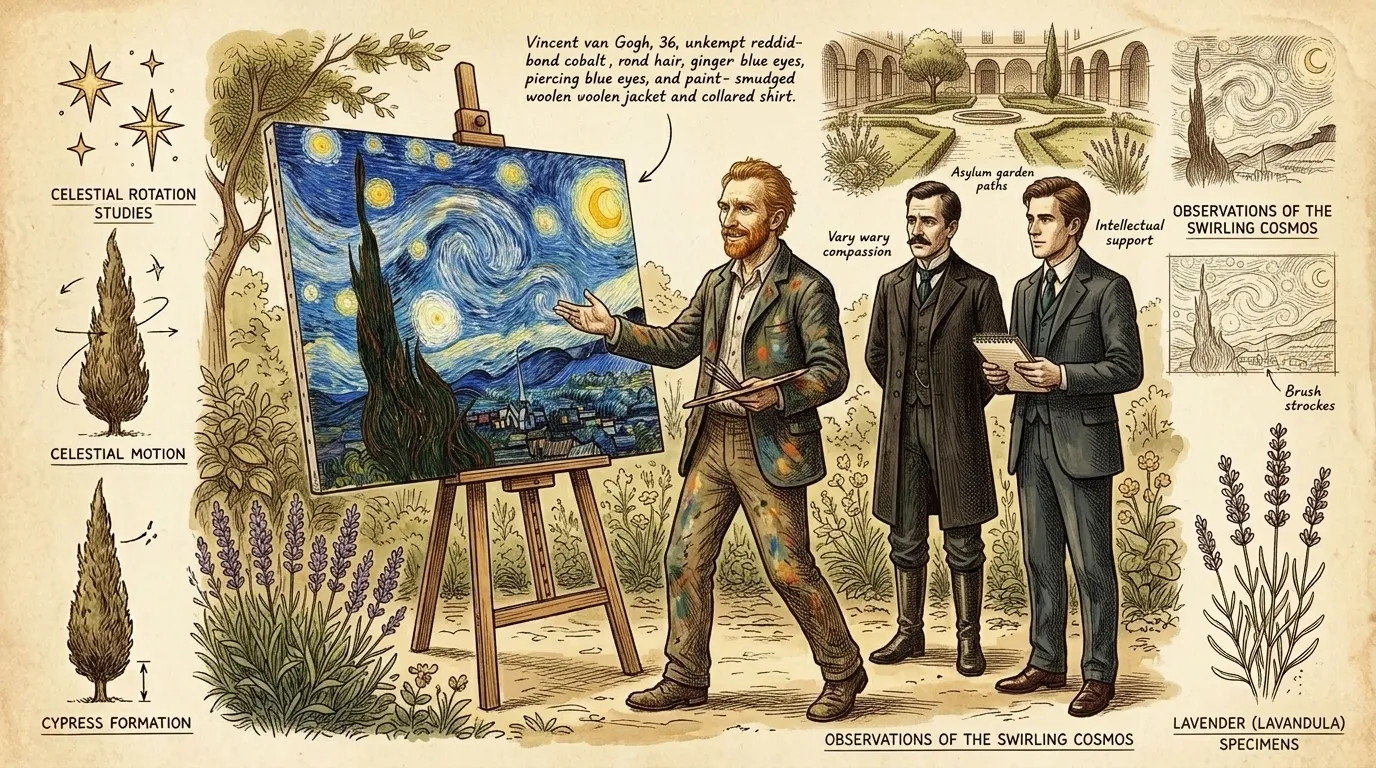
The night sky from his window, though remembered, became less an observation and more a profound inner vision. Van Gogh fused the celestial with the psychological, translating his agitated state into a swirling vortex of stars and moonlight. The village below, nestled in quiet contemplation, offered a counterpoint to the cosmic dynamism, a fleeting sense of peace within the surrounding emotional storm. This was his breakthrough: to make visible the invisible landscape of the soul.
"Vincent van Gogh, stepping back from the emerging canvas, exclaimed: "This is not merely sight, Theo, but insight! The stars are not just dots, but pulsating souls!""
Art Fact: Van Gogh's brother and primary confidant, Theo, often received letters detailing Vincent's artistic struggles and triumphs. Theo's encouragement, even in the face of Vincent's perceived stylistic eccentricities, was crucial.
Page 7
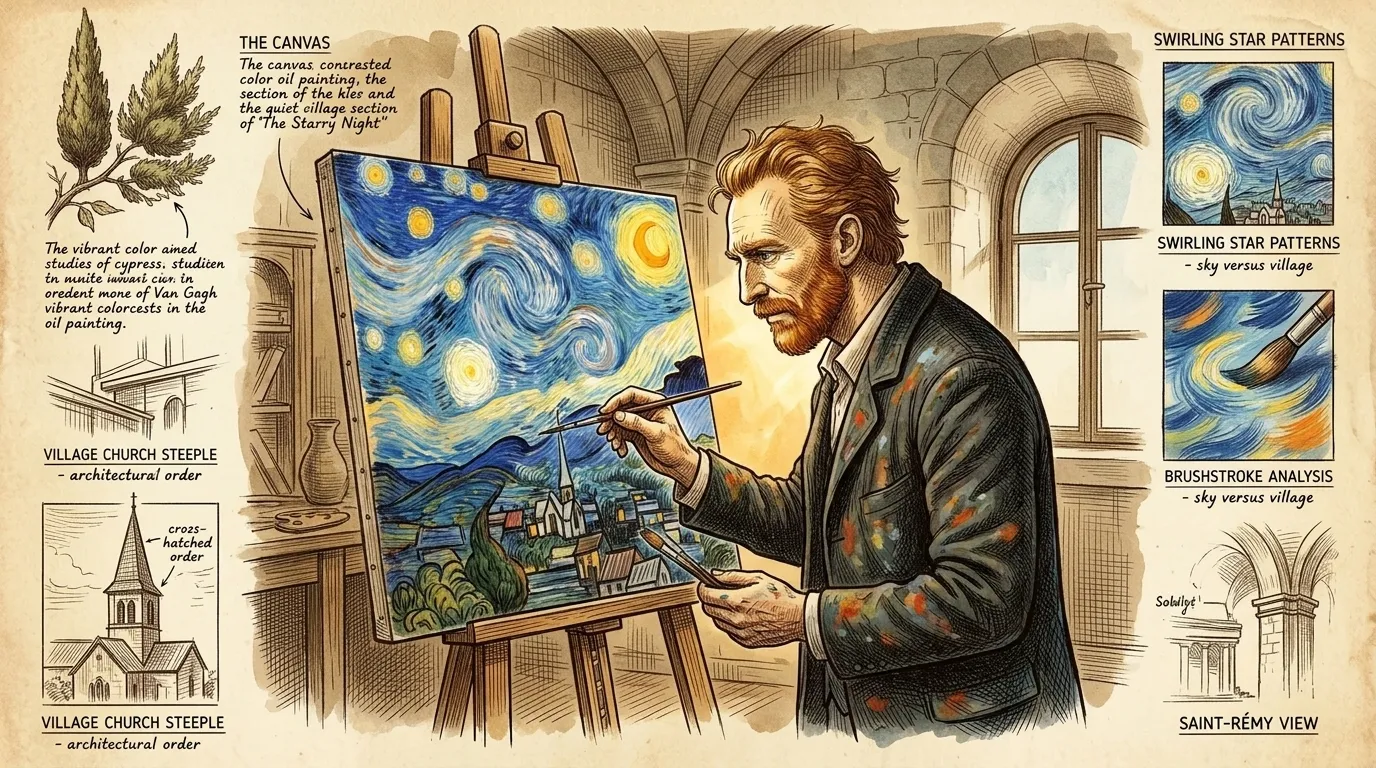
Within the tumultuous cosmic swirl, Van Gogh introduced the quiet village, its steeple piercing the tranquil night. This wasn't the actual Saint-Rémy village, but an idealized composite, possibly from his Dutch homeland. It represented human solace, a grounding counterpoint to the overwhelming power of the celestial realm. The stark contrast between the vibrant, expressive sky and the serene, ordered village amplified the painting's emotional depth, weaving together anguish and a profound sense of peace.
"Vincent van Gogh, carefully painting the small church steeple, murmured: "A village in the heart of chaos, a small haven. It reminds me, as Victor Hugo once said, 'The greatest happiness of life is the conviction that we are loved.' There is solace even in turbulent times, a quiet affection for humanity.""
Art Fact: The village in 'The Starry Night' is not a literal depiction of Saint-Rémy. Art historians believe it is either an imagined village or one inspired by Van Gogh's memories of his Dutch homeland, providing a symbol of quiet humanity within the cosmic drama.
Page 8
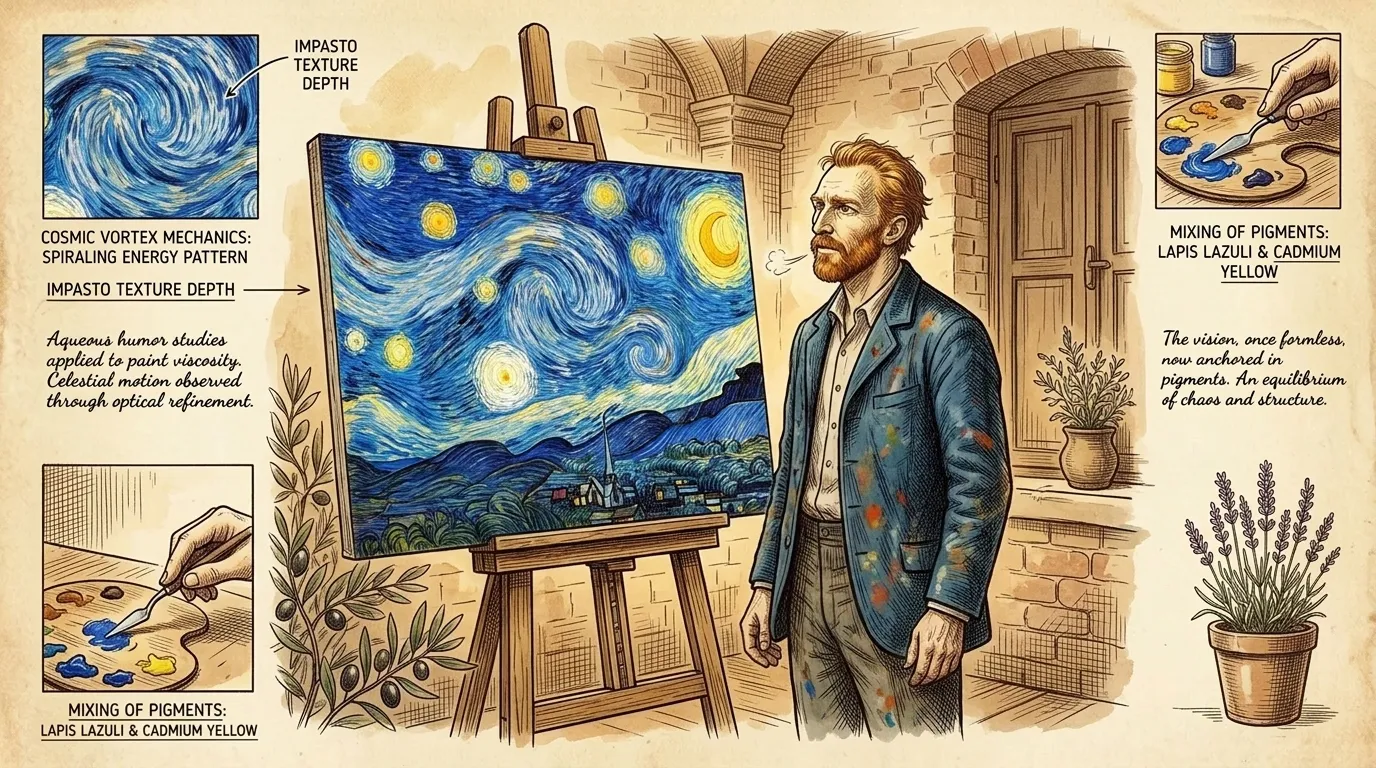
With each deliberate stroke, Van Gogh imbued the canvas with his deepest emotions, his 'inner vision' now fully manifest. The impasto became more pronounced, the colors more saturated, the swirling forms achieving their iconic rhythm. It was a meticulous yet frenzied act of creation, each dot and line a testament to his unique perception of the universe. The painting was no longer just a scene; it was a psychological landscape, an emotional symphony. The vision of the burning, swirling stars he had witnessed from his window, now a problem solved, had been successfully translated into a tangible, powerful artwork.
"Vincent van Gogh, stepping back for the last time, exhaled slowly. He whispered: "It is done. A truth, as I see it, revealed. A fragment of my soul, flung onto the canvas.""
Art Fact: Despite its fame today, 'The Starry Night' was not an immediate success. Vincent's brother, Theo, wrote to him, 'The Starry Night is not successful because it doesn't represent reality.' Yet, Vincent considered it an important work, a testament to his 'inner life'.
Page 9
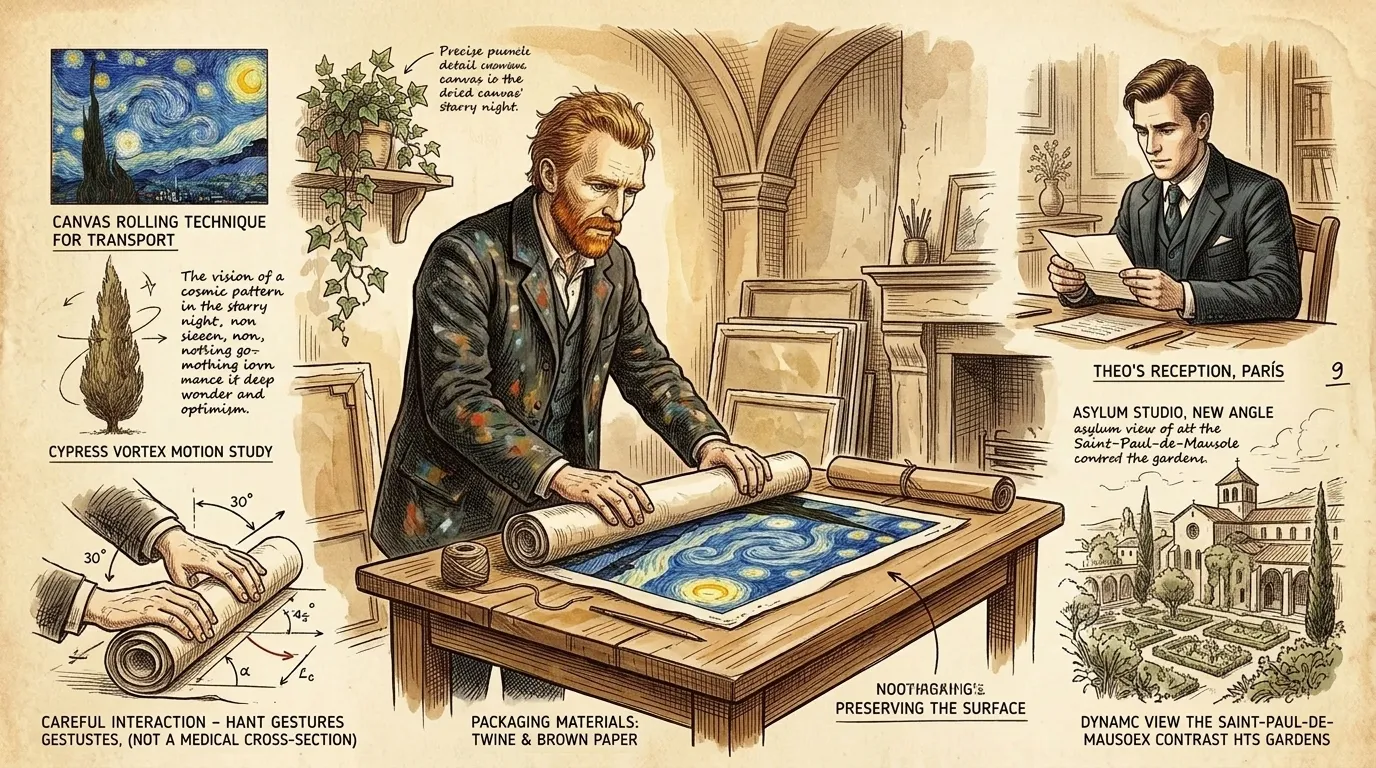
The completion of 'The Starry Night' marked a significant, if quiet, moment in Van Gogh's tumultuous life. Carefully, almost reverently, he prepared the canvas for shipment. It was destined for his brother, Theo, the unwavering patron and confidant, who tirelessly supported Vincent's artistic endeavors, even when he struggled to understand the radical departure from conventional representation. This was more than just a painting; it was a piece of Vincent's soul, embarking on its silent journey into the world.
"Vincent van Gogh, carefully rolling the dried canvas, said quietly to himself: "Theo will see it... Perhaps he will understand the intensity of this particular night.""
Art Fact: Vincent regularly sent his completed works to Theo in Paris. Despite his brother's reservations about 'The Starry Night,' Theo included it among the works he exhibited and eventually sold, albeit posthumously. The painting was not sold during Van Gogh's lifetime.
Page 10
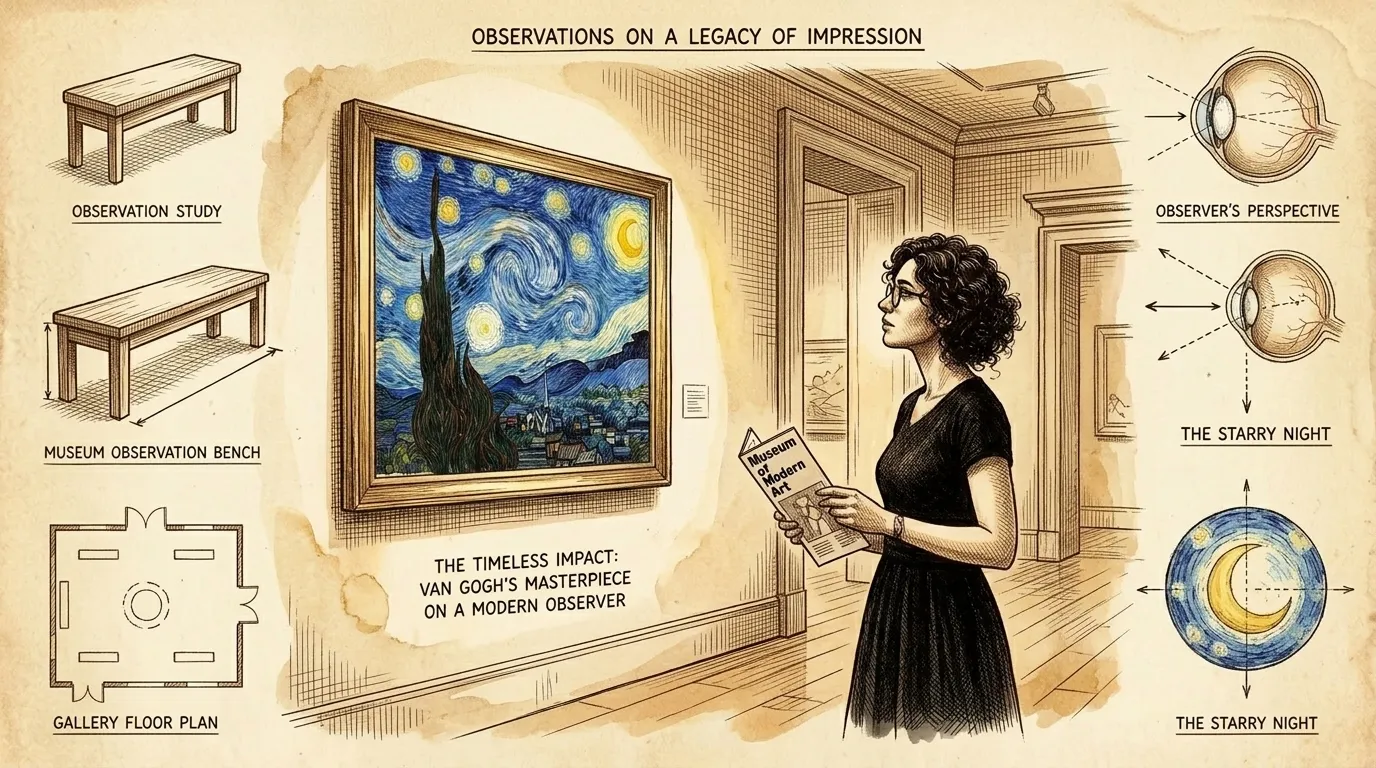
Today, 'The Starry Night' hangs in the Museum of Modern Art, an undisputed icon of Western art. Its swirling blues and luminous yellows continue to captivate millions, a testament to Van Gogh's unparalleled vision and emotional intensity. The painting transcends its canvas, inspiring poets, musicians, and artists across generations, its cosmic energy an eternal beacon. Vincent van Gogh, though his life was marked by suffering, found immortality in the swirling stars of a single, unforgettable night. His work endures because it speaks to the universal human experience of profound emotion, rendered with breathtaking, EXPRESSIONISTIC honesty.
"A modern art enthusiast, gazing at the painting, reflects: "It's as if you can feel his very heartbeat in those brushstrokes. It's more than a painting; it's a raw, beautiful cry.""
Art Fact: 'The Starry Night' has been part of MoMA's permanent collection since 1941, acquired through the Lillie P. Bliss Bequest. It remains one of the most frequently visited and reproduced artworks in the world, its impact extending far beyond the art world into popular culture, design, and music.
About this story
- Location: Global
- Audience: general readers
Questions and answers
Read Wonder Arts on your phone
Wonder Arts is available on Android. Get Wonder Arts on Google Play.
More Wonder Arts stories
- The Starry Night — Saint-Rémy-de-Provence, France — 1889
- A Burial at Ornans by Gustave Courbet (France — 1849)
- A Cavalier by Frans Hals (Australia — 1624)
- A Sunday on La Grande Jatte by Georges Seurat (Paris, France — 1884)
- Abbey in the Oakwood by Caspar David Friedrich (Germany — 1810)
- Abstract Expressionism by Jackson Pollock (New York, USA — 1940s)