Water Lilies by Claude Monet (Giverny, France — 1899)
Water Lilies by Claude Monet (Giverny, France — 1899) — an illustrated arts story, set in France. 10 illustrated pages, free to read on Wonder Arts.
Page 1
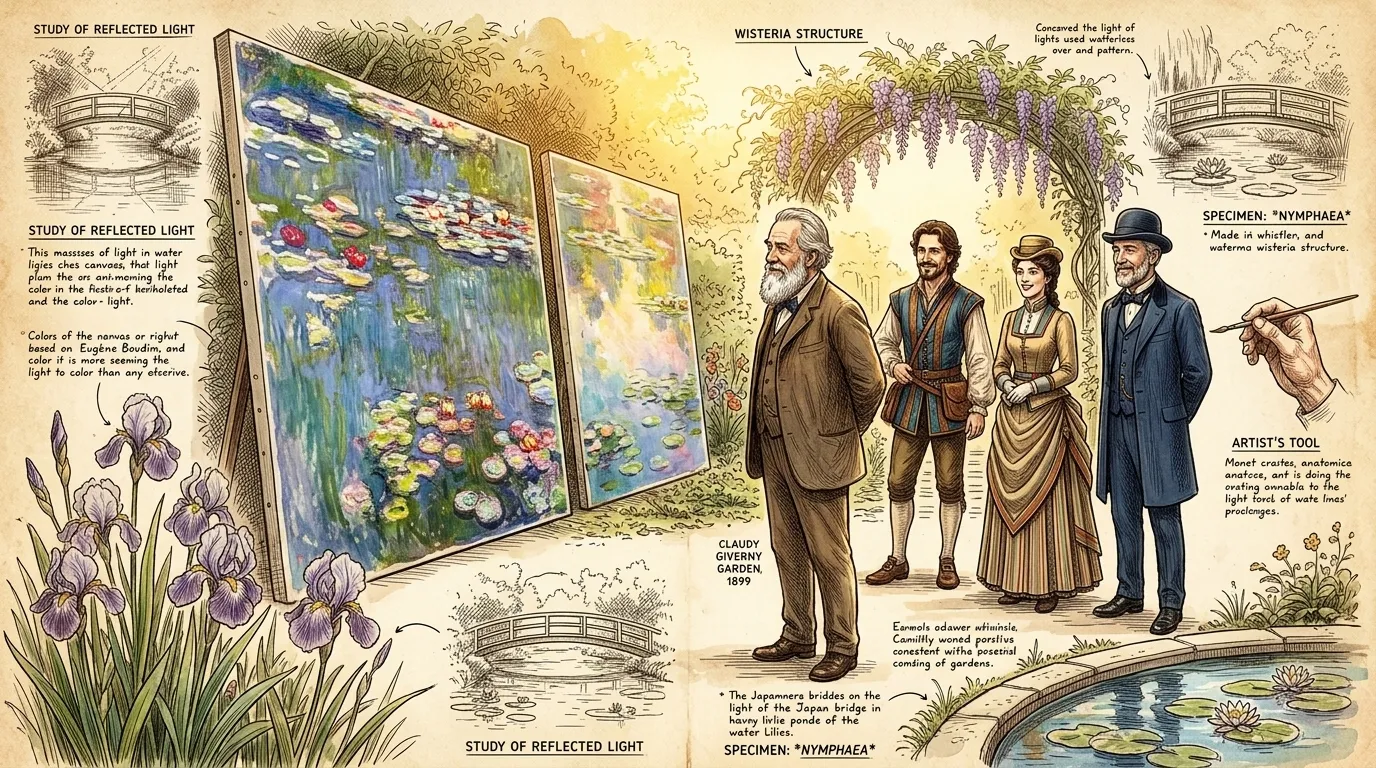
Claude Monet stands before his 'Water Lilies' series in his Giverny garden, 1899. The monumental canvases, some stretching over 20 feet, are not mere depictions of flowers, but reflections of a lifetime spent observing the nuances of light and color. These works, now housed in museums worldwide, represent Monet's dedication to capturing fleeting moments of beauty.
"Monet murmurs, "To see is to forget the name of the thing one sees,' as Christian Morgenstern said. I strive to forget the world and only see the light.""
Art Fact: The 'Water Lilies' series, also known as 'Nymphéas', comprises approximately 250 paintings which Monet painted over the last thirty years of his life in Giverny.
Page 2
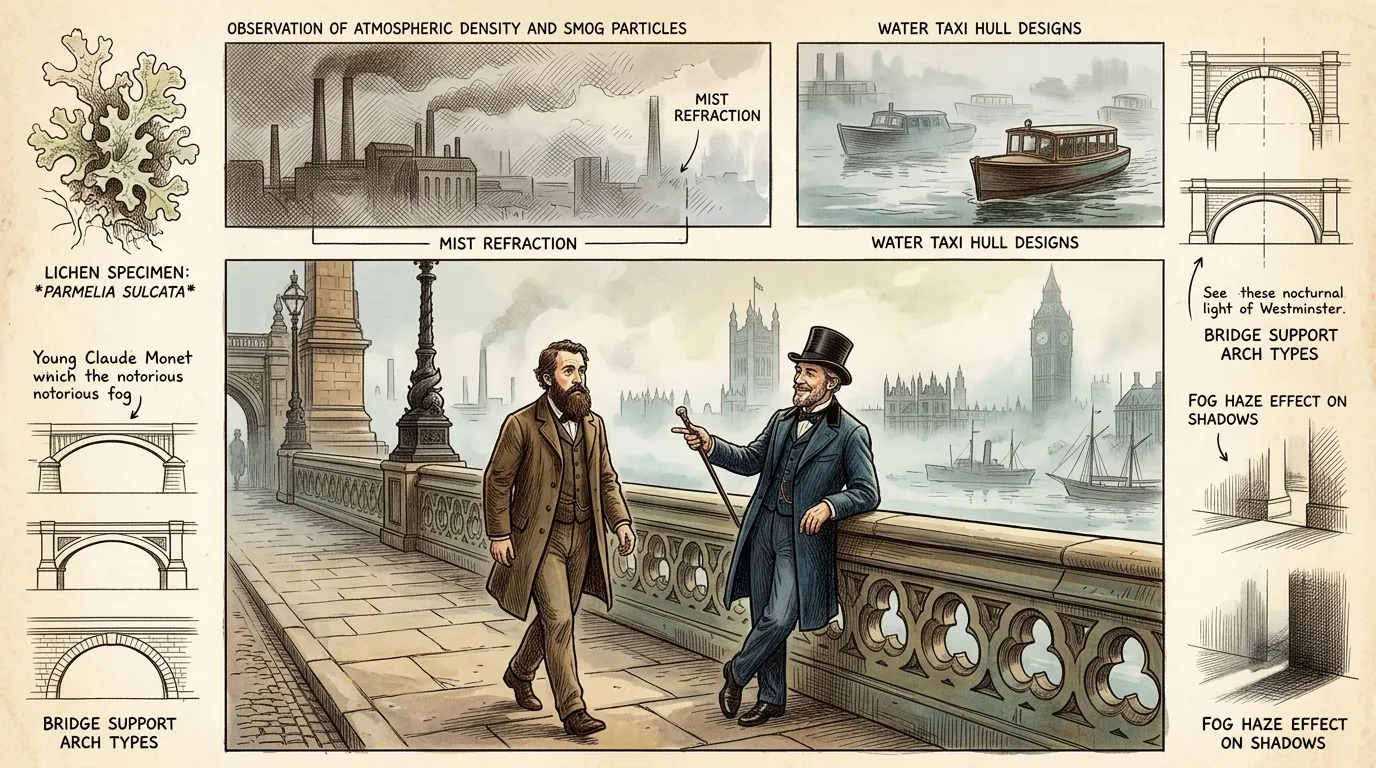
A young Monet, during his time in London, is captivated by the ethereal effects of the city's notorious fog. He strolls along the Thames, observing how the mist softens the harsh edges of the industrial landscape, transforming familiar scenes into dreamlike visions. It's here he begins to understand the power of atmosphere in painting.
"Whistler, leaning on the bridge's railing next to Monet, remarks, 'The fog transfigures everything, Monet. As Oscar Wilde said, 'Mere facts are of no importance at all; it is only feeling that counts'.'"
Art Fact: Monet's London paintings, particularly those depicting the Thames, foreshadow his later obsession with capturing fleeting atmospheric effects.
Page 3
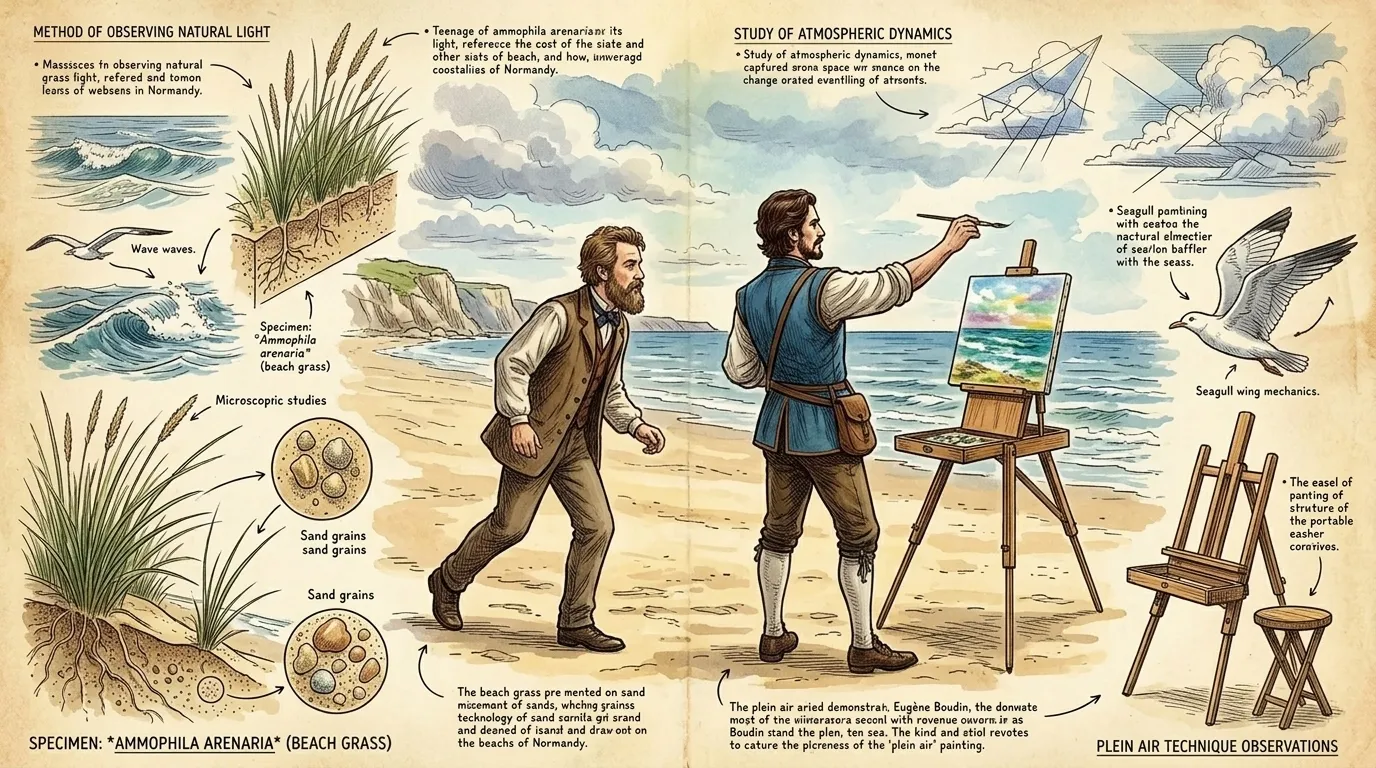
A teenage Monet, initially a caricaturist, encounters Eugène Boudin on the beaches of Normandy. Boudin, an advocate of 'plein air' painting, encourages Monet to abandon his caricatures and embrace the direct observation of nature. He teaches Monet to capture the light and atmosphere of the sea and sky. This encounter is pivotal in shaping Monet's artistic path.
"Boudin, holding a canvas, tells Monet, 'The artist should paint what he sees, not what he knows is there. As Gustave Courbet said, 'Painting is essentially a concrete art and must be applied to real and existing things.''"
Art Fact: Eugène Boudin was one of the first artists to encourage Monet to paint outdoors, a practice that would become central to Impressionism.
Page 4
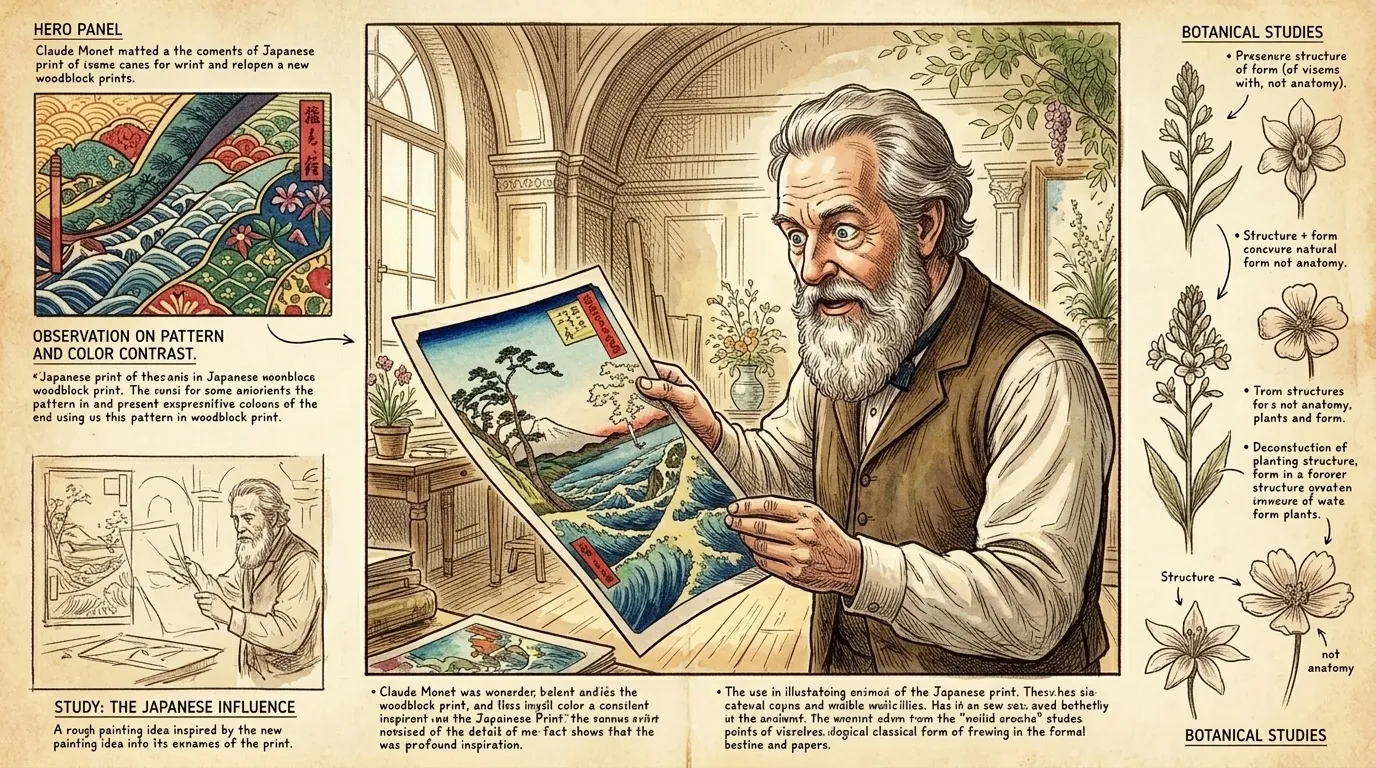
Monet becomes fascinated with Japanese woodblock prints, particularly those of Hokusai and Hiroshige. He is drawn to their bold compositions, flattened perspectives, and vibrant color palettes. This discovery influences his own work, leading him to experiment with asymmetrical arrangements and unconventional viewpoints. The Japanese aesthetic opens up new possibilities for depicting the natural world.
"Monet exclaims, gazing at a print, 'Such simplicity, such elegance! As Hokusai himself said, 'All I have done before the age of seventy is not worth bothering with. At seventy-three I have learned a little about the real structure of nature, of animals and plants, of trees and birds, of fishes and insects.''"
Art Fact: Monet's collection of Japanese prints was extensive and deeply influenced his artistic vision, particularly in his composition and use of color.
Page 5
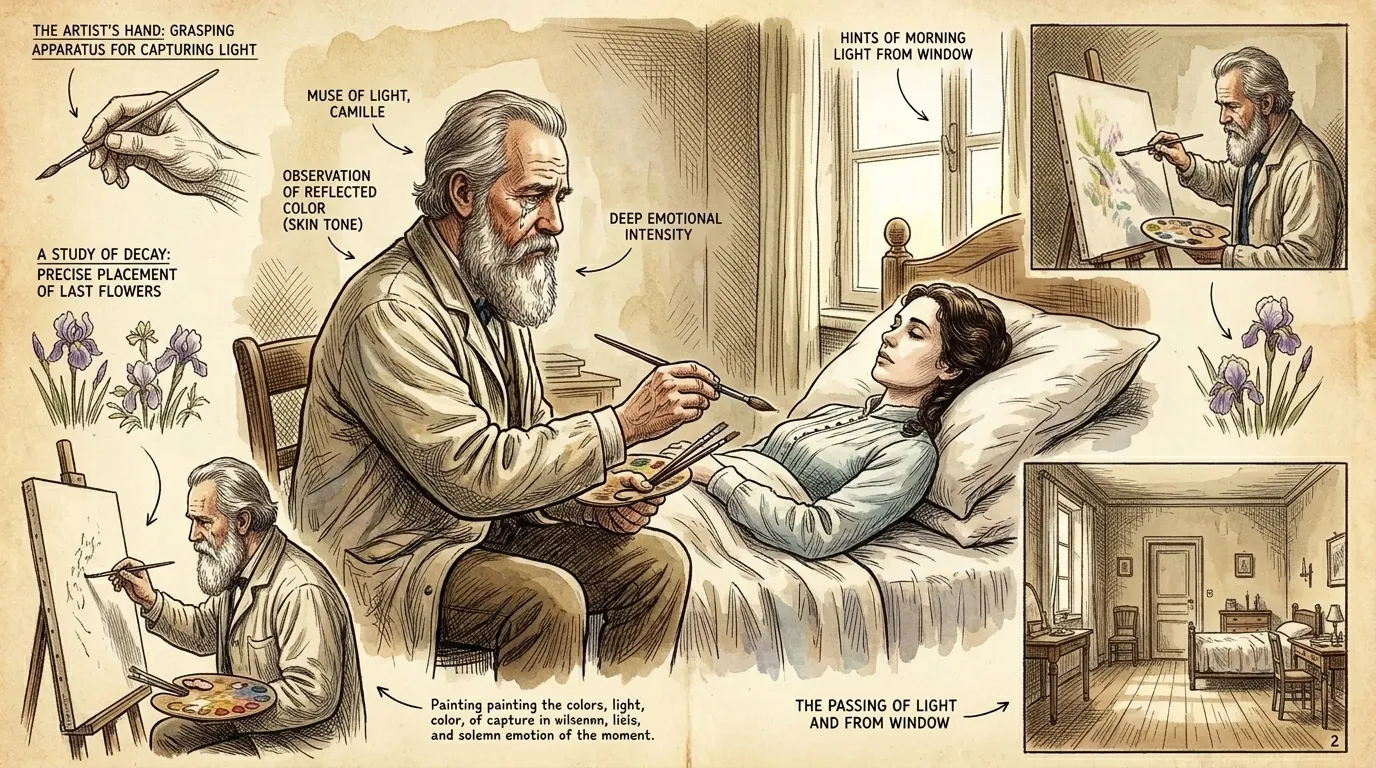
Monet's first wife, Camille Doncieux, is his muse and confidante. Her sudden death deeply affects Monet. He captures her on her deathbed, but it's the earlier joy they found together by the Seine that fuels his artistic explorations. The river becomes a recurring theme, a testament to their love and his grief.
"A tearful Monet, painting Camille on her deathbed, whispers, 'Life is hard, Camille. As Alfred de Musset wrote, 'Man often thinks he directs his life, when in reality it is his life that directs him.''"
Art Fact: Monet painted Camille on her deathbed, capturing the subtle changes in color and light on her face in his distinctive Impressionistic style.
Page 6
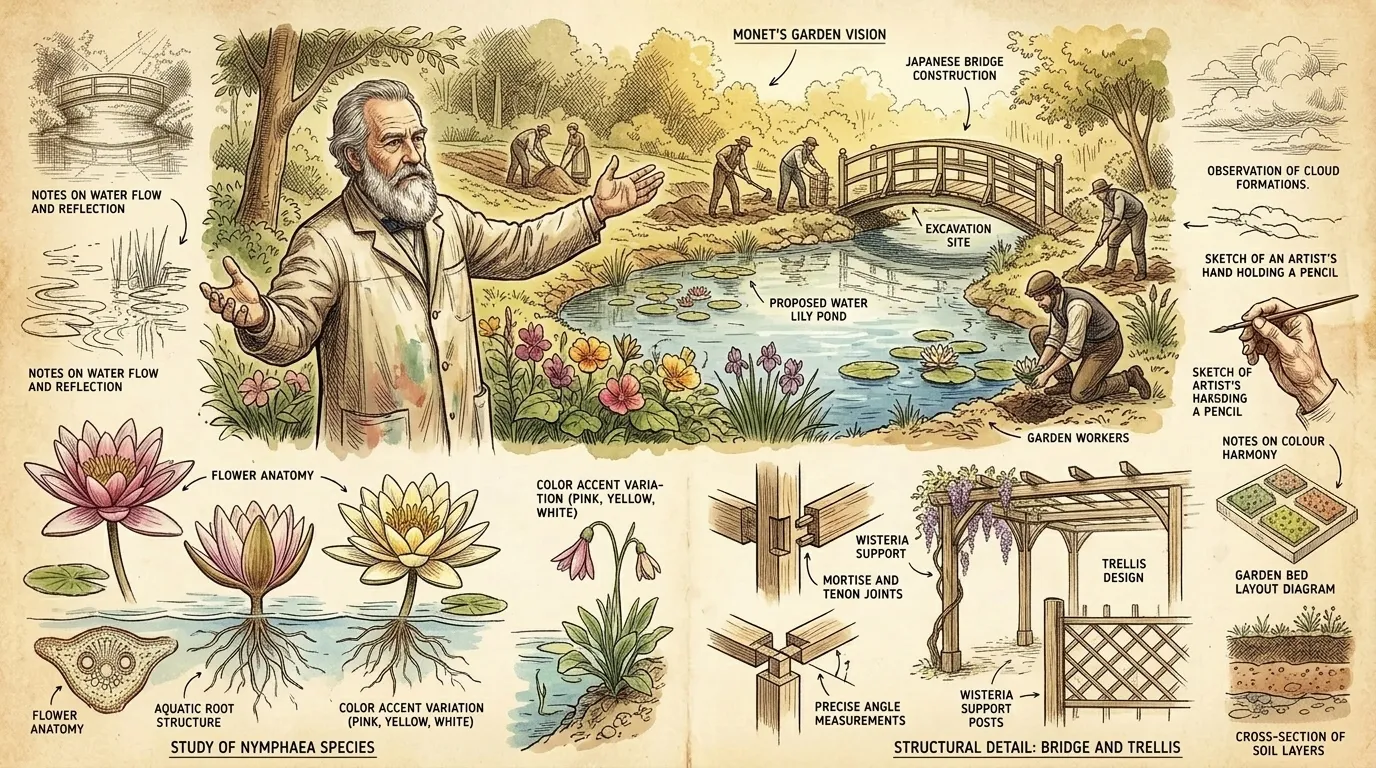
Monet moves to Giverny and begins to transform his garden into a living canvas. He designs the water garden with its iconic Japanese bridge and plants the water lilies that will become the subject of his most famous series. The garden is more than just a source of inspiration; it is an extension of his artistic vision, a place where he can control the light, color, and composition of his paintings.
"Monet, surveying his new garden, states, 'This will be my greatest masterpiece. As Voltaire said, 'One must cultivate one's own garden.''"
Art Fact: Monet meticulously designed his garden at Giverny, creating the perfect environment for his artistic pursuits.
Page 7
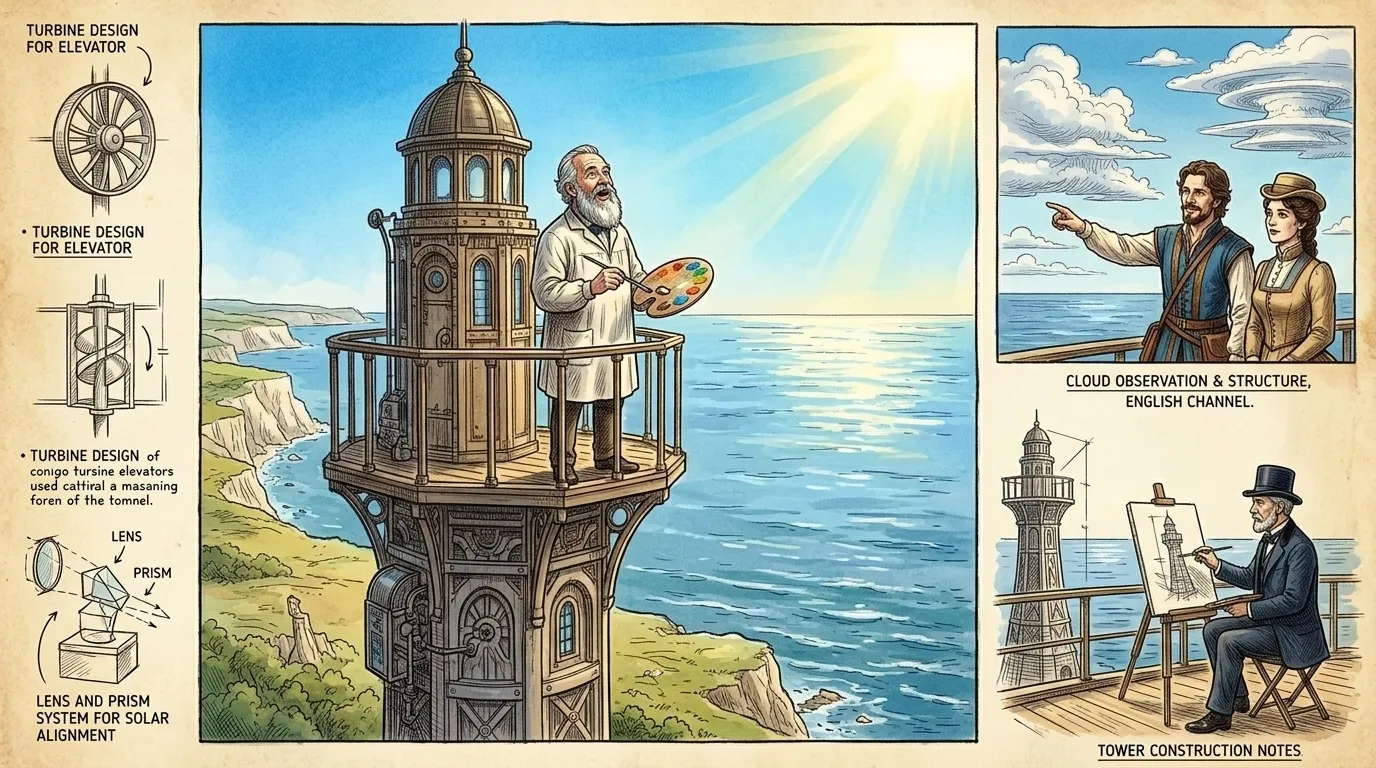
As Monet ages, his eyesight begins to fail. Cataracts cloud his vision, distorting his perception of color. After a successful eye surgery, his world is reborn. He marvels at the intensity of blues and yellows he had forgotten. This newfound clarity reinvigorates his painting, prompting him to revisit his earlier works and refine his vision.
"Monet, after his eye surgery, exclaims, 'The world is brighter than I remembered! As Helen Keller, who also struggled with vision, said, 'The best and most beautiful things in the world cannot be seen or even touched - they must be felt with the heart.''"
Art Fact: Monet's cataract surgery significantly altered his perception of color, leading him to repaint many of his earlier works.
Page 8
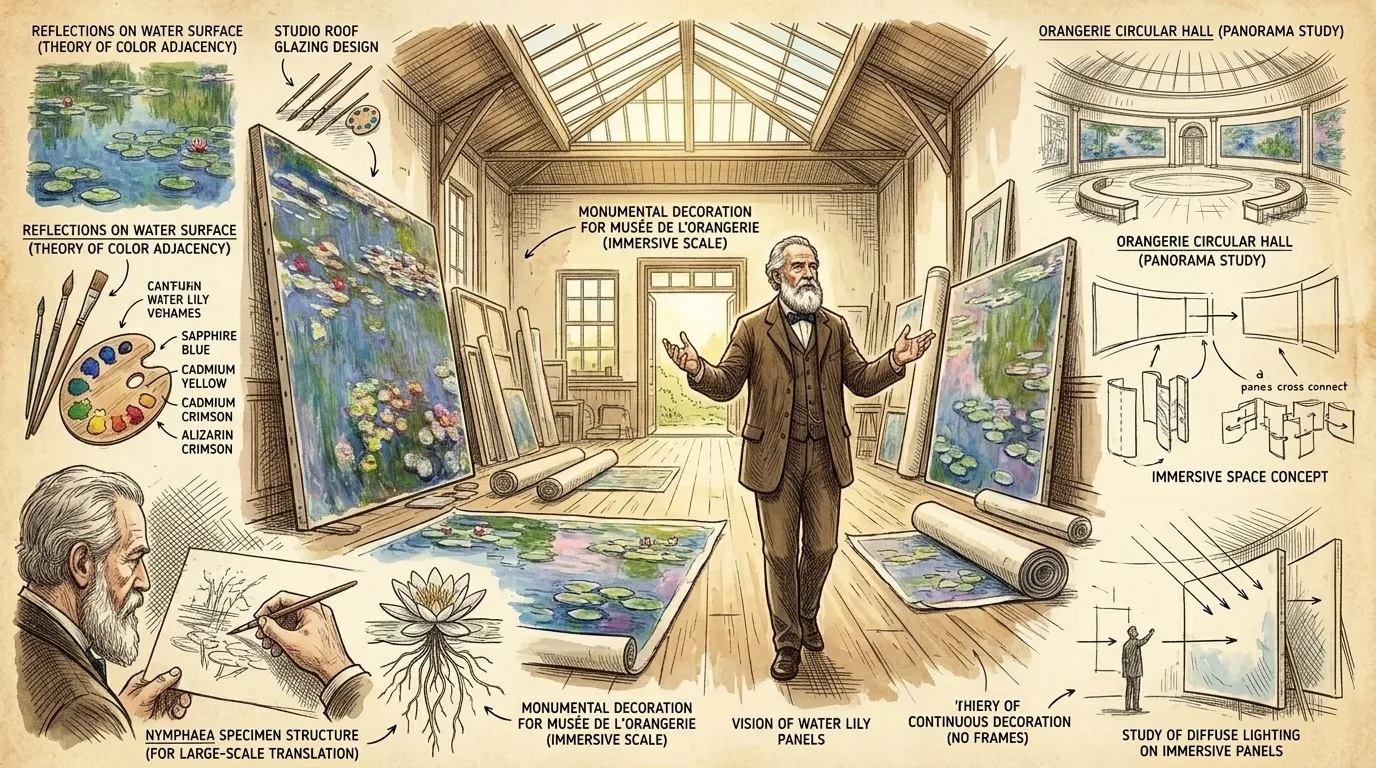
In his later years, Monet conceives of a monumental installation of his 'Water Lilies' for the Musée de l'Orangerie in Paris. He envisions a series of large-scale canvases that will envelop the viewer in a world of color and light. The installation becomes a testament to his lifelong dedication to capturing the essence of nature.
"Monet, pacing his studio, declares, 'This will be my legacy, a refuge for the soul. As Albert Camus wrote, 'In the depths of winter, I finally learned that within me there lay an invincible summer.''"
Art Fact: Monet's 'Water Lilies' installation at the Musée de l'Orangerie is a testament to his ambition and his desire to create an immersive artistic experience.
Page 9
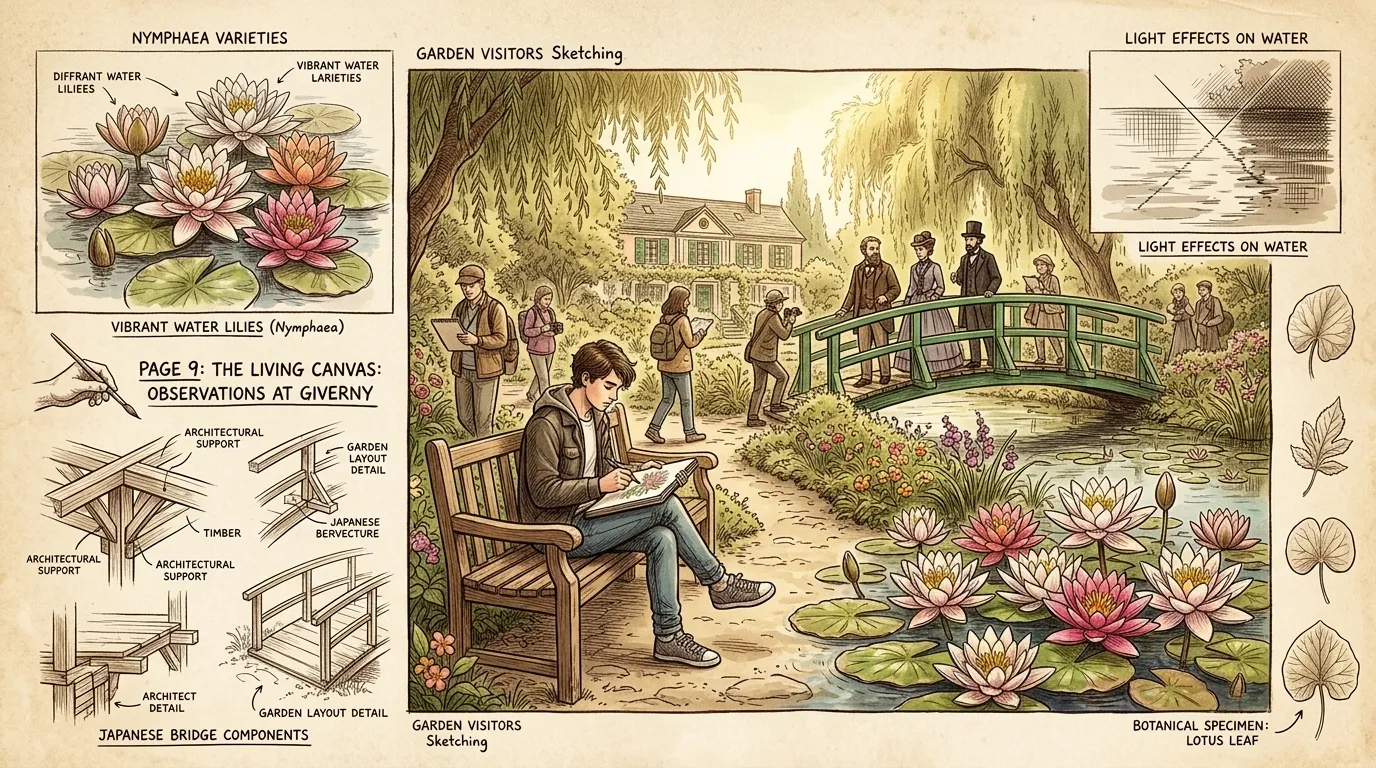
Years after Monet's death, his garden at Giverny is carefully preserved, drawing visitors from around the world. The 'Water Lilies' continue to inspire and captivate, their beauty undiminished by time. Monet's vision lives on, a testament to the power of art to transcend generations. A new generation of artists visits Giverny to soak in his inspiration.
"A young artist sketching in Giverny reflects, 'Monet's garden is a reminder of the power of observation. As Leonardo da Vinci said, 'Study the science of art. Study the art of science. Develop your senses. Especially learn how to see. Realize that everything connects to everything else.''"
Art Fact: Monet's garden at Giverny continues to inspire artists and art lovers from around the world, ensuring his legacy for generations to come.
Page 10
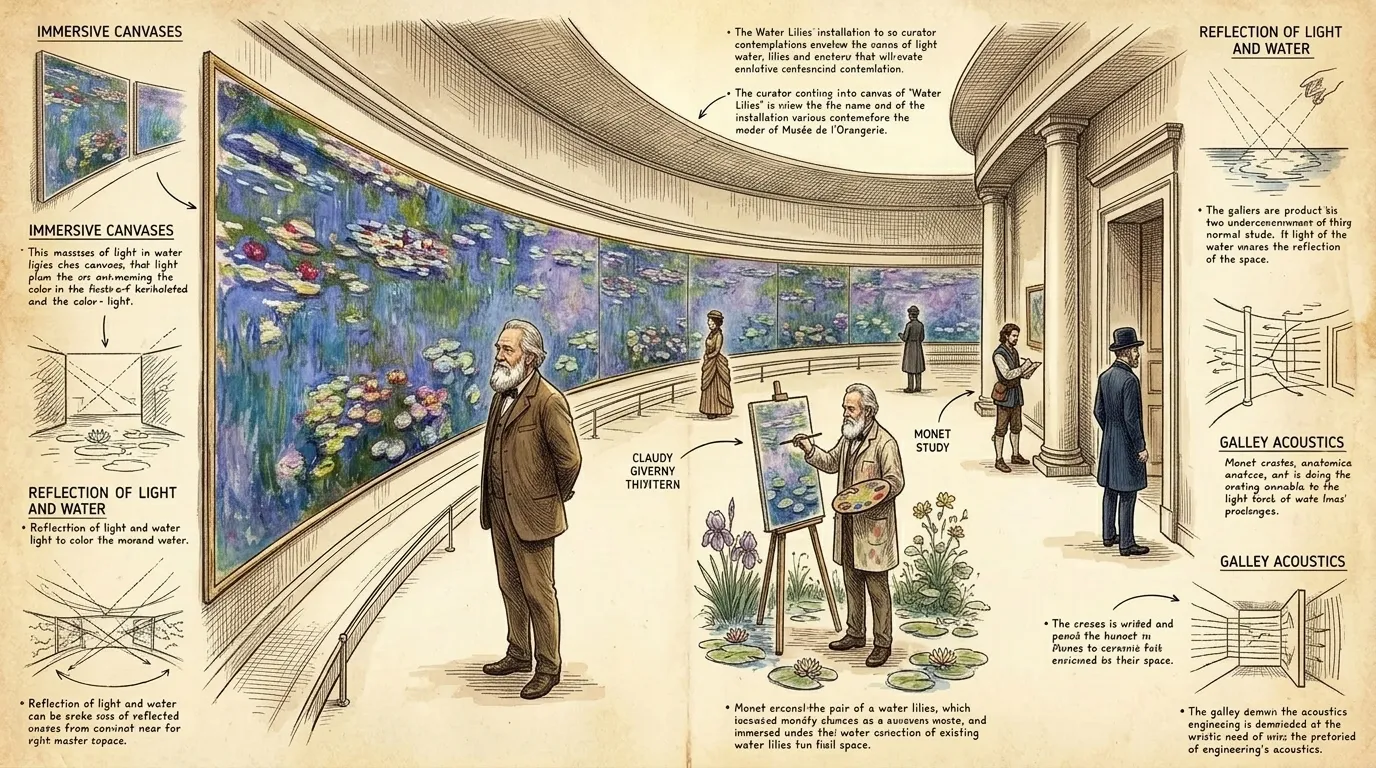
Today, Monet's 'Water Lilies' are celebrated globally, representing the epitome of Impressionism. Their beauty transcends borders and generations, inspiring artists and art enthusiasts. His paintings remind us of the ephemeral nature of beauty and the artist's eternal quest to capture it.
"A museum curator, standing before the Orangerie installation, muses, 'Monet gave us more than just paintings; he gave us a new way of seeing. As Vincent van Gogh said, 'I dream my painting, and then I paint my dream.''"
Art Fact: Monet's 'Water Lilies' series is considered one of the most important achievements of Impressionism and continues to inspire artists and art lovers worldwide. Monet's work survives because it is an endless reflection of the beauty he found in the world.
About this story
- Location: France
- Audience: kids (ages 6–12)
Questions and answers
Questions and answers about Water Lilies by Claude Monet (Giverny, France — 1899)
Read Wonder Arts on your phone
Wonder Arts is available on Android and iPhone and iPad. Get Wonder Arts on Google Play · Get Wonder Arts on the App Store.
More Wonder Arts stories
- Whistler’s Mother by James McNeill Whistler (Paris, France — 1871)
- Winged Victory of Samothrace by a Greek artist (Paris, France — c. 200 BC)
- Ziggurat of Ur (Iraq — c. 2100 BC)
- A Burial at Ornans by Gustave Courbet (France — 1849)
- A Cavalier by Frans Hals (Australia — 1624)
- A Sunday on La Grande Jatte by Georges Seurat (Paris, France — 1884)