Whistler’s Mother by James McNeill Whistler (Paris, France — 1871)
Whistler’s Mother by James McNeill Whistler (Paris, France — 1871) — an illustrated arts story, set in France. 10 illustrated pages, free to read on Wonder Arts.
Page 1
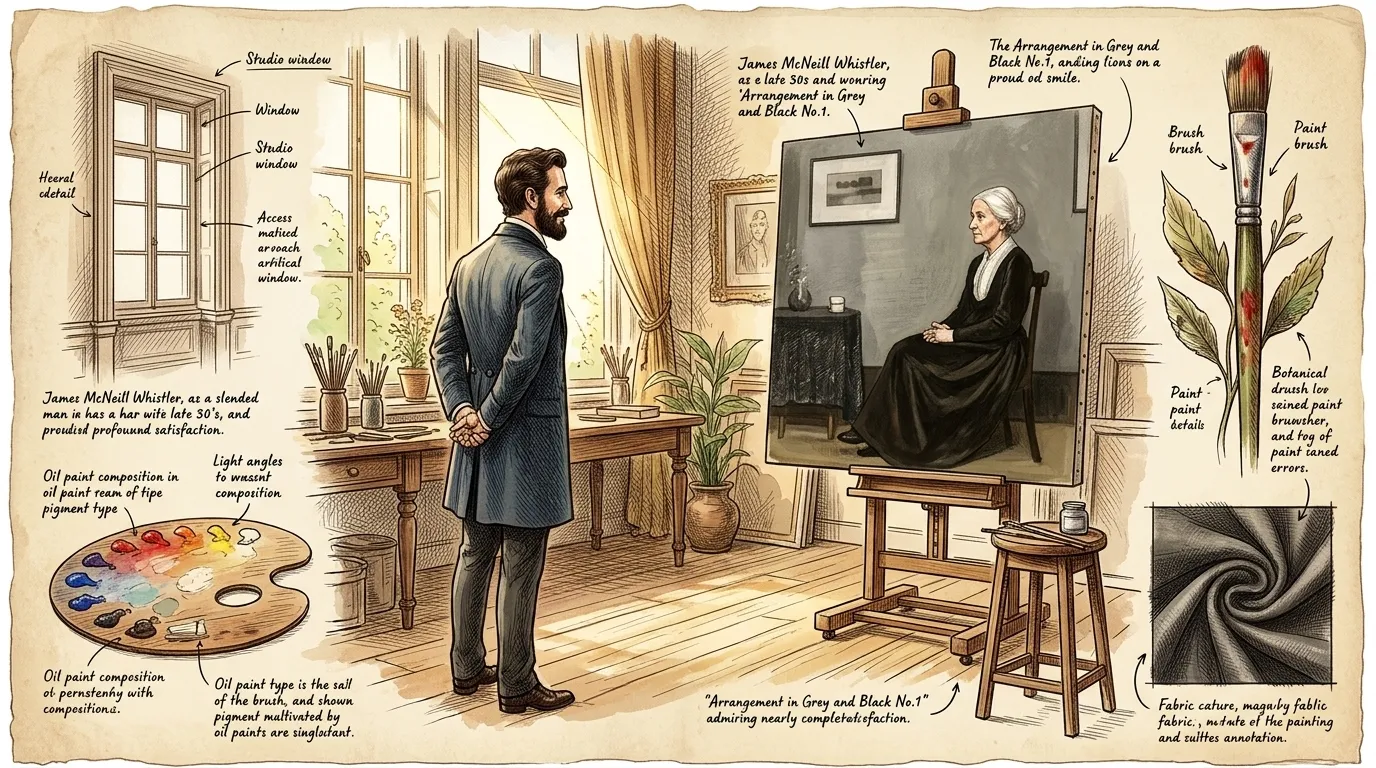
James McNeill Whistler, a name synonymous with artistic innovation, stands before his most famous work: 'Arrangement in Grey and Black No.1,' universally known as 'Whistler's Mother.' Painted in 1871 in Paris, this portrait transcends simple representation. It measures 144.3 cm 162.5 cm (56.8 in 64.0 in). What many don't know is that the model was initially intended to be another woman, but when she failed to appear, Whistler's mother, Anna McNeill Whistler, stepped in. The painting is currently housed at the Musée d'Orsay in Paris.
""This, more than a portrait, is an arrangement," Whistler murmurs, stepping back to view his completed work. "A symphony of line and tone.""
Art Fact: Whistler's Mother, also known as Arrangement in Grey and Black No.1, is among the most famous works by James McNeill Whistler, showcasing his aesthetic principles of 'art for art's sake.'
Page 2
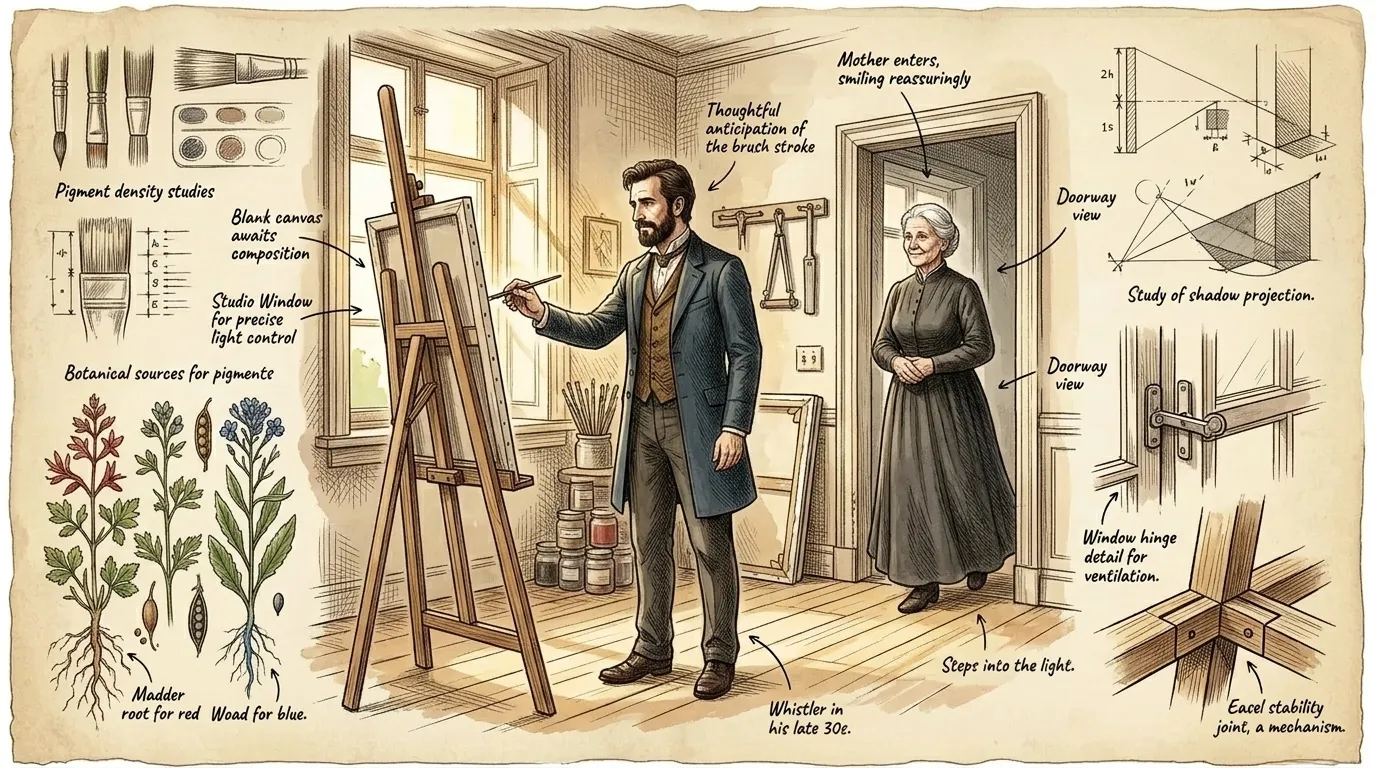
Whistler's model, as planned, did not arrive, creating a problem. He was in his studio, ready to work, when his mother arrived. This moment of near disappointment became the origin of his most famous work.
""James, dear," Anna said gently, entering the studio. "Your model didn't make it? I am happy to sit for you if need be, dear.""
Art Fact: The initial model's failure to appear was a twist of fate that led Whistler to portray his mother, immortalizing her in art.
Page 3
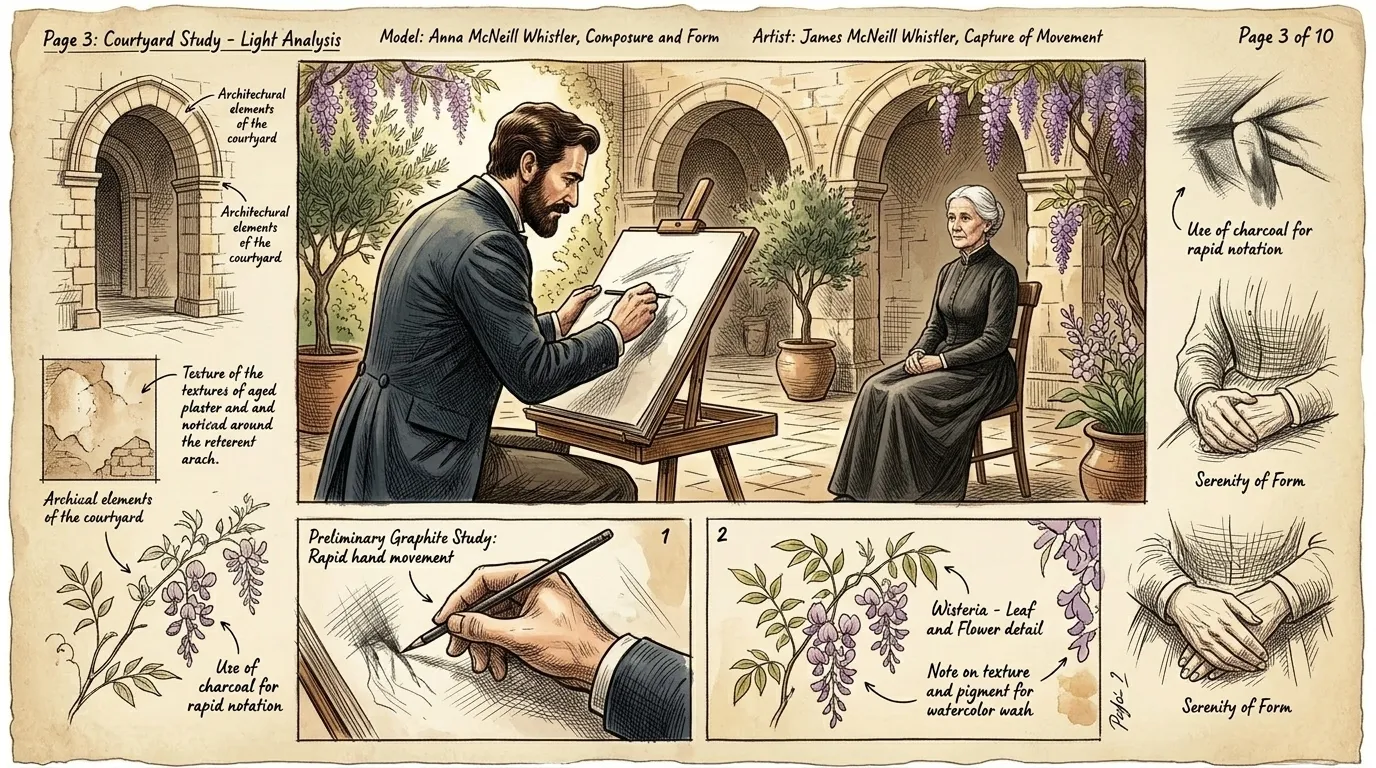
As Whistler began his preliminary sketches, his mother's still and quiet presence allowed him to focus on the arrangement of lines and tones. The early concepts were rough, but the foundation of the artwork was visible. He later reflected, 'An artist is not paid for his labor but for his vision.'
""Mother, please, a moment longer," James says, intensely sketching. "Your stillness is the key to unlocking this composition.""
Art Fact: Whistler's initial sketches reveal his primary concern was the arrangement of forms and tones, not merely a literal depiction.
Page 4
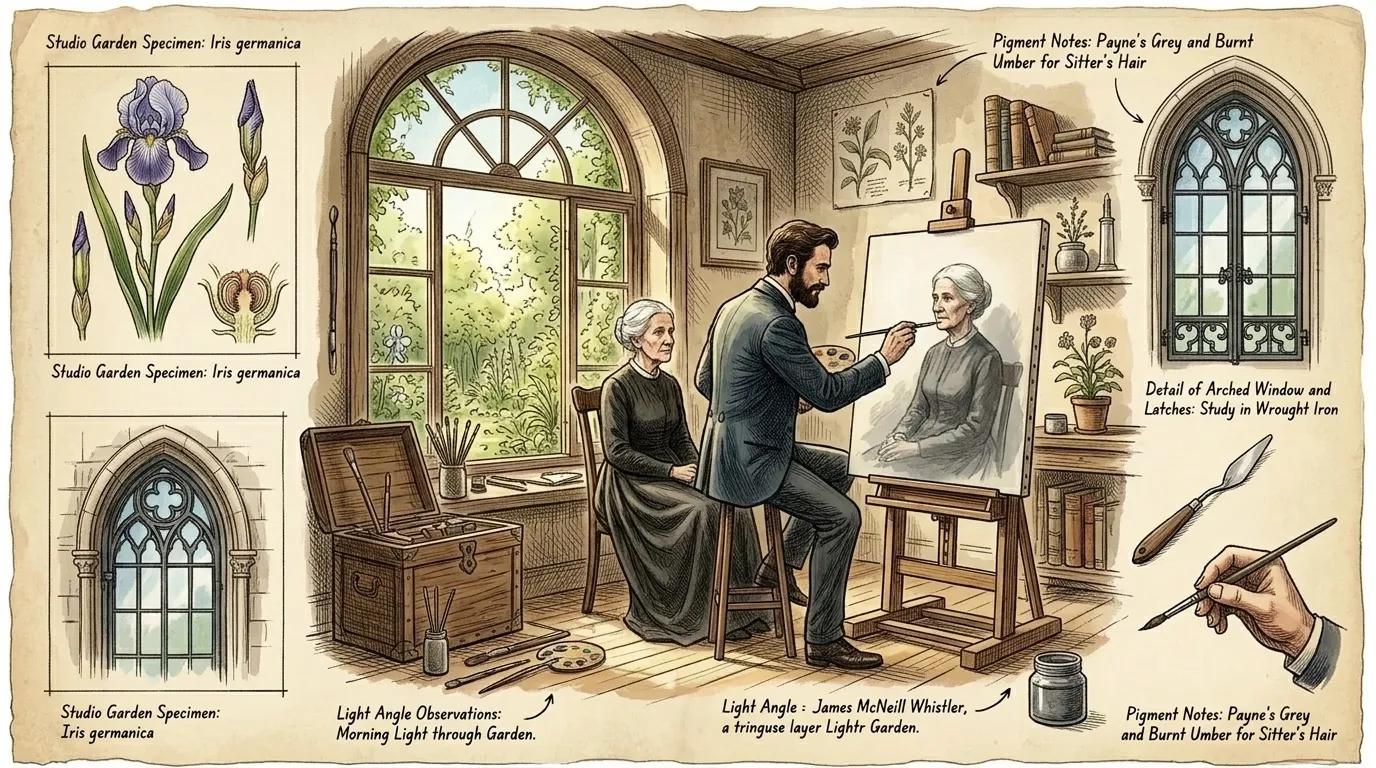
Days turned into weeks as Whistler meticulously built up the composition. He carefully considered the precise placement of every element, focusing on the interplay of light and shadow. Whistler experimented, he said of his technique, "to bring about that particular harmony of color.'"
""The grey, Mother, the subtle grey is what gives it its peace," Whistler murmurs, applying a delicate layer of paint. "It's the soul of the composition.""
Art Fact: Whistler's focus on tonal harmony and the arrangement of forms demonstrates his commitment to aesthetic principles over mere representation.
Page 5
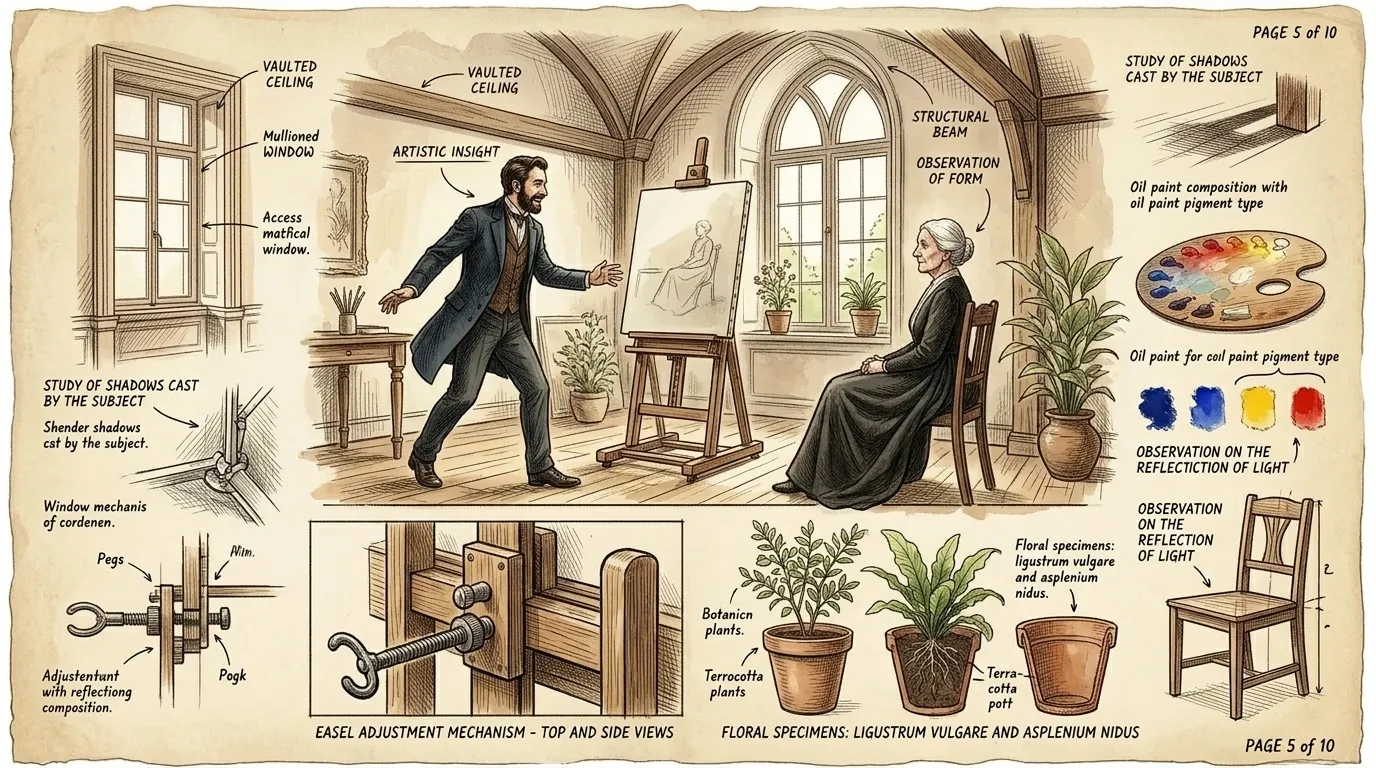
The moment of clarity arrived when Whistler realized the power of simplicity. Reducing the palette and focusing on the essential forms brought the painting to life. Whistler exclaimed, 'By placing a greater distance between himself and the subject, the artist lets us look at it from slightly further away so that we may appreciate it more fully.'
""It is not about likeness, Mother, but about presence," Whistler declares, stepping back from the painting. "The truth lies in the arrangement, not in the detail.""
Art Fact: The breakthrough came as Whistler embraced a more minimalist approach, stripping away unnecessary detail to focus on the essential harmony of forms.
Page 6
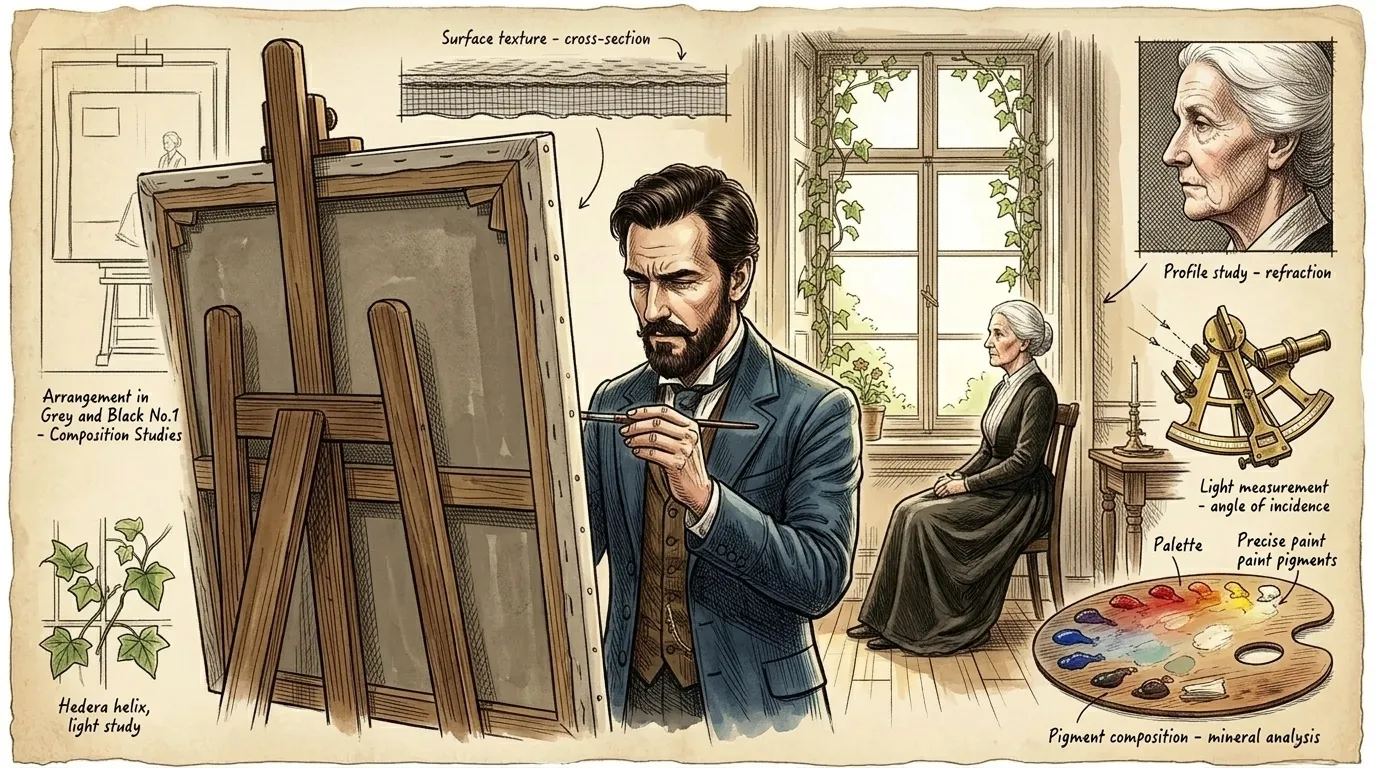
With the composition established, Whistler meticulously refined the details, balancing light and shadow to create depth and atmosphere. He spent hours adjusting the tones, pursuing a perfect balance. He once said, 'To say to the painter, that Nature is to be taken as she is, is to say to the player, that he may sit on the piano.'
""The balance, Mother, it is all about the balance," Whistler explains, squinting at the canvas. "A little more grey here, a little less black there.""
Art Fact: Whistler's meticulous approach to detail and tonal balance reveals his dedication to achieving a perfect harmony of form and color.
Page 7
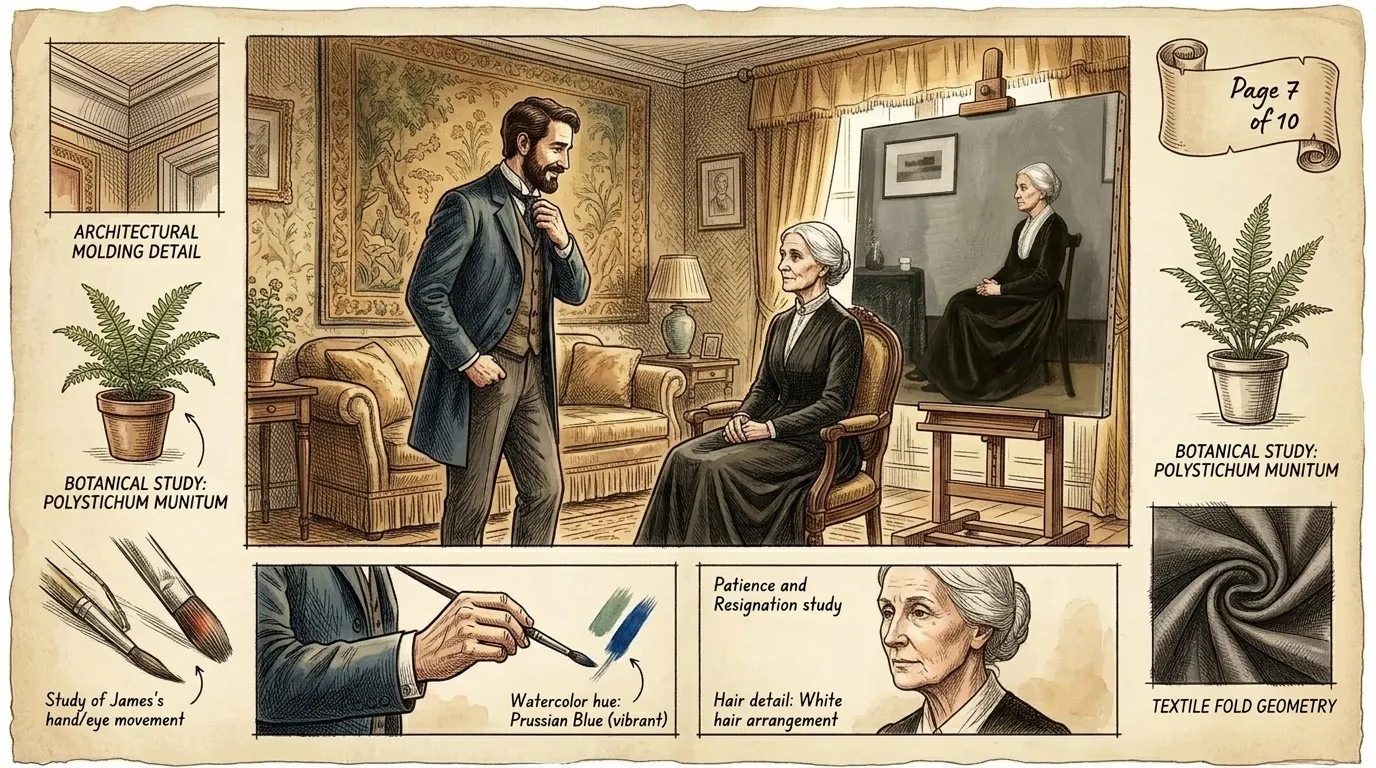
Anna McNeill Whistler endured countless hours of posing, providing the stillness and quiet that Whistler needed to bring his vision to life. Her stoicism became an essential part of the painting's character.
""You have the patience of a saint, Mother," Whistler acknowledges, admiring her composure. "Your presence brings a depth to the work that I could never have imagined.""
Art Fact: Anna McNeill Whistler's enduring patience was crucial to Whistler's creative process, providing him with the stillness needed to capture his vision.
Page 8
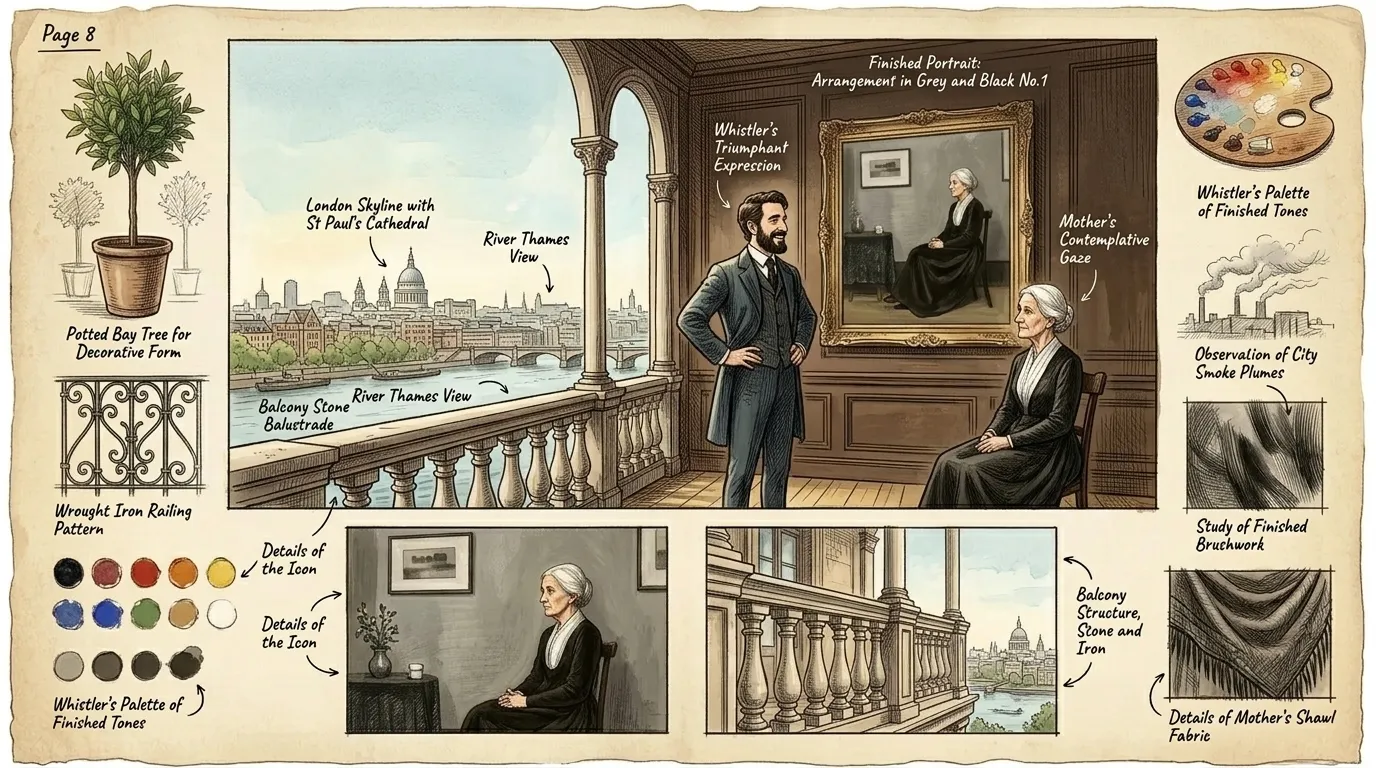
Finally, the painting was complete. Whistler stepped back, satisfied. He knew he had created something that transcended the traditional portrait, achieving an aesthetic masterpiece. As Leonardo da Vinci said, 'Painting embraces all the ten functions of the eye; that is to say, darkness, light, body and colour, shape and location, distance and nearness, motion and rest.'
""Finished," Whistler announces, his voice filled with relief and pride. "An arrangement, a symphony, a tribute.""
Art Fact: With the painting completed, Whistler recognized that he had created more than a portrait – he had achieved an aesthetic masterpiece.
Page 9
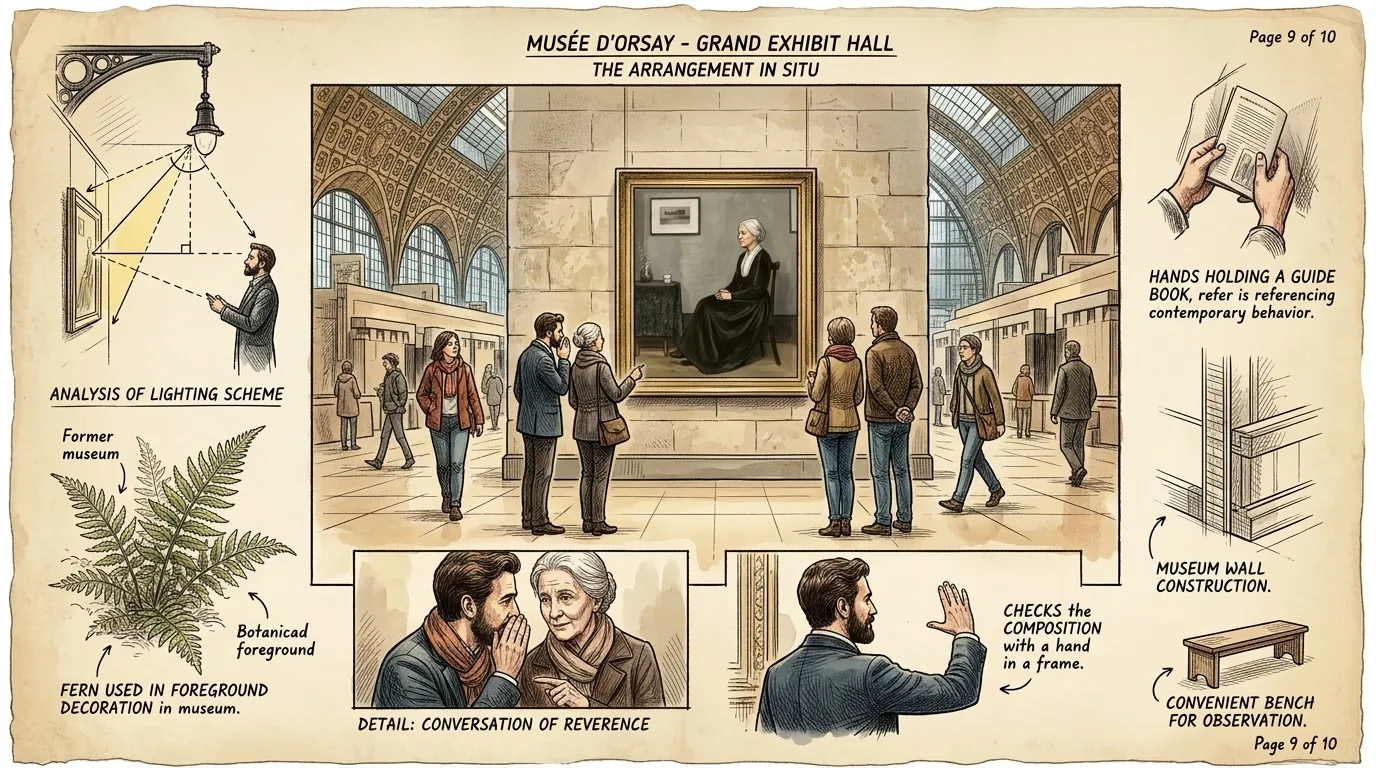
Today, 'Whistler's Mother' hangs in the Musée d'Orsay, Paris, a celebrated masterpiece viewed by thousands each year. It's a symbol of artistic vision, familial love, and the power of subtle beauty. The world recognized what James had created.
""That's a beautiful painting," an admirer whispers, gazing at 'Whistler's Mother.'"
Art Fact: The painting hangs in the Musée d'Orsay, Paris, where its quiet beauty continues to inspire art lovers from around the world.
Page 10
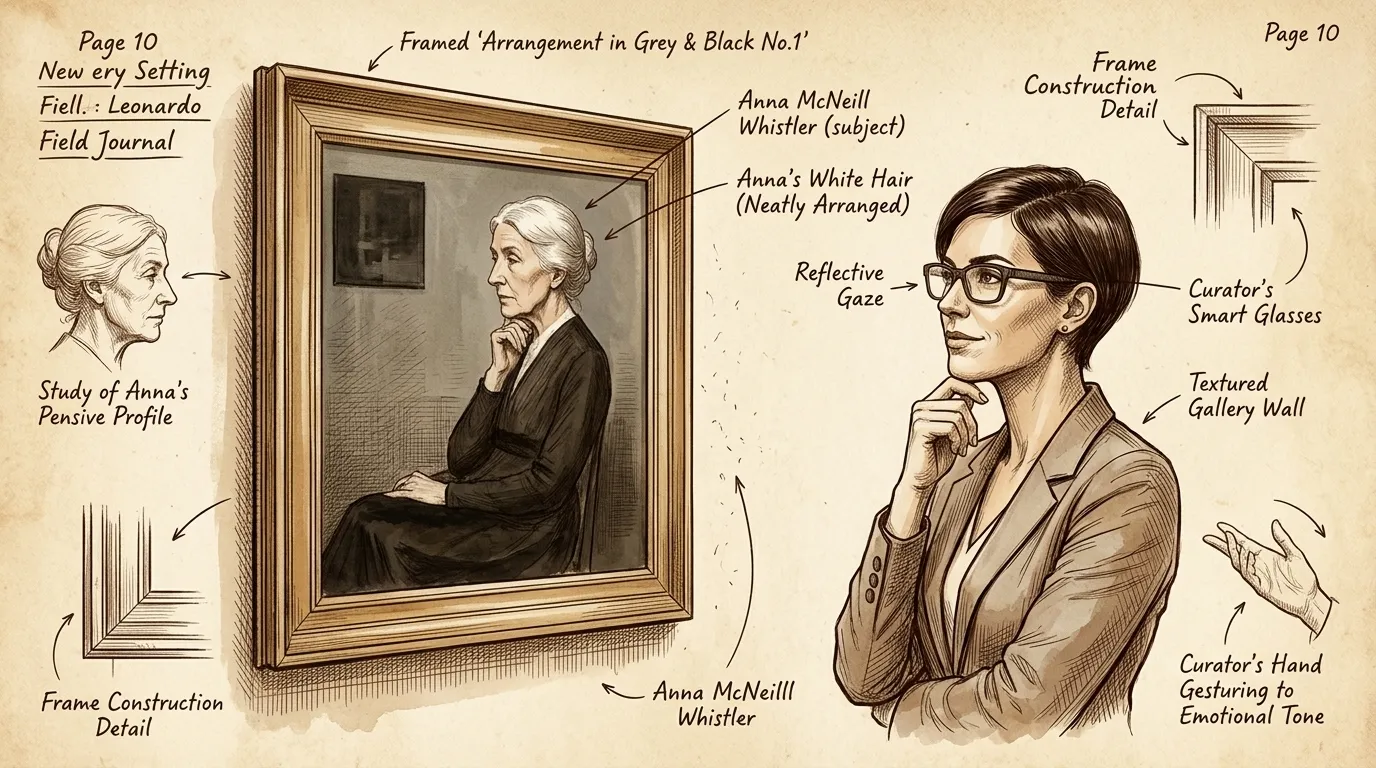
'Whistler's Mother' remains an iconic image, a testament to the power of artistic vision and the beauty of quiet contemplation. It stands not merely as a portrait but as an arrangement of form, tone, and emotion that speaks across generations. Whistler's vision survives because art, at its best, captures the essence of what it means to be human.
"A curator reflects, "Whistler taught us to see beyond the subject, to appreciate the pure beauty of art itself. That is why his work endures.""
Art Fact: 'Whistler's Mother' continues to inspire, demonstrating the enduring power of artistic vision to capture the essence of human experience.
About this story
- Location: France
- Audience: general readers
Questions and answers
Questions and answers about Whistler’s Mother by James McNeill Whistler (Paris, France — 1871)
Read Wonder Arts on your phone
Wonder Arts is available on Android and iPhone and iPad. Get Wonder Arts on Google Play · Get Wonder Arts on the App Store.
More Wonder Arts stories
- Winged Victory of Samothrace by a Greek artist (Paris, France — c. 200 BC)
- Ziggurat of Ur (Iraq — c. 2100 BC)
- A Burial at Ornans by Gustave Courbet (France — 1849)
- A Cavalier by Frans Hals (Australia — 1624)
- A Sunday on La Grande Jatte by Georges Seurat (Paris, France — 1884)
- Abbey in the Oakwood by Caspar David Friedrich (Germany — 1810)