The Bust of Nefertiti
The Bust of Nefertiti — an illustrated history story. 10 illustrated pages, free to read on Wonder Egypt.
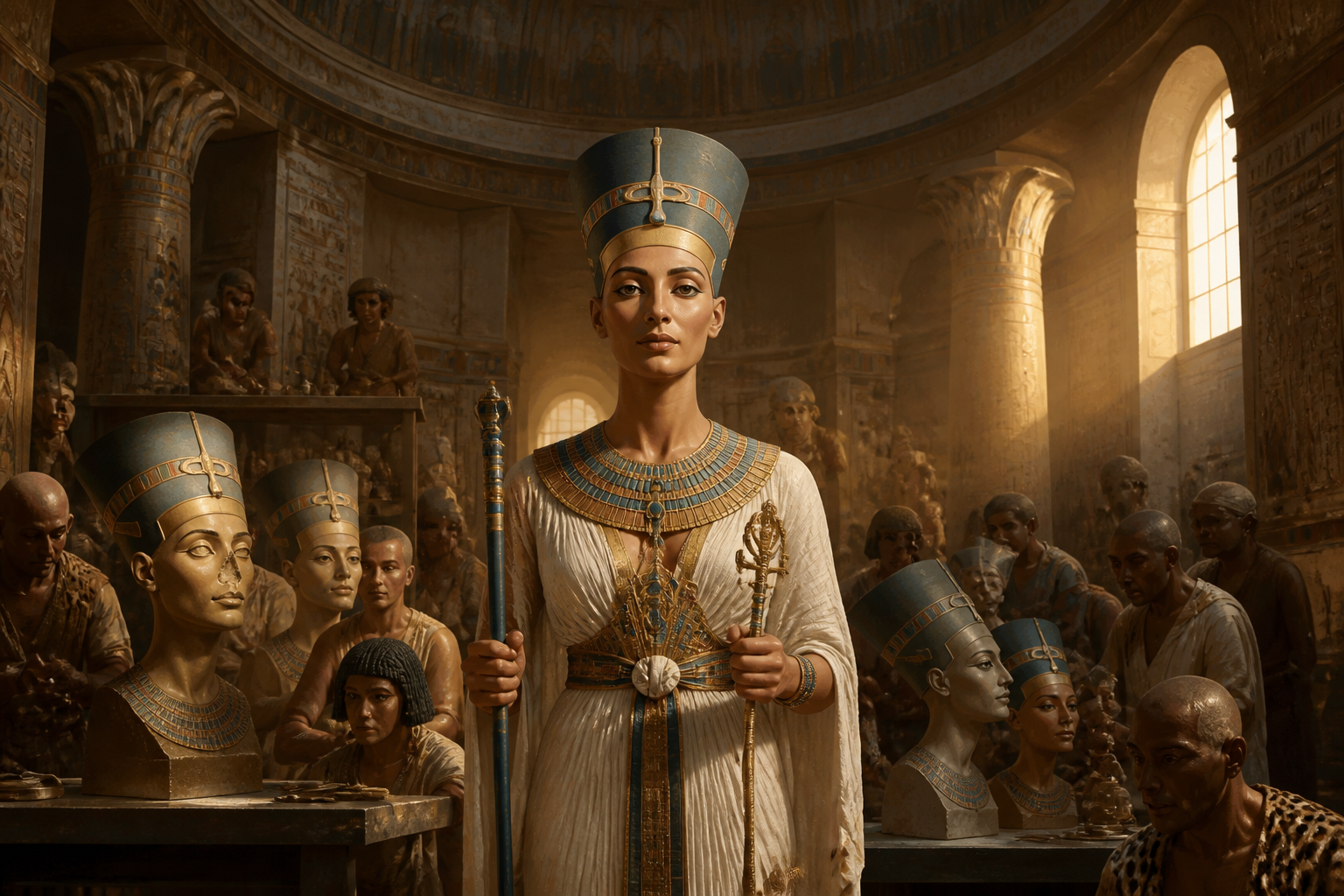
Page 1 — The Gaze of Eternity

The room is filled with a soft, ambient light that highlights the serene beauty of the Bust of Nefertiti. Crafted from limestone and finished with a delicate plaster skin, this iconic piece is housed in the domed room of the Neues Museum, Berlin. Her left eye glistens with inlaid quartz, while the right socket remains mysteriously empty, an omission that adds to her enigmatic allure. Visitors marvel at the elegant symmetry of her features, emblematic of the Amarna art style, which aimed to capture a divine ideal. This piece stands as a testament to the skill of the sculptor Thutmose and the shifting artistic ideals under Akhenaten's reign. The bust is flanked by unfinished study heads, as if frozen in the act of becoming.
Akhenaten: 'Let her likeness echo the beauty of Aten's light.'
Page 2 — Faces in Waiting

In the quietude of the museum, rows of plaster study heads stand as silent witnesses to the past. These unfinished faces were sculpted in the workshop of Thutmose, where apprentices learned their craft by replicating the idealized forms of the royal family. Each head bears the soft, elongated features characteristic of the Amarna period, with high cheekbones and serene expressions. The heads, while unfinished, offer insight into the artistic process and the educational methods of the time. They capture a moment frozen in time, where each curve and line was a deliberate step towards perfection. The presence of these heads alongside the Bust of Nefertiti suggests a workshop bustling with creativity and reverence for the divine likenesses they sought to immortalize.
Thutmose: 'Each face a canvas, each stroke a prayer to eternity.'
Page 3 — Markers of a City

Carved into the cliffs of Amarna, the boundary stelae mark the physical and spiritual limits of Akhetaten, the city dedicated to Aten. These stone markers, set against the harsh Egyptian desert, were both a territorial claim and a divine invocation. Akhenaten himself is depicted, worshipping the sun disc Aten, alongside his family. The stelae, towering and imposing, stand resilient under the relentless sun, their inscriptions a testament to the religious fervor and political ambitions of Akhenaten’s reign. The engravings articulate a vision of monotheism that was radical for its time, a vision that dared challenge millennia of polytheistic tradition. Weathered by centuries, they remain resolute, reminders of the city that once was and the ideals upon which it was built, echoing with the chants of ancient rituals and the silent whispers of history.
Akhenaten: 'Here, we build not just a city, but the heart of eternity.'
Page 4 — The Silent Workshop

In the ruins of ancient Amarna, the workshop of Thutmose was uncovered, its work abruptly abandoned. Inside, tools lay scattered and half-finished sculptures stood upon dusty shelves. This place was a crucible of creativity where the skilled hands of artisans worked tirelessly to capture the beauty of their subjects. The discovery of the Bust of Nefertiti here, among these remains, speaks volumes about its intended use as a model, rather than for public display. Every chisel mark and unfinished piece tells of a time when art met divine purpose, echoing the tumultuous times of the Amarna period, a period rife with artistic innovation and religious upheaval. The silence in the workshop today contrasts with the once-bustling activity, whispering stories of ambition and devotion, where artistry sought to immortalize divine beauty in stone and plaster.
Thutmose: 'Here, amidst the dust and stone, we seek the face of the gods.'
Page 5 — Discovery in the Dust

The year was 1912 when archaeologist Ludwig Borchardt, leading an excavation at Amarna, stumbled upon the workshop of Thutmose. Hidden beneath centuries of sand, the workshop yielded a treasure trove of artistic relics, including the Bust of Nefertiti. Borchardt's heart raced as he uncovered the limestone masterpiece, its colors vivid even after millennia. This discovery was a monumental leap in our understanding of the art and culture of the Amarna period. The bust, exuding elegance and grace, stood distinct among the relics, her serene visage a snapshot of a world long past. Yet, the bust’s journey was only beginning, as it would soon traverse continents to find a new home. The sands of Amarna had concealed a legacy of beauty and artistic expression, now revealed to the world, prompting a reevaluation of history's artistic narrative.
Ludwig Borchardt: 'A find such as this, it is as if she breathes anew.'
Page 6 — A Contested Journey

In 1913, the Bust of Nefertiti was transported to Berlin, where it underwent restoration and was displayed to the public. The exquisite craftsmanship and beauty captivated an audience far removed from its origins. The bust, a masterpiece of ancient artistry, became a magnet for art lovers and historians alike, drawing them into the world of ancient Egypt. However, its acquisition was not without controversy. Since 1925, Egypt has persistently requested the return of this cultural treasure, citing its significance as a national emblem of identity and heritage. Germany, citing legalities of its acquisition, has rebuffed these requests. The bust stands not only as an object of beauty but as a focal point of cultural diplomacy and heritage debates, a silent testament to its enduring power, the debates around it mirroring the complexities of history and ownership.
James Simon: 'It belongs in Berlin now, a beacon of our shared human history.'
Page 7 — The Facing City

The city of Akhetaten, now known as Amarna, was a fleeting but profound episode in ancient Egypt's history. Established by Akhenaten around 1353 BC, it was a city dedicated to the worship of Aten, the sun disc. Its ruins, spread along the Nile, tell tales of a city that once thrived under the sun's embrace. The palaces and temples, now eroded by time, once stood as grand embodiments of Akhenaten's revolutionary monotheistic vision. Yet, after his death, the city was abandoned, left to succumb to the desert sands, its glory eclipsed by shifting political tides. The remnants of Akhetaten offer a glimpse into a period of intense cultural and religious transformation, echoing the visions of its creator. The air seems to hum with the memories of a civilization that dared to dream of divine unity, whispering its stories to all who tread its sacred sands.
Akhenaten: 'In this city, we live in the light of Aten, forever enlightened.'
Page 8 — The Faces of Legacy

Within the Neues Museum, the Bust of Nefertiti is not alone. It shares its space with other relics of the Amarna period, each a testament to the artistry and spirituality of the time. The unfinished study heads, the intricate jewelry, and the detailed stelae paint a fuller picture of a civilization in the throes of radical change. These artifacts, silent witnesses to history, tell stories of devotion, innovation, and impermanence. Together, they form a narrative that transcends time, speaking to the human desire to capture the divine and the ephemeral. Each piece, a fragment of a much larger story, finds a voice within these walls, creating a dialogue between past and present that resonates with the heart of all who stand before them.
Thutmose: 'In each stroke, we capture more than form; we capture life’s essence.'
Page 9 — A Legacy of Light

The Bust of Nefertiti, though created in an era of divine devotion and artistic evolution, endures today as an emblem of beauty and cultural dialogue. Her enigmatic smile and graceful form transcend millennia, captivating generations with her timeless allure. The debates surrounding her rightful home only amplify her significance, a reminder of the complexities inherent in the stewardship of cultural heritage. Her presence in Berlin serves as both a testament to the shared history of humankind and a call for reflection on the responsibilities of preserving and respecting cultural legacies. The bust remains a luminous symbol, inviting all who stand before her to ponder the depths of history, challenging perceptions and igniting a dialogue about ownership, identity, and the very essence of cultural memory.
Nefertiti: 'In beauty, there is power; in endurance, there is truth.'
Page 10 — Eternal Return

Standing once more before the Bust of Nefertiti in the Neues Museum, visitors come full circle in their journey through history. The one-eyed gaze of the queen invites reflection on the beauty, power, and enigma of ancient Egypt. Surrounded by artifacts that speak of a time long past, the bust herself seems to bridge the millennia, offering a tangible connection to the world of Akhenaten and the artisans who immortalized her likeness. Her enduring presence in this room captures the essence of a civilization that, though ancient, remains forever vibrant in the collective memory. With every glance, she challenges viewers to consider the narratives held within her steadfast gaze. As the tour concludes, the room quiets, leaving only the whispered stories of a bygone era, each visitor carrying a piece of history with them, touched by a legacy that transcends time.
Visitor: 'To stand before her is to stand in the presence of history itself.'
About this story
- Audience: general readers
Read Wonder Egypt on your phone
Wonder Egypt is available on Android. Get Wonder Egypt on Google Play.