How Sugar Changed Three Continents (500 BC, Caribbean)

How Sugar Changed Three Continents (500 BC, Caribbean) — an illustrated history story, featuring Nikolai, Ravi, Elise, set in Caribbean. 10 illustrated pages, free to read on Wonder History.
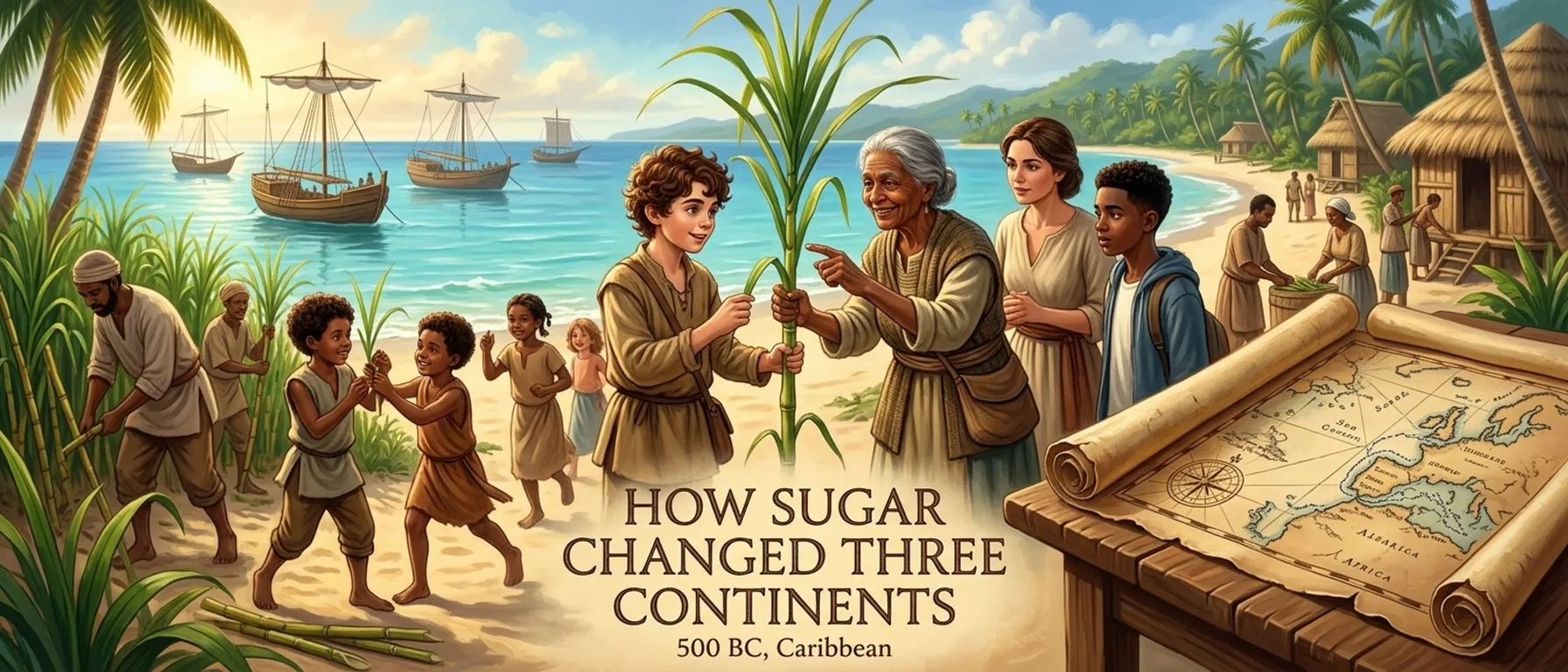
How Sugar Changed Three Continents (500 BC, Caribbean) — book cover — Wonder History
How Sugar Changed Three Continents (500 BC, Caribbean) — an illustrated history story, featuring Nikolai, Ravi, Elise, set in Caribbean. 10 illustrated pages, free to read on Wonder History.

Page 1
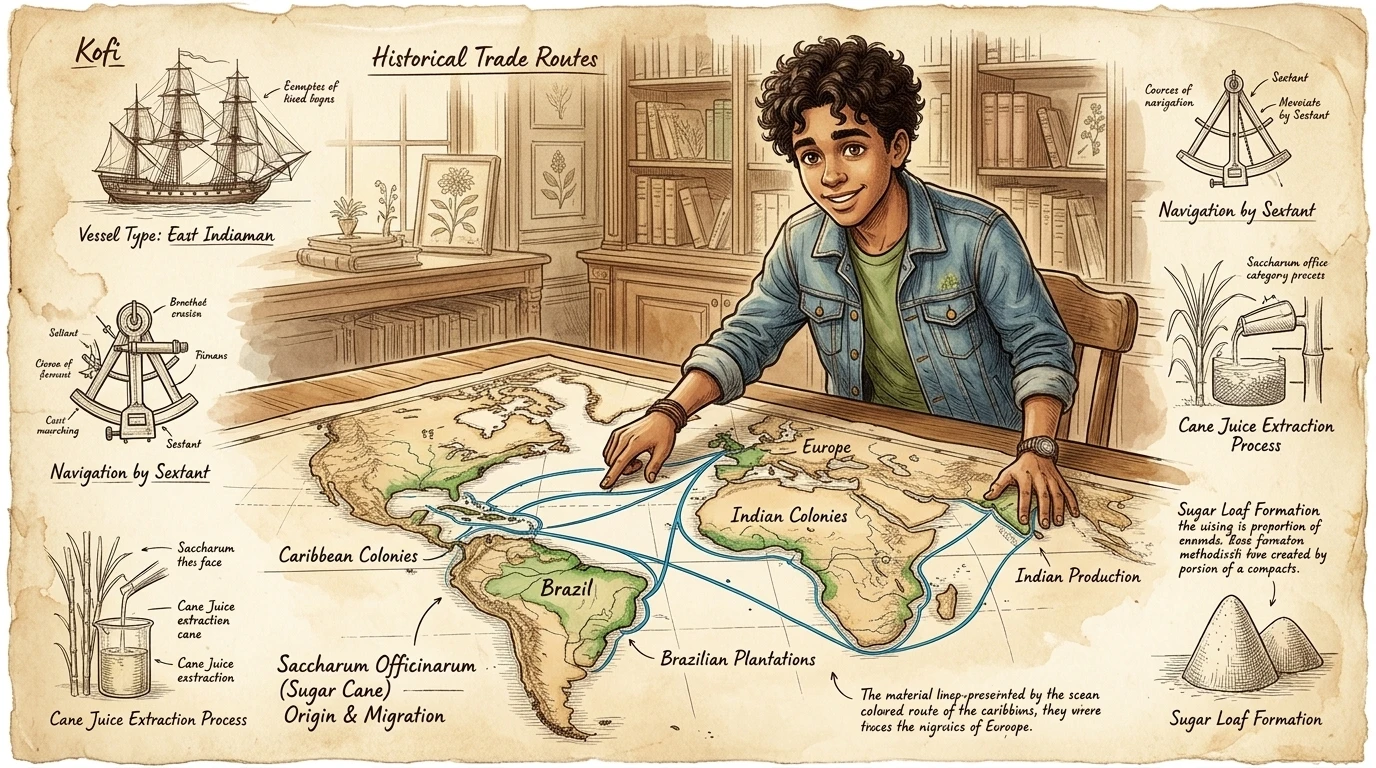
"We are in the archives of the Royal Botanical Garden, Kew, just outside London," Kofi announced, pointing to a large, antique map spread across a wooden table.
"We are in the archives of the Royal Botanical Garden, Kew, just outside London," Kofi announced, pointing to a large, antique map spread across a wooden table. The map highlighted the Caribbean islands, Brazil, and India, with lines of ships drawn to Europe. He traced a finger along a route. "This story began long ago, and far away."

"We are in the archives of the Royal Botanical Garden, Kew, just outside London," Kofi announced, pointing to a large, antique map spread across a wooden table. The map highlighted the Caribbean islands, Brazil, and India, with lines of ships drawn to Europe. He traced a finger along a route. "This story began long ago, and far away."

Page 2

Nikolai, a bold 6-year-old, perched on a mushroom stool, his tiny spectacles askew. "Grandma Ravi, tell me again how sugar started!" Ravi, an elderly woman with…
Nikolai, a bold 6-year-old, perched on a mushroom stool, his tiny spectacles askew. "Grandma Ravi, tell me again how sugar started!" Ravi, an elderly woman with sun-kissed bronze skin, chuckled, adjusting her spectacles. "Well, little one, it all began in Papua New Guinea," she began, pointing to a picture in her enormous, leather-bound book. "There, the sugarcane plant grew wild, and people chewed on its stalks for sweetness."

Nikolai, a bold 6-year-old, perched on a mushroom stool, his tiny spectacles askew. "Grandma Ravi, tell me again how sugar started!" Ravi, an elderly woman with sun-kissed bronze skin, chuckled, adjusting her spectacles. "Well, little one, it all began in Papua New Guinea," she began, pointing to a picture in her enormous, leather-bound book. "There, the sugarcane plant grew wild, and people chewed on its stalks for sweetness."

Page 3

"But how did it get to other places?" Nikolai asked, tilting his head. Ravi tapped the book with a gnarled finger. "Through trade, my dear.
"But how did it get to other places?" Nikolai asked, tilting his head. Ravi tapped the book with a gnarled finger. "Through trade, my dear. People carried it across oceans, and eventually, it reached India. In India, they learned to crush the cane and boil the juice, making crystals of sugar! They called it 'sharkara.'"

"But how did it get to other places?" Nikolai asked, tilting his head. Ravi tapped the book with a gnarled finger. "Through trade, my dear. People carried it across oceans, and eventually, it reached India. In India, they learned to crush the cane and boil the juice, making crystals of sugar! They called it 'sharkara.'"

Page 4

Elise, a woman in her mid-50s, entered the library, carrying a tray of steaming tea. "Did you know," she said, placing a cup before Ravi, "that around 500 BC…
Elise, a woman in her mid-50s, entered the library, carrying a tray of steaming tea. "Did you know," she said, placing a cup before Ravi, "that around 500 BC, people in India discovered how to make sugar into solid crystals?" Ravi smiled, taking a sip. "Indeed, Elise! And it was an Indian mathematician who first described sugar refining."

Elise, a woman in her mid-50s, entered the library, carrying a tray of steaming tea. "Did you know," she said, placing a cup before Ravi, "that around 500 BC, people in India discovered how to make sugar into solid crystals?" Ravi smiled, taking a sip. "Indeed, Elise! And it was an Indian mathematician who first described sugar refining."

Page 5

Nikolai leaned forward, eyes wide. "So sugar went from New Guinea to India? What happened next?" Ravi chuckled. "The Persians discovered it, too!
Nikolai leaned forward, eyes wide. "So sugar went from New Guinea to India? What happened next?" Ravi chuckled. "The Persians discovered it, too! 'Everything in moderation, including moderation,' they said, recognizing the allure of sweetness, even then. Sugar, they believed, was a precious medicine and a delightful spice."

Nikolai leaned forward, eyes wide. "So sugar went from New Guinea to India? What happened next?" Ravi chuckled. "The Persians discovered it, too! 'Everything in moderation, including moderation,' they said, recognizing the allure of sweetness, even then. Sugar, they believed, was a precious medicine and a delightful spice."

Page 6

Elise nodded, refilling Ravi's cup. "And from Persia, it traveled to the Arab world. They perfected the sugar-making process, developing new refining…
Elise nodded, refilling Ravi's cup. "And from Persia, it traveled to the Arab world. They perfected the sugar-making process, developing new refining techniques. They even gave us the word 'sugar' – 'sukkar' in Arabic!" She poured a cup for Nikolai, who eagerly took a sip. "Mmm, delicious!"

Elise nodded, refilling Ravi's cup. "And from Persia, it traveled to the Arab world. They perfected the sugar-making process, developing new refining techniques. They even gave us the word 'sugar' – 'sukkar' in Arabic!" She poured a cup for Nikolai, who eagerly took a sip. "Mmm, delicious!"

Page 7

"The Arabs brought sugar to the Mediterranean," Ravi continued. "It was grown in places like Sicily and Spain, but it remained a rare and expensive treat."…
"The Arabs brought sugar to the Mediterranean," Ravi continued. "It was grown in places like Sicily and Spain, but it remained a rare and expensive treat." Nikolai wrinkled his nose. "So not everyone could have it?" Ravi shook her head sadly. "Not at all. It was a luxury only for the wealthy."

"The Arabs brought sugar to the Mediterranean," Ravi continued. "It was grown in places like Sicily and Spain, but it remained a rare and expensive treat." Nikolai wrinkled his nose. "So not everyone could have it?" Ravi shook her head sadly. "Not at all. It was a luxury only for the wealthy."

Page 8

Elise chimed in, "Then, sugar crossed the Atlantic to the Americas. Plantations were established in the Caribbean and Brazil, and enslaved people were forced to…
Elise chimed in, "Then, sugar crossed the Atlantic to the Americas. Plantations were established in the Caribbean and Brazil, and enslaved people were forced to work under horrific conditions." Nikolai gasped. "That's terrible!" Ravi sighed. "Indeed. It became a major part of the transatlantic slave trade, a dark chapter in human history."

Elise chimed in, "Then, sugar crossed the Atlantic to the Americas. Plantations were established in the Caribbean and Brazil, and enslaved people were forced to work under horrific conditions." Nikolai gasped. "That's terrible!" Ravi sighed. "Indeed. It became a major part of the transatlantic slave trade, a dark chapter in human history."

Page 9

Nikolai looked down at his teacup. "So, sugar's journey... it's been both sweet and bitter." Ravi took his small hand in hers. "Yes, little one.
Nikolai looked down at his teacup. "So, sugar's journey... it's been both sweet and bitter." Ravi took his small hand in hers. "Yes, little one. It connects three continents—Africa, the Americas, and Europe—through trade, culture, and unfortunately, exploitation." Elise added quietly, "'The arc of the moral universe is long, but it bends toward justice,' as Martin Luther King Jr. once said. We must always strive to learn from the past."

Nikolai looked down at his teacup. "So, sugar's journey... it's been both sweet and bitter." Ravi took his small hand in hers. "Yes, little one. It connects three continents—Africa, the Americas, and Europe—through trade, culture, and unfortunately, exploitation." Elise added quietly, "'The arc of the moral universe is long, but it bends toward justice,' as Martin Luther King Jr. once said. We must always strive to learn from the past."

Page 10

Kofi smiled, closing the antique map. "And now," he said, looking at the camera, "sugar is a common part of our lives, found in almost everything we eat.
Kofi smiled, closing the antique map. "And now," he said, looking at the camera, "sugar is a common part of our lives, found in almost everything we eat. But its history reminds us that even the sweetest things can have a complex and sometimes painful past, but can also give us strength through knowledge of that past."

Kofi smiled, closing the antique map. "And now," he said, looking at the camera, "sugar is a common part of our lives, found in almost everything we eat. But its history reminds us that even the sweetest things can have a complex and sometimes painful past, but can also give us strength through knowledge of that past."

About this story

  • Historical figures: Nikolai, Ravi, Elise
  • Location: Caribbean
  • Period: Ancient
  • Audience: kids (ages 6–12)

Questions and answers

Questions and answers about How Sugar Changed Three Continents (500 BC, Caribbean)

Read Wonder History on your phone

Wonder History is available on Android. Get Wonder History on Google Play.

More Wonder History stories

All Wonder History stories · Open the library