Indus Valley Civilization (1924, India)
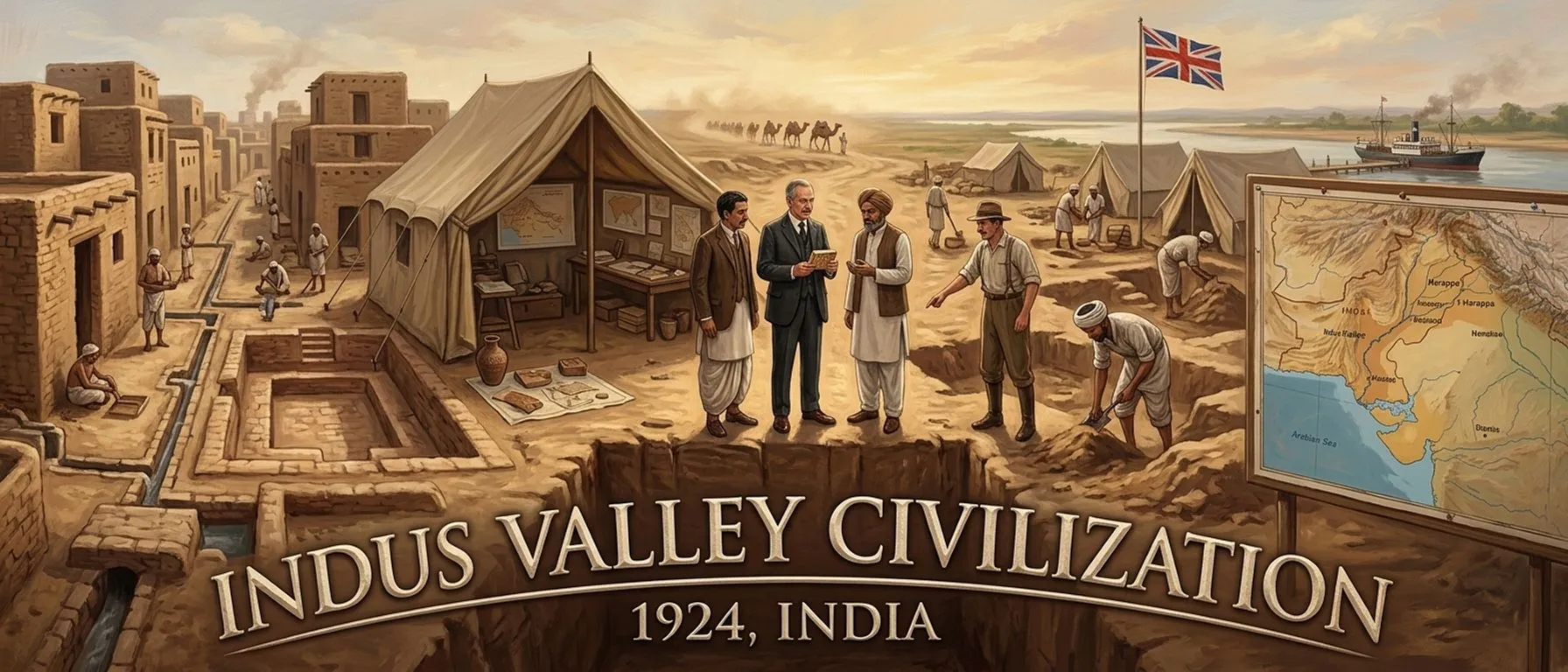
The discovery of Harappa and Mohenjo-Daro in the 1920s revealed the existence of the Indus Valley Civilization, rewriting the history of ancient South Asia. This civilization's advanced urban planning and unique script continue to fascinate archaeologists and historians.
Page 1
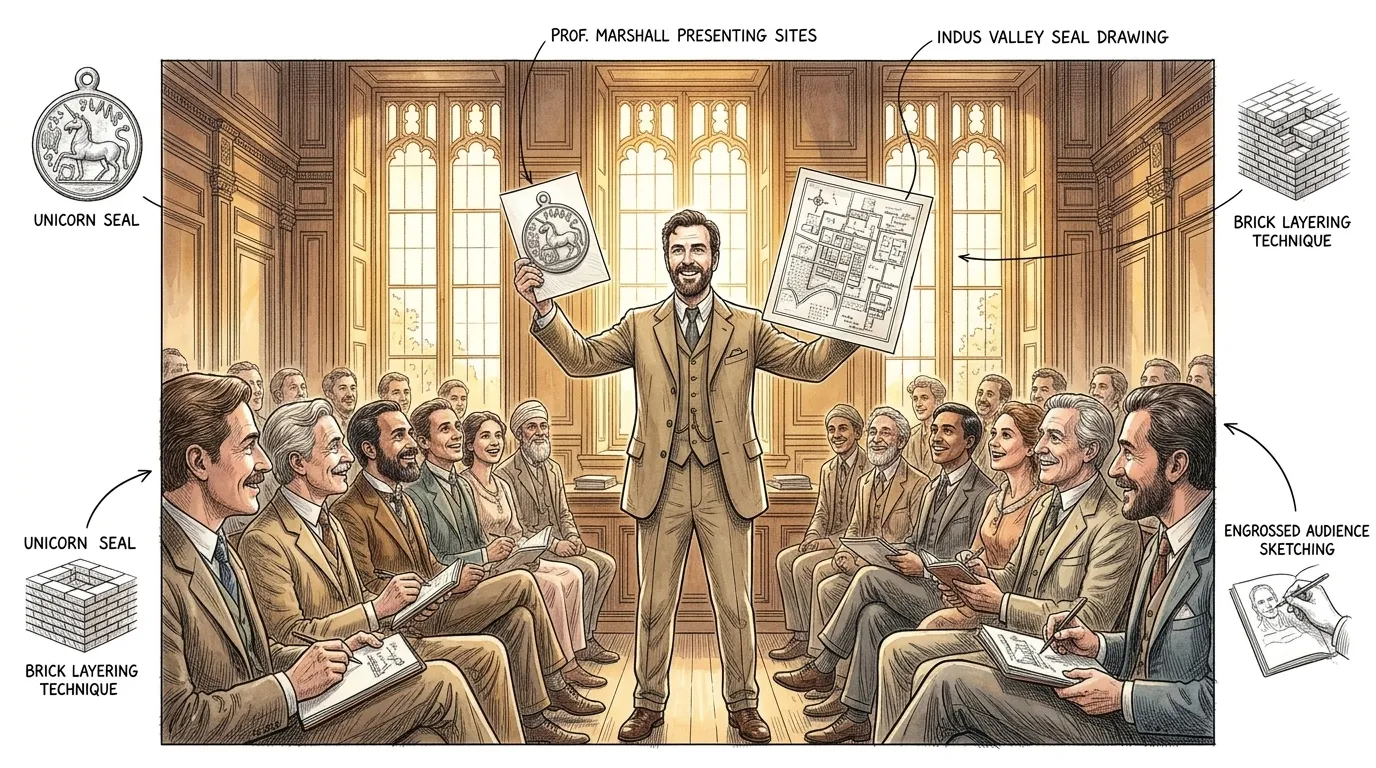
On September 20, 1924, in the hallowed halls of the Royal Asiatic Society in London, a profound declaration reverberated across the global academic landscape. Sir John Marshall, the esteemed Director-General of the Archaeological Survey of India, stood before a gathering of scholars and antiquarians, holding aloft images of enigmatic seals and meticulously drawn site plans. His words unveiled a lost civilization, an urban marvel rivalling Mesopotamia and Egypt, stretching across an estimated 1.3 million square kilometers of the Indus River basin. The painstaking work of his Indian colleagues, Rai Bahadur Daya Ram Sahni at Harappa and Rakhal Das Banerji at Mohenjo-Daro, had culminated in this moment, irrevocably rewriting the history of ancient South Asia. The implications were staggering: two vast, meticulously planned cities, built with uniform bricks, elaborate drainage systems, and a mysterious script, had lain buried and forgotten for millennia. But where did it all begin?
Historical Fact: The formal announcement by Sir John Marshall established the Indus Valley Civilization as a contemporary of ancient Egypt and Mesopotamia, shifting global understanding of early urbanism.
Page 2
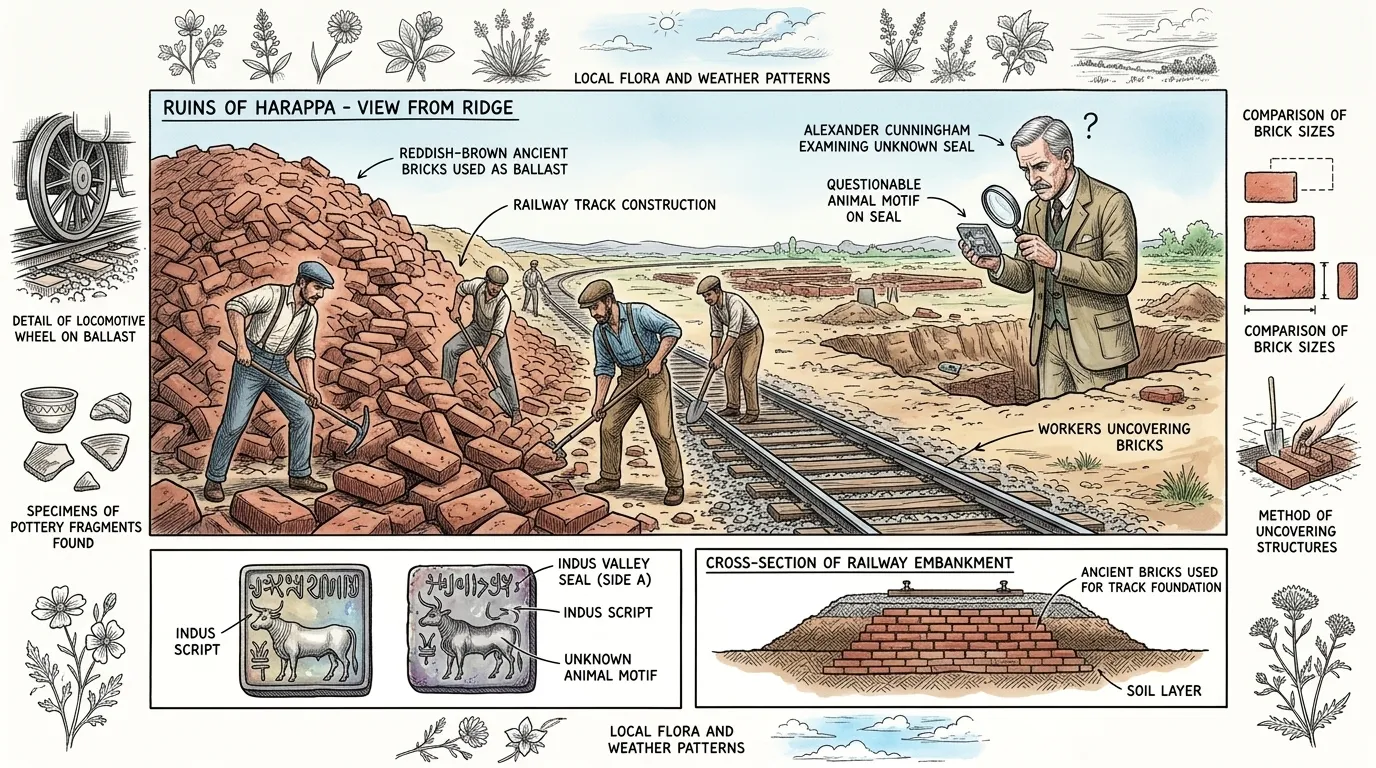
The grand revelation of 1924 was not a sudden flash but the culmination of decades of fragmented discoveries. As early as 1856, during the construction of the Lahore-Multan railway, engineers stumbled upon ancient brick mounds near a village called Harappa. They repurposed the well-fired bricks for ballast, unknowingly dismantling parts of a city thousands of years old. Later, in 1872, Alexander Cunningham, then Director-General of the Archaeological Survey of India, investigated the Harappa site, reporting on its peculiar seals adorned with unknown animal motifs and symbols. He dismissed them as foreign curiosities, failing to grasp their profound significance or the true age and scale of the buried city. These initial encounters were mere flickers in the dust, tantalizing hints of something vast and ancient, awaiting the systematic excavation that would truly bring it to light.
Historical Fact: Over 150 miles of ancient Harappan bricks were reportedly used as ballast for the Lahore-Multan railway, a testament to the vast quantities available from the forgotten city.
Page 3
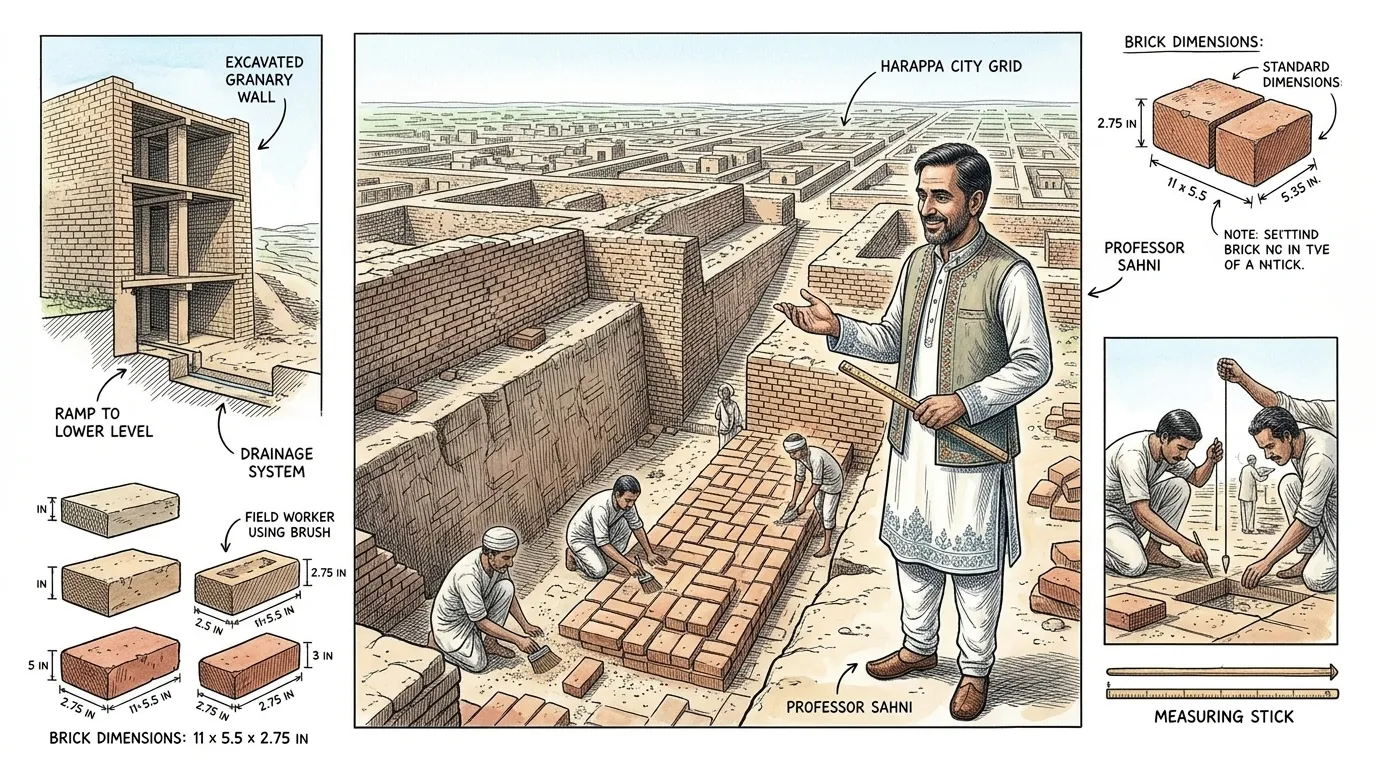
The true scale of Harappa began to emerge not from chance discoveries, but from dedicated archaeological inquiry. By the early 20th century, the Archaeological Survey of India had established protocols for systematic excavation. In 1920, Rai Bahadur Daya Ram Sahni, a distinguished Indian archaeologist working under Sir John Marshall, commenced the first extensive excavations at Harappa. Sahni's teams meticulously uncovered layers of a vast ancient city, revealing monumental walls, granaries, and residential blocks built of standardized fired bricks. His work confirmed that the site was not merely a collection of isolated mounds but a coherent, highly organized urban center. The quantity and uniformity of the artifacts, particularly the distinctive seals, began to suggest a civilization far more advanced and widespread than previously imagined for prehistoric India. Sahni's methodical approach laid the foundation for understanding Harappa's immense historical value.
Historical Fact: Excavations at Harappa revealed a highly organized urban plan, including a fortified citadel and a lower town with residential buildings and sophisticated drainage systems.
Page 4
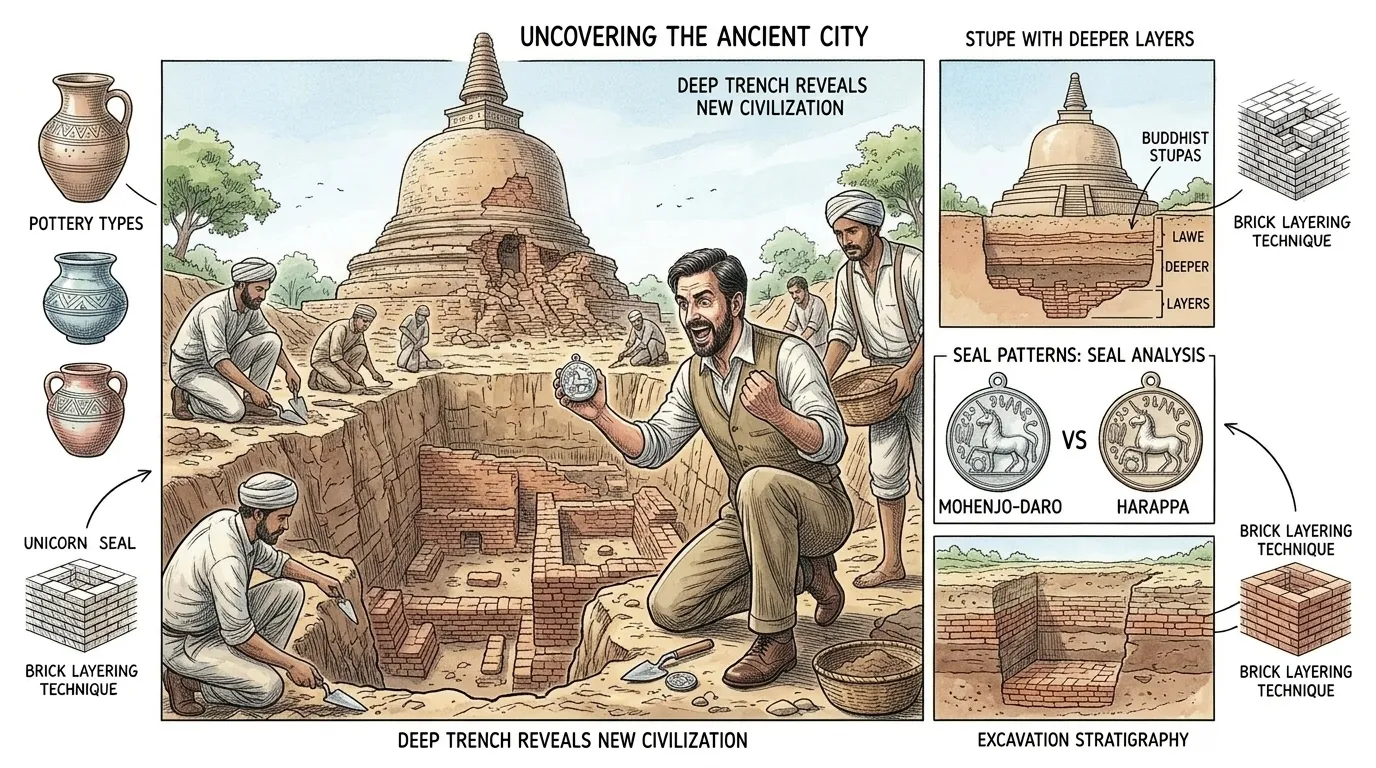
While Sahni's work advanced at Harappa, another pivotal discovery was simultaneously unfolding further south. In 1922, Rakhal Das Banerji, another dedicated Indian archaeologist from the Archaeological Survey of India, was investigating Buddhist stupa ruins near the town of Larkana in Sindh. As his team dug, they found ancient tools and pottery beneath the stupa, clearly predating the Buddhist period. Further excavation revealed layers upon layers of a massive, previously unknown city. Banerji quickly recognized that the artifacts, particularly the seals, were identical to those found at Harappa. He immediately communicated the significance of his findings to Sir John Marshall, articulating the breathtaking possibility that these two distant sites were part of a single, vast ancient civilization. Mohenjo-Daro, the 'Mound of the Dead,' was beginning to yield its secrets, echoing the grandeur of Harappa and confirming the existence of a grand, unified cultural sphere.
Historical Fact: The discovery of identical artifacts, particularly seals, at both Harappa and Mohenjo-Daro, separated by over 600 kilometers, proved the existence of a single, extensive civilization.
Page 5
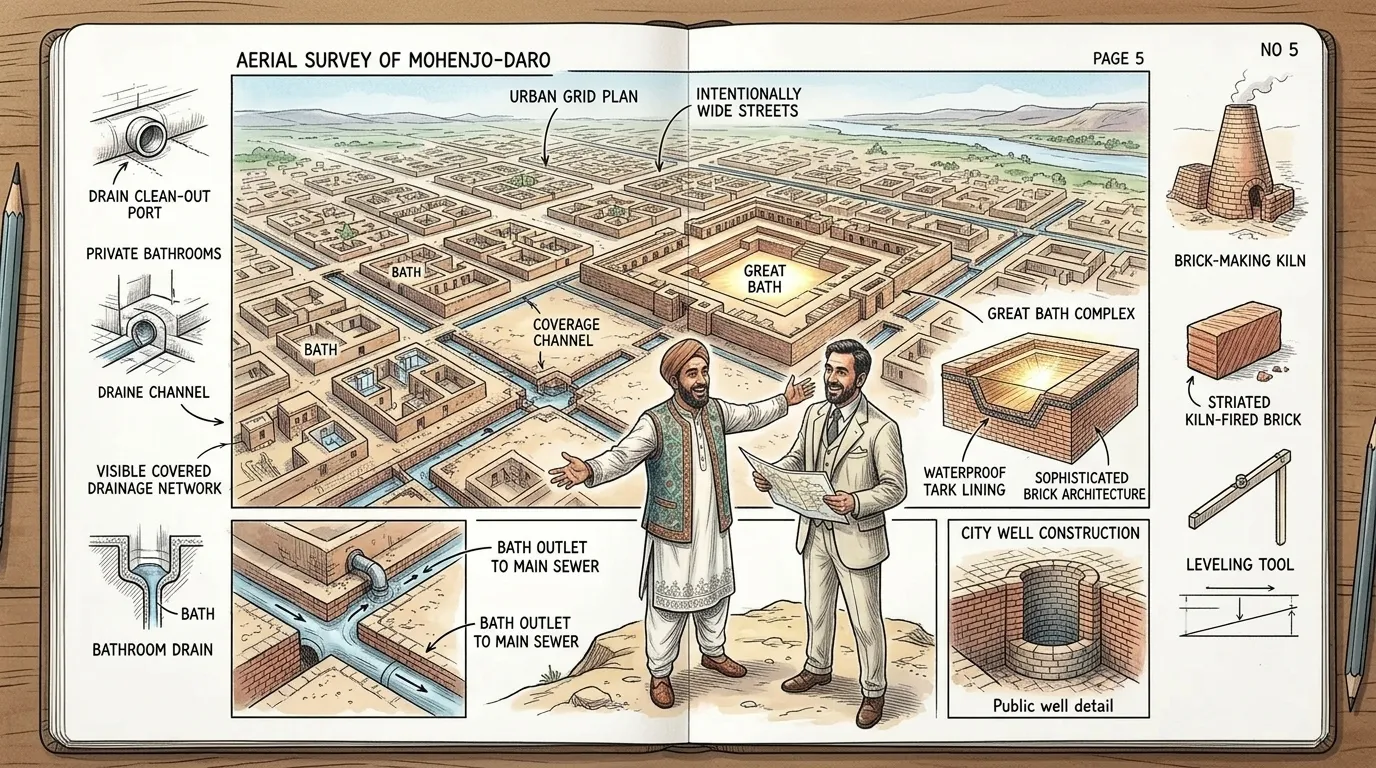
The excavations led by Sahni and Banerji, and later overseen by Marshall, revealed a civilization characterized by remarkable urban planning and sophisticated engineering. Mohenjo-Daro, in particular, showcased an astonishing level of foresight. Its streets were laid out on a precise grid pattern, remarkably consistent for a civilization flourishing over 4,500 years ago. Residential buildings featured private bathrooms, and a highly advanced drainage system carried waste away from the city into sumps and outfalls. The 'Great Bath' at Mohenjo-Daro, a meticulously constructed public water tank, hinted at ritualistic bathing or communal gatherings. This systematic approach to urban living, coupled with the standardization of brick sizes across sites, indicated a powerful central authority or a strong cultural uniformity that governed construction and infrastructure development across vast distances. The sheer scale of these organized cities amazed the archaeological world.
Historical Fact: Mohenjo-Daro featured one of the world's earliest known municipal sanitation systems, with almost every house equipped with a private well and bathroom, linked to covered drains.
Page 6
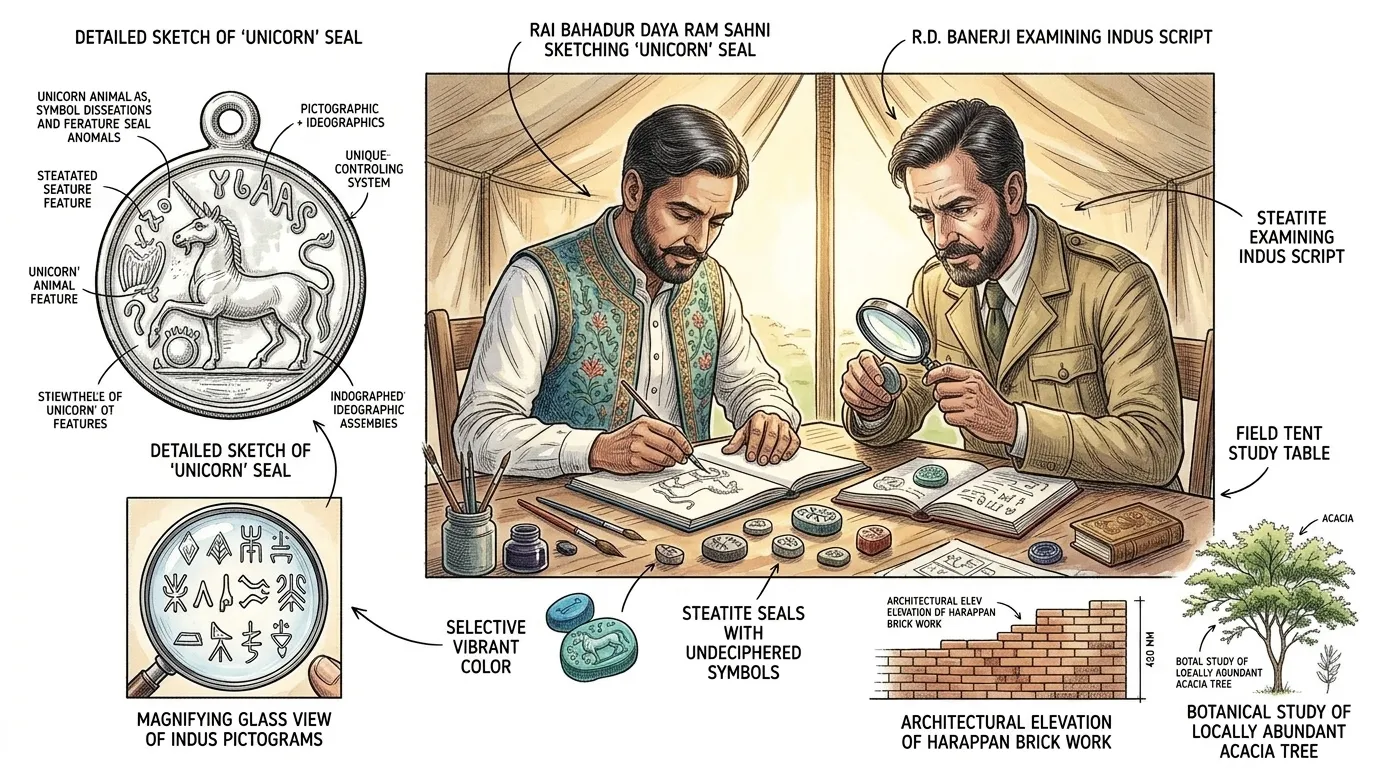
Among the most captivating and enduring mysteries of the Indus Valley Civilization were the thousands of seals and tablets bearing an undeciphered script. Discovered by the hundreds at Harappa and Mohenjo-Daro, these small, square or rectangular objects, often carved from steatite, depicted a variety of animals – unicorns, elephants, tigers – alongside intricate pictographic and ideographic symbols. Rai Bahadur Daya Ram Sahni and Rakhal Das Banerji had meticulously documented these unique artifacts during their excavations. The script, unlike any other known ancient writing system, contained between 400 and 500 distinct signs, suggesting a complex form of communication. Despite intense efforts by scholars worldwide, the Indus script remains undeciphered to this day. Its mystery continues to shroud the identity of the civilization's rulers, the details of its religious beliefs, and the precise nature of its social and economic organization. Without a Rosetta Stone, the voices of the Indus people remain silent.
Historical Fact: Over 4,000 objects bearing the Indus script have been found, primarily seals, suggesting its use in trade, administration, or ritual, but without a bilingual text, its meaning remains elusive.
Page 7
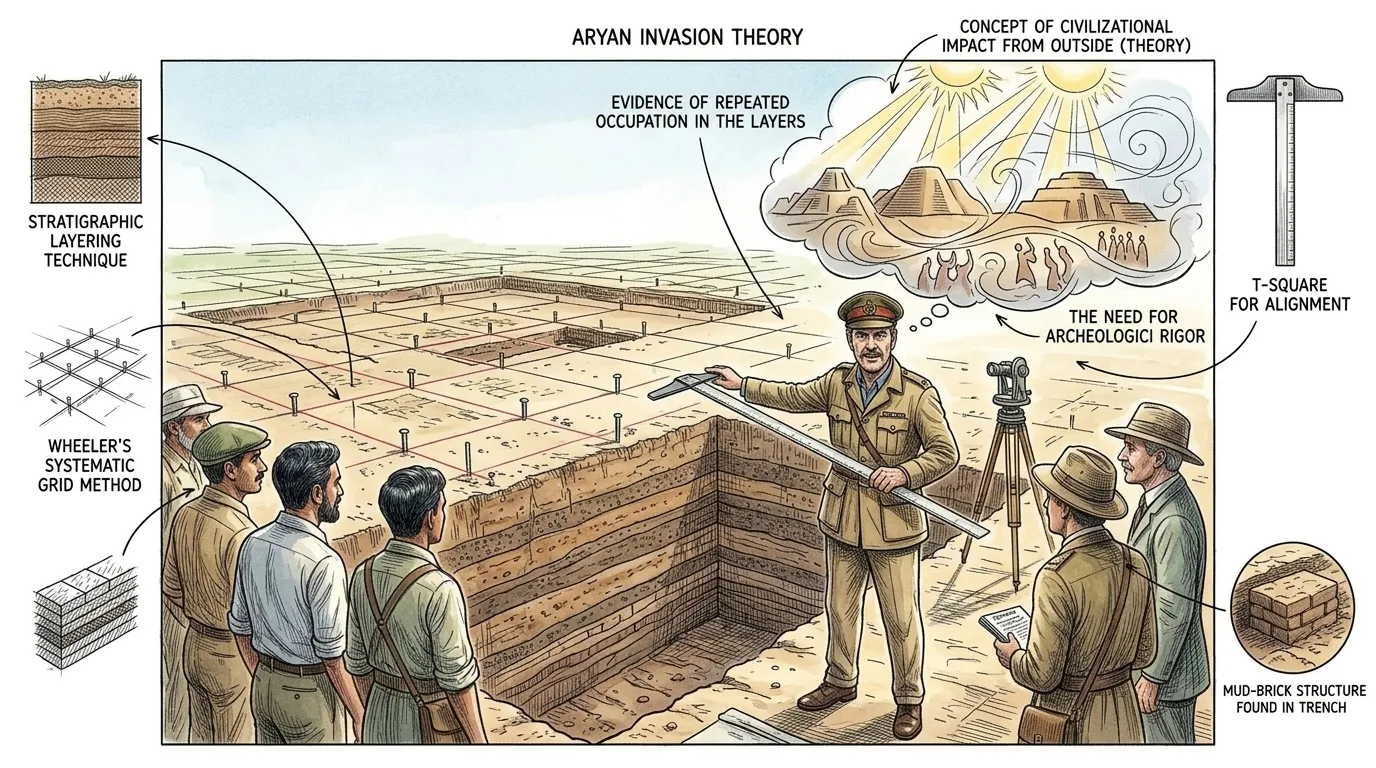
Decades after the initial discoveries, another formidable figure, Sir Mortimer Wheeler, became a central force in Indus Valley archaeology. Appointed Director-General of the Archaeological Survey of India in 1944, Wheeler brought a new level of rigor and military precision to excavations at Harappa. He systematized archaeological techniques, introducing stratigraphy and grid systems, which allowed for a more precise understanding of the layers of occupation. While acknowledging the incredible urban planning, Wheeler controversially proposed the 'Aryan Invasion Theory' as the primary cause of the civilization's decline, suggesting that invading Indo-Aryans violently overthrew the Harappan cities. Although later archaeological evidence largely discredited his invasion hypothesis, Wheeler's insistence on methodical excavation and his energetic communication of the civilization's significance profoundly influenced subsequent generations of archaeologists, solidifying the Indus Valley Civilization's place in world history.
Historical Fact: Sir Mortimer Wheeler's emphasis on meticulous stratigraphic excavation greatly improved the scientific standards of South Asian archaeology, even as some of his interpretive theories were later revised.
Page 8
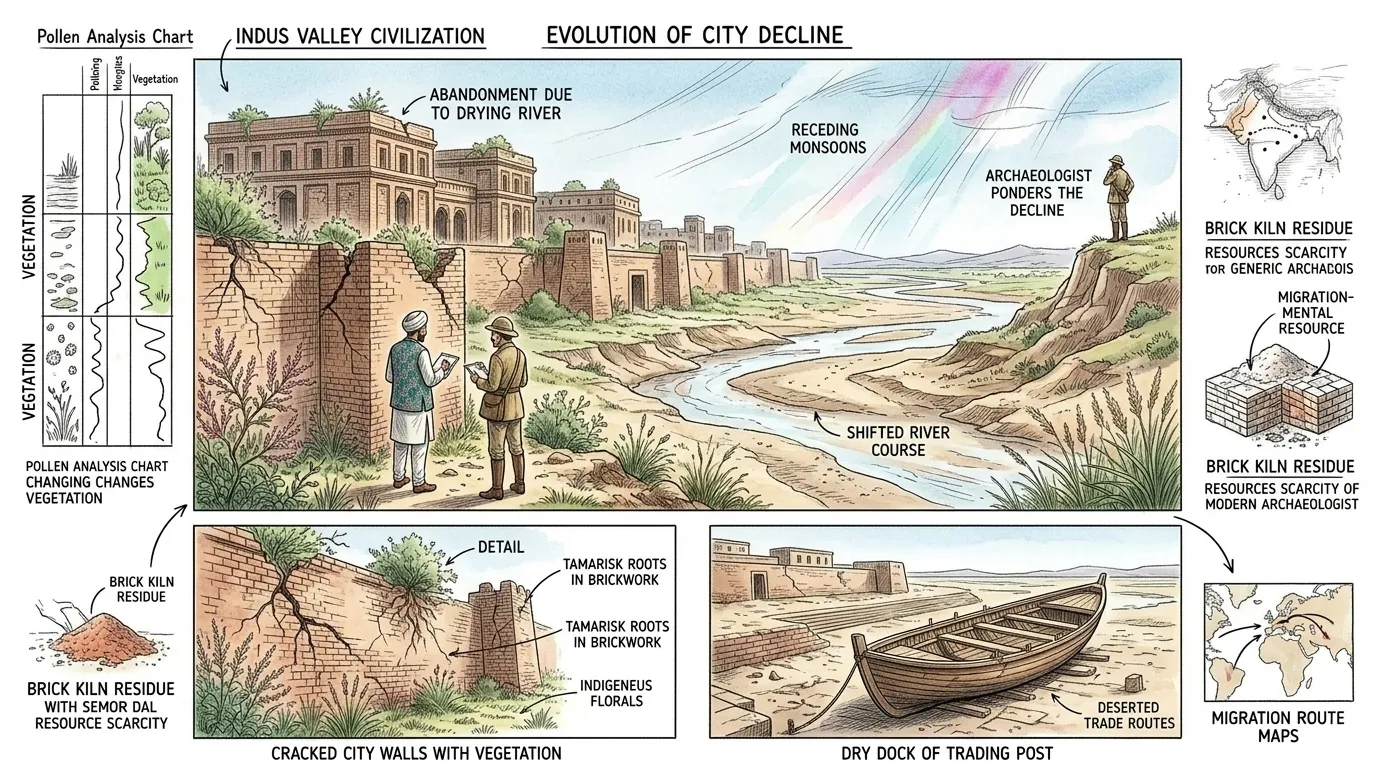
The flourishing cities of the Indus Valley Civilization, which peaked around 2500-1900 BCE, eventually faced a period of decline and abandonment. The exact causes remain a subject of intense academic debate among scholars. Theories range from environmental catastrophe, such as shifts in river courses or prolonged droughts impacting the agricultural base, to tectonic uplifts that altered drainage patterns and led to devastating floods. Others suggest social disintegration, disease, or even gradual economic decline. Archaeological evidence shows a general decrease in urban standards, a breakdown in the uniform planning, and a move towards smaller, more rural settlements in the later phases. While Mortimer Wheeler's 'Aryan Invasion Theory' was a dominant explanation for decades, it is now largely rejected due to lack of conclusive evidence for a large-scale violent conquest. The magnificent cities did not fall in a single catastrophic event, but rather faded over centuries, leaving behind their monumental ruins and enigmatic artifacts.
Historical Fact: Evidence suggests a complex interplay of factors, including climate change (such as weakening monsoons), tectonic activity, and potential internal socio-economic pressures, contributed to the gradual decline of the Indus Valley Civilization.
Page 9
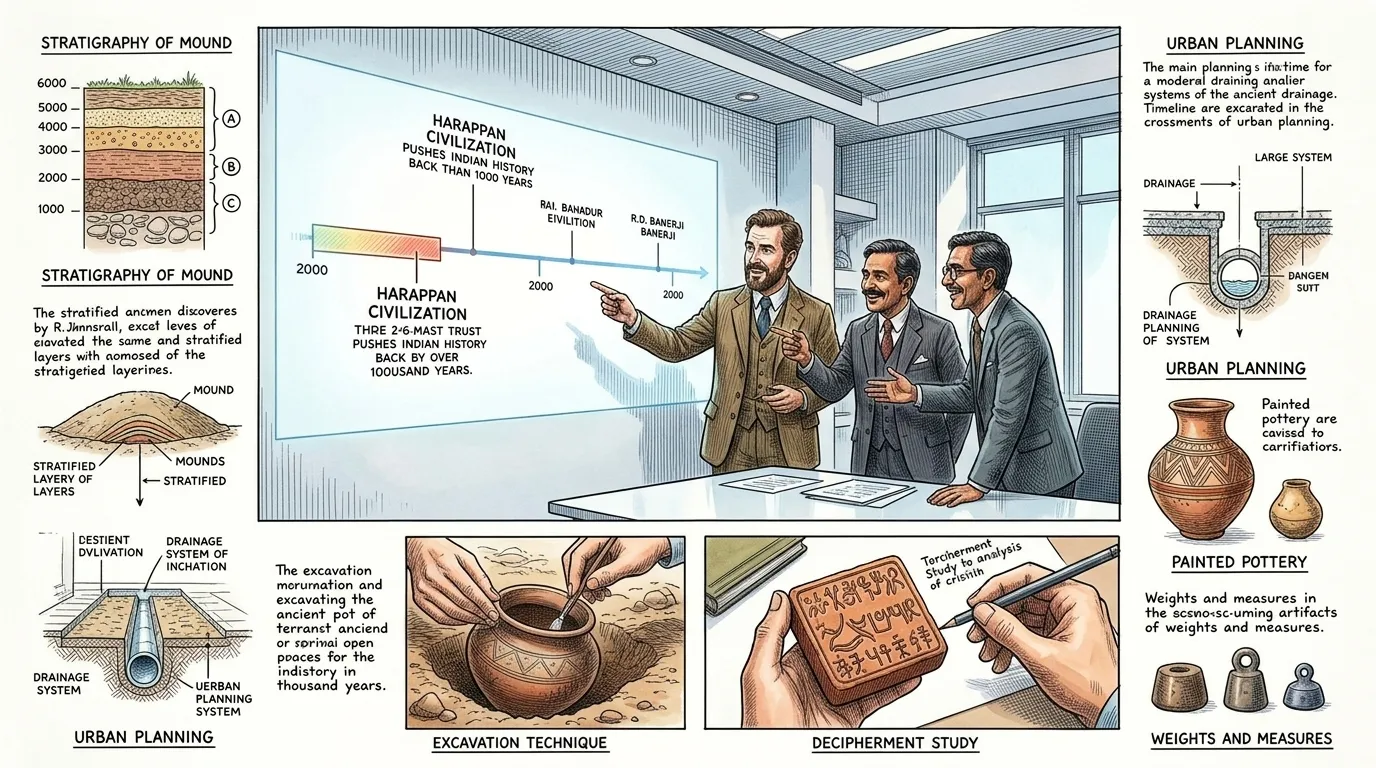
The discovery and ongoing study of the Indus Valley Civilization fundamentally reshaped our understanding of ancient history, particularly in South Asia. Before 1924, it was widely believed that Indian civilization began with the Vedic period, around 1500 BCE. The revelations by Marshall, Sahni, and Banerji pushed the timeline back by over a thousand years, establishing a vibrant, highly sophisticated urban culture that predated and possibly influenced subsequent Indian developments. The meticulous planning, advanced water management, and sophisticated craftsmanship revealed a society far from primitive. The continuing efforts of archaeologists and linguists, building on the foundations laid by these pioneers, strive to unlock more of the civilization's secrets. Despite the undeciphered script, the material culture offers invaluable insights into early state formation, trade networks, and social structures in a region pivotal to world history.
Historical Fact: The Indus Valley Civilization demonstrated early forms of urban planning and sanitation that were unparalleled for millennia, influencing later urban centers across the ancient world.
Page 10
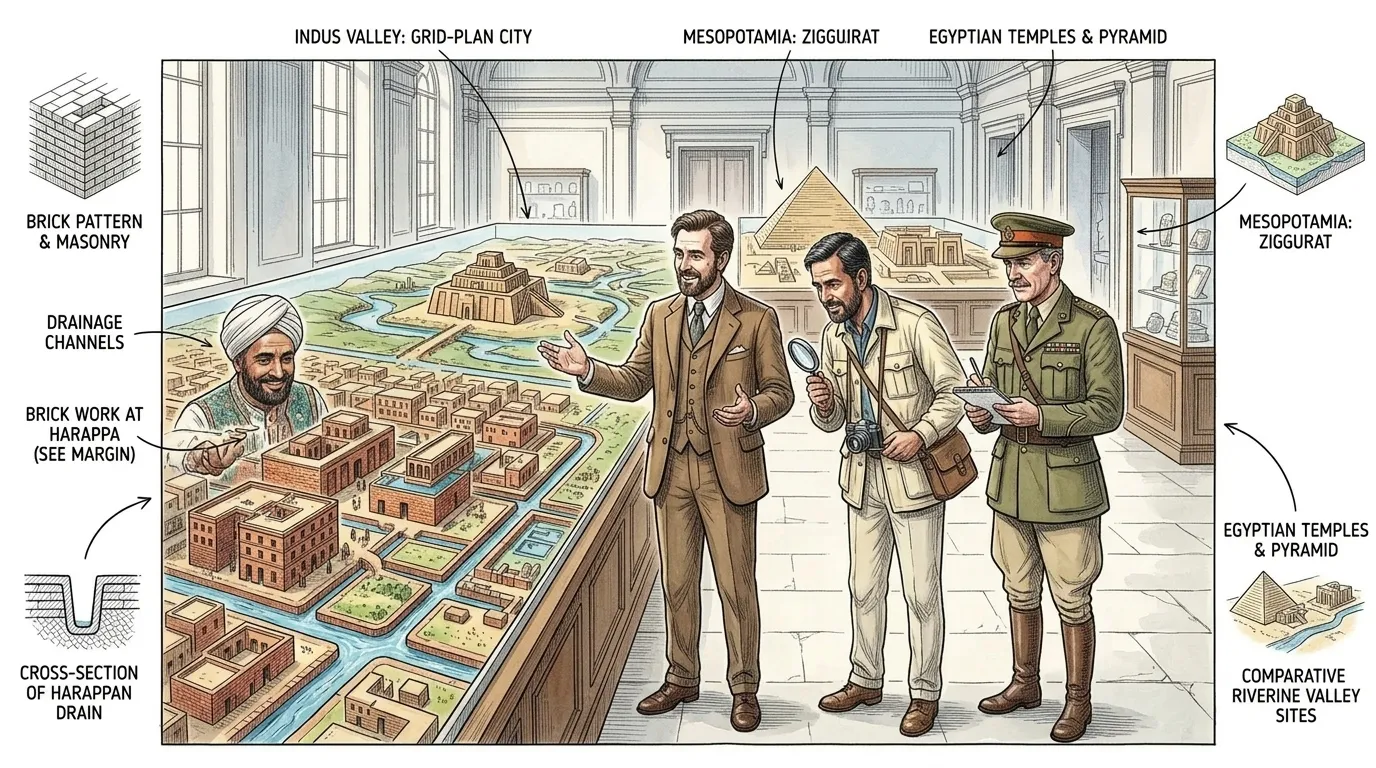
The Indus Valley Civilization stands today as one of the three early cradles of civilization, alongside Mesopotamia and Ancient Egypt, yet it remains the least understood due to its undeciphered script. Its urban centers, characterized by their remarkable uniformity, advanced water management, and sophisticated material culture, offer profound lessons in sustainable urbanism and societal organization. The work of pioneers like Sir John Marshall, Rai Bahadur Daya Ram Sahni, Rakhal Das Banerji, and later Sir Mortimer Wheeler, brought this forgotten chapter of human history to light, compelling us to reconsider the origins of complex societies. Its legacy is etched into the very landscape of South Asia and continues to inspire archaeologists, historians, and urban planners worldwide. The silent cities along the Indus River serve as a powerful testament to human ingenuity and the enduring mysteries of our collective past.
Historical Fact: Both Mohenjo-Daro and Harappa are significant archaeological sites, drawing researchers and tourists alike, recognized for their contribution to understanding early urban development.
About this story
- Historical figures: Sir John Marshall, Daya Ram Sahni, Rakhal Das Banerji
- Location: India
- Period: Modern
- Audience: general readers
Questions and answers
Questions and answers about Indus Valley Civilization (1924, India)
Read Wonder History on your phone
Wonder History is available on Android. Get Wonder History on Google Play.
More Wonder History stories
- Leonardo da Vinci’s Era — Italy (1494, Italy)
- The Abolition of Slavery in the British Empire — United Kingdom & Colonies (1833, United Kingdom & Colonies)
- The Age of Exploration — Global (Europe, Americas, Africa, Asia) (1492, Global)
- The American Civil War — United States (1863, United States)
- The American Declaration of Independence — USA (1776, USA)
- The American Revolution (1775–1783, North America)