The Hungry Years
A blight, a government's choices, and the famine that emptied Ireland 10 illustrated pages, narrated, free to read on Wonder History.
Page 1
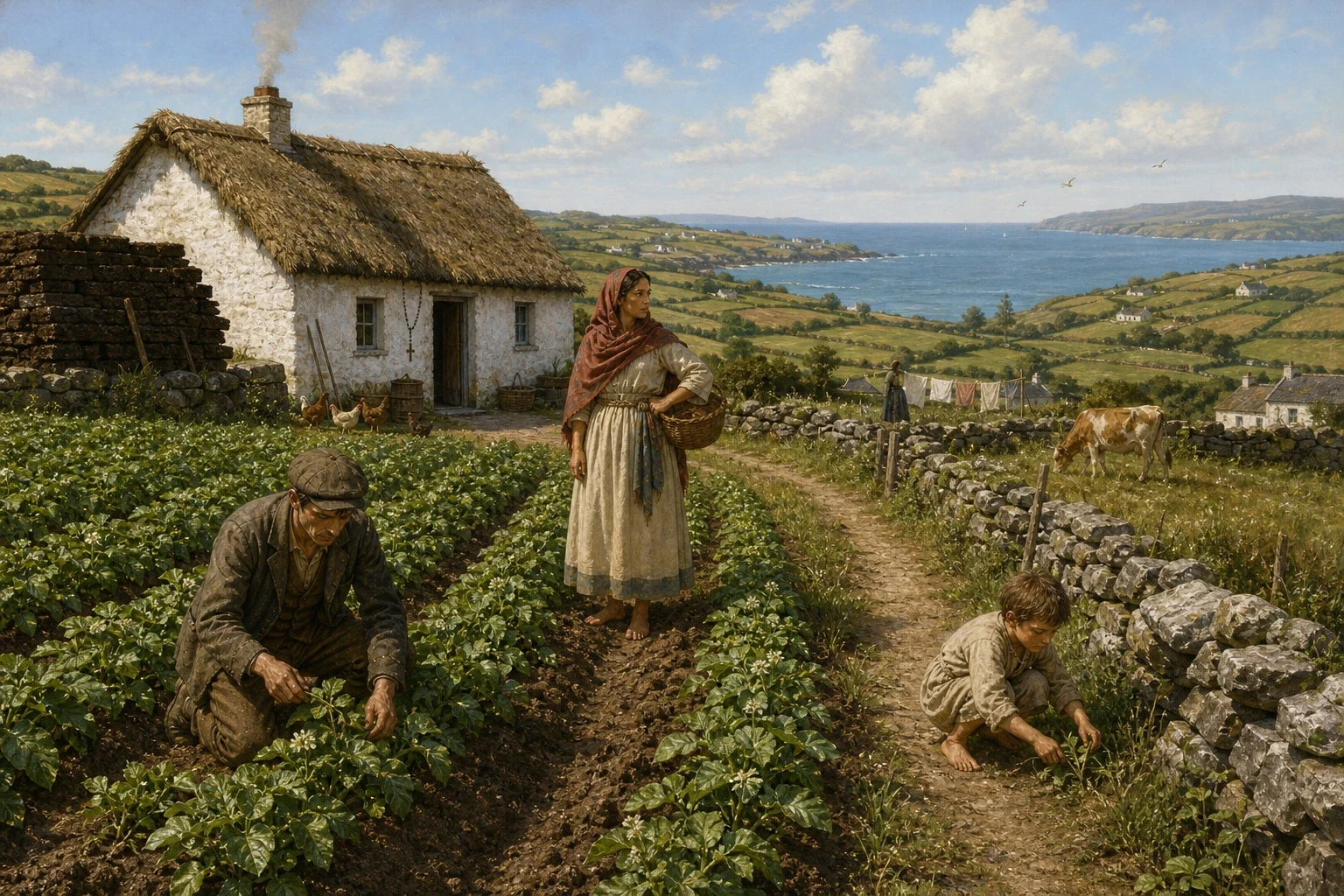
In the summer of 1845, in the south of Ireland near the town of Skibbereen, a tenant farmer and his family worked a few acres of rented land the way most of their neighbors did, the way their parents had before them. Long green ridges of potatoes ran across the field — rows and rows of them, planted close, because the potato gave more food from less land than almost anything else that could be grown. A single family could live on a small plot of it for most of the year. There was little money in the house and no land of their own, but the crop in front of them looked healthy and full, and the harvest was still weeks away. Across Ireland that August, roughly a third of the population lived this same way, depending on this one plant for most of their food. Nothing yet was wrong with it. The leaves were green. The rows were straight. Nobody standing in that field had any reason to think the plant itself would fail.
Page 2
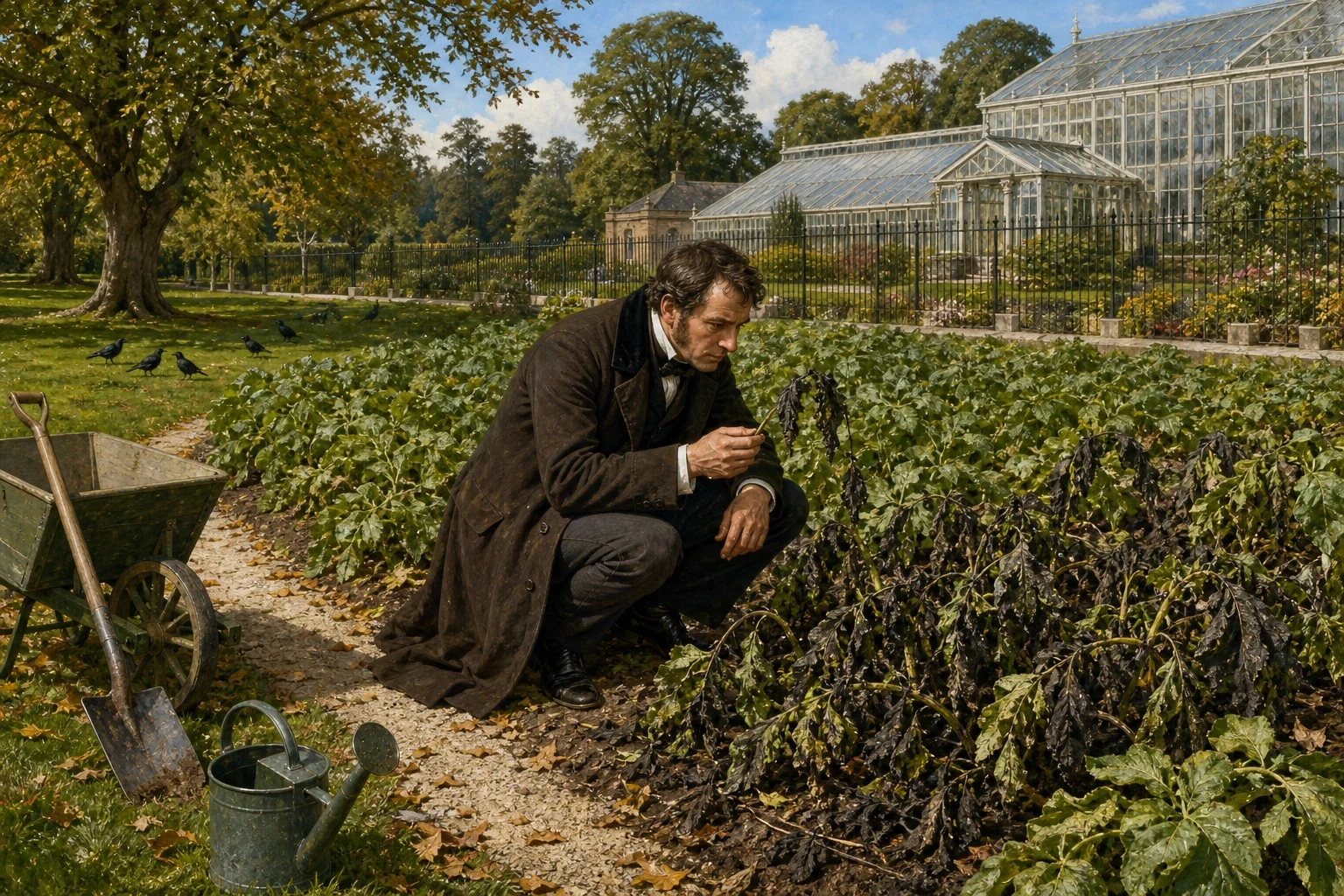
That September, at the National Botanic Gardens in Glasnevin, on the edge of Dublin, the gardens' curator, David Moore, found something wrong with the potato plants under his care. The leaves had turned black and were curling at the edges, as though scorched, and underneath them the stems gave off a smell of rot. It was not anything the gardeners had seen before. The cause was a water mould, a disease now known as Phytophthora infestans, that had already crossed from Belgium into England that summer and had now reached Ireland. Moore reported what he had found. Word of a strange blight on the potato leaves began to spread from farm to farm and from newspaper to newspaper through the autumn, first as a worry, then as a fact nobody could any longer doubt. The plant that fed a third of Ireland's people had started, in one growing season, to fail.
Page 3
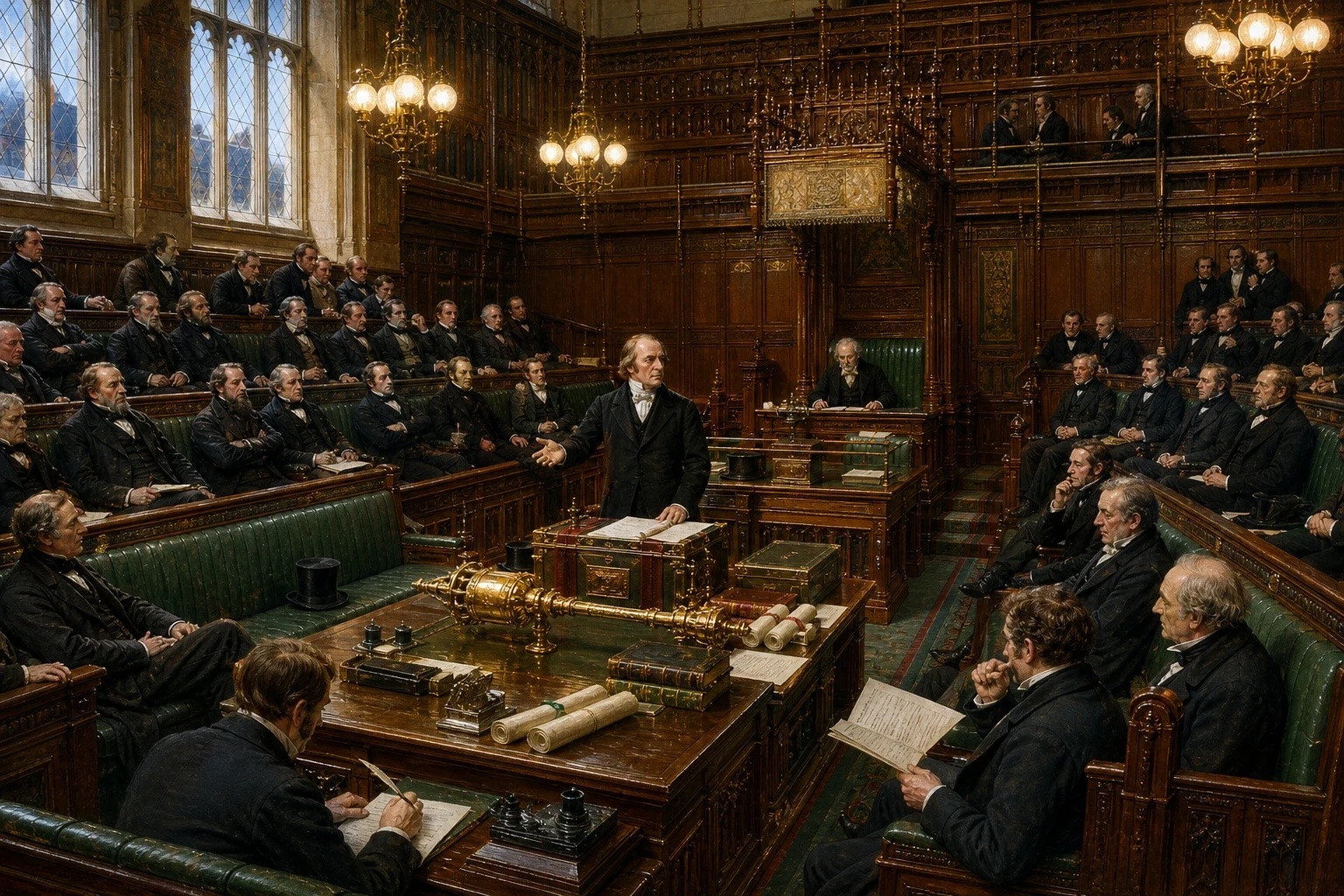
In London, through the winter of 1845 and into 1846, Prime Minister Sir Robert Peel's government weighed what to do about a famine three hundred miles away in a country most of Parliament had never visited. Peel acted further than many in his own party wanted. He arranged for a shipment of Indian corn to be bought and quietly stored in Ireland against the worst of the shortage, and he set up a relief commission and public works to give some men paid labor. He also judged that the Corn Laws, which kept the price of imported grain artificially high to protect British landowners, had to go, so that cheaper food could reach people who needed it. Repealing them split his own party. In June 1846, having pushed the repeal through, Peel resigned. The famine he had begun to answer was not yet over. It was about to grow far worse, under a different government.
Page 4
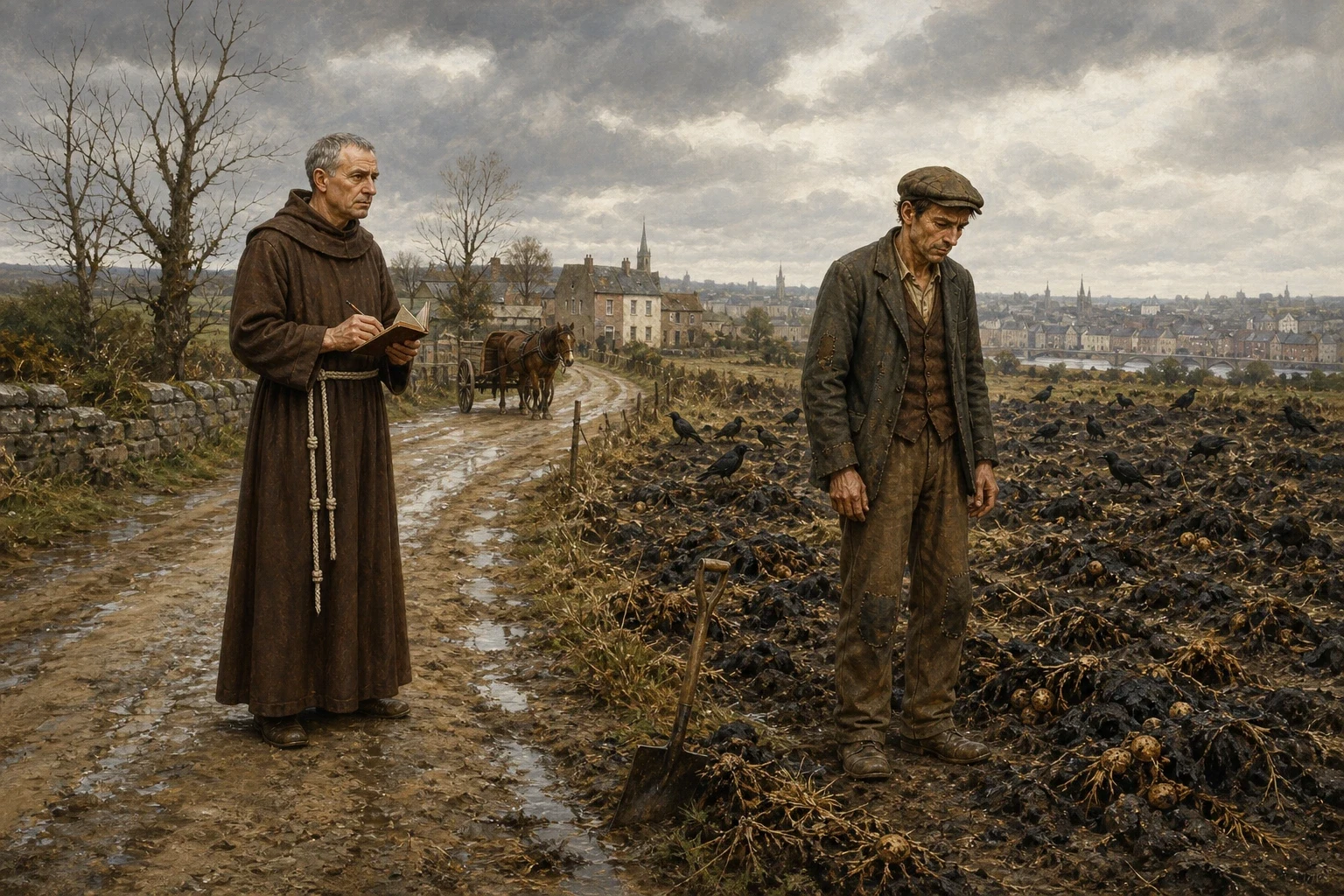
By August 1846, the second blight was worse than the first — not a partial loss this time, but almost total. Fr. Theobald Mathew, a Capuchin friar well known in Cork for his temperance work, traveled the roads of the county that month and saw fields that had looked green and full a week before now blackened and collapsed into a stinking mass. He wrote directly to Charles Trevelyan at the Treasury in London, describing what he had seen with his own eyes, in the hope that plain testimony from the ground would move the government to act faster than reports alone. Along the same roads, tenant farmers who had staked everything on this harvest stood at the edges of their ruined ridges with nothing to dig up and no way to pay their rent. The letter went to London. What came back from London, over the months that followed, was less than Mathew had hoped for.
Page 5
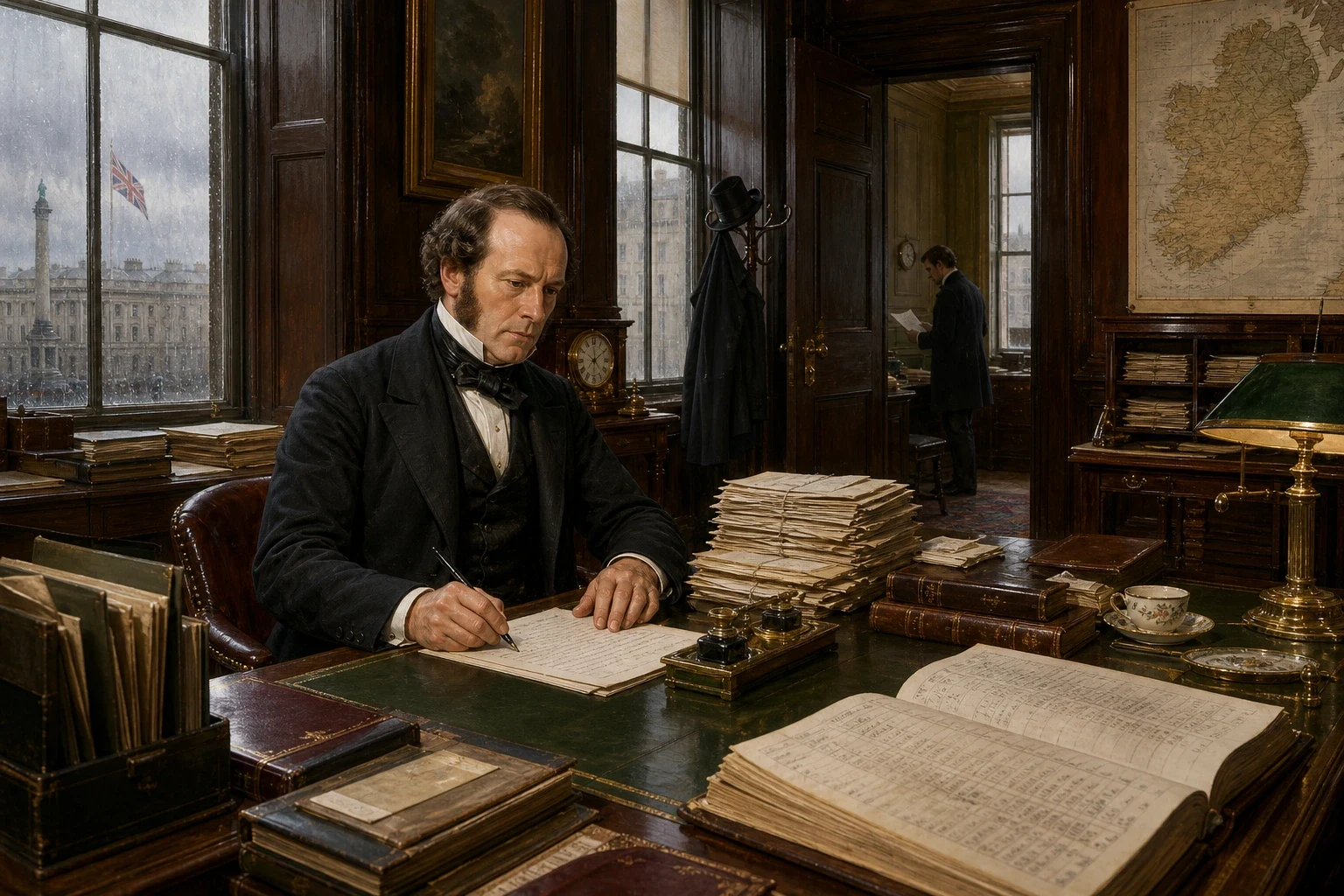
That autumn, under the new government of Lord John Russell, responsibility for relief fell mainly to Charles Trevelyan at the Treasury. Trevelyan believed strongly that government aid should not interfere with ordinary trade, and that paying people directly for food, rather than for labor, would make them dependent and would undercut merchants trying to sell grain at a profit. Under his direction, the large-scale purchase and free distribution of food that Peel's government had begun was largely replaced with paid public works — roads, walls, and drainage projects that put a wage in a man's pocket rather than food in his hand, on the belief that the market would then supply the rest. Letters like Fr. Mathew's reached his desk and were read, filed, and answered with policy, not with the scale of food aid being asked for. The decision to hold the line on this approach, made in rooms like this one, shaped how the worst year of the famine was handled.
Page 6
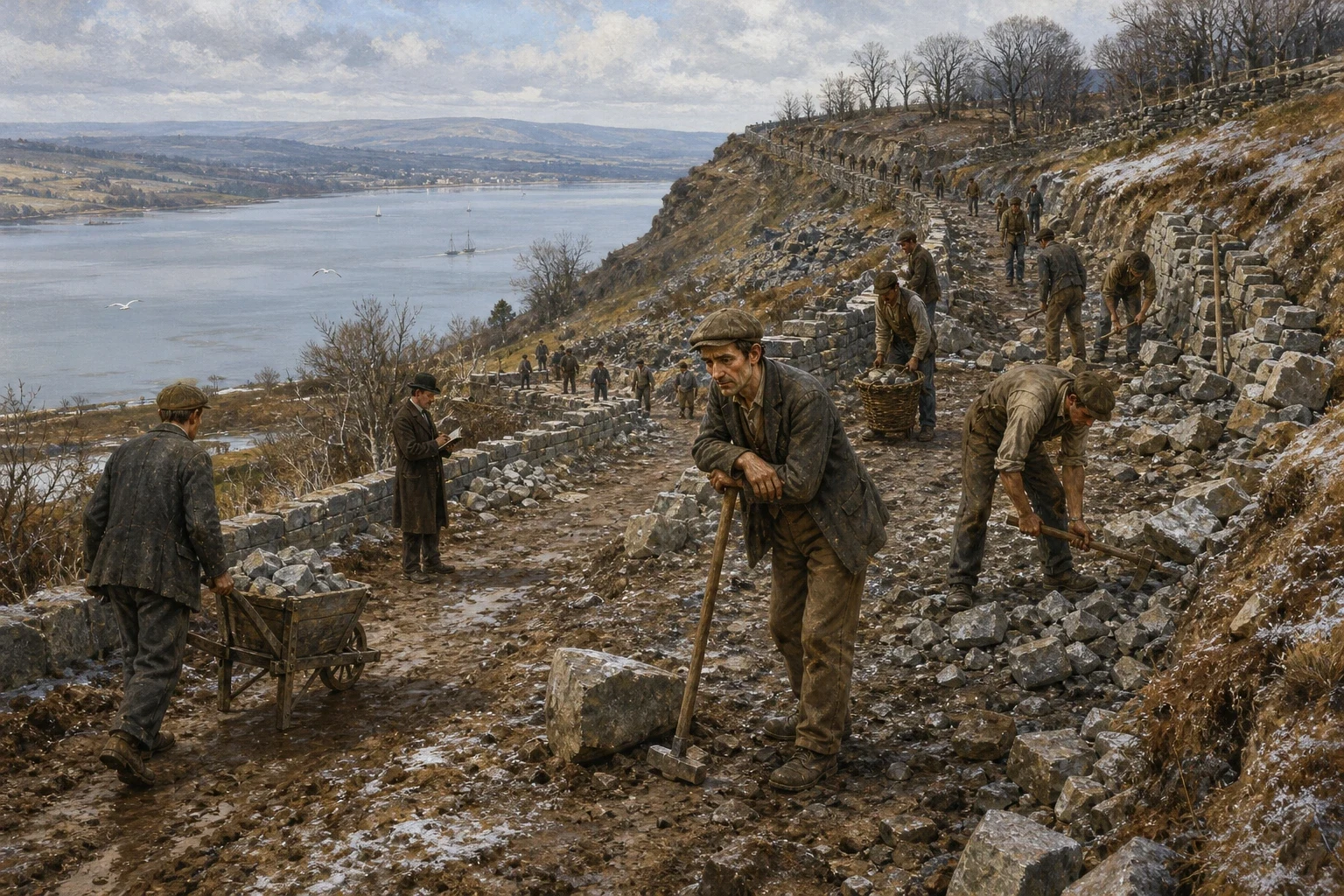
The winter of 1846 into 1847 became known afterward as Black '47, the worst of the famine years. Along a half-built road above the Shannon estuary in County Clare, men who had lost their entire food supply worked breaking stone and shifting earth for one of the government's public-works schemes, in exchange for a wage that was often too small to buy enough food at the inflated prices in the local market. Many of the men on roads like this one were already weakened by months of hunger, and the outdoor winter labor made that worse rather than better. Some of these works led nowhere useful — roads that stopped partway across a hillside, walls that enclosed nothing — because the point, as the scheme was designed, was simply to test that a man was willing to labor for relief, not to build anything the country needed. By the spring of 1847, the public-works approach was already being abandoned as a failure.
Page 7
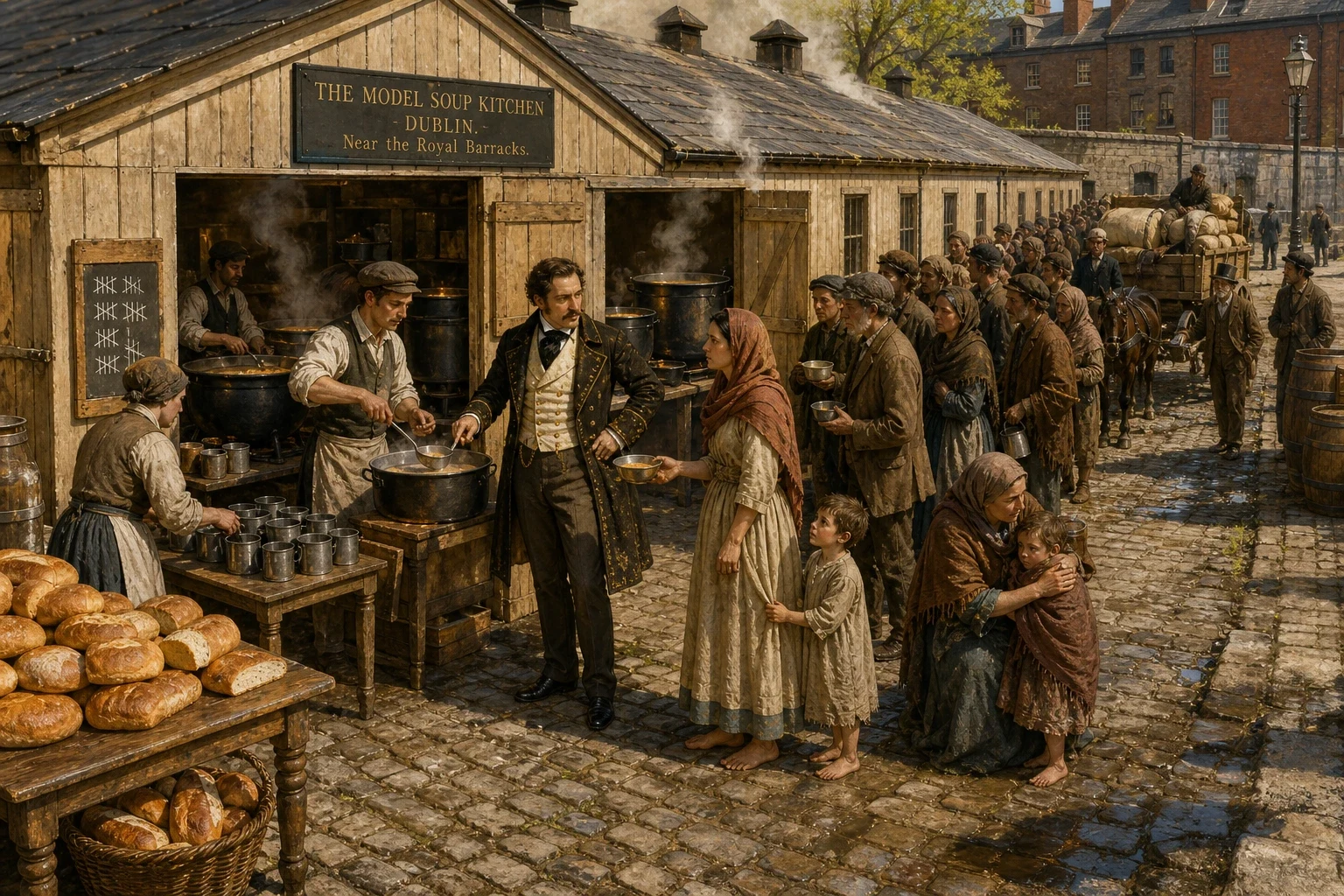
In April 1847, the French chef Alexis Soyer, already famous in London for his cooking at the Reform Club, opened a model soup kitchen near the Royal Barracks in Dublin, designed to feed thousands of people a day as efficiently as possible under a temporary government relief act. At its busiest, Soyer's kitchen and others like it across the country fed close to three million people daily — the single largest and most direct relief effort of the whole famine. A tenant farmer's wife and child, among the great many who had lost everything on their small holdings, stood in line for a bowl of soup and a measure of bread, the first steady food some families had seen in months. It was real relief, and it worked. But it was also temporary by design, and by the end of that same summer, with the government judging the worst of the emergency past, the soup kitchens began closing. The hunger they had been feeding had not actually ended.
Page 8
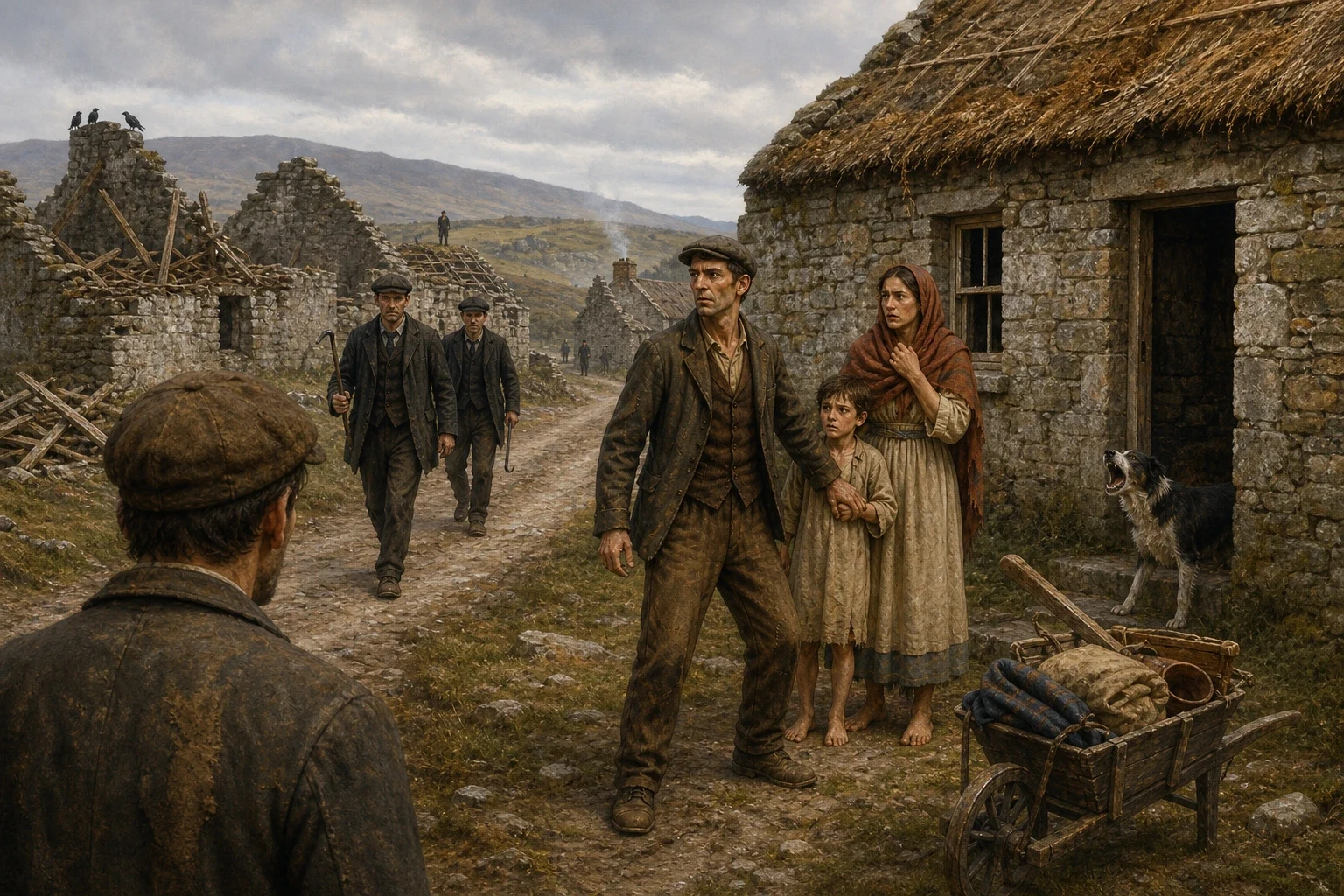
By 1848, with rents unpaid and relief narrowed, landlords across Ireland were clearing tenants from the land in large numbers. A new rule that year, known as the Gregory clause, refused relief to anyone still holding more than a quarter-acre of land, which pushed many families to give up their small holdings simply to qualify for help at all. In County Mayo, as in many counties, agents arrived at townland after townland with crowbars to pull down the walls and roofs of cottages whose tenants had been evicted, so the land could be cleared for grazing or simply so the family could never return to it. A tenant family who had survived the blight itself now faced losing the only shelter they had, in the same year the local workhouse was already far beyond anything it had been built to hold. There was no appeal that reached most of these families in time. The clearances went on through the worst and coldest months of the year.
Page 9
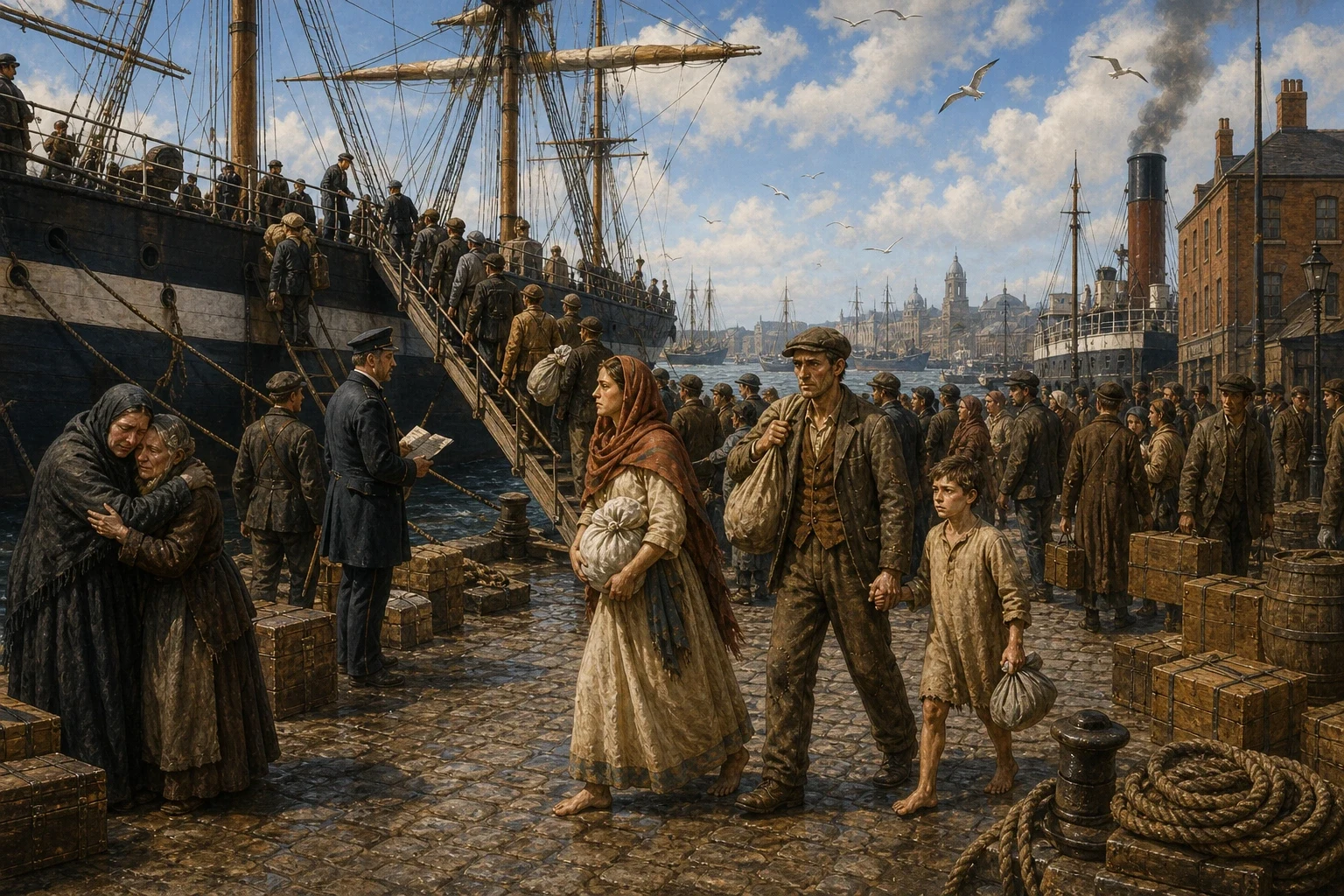
Between 1847 and 1849, as land and food and relief all narrowed at once, roughly a million people left Ireland for good, many of them sailing first to Liverpool and from there onward to North America. Ships carrying emigrants were often badly overcrowded, with little food or clean water for a crossing that could take six weeks or more, and typhus spread easily in the crowded holds. So many emigrants arrived sick or dying that the ships became known as coffin ships, and the quarantine station at Grosse Île, near Quebec, buried more than five thousand people in a single year, 1847, in mass graves there. A tenant family who had already lost their land and their crop stood on the Liverpool quayside with what little they could carry, choosing a dangerous crossing over certain hunger at home. Most who left never saw Ireland again. The country they left behind would not fully recover its population for more than a century.
Page 10
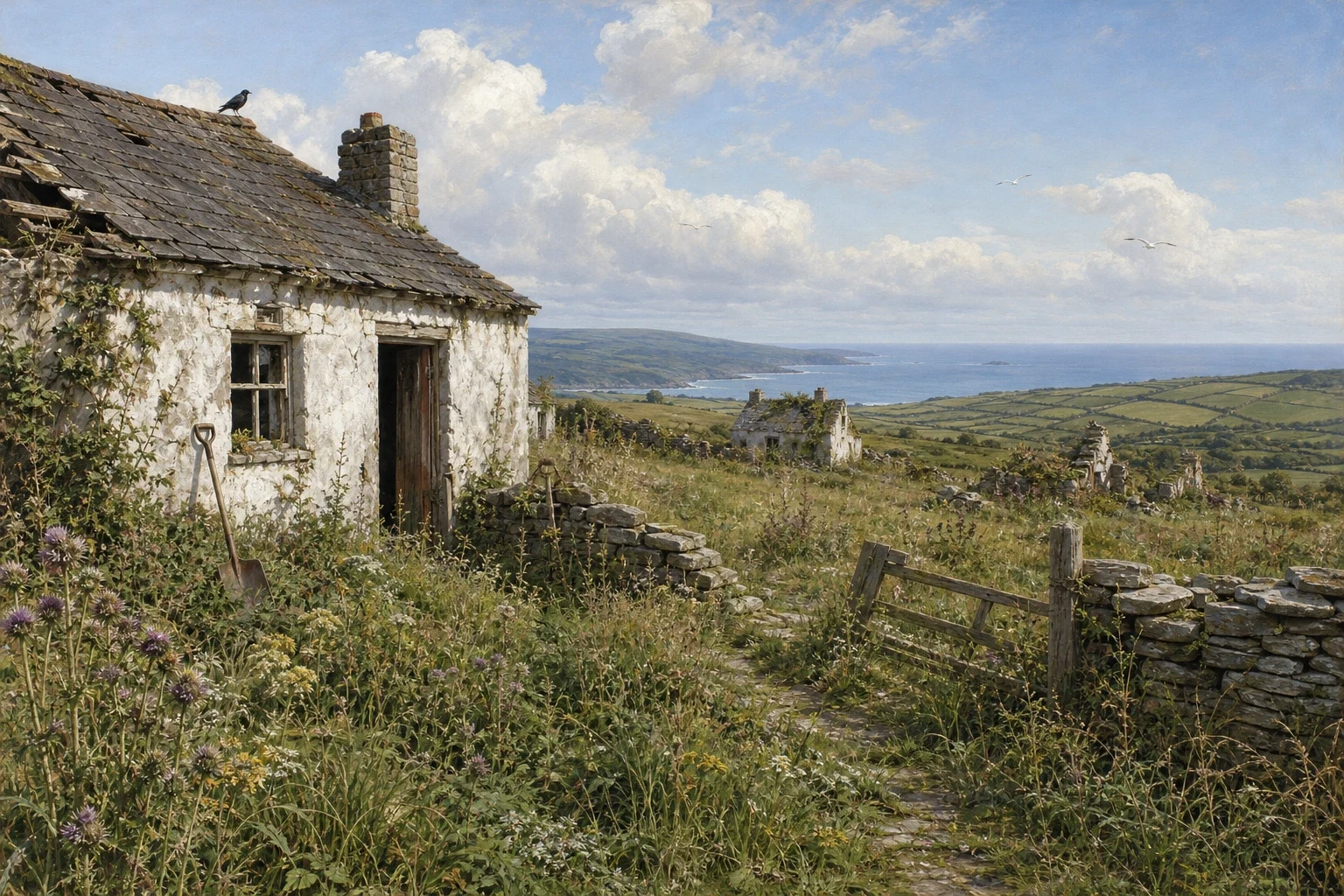
By 1852, when the blight had finally passed and the worst of the famine years were over, Ireland's population had fallen by roughly a quarter in a single decade, from about eight and a quarter million people in 1841 to about six and a half million in 1851 — close to a million dead of hunger and disease, and roughly a million more gone across the sea, most of them never to return. Near Skibbereen, the field that had once carried neat ridges of potatoes stood overgrown and half wild, its cottage empty, its family among those who had left or not survived. Across the country, similar fields lay the same way, and whole townlands stood silent that had once held hundreds of people. Ireland would go on, but it would not be the same country it had been in 1845, and for many of the dead and departed, nothing that came afterward made up for what the famine years had cost them.
About this story
- Audience: general readers
- Format: 10 illustrated pages, narrated, free to read on Wonder History
Read Wonder History on your phone
Wonder History is available on Android and iPhone and iPad. Get Wonder History on Google Play · Get Wonder History on the App Store.