The Assassination of Julius Caesar (44 BC) - Italy (44 BC, Italy)
The Assassination of Julius Caesar (44 BC) - Italy (44 BC, Italy) — an illustrated history story, featuring Julius Caesar, Marcus Junius Brutus, Gaius Cassius Longinus, set in Italy. 10 illustrated pages, free to read on Wonder History.
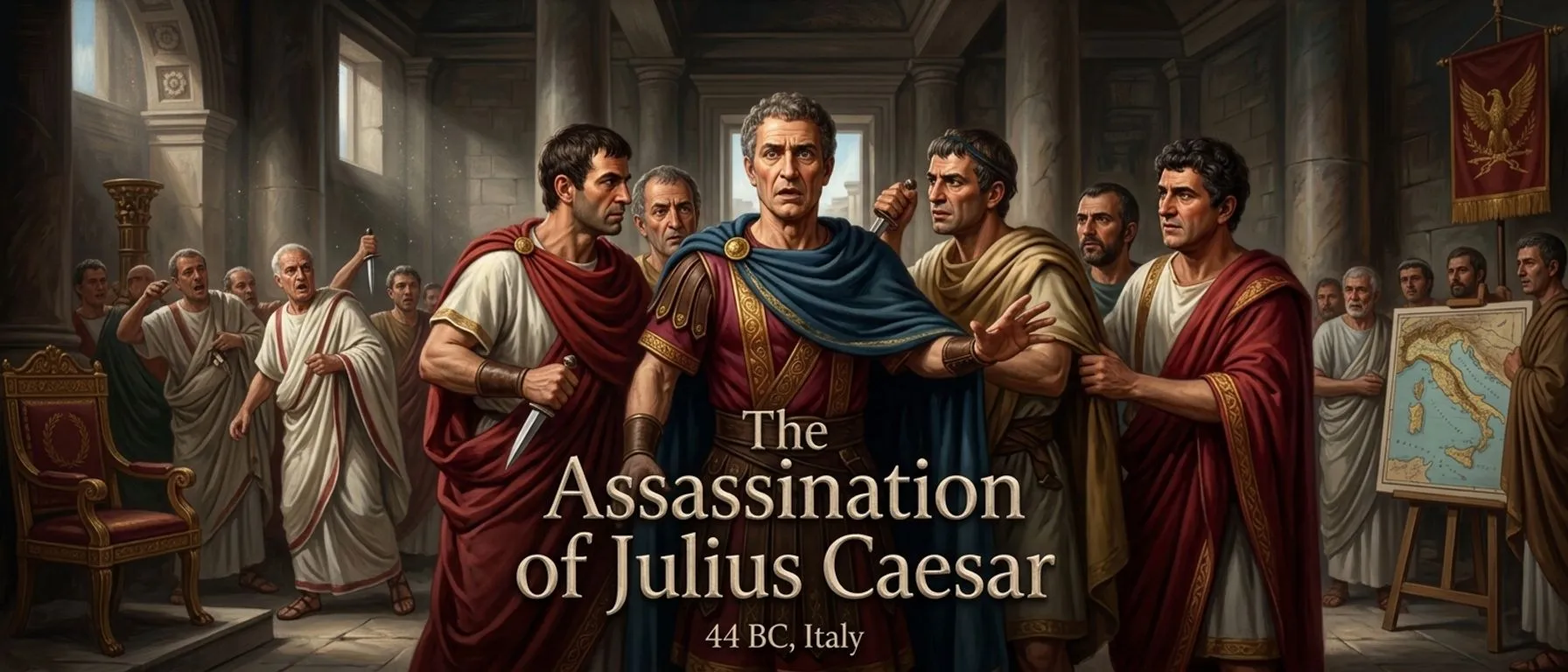
Page 1

March 15, 44 BC. The Roman Senate was in session. But today, the fate of Rome and its most powerful figures hung in the balance. Julius Caesar, the celebrated general and dictator, Marcus Junius Brutus, a respected senator, Gaius Cassius Longinus, the prime instigator, and Mark Antony, Caesar's loyal ally—their destinies were about to collide in a bloody act that would change the course of history.
Historical Fact: The Roman Senate was the governing and advisory assembly of the aristocracy in the Roman Republic.
Page 2

The seeds of Caesar's assassination were sown in the ambitions and fears of Rome's elite. Caesar's unprecedented power, assumed as dictator for life, threatened the traditional Republican order. Many senators, fearing the rise of a monarchy, began to plot against him. Cassius, a seasoned politician, saw Caesar's ambition as a direct threat to the Republic.
""If you love Caesar, love Rome more," Cassius muttered to Brutus, trying to sway him."
Historical Fact: Cassius was a Roman senator and a leading instigator in the conspiracy against Julius Caesar.
Page 3

Brutus, a man of high moral principle, was torn. He admired Caesar but also valued the Republic. The conspirators played on his sense of duty, convincing him that Caesar's death was necessary to save Rome from tyranny. Brutus wrestled with his conscience, knowing that his decision would determine the fate of Rome.
""It is not that I loved Caesar less, but that I loved Rome more," Brutus said to himself, echoing a sentiment he had heard from Cassius."
Historical Fact: Marcus Junius Brutus was a Roman senator known for his integrity and commitment to the Republic.
Page 4

As the Ides of March approached, strange omens appeared. A soothsayer warned Caesar to 'Beware the Ides of March.' Calpurnia, Caesar's wife, had unsettling dreams. Despite the warnings, Caesar, emboldened by his power, dismissed them as mere superstition. The atmosphere in Rome was thick with dread.
""Beware the Ides of March!" the soothsayer cried out, his voice echoing through the Forum."
Historical Fact: The Ides of March was a date in the Roman calendar that corresponded to March 15. It was marked by several religious observances.
Page 5

On the morning of March 15, the conspirators gathered near the Theater of Pompey, where the Senate was to convene. They concealed daggers beneath their togas, their hearts pounding with a mixture of fear and resolve. Each man was prepared to play his part in what they believed was a necessary act of liberation. A tense calm settled over the group as they awaited Caesar's arrival.
""Remember why we are doing this. For Rome!" Cassius said, steel in his voice."
Historical Fact: The Theater of Pompey was a large structure in ancient Rome that housed a theater, gardens, and a curia.
Page 6

Caesar, surrounded by his guards, entered the Senate chamber. Despite the warnings, he walked with confidence, unaware of the plot that awaited him. As he took his seat, the conspirators closed in around him. Trebonius lured Mark Antony away, fulfilling their plan. The moment of truth had arrived.
""Et tu, Brute?" Caesar exclaimed, realizing the betrayal."
Historical Fact: Caesar was stabbed 23 times by the conspirators.
Page 7

The conspirators struck swiftly. Cassius struck the first blow, followed by others. Caesar, realizing the betrayal, tried to fight back, but he was overwhelmed. According to Suetonius, Caesar said the famous phrase, 'Et tu, Brute?' Upon seeing his close friend Brutus among the assassins, Caesar ceased to resist. The Senate chamber was filled with chaos and blood.
""So falls tyranny!" Cassius cried out, raising his bloodied dagger."
Historical Fact: Suetonius was a Roman historian who wrote biographies of the Roman emperors.
Page 8

Mark Antony, though loyal to Caesar, skillfully navigated the aftermath. He delivered a powerful eulogy at Caesar's funeral, stirring the people of Rome against the assassins. Antony said, 'Friends, Romans, countrymen, lend me your ears...' as Shakespeare wrote centuries later, though his actual words were recorded by historians such as Plutarch. Antony then formed an alliance with Octavian, Caesar's adopted son, and Lepidus, to avenge Caesar's death.
""The evil that men do lives after them; the good is oft interred with their bones," Mark Antony proclaimed during Caesar's funeral oration, igniting fury amongst the Romans."
Historical Fact: Mark Antony was a Roman politician and general who was a close ally of Julius Caesar.
Page 9

The Second Triumvirate, composed of Antony, Octavian, and Lepidus, hunted down the conspirators. Brutus and Cassius were defeated at the Battle of Philippi in 42 BC, bringing an end to their rebellion. The Roman Republic was effectively over, paving the way for the rise of the Roman Empire. The dream of restoring the Republic died with Brutus and Cassius.
""The fault, dear Brutus, is not in our stars, but in ourselves," Cassius whispered to Brutus, quoting William Shakespeare, centuries later, shortly before his death."
Historical Fact: The Battle of Philippi was fought in 42 BC between the forces of Mark Antony and Octavian against the forces of Brutus and Cassius.
Page 10

Caesar's death marked a turning point in Roman history. The Republic collapsed, and Octavian, later known as Augustus, became the first Roman Emperor. Caesar's legacy lived on through the Empire, shaping Roman law, culture, and governance for centuries. Though his life ended tragically, his impact on the world remains profound.
Historical Fact: Augustus was the first Roman Emperor and ruled from 27 BC to 14 AD.
About this story
- Historical figures: Julius Caesar, Marcus Junius Brutus, Gaius Cassius Longinus
- Location: Italy
- Period: Ancient
- Audience: general readers
Questions and answers
Questions and answers about The Assassination of Julius Caesar (44 BC) - Italy (44 BC, Italy)
Read Wonder History on your phone
Wonder History is available on Android. Get Wonder History on Google Play.