The Industrial Revolution (18th–19th Century, United Kingdom & Europe)
The Industrial Revolution (18th–19th Century, United Kingdom & Europe) — an illustrated history story, featuring Queen Victoria, Richard Arkwright, Matthew Boulton, set in United Kingdom & Europe. 10 illustrated pages, free to read on Wonder History.
Page 1

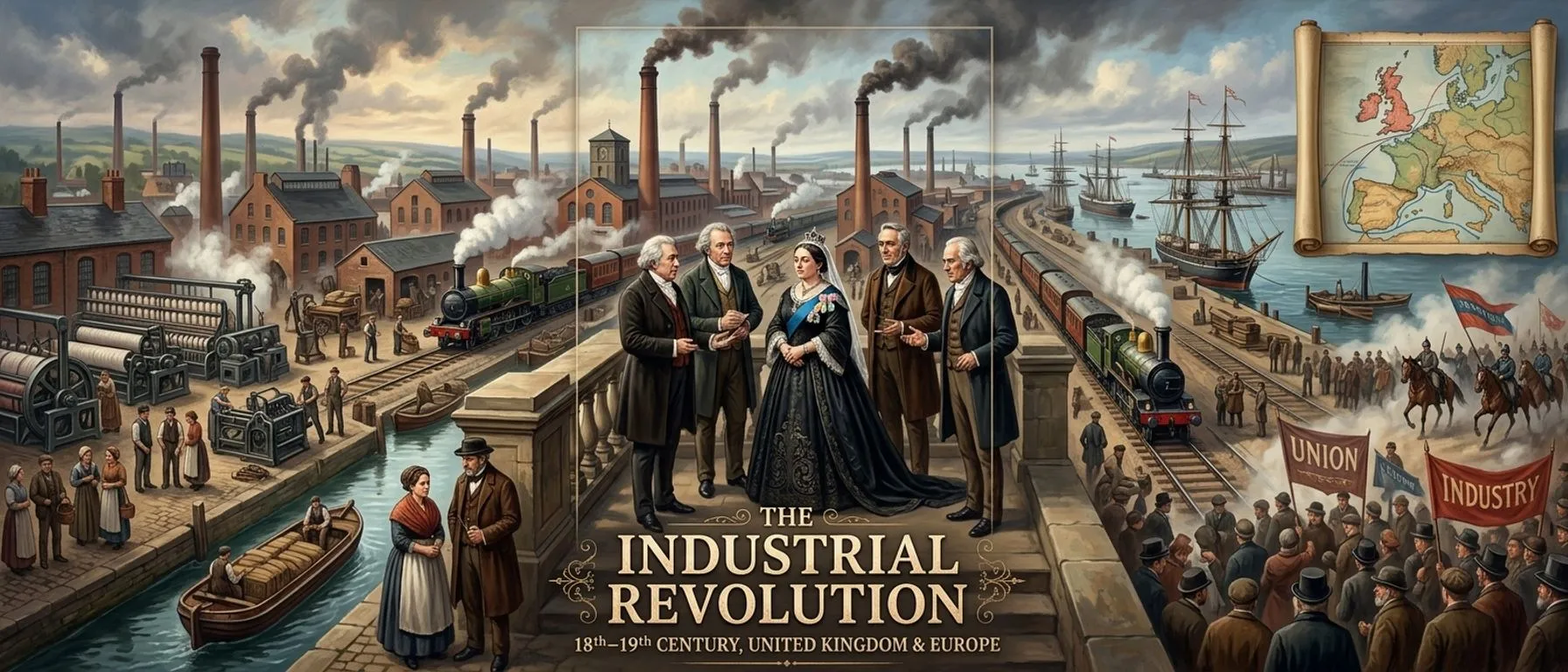
In 1851, London hosted the Great Exhibition in the Crystal Palace, a testament to British industrial might. Queen Victoria, inventor Richard Arkwright, entrepreneur Matthew Boulton, and engineer George Stephenson—their innovations and ambitions fueled an era of unprecedented change. But what transformative forces ignited this revolution that reshaped Britain and spread across Europe?
Page 2

Jethro Tull, a Berkshire farmer, studied his fields with furrowed brows. "There must be a better way!" he exclaimed, observing the inefficient scattering of seeds. He began tinkering with designs. Inspired by organ pipes, he invented the seed drill, a machine to plant seeds evenly and efficiently, transforming farming practices.
Page 3

Richard Arkwright stared intensely at the churning gears of his water frame. "This," he declared to his foreman, "is the future of textile production!" His vision extended beyond mere invention. He understood the power of organization, bringing workers together under one roof.
Page 4

Matthew Boulton, his ledger open, met with James Watt in Birmingham. "Watt's steam engine," Boulton boomed, "combined with my manufacturing expertise, will revolutionize industry!" The two men shook hands, sealing a partnership. The Soho Manufactory was born, a powerhouse of innovation.
Page 5

"Behold!" George Stephenson shouted over the hiss of steam. "The Rocket will shrink the world!" The crowd gasped as the locomotive roared down the tracks, connecting Liverpool and Manchester and ushering in the age of railways. Commerce would never be the same.
Page 6

Friedrich Engels, surveying the Manchester slums, grimaced. "These conditions," he wrote, "are a disgrace to humanity!" Overcrowding, pollution, and poverty festered in the shadows of industrial progress. The gap between the wealthy and the working class widened.
Page 7

Ned Ludd, though perhaps a myth, became a symbol of defiance. One masked weaver cried, "We will not be replaced by machines!" The Luddites smashed textile machines in protest, their anger a desperate cry against economic hardship and unemployment.
Page 8

Across the English Channel, Eugène Schneider, a French industrialist, toured Le Creusot factories. He realized the efficiency of steam-powered machinery. "France," he declared, to his assistant, "must embrace these advancements to compete with Britain!" He initiated the rapid industrialization of the French iron and steel industry.
Page 9

Karl Marx, sitting at his desk in London, wrote furiously. "'Workers of all countries, unite!'" he declared in The Communist Manifesto. His ideas spread across Europe, igniting debates about the rights of workers, fair wages, and the distribution of wealth. The old order was being challenged.
Page 10

Decades later, factories dotted the landscapes of Europe and beyond, cities grew to unprecedented sizes, and railways crisscrossed continents. As Charles Dickens said, "It was the best of times, it was the worst of times." The Industrial Revolution had irrevocably altered the world, forging the modern era.
About this story
- Historical figures: Queen Victoria, Richard Arkwright, Matthew Boulton
- Location: United Kingdom & Europe
- Period: Ancient
- Audience: general readers
Questions and answers
Questions and answers about The Industrial Revolution (18th–19th Century, United Kingdom & Europe)
Read Wonder History on your phone
Wonder History is available on Android. Get Wonder History on Google Play.