The Invention of the Gutenberg Printing Press (1440) - Germany
The Invention of the Gutenberg Printing Press (1440) - Germany — an illustrated history story, featuring Johannes Gutenberg, Johann Fust, Peter Schöffer, set in Germany. 10 illustrated pages, free to read on Wonder History.

Page 1

October 1454, Mainz, Germany. A technological revolution is underway. Johannes Gutenberg, the goldsmith turned inventor, stands amidst his workshop. Beside him is Johann Fust, the financier backing this ambitious endeavor. And Peter Schöffer, Fust's skilled apprentice, meticulously arranges the movable type.
"The printing press, promising to spread knowledge far and wide, is about to change the world."
Historical Fact: The Gutenberg printing press significantly lowered the cost of books, making information accessible to a wider audience. Before this, books were painstakingly hand-written by scribes, making them expensive and rare.
Page 2

Johannes Gutenberg, born around 1400 in Mainz, initially trained as a goldsmith. He experimented with metalworking techniques, seeking a way to reproduce texts more efficiently than laborious hand-copying.
"As Leonardo da Vinci once said, 'Every now and then go away, have a little relaxation, for when you come back to your work your judgment will be surer.' Even after hours of work, I must keep pushing forward. Gutenberg remarked. "
Historical Fact: Before inventing the printing press, Gutenberg experimented with using metal type to stamp letters onto paper, a technique he likely developed through his goldsmithing skills.
Page 3

Around 1434, Gutenberg resided in Strasbourg, where he continued his printing experiments with associates Andreas Dritzehn, Andreas Heilmann, and Johann Riffe. They refined the process of creating individual movable type from metal.
"Andreas, did you cast the letters yet?"
Historical Fact: The Strasbourg Document of 1439 provides evidence that Gutenberg and his associates were working on a 'secret art' related to printing several years before he returned to Mainz.
Page 4

Johannes Gutenberg, a masterful goldsmith from Mainz, Germany, dedicated himself to an audacious new craft: printing. With unwavering concentration, he meticulously arranged tiny, individual metal letters into a composing stick, each character precisely placed. This painstaking precision was vital, for every perfectly aligned letter would contribute to forming an entire page of text. Though a slow and careful process, this innovative method promised to utterly transform how knowledge and stories would spread across the world.
Page 5

Johannes Gutenberg, the visionary goldsmith, meticulously operated the robust wooden screw mechanism, his strong pull on the lever bringing immense force to bear upon the waiting page. Beside him, the nimble apprentice Peter Schöffer carefully peeled away a freshly pressed sheet, his eager gaze confirming the crisp, uniform impression of the type. Johann Fust, the shrewd financier, observed the bustling workshop with keen approval, understanding that each precise motion brought them closer to revolutionizing the written word. This collaborative ballet of innovation in Mainz was steadily transforming individual pages into an unstoppable wave of knowledge.
Page 6

The first major book printed using Gutenberg's press was the Latin Vulgate Bible, completed around 1455. Around 180 copies were printed, a monumental achievement that marked the beginning of the age of mass communication.
"The Bible, replicated. A powerful thing, indeed."
Historical Fact: It's estimated that around 180 copies of the Gutenberg Bible were printed, with approximately 48 copies surviving today. Each Bible contained 1,282 pages and required the setting of over 2.5 million individual pieces of type.
Page 7
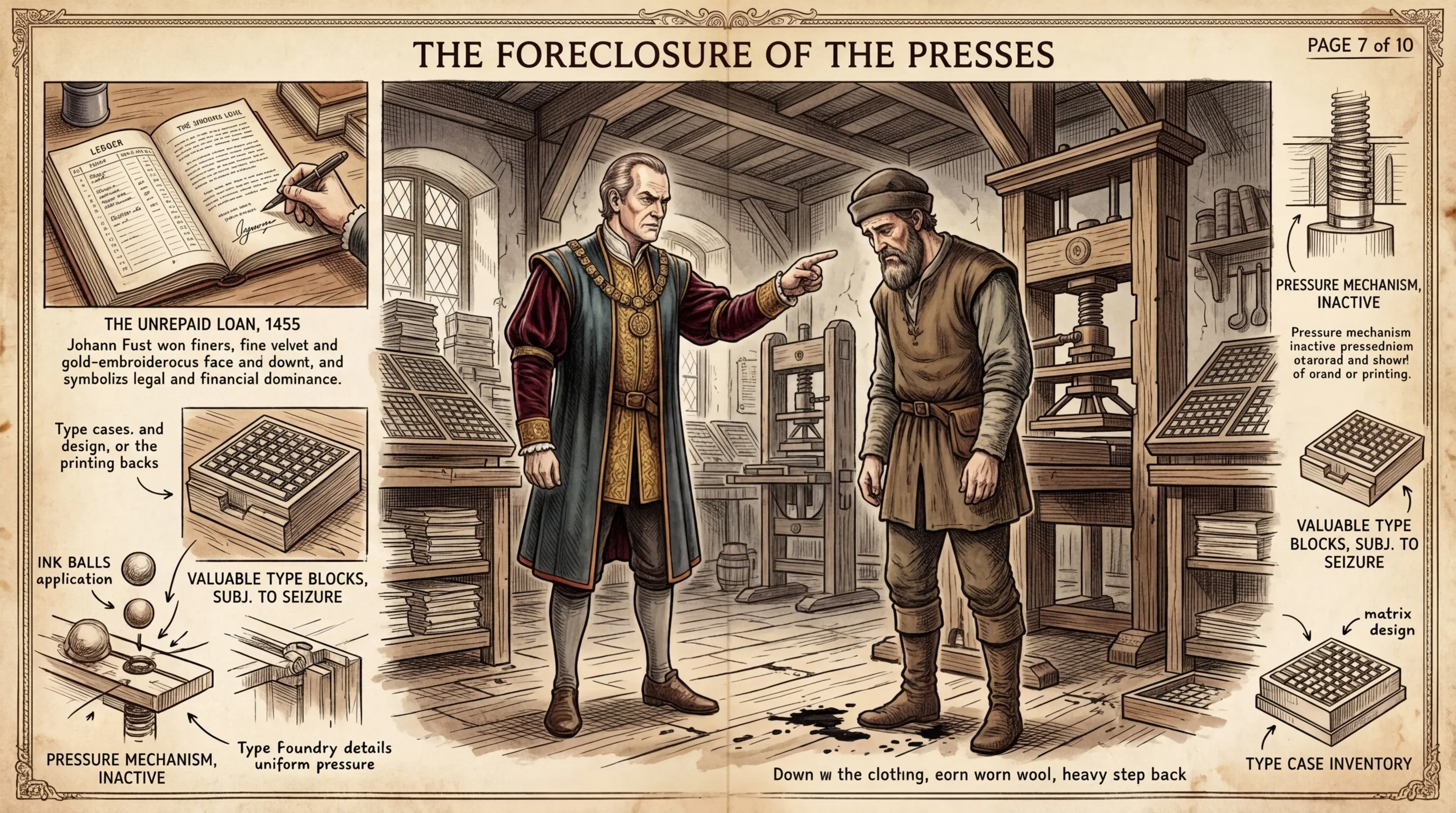
In 1455, Johann Fust sued Gutenberg, demanding repayment of the loans. Fust won the lawsuit and seized Gutenberg's printing equipment and a substantial number of printed Bibles.
"Your invention is groundbreaking, Gutenberg, but your financial management is...lacking! You are in breach of your agreement."
Historical Fact: The exact details of the lawsuit between Gutenberg and Fust are not fully known, but historical records suggest Fust claimed Gutenberg misused the loan and failed to uphold his end of the agreement.
Page 8

Despite losing his equipment, Gutenberg continued to experiment with printing, setting up a new, smaller workshop. Peter Schöffer, now working with Fust, further refined printing techniques and established a successful printing business.
"Indeed, Peter, said Gutenberg, let us learn from each other. As Henry Ford said, 'Coming together is a beginning, staying together is progress, and working together is success.'"
Historical Fact: After separating from Gutenberg, Peter Schöffer married Fust's daughter and became a partner in Fust's printing business, which went on to produce some of the finest incunabula (early printed books).
Page 9
Johannes Gutenberg died in 1468. Although he faced financial difficulties and legal battles, his invention of the printing press revolutionized communication and paved the way for the widespread dissemination of knowledge. He later was awarded by the Archbishop.
"Gutenberg's mind was truly extraordinary."
Historical Fact: Gutenberg received recognition for his invention later in life, and was granted a pension and certain exemptions by Archbishop Adolph II von Nassau.
Page 10

By the late 15th century, printing presses had spread throughout Europe, from Italy to England. The increased availability of books transformed education, science, and religion, leading to the Renaissance and the Reformation.
"The word is now available for all. The world will never be the same."
Historical Fact: By 1500, printing presses were operating in over 200 European cities, and an estimated 20 million books had been printed, representing a massive increase in the availability of information.
About this story
- Historical figures: Johannes Gutenberg, Johann Fust, Peter Schöffer
- Location: Germany
- Period: Middle Ages
- Audience: general readers
Questions and answers
Questions and answers about The Invention of the Gutenberg Printing Press (1440) - Germany
Read Wonder History on your phone
Wonder History is available on Android and iPhone and iPad. Get Wonder History on Google Play · Get Wonder History on the App Store.