The Velvet Divorce (1989, USA)

The Velvet Divorce (1989, USA) — an illustrated history story, featuring Alexander Dubček, Václav Havel, Gustáv Husák, set in USA. 10 illustrated pages, free to read on Wonder History.
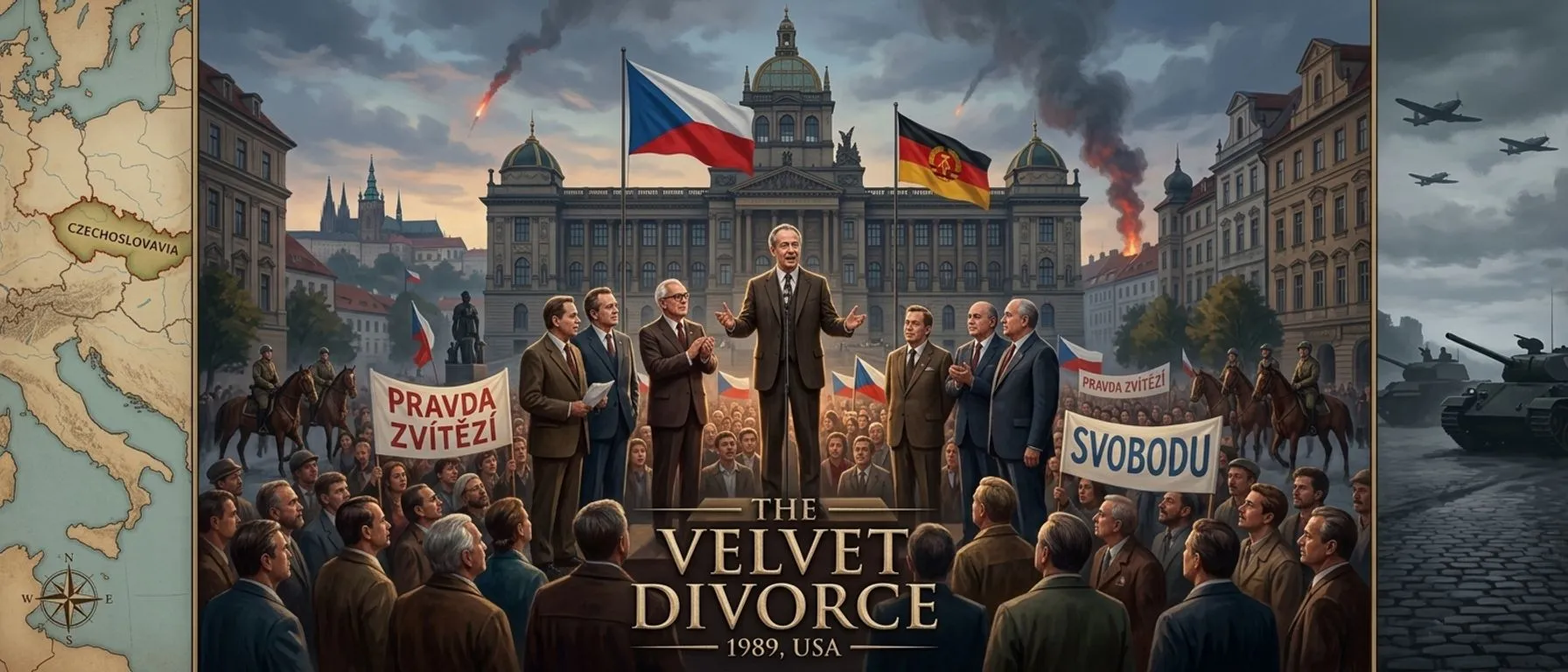
The Velvet Divorce (1989, USA) — book cover — Wonder History
The Velvet Divorce (1989, USA) — an illustrated history story, featuring Alexander Dubček, Václav Havel, Gustáv Husák, set in USA. 10 illustrated pages, free to read on Wonder History.

Page 1

November 17, 1989. Hundreds of thousands of students and citizens flooded Wenceslas Square in Prague, their chants echoing against the historic buildings.
November 17, 1989. Hundreds of thousands of students and citizens flooded Wenceslas Square in Prague, their chants echoing against the historic buildings. Alexander Dubček, a key figure during the Prague Spring, watched from a nearby balcony, his face etched with a mixture of hope and apprehension. The air crackled with the energy of change, a stark contrast to the decades of Soviet control.

November 17, 1989. Hundreds of thousands of students and citizens flooded Wenceslas Square in Prague, their chants echoing against the historic buildings. Alexander Dubček, a key figure during the Prague Spring, watched from a nearby balcony, his face etched with a mixture of hope and apprehension. The air crackled with the energy of change, a stark contrast to the decades of Soviet control. But could this movement truly bring about a 'velvet divorce' from the hardline regime?

Page 2

The seeds of dissent had been quietly germinating for years. Gustáv Husák, the hardline communist leader, clung to power, enforcing strict policies and…
The seeds of dissent had been quietly germinating for years. Gustáv Husák, the hardline communist leader, clung to power, enforcing strict policies and suppressing any sign of opposition. In his presidential office, surrounded by portraits of communist leaders, Husák dismissed reports of growing unrest, declaring, "The situation is stable, and these troublemakers will be dealt with accordingly." But Václav Havel, a dissident playwright, saw a different reality brewing.

The seeds of dissent had been quietly germinating for years. Gustáv Husák, the hardline communist leader, clung to power, enforcing strict policies and suppressing any sign of opposition. In his presidential office, surrounded by portraits of communist leaders, Husák dismissed reports of growing unrest, declaring, "The situation is stable, and these troublemakers will be dealt with accordingly." But Václav Havel, a dissident playwright, saw a different reality brewing.

Page 3

Mikhail Gorbachev's reforms of 'Glasnost' and 'Perestroika' in the Soviet Union sent ripples of hope through Czechoslovakia.
Mikhail Gorbachev's reforms of 'Glasnost' and 'Perestroika' in the Soviet Union sent ripples of hope through Czechoslovakia. Zdeněk Mlynář, a close confident of Dubček, visited him, discussing the political climate of the time, 'If Moscow embraces change,' Mlynář said to Dubček, 'then perhaps we can begin to dismantle this system from within.' Dubček, cautious as ever, responded, 'Change must be gradual, Zdeněk. We learned that lesson in '68.'

Mikhail Gorbachev's reforms of 'Glasnost' and 'Perestroika' in the Soviet Union sent ripples of hope through Czechoslovakia. Zdeněk Mlynář, a close confident of Dubček, visited him, discussing the political climate of the time, 'If Moscow embraces change,' Mlynář said to Dubček, 'then perhaps we can begin to dismantle this system from within.' Dubček, cautious as ever, responded, 'Change must be gradual, Zdeněk. We learned that lesson in '68.'

Page 4

Jiří Němec, a human rights activist, organized peaceful demonstrations, challenging the regime's authority. "We cannot remain silent any longer," Němec declared…
Jiří Němec, a human rights activist, organized peaceful demonstrations, challenging the regime's authority. "We cannot remain silent any longer," Němec declared to a small group of supporters. "As Edmund Burke said, 'All that is necessary for the triumph of evil is that good men do nothing.' We must stand up for our rights, peacefully, but firmly." These protests, though small, were a spark that threatened to ignite the tinderbox of public discontent.

Jiří Němec, a human rights activist, organized peaceful demonstrations, challenging the regime's authority. "We cannot remain silent any longer," Němec declared to a small group of supporters. "As Edmund Burke said, 'All that is necessary for the triumph of evil is that good men do nothing.' We must stand up for our rights, peacefully, but firmly." These protests, though small, were a spark that threatened to ignite the tinderbox of public discontent.

Page 5

Erich Honecker, the East German leader, vehemently opposed any reform. He phoned Husák, urging him to crush the dissent.
Erich Honecker, the East German leader, vehemently opposed any reform. He phoned Husák, urging him to crush the dissent. "These so-called 'reforms' are a cancer," Honecker said, his voice booming across the line. "They must be cut out before they spread and destroy the entire Eastern Bloc!" Husák, caught between Moscow's changing stance and Honecker's pressure, hesitated.

Erich Honecker, the East German leader, vehemently opposed any reform. He phoned Husák, urging him to crush the dissent. "These so-called 'reforms' are a cancer," Honecker said, his voice booming across the line. "They must be cut out before they spread and destroy the entire Eastern Bloc!" Husák, caught between Moscow's changing stance and Honecker's pressure, hesitated.

Page 6

On November 17, 1989, the brutal suppression of a student demonstration in Prague triggered a massive outpouring of public anger.
On November 17, 1989, the brutal suppression of a student demonstration in Prague triggered a massive outpouring of public anger. As the crowds swelled in Wenceslas Square, Ladislav Adamec, the Prime Minister, saw the writing on the wall. The Communist party was at risk of losing control, 'If we don't find a peaceful solution', Adamec told his cabinet, 'we risk bloodshed.'

On November 17, 1989, the brutal suppression of a student demonstration in Prague triggered a massive outpouring of public anger. As the crowds swelled in Wenceslas Square, Ladislav Adamec, the Prime Minister, saw the writing on the wall. The Communist party was at risk of losing control, 'If we don't find a peaceful solution', Adamec told his cabinet, 'we risk bloodshed.'

Page 7

Negotiations began between the Communist government and the Civic Forum, led by Václav Havel. 'We demand free elections and the release of all political…
Negotiations began between the Communist government and the Civic Forum, led by Václav Havel. 'We demand free elections and the release of all political prisoners,' Havel declared to Adamec during a tense meeting. Adamec, seeking a peaceful resolution, replied 'These are serious demands, Mr. Havel, but we are prepared to discuss them. We must find a way to avoid violence at all costs.'

Negotiations began between the Communist government and the Civic Forum, led by Václav Havel. 'We demand free elections and the release of all political prisoners,' Havel declared to Adamec during a tense meeting. Adamec, seeking a peaceful resolution, replied 'These are serious demands, Mr. Havel, but we are prepared to discuss them. We must find a way to avoid violence at all costs.'

Page 8

The pressure mounted as daily protests paralyzed the country. The Communist Party, sensing its grip on power slipping, began to crumble.
The pressure mounted as daily protests paralyzed the country. The Communist Party, sensing its grip on power slipping, began to crumble. One day, Alexander Dubček stepped onto the balcony overlooking Wenceslas Square. He held his arms wide, addressing the crowds as a pivotal leader, 'As Victor Hugo said, 'No army can stop an idea whose time has come!' This nation is ready for change, and so it shall receive!'.

The pressure mounted as daily protests paralyzed the country. The Communist Party, sensing its grip on power slipping, began to crumble. One day, Alexander Dubček stepped onto the balcony overlooking Wenceslas Square. He held his arms wide, addressing the crowds as a pivotal leader, 'As Victor Hugo said, 'No army can stop an idea whose time has come!' This nation is ready for change, and so it shall receive!'.

Page 9

On December 10, 1989, Gustáv Husák resigned, paving the way for the first free elections in Czechoslovakia since 1946. A small group of students cheered outside…
On December 10, 1989, Gustáv Husák resigned, paving the way for the first free elections in Czechoslovakia since 1946. A small group of students cheered outside the presidential palace with glee and excitement. The moment felt surreal. The communist party had fallen. At last, the world could see a new beginning.

On December 10, 1989, Gustáv Husák resigned, paving the way for the first free elections in Czechoslovakia since 1946. A small group of students cheered outside the presidential palace with glee and excitement. The moment felt surreal. The communist party had fallen. At last, the world could see a new beginning.

Page 10

On January 1, 1993, Czechoslovakia peacefully dissolved into two separate countries: the Czech Republic and Slovakia. Václav Havel became the first president of…
On January 1, 1993, Czechoslovakia peacefully dissolved into two separate countries: the Czech Republic and Slovakia. Václav Havel became the first president of the Czech Republic, guiding the nation toward democracy and freedom. The 'Velvet Divorce' stood as a testament to the power of peaceful resistance and the enduring desire for self-determination, inspiring future generations.

On January 1, 1993, Czechoslovakia peacefully dissolved into two separate countries: the Czech Republic and Slovakia. Václav Havel became the first president of the Czech Republic, guiding the nation toward democracy and freedom. The 'Velvet Divorce' stood as a testament to the power of peaceful resistance and the enduring desire for self-determination, inspiring future generations.

About this story

  • Historical figures: Alexander Dubček, Václav Havel, Gustáv Husák
  • Location: USA
  • Period: Contemporary
  • Audience: general readers

Questions and answers

Questions and answers about The Velvet Divorce (1989, USA)

Read Wonder History on your phone

Wonder History is available on Android. Get Wonder History on Google Play.

More Wonder History stories

All Wonder History stories · Open the library