Compact Disc
Compact Disc — an illustrated inventions story, set in Global. 10 illustrated pages, free to read on Wonder Inventions.
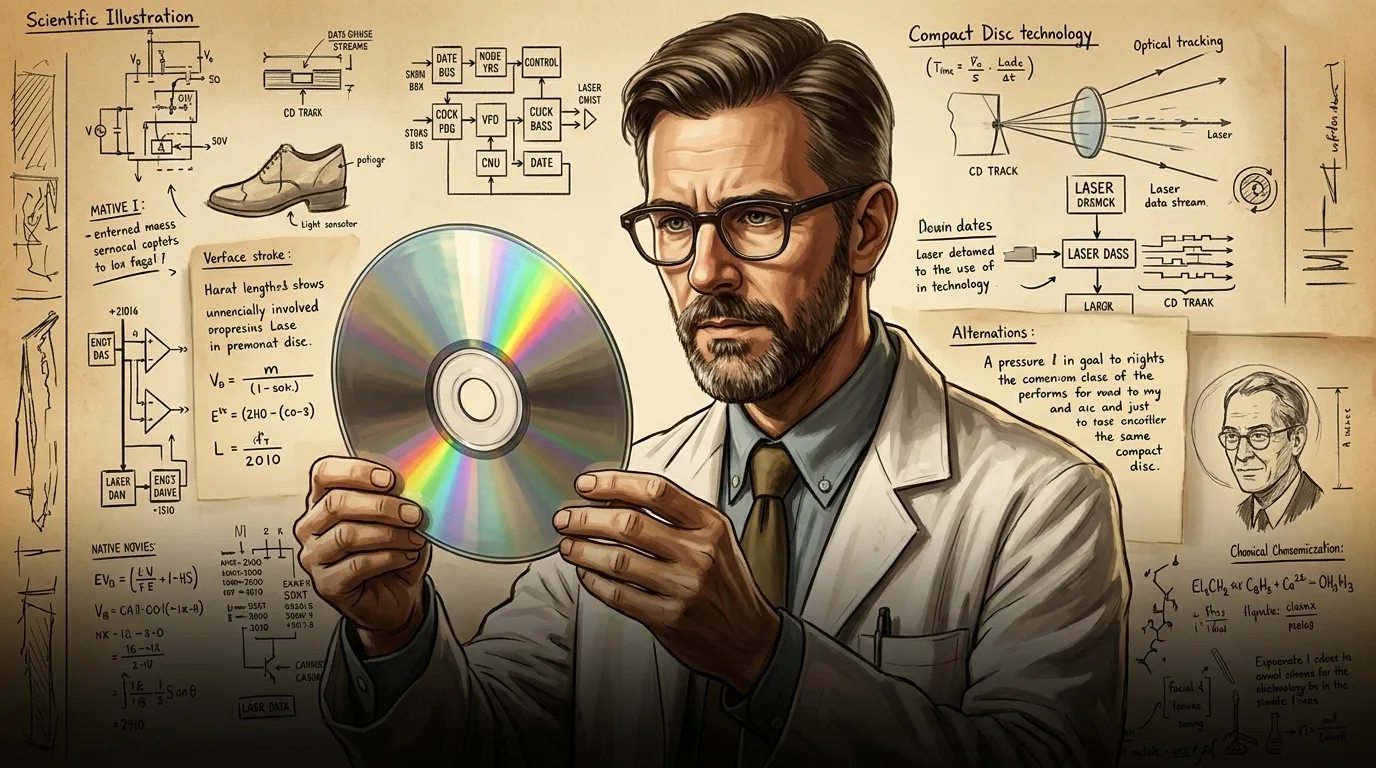
Page 1
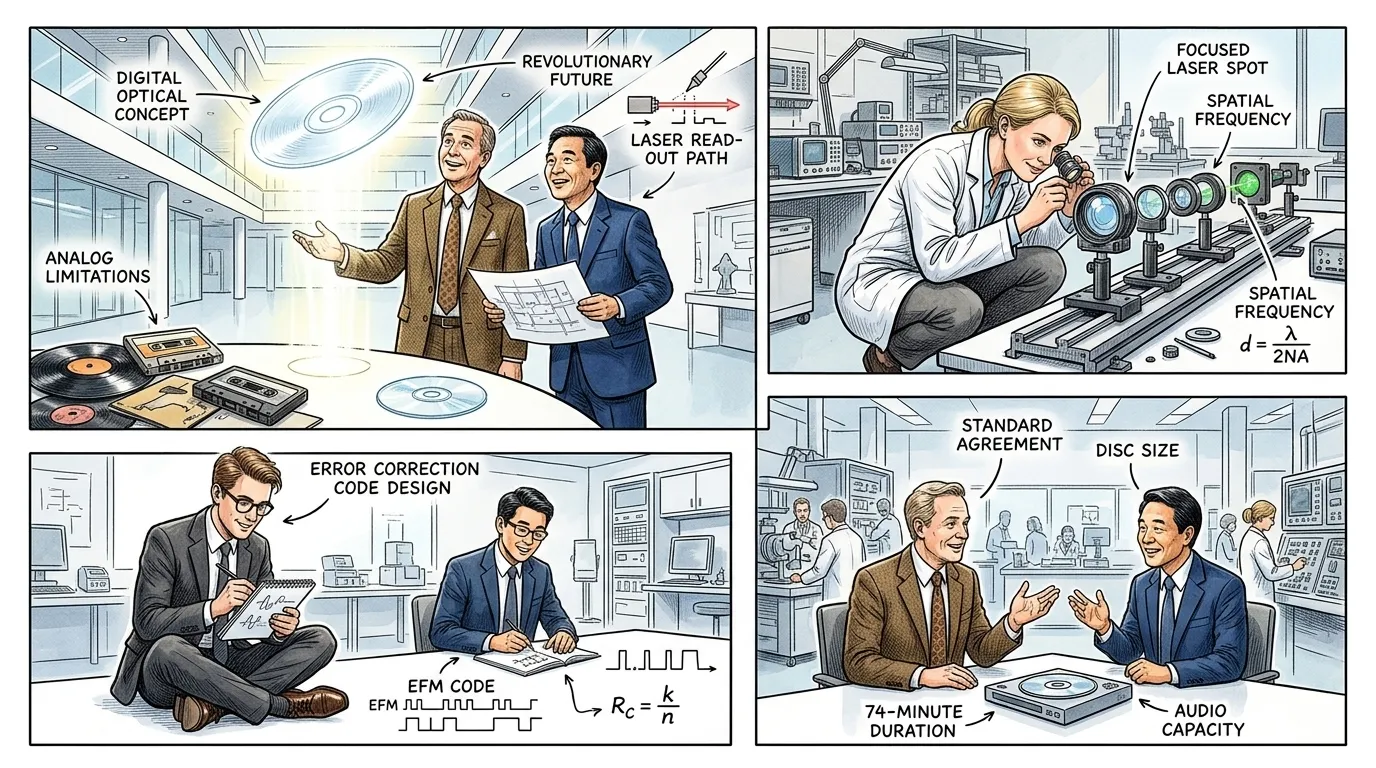
For decades, music enthusiasts sought perfection, but the dominant analog formats, vinyl records and cassette tapes, held inherent limitations. Each play introduced wear, dust accumulated, and the delicate grooves or magnetic particles degraded, adding hiss and crackle to the sound. The quest for pristine, durable audio was a pervasive challenge, demanding a radical new approach to sound reproduction. Engineers and visionaries across the globe dreamed of a medium that could deliver music without compromise, forever changing how we experience recorded sound. This vision would soon coalesce into a revolutionary digital format. Joop van Tilburg and Norio Ohga were pivotal figures in forging the industry standard.
Page 2
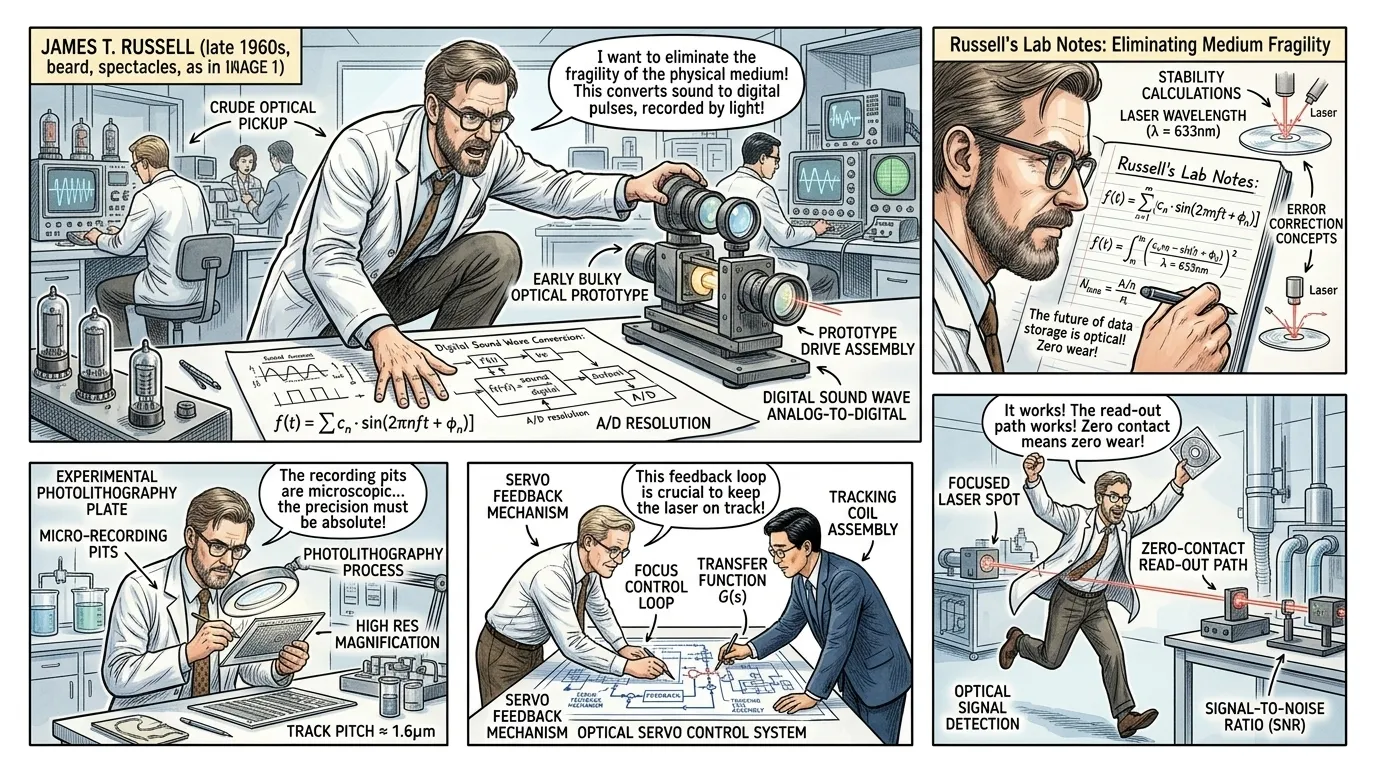
Analog recording fundamentally captures sound as a continuous wave, directly mirroring the original vibration. While seemingly intuitive, this continuous nature meant that any imperfection—a dust particle, a tiny scratch, magnetic interference—translated directly into audible noise and distortion. The ambition was to transition from this susceptible physical analogy to a robust numerical representation. Pioneering this conceptual shift was American inventor James T. Russell, whose early work demonstrated the feasibility of optically recording and playing back digital data. His audacious vision laid a critical foundation, proving that sound could be converted into a stream of numbers, stored, and then perfectly reconstructed, free from the physical degradations plaguing analog formats.
""Our challenge," James Russell, a focused, lean man in his late 40s with a neat beard and spectacles, often remarked to his research team, "is to eliminate the inherent fragility of the physical medium. Can we truly translate the richness of sound into an uncorruptible code?" He would gesture at early optical prototypes. "If we can achieve that, the possibilities for clarity and preservation are boundless.""
Page 3
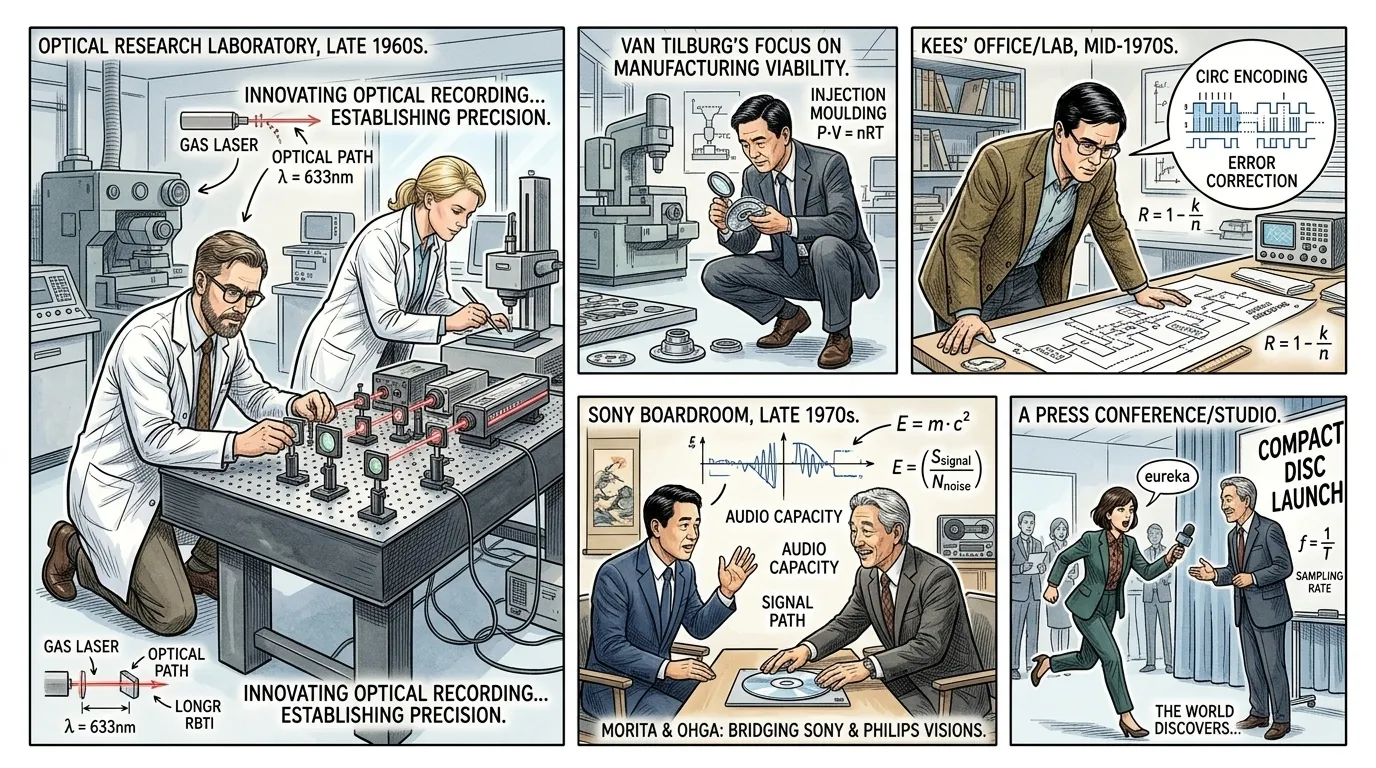
To store an entire album's worth of music as digital information on a disc required unprecedented data density. Engineers faced the daunting task of etching microscopic features—pits and lands—onto a reflective surface with incredible precision. Each pit, only 0.5 micrometers wide, represented a binary '0' or '1' through its transition points. This demanded optical components capable of focusing a laser beam to an almost infinitesimal point and a tracking system robust enough to follow a spiral track that stretched for nearly five kilometers on a single disc. The smallest deviation would lead to data loss. The sheer scale of miniaturization and precision was a monumental hurdle, pushing the boundaries of material science and optics. The question remained: how could such tiny data points be read reliably?
""The very idea of a laser reading such microscopic data points with absolute accuracy," Philips engineer Kees Schouhamer Immink, a sharp, bespectacled man in his late 30s with short, dark hair, explained to his colleague, "is like trying to guide a needle through an invisible maze. One errant vibration, one speck of dust, and the entire sequence could be lost." He pointed to a detailed schematic. "We need a system that not only reads flawlessly but also anticipates imperfections.""
Page 4

The promise of digital audio was so immense that two electronics giants, Philips of the Netherlands and Sony of Japan, embarked on independent research. However, recognizing that true success depended on a universal, interoperable standard, they initiated a groundbreaking collaboration in 1979. This partnership, driven by key figures like Joop van Tilburg from Philips and Norio Ohga from Sony, sought to define every aspect of the Compact Disc: its physical dimensions, sampling rate, error correction methods, and modulation schemes. The resulting 'Red Book' standard was not just a technical document; it was a blueprint for a global revolution in media, ensuring that any CD player could play any CD, regardless of manufacturer. This unprecedented cooperation, especially between direct competitors, was critical to the CD's eventual dominance.
"Norio Ohga, a distinguished man in his mid-50s, wearing a dark business suit, addressed Joop van Tilburg, his counterpart from Philips, during an intense negotiation session. "Creating a global standard requires more than mere invention; it demands a shared vision." Ohga paused, reflecting. "I recall the words of Leonardo da Vinci, who once said, 'Learning never exhausts the mind.' Indeed, our minds will be stretched to their very limits to achieve this dream of perfect sound and universal compatibility." Van Tilburg, a steady presence, nodded in agreement. "Our combined expertise will define this new format, Mr. Ohga. It is an undertaking of extraordinary complexity, but one that promises an extraordinary reward for the world.""
Page 5
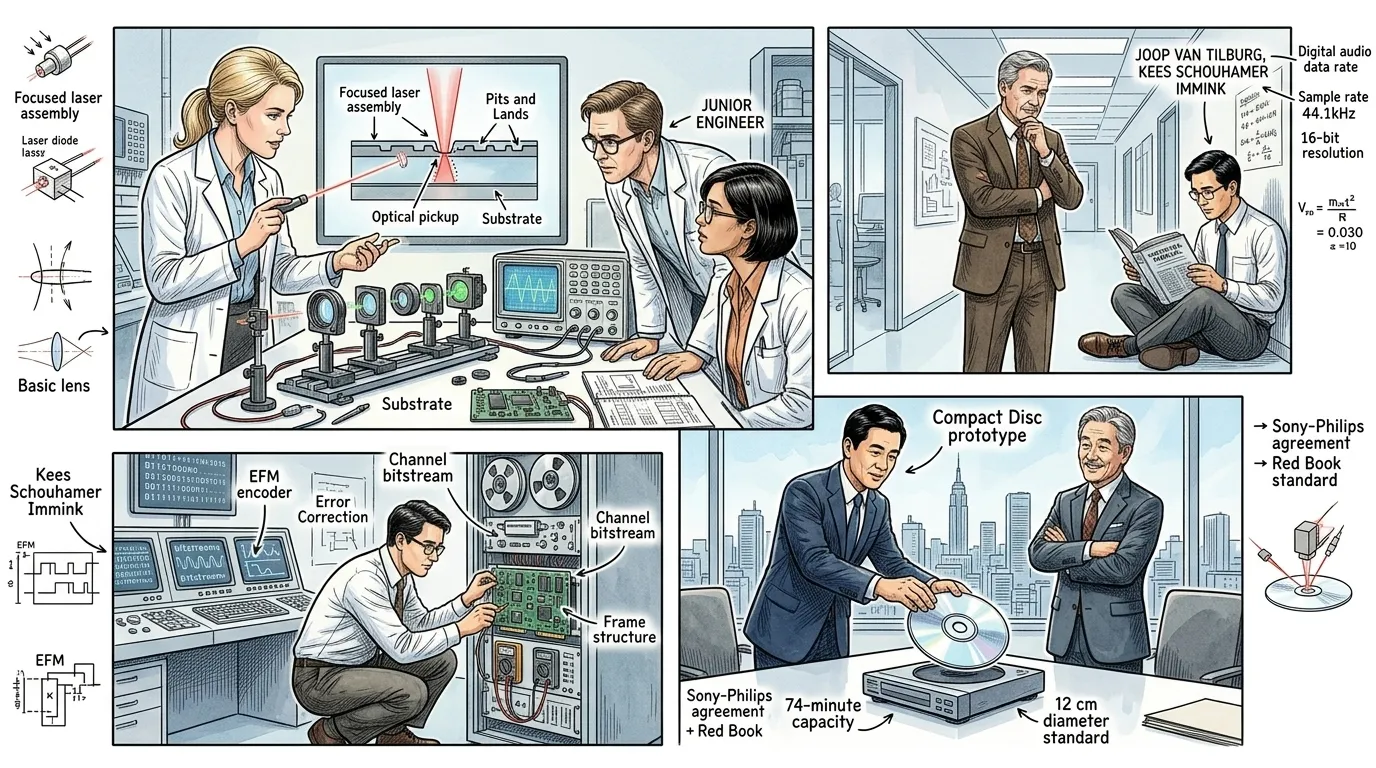
The Compact Disc operates on a principle of optical reflection. Inside every CD player, a tiny semiconductor laser emits a highly focused beam of light. As the disc spins, this laser shines onto its polycarbonate surface, which is coated with a thin layer of aluminum to make it reflective. The disc's surface isn't smooth; it's intricately patterned with a continuous spiral track containing microscopic indentations, known as 'pits,' separated by flat areas called 'lands.' When the laser beam encounters a 'land,' it reflects directly back to a photodetector. However, when it hits a 'pit,' the light scatters or interferes, significantly reducing the amount of reflected light. This change in reflected light intensity is precisely what the photodetector senses, converting these optical variations into an electrical signal. This signal is the raw digital data, a stream of binary '1s' and '0s' waiting to be deciphered.
""The elegance lies in its simplicity," said a lead Philips optical engineer, Dr. Pieter Kramer, a methodical woman in her late 40s with pulled-back blonde hair and a pristine lab coat, as she demonstrated a prototype laser assembly. She addressed a group of junior engineers. "It's about detecting minute changes in light. Think of it as feeling for bumps in the dark, but with light. Each transition from a pit to a land, or land to a pit, signals a 'one'—a critical piece of information. No transition over a certain length implies a 'zero.' This subtle interplay forms the language of digital sound, enabling the accurate retrieval of every single bit of music.""
Page 6
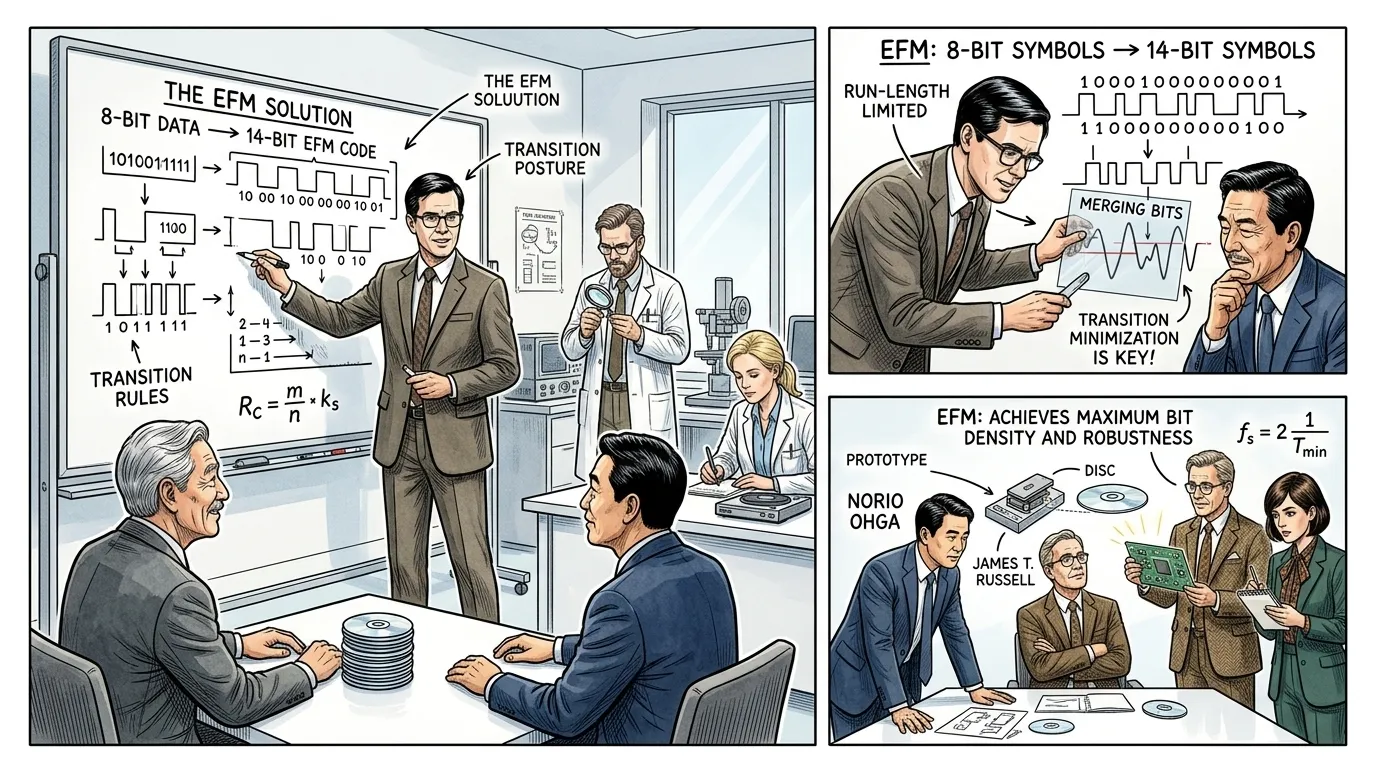
The raw binary data—a sequence of '1s' and '0s'—could not be directly etched onto the disc. A simple '1' for a pit and '0' for a land would create long sequences of identical states, making it difficult for the player to maintain synchronization (known as 'clocking'). To overcome this, Philips developed Eight-to-Fourteen Modulation (EFM), a clever encoding scheme. EFM takes blocks of 8 data bits and converts them into 14-bit codes, adding three 'merging bits' between each code. This system ensures that there are always at least two 'zeros' and never more than ten 'zeros' between consecutive 'ones.' These 'ones' correspond to the transitions between pits and lands, providing the necessary clocking signals for the player to read the data accurately. EFM dramatically improved data density and reading reliability, becoming a cornerstone of the CD's success.
""The genius of EFM," explained Dr. Schouhamer Immink, standing beside a complex whiteboard diagram, "is how it orchestrates the transitions. We cannot simply represent a '1' with a pit and a '0' with a land directly; the laser would lose its timing." He tapped the diagram. "By mapping every 8 data bits to a carefully chosen 14-bit sequence, we guarantee a minimum and maximum number of 'zeros' between 'ones.' These 'ones' are the crucial transitions that the laser uses to keep its rhythm, like a conductor guiding an orchestra. Without this elegant modulation, the entire optical system would struggle to maintain data integrity.""
Page 7
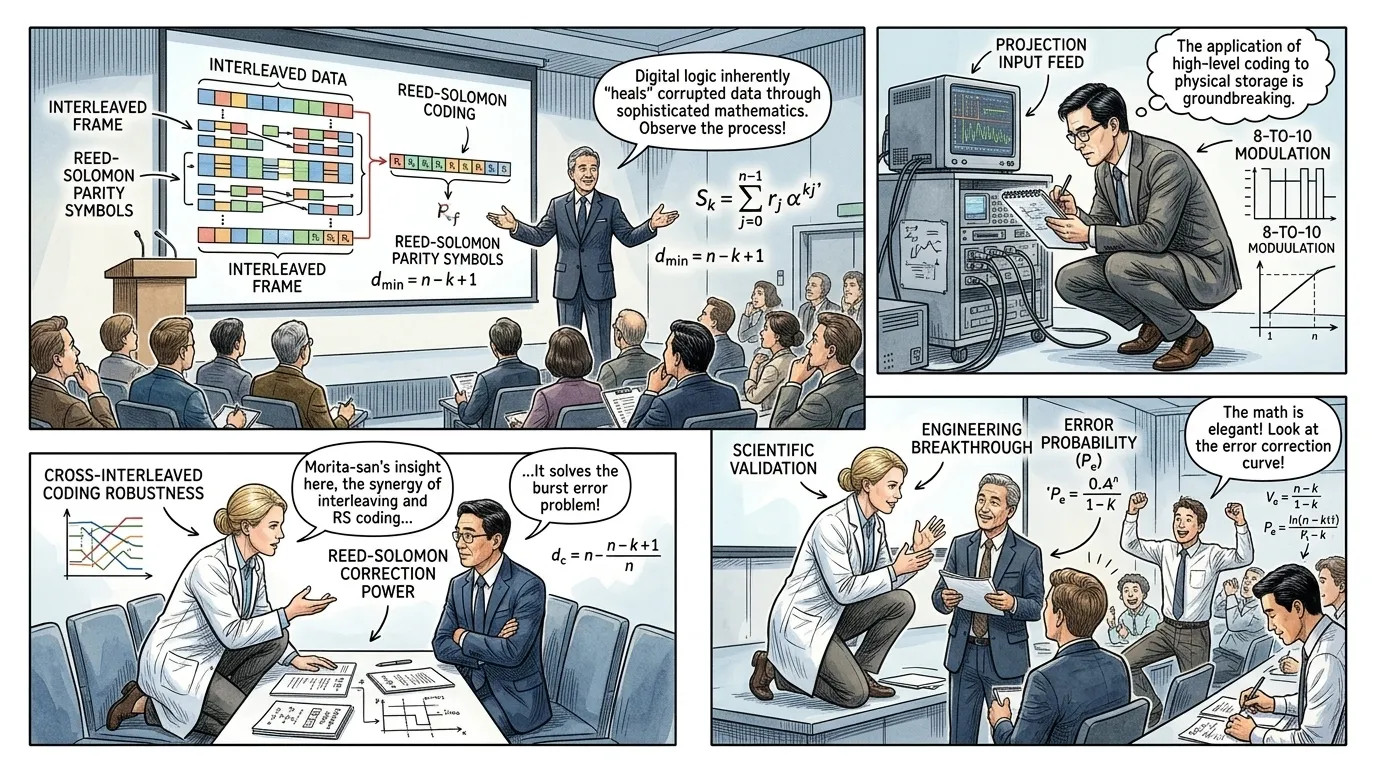
Even with meticulous manufacturing and precise laser optics, a disc can acquire scratches or dust, leading to momentary loss of data. This is where the CD's robust error correction system, primarily based on Reed-Solomon coding, becomes invaluable. Before the data is etched onto the disc, it is encoded with redundant information—essentially, extra mathematical checks. This data is then interleaved, meaning consecutive bits of a data word are spread out across different sectors of the disc. If a scratch obliterates a small section, it only damages a tiny part of many different data words, rather than destroying one entire word. The CD player then uses the redundant information and the undamaged fragments of interleaved data to mathematically reconstruct the missing or corrupted portions, often without any audible impact. This ingenious system is why a slightly scratched CD often plays perfectly, a testament to its digital resilience, delivering on the promise of durable, pristine audio.
""The beauty of digital is its inherent ability to heal," proclaimed a lead Sony engineer, Dr. Akio Morita, a distinguished man in his early 50s with grey hair and a knowing smile, during a technical presentation. He addressed a room of engineers and executives, gesturing toward a large display showing interleaved data. "Imagine a sentence written on many strips of paper, then shuffled. If one strip is torn, you can still piece together the original sentence from the remaining fragments and the context. Our Reed-Solomon code does precisely that, but with binary data. It's not just about storage; it's about making that storage invulnerable to the common accidents of life. This ensures the digital promise of perfect playback, even in the face of physical imperfection.""
Page 8
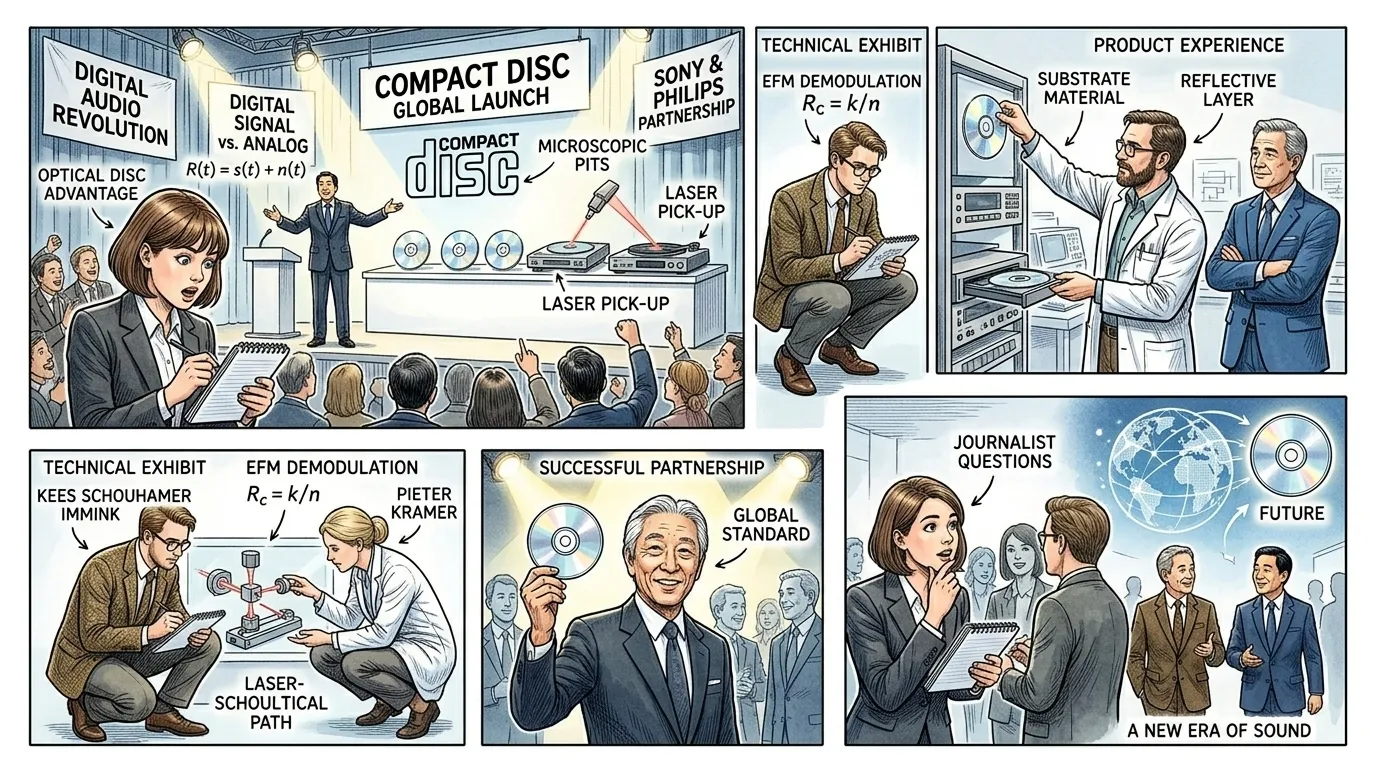
On October 1, 1982, the world witnessed the official launch of the Compact Disc and its players in Japan. The first commercially released CD was Billy Joel's "52nd Street." The impact was immediate. Consumers were captivated by the promise of "perfect sound forever" and the disc's immunity to common annoyances like scratches, warps, and tape hiss. Early CD players, though expensive, offered a listening experience fundamentally superior to anything before. The meticulous engineering, the precise laser mechanisms, and the robust error correction system had delivered on their ambitious goals. This wasn't merely an incremental improvement; it was a paradigm shift in audio reproduction, setting a new benchmark for fidelity and convenience that would soon sweep across the globe.
""This is not merely a product; it is a declaration of a new age," Norio Ohga announced confidently at the Tokyo launch event, gesturing towards a stack of gleaming Compact Discs. The crowd murmured with anticipation. "No more crackle, no more hiss. Just pure, unadulterated sound, reproduced exactly as the artist intended." An eager journalist, a young woman in her late 20s with a fashionable bob haircut and sharp suit, scribbled furiously in her notepad. "The clarity is astonishing," she whispered to a colleague, "like hearing music for the very first time.""
Page 9
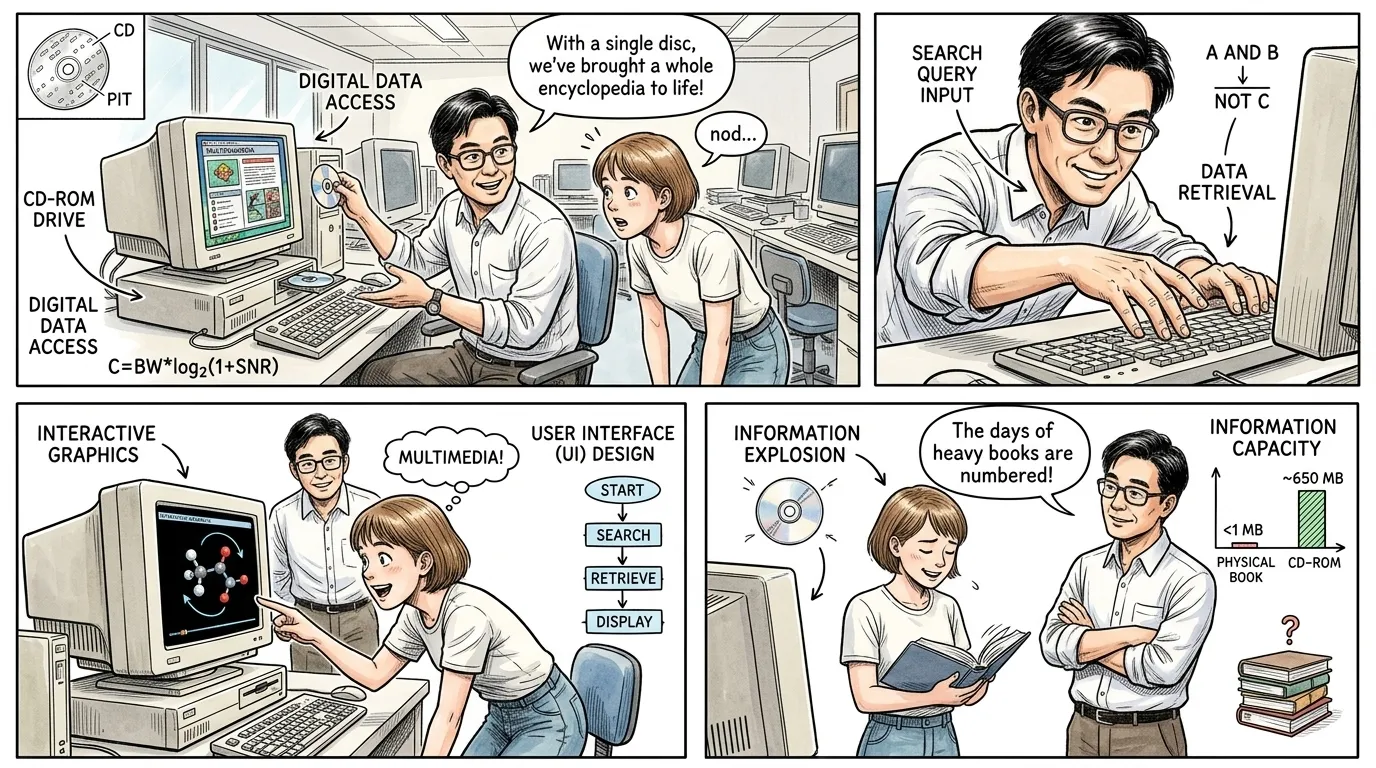
The Compact Disc's high capacity and robust data integrity quickly demonstrated its potential far beyond audio. In 1985, the CD-ROM (Compact Disc Read-Only Memory) was introduced, leveraging the same optical technology to store vast amounts of digital data for computers. This innovation rapidly transformed personal computing. Suddenly, a single disc could hold entire encyclopedias, massive software applications, multimedia presentations, or gigabytes of information that would have previously required dozens of floppy disks. The CD-ROM became an indispensable medium for distributing software, academic resources, and interactive entertainment, fundamentally changing how information was accessed and consumed in the burgeoning digital age. Its permanence and accessibility propelled the multimedia boom of the 1990s, making computing richer and more dynamic.
""This is a game-changer for information access," exclaimed a thrilled software developer, Dr. Kenji Tanaka, a man in his early 40s with a focused expression and thick-rimmed glasses, as he loaded a CD-ROM into a 1990s desktop computer. He addressed his colleague, a curious intern in her early 20s. "Imagine, an entire encyclopedia, every word and image, on this single disc! It eradicates the limitations of floppy disks for distribution and capacity. This is not just a storage medium; it's a portal to unprecedented knowledge right on our desks. The implications for education and software are staggering." The intern nodded, wide-eyed, clearly grasping the magnitude of the breakthrough."
Page 10
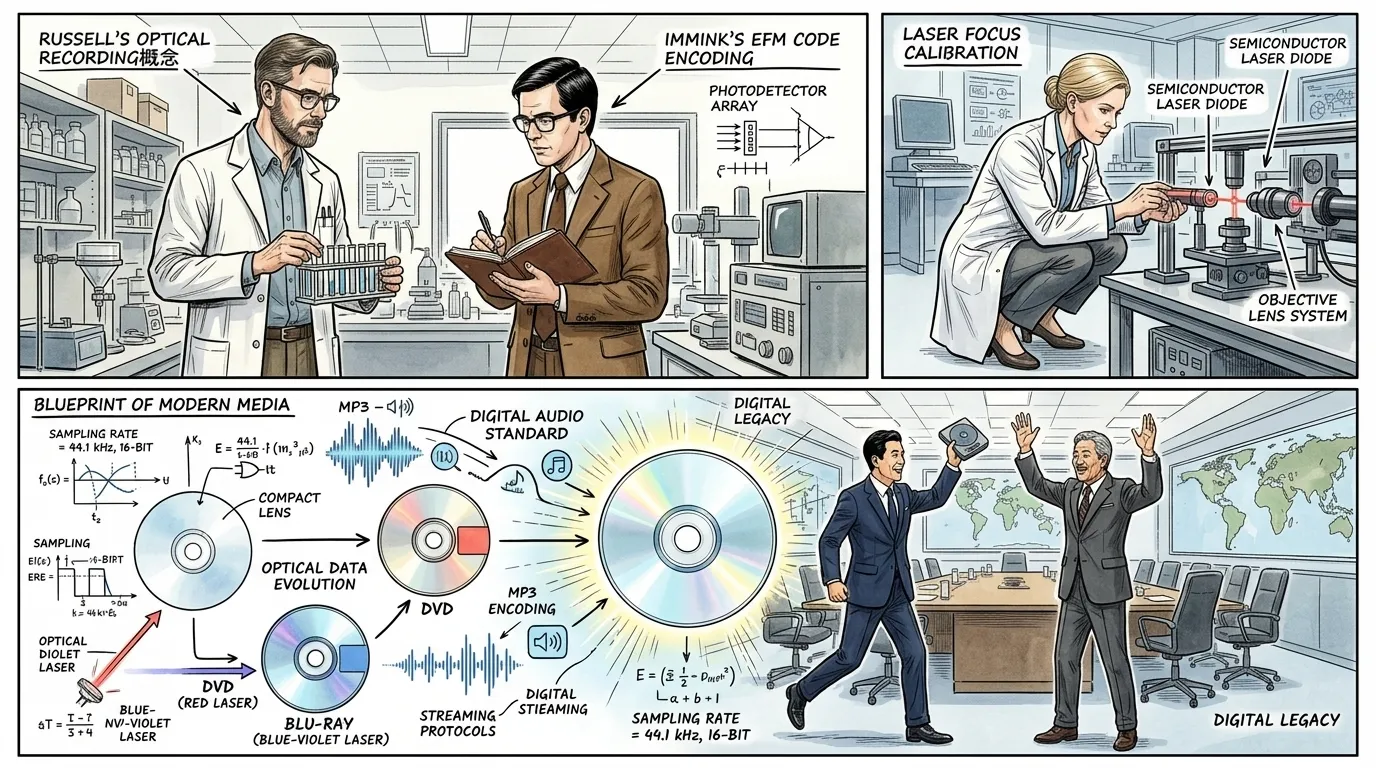
While the Compact Disc's dominance in music has waned with the rise of digital streaming, its legacy remains profound and far-reaching. The CD established digital audio as the standard, paving the way for file formats like MP3 and the entire ecosystem of online music delivery. More fundamentally, it pioneered the principles of optical data storage that subsequently evolved into higher-capacity formats like DVD and Blu-ray, which continue to be vital for high-definition video and data archiving. The meticulous engineering, the sophisticated error correction, and the global standardization effort behind the CD created a blueprint for countless subsequent digital technologies. It transformed not only how we listen to music but also how we store, access, and interact with vast quantities of digital information, leaving an indelible mark on the landscape of modern media and technology.
About this story
- Location: Global
- Audience: general readers
Questions and answers
Read Wonder Inventions on your phone
Wonder Inventions is available on Android. Get Wonder Inventions on Google Play.