Compass
Compass — an illustrated inventions story, set in Global. 10 illustrated pages, free to read on Wonder Inventions.
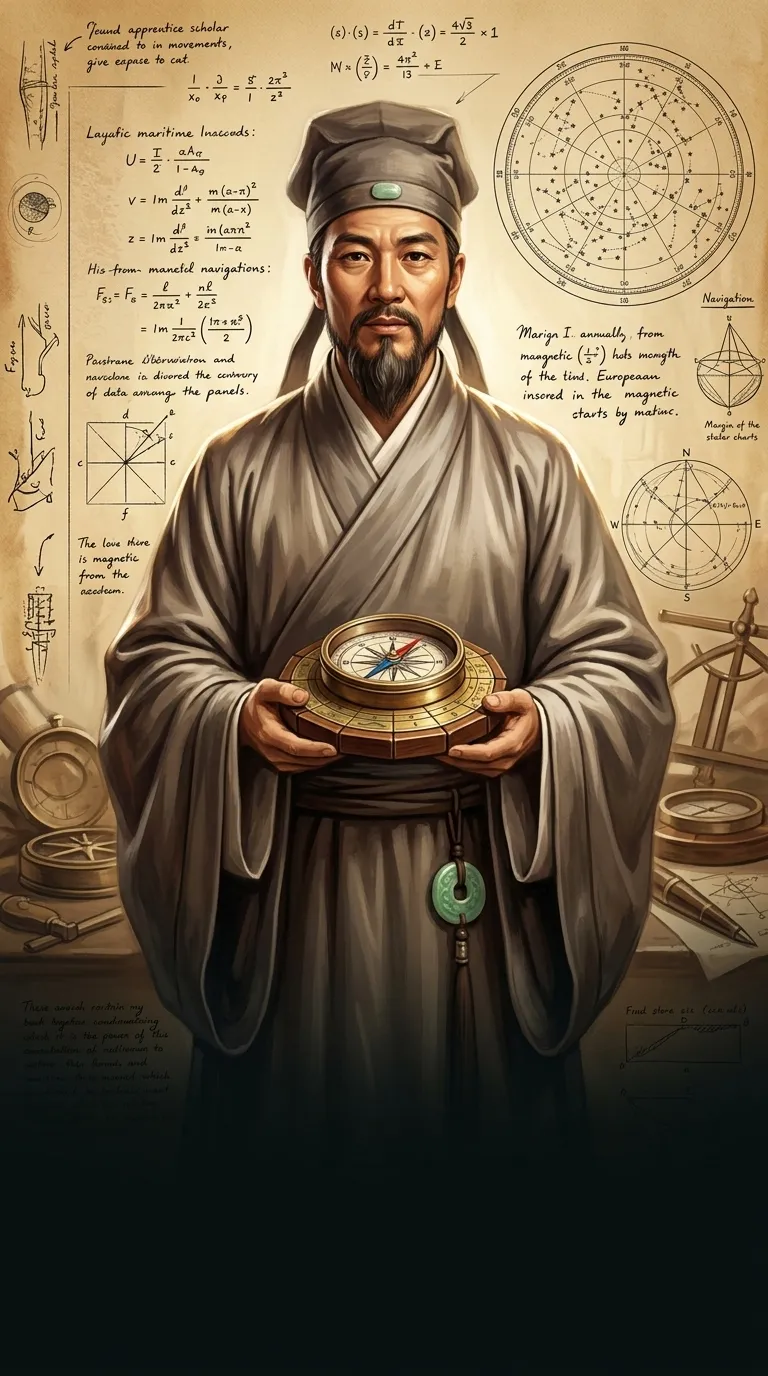
Page 1
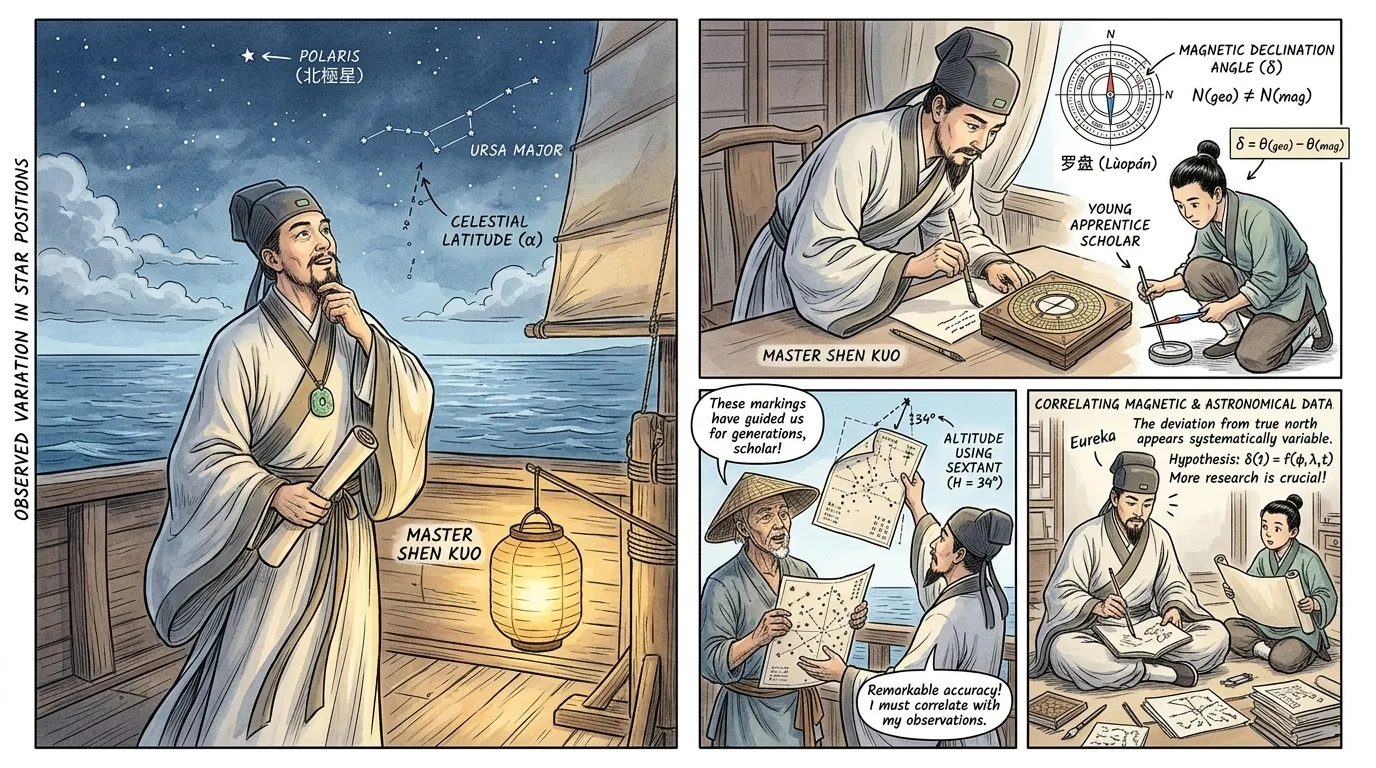
Before the compass, humanity's reach was constrained by the visible horizon and the fickle guidance of celestial bodies. Navigators dared to venture beyond sight of land, but their journeys were fraught with uncertainty, dependent on clear skies and known constellations. The absence of a reliable, constant directional tool was a profound impediment to exploration, trade, and the understanding of a connected world.
"'Our reliance on the stars is a testament to our ingenuity, yet a chain on our ambition,' observed Master Shen Kuo, a polymath of the Song Dynasty. 'When clouds obscure the heavens, or the sun dips below the waves, the vast ocean becomes a realm of blind wandering. We chart paths not by certain knowledge, but by courageous guesswork.'"
Page 2
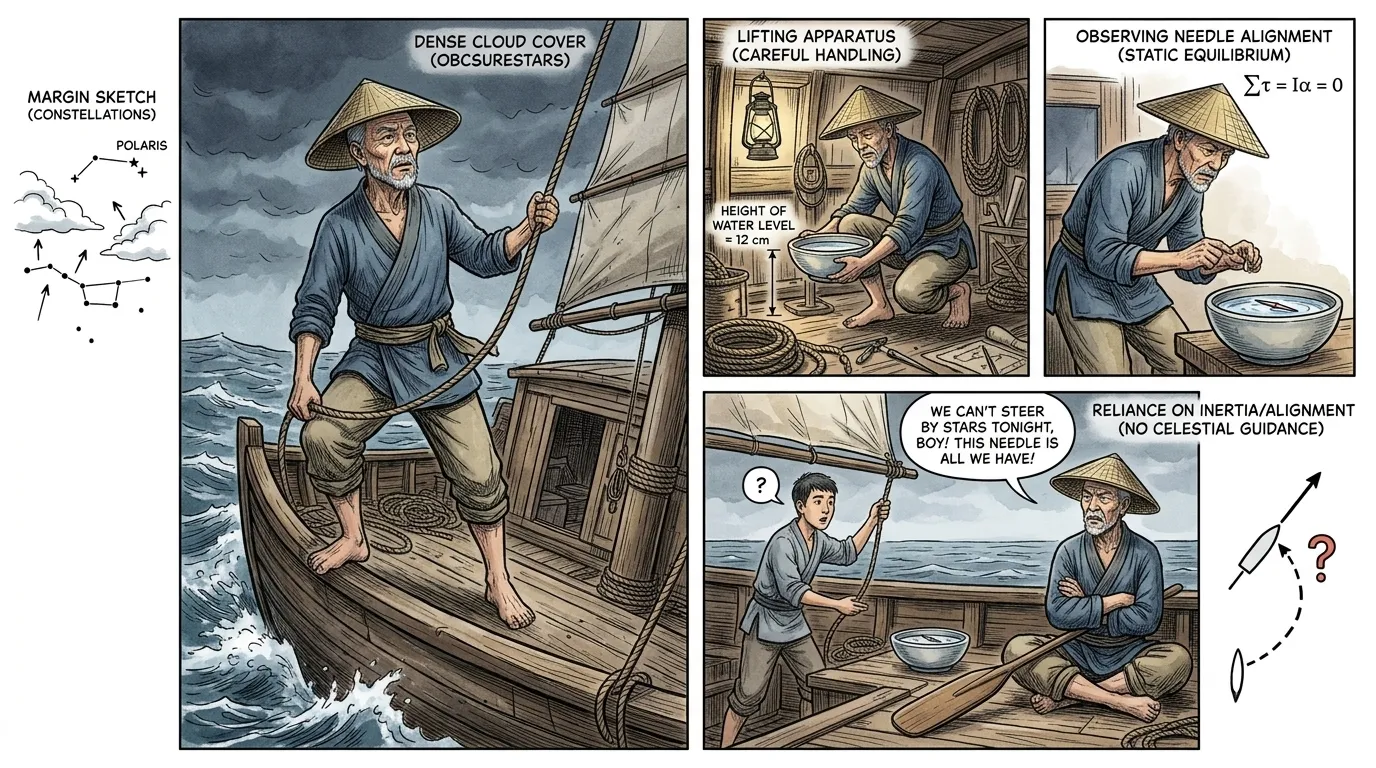
For millennia, mariners clung to coastlines, fearing the open sea. Fog, storms, or prolonged overcast skies could disorient even the most experienced sailor, turning a predictable journey into a desperate struggle for survival. Navigation relied on visual cues: landmarks, known currents, the flight of birds, and the precise, yet often unavailable, positions of the sun and stars. This reliance made long-distance voyages dangerous, limiting trade routes and the cultural exchange that drives civilization.
"'The ocean gives, and the ocean takes,' murmured an elderly mariner, his face weathered by countless journeys. He steadied himself against the pitching deck of a sturdy wooden junk, its sails furled against a darkening sky. 'One moment, Polaris guides us true. The next, a squall descends, and the world becomes a grey expanse where north is indistinguishable from south. We are but leaves on the wind without a constant guide.'"
Page 3

Long before its application in navigation, the natural magnetism of lodestone, a form of magnetite, intrigued ancient Chinese scholars. They observed its peculiar property: when freely suspended, it consistently aligned itself along a north-south axis. This phenomenon, though not fully understood, suggested an invisible, pervasive force. Early uses were largely for geomancy and fortune-telling, but the seed of a profound scientific breakthrough had been planted.
"'It is as if the earth itself whispers secrets to this stone,' exclaimed a young apprentice scholar, gesturing towards a rough piece of lodestone. 'No matter how we turn it, given freedom, it always returns to its favored direction. Could this intrinsic property be more than mere divination? Master Shen Kuo often spoke of finding constant principles in the natural world. This constant direction is a powerful truth, a hidden 'knowledge' that could serve a greater purpose, a secret of the planet itself.'"
Page 4
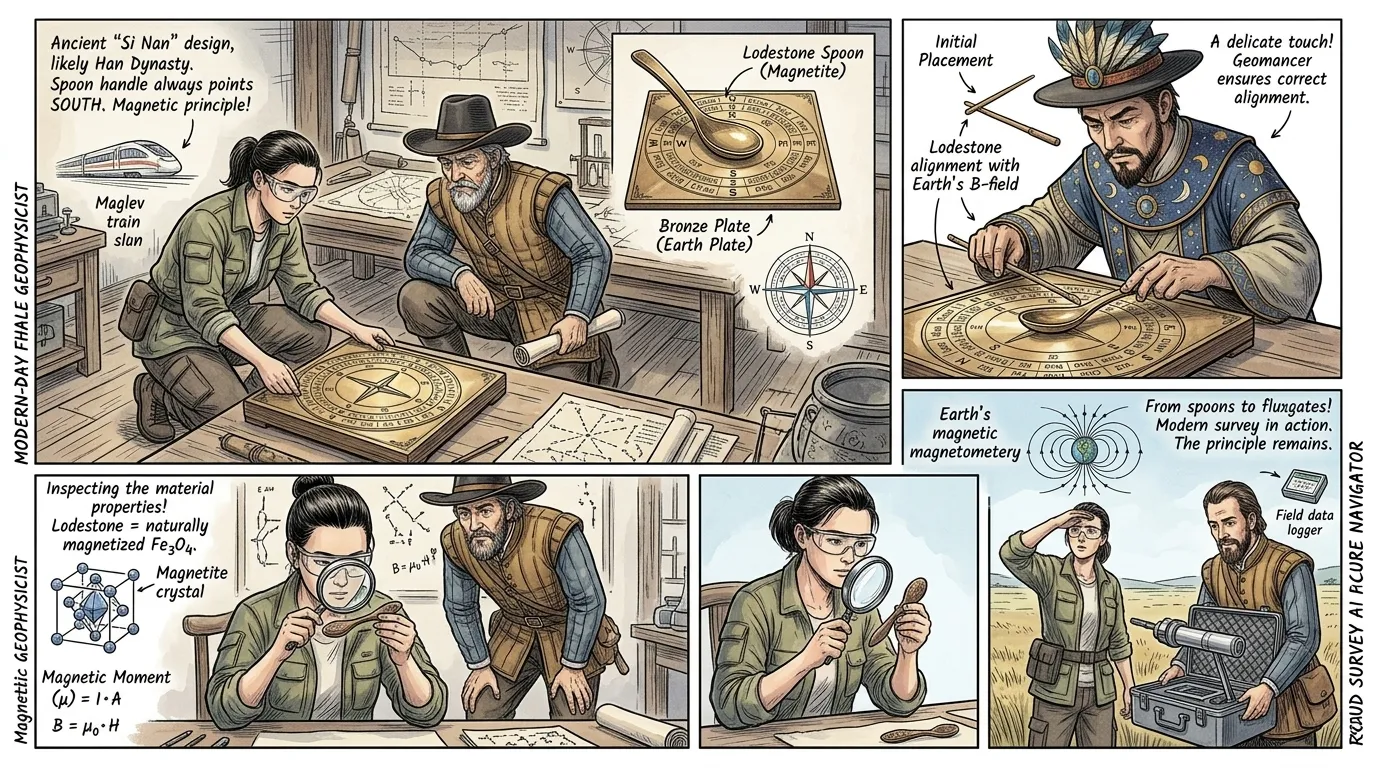
The first practical application of lodestone's directional property emerged during China's Han Dynasty (206 BCE – 220 CE). This instrument, known as the 'Si Nan' (South-pointing spoon), was a carefully carved spoon of lodestone. Placed on a smooth, circular bronze plate etched with the cardinal directions and the 24 directions of ancient China, the spoon would settle with its handle consistently pointing south. This crude device was initially used by geomancers to ensure auspicious building orientations and land layouts, not for maritime navigation.
"'Behold the Si Nan,' announced a geomancer, his voice resonating with ancient wisdom, as he demonstrated the spoon's alignment. 'Its handle, forged from the very heart of the Earth, seeks the great southern qi. Though its purpose now serves the harmony of land and spirit, the principle it demonstrates—this unwavering directional sense—holds untold potential beyond our present understanding. Think of the boundless directions this 'knowledge' could open if we could make it portable, dependable.'"
Page 5
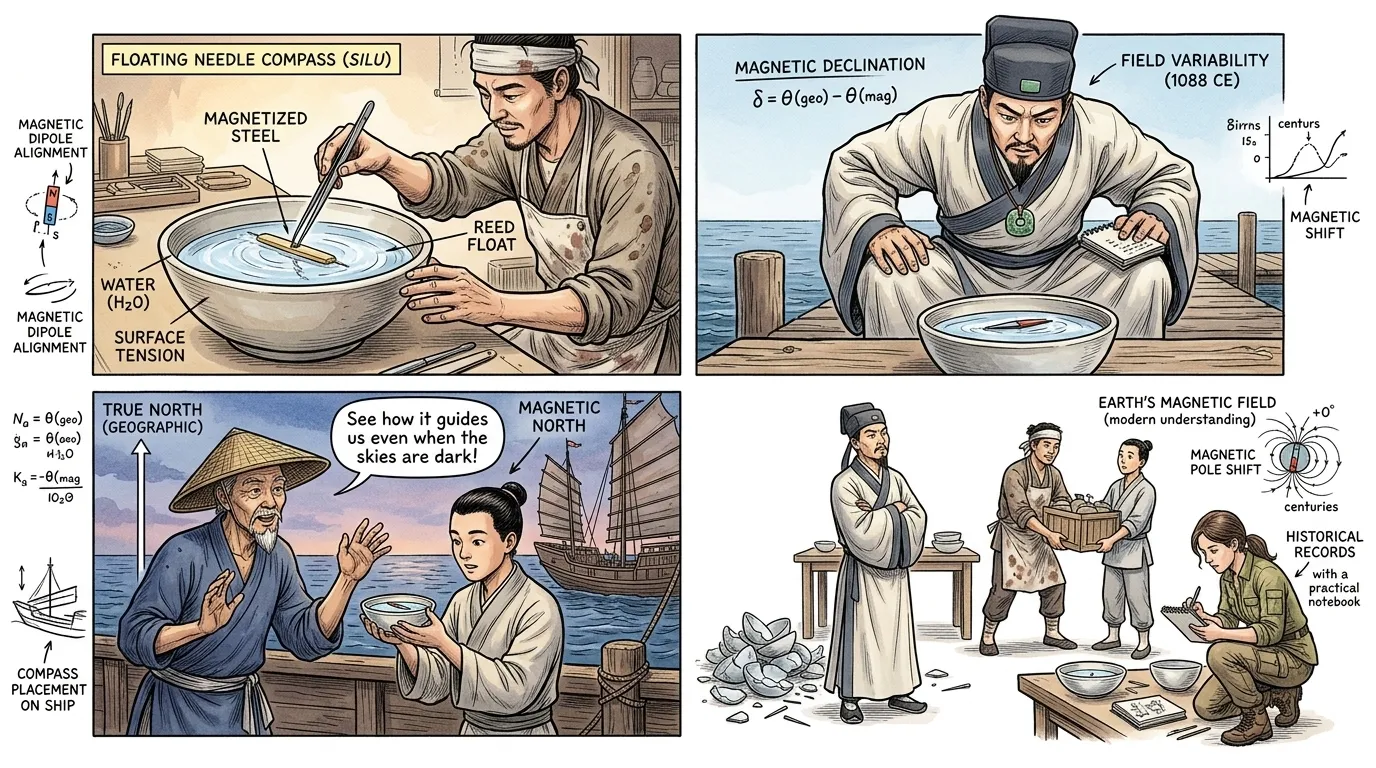
The Si Nan, while revolutionary in concept, was cumbersome and required a perfectly flat surface, rendering it impractical for dynamic environments like a ship's deck. The next critical innovation, appearing by the Song Dynasty (960–1279 CE), involved magnetizing steel needles. These slender needles, when floated on water in a bowl, could rotate freely, providing a more agile and responsive directional indicator than the heavy lodestone spoon. However, they were still susceptible to disturbance by the ship's motion and the surface tension of the water.
"'The floating needle, a marvel of ingenuity, offers greater flexibility than the ancient spoon,' explained a diligent artisan, carefully dropping a magnetized needle onto a piece of reed floating in a bowl. 'We can now observe its true alignment even on a slight incline. Yet, the water's ripple, the sway of the ship, even a gentle breath—all these conspire against its steady indication. The very freedom that makes it useful also makes it fragile. How do we gain stability without losing its responsive nature?'"
Page 6
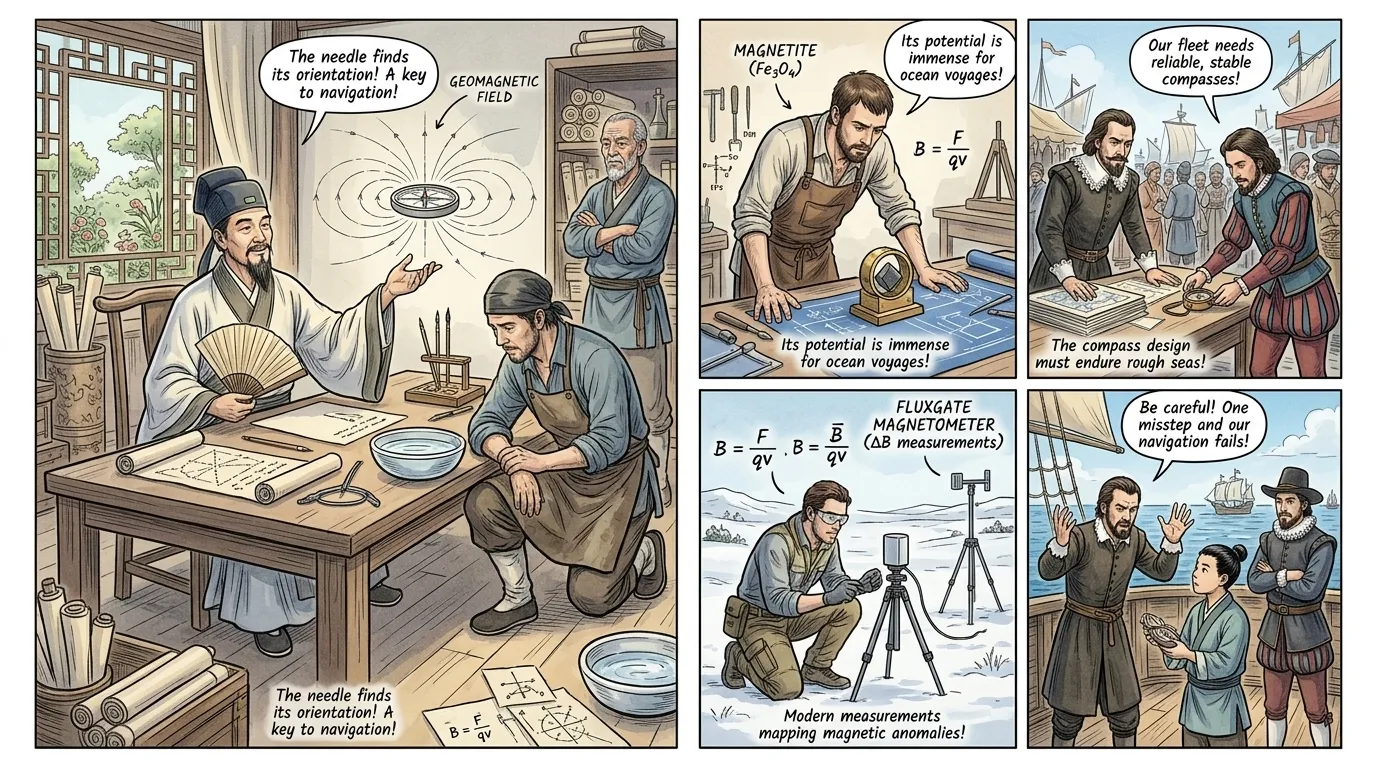
The core breakthrough, refined over centuries, was the understanding that a freely suspended magnet would consistently align itself with Earth's geomagnetic field. The floating needle, by minimizing friction, allowed this alignment to occur with relative ease. The Earth itself acts as a giant, invisible magnet, with magnetic poles that are distinct from the geographic poles. The compass needle, being a small magnet, is drawn to these magnetic poles, thereby indicating a consistent north-south direction.
"'Observe this simple marvel,' instructed a learned scholar, gesturing to the stable, floating needle. 'The Earth's own unseen force, an immense magnetic field, now acts as our guide. The magnetized needle, a small bar magnet, responds to this global pull. Its North-seeking pole is drawn to the Earth's magnetic North Pole, and its South-seeking pole to the Earth's magnetic South Pole. This consistent attraction is what gives us our infallible direction, even in the darkest night or densest fog. This is how the 'knowledge' of magnetism is finally harnessed.'"
Page 7
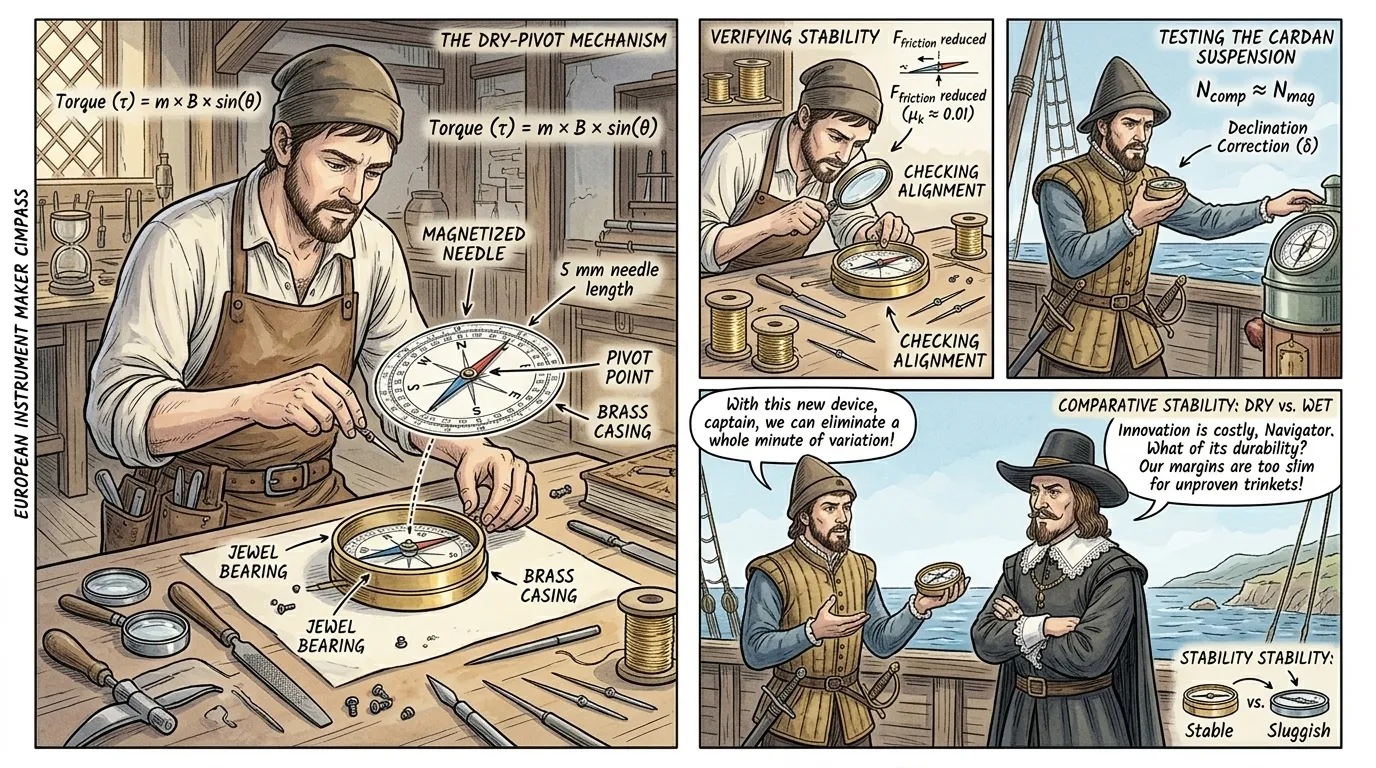
The floating compass had its limitations; freezing water in cold climates and spillage in rough seas were persistent problems. The solution arrived with the dry-pivot compass, where the magnetized needle was mounted on a sharp pivot point, typically a jewel bearing, allowing it to rotate freely in a sealed box. A significant advancement was the integration of a 'compass card'—a circular disc marked with cardinal directions (N, S, E, W) and degrees—fixed to the needle. This meant the entire card rotated with the needle, making it far easier to read a stable bearing.
"'This dry compass represents a leap in practical utility,' explained a European instrument maker, carefully assembling a compass mechanism. 'No longer do we contend with liquid. The needle, now affixed beneath a rotating card, spins freely on a hardened pivot point. One merely aligns the ship's heading with the lubber line, and the compass card instantly reveals our bearing. This 'knowledge' of fixed direction, once a fragile whisper, is now an unwavering voice, easily read by any mariner.'"
Page 8
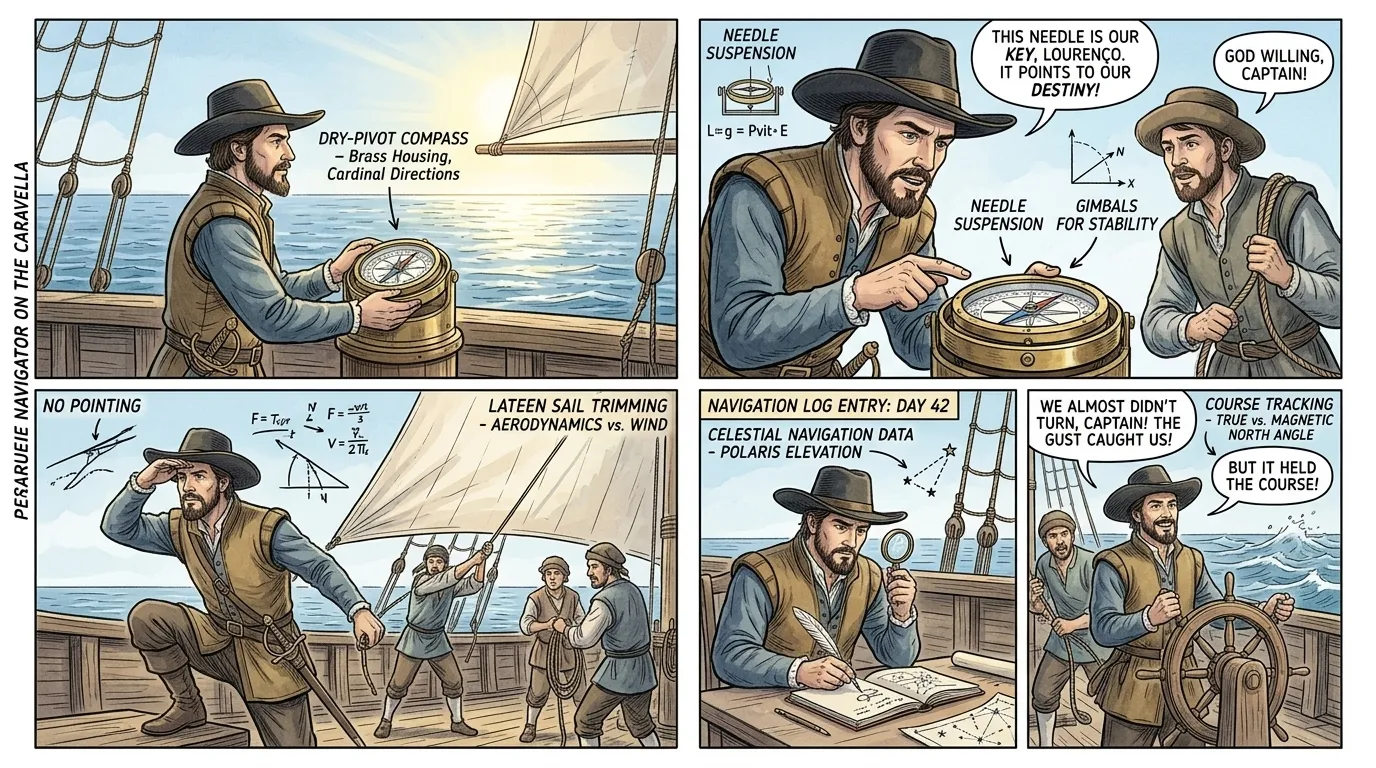
The introduction of the compass to Europe, notably by the 12th century, marked the dawn of the Age of Exploration. Sailors, no longer tethered to visible landmarks or clear skies, could venture across vast, uncharted oceans with unprecedented confidence. This transformative tool enabled voyages that reshaped world maps, connected continents, and initiated an era of global trade and cultural exchange. It was the instrument that made the 'Great Discoveries' possible.
"'With this instrument, the unknown becomes knowable,' declared a Portuguese navigator, tapping a finger on a brass-cased compass. 'As Confucius once said, 'A journey of a thousand miles begins with a single step.' And with this compass, every step we take across the boundless sea is measured, guided, and brings us closer to lands once thought mythical. The North Star, though a reliable friend, cannot pierce the storm clouds, but this needle, it always points true, guiding us home or to new worlds.'"
Page 9
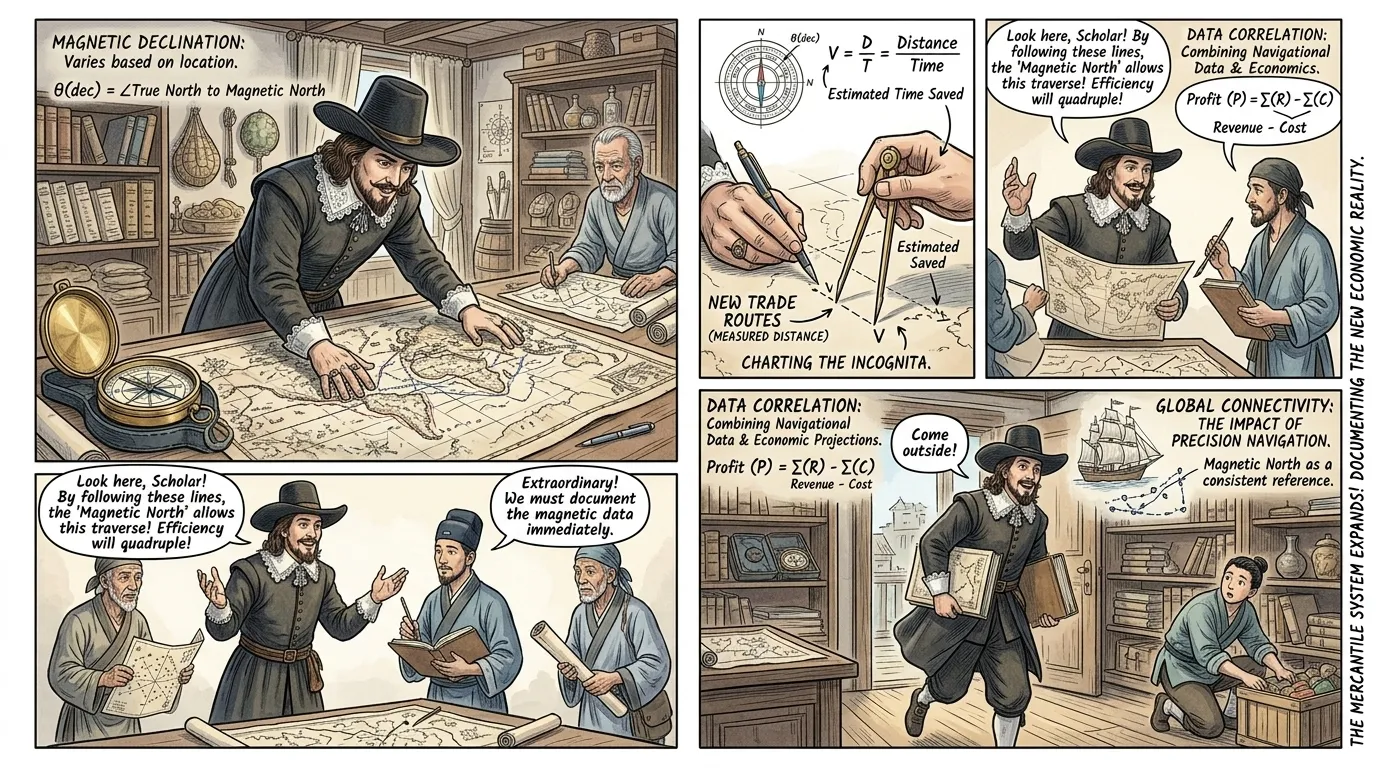
The compass fundamentally reshaped human civilization. It facilitated the establishment of global trade networks, linking distant cultures and economies. It enabled the mapping of the world with greater accuracy, inspiring advancements in cartography and scientific understanding of Earth's geography and magnetism. The power to navigate reliably across oceans fostered the rise of maritime empires and spurred an insatiable quest for knowledge about the planet.
"'The world has shrunk, yet our understanding of it has expanded immeasurably,' remarked a Dutch merchant, poring over a new world map. 'The compass allows our ships to bring silks from the East and spices from the Indies, linking economies that were once isolated. It is more than a tool; it is the enabler of our entire mercantile system, a silent partner in every voyage that connects us all. The compass is not merely about finding direction; it's about connecting the entire human world.'"
Page 10
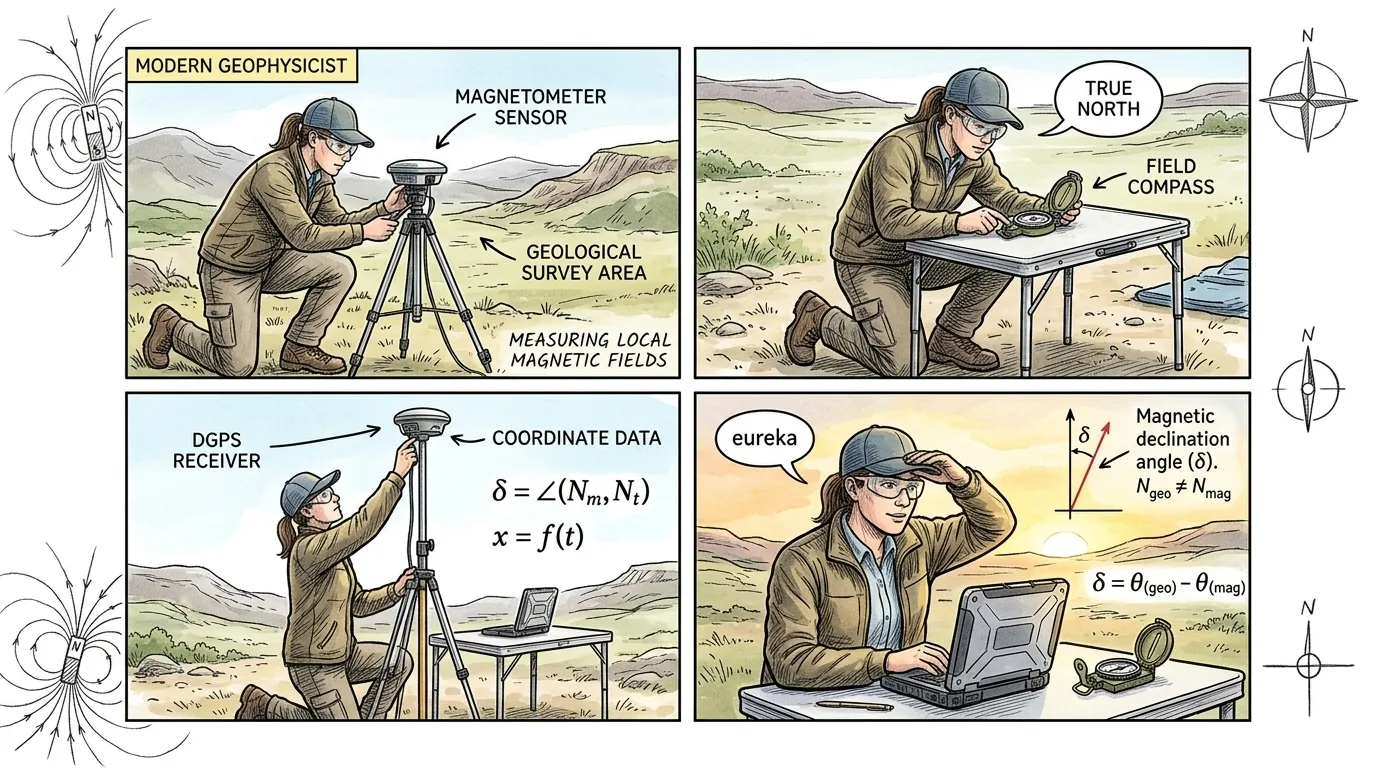
Even in the age of satellite navigation, the compass retains its fundamental importance. It remains an indispensable backup on aircraft and ships, a vital tool for hikers and explorers, and a cornerstone of our understanding of magnetism. Its journey from a geomancer's spoon to a precision instrument is a testament to human ingenuity—a simple, elegant solution to one of humanity's oldest and most profound challenges: finding our way in an often-unforgiving world.
"'The compass teaches us that even the most complex problems can have elegantly simple solutions, rooted in the fundamental laws of nature,' observed a modern geophysicist, adjusting a scientific instrument. 'From ancient mariners to astronauts, the principle remains constant: understanding Earth's invisible forces can guide our every endeavor. The compass is a humble yet profound reminder that even as technology evolves, the core principles of discovery endure.'"
About this story
- Location: Global
- Audience: general readers
Read Wonder Inventions on your phone
Wonder Inventions is available on Android. Get Wonder Inventions on Google Play.