Helicopter
Helicopter — an illustrated inventions story, set in Global. 10 illustrated pages, free to read on Wonder Inventions.
Page 1
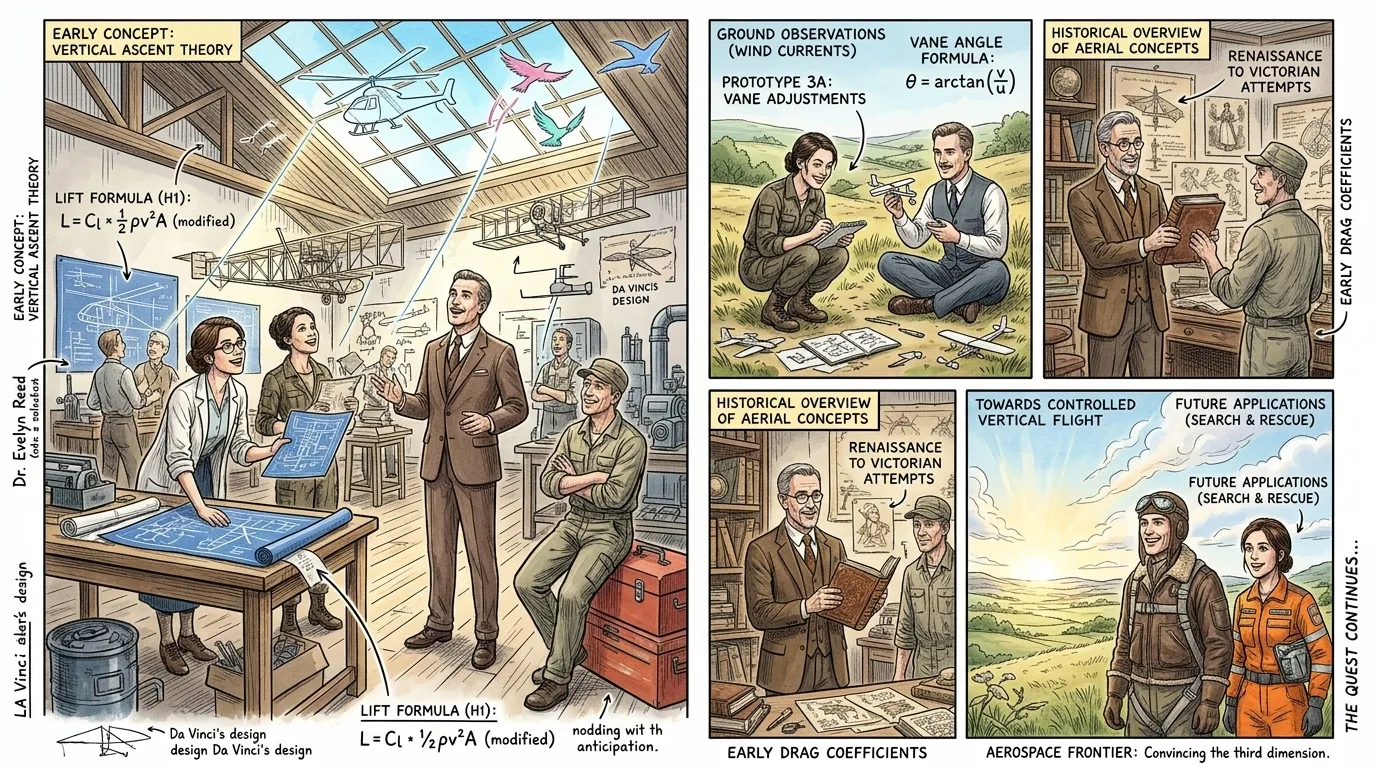
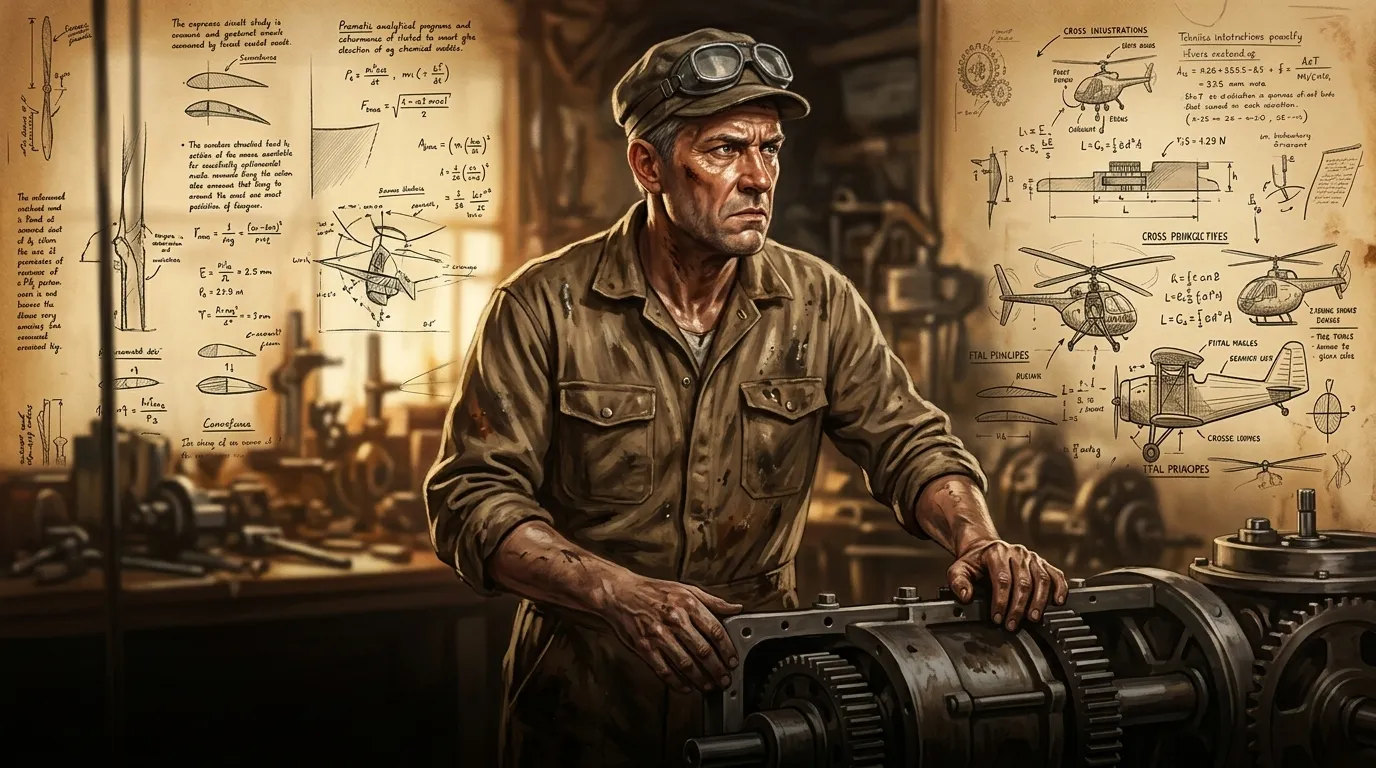
For millennia, humanity gazed skyward, dreaming of true vertical flight—a machine that could ascend straight up, hover motionless, and land precisely without the need for runways. This profound challenge baffled inventors, even as fixed-wing aircraft began to dominate the skies. It was the fundamental limitation of access, the inability to reach remote, confined, or disaster-stricken areas that drove this relentless pursuit.
"Yet, as engineers would lament decades later, 'The fixed-wing aircraft, for all its speed and reach, remains tethered by its need for vast open spaces, leaving vast swathes of terrain utterly unreachable.' This very limitation fueled the audacious ambition to conquer the third dimension without horizontal momentum."
Page 2
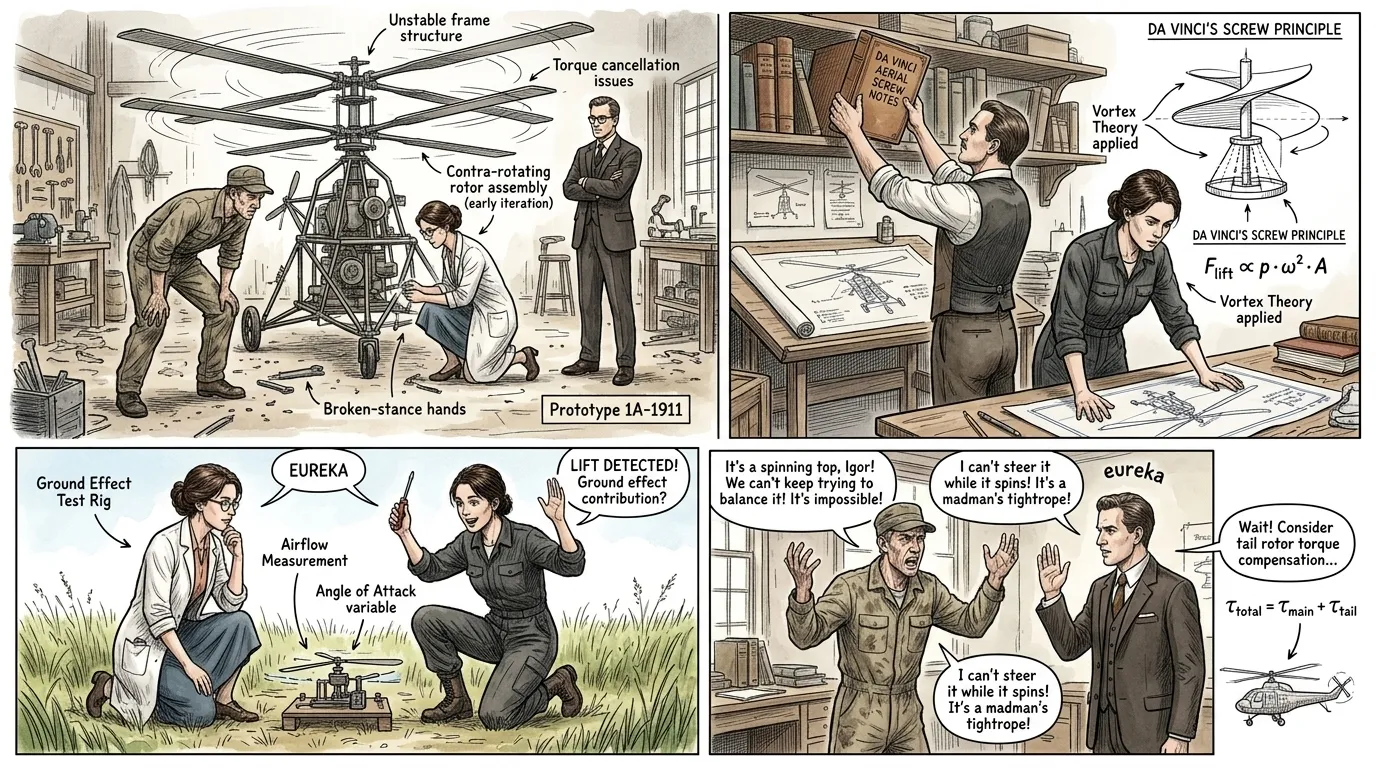
The dream of vertical flight persisted, spurred by Da Vinci's imaginative sketches. By the late 19th and early 20th centuries, significant strides in internal combustion engines provided the necessary power for heavier-than-air flight. However, merely generating lift proved insufficient; the true enigma was control—how to command a machine suspended in the air. Pioneer inventors experimented with various configurations, from stacked contra-rotating rotors to multiple independent lift-generating systems, each facing formidable stability issues.
"As one exasperated early engineer, a stern-faced man in a dusty jumpsuit, remarked, 'We can get it off the ground, yes, even for a few seconds. But keeping it there, stable, moving where we intend it to move—that's the dragon we truly struggle to tame. It's like trying to balance on a spinning top while simultaneously steering it across a tightrope.'"
Page 3
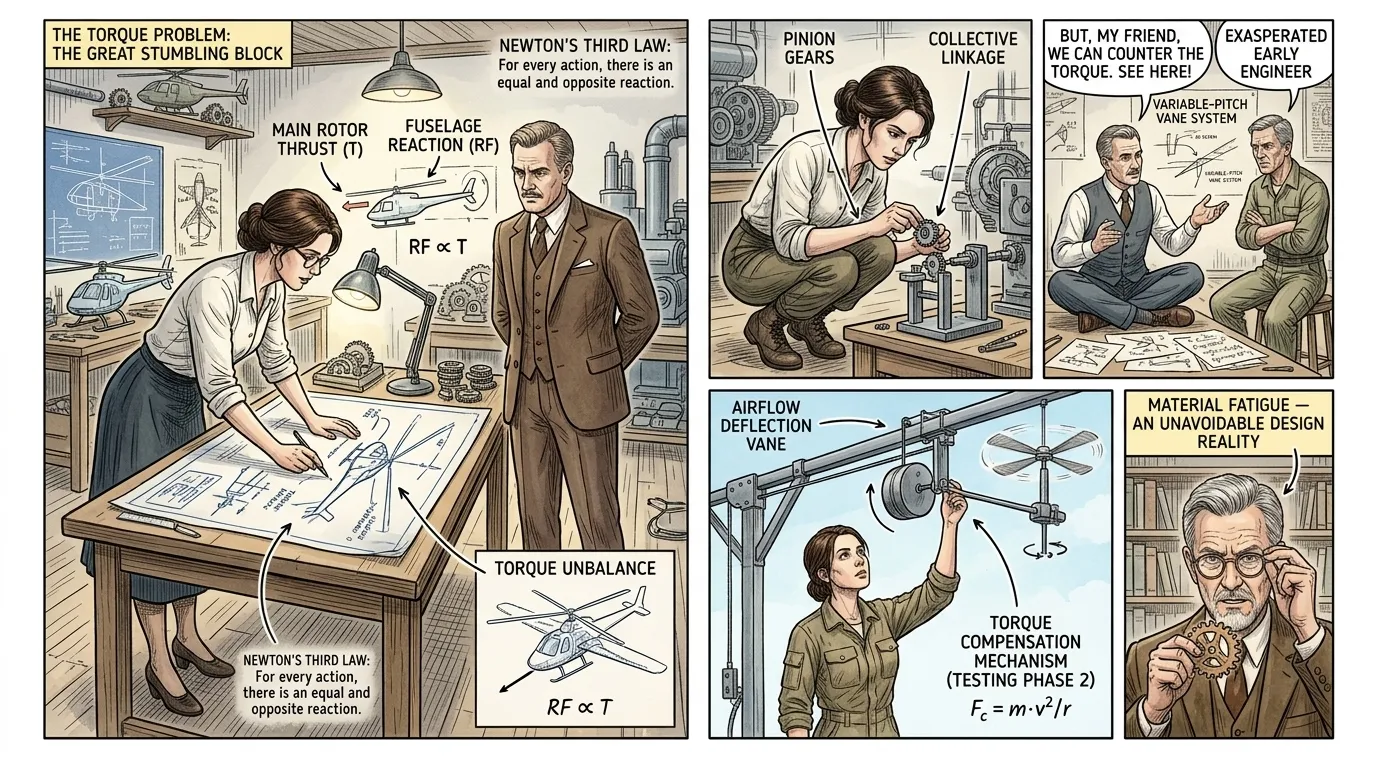
The core problem plaguing early single-rotor designs was elegantly simple yet devastatingly complex: torque. When a helicopter's main rotor spins in one direction to generate lift, the fuselage, obeying Newton's Third Law of Motion, attempts to rotate in the opposite direction. This uncontrolled rotation made stable flight impossible, leading to a dizzying, perilous spin. Inventors grappled with this inherent rotational force, leading to a myriad of cumbersome, often ineffective, solutions.
"An experienced aeronautical engineer, Dr. Evelyn Reed, her face illuminated by the glow of a blueprint on a workshop table, explains to a colleague: 'As Sir Isaac Newton famously posited, 'For every action, there is an equal and opposite reaction.' In our rotorcraft, the sheer force applied to spin the main rotor upward is met by the fuselage's stubborn desire to twist counter to it. Without a precise counter-measure, we are condemned to uncontrolled pirouettes, not flight. This fundamental principle is what kept us grounded for so long.'"
Page 4
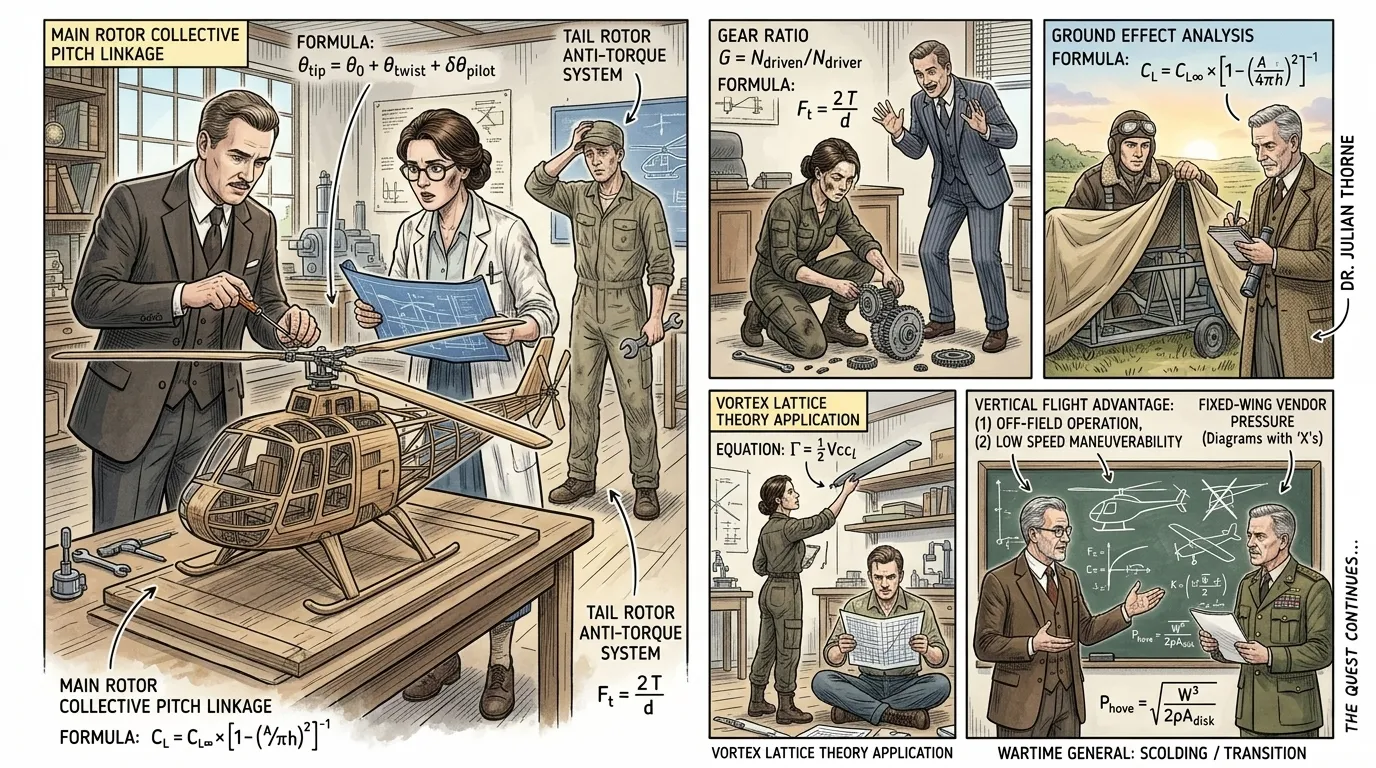
Amidst this landscape of technical frustration, one man, Igor Sikorsky, emerged as a pivotal figure. Born in Kyiv, Ukraine, in 1889, Sikorsky demonstrated an early genius for aviation, first achieving success with fixed-wing aircraft and even pioneering multi-engine designs. However, the allure of the helicopter—the ultimate flying machine—never truly left him. After years of designing and building successful fixed-wing aircraft, he returned to the vertical flight challenge in the 1930s, driven by an unshakeable belief that it was achievable.
"Sikorsky, a man with a focused gaze and a determined set to his jaw, once mused, 'The airplane's dominion is speed and distance. But for a machine that can truly liberate us from the confines of terrain, that can rise from any spot and hover with precision, we must look to the rotary wing. It is not a matter of 'if,' but 'how' and 'when' we solve its inherent complexities.' He was tireless in his pursuit."
Page 5
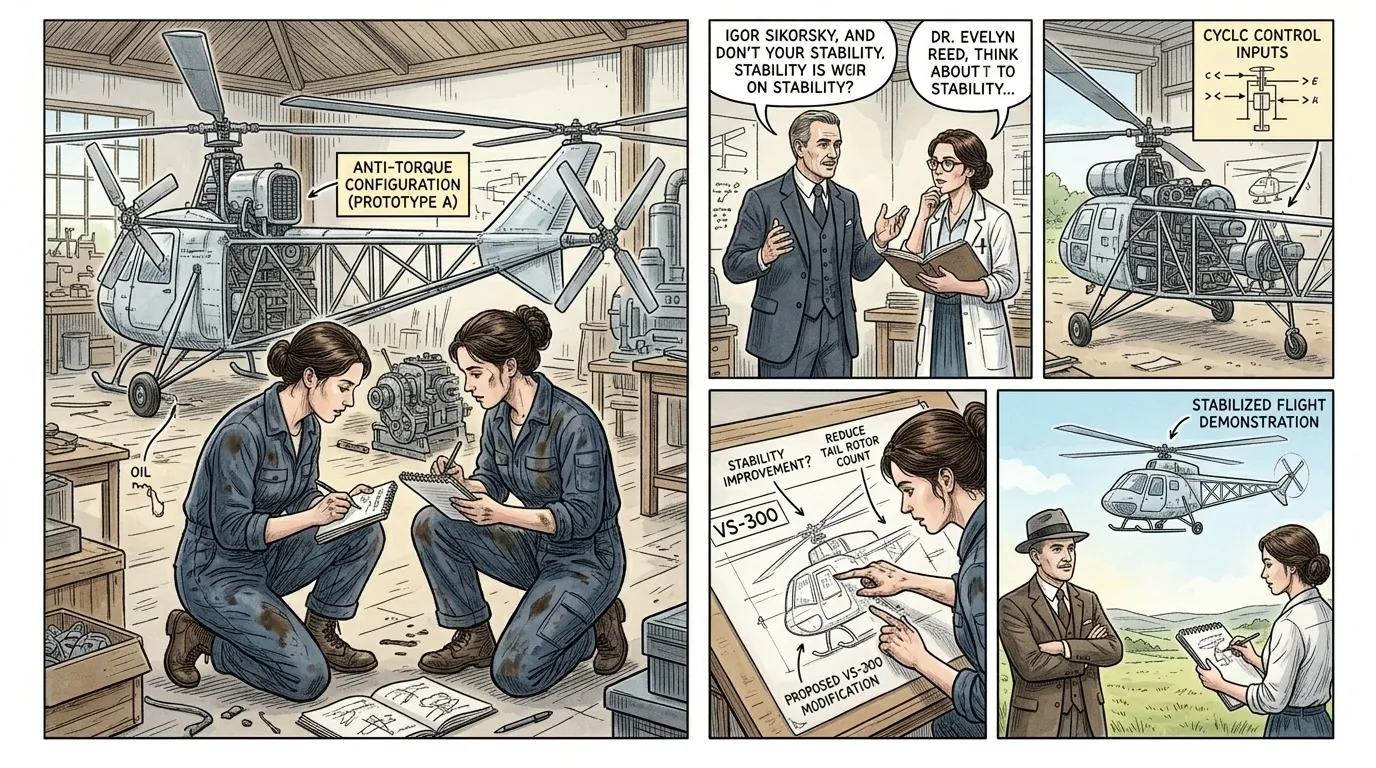
Sikorsky's methodical approach culminated in the VS-300, first flown in 1939 at Stratford, Connecticut. This prototype was a single main rotor design, which inherently faced the torque problem. His initial attempts used a complex system of three tail rotors on outriggers to counteract the main rotor's torque and provide directional control. It was far from perfect, plagued by intense vibration and instability, demanding constant, skilled pilot input. Each flight was a lesson, leading to further refinement and structural modification.
"One of Sikorsky's lead engineers, a pragmatic woman named Anya Petrova, with her dark hair tied back and smudges of grease on her coveralls, points to a newly sketched modification. She states, 'The vibrations from the main rotor are formidable. Each flight reveals a new harmonic resonance, a new structural stress point. We refine, we reinforce, we re-evaluate. It is an engineering dialogue with the air itself, demanding unwavering persistence against the forces of physics.'"
Page 6
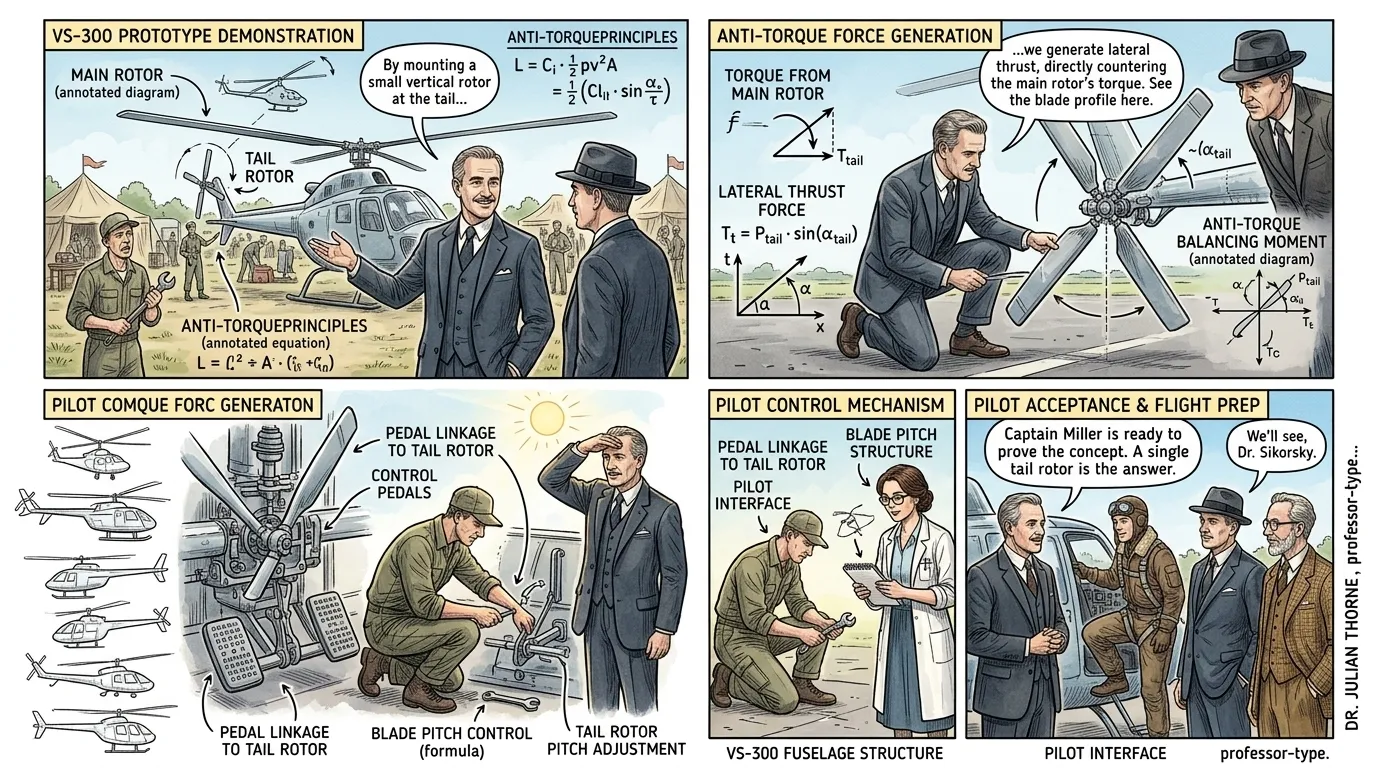
Sikorsky's genius reached its zenith with two critical innovations. First, he simplified the anti-torque system from multiple complex tail rotors to a single, vertically mounted tail rotor. This smaller rotor, positioned at the end of the tail boom, provided thrust perpendicular to the main rotor's torque, effectively neutralizing the unwanted spin. Second, and equally vital, was the refinement of cyclic pitch control. This allowed the pilot to individually alter the angle of attack of each main rotor blade as it rotated, effectively tilting the entire rotor disc in any desired direction.
"Sikorsky, a look of profound satisfaction on his face, demonstrates the tail rotor to a government official. He says, 'The solution to our rotational dilemma lay not in brute force, but in elegant counter-force. The tail rotor, our 'anti-torque' device, precisely balances the rotational moment from the main rotor. Coupled with the refined cyclic control, which allows us to effectively 'steer' the lift, we have finally achieved true directional mastery.'"
Page 7
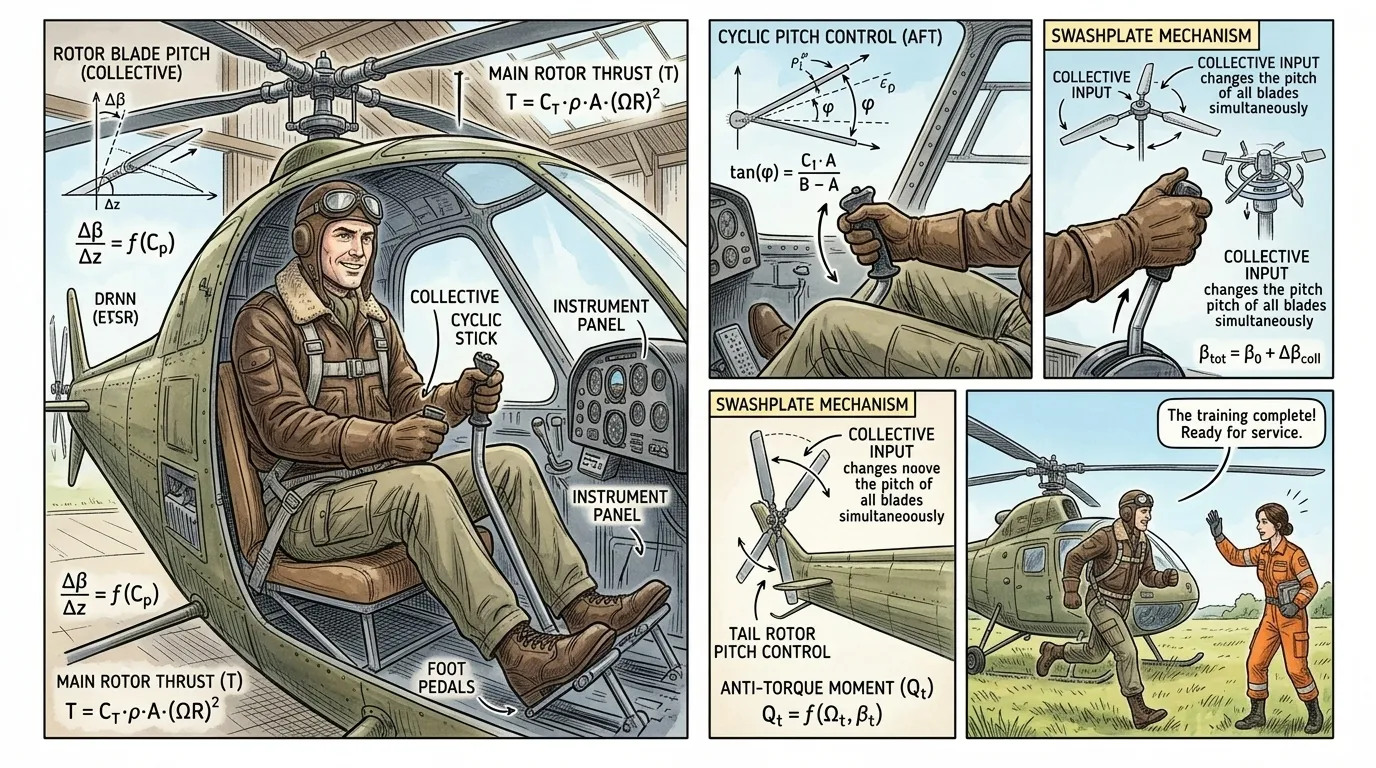
With the tail rotor addressing torque, the focus shifted to precise three-dimensional maneuverability, achieved through sophisticated blade pitch control. The collective pitch lever, located beside the pilot, simultaneously adjusts the angle of attack of all main rotor blades. Pushing it up increases pitch, generating more lift for ascent; pulling it down decreases pitch for descent. Complementing this is the cyclic stick, positioned between the pilot's legs. Moving the cyclic tilts the rotor disc by changing the pitch of individual blades cyclically, enabling forward, backward, or sideways flight by directing the thrust.
"A test pilot, Captain Miller, a focused man with a leather flight helmet and a confident grin, demonstrates the controls in the cockpit of an early R-4. He explains: 'Observe, this is the magic: the collective for pure vertical lift and descent. And this cyclic stick—by subtle movements, I dictate the tilt of the entire rotor disc, allowing us to glide forward, slide sideways, or even reverse our course. It's a delicate dance, but the machine now obeys our will, moving with uncanny precision in the air.'"
Page 8
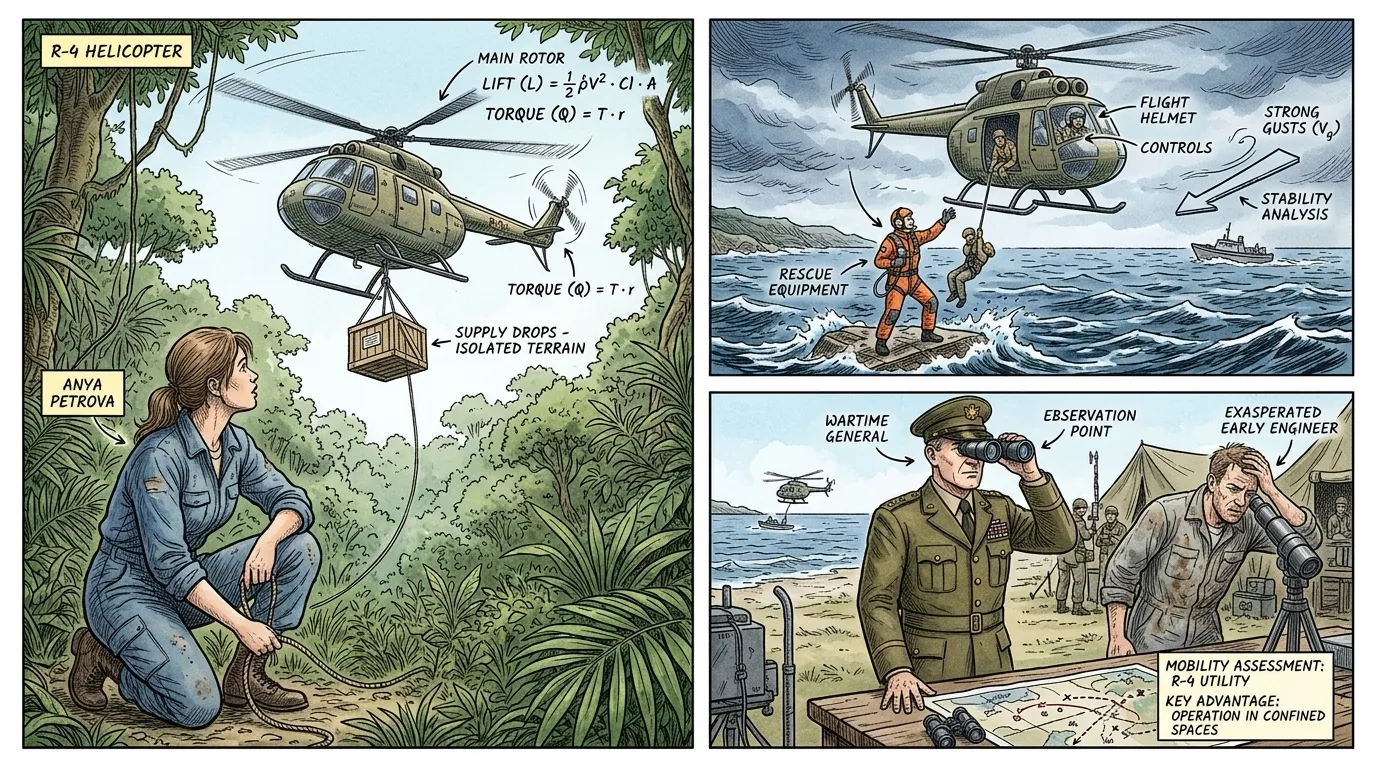
Sikorsky's innovations transformed the helicopter from an unstable curiosity into a practical, indispensable machine. The United States military quickly recognized its unparalleled strategic potential, especially as World War II intensified. The Sikorsky R-4, the world's first mass-produced helicopter, saw active service for reconnaissance, air-sea rescue, and troop transport in challenging terrains. This era proved the helicopter's unique capability to operate from confined spaces, bypassing traditional logistical nightmares and providing critical support where fixed-wing aircraft could not.
"A wartime general, a stoic man with a stern expression and a military uniform, observed, 'The Sikorsky machine has rewritten the rules of engagement and rescue. Where roads end and terrain becomes impassable, where fixed-wing aircraft cannot land, this 'whirlybird' delivers. It is an invaluable asset for observation in dense jungles and, crucially, for saving lives from inaccessible battlefields. The problem of stable, controlled vertical flight, once insurmountable, is now a triumph.'"
Page 9
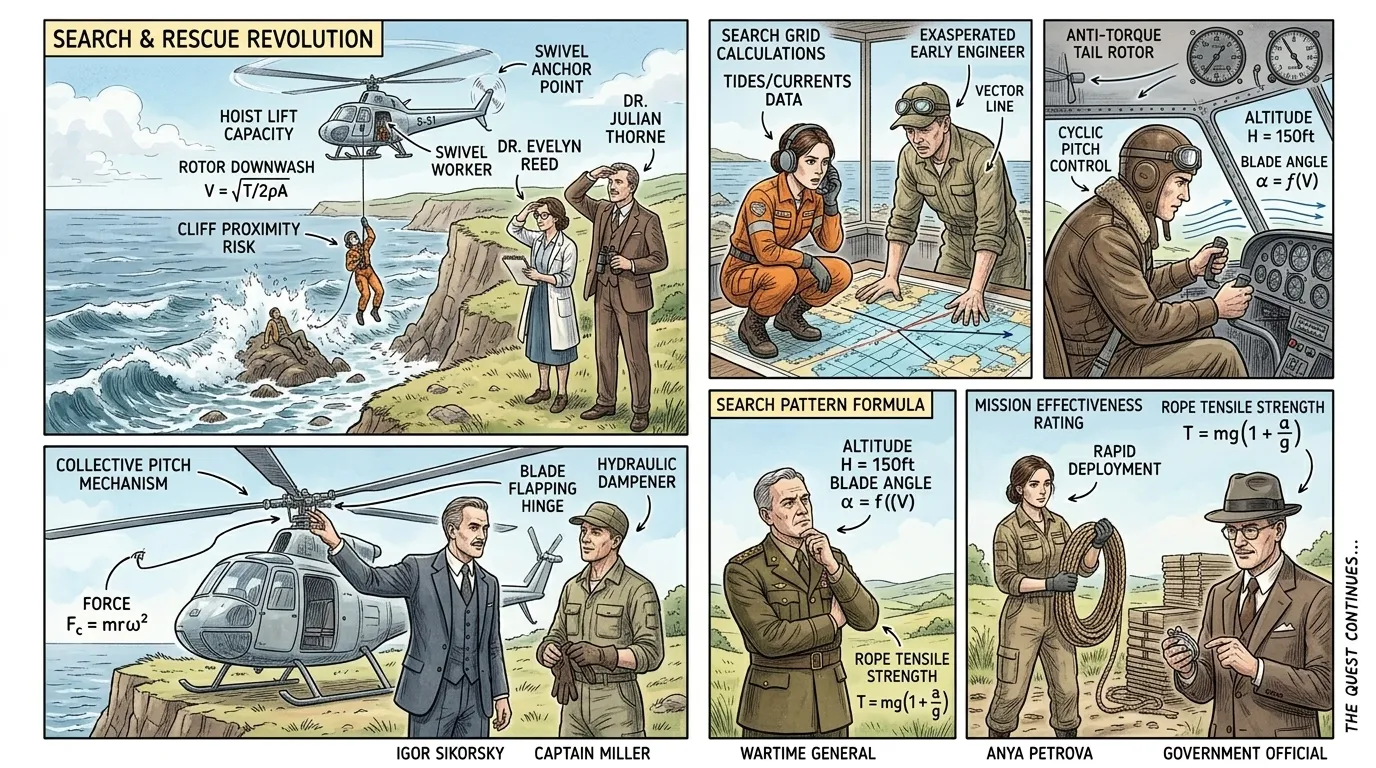
Post-war, the helicopter's utility blossomed beyond military applications. Its singular ability to hover, move in any direction, and land in virtually any clearing opened up entirely new sectors. Search and rescue operations were revolutionized, transforming remote emergencies into viable missions. Medical evacuation, law enforcement surveillance, offshore oil platform support, agricultural crop-dusting, and heavy-lift construction became commonplace, demonstrating the helicopter's extraordinary versatility. Its design continued to evolve, becoming faster, more powerful, and increasingly reliable.
"A rescue worker, a determined woman with a pragmatic, kind face, her bright orange uniform standing out against a rugged coastline, speaks into a radio, 'We found them, the storm stranded them on that isolated cliff edge. Without the 'bird,' it would have been days, maybe never. It's not just a machine; it's an extension of our capability to reach out and pull life back from the brink.' Her words resonate with the dramatic shift in emergency response."
Page 10
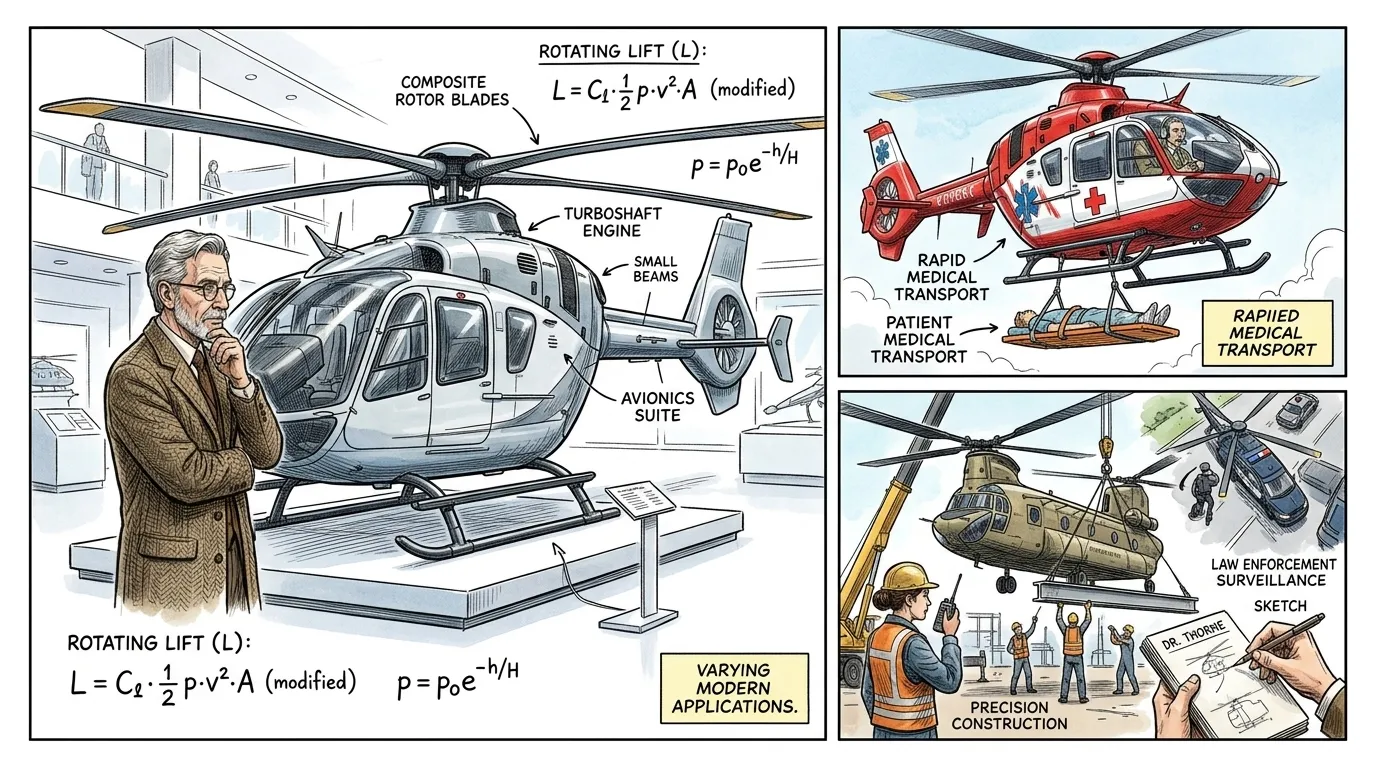
The helicopter's legacy is etched into the fabric of modern society, fundamentally reshaping our capabilities in mobility, logistics, and emergency response. From rapid medical transport, delivering critical aid in disaster zones, to precision construction and law enforcement, its unique operational envelope remains unmatched. It stands as a testament to human ingenuity and the persistent drive to overcome seemingly insurmountable engineering challenges, forever altering our relationship with inaccessible landscapes and the critical demands of time and distance.
"A renowned aerospace historian, Dr. Julian Thorne, a man with wise eyes and distinguished grey hair, stands before a display of a modern helicopter, reflecting: 'The helicopter, once a wild dream and an engineering nightmare, has become an indispensable tool. It transcends the limitations of fixed-wing flight and ground transport, offering unparalleled access. Its impact on saving lives, enabling commerce in challenging environments, and extending the reach of human endeavor is immeasurable. It is a powerful symbol of what persistent innovation can achieve.'"
About this story
- Location: Global
- Audience: general readers
Questions and answers
Read Wonder Inventions on your phone
Wonder Inventions is available on Android. Get Wonder Inventions on Google Play.