Locomotive

Locomotive — an illustrated inventions story, set in Global. 10 illustrated pages, free to read on Wonder Inventions.

Locomotive — book cover — Wonder Inventions
Locomotive — an illustrated inventions story, set in Global. 10 illustrated pages, free to read on Wonder Inventions.

Page 1

In the early 19th century, Great Britain's burgeoning industries faced a formidable challenge: moving colossal quantities of raw materials like coal and iron…
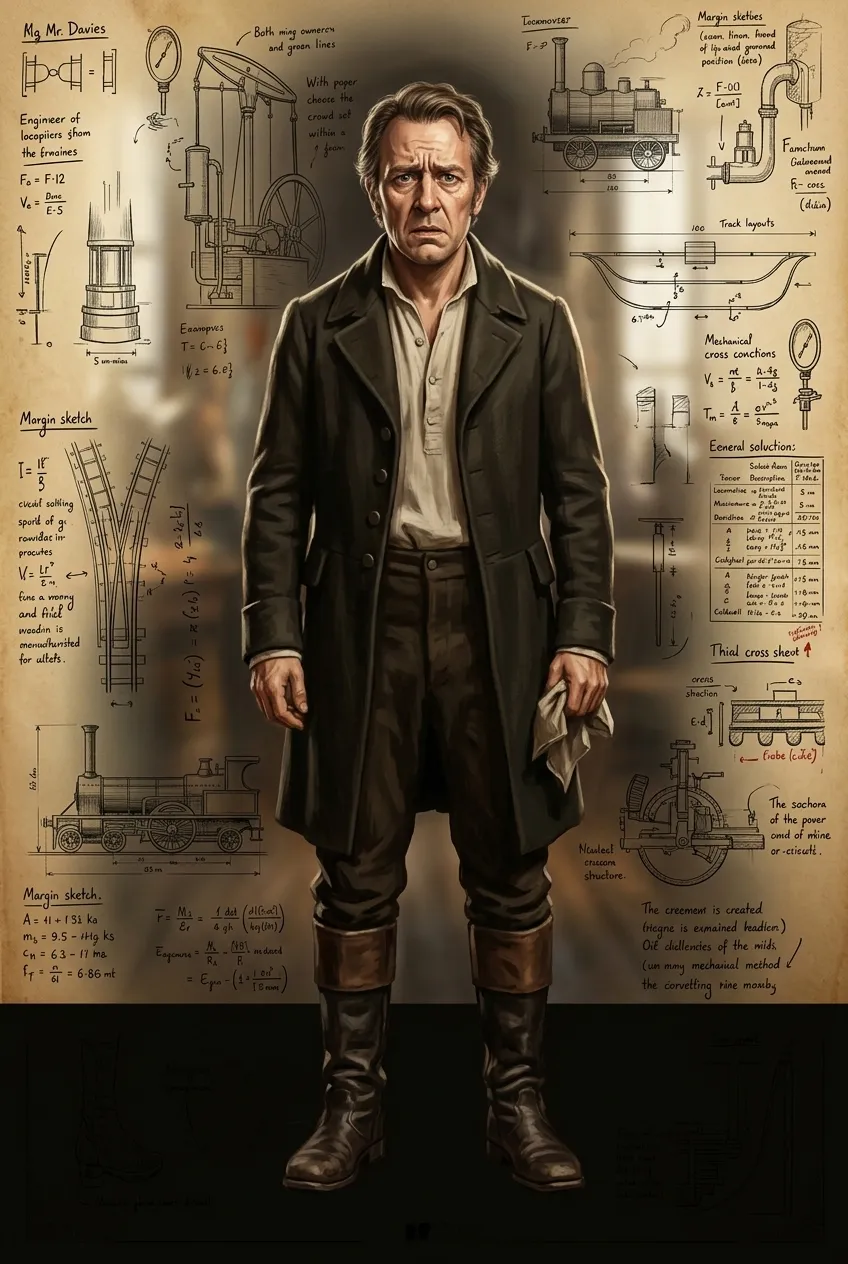
In the early 19th century, Great Britain's burgeoning industries faced a formidable challenge: moving colossal quantities of raw materials like coal and iron ore. Horse-drawn carts, even on rudimentary tracks, were slow, inefficient, and physically demanding, limiting industrial growth and escalating transportation costs. "'The sheer weight of these wagons is crippling our mines!' exclaimed Mr. Davies, a mine owner, wiping sweat from his brow.

In the early 19th century, Great Britain's burgeoning industries faced a formidable challenge: moving colossal quantities of raw materials like coal and iron ore. Horse-drawn carts, even on rudimentary tracks, were slow, inefficient, and physically demanding, limiting industrial growth and escalating transportation costs.

"'The sheer weight of these wagons is crippling our mines!' exclaimed Mr. Davies, a mine owner, wiping sweat from his brow. 'We need a power that doesn't tire, a force that can pull mountains of material.' A visionary engineer, Richard Trevithick, had already begun to conceive of just such a solution."

Page 2

Traditional steam engines, pioneered by Newcomen and improved by Watt, were colossal, low-pressure machines tethered to fixed locations.
Traditional steam engines, pioneered by Newcomen and improved by Watt, were colossal, low-pressure machines tethered to fixed locations. Their immense size and thirst for water made them utterly impractical for any form of mobile transport. "'Watt's engine is magnificent for pumping water from the pits,' remarked Engineer Thomson, observing a massive, stationary beam engine, 'but to put that power on wheels?

Traditional steam engines, pioneered by Newcomen and improved by Watt, were colossal, low-pressure machines tethered to fixed locations. Their immense size and thirst for water made them utterly impractical for any form of mobile transport.

"'Watt's engine is magnificent for pumping water from the pits,' remarked Engineer Thomson, observing a massive, stationary beam engine, 'but to put that power on wheels? The boiler alone would crush any road!' His colleague, Engineer Miller, added, 'Precisely; we need high-pressure steam, something compact yet immensely powerful, to truly revolutionize carriage.'"

Page 3

Richard Trevithick's groundbreaking 1804 locomotive for the Pen-y-darren Ironworks demonstrated that a steam engine could indeed pull ten tons of iron and 70…
Richard Trevithick's groundbreaking 1804 locomotive for the Pen-y-darren Ironworks demonstrated that a steam engine could indeed pull ten tons of iron and 70 men. Yet, this triumph exposed a critical weakness: the heavy machine repeatedly fractured the brittle cast-iron rails. "'The engine runs, Mr. Trevithick, it truly runs!' exclaimed Mr. Homfray, the ironworks owner, observing the scene with a mix of excitement and dismay. 'But these tracks...

Richard Trevithick's groundbreaking 1804 locomotive for the Pen-y-darren Ironworks demonstrated that a steam engine could indeed pull ten tons of iron and 70 men. Yet, this triumph exposed a critical weakness: the heavy machine repeatedly fractured the brittle cast-iron rails.

"'The engine runs, Mr. Trevithick, it truly runs!' exclaimed Mr. Homfray, the ironworks owner, observing the scene with a mix of excitement and dismay. 'But these tracks... they simply cannot bear the weight!' Dr. Blackwood, wiping soot from his brow, nodded gravely. 'Indeed, the path of progress is rarely smooth. As the philosopher Seneca once wrote, 'Every new beginning comes from some other beginning's end.' It seems, Mr. Trevithick, we've found an end to our old rail designs, but also the beginning of many new problems to solve.'"

Page 4

Following Trevithick's early experiments, engineers grappled with a fundamental question: how could a smooth iron wheel gain sufficient grip on a smooth iron…
Following Trevithick's early experiments, engineers grappled with a fundamental question: how could a smooth iron wheel gain sufficient grip on a smooth iron rail to pull heavy loads, especially on inclines, without constant slippage? "'Thomas, look at this smooth iron wheel on the smooth iron rail,' George Stephenson pondered, sketching in his notebook. 'Many say we need gears, a rack and pinion, but that adds weight, complexity.

Following Trevithick's early experiments, engineers grappled with a fundamental question: how could a smooth iron wheel gain sufficient grip on a smooth iron rail to pull heavy loads, especially on inclines, without constant slippage?

"'Thomas, look at this smooth iron wheel on the smooth iron rail,' George Stephenson pondered, sketching in his notebook. 'Many say we need gears, a rack and pinion, but that adds weight, complexity. Is there no simpler way for smooth wheels to grip, especially on an incline? We must overcome this 'adhesion problem,' as Mr. Trevithick struggled with it.' Thomas, his chief mechanic, leaned closer. 'The common wisdom holds that friction alone is insufficient, Master Stephenson. Every ounce of power could be lost to slip.'"

Page 5

Dismissing the prevailing belief that smooth wheels would always slip, George Stephenson embarked on a series of practical experiments.
Dismissing the prevailing belief that smooth wheels would always slip, George Stephenson embarked on a series of practical experiments. His initial locomotives, like the 1814 'Blücher,' still utilized a cogged wheel and rack system to ensure traction. "'While the rack-and-pinion offers certainty,' Stephenson explained to a delegation of mine managers, gesturing towards a blueprint, 'my observations suggest that with enough weight applied, and precision engineering, smooth…

Dismissing the prevailing belief that smooth wheels would always slip, George Stephenson embarked on a series of practical experiments. His initial locomotives, like the 1814 'Blücher,' still utilized a cogged wheel and rack system to ensure traction.

"'While the rack-and-pinion offers certainty,' Stephenson explained to a delegation of mine managers, gesturing towards a blueprint, 'my observations suggest that with enough weight applied, and precision engineering, smooth wheels can achieve adequate adhesion. It is a matter of distributing the mass effectively.' A mine manager, Mr. Ainsworth, stroked his chin. 'Are you certain, Mr. Stephenson? The cost of laying a geared track is considerable.'"

Page 6

The locomotive's heart is its boiler, where water is heated to a high temperature, generating pressurized steam. This steam is then directed into cylinders…
The locomotive's heart is its boiler, where water is heated to a high temperature, generating pressurized steam. This steam is then directed into cylinders, pushing pistons back and forth in a linear motion. "'Observe, gentlemen,' Stephenson indicated, pointing to a cutaway model of a boiler. 'The firebox heats the water, creating steam under immense pressure.

The locomotive's heart is its boiler, where water is heated to a high temperature, generating pressurized steam. This steam is then directed into cylinders, pushing pistons back and forth in a linear motion.

"'Observe, gentlemen,' Stephenson indicated, pointing to a cutaway model of a boiler. 'The firebox heats the water, creating steam under immense pressure. This pressure, when channeled correctly, becomes our engine's driving force.' An apprentice, young Arthur, peered closely. 'So, the steam pushes that rod, sir?' Stephenson nodded. 'Precisely, Arthur. It is the controlled expansion of heated water that delivers power.'"

Page 7

The linear thrust of the pistons must be converted into rotary motion to turn the wheels. This is achieved through sturdy connecting rods linked to the…
The linear thrust of the pistons must be converted into rotary motion to turn the wheels. This is achieved through sturdy connecting rods linked to the locomotive's main drive wheels, allowing it to move along the tracks. "'The ingenious part lies here,' Stephenson stated, demonstrating with a working model. 'The piston's powerful back-and-forth movement is transmitted by this connecting rod to the crankshaft, which then rotates the drive wheels.

The linear thrust of the pistons must be converted into rotary motion to turn the wheels. This is achieved through sturdy connecting rods linked to the locomotive's main drive wheels, allowing it to move along the tracks.

"'The ingenious part lies here,' Stephenson stated, demonstrating with a working model. 'The piston's powerful back-and-forth movement is transmitted by this connecting rod to the crankshaft, which then rotates the drive wheels. Furthermore, coupling several wheels together ensures maximum grip and distributed force, crucial for heavier loads.' Engineer Thompson, now convinced, said, 'A truly elegant solution, converting raw power into relentless forward motion.'"

Page 8

The definitive moment for the locomotive arrived with the 1829 Rainhill Trials, a competition to find the most efficient and reliable engine for the new…
The definitive moment for the locomotive arrived with the 1829 Rainhill Trials, a competition to find the most efficient and reliable engine for the new Liverpool and Manchester Railway. George Stephenson's 'Rocket' emerged victorious, fundamentally proving the locomotive's viability. "'Incredible! Look at her go!' shouted a trackside observer, Mr. Caldwell, as the Rocket thundered past. 'Stephenson has truly mastered the 'adhesion problem' we spoke of earlier!

The definitive moment for the locomotive arrived with the 1829 Rainhill Trials, a competition to find the most efficient and reliable engine for the new Liverpool and Manchester Railway. George Stephenson's 'Rocket' emerged victorious, fundamentally proving the locomotive's viability.

"'Incredible! Look at her go!' shouted a trackside observer, Mr. Caldwell, as the Rocket thundered past. 'Stephenson has truly mastered the 'adhesion problem' we spoke of earlier! His design proves that with sufficient weight and controlled power, smooth wheels can achieve incredible grip, delivering both speed and efficiency!' Engineer Thompson, standing beside him, nodded vigorously. 'The Rocket is not merely a machine; it is the harbinger of a new age of transport!'"

Page 9

The 'Rocket's' success at Rainhill and the subsequent opening of the Liverpool and Manchester Railway ignited a period of unprecedented investment known as…
The 'Rocket's' success at Rainhill and the subsequent opening of the Liverpool and Manchester Railway ignited a period of unprecedented investment known as 'Railway Mania.' Across Britain, new lines were proposed and constructed at a frantic pace, transforming the landscape. "'The demand for these 'iron horses' is insatiable!' exclaimed Mr. Hawthorne, an industrialist, poring over a new railway map. 'Faster movement of coal to our factories, finished goods to our ports...

The 'Rocket's' success at Rainhill and the subsequent opening of the Liverpool and Manchester Railway ignited a period of unprecedented investment known as 'Railway Mania.' Across Britain, new lines were proposed and constructed at a frantic pace, transforming the landscape.

"'The demand for these 'iron horses' is insatiable!' exclaimed Mr. Hawthorne, an industrialist, poring over a new railway map. 'Faster movement of coal to our factories, finished goods to our ports... the economic opportunities are limitless!' His colleague, Mrs. Albright, concurred. 'It's not just goods; people are traveling farther and faster than ever imagined, connecting towns and cities in ways we only dreamed possible.'"

Page 10

The locomotive irrevocably altered human society, not just in Britain but across the globe. It compressed distances, accelerated commerce, and shaped the very…
The locomotive irrevocably altered human society, not just in Britain but across the globe. It compressed distances, accelerated commerce, and shaped the very fabric of industrial civilization, forever changing how goods moved, people traveled, and economies thrived. Its legacy echoes in every facet of modern transport.

The locomotive irrevocably altered human society, not just in Britain but across the globe. It compressed distances, accelerated commerce, and shaped the very fabric of industrial civilization, forever changing how goods moved, people traveled, and economies thrived. Its legacy echoes in every facet of modern transport.

"'From connecting distant continents to powering the engine of industry, the locomotive's impact is immeasurable,' reflected an aged George Stephenson, looking out over a busy railway yard. 'It gave us the means to reshape the world, linking isolated communities and fostering a global exchange of ideas and goods previously unimaginable.' His words resonated with the endless churn of the railway age."

About this story

  • Location: Global
  • Audience: general readers

More Wonder Inventions stories

All Wonder Inventions stories · Open the library