Mechanical Computer
Mechanical Computer — an illustrated inventions story, set in Global. 10 illustrated pages, free to read on Wonder Inventions.
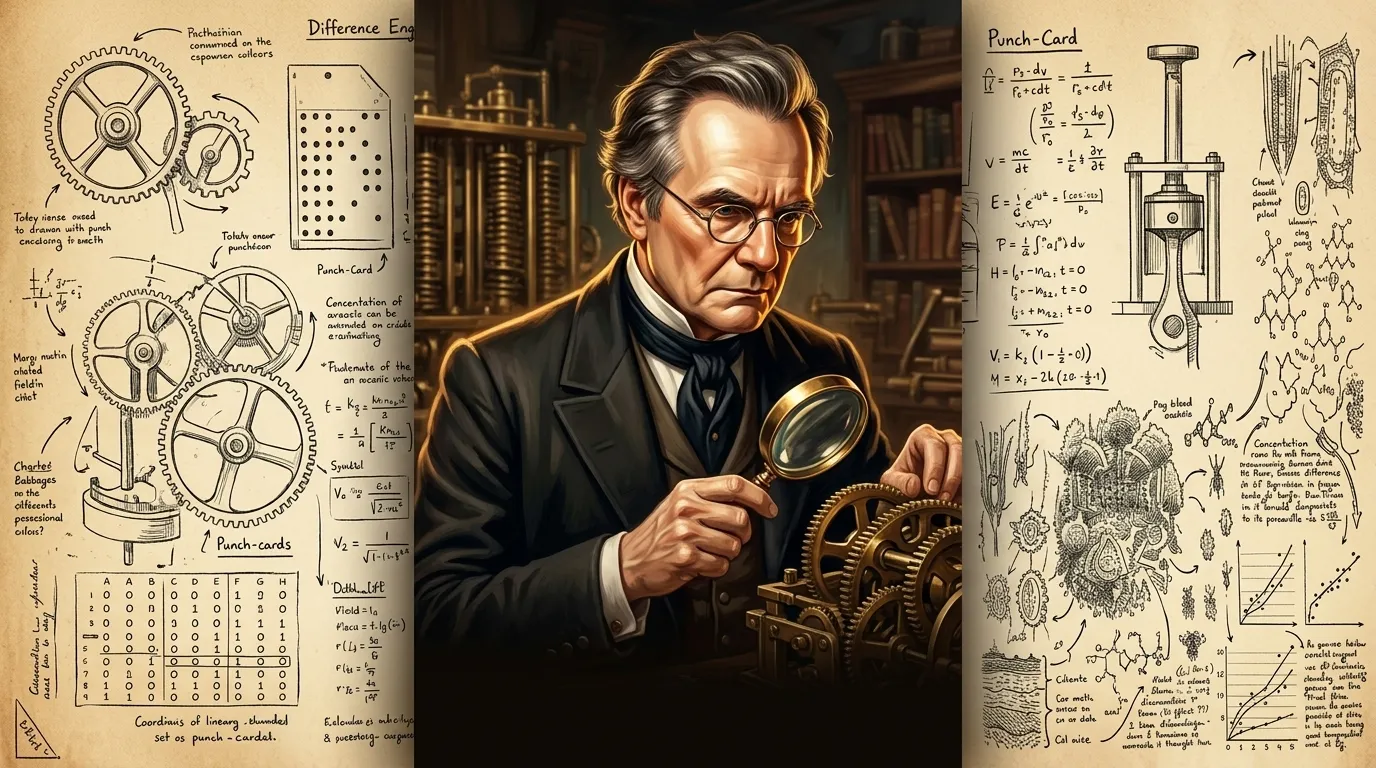
Page 1
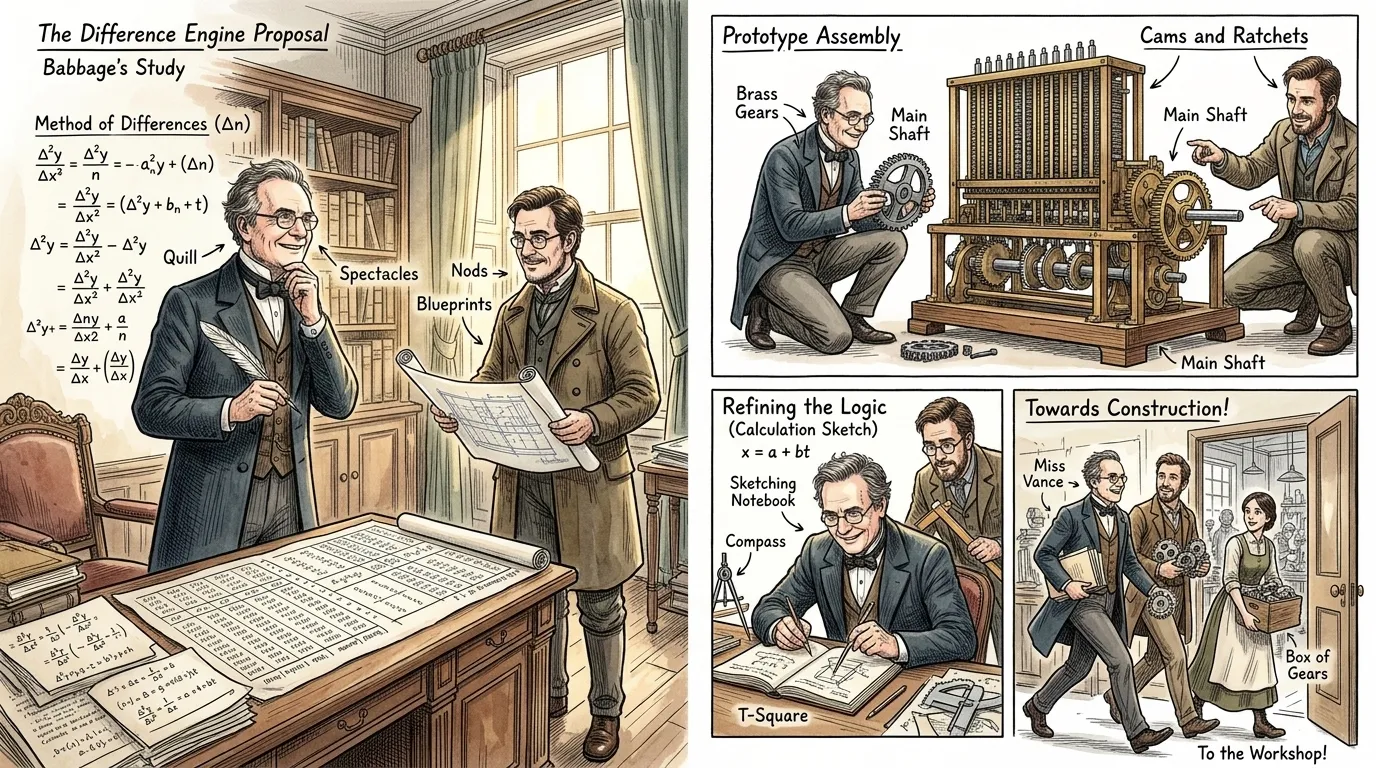
The dawn of the 19th century demanded unprecedented precision in calculation, from nautical tables guiding empires across oceans to astronomical predictions charting the cosmos. Humanity, however, remained bound by manual effort, prone to errors that could spell disaster. In this era of burgeoning industry and scientific ambition, a visionary sought to liberate computation from human fallibility.
"Charles Babbage, a distinguished mathematician in London, lamented, "The whole object of my design is to construct machinery so that it shall perform the work of analysis, not of human intellect. The human element, my dear colleague, introduces an intolerable degree of error into our most vital tables!" An adjacent engineer, Mr. Henry Fancourt, nodded gravely, responding, "Indeed, Professor. The 'computers' – those poor souls toiling over columns of figures – cannot sustain the accuracy required for our naval charts, let alone the complex equations of celestial mechanics.""
Page 2
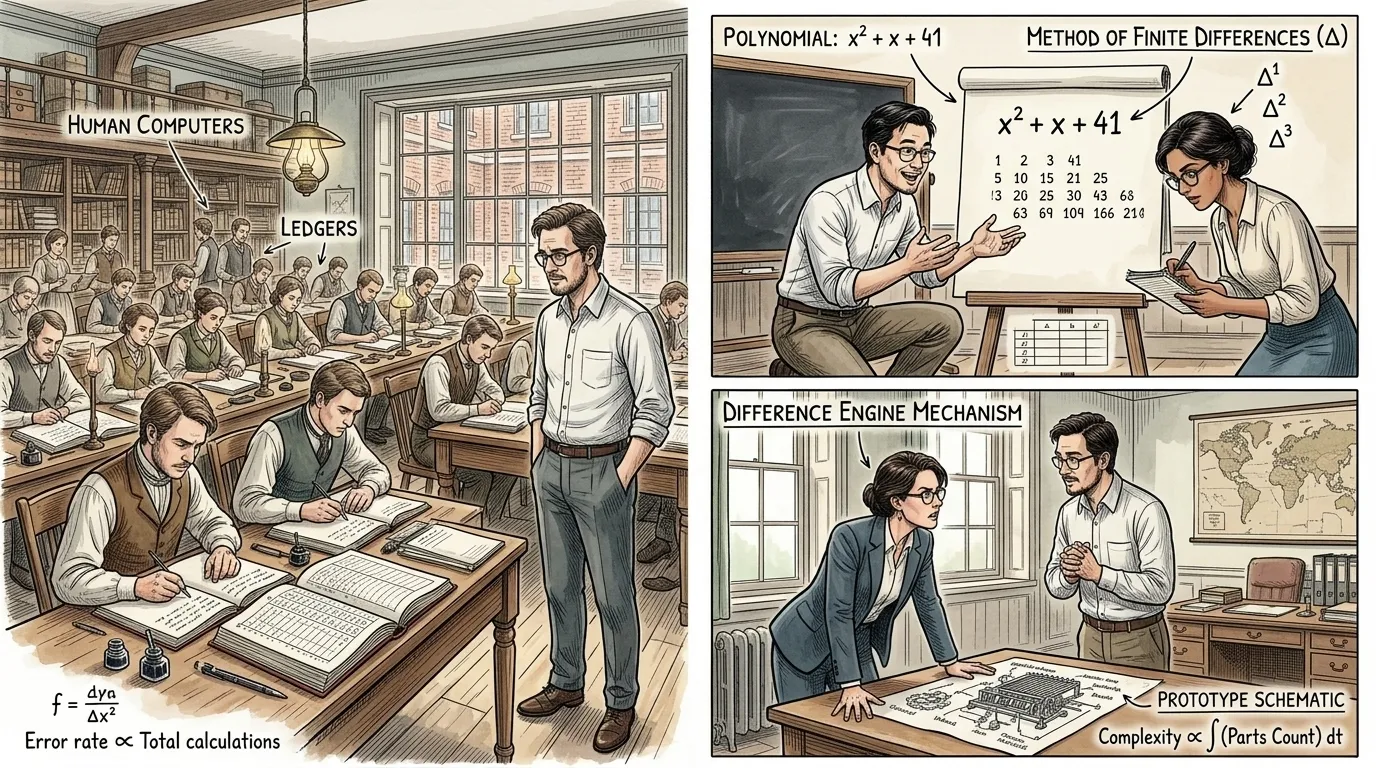
Before mechanical computers, armies of human 'computers' labored in large rooms, meticulously calculating vast tables for navigation, insurance, and engineering. These calculations, often involving complex polynomial functions, were ripe for human error, demanding a more reliable method.
"Babbage, observing a group of clerks, once remarked, "Watching these industrious individuals, I saw the endless drudgery, the inevitable fatigue leading to mistakes. The method of finite differences, if mechanized, offers a path to escape this." He then turned to a young assistant, Miss Eleanor Vance, explaining, "Consider a polynomial like x2 x 41. Instead of calculating each value directly, we find the differences between consecutive terms. Then, we find the differences of those differences. Eventually, a constant difference emerges, allowing us to generate the sequence with simple additions." Miss Vance, dressed in a simple, practical dress, took diligent notes."
Page 3
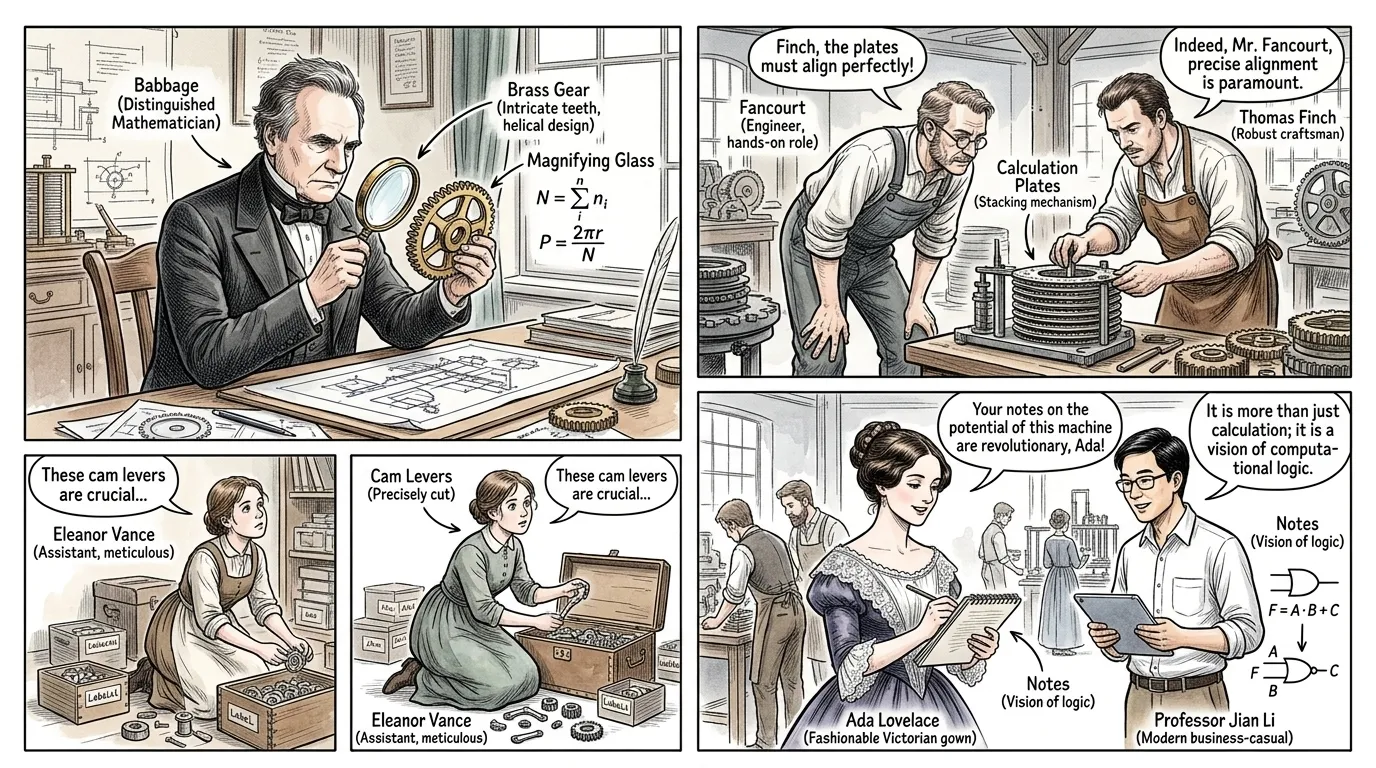
Babbage's initial ambition materialized as the Difference Engine, designed specifically to automate polynomial calculations using the method of finite differences. Its complexity pushed the limits of 19th-century engineering, requiring unprecedented precision in gear cutting and assembly.
"During one of his numerous factory visits, Babbage engaged a master craftsman, Mr. Thomas Finch. "The accuracy of these gears, Mr. Finch, is paramount. A deviation of even a thousandth of an inch could propagate errors throughout the entire machine," Babbage stressed, holding up a precisely cut brass gear. Mr. Finch, a robust man with calloused hands and a leather apron, replied, "Indeed, Professor. As our great philosopher John Locke once wrote, 'New opinions are always suspected, and usually opposed, without any other reason but because they are not common.' This Difference Engine is certainly not common, and its perfection demands uncommon dedication." Babbage nodded, contemplating the immense mechanical challenge."
Page 4
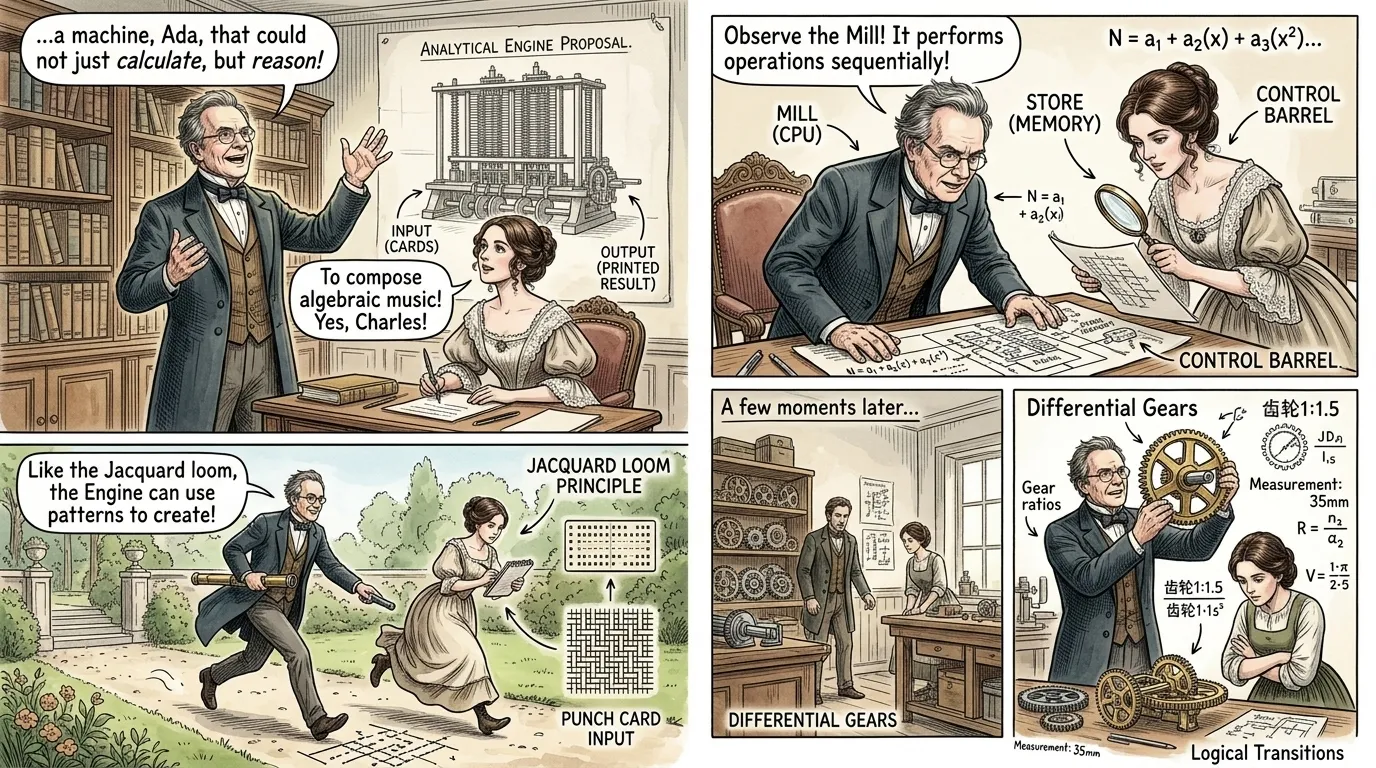
While the Difference Engine addressed a specific class of problems, Babbage's mind surged towards a more profound concept: a general-purpose programmable calculating machine. This conceptual leap transformed his focus from automating specific tables to creating a truly universal analytical engine.
"Babbage, in a lively discussion with Ada Lovelace, articulated his expanded vision. "The Difference Engine, for all its ingenuity, is ultimately a specialized instrument. But what if we could design a machine capable of performing any calculation, provided it could be broken down into a sequence of fundamental operations?" Ada Lovelace, elegantly dressed in a fashionable Victorian gown, her dark hair styled in soft curls, responded with keen insight, "You are not merely mechanizing arithmetic, Mr. Babbage; you are proposing a mechanism to execute an arbitrary sequence of mathematical operations. This 'Analytical Engine' concept hints at something far grander – a machine that can process logic, not just numbers.""
Page 5
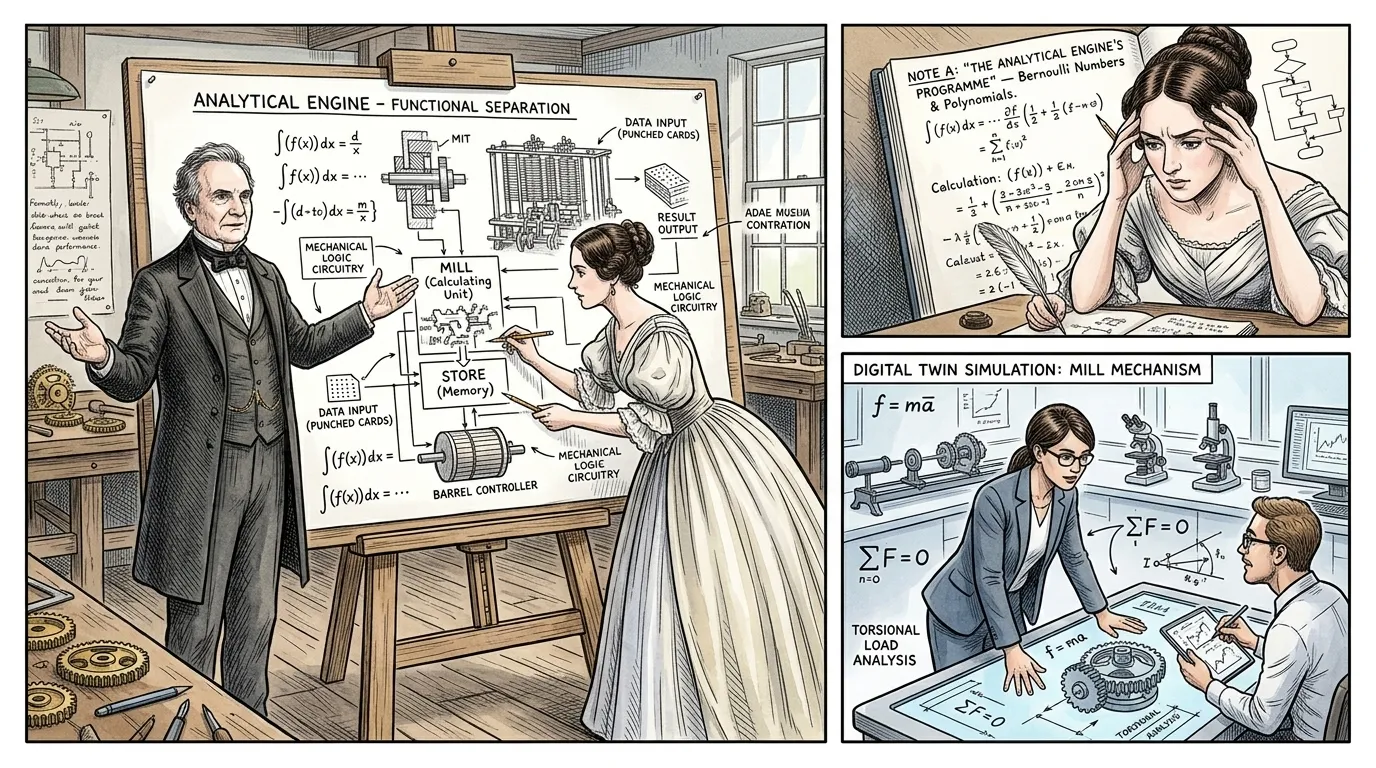
The Analytical Engine's proposed architecture foreshadowed modern computers. It comprised distinct units: the 'Mill' for calculations, the 'Store' for holding numbers, an input mechanism for instructions and data, and an output for results. This modular design allowed for unprecedented flexibility.
"Babbage meticulously outlined the machine's functional separation. "Imagine the Mill as the heart of the engine, the place where all arithmetical operations are executed. It takes numbers from the Store, performs the prescribed calculus, and returns the result." He then gestured towards a conceptual drawing. "The Store, conversely, is where all numerical values, both input and intermediate results, are held on number wheels. Their separation prevents computational interference." Lovelace, scrutinizing the schematic, added, "And the ingenious part, Mr. Babbage, is the control unit, which orchestrates the flow of numbers and operations, enabling a dynamic sequence rather than a fixed one. This is truly the essence of programmability.""
Page 6
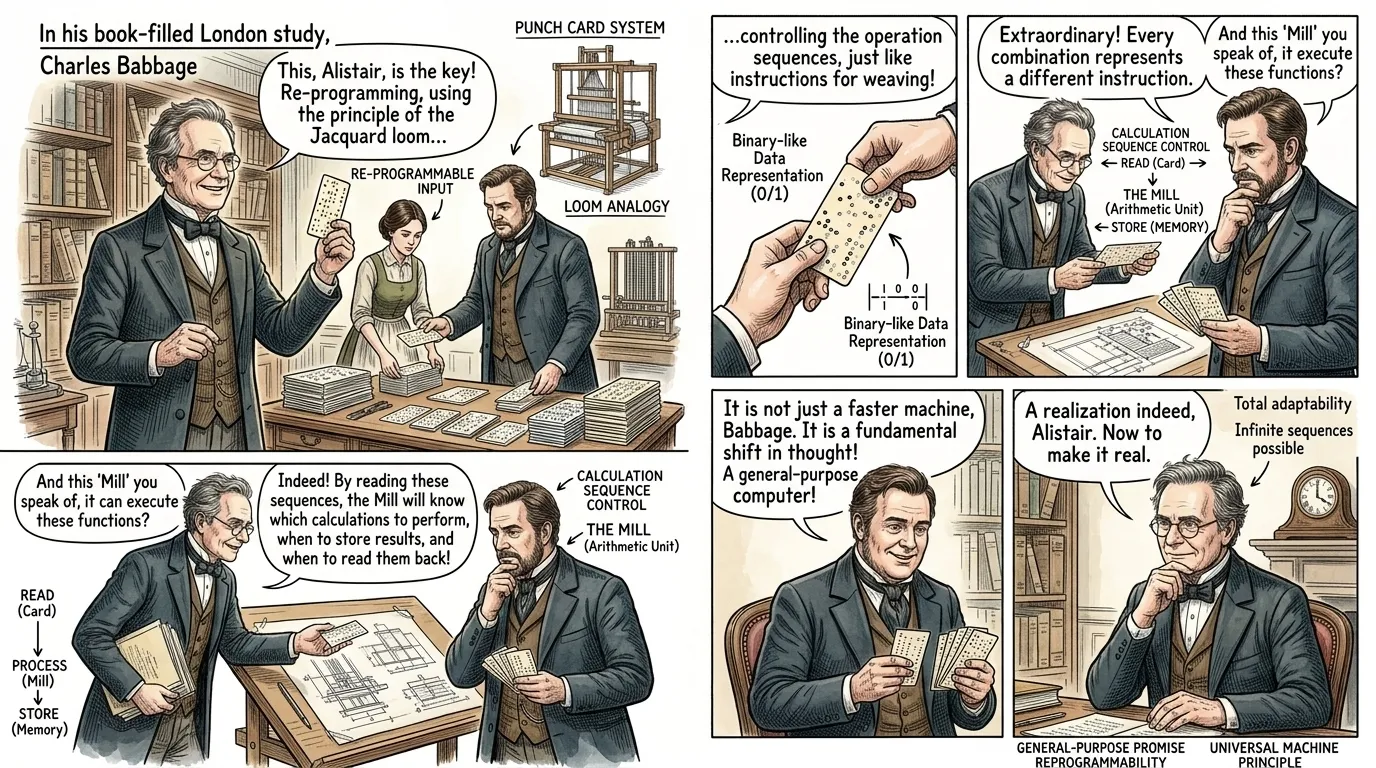
To feed instructions and data into the Analytical Engine, Babbage ingeniously adapted the punch card technology already employed in Jacquard looms for weaving complex patterns. These cards offered a binary language of presence or absence, directing the machine's intricate operations.
"Babbage explained to a visiting industrialist, Mr. Alistair Croft, "The brilliance of Monsieur Jacquard's loom lies in its ability to follow a pattern encoded by holes in cards. My vision extends this principle. One set of cards will dictate the sequence of operations for the Mill—addition, subtraction, multiplication—while another provides the numerical data itself." Mr. Croft, a stout man in a tailored suit, picked up a sample card. "So, the holes act as a mechanical conductor, telling the machine what to do and with what numbers? This has profound implications for automation far beyond textiles!" Babbage smiled, "Indeed, Mr. Croft. The machine essentially 'reads' the program.""
Page 7
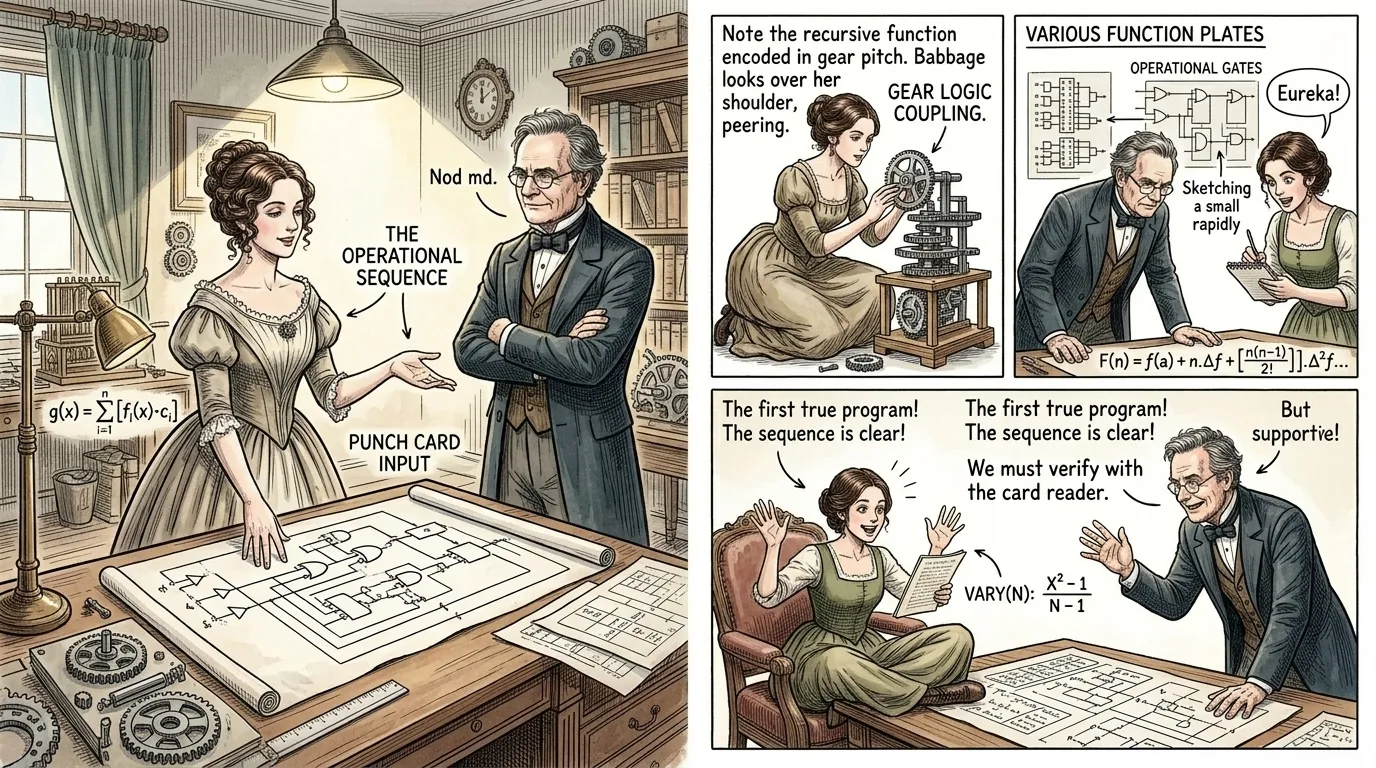
Though never fully built in Babbage's lifetime, the Analytical Engine's conceptual operation was clear. Punch cards would sequence instructions, guiding the machine to retrieve numbers from the Store, process them in the Mill, and record results back, all without human intervention.
"Lovelace, expanding on the machine's potential, elaborated, "Consider the process of solving a complex equation. First, the variable cards would input the initial values into the Store. Then, the operation cards would direct the Mill to perform, for example, a series of multiplications and additions." She paused, then added, "The result, once computed, could be printed or returned to the Store for subsequent calculations, creating a recursive loop of mechanical intelligence. It is a systematic process where the machine follows a predetermined logical flow." Babbage affirmed, "Precisely. The machine does not 'think,' but it executes complex instructions with unwavering fidelity.""
Page 8
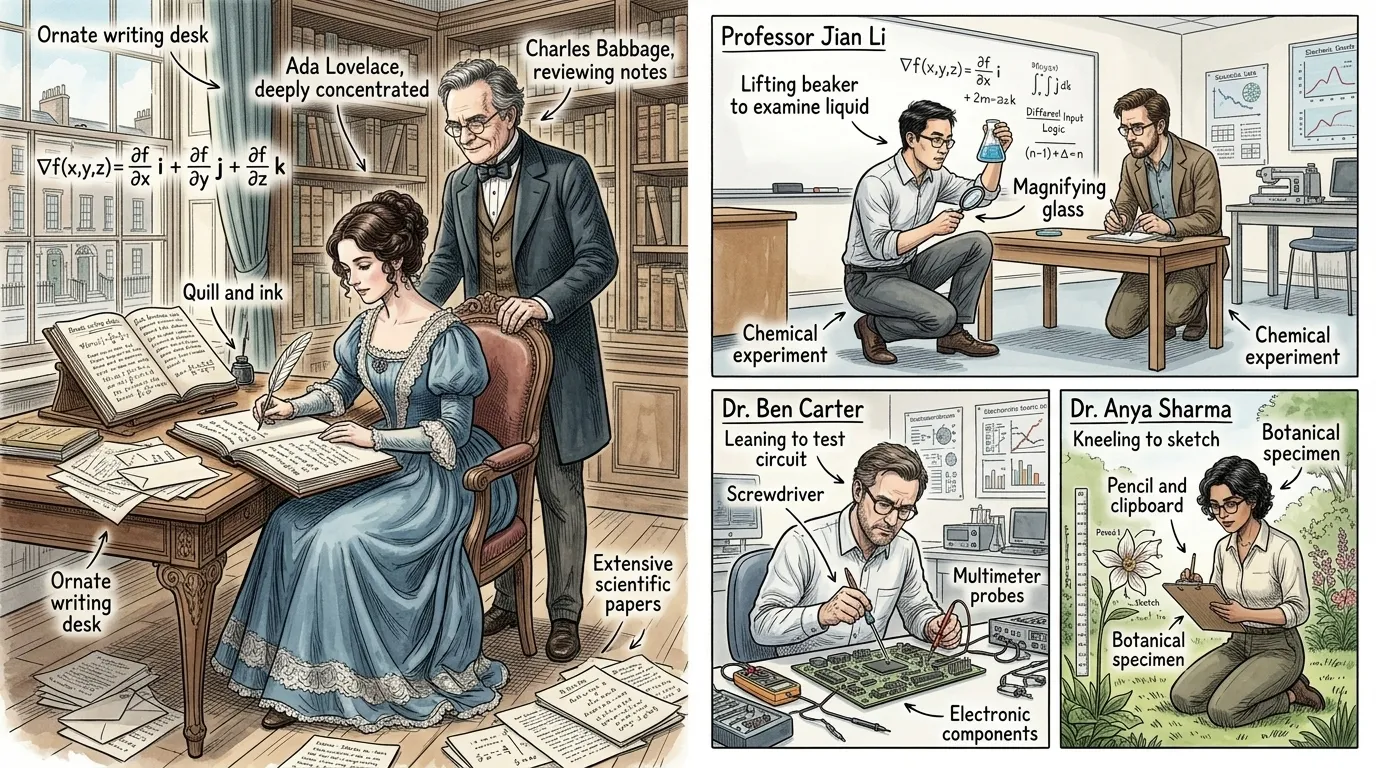
Ada Lovelace's contribution transcended mere understanding of Babbage's designs; she foresaw the Analytical Engine's potential far beyond simple arithmetic. Her detailed notes contained what is now considered the first computer algorithm, illustrating how the machine could calculate Bernoulli numbers.
"Lovelace, in correspondence with a scientific peer, articulated her groundbreaking insight: "The Analytical Engine weaves algebraic patterns just as the Jacquard loom weaves flowers and leaves. Its operations are not limited to magnitude; it can act upon other things besides number, if these things can have their fundamental relations expressed by those of the abstract science of operations." Babbage, reviewing her extensive notes, remarked, "Miss Lovelace grasps the full philosophical import. She understands that by encoding the relations, the engine becomes capable of symbolic manipulation, extending its reach beyond pure numerical computation.""
Page 9
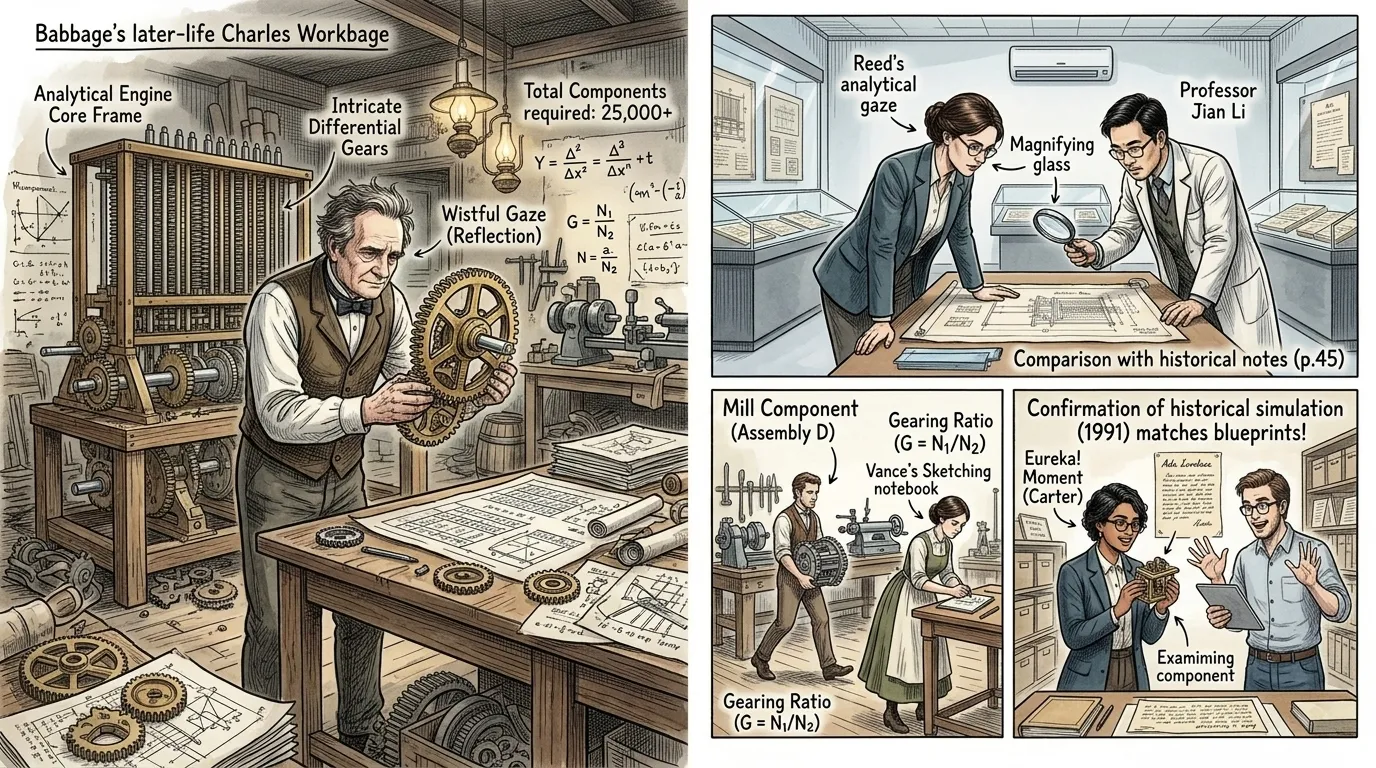
Despite the brilliance of Babbage's designs and Lovelace's algorithms, the Analytical Engine was never fully constructed in their lifetime. Financial constraints, political indifference, and the sheer mechanical difficulty of manufacturing its thousands of precise parts proved insurmountable obstacles.
"A dejected Babbage, late in his life, reportedly mused, "I have been harassed by not a single idea but by the necessity of perpetually changing my designs and of sacrificing my first intentions to those which a more advanced knowledge suggested." A modern historian, Dr. Evelyn Reed, reflecting on this period, states, "While the immediate realization of Babbage's machine was thwarted by 19th-century limitations, his theoretical framework laid the undeniable groundwork. His 'Mill' is our CPU, his 'Store' our memory. The conceptual blueprint was complete, even if the physical manifestation was delayed.""
Page 10
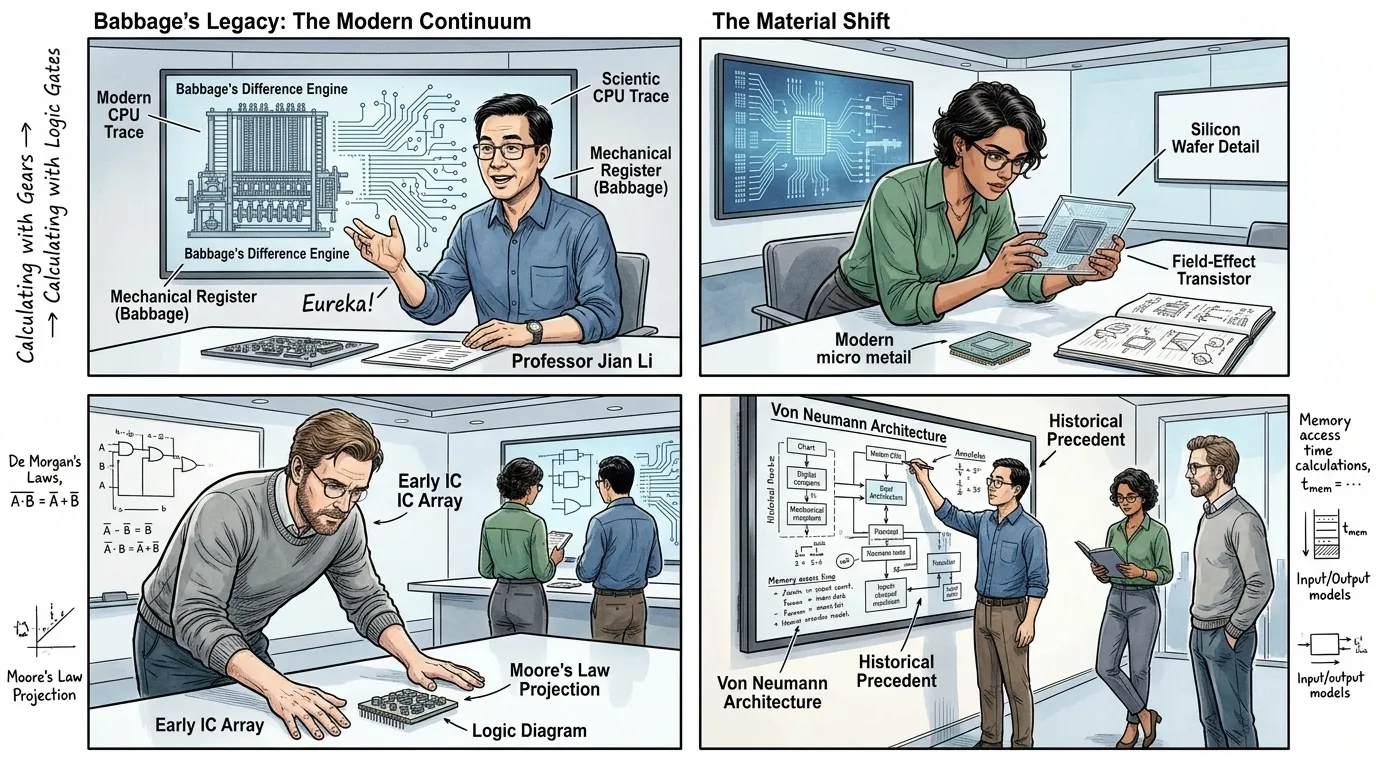
Babbage's profound theoretical work, particularly on the Analytical Engine, remained largely unappreciated for decades. Yet, his fundamental concepts of a programmable, general-purpose machine eventually found their realization, laying the intellectual foundation for every computer that followed.
"A panel of modern computer scientists, assembled for a documentary, discuss Babbage's legacy. Professor Jian Li states, "The very architecture of modern computers – the separation of processing, memory, input, and output – directly echoes Babbage's Analytical Engine. He provided the foundational blueprint." Dr. Anya Sharma adds, "And Lovelace's insight into the machine's symbolic capabilities, beyond just numbers, truly anticipated the software revolution. They were a century ahead of their time, conceiving of a universal machine." Dr. Ben Carter concludes, "From his gears to our microchips, the spirit of mechanical computation lives on.""
About this story
- Location: Global
- Audience: general readers
Questions and answers
Read Wonder Inventions on your phone
Wonder Inventions is available on Android. Get Wonder Inventions on Google Play.