Microprocessor
Microprocessor — an illustrated inventions story, set in Global. 10 illustrated pages, free to read on Wonder Inventions.
Page 1
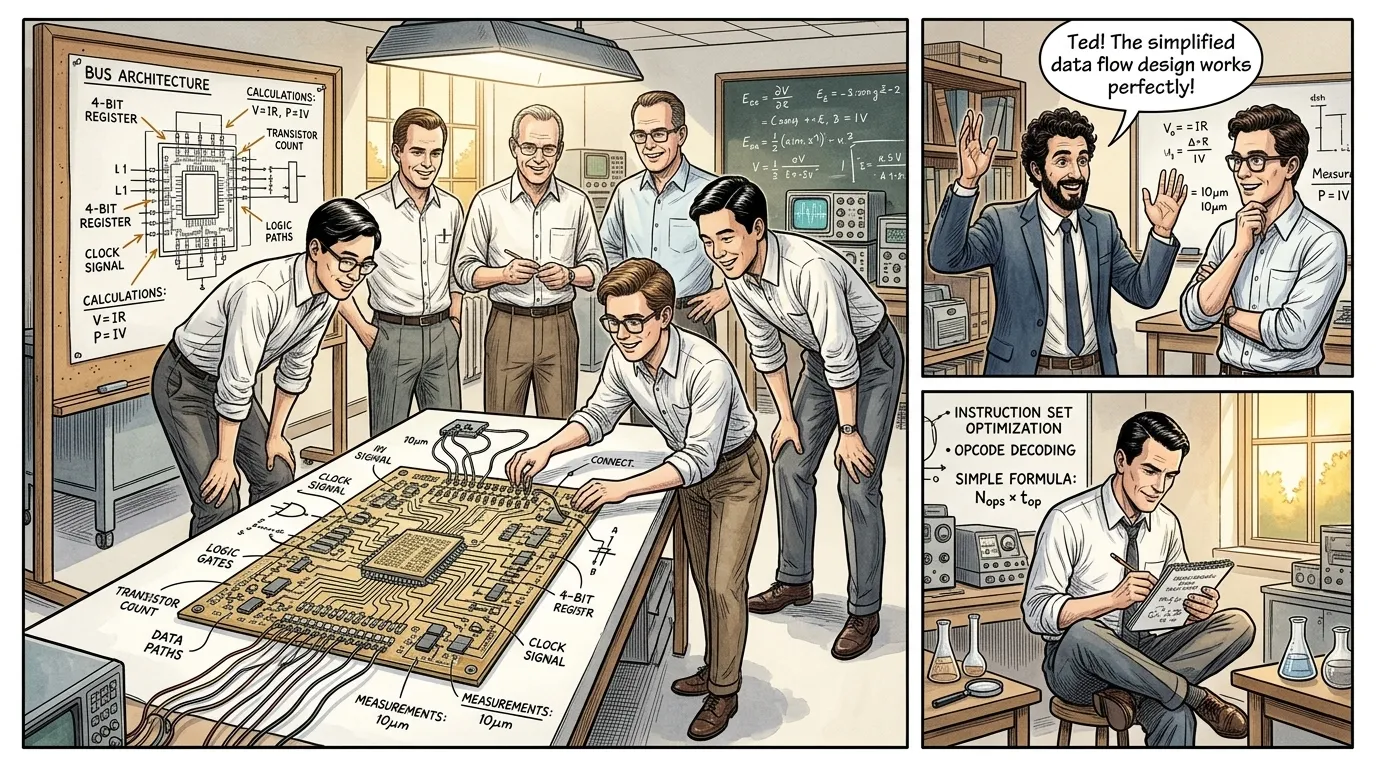
In the late 1960s, computing faced a formidable challenge: every complex electronic function required a dedicated, custom-designed integrated circuit. This meant vast arrays of specialized chips for even modest devices, increasing complexity and cost exponentially. Engineers grappled with the limitations of inflexible, hardwired logic, hindering the miniaturization and versatility of electronics. The vision for a truly programmable, universal processing unit remained a distant, theoretical goal.
Page 2
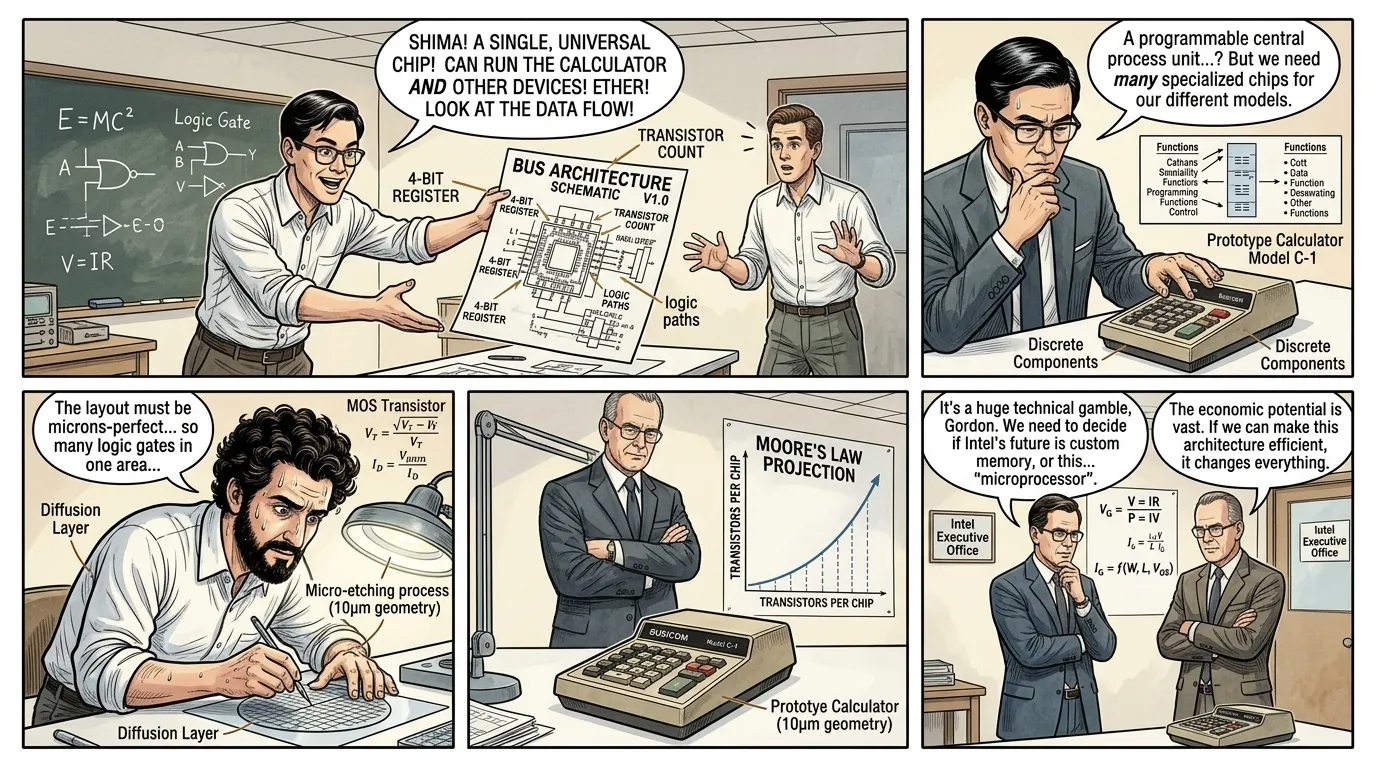
The urgent catalyst for change arrived from Japan: Busicom, a calculator manufacturer, requested a sophisticated set of custom chips for their new desktop models. Their initial design necessitated twelve individual integrated circuits, each programmed for a distinct mathematical or control function. This approach, while conventional, presented a staggering design and manufacturing burden, pushing the boundaries of what was economically and practically viable for a single product.
"Ted Hoff, holding up a dense schematic, exclaimed to Masatoshi Shima, "Masatoshi, this isn't scalable! Designing twelve custom chips for a single calculator is immensely complex and costly for every new product variant. We need something fundamentally different." Masatoshi Shima, a meticulous engineer with dark hair and glasses, replied, "But Mr. Hoff, this is how all logic is built. We require dedicated arithmetic, memory, and input-output functions for the Busicom 141-PF." Hoff responded, "What if, instead of twelve specialized components, we could craft a single, universal device? A programmable 'brain' that could adapt to any task?""
Page 3
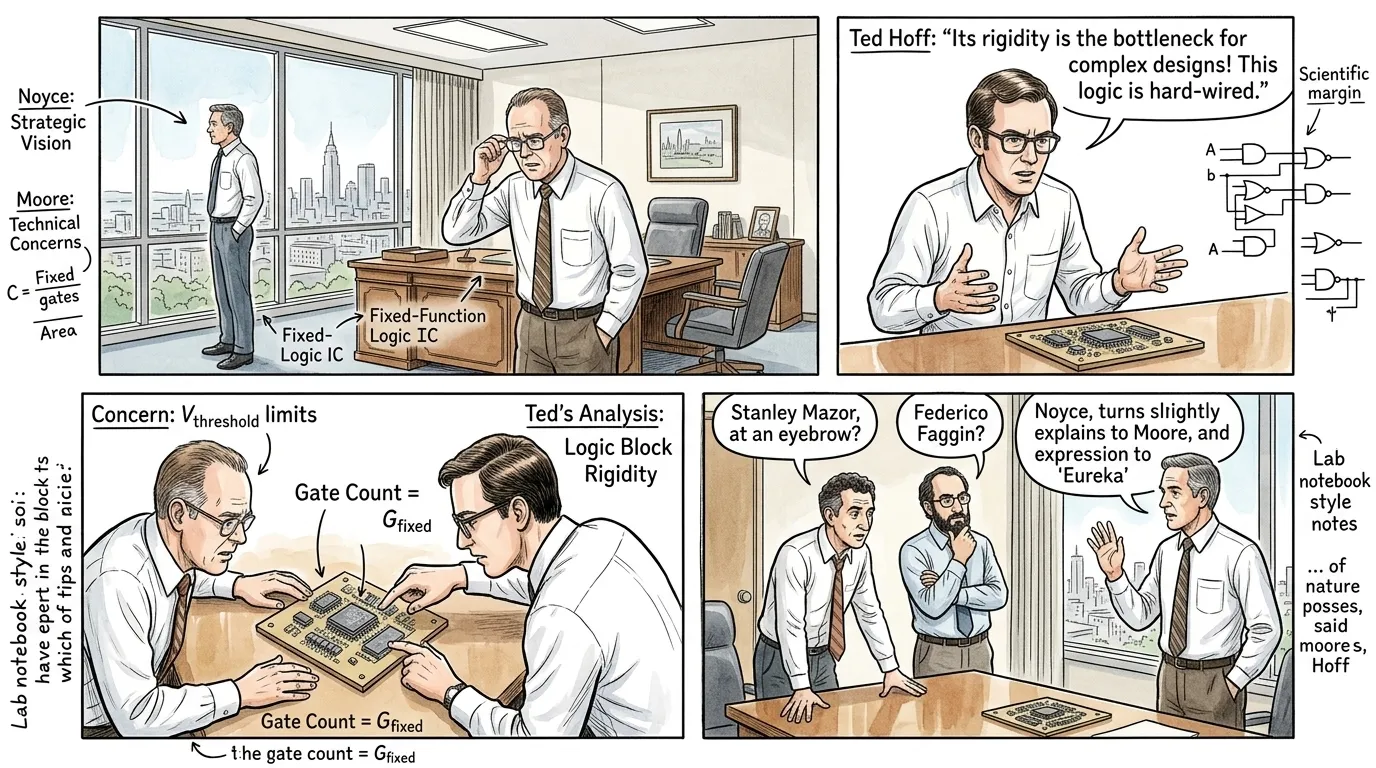
Prior to 1970, integrated circuit technology allowed for the consolidation of multiple transistors onto a single silicon chip, creating functional blocks like memory registers or simple logic gates. However, these circuits remained 'fixed-function,' meaning their operation was hardwired into their physical layout. Any change in desired functionality required a completely new chip design and fabrication process, a laborious and expensive undertaking for even minor adjustments.
"Robert Noyce gazed out the window, stating, "As Ralph Waldo Emerson once said, 'The ancestor of every action is a thought.' Our thought, right now, must be a radical rethinking of how we build these circuits, otherwise, we'll drown in a sea of specialized designs." Gordon Moore, adjusting his glasses, added, "Indeed. Current ICs are marvels, but their inherent rigidity is our bottleneck. Every logic change necessitates a physical redesign, a process that consumes immense resources and time." Ted Hoff nodded, "Precisely. We need a component that abstracts away the specific function, allowing software to define its purpose rather than hardware.""
Page 4
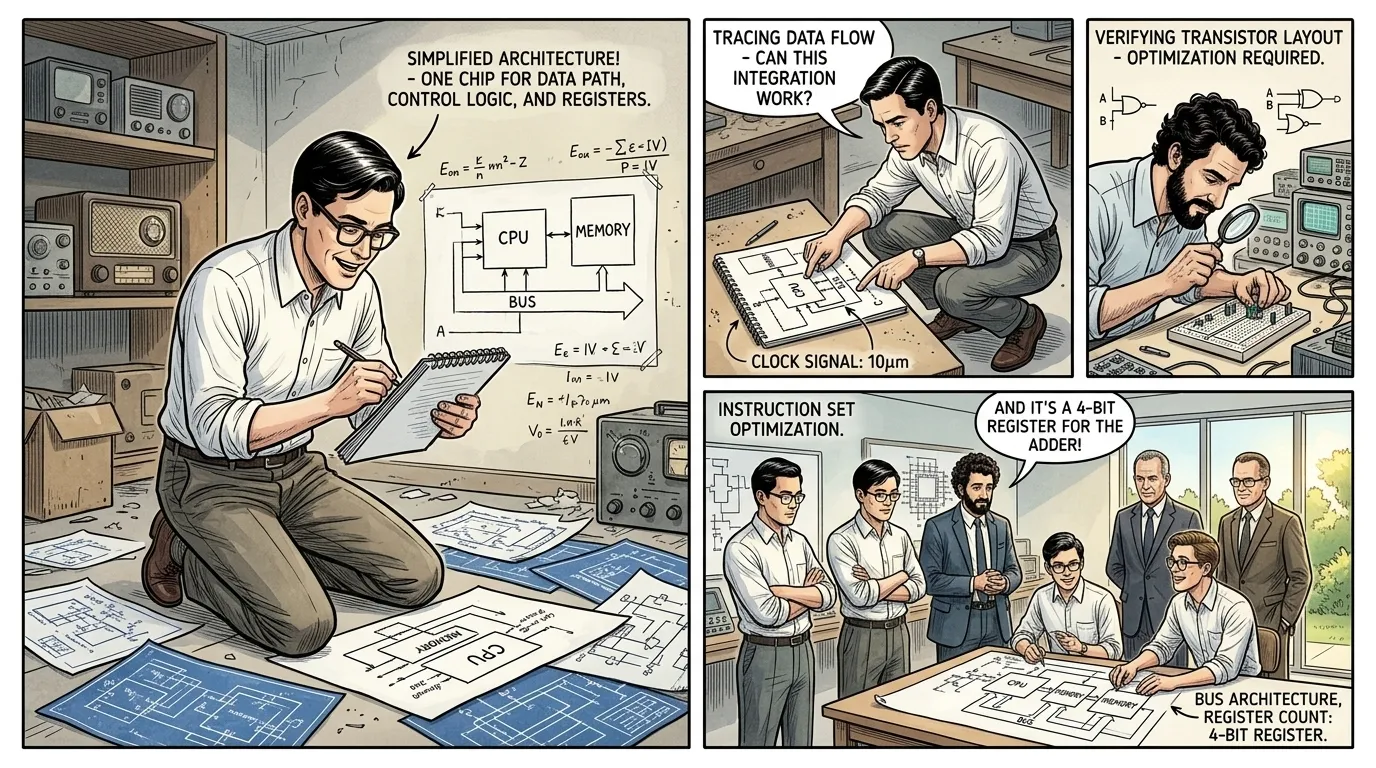
Ted Hoff, a young but brilliant engineer at Intel, saw beyond the immediate problem. He envisioned a radical departure from the fixed-function paradigm: a single, programmable chip that could perform a variety of tasks by executing instructions from memory. This conceptual leap – moving intelligence from specialized hardware to flexible software – would simplify design, reduce costs, and unlock unprecedented versatility. It was an idea that promised to fundamentally reshape electronics.
"Ted Hoff sketched furiously on a notepad, explaining to Stanley Mazor, "Imagine, Stanley, a central processing unit – a CPU – on a single chip. Instead of hardwiring calculator functions, we provide a simple instruction set. The calculator's logic becomes a program, residing in memory, which our CPU executes." Stanley Mazor, a sharp-featured engineer with neat dark hair, leaned closer, scrutinizing the sketch. "A general-purpose device? It's ambitious, Ted. The complexity of integrating all those functions on one piece of silicon... it's daunting. How do we make it compact enough?""
Page 5
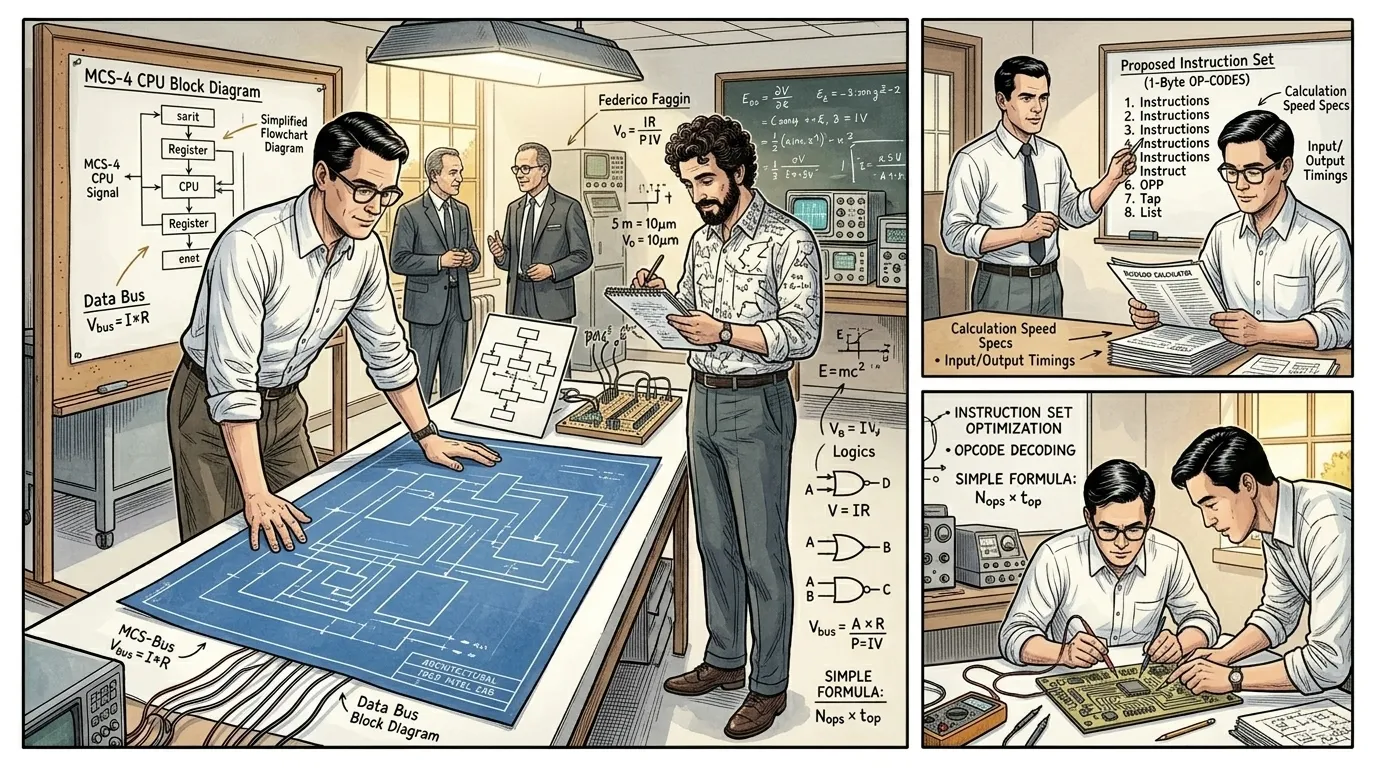
Hoff's concept required a novel architecture: defining a simple yet powerful instruction set that could handle various computational tasks. Stanley Mazor contributed significantly to refining these instructions, ensuring they were efficient and versatile. Masatoshi Shima, representing Busicom, provided critical feedback, guiding the design to meet the practical demands of a calculator while retaining the ambitious general-purpose philosophy. This collaborative effort laid the conceptual foundation for the world's first microprocessor.
"Stanley Mazor tapped a pen on a list of proposed instructions. "For our 'single brain,' these basic arithmetic and logical operations are essential. We need load, store, add, subtract, and conditional jumps. Efficiency is paramount." Masatoshi Shima, reviewing the specifications, confirmed, "The Busicom 141-PF requires BCD arithmetic and robust I/O handling. Your instruction set seems to cover the core needs, but how will it be implemented physically on the chip? That is the formidable challenge." Ted Hoff, nodding, replied, "That's where the next level of innovation must come. The architecture is sound; now, the engineering execution.""
Page 6
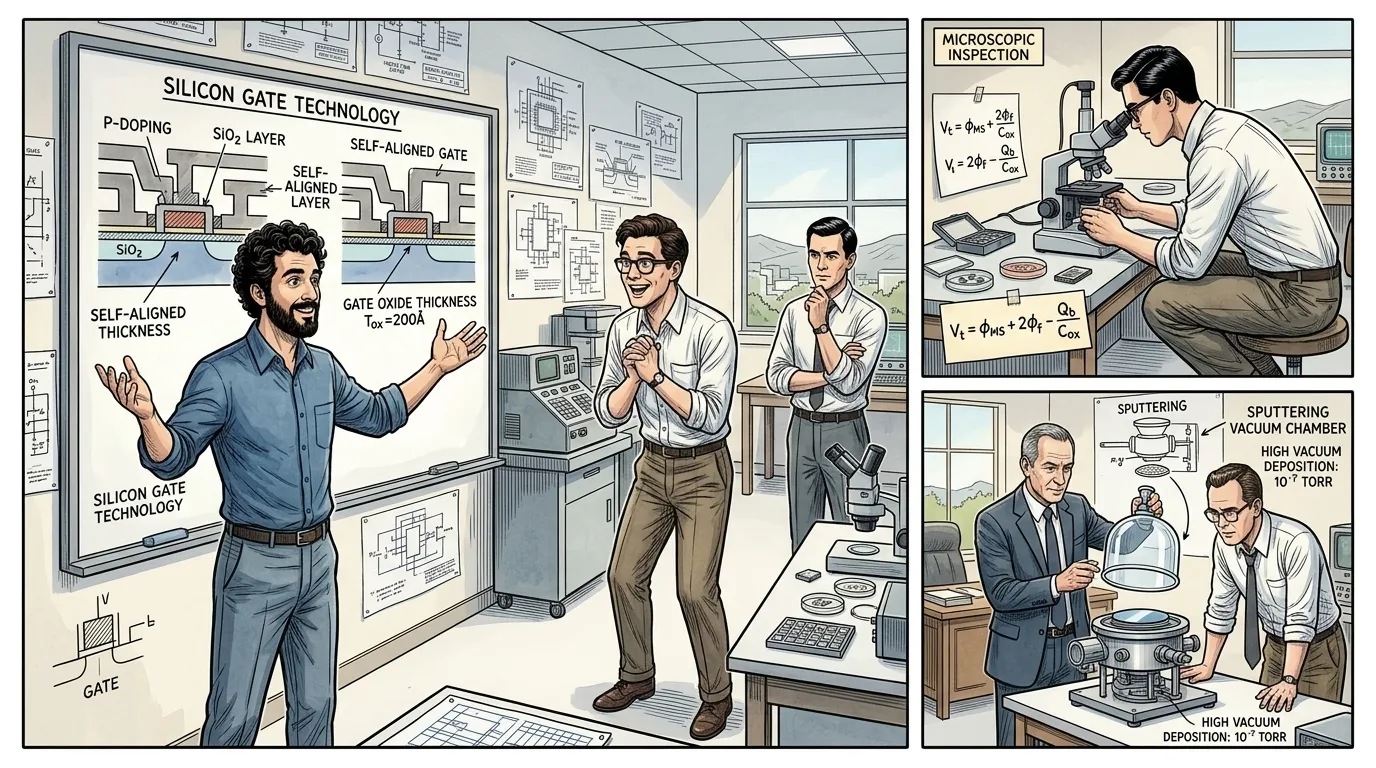
The conceptual architecture was visionary, but its physical realization posed immense technical hurdles. The sheer number of transistors required for a general-purpose processor on a single chip seemed impossible with existing fabrication methods. The breakthrough arrived with Federico Faggin, an Italian engineer who joined Intel. Faggin had pioneered Silicon Gate Technology (SGT) at Fairchild Semiconductor, a revolutionary process that allowed for vastly smaller, faster, and more power-efficient transistors. He was the only engineer at Intel with the expertise to transform Hoff's ambitious ideas into a manufacturable silicon reality.
"Federico Faggin, a focused and energetic engineer with dark curly hair and a neatly trimmed beard, asserted to Ted Hoff, "The silicon gate technology I've refined will be crucial. It allows for self-aligned gates, significantly reducing parasitic capacitance and enabling higher packing density. This is how we push transistor count beyond the limits you've seen." Ted Hoff, eyes wide with understanding, replied, "Federico, this is exactly what we need! My architectural design, combined with your process mastery, could truly yield our 'single brain.'" Faggin concluded, "It will be challenging, but the potential is immense. We can build a fully functional central processing unit on one chip.""
Page 7
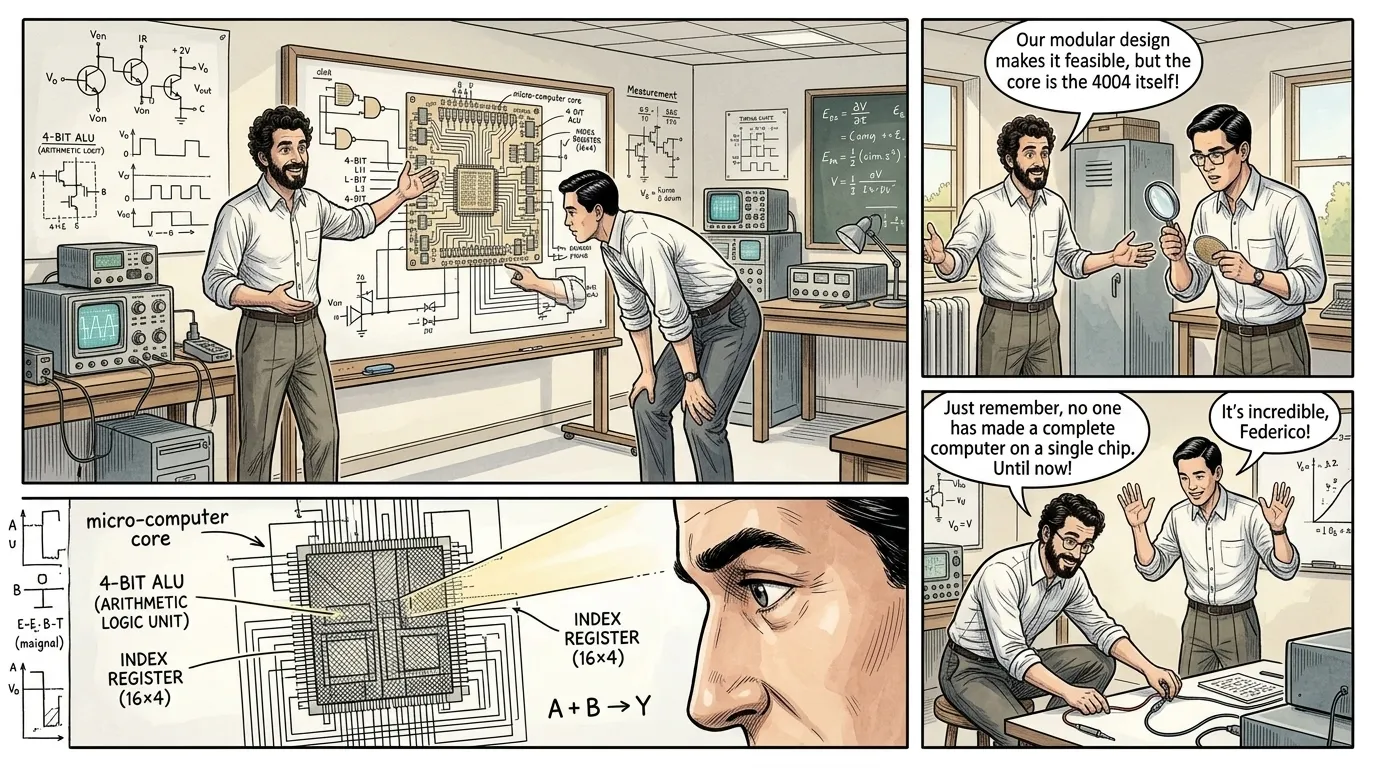
The Intel 4004, born from this convergence of architecture and fabrication, integrated 2,300 transistors onto a 12mm2 die. Its core mechanism involved a tiny Central Processing Unit (CPU) with an Arithmetic Logic Unit (ALU) for calculations, registers for temporary data storage, and a control unit to fetch and decode instructions. Data flowed through a 4-bit bus, executing commands stored in external memory. This revolutionary chip performed 60,000 operations per second, a feat previously requiring racks of dedicated logic.
"Federico Faggin gestured to a detailed diagram of the Intel 4004's internal architecture. "Here, the 4004's mechanism is clear. The Program Counter dictates which instruction is fetched from memory. The Instruction Decoder then interprets that command, directing the ALU to perform operations on data held in these registers." Stanley Mazor, examining the diagram, remarked, "So, the control unit orchestrates everything – fetching instructions, performing calculations, managing data flow. It's truly a miniature computer core." Faggin affirmed, "Precisely. This single chip now executes the complex logic that once required a dozen specialized components.""
Page 8
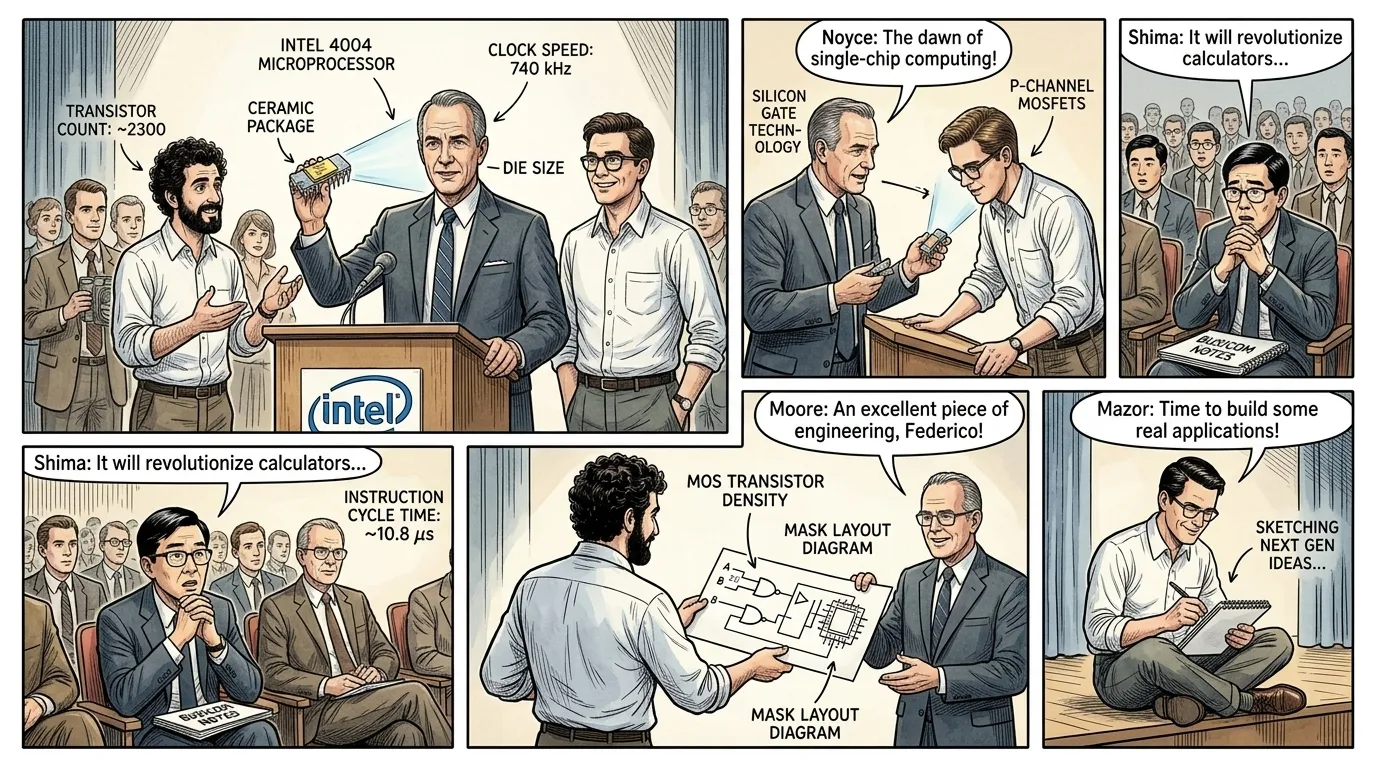
In November 1971, the Intel 4004 was officially announced to the world. It was a humble, 4-bit device, primarily intended for calculators, yet its implications were profound. It was the realization of a 'computer on a chip,' a single device capable of general-purpose computation. The problem of designing countless specialized integrated circuits, identified by Ted Hoff years prior, had found its elegant solution. This tiny silicon rectangle marked the dawn of the microprocessor era.
"Robert Noyce, holding up a small Intel 4004 chip, declared to a small, assembled press group and Intel engineers, "Here is the world's first microprocessor, the Intel 4004. Ted Hoff, do you recall your vision years ago? Your 'single brain' concept to address the proliferation of specialized chips?" Ted Hoff, with a proud smile, responded, "Indeed, Robert. This chip, meticulously engineered by Federico and the team, is that universal component. It validates our belief that software-defined logic could supersede hardwired rigidity, starting with Busicom's calculator and expanding far beyond." Federico Faggin added, "It's not just a calculator chip; it's a blueprint for the future of all electronics.""
Page 9
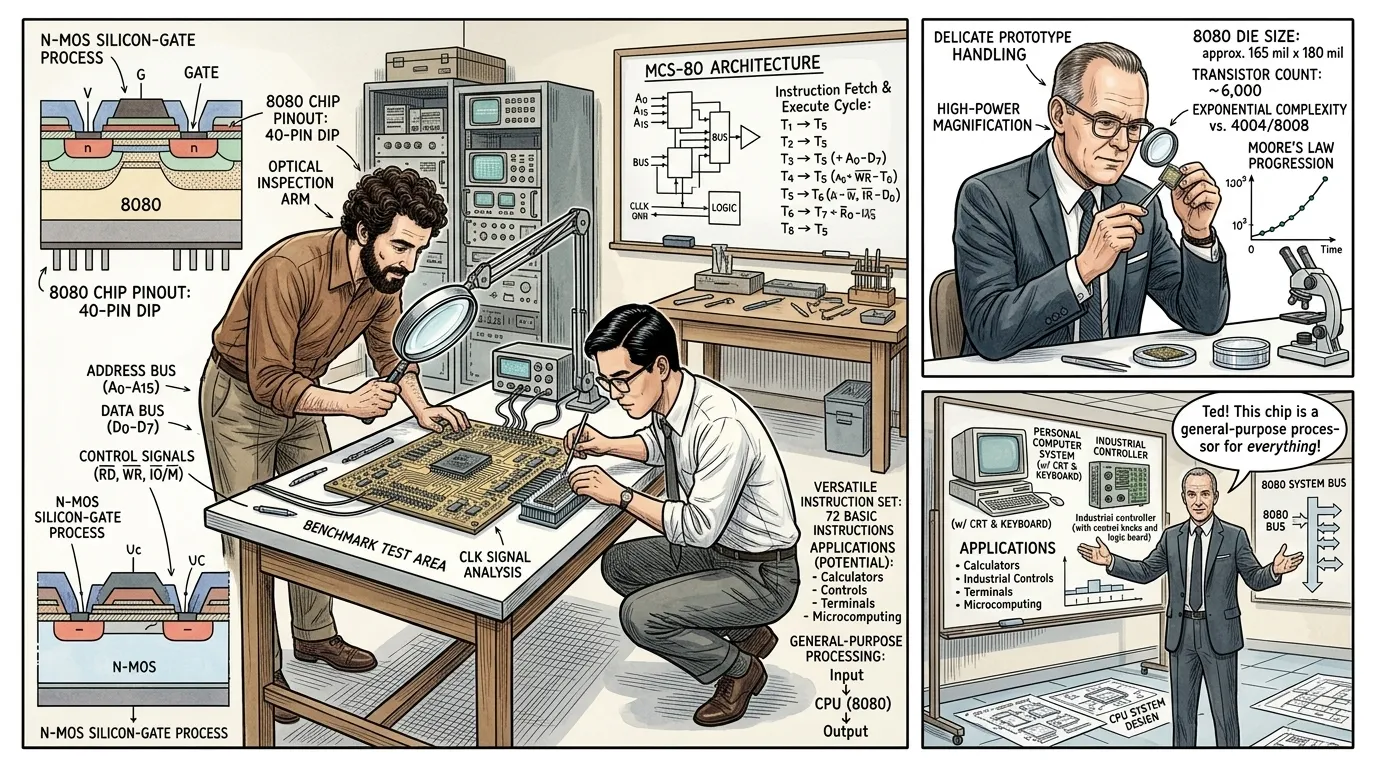
The Intel 4004 quickly evolved. Its successors, the 8008 and then the groundbreaking 8080, rapidly increased processing power and expanded bit width, moving beyond calculators into terminals, industrial control systems, and eventually, the nascent personal computer market. This rapid evolution validated the microprocessor's potential, creating entirely new industries and transforming existing ones. The ability to program a single chip for diverse applications fueled an explosion of innovation.
"Gordon Moore, observing a new prototype of the Intel 8080 chip, mused, "The exponential growth is astonishing. From a simple calculator, we've moved to a chip capable of running early computing systems. This is more than a device; it's an enabler." Robert Noyce added, "The flexibility of the microprocessor means it can adapt to challenges we haven't even conceived yet. Industrial automation, communication systems, and soon, personal computing will all benefit immensely." Federico Faggin, examining a complex circuit board, noted, "Each generation shrinks components, boosts speed, and reduces power consumption. The fundamental architecture remains, but the scale of what's possible expands daily.""
Page 10
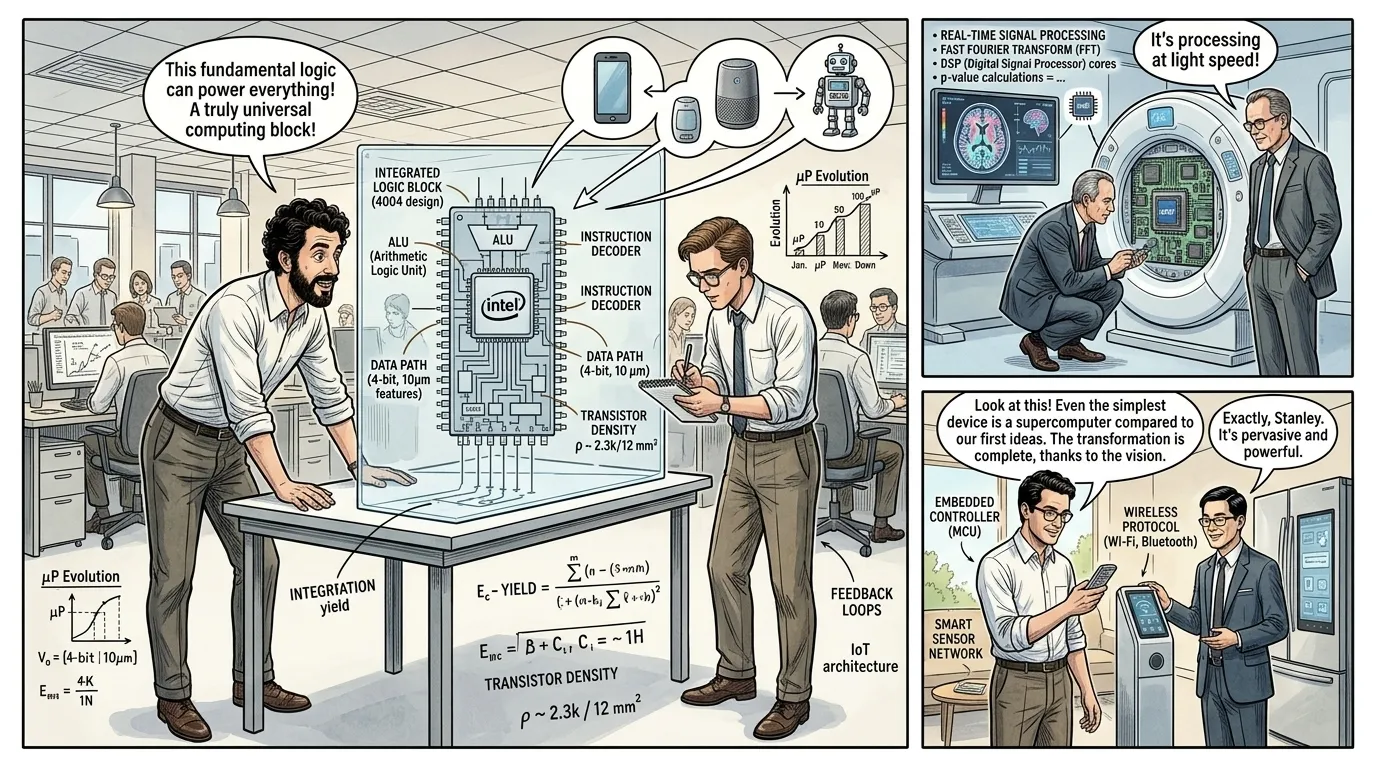
The microprocessor's impact is immeasurable. From its humble origins in a calculator, it became the 'brain' of virtually every electronic device, profoundly reshaping society. It powered the personal computer revolution, the internet, and mobile communications, democratizing access to information and processing power. Today, billions of microprocessors operate unseen in cars, medical devices, appliances, and smart infrastructure, a testament to the vision that transformed specialized logic into a universal, programmable core.
About this story
- Location: Global
- Audience: general readers
Questions and answers
Read Wonder Inventions on your phone
Wonder Inventions is available on Android. Get Wonder Inventions on Google Play.