Motion Picture Projector
Motion Picture Projector — an illustrated inventions story, set in Global. 10 illustrated pages, free to read on Wonder Inventions.
Page 1

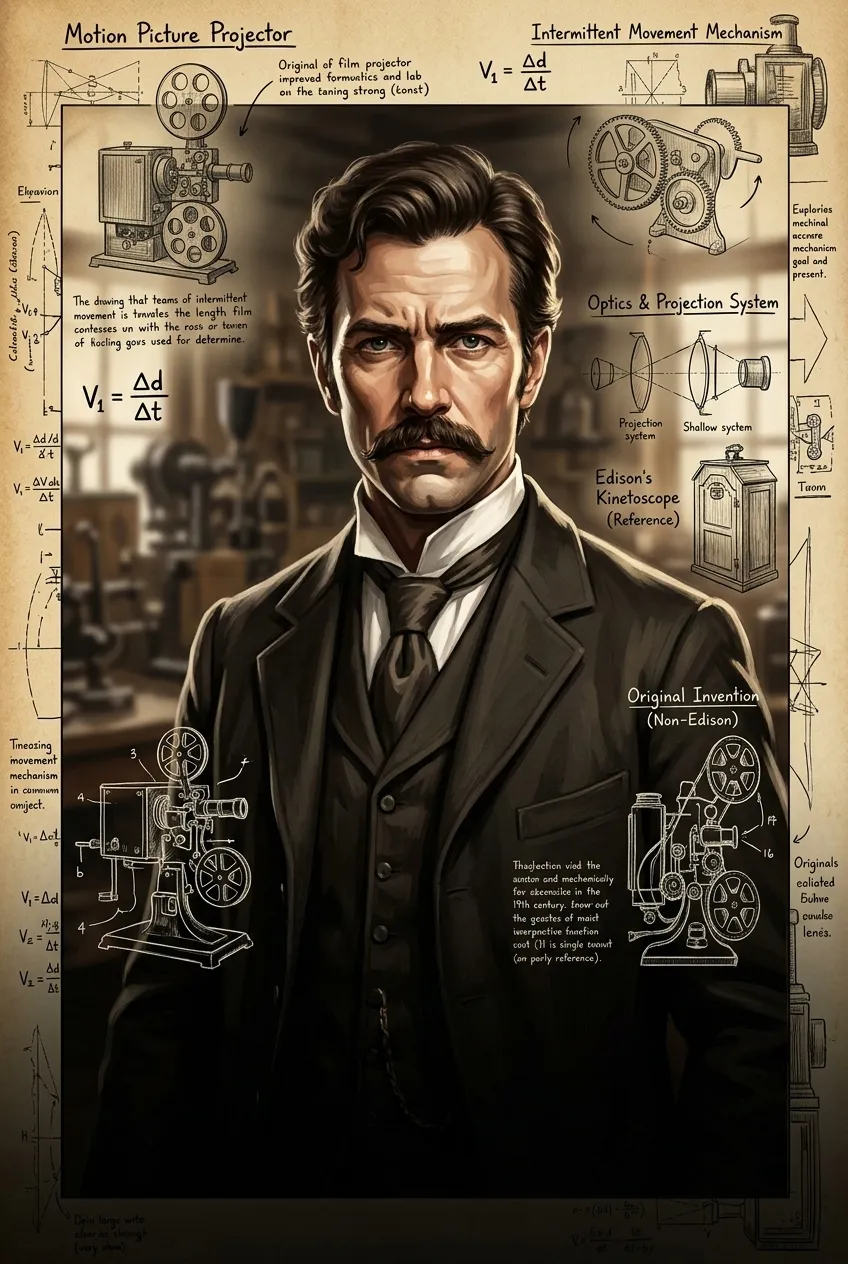
For centuries, humanity possessed the ability to capture individual moments—still images frozen in time. Yet, the vibrant, ceaseless flow of life remained elusive. The late 19th century buzzed with the promise of technology, but no existing apparatus could truly reanimate the world's dynamic tapestry. How could flickering glimpses transform into seamless, living spectacle?
"'We have excellent photographs, Dr. Smith,' remarked William K.L. Dickson, an associate of Thomas Edison, examining a series of still portraits. 'But the challenge, as Mr. Edison often states, is to give them breath, to make them move as they did in life. This desire for visual narrative compels us forward.'"
Page 2
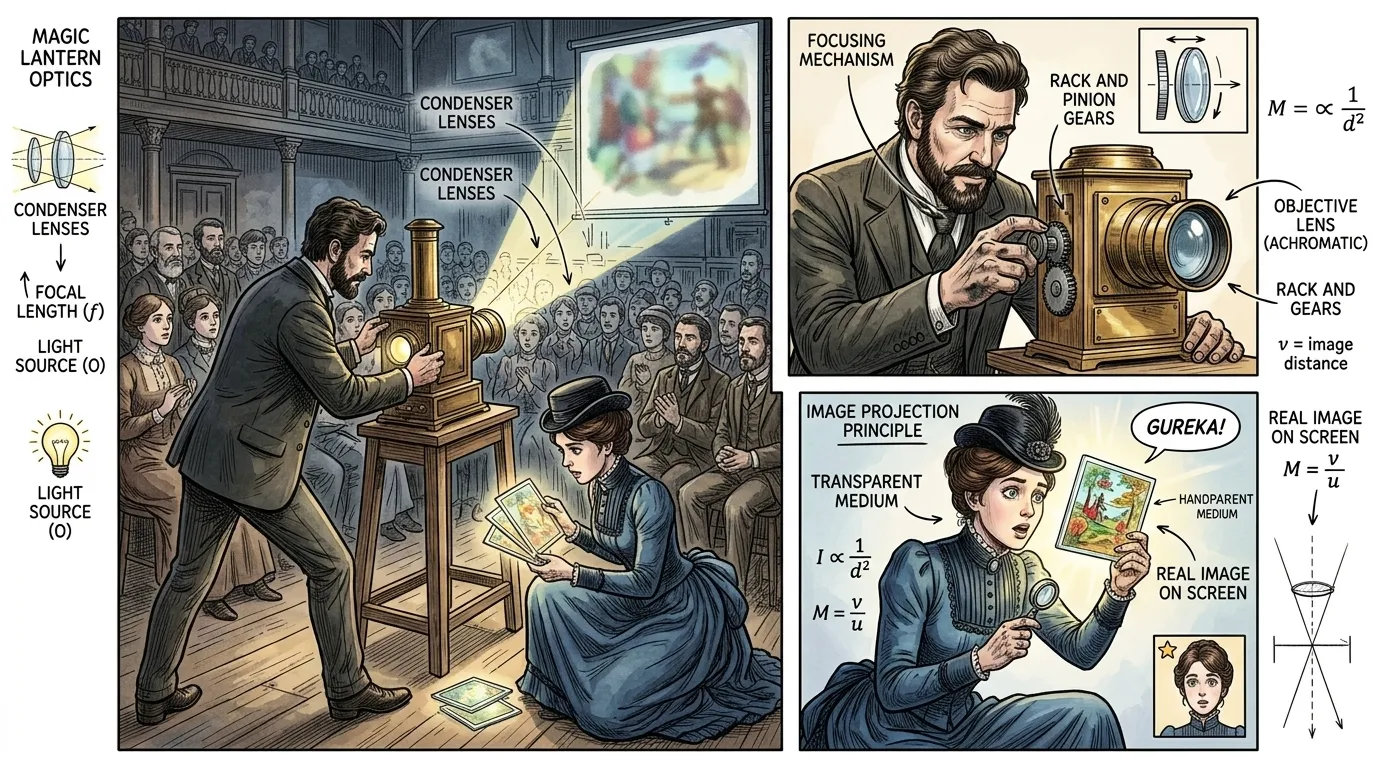
Before the motion picture projector, the world experienced storytelling and information through static mediums. Illustrations, paintings, and photographs offered compelling glimpses, yet they lacked the intrinsic quality of movement that defined human experience. The aspiration to animate these sequences was not new, but the technical means to do so remained rudimentary and largely ineffective.
"'These magic lanterns, while entertaining, are merely sequential slides, aren't they?' observed a fascinated patron at a public demonstration, peering at painted glass plates. An attending engineer, a man named Henri Dubois, adjusted the lantern's focus. 'Indeed,' Dubois replied, 'the illusion of motion is limited by the manual speed of the operator and the number of distinct images. There's no true fluidity, merely a rapid succession of discrete stills. We desire something far more immersive, something that transcends the mere 'magic' of light and shadow.'"
Page 3

Thomas Edison's Kinetoscope, developed by his lab primarily by William K.L. Dickson, represented a monumental step. It captured and displayed motion, but only for a single viewer through a peephole. The Kinetoscope ran a continuous loop of film past a rapidly flashing light, creating the illusion of movement. While groundbreaking, it failed to project images large enough for a communal experience.
"'The Kinetoscope undeniably works, Mr. Dickson,' an investor noted, peering into the machine. 'But it is a personal novelty, not a public spectacle. The experience remains solitary. To truly revolutionize entertainment, we must find a way to project these moving images onto a screen for hundreds, simultaneously.' Dickson, a determined man with a serious expression, nodded. 'The challenge is immense: we need significantly brighter illumination, a larger projection surface, and a precise mechanism to stop and start the film quickly enough without tearing. The Kinetoscope's continuous feed is insufficient for projection.'"
Page 4

Across the Atlantic, in Lyon, France, the Lumière brothers, Auguste and Louis, embarked on their own quest. Building upon existing photographic principles and observing Edison's work, they sought to combine camera, printer, and projector into a single, portable device. Their genius lay in refining the intermittent motion mechanism, critical for projecting individual frames.
"Louis Lumière, a thoughtful man in his early 30s with a neatly trimmed beard, held a strip of perforated film up to the light in their workshop. 'Auguste, the key lies not just in capturing the images, but in their precise presentation. A continuous flow, like Edison's Kinetoscope, lacks the necessary pause for projection. We need distinct frames, each briefly held steady before the next.' Auguste Lumière, slightly older with a similar beard, nodded intently. 'Precisely. The mechanism must advance the film one frame at a time, momentarily hold it, and then swiftly move to the next. This 'intermittent movement' is our greatest hurdle.'"
Page 5
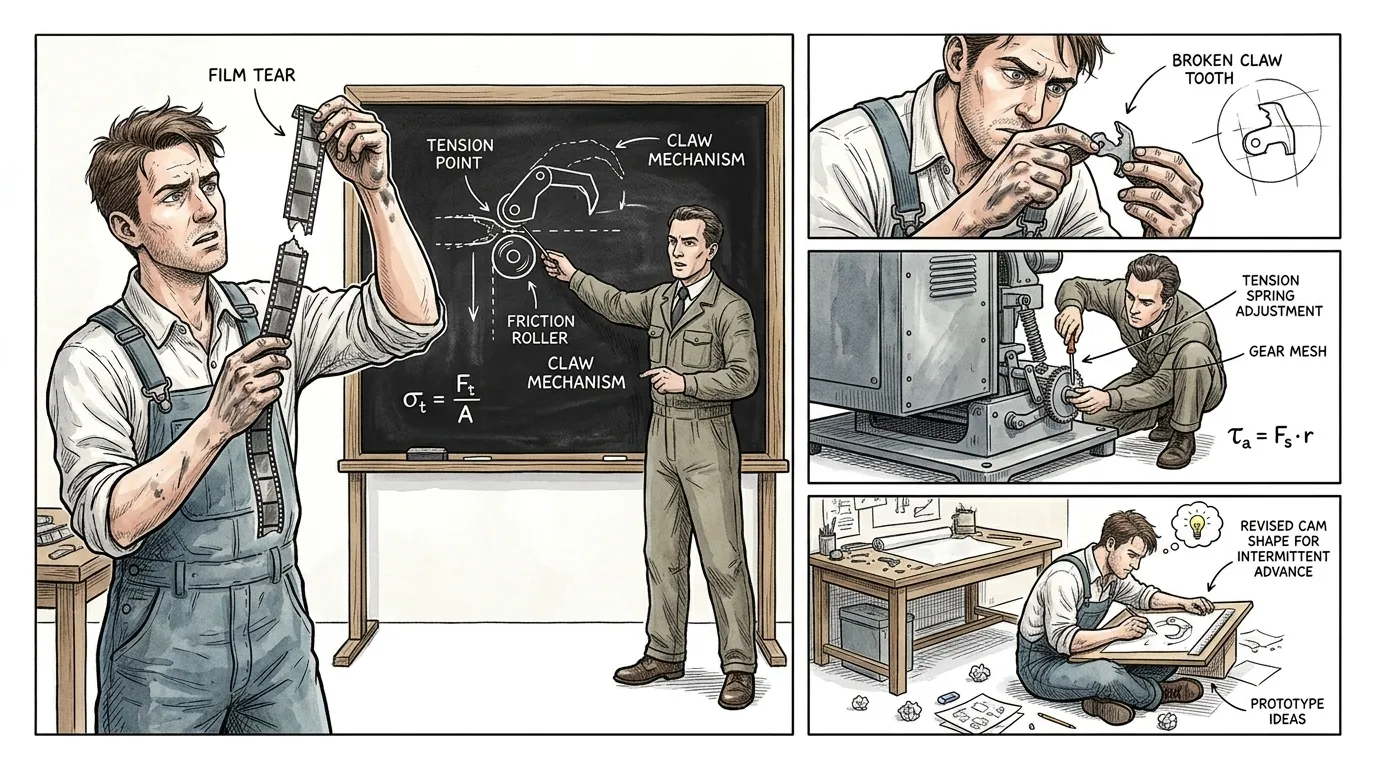
Achieving intermittent motion proved notoriously difficult. Early attempts often relied on simple claw mechanisms or friction rollers. These were crude, frequently tearing the delicate film, causing jerky projections, or failing to register frames consistently. The film had to stop, remain perfectly still for a fraction of a second while light passed through, and then advance to the next frame—all in rapid succession.
"'The friction roller simply isn't precise enough,' grumbled a frustrated engineer, wiping grease from his hands as he examined a torn film strip. 'Even with careful adjustments, the film either slips or bunches, ruining the sequence. We need something more robust, more mechanically intelligent.' A colleague pointed to a diagram on a blackboard. 'And the simple claw, while better, still exerts too much stress on the perforations. The delicate celluloid cannot withstand such abrupt stops and starts for prolonged periods. The film tears, and the illusion is shattered.'"
Page 6

The breakthrough arrived with the integration of the Maltese cross, also known as the Geneva drive, into projection systems. This ingenious mechanism translated continuous rotary motion into precise intermittent rotary motion. A driving pin engaged a slot in the cross, turning it exactly one step, then disengaged, allowing the cross to rest while the film remained stationary. This sequence ensured perfect registration and minimal stress on the film.
"'Observe, Auguste,' Louis Lumière demonstrated, slowly turning a hand crank connected to their new mechanism. 'The driving pin enters the slot, advances the cross, and then cleanly exits. The interval between engagements provides the crucial pause.' Auguste, his eyes wide with understanding, watched the mechanism. 'It's a marvel of mechanical precision! This 'Maltese cross' provides the controlled stillness we require, followed by rapid, gentle advancement. It's robust enough for continuous operation without tearing the film. This changes everything for projection.'"
Page 7
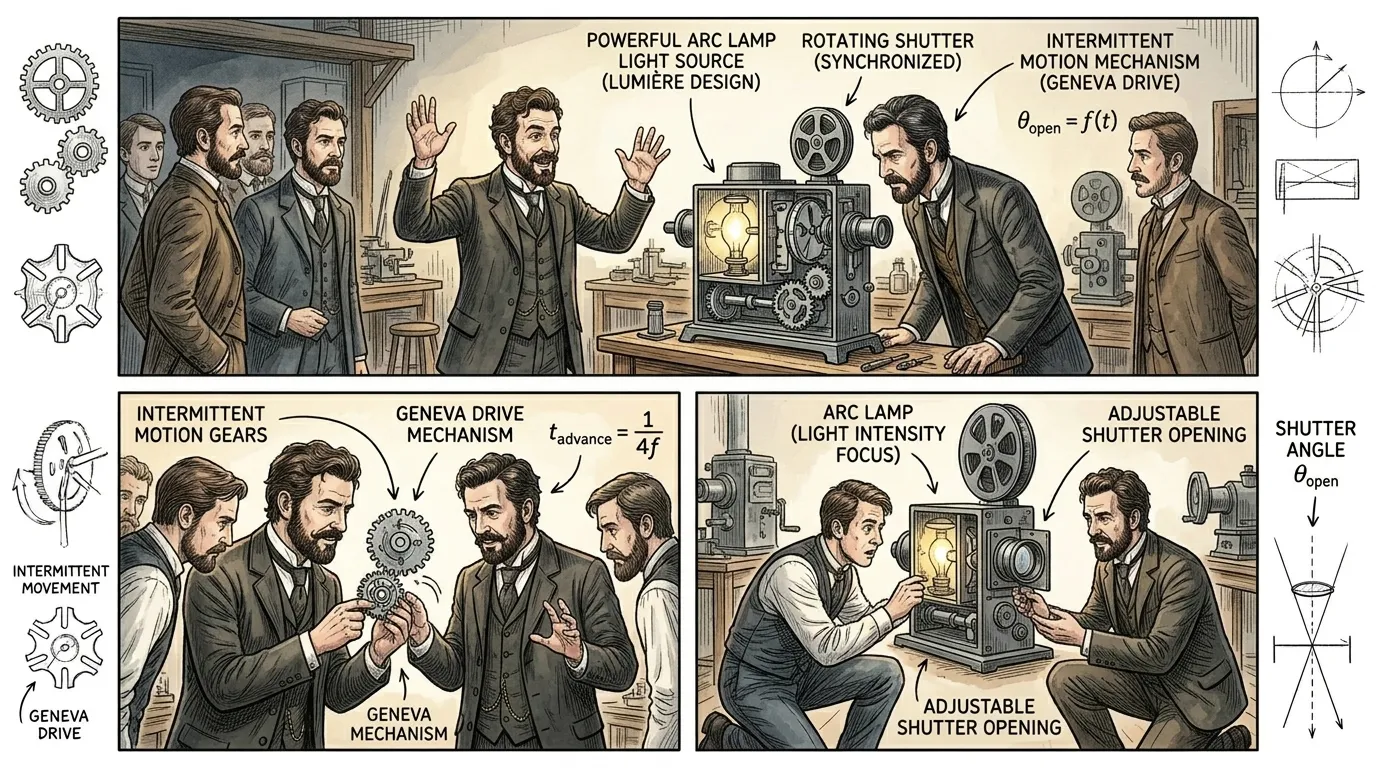
The core operation of the motion picture projector combined several critical elements. A powerful light source illuminated the film. A rotating shutter briefly blocked the light during film advancement, preventing blur. The intermittent motion mechanism precisely moved each frame into position, holding it steady. Finally, a series of lenses magnified the tiny film image onto a large screen, creating a sharp, bright, moving picture for all to see.
"'Think of it as a synchronized dance of light and shadow,' Louis Lumière explained during an early demonstration to a small group of fascinated engineers. He gestured to the projector's internal workings. 'The arc lamp, here, provides immense illumination. As each frame sits momentarily in the gate, the shutter opens—allowing light to pass. Then, it closes instantly as the Maltese cross advances the film to the next frame. Without this precise timing, the projected image would be a blur, a chaotic smear of light. This coordination is paramount.'"
Page 8
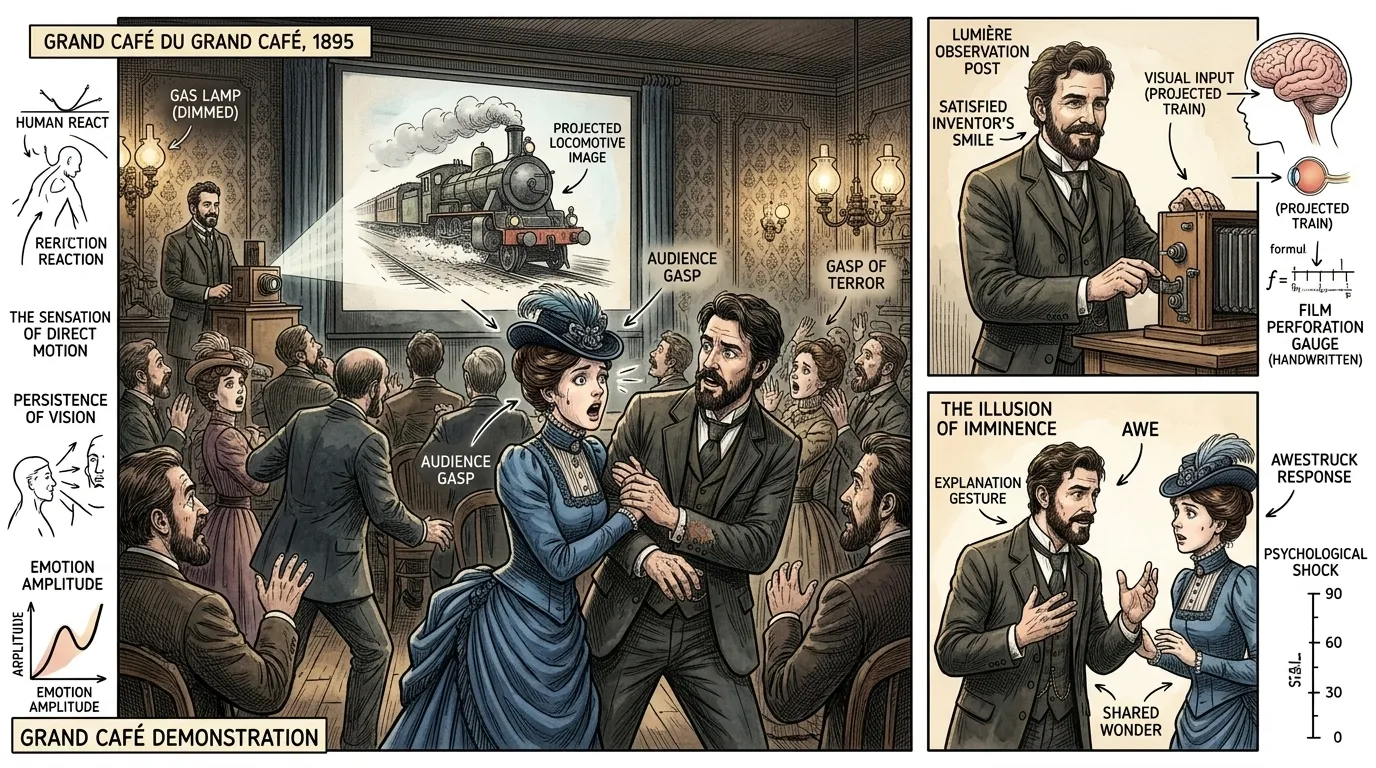
With the Cinématographe perfected, the Lumière brothers launched their first public commercial screening on December 28, 1895, at the Salon Indien du Grand Café in Paris. This moment marked the true birth of cinema as a public spectacle. The audience was captivated, even startled, by the projection of 'Workers Leaving the Lumière Factory' and 'The Arrival of a Train at La Ciotat Station'. The world had never seen anything quite like it.
"As the projected image of a train rushing towards the audience filled the screen, a collective gasp rippled through the Parisian crowd. 'Mon Dieu!' exclaimed a woman, clutching her companion's arm. 'It's as if it will come right through the wall!' Louis Lumière, observing from the back, smiled faintly. 'Indeed,' he thought, recalling what Leonardo da Vinci once said about art and life, '"Art is never finished, only abandoned." But tonight, we have not abandoned it; we have brought it to life. This is not merely a record of reality; it is reality re-experienced, a powerful illusion that captivates and transports.'"
Page 9

From its humble Parisian debut, the motion picture projector rapidly disseminated across the globe. Inventors and entrepreneurs quickly adopted and refined the technology. Early projectors were often hand-cranked, but electric motors soon automated the process, ensuring smoother and more consistent playback. Film reels grew longer, and projection booths became dedicated, specialized spaces within burgeoning cinemas.
"A projectionist, a diligent woman named Eleanor Vance in a neat uniform, carefully threaded a large reel of film into a powerful, electrically-driven projector in 1910. 'The early days were arduous,' she recounted to a curious newcomer, a young apprentice. 'Manual cranking often led to uneven speeds, but these new electric motors ensure consistent frame rates. It allows us to focus entirely on the artistic presentation, rather than just the mechanics.' The apprentice watched intently. 'The sheer scale of these new cinemas is incredible. Millions are now experiencing these stories, thanks to a few simple gears and a bright light.'"
Page 10

The motion picture projector not only brought moving images to the masses but fundamentally reshaped global culture. It birthed the art form of cinema, creating new industries, professions, and narrative possibilities. From silent films to synchronized sound, from black and white to Technicolor, the projector remained the heart of the cinematic experience for over a century, transforming how humanity entertained, informed, and connected with stories.
"The impact of the motion picture projector is immense, creating a lasting legacy that stretches from early nickelodeons to modern digital multiplexes. This revolutionary device transformed static images into a dynamic narrative art form. It illuminated the path for global communication, inspiring generations of storytellers and shaping collective human experience for over a century."
About this story
- Location: Global
- Audience: general readers
Questions and answers
Read Wonder Inventions on your phone
Wonder Inventions is available on Android. Get Wonder Inventions on Google Play.